CD Reviews | CTD (Briefly Noted) | JFL (Dip Your Ears) | DVD Reviews

8.10.26

A Survey of Bruckner Cycles

Anton Bruckner Symphony Cycles


► An Index of ionarts Discographies


Like the Beethoven Piano Sonata Cycle Survey, the Dvořák Symphony Cycle Survey, the Bach Organ Cycle Survey, and the Sibelius Symphony Cycle Survey, this Bruckner Symphony Cycle Survey started life a mere inventory of what has been recorded and whether it is still available. It has become more ambitious, since, and the February 2023 update (see details below) reflects this, bringing the format up to the type used in the Beethoven- and Bartók String Quartet- Cycle Surveys, for example. Favorites are still denoted with the "ionarts' choice" graphic.

See also: Bruckner: The Divine and the Beautiful

[Even after this latest update, there] are several incomplete, out-of-print, hard-to-get, and just plain obscure (at least in the West) Bruckner Symphony cycles that are probably not listed below, because I've found it impossible to get adequate information on them. This includes all but the third of six (!) complete and partial cycles of the Japanese conductor, founder of the Osaka Philharmonic Orchestra, and Furtwängler-inspired Bruckner-nut Takashi Asahina. That also includes the once ultra-inclusive Gennadi Rozhdestvensky cycle on Melodiya, a selection of which can be found digitally as a sketchy MP3 offering on Amazon. While some incomplete and unboxed cycles have been included (Norrington, because I think his traversals are worthwhile), others (Roegner, on Edel) have not. [Ed. It has now.] There is no particular logic to that decision.

Bruckner wrote 11 Symphonies (counting the Study Symphony in F minor, or "00", and the retracted Symphony in d, "0"). Ten of them are complete, and the unfinished "Ninth" exists in various performance versions. The inclusiveness of a set is indicated: 00-9* would mean all 11 Symphonies including a completed 9th; 1-9 would indicate the conventional nine, with only the three finished movements for the Ninth. There are no cycles that include "00" but not "0". Where the Te Deum is included in a set, it is mentioned; "Te Deum (F)" means that the Te Deum directly follows the third movement of the Ninth in the make-shift completion suggested by Bruckner. There are a few different 'performing editions' of the finale, most prominently William Carragan's (in three revisions) and those based on the work of Nicola Samale and Giuseppe Mazzuca (1984). With John A. Phillips and Benjamin-Gunnar Cohrs included on their team, they produced the 1992 Samale/Mazzuca/Phillips/Cohrs Completions below abbreviated SMPC, along with the year of the particular revised version. Gerhard Schaller has also produced a finale of his own - although everyone attempting this feat is invariably hampered by the looming lawsuits of those who have attempted this before and who are ready to assume plagiarism on principle. (It is, therefore, impossible to have a best-of-all-versions Finale until the copyrights of the current versions run out.)

For the truly dedicated Brucknerians, I have added the information of which versions the various cycles use in the Alt-Text which you can find if you mouse-over the cover image.

A note on Bernard Haitink: Haitink recorded a Bruckner Symphony cycle with the Concertgebouw for Philips, which is usually out of print. [Ed.: It can be had as part of the catch-all "Haitink Symphony Edition" box set, along with his Beethoven, Brahms, Schumann, Tchaikovsky, and Mahler {[Ed.: ...but that's out of print already, as well, as is the Bruckner-only Blu-ray version that had come out.] It's a tame cycle, as early Haitink was wont to be (though the 1967 analog 7th ought to be sampled!) and maybe not that great a loss. Meanwhile, he was busily recording with his favorite orchestras (BRSO, CSO, Dresden Staatskapelle, LSO, and RCO of course). From those recordings, many in the Super Audio format, one can cobble together an incomplete Bruckner cycle of astounding quality, as Haitink became ever more interesting in old age.


[Ed. Feb. 23 through Oct. 26] This is the update you've been waiting for. The format has been brought into line with the most recent discographic surveys, allowing for commentary and alternate editions to be displayed. And I have scoured enough information to bring all seven (!) Asahina-cycles into the fold! I have kept the alphabetical ordering by conductor out of convenience and because it is quite interesting to see which conductors have recorded Bruckner multiple times. I have become more accepting of partial cycles (Klemperer, Celi III, van Beinum, Norrington and I have included all the most recent cycles (Ballot, Gergiev, Jansons, P.Järvi, Nelsons, Poschner, Schaller, Thielemann), orchestra-centric cycles (Berlin and Vienna Philharmonics, Bavarian Radio Symphony Orchestra), and numerous re-issues of extant cycles.
.
[Ed.08/03/18] I've now added Ivor Bolton's cycle - the third to appear on Oehms! Somebody loves Bruckner overe there!

[Ed.03/03/18] Yannick Nézet-Séguin's cycle has just been released and added below. The mostly-Kurt Eichhorn-cycle of the Bruckner Orchester Linz has also been added, at last.

[Ed.10/09/17] A massive, much overdue update: SWR Classic has at last issued Hans Rosbaud's near-complete cycle (2-9) in never before achieved sound quality. Kurt Masur's Bruckner has been re-issued. Daniel Barenboim has recorded a third cycle, now, for the first time with "his" orchestra, the Berliner Staatskapelle. I have reviewed the 7th on Forbes: "Classical CD of the Week: Bruckner for DG" and the 4th here on ionarts: "Dip Your Ears, No. 163 (Visual Bruckner)". Jaap van Zweden had his excellent Bruckner cycle issued on Challenge Records on SACDs. The Korean Symphony Orchestra has recorded a cycle for Korean Decca under Hun-Joung Lim. The Riccardo Chailly cycle has been re-issued cheaply on Decca/Eloquence. Mario Venzago finished his controversial cycle on CPO. Brilliant Classic has put all of Heinz Rögner's Bruckner with the RSO Berlin together and made a complete cycle out of it by adding contemporary East German performances of Vaclav Neumann, Kurt Sanderling, and Franz Konwitschny to it. The Bruckner Orchestra Linz' cycle with Dennis-Russell Davies will be re-issued by Sony in December of this year. And Simone Young completed her very complete set ("00" + "0"), which has been released on Oehms. Global Amazon links have been added in all the lines I had to edit. The incomplete cycles of Dohnanyi & Harnoncourt will be added in the next round of edits...

2.10.26

'Here’s a change indeed in the Commonwealth!': Segregation-era 'Measure for Measure' at Folger

Nathan Darrow (The Duke), Renea S. Brown (Isabella, center), and Holly Twyford (Escalus) in Measure for Measure, Folger Theatre. Photo: Erika Nizborski
Folger Theatre has opened its season with an intriguing production of Shakespeare’s Measure for Measure. Director Psalmayene 24, who won a Helen Hayes Award for his Africa-centered production of Mary Zimmerman’s Metamorphoses in 2024, has shifted the action from the court of Vienna to the American South under Jim Crow segregation law: the town of “Vye-enna” in what is clearly the Commonwealth of Virginia.

To underscore the point about the causes of injustice in that world, the play’s wronged parties are all played by black actors, while those in power are white. Nathan Darrow’s high-minded Duke becomes the mayor of the town, presiding with a genteel drawl in a courthouse building with two racially separated drinking fountains and a large sign pointing to a “Colored Waiting Room.” He appoints Lee Osorio’s uptight Angelo, a judge known for the rigorous enforcement of old laws, to rule the town in his absence.

The “fornication” laws that the Duke hopes Angelo will enforce, after some years of laxity, are read in the production as southern laws against racial intermarriage, recalling the legal struggles that led to the case of Loving v. Virginia. Dance once again features prominently in this production, in an opening all-cast number that depicts, among other things, the courtship of JaBen Early’s earnest Claudio with Maryanne Henderson’s beautiful Juliet. This adds poignant overtones to the idea that the couple, a black man and a white woman, were married in their own eyes but without the cover of the law.

Renea S. Brown, who acted in the director’s earlier Metamorphoses, played Claudio’s sister, Isabella, with both wide-eyed innocence and caustic moral indignation. She rebuffs the clumsy sexual advances of Angelo, given an extra air of menace by the different legal statuses implied by their racial identities. When Darrow’s Duke, disguised as a Franciscan friar, makes his own more honorable proposal, Isabella’s curious silence plays out with new resonance. The production leaves the conclusion open to interpretation, but Isabella seems ready to make her own way, neither in the convent she was planning to enter nor as a wife.

The supporting cast was equally talented, especially the wise-guy Lucio of Jonathan Feuer, who believes in his own infallible slickness even as he is insulting both the Duke and the Friar, actually the same person, to one another. Ryan Sellers hammed up Elbow, the hapless constable, as a country-bumpkin sheriff, to hilarious effect, and Holly Twyford’s cross-cast Escalus, costumed as a sort of executive secretary, bristled with authority.

The conceit of the production becomes overbearing to the original plot only at the end. As part of his declaration of love, the Duke tears down the signs of segregation on the set. While the element of racial discrimination may be offered as an explanation of why the Duke takes so long to reveal the truth to Isabella, this contrived idea seems like virtue-signaling, which may be why Isabella does not seem so impressed.

Measure for Measure runs through November 1. folger.edu


20.9.26

Brian Cox heads a musical dynasty in Shakespeare's "The Score"

Peter De Jersey (Voltaire, left) and Brian Cox (J.S. Bach, right) in The Score, Shakespeare Theatre Company. Photo: Teresa Castracane

Shakespeare Theatre Company and its artistic director, Simon Godwin, have brought Oliver Cotton’s recent play The Score stateside. Premiered in 2023 at Theatre Royal Bath, the play stars Brian Cox as Johann Sebastian Bach during his May 1747 visit to the court of Frederick the Great in Potsdam. Cox, the star of the television series Succession, has come to Washington, along with some members of the British cast, for a run at Harman Hall, seen Thursday evening.

Cox is sharp-tongued and cantankerous as the fabled composer, who goes to the Prussian court to visit his son C.P.E. Bach (played ably by Jamie Wilkes), one of a stable of composers employed there. The elder Bach is advanced in age, only three years from his own death. His demise will be partly due to the ill-advised eye surgery that is discussed in the play, somewhat prematurely. Cotton has Bach challenge the Prussian king about his role in the Second Silesian War, an ahistorical invention.


The play soft-pedals the actual revelation of Bach’s visit: The Musical Offering, an intricate, complex work inspired by the theme Frederick the Great gave to Bach during the visit. Whether the king himself actually wrote the theme, or whether his court composers made it more forbidding is a matter of speculation. The melody is close in style to themes by Handel and others, but whatever its virtues or challenges, Bach made one of the most varied collections of musical elaborations out of it. Little of that is mentioned in the play.


Cox’s main foil in the play is Frederick the Great, given a wry, arrogant interpretation by Stephen Hagan. The scenes of confrontation between the monarch and the Thomaskantor are beyond fanciful, as is the concluding scene in which Frederick visits Bach’s home in Leipzig. Bach was most likely dazzled and flattered by the king’s attention. As the Bach-Archiv Leipzig has noted of the visit to Potsdam, “it was the only time when Bach was still alive that he was mentioned on the front page of a newspaper,” when the Berlinische Nachrichten reported on Bach’s reception.


Good fun is had by the range of Frederick’s servants, from the humble maid Emelia (Juliet Garricks) to the trio of royal composers, Carl Graun (Matthew Romain), Johann Quantz (Christopher Staines), and Franz Benda (Toby Webster). Whatever Frederick the Great’s faults, he was a first-rate musical patron.


Frederick also collected writers and philosophers, most famously Voltaire. While it is true that the French philosophe resided at Potsdam in the early 1750s, he was not present during Bach’s brief visit. Peter De Jersey plays him as an over-the-top French caricature, among the least convincing roles in the play. Voltaire soon enough made himself a nuisance at Potsdam, even referring to stories about Frederick’s homosexuality, one open secret among many at his court.


While Nicole Ansari-Cox, who happens to be Brian Cox’s wife, makes a piquant Anna Magdalena Bach, the role seemed almost entirely unnecessary to the plot, one of the elements that should probably be cut to shorten a long run time. Trevor Nunn, the director of Lady Jane (an Ionarts favorite film), has done well to minimize the play’s longueurs with a snappy production. Robert Jones’s lavish costumes and the musical soundworld designed by Sophie Cotton add much needed diversion as well.


The run of The Score has been extended to October 25. shakespearetheatre.org


15.9.26

Notes from the 2026 Salzburg Festival ( 3 )
Sol Gabetta & Kristian Bezuidenhout

Salzburg Festival • Soloists Concert • Sol Gabetta & Kristian Bezuidenhout


Also published in Die Presse: Salzburg: Sol Gabetta kredenzt hübsche Violoncello-Zuckerl


available at Amazon
Brahms / Mendelssohn
Cello Sonatas
♥ Starker/Sebők ♥
Mercury, 1996

US | UK | DE

Gabetta and Bezuidenhout: Well-behaved German Romanticism

Pretty Cello Bonbons and a Trio for Piano, Cello and Hearing Aid


Tuesday at the Mozarteum she was still part of Patricia Kopatchinskaja’s quintet, on Wednesday she was back as the headliner: Sol Gabetta – with fortepianist extraordinaire Kristian Bezuidenhout, in the Haus für Mozart. Schumann’s Fantasiestücke, sonatas by Brahms (No. 1) and Mendelssohn (No. 2), garnished with arrangements for cello and piano of various smaller melodic confections. The two concerts could scarcely have been more different. Gabetta fits in beautifully when Kopatchinskaja sets the agenda – wild, unruly, tussled. When the Argentine star is in charge herself, different principles apply. Here she plays with lyrical assurance, always nice-sounding, dutifully beautiful to the point of cooing. In the golden depths of her cello, she is tonally at home; as the register rises, the tone seems to lose color. Somehow Bezuidenhout went along with all of this and appeared to recede into the background.

This exquisite music-making – take Gabetta’s honeyed sweetness in the slow Allegro non troppo of the Brahms Sonata, and Bezuidenhout's sparkling-delicate accompaniment – is all a pleasure and music-making at the highest level. Objectively there is nothing to fault in the trim attack with which Gabetta draws her notes from the cello. Nor in her intonation or phrasing. And yet… Perhaps it was the vast acoustic of the Haus für Mozart itself, which resists the intimacy her playing needs – swallowing any and all of the energy that didn’t come directly from the chosen tempos. Fast tempos, however, had to wait until the concluding Mendelssohn Sonata. For everything before it – entirely in keeping with Johannes “ma non troppo” Brahms’s own prescription – was awfully tasteful and measured.

And yes: as if something had been building up, the Mendelssohn was, if not exactly exuberant, at least somewhat uberant. The applause after the first movement felt natural, necessary, and was considerably more welcome than awkward embarrassed coughing would have been. Then, at the close, a rogue hearing aid joined the ensemble persistently – at times louder than the cello. Gabetta was not notably displeased. Friction arrived at last. She threw herself into the notes with good deal of bite and fury: The best three minutes of the evening.

Sol Gabetta (Cello), Kristian Bezuidenhout (Piano) © SF/Marco Borrelli


13.9.26

Notes from the 2026 Salzburg Festival ( 2 )
Kopatchinskaja, Friends, and György Kurtág

Salzburg Festival • Chamber Music • Hommage à Kurtág


Also published in Die Presse: Kopatchinskaja in Salzburg: Schnurren und Kratzen für Kurtág & Co.


available at Amazon
Kurtág / Schumann
Hommage à R. Sch et al Kashkashian, Levin, Brunner
ECM, 2006

US | UK | DE

available at Amazon
György Kurtág
Játékok (selection) Gábor Csalog, M.& G. Kurtág
BMC Records, 2006

US | UK | DE

Playing with Music

Music as lived joy: Kopatchinskaja brings Kurtág to Salzburg — and it's simply great entertainment


Patricia Kopatchinskaja was made for playing the music of György Kurtág — or vice versa. However that may be, in her chamber music homage to the hundred-year-old composer at the Salzburg Festival, she demonstrated how much is already won — not only in contemporary music — when a violinist refuses to insist on playing just beautifully, and instead interprets with the whole body, from the curls down to the tips of her toes.

Fiddling, stomping, plucking, she worked her way through Kurtág's profound scrawlings from „Zeichen, Spiele und Botschaften" and the „Játékok" collections with her musical partners. Pianist Olga Pashchenko had already impressed in the opening second Bartók Rhapsody for violin and piano — both in the restraint of her part, palying along as if parallel to the violin, and in the suddenness with which she lunged forward, like a hungry moray-eel, whenever Bartók thrusts the piano into the spotlight. In the Kurtág she drew out the abstract tenderness of „Hommage à Márta," just as Kopatchinskaja shaped „…féerie d'automne…" as a pianissimo exhalation — light as on butterfly-wings. Elsewhere Kopatchinskaja plunged into her instrument — alone or alongside Pashchenko, violinist Jonia Ilias Kadesha, the lusciously toned Lawrence Power on viola, and/or Sol Gabetta on cello — like a tomcat in a mating fight, driving it through Kurtág's fragile, skewed, compressed music. What strikes one above all is how unpretentiously modern Kurtág writes. What would sound simply absurd from other, self-important composers is here disarming.

Bartók's „Bagpipe" Duo from the „44 Duos" for two violins was staged as a small, spontaneous theatrical piece for all six musicians, with the musicians eventually exiting until only Reto Bieri (clarinet), Kopatchinskaja and Pashchenko remained for the wild „Contrasts" for violin, clarinet and piano — also Bartók — which, living up to its name, was carried forward wild and unleashed, then whispering and murmured.

Mozart's Clarinet Quintet K. 581 waited as a reward in the second half — though the audience was already so enthused by the Kurtág and Bartók that no lure would have been needed. Then again, one simply doesn't say no to a slow movement that sublime — and so they listened to the fiveseome, gathered around Bieri and his modern basset clarinet, in these four movements of pure pleasure: Sensitive, soft and supple, genuine ego-free chamber music atmosphere par excellance. Where Bieri had — deliberately — hissed and spat air in the excitable Bartók, here he was milk and honey manifest in the form of a clarinet, bewitchingly quiet and breathless in the slow movement. But „contrasts" was the watchword here too — the Quintet went off in the Menuetto as if stung by hornet: Kopatchinskaja does not let such opportunities pass to go for broke instead of playing nice. (That's rather Gabetta's game, although she went along with the general gist quite nicely here.) The Variations finale was handled with generous latitude — entirely in keeping with so playful an ensemble.

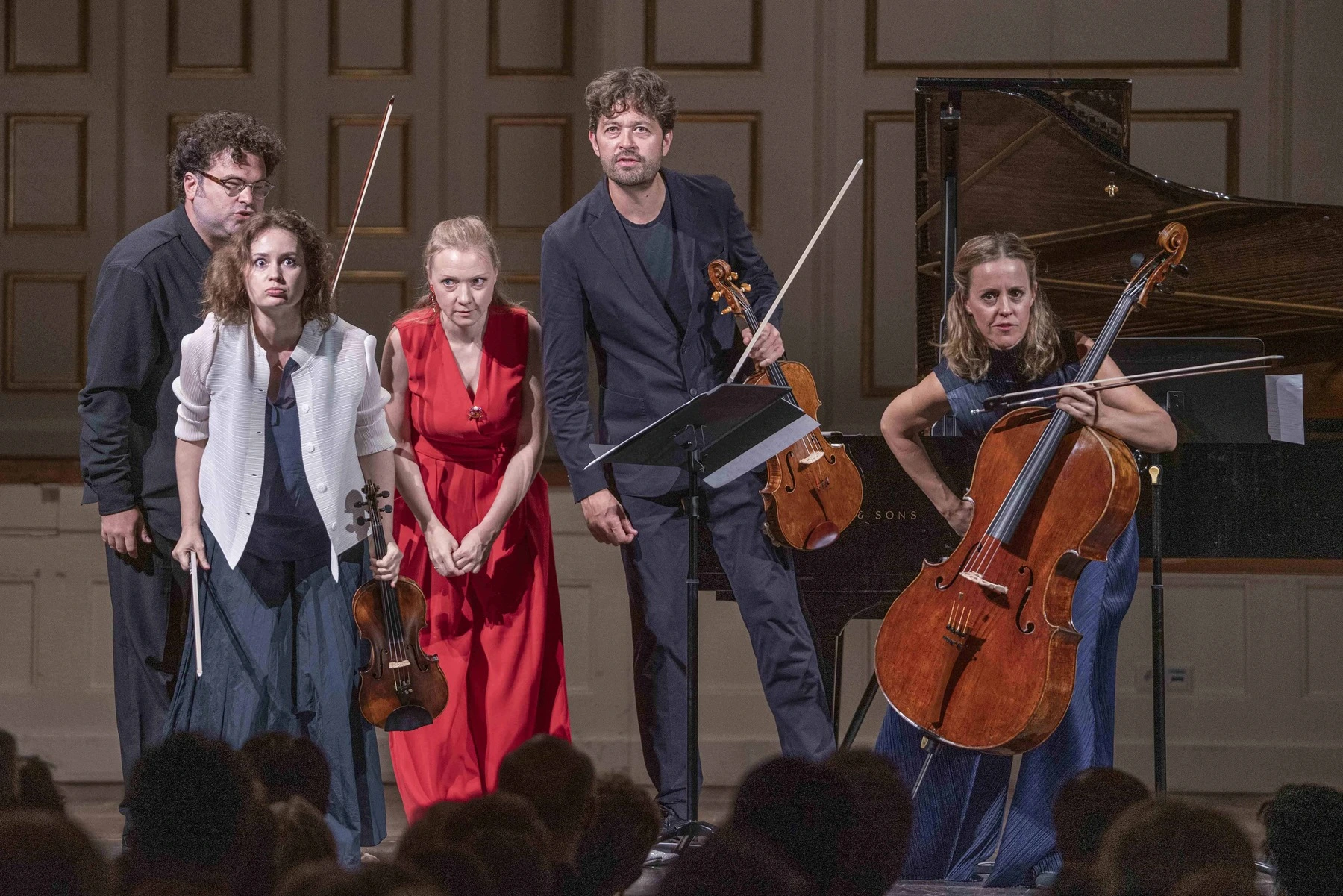
Jonian Ilias Kadesha, Patricia Kopatchinskaja, Olga Pashchenko, Lawrence Power, Sol Gabetta. SF / Marco Borrelli


23.8.26

Critic’s Notebook: Andrea Bocelli in Vienna


Also reviewed for Die Presse: Was passiert, wenn sich ein Klassikkritiker zu Andrea Bocelli ins Stadion verirrt?

available at Amazon
Andrea Bocelli
Duets by Andrea Bocelli
- 30th Anniversary

Brightman, Sheeran, Twain, Stefani, Piaf, Aguilera et al.
(Decca, 2025)

US | UK | DE

available at Amazon
Andrea Bocelli
Romanza
30th Anniversary Edition

(Verve, 2026)

US | UK | DE

Andrea Bocelli, or: Who's Afraid of Popularity?

The Italian pop star fills the Ernst Happel Stadium and raises questions nobody there is asking.

Finding oneself as a classical music critic in a stadium sets off the alarm bells. For one thing, it is not exactly the ideal venue for conveying the nuances of a classical art form in any detail. Worse: what is happening here appears to be something Popular — the natural enemy of the cultural snob. And indeed, Andrea Bocelli — for three decades an indispensable acoustic ingredient of every „Italian" restaurant — had come to Vienna, drawing an estimated 25,000 fans to cheer their Schlager star through his „Romanza 30th Anniversary Tour."

The controversy around the blind-from-childhood Bocelli exists really only because his popularity has swept him into the rarified lane of classical music, where he is inevitably measured by the wrong criteria — as are almost all Pop-Classical Crossover-acts: Richard Clayderman, André Rieu, David Garrett, Il Divo, Katherine Jenkins. For anyone coming from the classical world, these figures must seem bafflingly, inexplicably popular. Not because high culture cannot, inherently, abide popularity — though that is, in fact, high culture's inherent contradiction: it wishes to be widely loved while remaining exclusive. No: the primary irritant is that these artists circumvent established standards of quality; ignore hallowed rules. By objective classical criteria, Bocelli is simply not a very good... OK: rubbish singer — however many times (three) he may have performed alongside Pavarotti. One need not listen to his appearance on the Verdi Requiem recording (Gergiev, Decca) to notice this... though it would help.

What so vexes the snob when Bocelli croons his way through „La donna è mobile," backed by an unnamed orchestra projecting a solid wall of amplified sound that taxed the eardrums? It is not popularity per se. It is rather that something here creates the impression of being what it is not — and instead of being unmasked, is celebrated. “That's not the real thing”, one wants to call out, gesticulating wildly. It is — to paraphrase Jean Baudrillard — at best a symbol, at worst one without an original. As dyed carp is not wild salmon, as Nescafé only superficially resembles real coffee, and as 50 Shades of Grey has 514 pages without thereby constituting literature. Bocelli et al. is at best the illusion of high culture, packaged so harmlessly and agreeably that no one need stretch to partake of it.

But here is the good news: the market sorts itself out. The estimated number of devoted opera fans in the Ernst Happel Stadium: two. The rest were enjoying themselves. Anyone happy in attendance here would not have been secretly happier at Tristan und Isolde or at a Christian Gerhaher recital. No poor soul, somehow under the misapprehension that this was „classical music", wandered into the stadium and now needs rescuing, or subsequent informing that Bocelli has no breath technique, a limited range, sounds small and strained at both ends of it and watery in between. But: One was able to simply enjoy a ravishingly schmaltzy pop concert, with morsels from the classical repertoire thrown in to tick the boxes: a little from „The Barber of Seville." „Au fond du temple saint" (Bizet). „O Fortuna" (Orff). Rodrigo and Morricone.

Where a baritone was needed, Roberto De Candia was on hand; where a high voice, soprano/DJ/life coach Cristina Păsăroiu; where a fiddle, Viennese crossover violinist Rusanda Panfili. And where a pop singer, Andrea Lykke for Stand Up" and Vivo per lei. A pity these performers went unacknowledged — after all, they were responsible for more than half the programme and more than a couple highlights. Bocelli fils Matteo („Fall on Me") also got his duet, and he was very much mentioned. Bel nepotismo. Finally, what everyone had been waiting for: „Time To Say Goodbye" — and as a parting shot, a charmingly askew „Nessun dorma" that rang out across the Prater.


20.7.26

The Flourishing Arts with Les Arts Florissants in "Les Arts Florissants"

Les Arts Florissants performed Charpentier's Les Arts Florissants at Caramoor Friday evening. Photo: Gabe Palacio

KATONAH, N.Y. -- William Christie, who turned 81 last December, founded Les Arts Florissants in 1979 in France, where he had relocated due to his opposition to the Vietnam War. The preeminent French early music ensemble took its name from a short chamber opera, composed by Marc-Antoine Charpentier in 1685 for Marie de Lorraine, Duchesse de Guise, and likely performed at her residence in Paris. Long after recording the piece in 1982, the group has returned to its namesake work as part of the ongoing celebrations for Christie's 80th birthday. Christie himself is leading a North American tour with the organization, pairing Les Arts Florissants with the same composer's La Descente d’Orphée aux Enfers, which came to Caramoor Friday evening. Although the ongoing wildfire smoke influx threatened to scuttle the performance in that venue's outdoor Venetian Theater, by that afternoon the winds had shifted and the air was relatively cool and clear.

The story of Les Arts Florissants is allegorical. Music, Poetry, Painting, and Architecture greet warriors returning from conflict, hoping that the arts may hold greater sway over Louis XIV, now that war is at an end. War and Discord enter, leading the Chorus of the Furies in frightful displays until Peace appears, dispersing the forces of chaos. The ultimate meaning of the work, and how it may have been referencing the political situation in France in 1685, remains obscure, but its message remains ever timely. The coincidence of this performance, although likely planned long ago, with the renewed hostilities by the United States against Iran underscored Charpentier's message: the arts flourish only when war is kept at bay.

For this tour, Christie assembled a cast drawn from the flower of Le Jardin des Voix, the French Baroque training program for young singers he established in 2002. French soprano Camille Chopin presided as La Musique, with a limpid top range and impeccable phrasing, matched by American soprano Sarah Fleiss's spirited La Poésie. Tenor Bastien Rimondi and Canadian-American contralto Sydney Frodsham made a more comical pair as La Peinture and L'Architecture, respectively, but with musical delicacy. Bass-baritone Olivier Bergeron gave an over-the-top rendition of La Discorde, echoed by the ensemble as shrieking Furies, with plenty of nasal cackling to make the point. Cast and audience alike sank into serene contemplation when Croatian soprano Josipa Balić appeared as La Paix, bringing an end to discord: even a moth, seemingly charmed, alit on the end of her finger at one point.

A quartet of dancers graced the production with their movements, joined in some dances by the vocal cast, and in the final unaccompanied choral section, they sang along with their singer counterparts. The choreography by Martin Chaix was more Mark Morris than Baroque France in style, but the dancers' movements matched the elegant music with visual shapes in ways that diverted the eyes. The costumes, as such, were formalwear and simple gowns in soft pastel colors, again giving the impression of a scene that was more of our age than the past. (Two F-holes on the back of La Musique's white jacket were a nice touch.) The sense of benevolence created by the performance hung in the air, echoing the poignant lines of the final strophe: "Ô paix si longtemps désirée, / Que tes fruits à goûter sont doux, / Tu ramènes les temps de Saturne et de Rhée, / Demeure toujours avec nous." If only peace could bring back the Golden Age and dwell with us forever.

Christie presided in a self-effacing way, adding continuo touches on both harpsichord and chamber organ. Two Baroque violins took the twin parts for treble viols, part of the specific musical establishment kept by the Duchesse de Guise. (Christie recorded the work with treble viols, but they were not missed here.) Two flutists also doubled on flageolets to add a folksy character to some of the dances. Christie's delicate approach and the beautiful French declamation of the singers are what was missing from the ensemble's most recent visit to the Library of Congress in November.

Charpentier's La Descente d’Orphée aux Enfers is a showcase for the high tenor who sings Orpheus. American tenor Richard Pittsinger distinguished himself with a shining high range, capable of extraordinary softness, and refined phrasing. In Act II, he gave a different vocal sheen to each of the three pleas Orpheus made to the powers of the Underworld, concluding almost in a whisper. While the opening wedding scene of Act I featured spirited singing and dancing (including the affecting return of Camille Chopin as Euridice), the piece became exquisite with the entrance into Hell in Act II. Two bass viols, played by Myriam Rignol and Mathilde Vialle, set the somber tone of the infernal scene, bathed in red light. The striking trio sung by Ixion, Tantalus, and Tityus (all infamous denizens of the Underworld) featured the perfectly matched voices of tenors Bastien Rimondi and Attila Varga-Tóth with baritone Olivier Bergeron. Their complex, interwoven lines meshed beautifully with the bass viols and other low instruments. The dark episode continued with bass Kevin Arboleda-Oquendo's sunglasses-sporting Pluton and Sarah Fleiss's alluring Proserpine.

The return of the two flutes and higher registers sounded like a ray of light as Orpheus led Euridice out of Hell. Charpentier's opera ends with that moment, probably because a third act has been lost. The choice to end the performance there added to the sense of hope. Beauty can return to the world, and it does all the time, as long as peace prevails.

The Philharmonia Baroque Orchestra performs Handel's Tolomeo, starring Aryeh Nussbaum Cohen, Lauren Snouffer, and Nicole Heaston 4 p.m. July 26 at Caramoor. caramoor.org

18.7.26

Teatro Nuovo marks bicentenary of Italian opera in America


Sedona Libero (Donna Elvira), Kevin Spooner (Leporello, right), and Ricardo José Rivera (Don Giovanni), Teatro Nuovo. Photo: Steven Pisano

NEW YORK, N.Y. -- Will Crutchfield, a leading American specialist in bel canto opera, has led the summer festival Teatro Nuovo since 2018, at various venues around New York. This year's programming, more than worth a trip to Manhattan this week, went back to the start of bel canto history, with the 1826 version of Mozart's Don Giovanni, heard Wednesday evening at the Rose Theater on Columbus Circle, home of Jazz at Lincoln Center.

A bit of history is required for that last sentence to make sense. Our country’s first operatic performances go back to the 18th century, with ballad operas in New York and French operas in New Orleans, even before the latter city technically became American. Crutchfield instead is celebrating the 200th anniversary of Italian opera in America, when Lorenzo da Ponte organized a string of performances in New York in 1826. Mozart's one-time librettist had settled in the U.S. in 1805, driven here by his scandals and bankruptcy in Europe. The troupe that presented the first Don Giovanni in America, among other works, was led by Manuel García and featured the Spanish baritone's wife, his son, and his daughter -- she who would become known as the celebrated soprano Maria Malibran. (García's other daughter, later known as Pauline Viardot, was still a child.) Crutchfield has consulted the 1826 version of the libretto, created by da Ponte, and many other sources to reconstruct the opera. His singers studied 19th-century sources to understand how the Italian singers may have added ornamentation and cadenzas to Mozart's score.

The edition is a mixture of the original Prague version with Mozart's Vienna revision, as are most modern performances. Tenor Martin Luther Clark's Ottavio sang "Il mio tesoro" and not "Dalla sua pace," and Sedona Libero's Elvira sang "Mi tradi," but not in the expected place. Noah B. Rogers, who made a pleasingly assertive Masetto, did not get to sing his aria, which was a shame, but keeping the run time just under three hours seemed worth the trade-offs. The most striking change was the shortened Act II Finale, ending almost immediately after Don Giovanni was taken off to hell. The production cut the entire concluding ensemble, as apparently most productions of the opera did until the 20th century. More significant was the adaptation of the recitatives. Conductor Geoffrey Loff led them from what looked like a clavichord, which produced a very faint, tinkling sound. Double-bassist Dane Roberts provided the foundational bass line, while cellist Hilary Metzger created an intriguing harmonic fabric of viol-like double-stop chords and melodic ideas. Along with the rhythmic freedom taken by the singers, it made the recitatives utterly different and of much greater musical interest.

Baritone Ricardo José Rivera, who is familiar to Washington audiences from his turns with Washington Concert Opera in recent years, made a caustic and insistent Don Giovanni. His scornful anger and his tender love-making, the latter heard most effectively in "Deh! viene a la finestra" (senza mandolino but with a velvety violin solo from concertmaster Laura Lutzke, accompanied by pizzicato strings), were both credible. Both leading women suited their roles admirably, with mezzo-soprano Sedona Libero's Donna Elvira erupting in spitfire ornamentation and cadenzas, and soprano Elizabeth Novella reaching an intensity of Donna Anna's grief and anger with interesting rubato choices in her big scenes. As Leporello, Kevin Spooner displayed nimble comic timing, especially in the Catalog Aria, and sure-footed rhythmic skills.

The voice shifting choices also included casting the potent mezzo-soprano of Simona Genga as Zerlina, for sheer volume the most present singer on the stage. The vocal weight affected her characterization as well, giving her a more aggressive touch in the duets with both Don Giovanni and Masetto. The Commendatore of bass-baritone Daniel Mobbs, a veteran singer, impressed more with elegance of tone than raw power. Tenor Martin Luther Clark used the pointed edge of his sound to give Don Ottavio a dignified presence, occasioning none of the usual audience laughs at the character ending up in the friend zone.

Teatro Nuovo is essentially presenting concert opera, with formal wear for costumes and a set consisting of a large projection-bearing screen (images designed by Adam J. Thompson). The orchestra of gut strings and early instruments made mostly pleasing sounds (with the natural horns and trumpets sounding most rustic), although just because the instruments are less powerful than their modern counterparts does not mean they cannot overpower singers, which Loff should have taken greater care to avoid. A skilled ensemble of ten extra musicians provided the on-stage musical performances during the Act I finale, to appropriately confusing effect.

* * *

Crutchfield paired the Mozart with Rossini's Il Turco in Italia, premiered in Milan in 1814 before the Garcías brought it to New York, also in 1826. Singer illness gutted that first American production. Happily no such issues plagued Teatro Nuovo's performance, heard at the Rose Theater on Thursday night, even with the unbreathable air in New York City this week, caused by smoke blowing in from the devastating Canadian wildfires. This is not one of Rossini's most sparkling achievements, and at well over three hours, it could have used serious truncation along the lines of what Crutchfield did with Don Giovanni. One could certainly start by excising the superfluous aria given to Albazar toward the end, as well as one or maybe both of Don Narciso's arias.

Felice Romani's libretto is predictably absurd. Selim, a Turkish prince, visits Naples and falls in love with Donna Fiorilla, who is already managing her intimacies with a husband, the aged Don Geronio, and a lover, the vain and ridiculous Don Narciso. In Naples, somewhat miraculously, is Selim's former slave and lover, Zaida, now disguised as a Roma fortune-teller. (The use of the word gipsy and some Muslim stereotypes might also make the libretto unpalatable to modern listeners.) The most ingenious part of the story is the character of Prosdocimo, a poet who, in a metafictional twist, is creating the entire story as the basis of his latest opera libretto. Many funny jokes at the art form's expense happen along the way. (Crutchfield's program note pointed to a performance of Mozart's Così fan tutte in Milan just before Romani wrote this libretto, which may have influenced the Donna Fiorilla's polyamorous excesses.)

Kresley Figueroa, familiar from her recent and excellent work with Washington National Opera's Cafritz Young Artists program, showed exceptional technique as Donna Fiorilla, lighting up her many arias and ensembles with firecracker virtuosity. While her intonation strayed at times toward the top, Figueroa's physical presence made the character's outrageous vanity and ability to manipulate men more than credible. Of her three love interests, Mattia Venni's Don Geronio, the long-suffering husband, made the best impression, with impeccable comic timing and buffo antics. As the eponymous Turk, Vincent Graña displayed the most potent instrument, easily filling the room with sound, although in terms of comfort on the stage he seemed reserved. Tenor Max Alexander Cook struggled at times in the top range, but he sang the role of Don Narciso with technical ease in melismatic passages. Soprano Sabatina Mauro, as Zaida, and David Freides, as Albazar, both made worthy appearances from the ranks of this year's Resident Artists. Hans Tashjian brought more stage antics than vocal refinement to the poet Prosdocimo, with some charming breaking of the theatrical fourth wall.

Violinist Elisa Citterio, who stood facing the orchestra, led the performance while partially playing as well, with Derrick Goff seated at the clavichord next to her. The results were not as clean in terms of ensemble cohesion, as the establishment of fast tempos did not always happen with clarity. The same division of labor occurred for the recitatives, far fewer in number, as heard in Don Giovanni. The instrumental playing, here and in Don Giovanni, was generally impeccable. The extended horn solo from Nathaniel Udell proved a highlight of the Rossini overture, with the charming alternation of stopped and open notes necessary because of the natural horn's lack of valves.

Second image credit: Mattia Venni (Don Geronio) and Kresley Figueroa (Donna Fiorilla) in Teatro Nuovo's Il Turco in Italia. Photo: Steven Pisano