CD Reviews | CTD (Briefly Noted) | JFL (Dip Your Ears) | DVD Reviews
Showing posts with label Marc-Antoine Charpentier. Show all posts

20.7.26

The Flourishing Arts with Les Arts Florissants in "Les Arts Florissants"

Les Arts Florissants performed Charpentier's Les Arts Florissants at Caramoor Friday evening. Photo: Gabe Palacio

KATONAH, N.Y. -- William Christie, who turned 81 last December, founded Les Arts Florissants in 1979 in France, where he had relocated due to his opposition to the Vietnam War. The preeminent French early music ensemble took its name from a short chamber opera, composed by Marc-Antoine Charpentier in 1685 for Marie de Lorraine, Duchesse de Guise, and likely performed at her residence in Paris. Long after recording the piece in 1982, the group has returned to its namesake work as part of the ongoing celebrations for Christie's 80th birthday. Christie himself is leading a North American tour with the organization, pairing Les Arts Florissants with the same composer's La Descente d’Orphée aux Enfers, which came to Caramoor Friday evening. Although the ongoing wildfire smoke influx threatened to scuttle the performance in that venue's outdoor Venetian Theater, by that afternoon the winds had shifted and the air was relatively cool and clear.

The story of Les Arts Florissants is allegorical. Music, Poetry, Painting, and Architecture greet warriors returning from conflict, hoping that the arts may hold greater sway over Louis XIV, now that war is at an end. War and Discord enter, leading the Chorus of the Furies in frightful displays until Peace appears, dispersing the forces of chaos. The ultimate meaning of the work, and how it may have been referencing the political situation in France in 1685, remains obscure, but its message remains ever timely. The coincidence of this performance, although likely planned long ago, with the renewed hostilities by the United States against Iran underscored Charpentier's message: the arts flourish only when war is kept at bay.

For this tour, Christie assembled a cast drawn from the flower of Le Jardin des Voix, the French Baroque training program for young singers he established in 2002. French soprano Camille Chopin presided as La Musique, with a limpid top range and impeccable phrasing, matched by American soprano Sarah Fleiss's spirited La Poésie. Tenor Bastien Rimondi and Canadian-American contralto Sydney Frodsham made a more comical pair as La Peinture and L'Architecture, respectively, but with musical delicacy. Bass-baritone Olivier Bergeron gave an over-the-top rendition of La Discorde, echoed by the ensemble as shrieking Furies, with plenty of nasal cackling to make the point. Cast and audience alike sank into serene contemplation when Croatian soprano Josipa Balić appeared as La Paix, bringing an end to discord: even a moth, seemingly charmed, alit on the end of her finger at one point.

A quartet of dancers graced the production with their movements, joined in some dances by the vocal cast, and in the final unaccompanied choral section, they sang along with their singer counterparts. The choreography by Martin Chaix was more Mark Morris than Baroque France in style, but the dancers' movements matched the elegant music with visual shapes in ways that diverted the eyes. The costumes, as such, were formalwear and simple gowns in soft pastel colors, again giving the impression of a scene that was more of our age than the past. (Two F-holes on the back of La Musique's white jacket were a nice touch.) The sense of benevolence created by the performance hung in the air, echoing the poignant lines of the final strophe: "Ô paix si longtemps désirée, / Que tes fruits à goûter sont doux, / Tu ramènes les temps de Saturne et de Rhée, / Demeure toujours avec nous." If only peace could bring back the Golden Age and dwell with us forever.

Christie presided in a self-effacing way, adding continuo touches on both harpsichord and chamber organ. Two Baroque violins took the twin parts for treble viols, part of the specific musical establishment kept by the Duchesse de Guise. (Christie recorded the work with treble viols, but they were not missed here.) Two flutists also doubled on flageolets to add a folksy character to some of the dances. Christie's delicate approach and the beautiful French declamation of the singers are what was missing from the ensemble's most recent visit to the Library of Congress in November.

Charpentier's La Descente d’Orphée aux Enfers is a showcase for the high tenor who sings Orpheus. American tenor Richard Pittsinger distinguished himself with a shining high range, capable of extraordinary softness, and refined phrasing. In Act II, he gave a different vocal sheen to each of the three pleas Orpheus made to the powers of the Underworld, concluding almost in a whisper. While the opening wedding scene of Act I featured spirited singing and dancing (including the affecting return of Camille Chopin as Euridice), the piece became exquisite with the entrance into Hell in Act II. Two bass viols, played by Myriam Rignol and Mathilde Vialle, set the somber tone of the infernal scene, bathed in red light. The striking trio sung by Ixion, Tantalus, and Tityus (all infamous denizens of the Underworld) featured the perfectly matched voices of tenors Bastien Rimondi and Attila Varga-Tóth with baritone Olivier Bergeron. Their complex, interwoven lines meshed beautifully with the bass viols and other low instruments. The dark episode continued with bass Kevin Arboleda-Oquendo's sunglasses-sporting Pluton and Sarah Fleiss's alluring Proserpine.

The return of the two flutes and higher registers sounded like a ray of light as Orpheus led Euridice out of Hell. Charpentier's opera ends with that moment, probably because a third act has been lost. The choice to end the performance there added to the sense of hope. Beauty can return to the world, and it does all the time, as long as peace prevails.

The Philharmonia Baroque Orchestra performs Handel's Tolomeo, starring Aryeh Nussbaum Cohen, Lauren Snouffer, and Nicole Heaston 4 p.m. July 26 at Caramoor. caramoor.org

28.7.24

Notes from the 2024 Salzburg Festival ( 2 )
Ouverture Spirituelle • Te Deum & Mozart Matinee

Te Deum — La Capella Reial • Le Concert des Nations • Savall


Also reviewed for Die Presse: Strahlende Trauermusik mit Jordi Savall und Adám Fischer


ALL PICTURES (DETAILS) COURTESY SALZBURG FESTIVAL, © Marco Borrelli. CLICK FOR THE WHOLE PICTURE.


Evening and Mourning: De Profundis for Wolfgang Rihm


No one knew Friday evening, when Jordi Savall performed Michel-Richard Delalande’s (and Arvo Pärt’s) De Profundis. And When Adám Fischer conducted Mozart’s Masonic Funeral Music at the Saturday Mozart Matinee, news had just reached Salzburg that Wolfgang Rihm had died that night. In retrospect, those two concerts took on the character of a musical leave-taking from arguably the most respected living German composer and a dear human being.

available at Amazon
Charpentier
Te Deum
Ensemble Les Surprises
Alpha, 2024

The sun was just laying last bands of warm yellows across the battlements, church towers, and roofs of Salzburg when the sounds of early French baroque filled the Collegiate Church, courtesy of Le Concert des Nations and Jordi Savall, who made his way to stage with a crutch and his face that looks like an apostle carved from wood. The center of this Tootsie Pop, between Delalande and the timeless minimalism of Pärt, was Marc-Antoine Charpentier’s grand Te Deum, which Europeans of a certain age invariably associate with childhood moments in front of the TV, maybe for the Four Hills ski jumping tournament or the Eurovision Song Contest, seeing that the opening prelude is the signal of the “Eurovision” pan-European broadcasts. Only that that version is rather more stately than the tempestuous trumpets and snappy timpani were, that Savall & Co. hurled at the enthused audience – eliciting early Bravos after the “In te, Domine, speravi” faded away into the generous acoustic of the ideally suited (and carefully prepared) church space.

Throughout the evening, the young La Capella Reial de Catalunya choir radiated with musical joy, like a big family in a choral outing. The soloists from its own ranks pleased with fresh and clear interpretations – above all the positively glowing (it may partly have been the advanced state of pregnancy) soprano of Elionor Martínez. Mezzo Kristin Mulders added her incisive, blazing instrument into the mix, although the tight, pronounced vibrato did not quite gel with the other, purer voices.

The short encore, Pärt’s Da pacem Domine (written for Savall and inspired by the 2004 Madrid train bombings), opened like a Gregorian chorale before the typical Pärt-isms chimed in: The chords that drift apart, the shifting long vocal lines, the regular time signature of the timpani, all resting on a subtle, almost unnoticeable bed of gently buzzing strings.

Funereal and Rocking Mozart from A.Fischer

available at Amazon
W.A.Mozart
45 Symphonies
Danish National CO
Dacapo, 2013

Mozart’s Masonic Funeral Music, which Adám Fischer and the Mozarteum Orchestra performed, is not his best work – but it’s one of the more distinct ones in his output. The earthy, dark, woodwind-centered piece made for a most memorable curtain raiser, followed by a far less memorable D-minor Piano Concerto (K.466) in which the young Lukas Sternath, who won just about every prize at the 2022 ARD Music Competition, played flawless and lovely enough (“achingly sincere” is Tim Page’s suggestion for a put-down on such an occasion), but never achieved lift-off.

As if to prove that neither orchestra nor the conductor were to blame, Fischer and the Salzburgers went for a zany “Linz” Symphony that sparkled and crackled from start to end. With a smile across its collective face, the Mozarteum Orchestra delivered drive instead of legato, short but never choppy phrasing, and their joy transferred unto the audience’s – reminding us, why it is Adám Fischer, who currently has the best Mozart Symphony Cycle to his name.


Photo descriptions:

Picture No.1: Te Deum – La Capella Reial · Le Concert des Nations · Savall 2024: Jordi Savall (Dirigent), Le Concert des Nations, Solisten

Picture No.2: Mozart-Matinee · A. Fischer 2024: Adam Fischer (Dirigent), Mozarteumorchester Salzburg


11.11.23

Briefly Noted: Merry Charpentier Christmas

available at Amazon
Charpentier, Messe de Minuit, Ensemble Correspondances, Sébastien Daucé

(released on October 13, 2023)
Harmonia Mundi HMM902707DI2 | 80'52"
The French early music group Ensemble Correspondances has quickly become a favorite. For that unusual Christmas gift, conductor Sébastien Daucé has put together a most entertaining Noël program on this new release. In splendid performances, it pairs Marc-Antoine Charpentier's more familiar Messe de Minuit, a setting of popular Noël melodies to the Ordinary of the Mass, with two of the same composer's oratorio-like dramatic motets for Christmas.

In his excellent booklet essay, Graham Sadler notes a musical self-borrowing not often commented on, in which Charpentier based the "Gloria" movement of the Midnight Mass on the music that went with a parallel text in his motet In nativitatem Domini canticum, H. 416. Having always been struck by the beauty of this moment in the Mass, so much more reflective and introspective than the general take on the "Gloria" text, I was delighted to learn of this connection with the earlier work, which I did not know at all.

Daucé rounds out a Christmas Eve celebration with a number of charming selections, including two of Charpentier's instrumental settings of Noëls used in the Mass. The setting of "Laissez paître vos bêtes" for recorder consort is an absolute delight, as is a motet for the elevation of the host, excerpted from a longer work by Charpentier's contemporary, Sébastien de Brossard, a real find for music directors looking for something unusual to program next month. The disc ends with one of Charpentier's versions of the Te Deum, H. 147, likely used during the Christmas season at the Jesuit church of St. Louis in Paris, where Charpentier was maître de musique. Sung at the end of Matins, it would have directly preceded Midnight Mass.


Follow me on Threads (@ionarts_dc)
for more classical music and opera news

2.3.19

Briefly Noted: Bewitched by Opera

available at Amazon
L'opéra des opéras, Le Concert Spirituel, K. Deshayes, K. Watson, R. van Mechelen, H. Niquet

(released on January 11, 2019)
Alpha ALPHA442 | 74'10"
Do not let the silly cover art turn you away from this deserving new release led by French early music specialist Hervé Niquet. It is a selection of arias, choral numbers, and instrumental pieces from a range of operas by Rameau, Charpentier, Marais, Leclair, Campra, Francoeur, Mondonville, and names even more obscure. Not content with merely a random assortment of music, Benoît Dratwicki has chosen and arranged the pieces to create a new short opera, recorded in the Opéra Royal de Versailles in 2017. Dratwicki, the artistic director of the Centre de musique baroque de Versailles, took the idea from the gesture of Louis XIV when, in 1671, the Sun-King requested that Lully create a Ballet des ballets, bringing together excerpts from the 30-some ballets the composer had performed before his court.

The plot dreamed up for this makeshift opera suits, more or less, the excerpts from lots of different operas. A prince is in love with a princess, sung by tenor Reinoud van Mechelen and soprano Katherine Watson, respectively. The former has a sweet, sighing top well suited to the high-set haute-contre writing in French opera, while the latter sings with an edge sharpened by an active vibrato. The couple's love is thwarted by a wicked sorceress, sung with reedy, malevolent force by mezzo-soprano Karine Deshayes. (Hervé Niquet thought this triangle of characters similar to that found in the television show Bewitched, and thus the album cover was born.) If anything, the instrumental playing exceeds the singing in beauty, not least the magisterial Passacaille from Lully's Armide, which concludes the disc.

30.12.13

Briefly Noted: Louis Le Prince

available at Amazon
L. Le Prince, Missa Macula non est in te (inter alia), Le Concert Spirituel, H. Niquet

(released on April 8, 2013)
Glossa GCD921627 | 63'48"
Sacred music in 17th-century France has perhaps taken a back seat to the opera of that period. French conductor Hervé Niquet here makes an ingenious attempt to provide one glimpse into the Baroque chapelle -- French pronunciation of Latin and all -- with a disc of music from the period performed by all women's voices. The backbone of the program is the first recording of the Missa Macula non est in te, a setting of the Ordinary for six voices by Louis Le Prince, the maître de chapelle at the Cathedral of Lisieux, published in 1663, the only work by him known to survive. Proceeding from sources about practices relating to music performed by convents of nuns in the 17th century, Niquet has put together a sort of Mass-Office hybrid, with the five Mass movements surrounded by other pieces suited to different feast days but all for women's voices, here ten singers beautifully balanced in ensemble. The Mass, reconstructed from the score in the Bibliothèque Nationale de France by scholars at the Centre de Musique Baroque de Versailles, is worth rediscovering, performed here with instruments (violon consort, bassoon, positive organ) doubling (and sometimes replacing) the vocal parts and captured in radiant sound in the resonant space of the church of Notre Dame du Liban in Paris. The trappings are no less charming, especially the opening motet, Gaudete fideles by Marc-Antoine Charpentier, an ecstatic tribute to St. Bernard, and Lully's rapturous motet O dulcissime domine, with a text that blurs the line just slightly between heavenly devotion and earthly lust. The other pieces, all by Charpentier and all quite charming, include a similarly contemplative Elevation motet, O pretiosum, and his florid setting of the Magnificat canticle, H. 75. Watch a few excerpts performed in the Chapelle Royale de Versailles.

21.3.06

La Messe at Notre-Dame

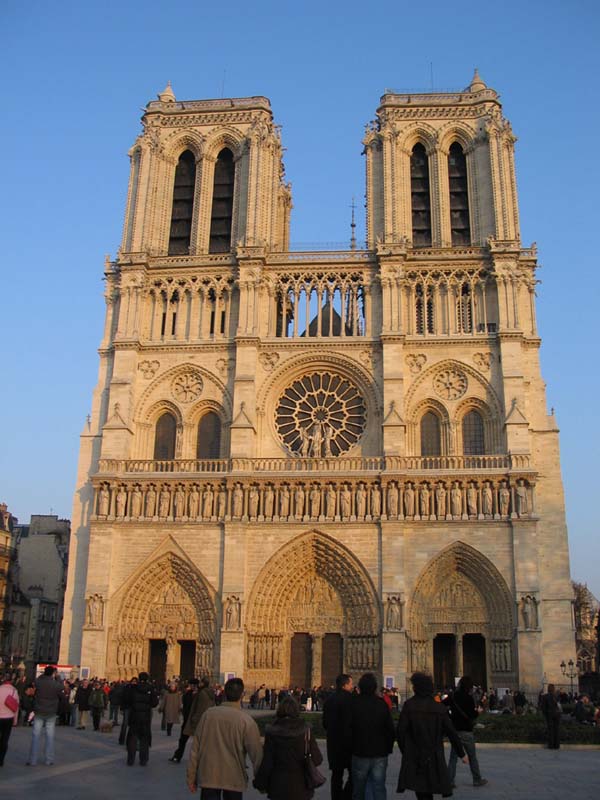
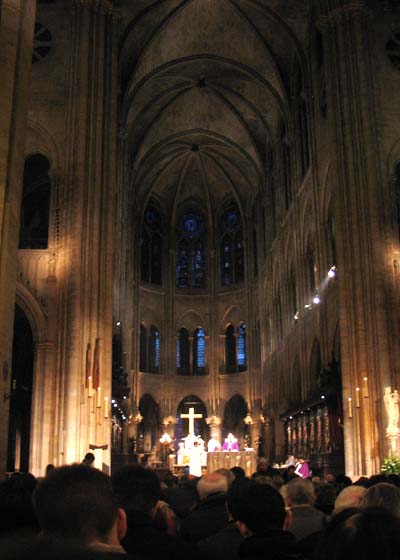
Notre-Dame de Paris, Harmonie du Soir, March 19, 2006On Sunday, we led our students through the Cathedral of Notre-Dame, a place that is so crowded with tourists most of the time -- often of the videotaping, foot-scuffling en masse, oblivious type -- it would seem to be impossible to have an aesthetic experience there, not to mention a religious one. However, I had both, yet again, first in the morning, when we sat in the nave to take part in the service of Lauds. Unlike the church in much of the world, the Cathedral of Notre-Dame, at least part of the week, observes parts of the Divine Office, which was historically a substantial part of the reason why much sacred music was composed. Indeed, this particular cathedral was the seat of a legendary medieval maîtrise, for whom both Leonin and Perotin composed their lavish new styles of polyphony, marking Notre-Dame as one of the cradles of European music, along with San Marco in Venice, the Cappella Sistina in Rome, and a few others. The Divine Office, not just the Mass, was the glory of these churches. The music for the service was very simple, French translations of the psalms and antiphons, set to basic tones, some of them modified from Gregorian ones. I wonder how much, if ever, the modern musical team programs Notre-Dame polyphony. I would dearly love to hear how it sounds, performed well in that choir.

Notre-Dame de Paris, Grande Orgue, March 19, 2006I am not sure which of the cathedral's organists was playing for this service, but the music -- improvised, I believe, in the legendary tradition of French organists -- was of the visionnaire style associated especially with Olivier Messiaen, often dissonant and searing in registration. As the final improvisation ended, we were showing the students silently around the outer perimeter of the building. All but one of them has had my Humanities class, where we study this particular building as our example of the French Gothic style of architecture, so there was not much I needed to say. As we were transfixed by the penetrating blue light of the transept rose window, the 10 am Gregorian Mass began, chanted in Latin by a very good male schola. It was the perfect demonstration of how musical and aesthetic experience can combine -- those sounds, that elevated place, that light -- to melt the most stubborn of hearts.

A place like this spoils you forever for, or rather purifies you from, the popularized musical rubbish and the demotic and blasé architectural and artistic style of most modern Catholic parishes. The Catholic Church is in possession of the some of the most glorious musical and artistic traditions in the world, most totally ignored by the modern church. Not that we have to rely only on the past either, but the church has mostly abandoned its position as the greatest patron of the arts.


Notre-Dame de Paris, Messe à 18h30, March 19, 2006We could not stay for the whole Mass, but I was able to come back Sunday evening for the 6:30 pm Mass, after Vespers. For that service, Olivier Latry was at the grande orgue, one of the most brilliant organists and improvisers in the world today. I have heard him play many times, and he never ceases to amaze me. Jens has already attested to his talents on a recent recording. His recording of the complete Messiaen organ works is a revelation. I am not sure if he was playing someone else's music or improvising, but I believe it was the latter. In the recessional music at the conclusion of Vespers, he started with some loud, staccato chords, bristling with dissonance, that made some people in front of me start in surprise, unsure if the organist had made a mistake. As he continued and wove those chords into something motivic, it was clear that there was no mistake. The music he played alternated between creepy, atmospheric hues and hallucinatory, angelic shouts. My spine literally tingled at points.

Available at Amazon:
available at Amazon
Marc-Antoine Charpentier, Messe, H. 1, and other works, Le Concert Spirituel, Hervé Niquet (released on May 13, 1997)
The choral portion of the service was performed by the young singers of the Maîtrise de Notre-Dame, an excellent choir on the English model, with larger numbers of boys and girls on the treble parts and a few adults on the lower ones. For the Ordinary, they sang a setting of the Mass by Marc-Antoine Charpentier (H. 1) -- Messe à 2 dessus et double chœur (a .PDF version of the Kyrie and Gloria) -- in a version with only organ accompaniment. (The piece has been critically edited by Catherine Cessac for the Centre de Musique Baroque de Versailles.) The Kyrie was not flawless, as there were a few problems with unified attacks and unsure intonation, but the sound was pretty, especially the pure trebles. This being Lent, the Gloria was omitted, but the Agnus Dei (an excerpt in .PDF format) was excellent and is in general a much more interesting piece of music, with its opposition of full chorus and a group of favoriti. During the distribution of communion, the choir sang one more piece, my favorite section of Bach's lengthy and glorious motet, Jesu, meine Freude. Toward the end of that motet, there is a setting of the chorale "Gute Nacht, o Wesen / das die Welt erlesen" (Good night, existence / that the world chose). It was a perfect Lenten reflection, bidding good night to one's sins: Dir sei ganz, du Lasterleben, / gute Nacht gegeben! (To you, life of vice, I bid a final good night!). Musically, it is an exquisitely crafted miniature. The celebrant was André Vingt-Trois, the former archbishop of Tours, who was appointed to succeed Cardinal Lustiger as Archbishop of Paris last year.