CD Reviews | CTD (Briefly Noted) | JFL (Dip Your Ears) | DVD Reviews
Showing posts with label Concert Reviews. Show all posts

15.9.26

Notes from the 2026 Salzburg Festival ( 3 )
Sol Gabetta & Kristian Bezuidenhout

Salzburg Festival • Soloists Concert • Sol Gabetta & Kristian Bezuidenhout


Also published in Die Presse: Salzburg: Sol Gabetta kredenzt hübsche Violoncello-Zuckerl


available at Amazon
Brahms / Mendelssohn
Cello Sonatas
♥ Starker/Sebők ♥
Mercury, 1996

US | UK | DE

Gabetta and Bezuidenhout: Well-behaved German Romanticism

Pretty Cello Bonbons and a Trio for Piano, Cello and Hearing Aid


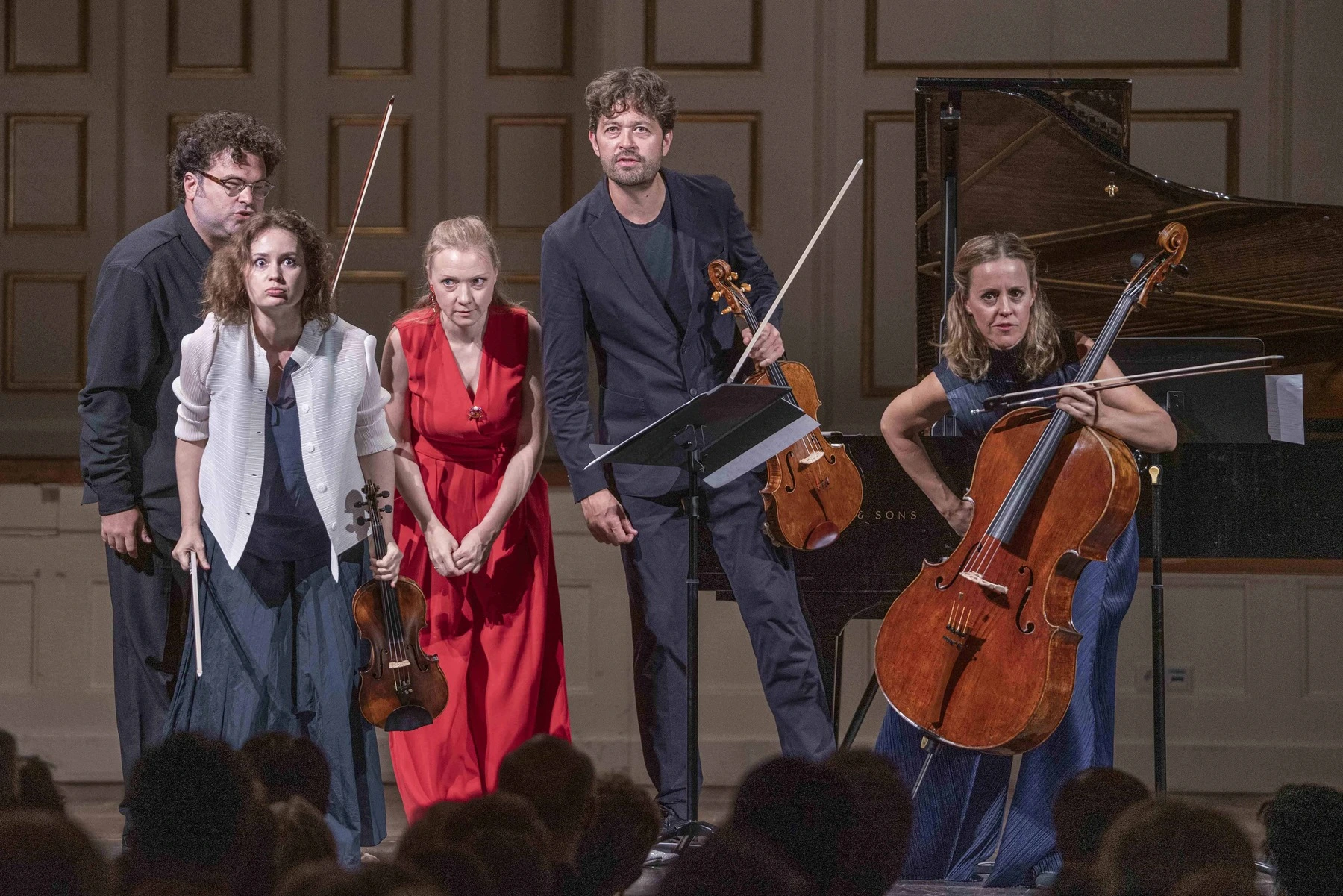
Tuesday at the Mozarteum she was still part of Patricia Kopatchinskaja’s quintet, on Wednesday she was back as the headliner: Sol Gabetta – with fortepianist extraordinaire Kristian Bezuidenhout, in the Haus für Mozart. Schumann’s Fantasiestücke, sonatas by Brahms (No. 1) and Mendelssohn (No. 2), garnished with arrangements for cello and piano of various smaller melodic confections. The two concerts could scarcely have been more different. Gabetta fits in beautifully when Kopatchinskaja sets the agenda – wild, unruly, tussled. When the Argentine star is in charge herself, different principles apply. Here she plays with lyrical assurance, always nice-sounding, dutifully beautiful to the point of cooing. In the golden depths of her cello, she is tonally at home; as the register rises, the tone seems to lose color. Somehow Bezuidenhout went along with all of this and appeared to recede into the background.

This exquisite music-making – take Gabetta’s honeyed sweetness in the slow Allegro non troppo of the Brahms Sonata, and Bezuidenhout's sparkling-delicate accompaniment – is all a pleasure and music-making at the highest level. Objectively there is nothing to fault in the trim attack with which Gabetta draws her notes from the cello. Nor in her intonation or phrasing. And yet… Perhaps it was the vast acoustic of the Haus für Mozart itself, which resists the intimacy her playing needs – swallowing any and all of the energy that didn’t come directly from the chosen tempos. Fast tempos, however, had to wait until the concluding Mendelssohn Sonata. For everything before it – entirely in keeping with Johannes “ma non troppo” Brahms’s own prescription – was awfully tasteful and measured.

And yes: as if something had been building up, the Mendelssohn was, if not exactly exuberant, at least somewhat uberant. The applause after the first movement felt natural, necessary, and was considerably more welcome than awkward embarrassed coughing would have been. Then, at the close, a rogue hearing aid joined the ensemble persistently – at times louder than the cello. Gabetta was not notably displeased. Friction arrived at last. She threw herself into the notes with good deal of bite and fury: The best three minutes of the evening.

Sol Gabetta (Cello), Kristian Bezuidenhout (Piano) © SF/Marco Borrelli


13.9.26

Notes from the 2026 Salzburg Festival ( 2 )
Kopatchinskaja, Friends, and György Kurtág

Salzburg Festival • Chamber Music • Hommage à Kurtág


Also published in Die Presse: Kopatchinskaja in Salzburg: Schnurren und Kratzen für Kurtág & Co.


available at Amazon
Kurtág / Schumann
Hommage à R. Sch et al Kashkashian, Levin, Brunner
ECM, 2006

US | UK | DE

available at Amazon
György Kurtág
Játékok (selection) Gábor Csalog, M.& G. Kurtág
BMC Records, 2006

US | UK | DE

Playing with Music

Music as lived joy: Kopatchinskaja brings Kurtág to Salzburg — and it's simply great entertainment


Patricia Kopatchinskaja was made for playing the music of György Kurtág — or vice versa. However that may be, in her chamber music homage to the hundred-year-old composer at the Salzburg Festival, she demonstrated how much is already won — not only in contemporary music — when a violinist refuses to insist on playing just beautifully, and instead interprets with the whole body, from the curls down to the tips of her toes.

Fiddling, stomping, plucking, she worked her way through Kurtág's profound scrawlings from „Zeichen, Spiele und Botschaften" and the „Játékok" collections with her musical partners. Pianist Olga Pashchenko had already impressed in the opening second Bartók Rhapsody for violin and piano — both in the restraint of her part, palying along as if parallel to the violin, and in the suddenness with which she lunged forward, like a hungry moray-eel, whenever Bartók thrusts the piano into the spotlight. In the Kurtág she drew out the abstract tenderness of „Hommage à Márta," just as Kopatchinskaja shaped „…féerie d'automne…" as a pianissimo exhalation — light as on butterfly-wings. Elsewhere Kopatchinskaja plunged into her instrument — alone or alongside Pashchenko, violinist Jonia Ilias Kadesha, the lusciously toned Lawrence Power on viola, and/or Sol Gabetta on cello — like a tomcat in a mating fight, driving it through Kurtág's fragile, skewed, compressed music. What strikes one above all is how unpretentiously modern Kurtág writes. What would sound simply absurd from other, self-important composers is here disarming.

Bartók's „Bagpipe" Duo from the „44 Duos" for two violins was staged as a small, spontaneous theatrical piece for all six musicians, with the musicians eventually exiting until only Reto Bieri (clarinet), Kopatchinskaja and Pashchenko remained for the wild „Contrasts" for violin, clarinet and piano — also Bartók — which, living up to its name, was carried forward wild and unleashed, then whispering and murmured.

Mozart's Clarinet Quintet K. 581 waited as a reward in the second half — though the audience was already so enthused by the Kurtág and Bartók that no lure would have been needed. Then again, one simply doesn't say no to a slow movement that sublime — and so they listened to the fiveseome, gathered around Bieri and his modern basset clarinet, in these four movements of pure pleasure: Sensitive, soft and supple, genuine ego-free chamber music atmosphere par excellance. Where Bieri had — deliberately — hissed and spat air in the excitable Bartók, here he was milk and honey manifest in the form of a clarinet, bewitchingly quiet and breathless in the slow movement. But „contrasts" was the watchword here too — the Quintet went off in the Menuetto as if stung by hornet: Kopatchinskaja does not let such opportunities pass to go for broke instead of playing nice. (That's rather Gabetta's game, although she went along with the general gist quite nicely here.) The Variations finale was handled with generous latitude — entirely in keeping with so playful an ensemble.

Jonian Ilias Kadesha, Patricia Kopatchinskaja, Olga Pashchenko, Lawrence Power, Sol Gabetta. SF / Marco Borrelli


2.7.26

Critic’s Notebook: Pavel Haas Quartet Makes the Ears Dance in an All-Czech Program


Also reviewed for Die Presse: Tiefenbeglückender Ohrentanz, gänzlich tschechisch: Bekanntes Ungehörtes, unerhört Beliebtes: Das Pavel Haas Quartet im Musikverein, mit einem Abend zum Schwärmen

available at Amazon
Bohuslav Martinů
String Quartets 2, 3, 5, 7 Pavel Haas Quartet
(Supraphon, 2025)

US | UK | DE

available at Amazon
Bedrich Smetana
The String Quartets Pavel Haas Quartet
(Supraphon, 2015)

US | UK | DE

Raving in Czech

The Known-unheard and outrageously popular: the Pavel Haas Quartet and an evening of chamber music to make your ears swoon

What a program — on paper alone. Who? One of the most celebrated string quartets of our time, Prague's Pavel Haas Quartet. Where? The Muskverein's Brahms-Saal. What? An entirely Czech program, running from the sole string quartet of the short-lived Vítězslava Kaprálová (1935) through Bohuslav Martinů's Fifth Quartet (1938) to that most reliable of pleasures, Antonín Dvořák's Fourteenth and last quartet, in A-flat major, op. 105 (1895). Kaprálová's music, barely two dozen works in total, has been rediscovered in spasmodically over the decades, tenaciously if intermittently — but one does not actually get to hear it very often. (Or else it's hidden in well-meaning but generally dismal "look: Women composers!" programs that are such an ironic, unintended bane to composers that happen to have been women.) This is a substantial three-movement quartet of some twenty minutes, written by a twenty-year-old nearing the end of her studies in Brno: rhythmic, mobile, tonal, but facing boldly forward — unsurprisingly in the musical orbit of Schulhoff, Pavel Haas, and Martinů. Certain works carry a luminous seriousness and quality that shimmers through them; Kaprálová's op.8 is one of those.

The Fifth Quartet of Martinů was not chosen as a companion piece, merely because it's a sensationally effective work at the intersection of Bartók, Shostakovich, and Janáček, and (like all of Martinů's quartets, which the Pavel Haas Quartet is currently recording for Supraphon) deserves to be far better known. Kaprálová is also the direct inspiration for the piece: she was Martinů's student in Paris for three years — and thereafter, in all likelihood, his lover. Think of it as Martinů's equivalent of Janáček's "Intimate Letters" — quartet. The work rocks from the opening bar with an irresistibility that seems to want to carry the momentum of Kaprálová's dynamic finale straight into itself. The relentless climaxes of the partially spooky Adagio, each time the Pavel Haas Quartet allowed them to relax, offered a delicious shiver of complex lyricism. As fragile as the movement dissolves, so wild does the Allegro vivo return — with maximum, ferocious forward thrust. Feet and heads bobbed in the audience, pretty much universally. The viola-throaty tone of the first violin in the finale's Lento feigned relaxation before the irresistible surge of the Allegro that followed.

Throughout all, one didn't actually pay all that much attention to the quartet's playing as such — because it seems to function by itself, entirely naturally: what one hears is not interpretation but music. Here, as in the Dvořák — whose fugal opening gradually yields to the composer's characteristic melodic abundance — it was the tonal richness of the ensemble that was so arresting. This isn't some pretty-playing style they indulge in, but a style that adapts, like an octopus, to its musical environment as needed: pallid, wild, sweet, spiky — irresistible. One could look elsewhere for finer individualists: the second violin in the Quatuor Ébène, the viola in the Belcea Quartet, the Cuarteto Casals' cello. But anyone who can make your ears dance the way this quartet did in the Dvořák is offering something singular — and seems to make this argument: one good string quartet evening is worth ten orchestral concerts, so sustainably and deeply satisfying are these hours.


18.4.26

Critic’s Notebook: Olivier Latry and Shin-Young Lee


available at Amazon
Olivier Latry & Shin-Young Lee,
Stravinsky, Heller, Alain
Trois danses
(BNL, 2013)

US | UK | DE

available at Amazon
Olivier Latry,
Transcriptions
Midnight at Notre-Dame
(DG SACD, 2004)

US | UK | DE

Olivier Latry and Shin-Young Lee Dance the Night Away

Organ Dances at the Konzerthaus's Rieger instrument

While early music is otherwise running riot at the Konzerthaus – it is, after all, “Resonanzen” time – one might intuitively expect an organ recital to be part of the baroque proceedings. For a good two minutes, that was indeed the case on Tuesday evening in the Great Hall, when Olivier Latry, titular organist of Notre-Dame, and Shin-Young Lee brought the Rieger organ to life with an arrangement of Rameau’s Les Sauvages. But the Rieger organ is anything but a baroque instrument, and so the remainder of the evening was devoted to (ballet) music that, while not written for the organ, was at least composed at roughly the same time as the instrument itself came into life.

The programme ranged from Béla Bartók via Maurice Ravel, Manuel de Falla and Alexander Borodin to the main course and undisputed high point: an arrangement of Igor Stravinsky’s Le sacre du printemps. Not such a far-fetched idea, given that The Rite of Spring also exists in a wildly percussive four-hand piano version by the composer himself. But everything before the Stravinsky amounted to little more than preliminaries – with the Rameau (surprisingly) perhaps the least satisfying of the lot: The organ sounded thick and dense in the Les Sauvages (recycled in Les Indes galantes and inspired by Reameau observering six Mitchigamea chiefs dance before King Louis XV. in the Théâtre-Italien in 1725) and in this arrangement – or rather in Latry’s and Lee’s registration – it clattered like a fairground carousel.

The Bartók miniatures, small musical playthings from the Romanian Dances, were never intended by the composer to court broad appeal and were unlikely to have acquired it in Latry’s arrangement either. Interesting, at least, was how the “Bagpipe Players” sonatina recalled 16-bit computer music. Cleanly and securely played, but at times somewhat laborious and monochrome in sound – whether for four hands or two – Lever du jour, Danza ritual and the Polovtsian Dances were hardly more invigorating.

But then! Almost from the very first note, Lee and her husband made it clear in the Stravinsky where all that effort in selecting organ stops had gone. The work gleamed, lively and colourful. The impudent little figures Stravinsky scatters throughout were wonderfully realised by four hands – as was, with two, three or even four feet, the underlying, driving rhythm. Altogether, this sounded far more natural, more organic, than, say, a Bruckner symphony on the organ and it kind-of salvaged the evening.


17.4.26

Critic’s Notebook: Barokksolistene and their Alehouse Sessions at the Konzerthaus


available at Amazon
Bjarte Eike,
Barokksolistene
The Alehouse Sessions
(Rubicon, 2017)


US | UK | DE

available at Amazon
Bjarte Eike,
Barokksolistene
The Image of Melancholie
(BIS SACD, 2014)


US | UK | DE

Jolly Musicke Till You Drop

Hip vibes at the Norwegian baroque hoedown


For the most part, the crowds pouring into the Konzerthaus on Thursday evening surged up the grand staircase straight into the Great Hall: Mahler’s Ninth, Rattle conducting! The high temple of music was calling. Those who took a turn a little further down the foyer, meanwhile, found considerably lighter fare waiting behind the doors of the Mozart-Saal. Nothing lowbrwo, mind you—Bjarte Eike and his Norwegian Barokksolistene are a superb early music outfit. But their motto (“It’s just old pop music”) already hints at the fact that the promised Alehouse Sessions probably aren't too darn serious.

This baroque watering hole promised Henry Purcell, English shanties, dance, ballads, and traditional tunes. You’d need to have known your Purcell pretty well, though, to pick him out from the charming tangle of virtuosity, comedy, and kitsch. The dramatically—even theatrically—conceived program, about ten years old now, cheerfully plops Purcell’s "Virgin Queen" next to a sea shanty with a Bach riff rising suddenly from the hand harmonica. Bass, percussion, and guitar solos are handled the way they’d be in a jazz club.

The result is less "classical" than when Berlin’s Lautten Compagney tackles similar material, and not as relentlessly dramatized as comparable projects from Ireland’s Heresy Records. It’s just a bunch of cool old dads in mildly hipster=casual carb, noticeably graying hair, beers in hand, having fun with the music and goofing around a good deal. Who could possibly be curmudgeon enough to hold that against them—even if the slow-motion fight scene staged at the end finally tipped this early-baroque hoedown definitively into slapstick territory. Well, if clap-alongs and audience participation were not your thing, then you might have felt a sense of mild vicarious embarrassement. As it was, everyone got the right turn at the Konzerthaus; the crowd in the reasonably well-filled Mozart-Saal positivley lapped it up and responded with enthusiasm to everything that was on offer. So much so, Barokksolistene could almost have forgone the plants in the audience, that goated the audience into the right responses.


12.3.26

Critic’s Notebook: Force Majeure! Marianne Crebassa at the Musikverein


available at Amazon
M. Crebassa / F. Say,
"Secrets",
French Songs
(Erato, 2017)


US | UK | DE

available at Amazon
M. Crebassa / Glassberg,
Orch. Ntl. du Capit. de Toulouse
"Seguedilles",
Spanish Songs
(Erato, 2022)


US | UK | DE

Force Majeure! A MET-voice in a MINI-space.

The French mezzo-soprano bewitched and trumpeted in her song recital – more impressively than moving


Anyone who experienced the young Marianne Crebassa – for instance at the Salzburg Festival, as Irene in Tamerlano (2012), Cecilio in Lucio Silla (2013), or in Marc-André Dalbavie’s Charlotte Salomon (2014), where she basically carried the entire opera single-handedly – knows her as a French mezzo starlet on the operatic firmament and one of the postively most charming stage presences around. On Wednesday evening, the Béziers-born singer made her way to the Musikverein with some mélodies, some Mahler, and pianist Alphonse Cemin.

She still has the presence – but the evening would have been more successful had she traded in her operatic voice for a more Lieder-suitable instrument. With her rather expansive vibrato, her darkly timbred tone was penetrating and mightily focused, occassionally even harsh. She was loud enough, for sure and sometimes almost overwhelming - and not in the best sense. On “¡Sereno!” in Jesús Guridi’s “Seis canciones Castellanas” it pressed you right back into your Brahms Hall seats. At the same time, those passages from Guridi where things got heated (esp. bullfight-related matters) and could thus absorb the vocal muscle-flexing thematically (“Llámale con el pañuelo” and for the last stanza of “Como quieres que adivine”) were also the best, indeed the outstandingly good moments of the evening. Damn, she has got character in that voice! But that evening she only brought one. Ravel, Debussy, and Mahler, however, suffered under the primordial force, the wooden-trumpet sound, and the none-too-distinct intelligibility.

Wholly enriching was Cemin’s contribution at the Bösendorfer: a beautifully gently drawn tempo in the transition of one of the Kindertotenlieder here; there, sensitive in tone and phrasing behind Crebassa’s steely onslaught; “pitter-pattering” in the introduction to “In diesem Wetter” and bell-like at the close of it. His “let’s-let-the-soloist-rest-a-bit” solistic contribution, usually more chore than pleasure in such evenings, was Ravel’s “La Puerta del vino”. Not only was it actually welcome, it also neatly set the mood for the Guridi.


Critic’s Notebook: Marin Alsop, the RSO and Bruce Liu in "Program vs. Performance"


available at Amazon
F. Chopin,
"Winner of the 2021 Chopin Competition",
Bruce Liu
(DG, 2022)


US | UK | DE

available at Amazon
S. Prokofiev,
The Symphonies
Marin Alsop, OSESP
(Naxos, 6CDs, 2021)


US | UK | DE

Insipid Program, Inspired Orchestra

Under Marin Alsop's baton the proof of the music is in the listening.

On paper, the Vienna Radio Symphony Orchestra’s program under Marin Alsop on Friday, February 27th, at the Musikverein was a rather incoherent hodgepodge, especially compared to the orchestra’s concert a week earlier under Ingo Metzmacher: A bit of Friedrich Cerha, honoring his 100th birthday. A Chopin concerto to showcase the second-most recent Chopin Competition winner, Bruce Liu (not to be mistaken for the most recent winner, U.S.American Eric Lu). And Prokofiev's Romeo and Juliet, because, presumably, returning chief conductor Marin Alsop wanted to present the suite she’d (very effectively!) assembled herself.

But what looks uninspired and conventional doesn’t necessarily have to sound that way — and after the aforementioned Prokofiev, no one will have been asking anymore whether the concert might not have been put together more elegantly or freshly, so rousing was this second half. Right from the opening, the suite convinced with exaggerated loud-soft contrasts. Even more: the RSO played passionately and with visible motivation, edgy (in the best sense) and with tension. It hummed and buzzed at such a tempo that no ballet dancer could have kept up, but to the ears it positively glittered and glistened.

The Chopin E-minor Concerto couldn’t, alas, compete with that, even though Canadian Liu played it classically and sensitively, with a calm, even touch. Nothing was romanticized – and neither was there an air of ostentatious cool. It was a sort-of middle-of-the-road-excellence, very fine in the moment, forgotten soon thereafter. As an encore, Liu chose something modern, witty, Hungarian. You’d think György Kurtág, given his hundredth birthday. Wrong: It was György Ligeti instead; a case of “close enough” perhaps – though it might be said that the latter’s Fanfares: Etude no.4 is rather more substantial than most Kurtág pieces for piano – and includes welcome hints of Rzewski, apart from light abstraction. Neither (to the surprise of no one) could the scraping and lyrical creaking of Cerha’s late work Three Movements for Orchestra that opened the concert compete with the Prokofiev. But! Those who stayed in the Golden Hall after the lengthy applause could still experience a programmatic bracket of sorts: Cerha's Six Postludes, played on the organ by Wolfgang Koger which (despite a few escape attempts on the part of some remainders who got cold feet) turned out a surprisingly sizeable amount from the curious crowd and a surprisingly gratifying experience.