CD Reviews | CTD (Briefly Noted) | JFL (Dip Your Ears) | DVD Reviews
Showing posts with label Wolfgang Amadeus Mozart. Show all posts

13.9.26

Notes from the 2026 Salzburg Festival ( 2 )
Kopatchinskaja, Friends, and György Kurtág

Salzburg Festival • Chamber Music • Hommage à Kurtág


Also published in Die Presse: Kopatchinskaja in Salzburg: Schnurren und Kratzen für Kurtág & Co.


available at Amazon
Kurtág / Schumann
Hommage à R. Sch et al Kashkashian, Levin, Brunner
ECM, 2006

US | UK | DE

available at Amazon
György Kurtág
Játékok (selection) Gábor Csalog, M.& G. Kurtág
BMC Records, 2006

US | UK | DE

Playing with Music

Music as lived joy: Kopatchinskaja brings Kurtág to Salzburg — and it's simply great entertainment


Patricia Kopatchinskaja was made for playing the music of György Kurtág — or vice versa. However that may be, in her chamber music homage to the hundred-year-old composer at the Salzburg Festival, she demonstrated how much is already won — not only in contemporary music — when a violinist refuses to insist on playing just beautifully, and instead interprets with the whole body, from the curls down to the tips of her toes.

Fiddling, stomping, plucking, she worked her way through Kurtág's profound scrawlings from „Zeichen, Spiele und Botschaften" and the „Játékok" collections with her musical partners. Pianist Olga Pashchenko had already impressed in the opening second Bartók Rhapsody for violin and piano — both in the restraint of her part, palying along as if parallel to the violin, and in the suddenness with which she lunged forward, like a hungry moray-eel, whenever Bartók thrusts the piano into the spotlight. In the Kurtág she drew out the abstract tenderness of „Hommage à Márta," just as Kopatchinskaja shaped „…féerie d'automne…" as a pianissimo exhalation — light as on butterfly-wings. Elsewhere Kopatchinskaja plunged into her instrument — alone or alongside Pashchenko, violinist Jonia Ilias Kadesha, the lusciously toned Lawrence Power on viola, and/or Sol Gabetta on cello — like a tomcat in a mating fight, driving it through Kurtág's fragile, skewed, compressed music. What strikes one above all is how unpretentiously modern Kurtág writes. What would sound simply absurd from other, self-important composers is here disarming.

Bartók's „Bagpipe" Duo from the „44 Duos" for two violins was staged as a small, spontaneous theatrical piece for all six musicians, with the musicians eventually exiting until only Reto Bieri (clarinet), Kopatchinskaja and Pashchenko remained for the wild „Contrasts" for violin, clarinet and piano — also Bartók — which, living up to its name, was carried forward wild and unleashed, then whispering and murmured.

Mozart's Clarinet Quintet K. 581 waited as a reward in the second half — though the audience was already so enthused by the Kurtág and Bartók that no lure would have been needed. Then again, one simply doesn't say no to a slow movement that sublime — and so they listened to the fiveseome, gathered around Bieri and his modern basset clarinet, in these four movements of pure pleasure: Sensitive, soft and supple, genuine ego-free chamber music atmosphere par excellance. Where Bieri had — deliberately — hissed and spat air in the excitable Bartók, here he was milk and honey manifest in the form of a clarinet, bewitchingly quiet and breathless in the slow movement. But „contrasts" was the watchword here too — the Quintet went off in the Menuetto as if stung by hornet: Kopatchinskaja does not let such opportunities pass to go for broke instead of playing nice. (That's rather Gabetta's game, although she went along with the general gist quite nicely here.) The Variations finale was handled with generous latitude — entirely in keeping with so playful an ensemble.

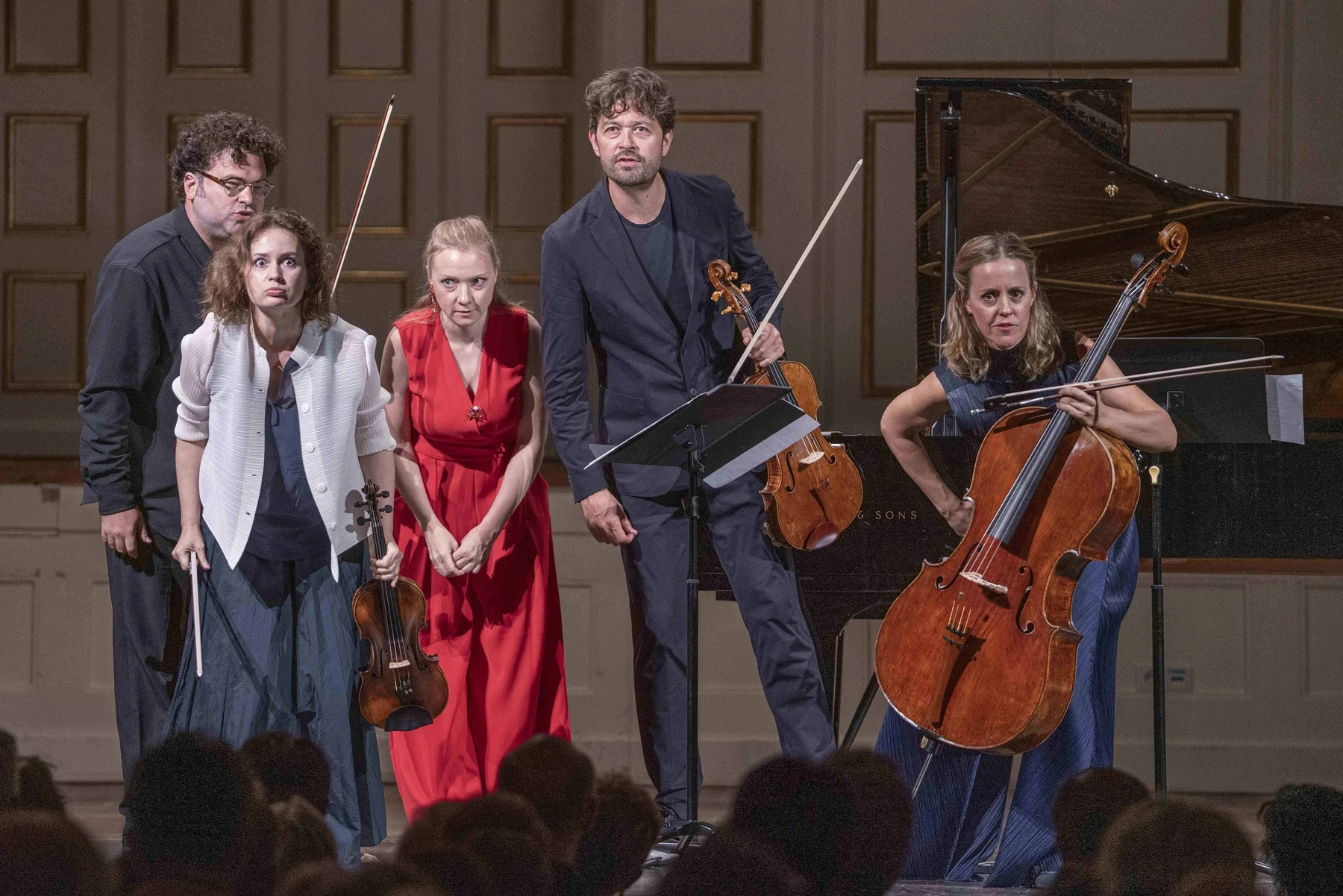
Jonian Ilias Kadesha, Patricia Kopatchinskaja, Olga Pashchenko, Lawrence Power, Sol Gabetta. SF / Marco Borrelli


18.7.26

Teatro Nuovo marks bicentenary of Italian opera in America


Sedona Libero (Donna Elvira), Kevin Spooner (Leporello, right), and Ricardo José Rivera (Don Giovanni), Teatro Nuovo. Photo: Steven Pisano

NEW YORK, N.Y. -- Will Crutchfield, a leading American specialist in bel canto opera, has led the summer festival Teatro Nuovo since 2018, at various venues around New York. This year's programming, more than worth a trip to Manhattan this week, went back to the start of bel canto history, with the 1826 version of Mozart's Don Giovanni, heard Wednesday evening at the Rose Theater on Columbus Circle, home of Jazz at Lincoln Center.

A bit of history is required for that last sentence to make sense. Our country’s first operatic performances go back to the 18th century, with ballad operas in New York and French operas in New Orleans, even before the latter city technically became American. Crutchfield instead is celebrating the 200th anniversary of Italian opera in America, when Lorenzo da Ponte organized a string of performances in New York in 1826. Mozart's one-time librettist had settled in the U.S. in 1805, driven here by his scandals and bankruptcy in Europe. The troupe that presented the first Don Giovanni in America, among other works, was led by Manuel García and featured the Spanish baritone's wife, his son, and his daughter -- she who would become known as the celebrated soprano Maria Malibran. (García's other daughter, later known as Pauline Viardot, was still a child.) Crutchfield has consulted the 1826 version of the libretto, created by da Ponte, and many other sources to reconstruct the opera. His singers studied 19th-century sources to understand how the Italian singers may have added ornamentation and cadenzas to Mozart's score.

The edition is a mixture of the original Prague version with Mozart's Vienna revision, as are most modern performances. Tenor Martin Luther Clark's Ottavio sang "Il mio tesoro" and not "Dalla sua pace," and Sedona Libero's Elvira sang "Mi tradi," but not in the expected place. Noah B. Rogers, who made a pleasingly assertive Masetto, did not get to sing his aria, which was a shame, but keeping the run time just under three hours seemed worth the trade-offs. The most striking change was the shortened Act II Finale, ending almost immediately after Don Giovanni was taken off to hell. The production cut the entire concluding ensemble, as apparently most productions of the opera did until the 20th century. More significant was the adaptation of the recitatives. Conductor Geoffrey Loff led them from what looked like a clavichord, which produced a very faint, tinkling sound. Double-bassist Dane Roberts provided the foundational bass line, while cellist Hilary Metzger created an intriguing harmonic fabric of viol-like double-stop chords and melodic ideas. Along with the rhythmic freedom taken by the singers, it made the recitatives utterly different and of much greater musical interest.

Baritone Ricardo José Rivera, who is familiar to Washington audiences from his turns with Washington Concert Opera in recent years, made a caustic and insistent Don Giovanni. His scornful anger and his tender love-making, the latter heard most effectively in "Deh! viene a la finestra" (senza mandolino but with a velvety violin solo from concertmaster Laura Lutzke, accompanied by pizzicato strings), were both credible. Both leading women suited their roles admirably, with mezzo-soprano Sedona Libero's Donna Elvira erupting in spitfire ornamentation and cadenzas, and soprano Elizabeth Novella reaching an intensity of Donna Anna's grief and anger with interesting rubato choices in her big scenes. As Leporello, Kevin Spooner displayed nimble comic timing, especially in the Catalog Aria, and sure-footed rhythmic skills.

The voice shifting choices also included casting the potent mezzo-soprano of Simona Genga as Zerlina, for sheer volume the most present singer on the stage. The vocal weight affected her characterization as well, giving her a more aggressive touch in the duets with both Don Giovanni and Masetto. The Commendatore of bass-baritone Daniel Mobbs, a veteran singer, impressed more with elegance of tone than raw power. Tenor Martin Luther Clark used the pointed edge of his sound to give Don Ottavio a dignified presence, occasioning none of the usual audience laughs at the character ending up in the friend zone.

Teatro Nuovo is essentially presenting concert opera, with formal wear for costumes and a set consisting of a large projection-bearing screen (images designed by Adam J. Thompson). The orchestra of gut strings and early instruments made mostly pleasing sounds (with the natural horns and trumpets sounding most rustic), although just because the instruments are less powerful than their modern counterparts does not mean they cannot overpower singers, which Loff should have taken greater care to avoid. A skilled ensemble of ten extra musicians provided the on-stage musical performances during the Act I finale, to appropriately confusing effect.

* * *

Crutchfield paired the Mozart with Rossini's Il Turco in Italia, premiered in Milan in 1814 before the Garcías brought it to New York, also in 1826. Singer illness gutted that first American production. Happily no such issues plagued Teatro Nuovo's performance, heard at the Rose Theater on Thursday night, even with the unbreathable air in New York City this week, caused by smoke blowing in from the devastating Canadian wildfires. This is not one of Rossini's most sparkling achievements, and at well over three hours, it could have used serious truncation along the lines of what Crutchfield did with Don Giovanni. One could certainly start by excising the superfluous aria given to Albazar toward the end, as well as one or maybe both of Don Narciso's arias.

Felice Romani's libretto is predictably absurd. Selim, a Turkish prince, visits Naples and falls in love with Donna Fiorilla, who is already managing her intimacies with a husband, the aged Don Geronio, and a lover, the vain and ridiculous Don Narciso. In Naples, somewhat miraculously, is Selim's former slave and lover, Zaida, now disguised as a Roma fortune-teller. (The use of the word gipsy and some Muslim stereotypes might also make the libretto unpalatable to modern listeners.) The most ingenious part of the story is the character of Prosdocimo, a poet who, in a metafictional twist, is creating the entire story as the basis of his latest opera libretto. Many funny jokes at the art form's expense happen along the way. (Crutchfield's program note pointed to a performance of Mozart's Così fan tutte in Milan just before Romani wrote this libretto, which may have influenced the Donna Fiorilla's polyamorous excesses.)

Kresley Figueroa, familiar from her recent and excellent work with Washington National Opera's Cafritz Young Artists program, showed exceptional technique as Donna Fiorilla, lighting up her many arias and ensembles with firecracker virtuosity. While her intonation strayed at times toward the top, Figueroa's physical presence made the character's outrageous vanity and ability to manipulate men more than credible. Of her three love interests, Mattia Venni's Don Geronio, the long-suffering husband, made the best impression, with impeccable comic timing and buffo antics. As the eponymous Turk, Vincent Graña displayed the most potent instrument, easily filling the room with sound, although in terms of comfort on the stage he seemed reserved. Tenor Max Alexander Cook struggled at times in the top range, but he sang the role of Don Narciso with technical ease in melismatic passages. Soprano Sabatina Mauro, as Zaida, and David Freides, as Albazar, both made worthy appearances from the ranks of this year's Resident Artists. Hans Tashjian brought more stage antics than vocal refinement to the poet Prosdocimo, with some charming breaking of the theatrical fourth wall.

Violinist Elisa Citterio, who stood facing the orchestra, led the performance while partially playing as well, with Derrick Goff seated at the clavichord next to her. The results were not as clean in terms of ensemble cohesion, as the establishment of fast tempos did not always happen with clarity. The same division of labor occurred for the recitatives, far fewer in number, as heard in Don Giovanni. The instrumental playing, here and in Don Giovanni, was generally impeccable. The extended horn solo from Nathaniel Udell proved a highlight of the Rossini overture, with the charming alternation of stopped and open notes necessary because of the natural horn's lack of valves.

Second image credit: Mattia Venni (Don Geronio) and Kresley Figueroa (Donna Fiorilla) in Teatro Nuovo's Il Turco in Italia. Photo: Steven Pisano

10.12.25

Critic’s Notebook: A Requiem for Mozart


Also published in Die Presse: Mozarts Requiem wird unterminiert

available at Amazon
W.A.Mozart
Requiem N.Harnoncourt, Concentus Musicus, A.Schoenberg Choir
(DHM, 2004)


US | UK | DE

available at Amazon
W.A.Mozart
Masonic Funeral Music, Symphony in G-mionr KV.550
Stuttgart CO, Dennis-Russell Davies
(ECM, 1996)


US | UK | DE

available at Amazon
G.P.Telemann
Ouvertures à 4 ou 6 (1736) L'Orfeo Barockorchester, Carin van Heerden
(DHM, 2004)


US | UK | DE

The L’Orfeo Barockorchester celebrates Mozart’s Death


Competent music-making and killing dolphins in the name of humanity


L’Orfeo Barockorchester usually rummages delightfully through the more remote corners of the repertoire – as their recordings of symphonies by Josef Mysliveček, Anton Fils, Leopold Mozart, or – hot off the press – Franz Xaver Richter make plain. Not to mention their superb Telemann: whether overtures or (all!) the violin concertos. At a Jeunesse-organized concert in the Musikverein – fittingly on the 234th anniversary of Mozart’s death – the program was, however, fixed squarely on the birthday boy of the afterlife. Mozart’s Masonic Funeral Music in C minor, as the warm-up overture, had a few wobbly entries but pleased with its even, nobly flowing tempo. The attacca transition into the G minor Symphony K. 550 was presumably meant to be just as fluid, but turned out a touch abrupt. No harm done to the piece, though, last heard in the same spot only a week earlier with the VSO. With robust entries, quicksilver vitality, and no kid gloves in sight, it sounded plenty concining, even with the much smaller forces assembled here. Michi Gaigg might have pushed the inner movements forward rather hard – nearly breathlessly – but the finale regained a gratifying swing.

The main course of this Mozart commemoration was to be the Requiem, in its regular Süssmayr completion. Several things conspired against it. Chief among them: the request to switch on small LED candles – handed out before the concert – during the Lacrimosa, for purposes of introspection and “collective contemplation”. Because, apparently, the music alone does not suffice to do the job. Predictably, it all went to sh...pieces. First, half the lights in the hall were switched off. No dimming, no subtlty. Then: rustling, rummaging, rumbling. Finally, the little LED bitties had been pulled out of bags and pockets – but now what? The hall was still too bright, no one quite knew what to do, and everyone stood around sheepishly, holding their gadget. And the Lacrimosa is not, in fact, a piece that lends itself to waving little lights like lighters during the ballad at a rock concert. What remained was disturbance – and plastic waste for the sake of humanity. A fool’s errand of the highest order.

Not that it disrupted anything particularly exquisit (the music itself excepted, of course), since this Requiem sounded undernorished and pale with the smallish ensemble – and not solely because of our modern listening habits or the historically informed performance. There have been plenty HIP takes of the Requiem that have knocked our socks off. Here, too, the music felt driven, as if fatigue was to be avoided at all costs – thereby causing it. The quartet of soloists was at least respectable: Ekaterina Krasko, once warmed up, with a bright soprano; Tamara Obermay’s alto strikingly even and balanced (a stand-out performance); Virgil Hartinger’s tenor alternately lyrical and croaky; and Daniel Okulitch pleasingly dark and secure in the depths, for a bass-baritone. The Salzburg chorus, fielding four voices per part, sang with clear tone and had no trouble making itself heard in the Golden Hall. Most of the dynamic shaping came from them, to the extent there was any. Intelligibility, however, was not their strong suit, depsite the reduced numbers. At least the natural trumpets, in fine form indeed, cut through the texture as if determined to grab you by the scruff of the neck. But for all the everal fine individual moments, the overall impression was one of dull gray, and essentially had evaporated by the time one stepped out of the Musikverein.


6.12.25

Critic’s Notebook: The Vienna Symphony in Mozart and Haydn’s Nelson-Mass w/Andrea Marcon


Also published in Die Presse: Mozart im Musikverein: Wo warst du, Ádám?

available at Amazon
Wolfgang A. Mozart
Symphony Nos. 32, 38, 40,
Josef Krips / Royal Concertgebouw Orchestra
(Philips, 2007)


US | UK | DE

available at Amazon
Joseph Haydn
Nelson Mass
John Eliot Gardiner / Monteverdi Choir, English Baroque Orchestra
(Archiv, 2000)


US | UK | DE

Where Were You, Ádám?


A fine evening of great Viennese Classicism from the Vienna Symphony — but a lingering “what if?”


As long as the unmistakable sounds of Mozart’s “Great” G-minor Symphony still stir childhood memories in us, concert halls will never run empty. Whether that is an optimistic or pessimistic outlook is another matter. In any case, the Golden Hall was respectably full on Saturday night when the Vienna Symphony let this work unfold. A wistfully radiant mood emanated from the penultimate of Wolfgang Amadé’s symphonies — a piece that seems like the very quintessence of the Mozartian spirit. The orchestra supplied a good portion of that, playing the first movement with lively, if not exactly “light” but buoyantly supple, verve. On the podium, replacing the indisposed Ádám Fischer, stood Andrea Marcon, who managed to retain some of that spring in the third and fourth movements’ step as well.

At this point, Fischer — who has a great rapport with the orchestra — was not yet sorely missed. But in the ensuing “Nelson Mass” by Haydn, he decidedly was. The Wiener Singverein was not to blame; they sang with heart and commitment. The solo quartet, on the other hand, though each contributed something solid individually, never really blended. Peter Mauro: solid and unobtrusive, which is not the worst you could say about a tenor. Mezzo Yajie Zhang: milky, with generous vibrato, but somewhat vague and indistinct. Florian Bösch: dark-hued, clear, impeccable. And then Katharina Konradi, who in her opening notes sounded like a car alarm going off — piercing, sharp, impossible to ignore — but had found her voice by the Gloria, singing expressively, if several decibels above the rest, as befits a Bayreuth Woglinde.

The Rieger organ sounded like something out of the Addams Family, and the orchestra — ultimately a touch unfocused in the Agnus Dei — seemed to reduce itself to accompaniment. Thank goodness the music is magnificent.


24.6.25

In Memoriam: Listening to Alfred Brendel


Most people listening to classical music today have, to a greater or lesser degree, been musically socialized with the performances of Alfred Brendel. He was a fixed star on the international scene when it came to Beethoven, Mozart, Schubert and a few other of his favorite composers. His dry wit, usually gentle, rarely acerbic, poignancy, his unapologetic classicism made him an unlikely, charming icon. He has passed away on Tuesday, June 17th, 2025 at his home in London.


I was on the steps outside the Musikverein when I read the news that Alfred Brendel had passed away in London, at the age of 94. This was the place he had given his final recital of his truly final farewell tour and this was the town where he lived when his career got under way in 1950 after first successes in Graz and before he permanently settled in the UK in 1971.

His success was a stellar one; born in the 1930s, Brendel was of a time that came a generation-plus after the keyboard titans à la Arthur Schnabel (1882), Wilhelm Backhaus (1884), Edwin Fischer (1886), Arthur Rubinstein (1887), Wilhelm Kempff (1895), Vladimir Horowitz, Rudolf Serkin and Claudio Arrau (all 1903). He was thus a “modern” artist, to anyone born before 1980, and, crucially, born into the stereo age. This is relevant, because as the exclusive go-to pianist of one of the major labels – Philips (now Decca) – for the heydays of the late analog and digital age, Brendel became a superstar of – and to some extent also because of – the recorded age. In the 100-volume, 200-CD “Great Pianists Of The 20th Century” project of Tom Deacon’s – to which Brendel was an advisor – Brendel is one of only seven pianists (Arrau, Gilels, Horowitz, Kempff, Richter & Rubinstein being the others) with three volumes dedicated to his art. If it had to be the classical repertoire – Mozart, Schubert, Beethoven – Brendel was there for you. Within that realm – and a little beyond – he recorded most of what there was to be recorded and much of that twice, some, like the Beethoven Sonatas, even thrice or more: In the 60s for Vox, in the 70s for Philips, analog, and for Philips again in the 90s, digitally. And of select works Brendel, who exerted quite a bit of control over what would get released and what would not, opted to have live accounts published, which he professedly preferred over his studio accounts. With the different releases of each of these versions (and most of them on Philips or Decca, still), it can get a bit messy trying to figure out which the analog second recording of D.960 or the digital remake of the Moonlight Sonata is or isn't. (But I am here to help.)

Alfred Brendel on Ionarts:

In Performance

His Soft Touch, Powerfully Moving, 02/09/2006 (jfl)

Closing the Lid: Alfred Brendel, 19/03/2008 (Charles)

A Conversation with Alfred Brendel, 20/03/2008 (Michael Lodico)

Alfred Brendel Speaks, 11/18/2000 (Charles)


On Record:

Best Recordings of 2004 (#8), 12/16/2004 (jfl)

From Goerne to His Distant Beloved, 07/18/2005 (jfl)

Brendel and Mozart, 02/06/2006 (Charles)

Brendel’s Choice, 02/06/2006 (jfl)

Best Recordings of 2009 (#3), 12/14/2009 (jfl)
In Austria, his success shadowed that of fellow pianists Paul Badura-Skoda (1927), who, to some degree, escaped into the historical performance niche, Jörg Demus (1928), who found his main fame in Lied accompaniment, Ingrid Haebler (1929), who recorded much the same repertoire but whose star waned earlier, and Friedrich Gulda (1930), who became the eccentric: Considered by people in the know as a superior pianist but with a far smaller reach, ultimately. Internationally – specifically in America – there were contemporaries Byron Janis (1928), Glenn Gould (1932), Van Cliburn (1934), Leon Fleisher (1928), Richard Goode (1943), most of whom had their careers cut prematurely short; elsewhere, pianists like Ivan Moravec (1930) were stuck behind the iron curtain. As a result, the name “Alfred Brendel” and the maroon bar of the Philips label’s recordings became as indicative of a musically interested household as Wilhelm Kempff on the Yellow Label had been, a few decades earlier. Brendel’s association with the “Complete Mozart Edition” only furthered this omnipresence.

This kind of prominence brought about the invariable backlash in the form of criticism – the thrust of which, generally, was that Brendel was boring. This accusation might have had its understandable roots in Brendel’s style, which relied on subtlety and wit, level-headedness and sincerity, articulation, intelligence, and purpose, but never flash. The grand romantic gesture, even if it had been within his reach, was not temperamentally his. Even Liszt (where he did show the kind of chops that some critics might occasionally have forgotten he had) was not showy with Brendel.

It also showed in the repertoire he chose to play and even more so the repertoire he chose not to play. He left out composers most pianists couldn’t envisage making a career without: Chopin was (largely) missing; hardly, if any, Debussy or Ravel; no Rachmaninoff was ever in his sights, nor Tchaikovsky. Instead, he dropped morsels of

20.6.25

Critic’s Notebook: Perfection in Mozart Lies not in the Fingers, but the Heart. Alfred Brendel’s Final Concert in Munich


While preparing ionarts' appreciation of Alfred Brendel (and newly indexing the computer), I found a review of Alfred Brendel's last concert in Munich on my hard drive. He performed with the Munich Philharmonic und Christian Thielemann at the Gasteig's Philharmonic Hall, on November 6th, 2008


Brendel in the Mozart C minor Piano Concerto with Mackerras

W.A.Mozart
Piano Concertos 20 & 24
C.Mackerras, Scottish CO
Decca (2007)


US | UK | DE

Brendel in the Mozart C minor Piano Concerto with Marriner

W.A.Mozart
Piano Concertos 20 & 24
N.Marriner, ASMF
Philips (199?)


US | UK | DE

Mozart: Piano Concerto in c, K491, Beethoven: Coriolan Overture op.62, Symphony No.6 “Pastorale” op.68


Twelve more towns will hear the pianism of Alfred Brendel before the near-octogenarian retires after 60 years of concertizing around the world. Munich was thirteenth to last, and he stopped by with Mozart’s C minor Piano Concerto, supported by Christian Thielemann and the Munich Philharmonic. But before Brendel went on the stage to play his farewell, the orchestra nearly stole the show with a magnificent, indeed brilliant Beethoven Coriolan Overture.

With an opening more explosive than clean (but so much of the former that the privation of the latter did not distract), this was gripping stuff with intense, soft, hushed passages and merciless, jolting, violent bursts; nicely driven and propulsive in everything between. Thielemann, conducting from memory as he does with all his core repertoire, commanded a beautiful sound from his players – making Beethoven, as ever, an occasion worth looking forward to even for the most jaded or experienced concert-goer.

Beethoven’s Sixth Symphony, the Pastorale, broad and flexible, had many of these qualities, but not as obviously so. Slightly understated and légère in the first movement, very flexible with its quickening and slowing tempos, and featuring a horrifying storm worthy of a “Flying Dutchman” performance, it was an attractive-enough proposition, but the true strengths of this conductor/orchestra combination did not emerge as obviously here as in the overture or other repertoire.

The principle of Thielemann conducting Mozart is, as of yet, better than the actual result – but I suspect he might find his unique, grand way with it before long. In any case, the orchestra was relegated to the background in the C minor Concerto, where Alfred Brendel was the focus of everybody’s attention. His opening notes were halting, as if acknowledging that these would be some of his last sounds emitted from the piano in Germany. But even if this was good-bye, ‘C minor’ was not sad with the level-headed, unsentimental Brendel – it was serious and collected.

The separation of notes in the cadenza made the ears perk, and his skilled simplicity, his serious ease and dry wit (well hidden) made the ears smile. Perfection in Mozart lies not in the fingers, but the heart; few pianists have more of the latter for Mozart than Brendel. Because of who he is, how he plays, and what we know him to be, his whole persona makes up the impression in concert, not just the naked notes. Perhaps that’s one reason why this listener finds – found – him a good deal more appealing live than on record. How good to have had one more opportunity to take him in at his best, then.


15.6.25

Critic’s Notebook: Haydn as the Highlight with the Concentus Musicus


Also published in Die Presse: Concentus Musicus im Musikverein: So wird Haydn zur großen Unterhaltung


available at Amazon
W.A.Mozart,
Sinfonia Concertante
G.Kremer/K.Kashkashian N.Harnoncourt / WPh
DG


available at Amazon
J.Haydn,
Symphonies No.103/104
N.Harnoncourt / RCO
Teldec


Splendid entertainment courtesy of the "Drumroll" Symphony. The double concerto? Less so.


A proper classical evening at the Musikverein: Mozart overture (The Magic Flute), Mozart concerto (Sinfonia Concertante), and a Haydn symphony ("Drumroll") — performed by the Concentus Musicus in the sunlit Golden Hall of the Musikverein. A fine concert that even a — to put it mildly — rather dicey performance of Mozart’s double concerto couldn’t derail.

It’s a tricky piece, the Sinfonia Concertante. Superficially charming and “pleasant” — but don’t be fooled. It demands vigilance. The viola part in particular (especially if, as was commendably done here, one adheres to the original “scordatura” tuning — up a half-step) is rife with pitfalls. Add to that the fact that the Sinfonia Concertante is not exactly a box-office draw, so you rarely get actual soloists (i.e. the expensive kind). Instead, it becomes an occasion for the section leaders to step out of the orchestral shadow every once in a while.

More often than not, that goes sideways. And so it did here: Cohesion among the soloists, intonation, even the basic tonal quality — all were wanting. The first movement, in particular, was limp and mewling; the third showed marked improvement, but not enough to erase what came before. No matter: the audience, especially and understandably fond of the longtime concertmaster for his decades of musical trailblazing, responded with cheers that masked the crooked playing.

Before that, and fittingly rare in this setting, came the Magic Flute overture: lively strings and spirited winds, ably held together by the deputy concertmaster in a performance that sounded fresh and spontaneous.

And then there was Haydn. Symphony No. 103 — unmistakably the highlight of the evening. As it should be, and as it was. Granted, it remains an unfortunate quirk of Vienna — the classical music city par excellence — that Haydn must be sought-and-found in period-instrument subscription series rather than in the main symphonic concerts (Wilhelm Sinkovicz quite rightly lamented this recently in Die Presse: “Die Musikstadt Wien verliert nach und nach ihre Klassiker”). Still, one takes what one can get — especially when it's done as well as here: Snappy and incisive in the first movement, bold accents confidently absorbed. The slow second flowed with life (though marred by an extended solo passage for the erstwhile soloist, now returned to his concertmaster post). The minuet was cheeky, and the finale pulsed with a driving, unhurried, and delightfully agitated energy — culminating in a result both thrilling and gloriously tumultuous.

This is Haydn as high entertainment.


15.10.24

Kritikers Notizbuch: Das Wiener Kammerorchester unter Jan Willem de Vriend Erfreut

available at Amazon
J.C.Bach,
The Symphonies
A.Hoalstead, The Hanover Band
CPO


available at Amazon
W.A.Mozart,
Piano Cto. No.15 K.450
V.Ashkenazy, Philharmonia
Decca


available at Amazon
F.Schubert,
Symphony No.5
D.Barenboim, StaKap Berlin
Teldec/Warner


Klassische Morgengabe

Das Wiener Kammerorchester überzeugt unter Jan Willem de Vriend auch zu früher Stunde im Mozart Saal


Halb-Elf Uhr morgens ist der natürliche Feind des Orchestermusikers; mehr noch, als der des Musikkritikers. Aber das Wiener Kammerorchester spielte im Konzerthaus das Zwillingskonzert zu dem so großartigen Konzert vom 23. September (siehe Rezension in der Presse): Die gleichen Komponisten, die gleichen Gattungen, andere Werke. Johann Christian Bach: Sinfonie g-Moll, op .6/6. Mozart: B-Dur Klavierkonzert K 450. Schubert: Sinfonie No. 5. Konnte dieses hohe Niveau unter dem neuen Chef Jan Willem de Vriend auch ante meridiem wiederholt werden? Kurz: Ja! Spannung von der allerersten Note und im Mozart Saal noch direkter erfahrbar als im Großen. Da knarzt das Blech gleich nochmal so sehr, das Fagott brummt herrlich und zwei engagierte Kontrabässe füllen den Raum locker mit peppigen, antreibenden Noten. Kaum Spannungsabfall im Andante mit aufheulenden Geigen und packend „furioso“ im Allegro molto finale.

Ohne Sperenzchen spielte Jasminka Stancul, mit sympathisch-nervöser Energie, das Mozart Konzert (mit bemerkenswerten Beiträgen von der Flöte und den Oboen) und wurde von freundlich-familiären Publikum wärmstens beklatscht. Ob es die zum Ritual sklerotisierte Zugabe gebraucht hätte, sei dahingestellt.

Dann Schuberts Fünfte. Über Vernachlässigung kann sich die Sinfonie nicht beschweren; alleine im Konzerthaus ist sie seit 1913 öfters aufgeführt worden, als ihr vermeintliches Vorbild, Mozarts „große“ g-Moll Sinfonie die erst am Vorabend vom Bremer Kammerorchester gegeben wurde. Auch diese zeitliche Nähe macht die Beziehung allerdings – außer im letzten Satz – kaum deutlicher, denn wer die Fünfte als „Schubert“ kennen und lieben gelernt hat und nicht als epigonalen Mozart-Light, der hört ein originelles, durchweg entzückendes, zu Recht populäres Werk: Die mit Abstand lebendigste seiner frühen Sinfonien. Aber auch eine schwierige, denn sie soll einerseits sonnig-lyrisch klingen, andererseits heiter-lebendig. Etwas kantig im Holz und mit kurzen Phrasen und wenig warmem Streicherklang ging es hier zuweilen hektisch voran, mit wenig Sonne, aber lieber lebendig und bewölkt als geschmeidig und langweilig. Wenn das Kritik sein soll, zeigt dass nur, wie hoch die Erwartungen nach eineinhalb superben Konzerten unter de Vriend schon sind, nach eineinhalb Jahrzehnten Enttäuschung. Nein, in dieser Verfassung kann man zum Kammerorchester schon nach der Frühmesse gehen und musikalisch Hocherfreuliches erwarten.