CD Reviews | CTD (Briefly Noted) | JFL (Dip Your Ears) | DVD Reviews
Showing posts with label jfl. Show all posts

15.9.26

Notes from the 2026 Salzburg Festival ( 3 )
Sol Gabetta & Kristian Bezuidenhout

Salzburg Festival • Soloists Concert • Sol Gabetta & Kristian Bezuidenhout


Also published in Die Presse: Salzburg: Sol Gabetta kredenzt hübsche Violoncello-Zuckerl


available at Amazon
Brahms / Mendelssohn
Cello Sonatas
♥ Starker/Sebők ♥
Mercury, 1996

US | UK | DE

Gabetta and Bezuidenhout: Well-behaved German Romanticism

Pretty Cello Bonbons and a Trio for Piano, Cello and Hearing Aid


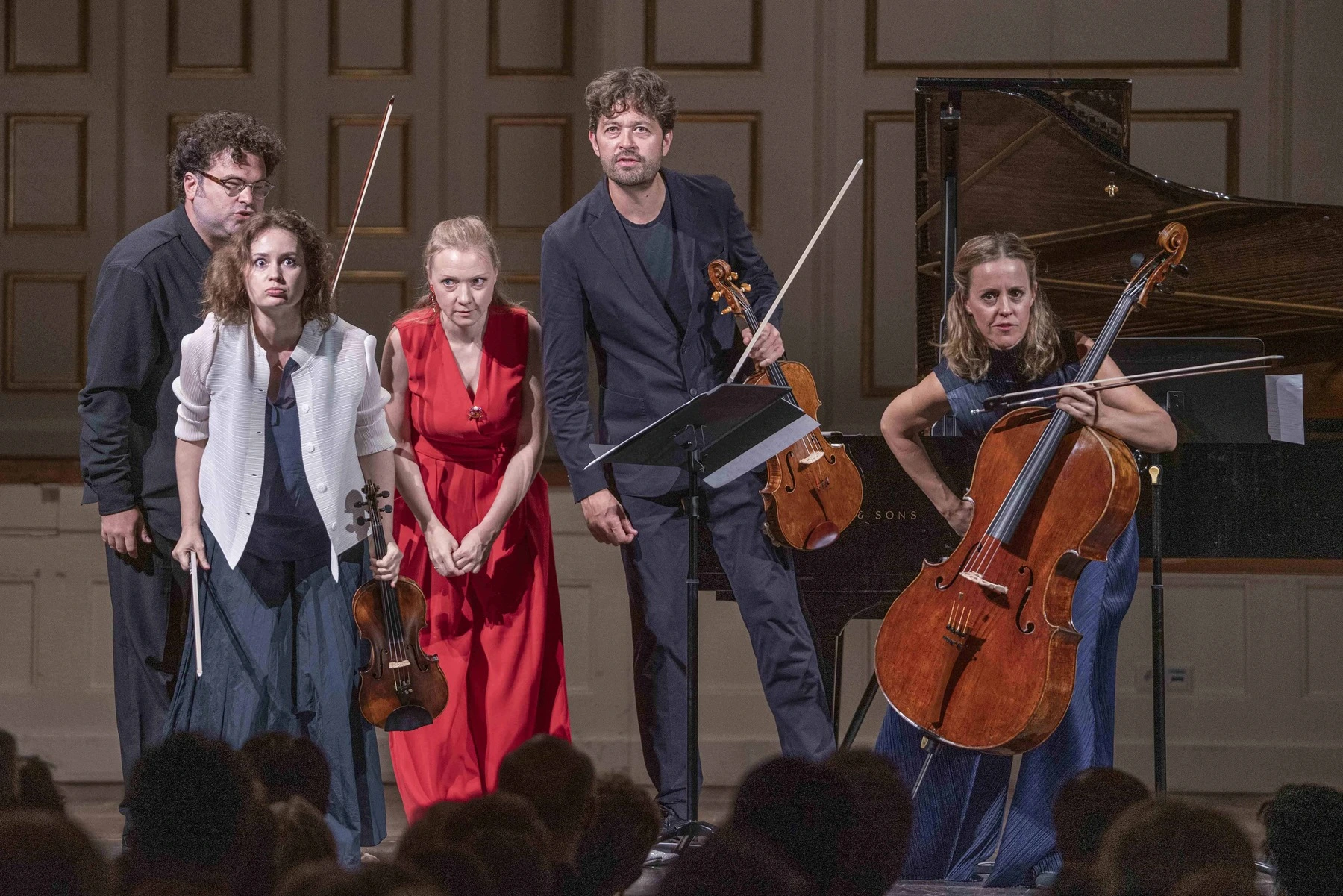
Tuesday at the Mozarteum she was still part of Patricia Kopatchinskaja’s quintet, on Wednesday she was back as the headliner: Sol Gabetta – with fortepianist extraordinaire Kristian Bezuidenhout, in the Haus für Mozart. Schumann’s Fantasiestücke, sonatas by Brahms (No. 1) and Mendelssohn (No. 2), garnished with arrangements for cello and piano of various smaller melodic confections. The two concerts could scarcely have been more different. Gabetta fits in beautifully when Kopatchinskaja sets the agenda – wild, unruly, tussled. When the Argentine star is in charge herself, different principles apply. Here she plays with lyrical assurance, always nice-sounding, dutifully beautiful to the point of cooing. In the golden depths of her cello, she is tonally at home; as the register rises, the tone seems to lose color. Somehow Bezuidenhout went along with all of this and appeared to recede into the background.

This exquisite music-making – take Gabetta’s honeyed sweetness in the slow Allegro non troppo of the Brahms Sonata, and Bezuidenhout's sparkling-delicate accompaniment – is all a pleasure and music-making at the highest level. Objectively there is nothing to fault in the trim attack with which Gabetta draws her notes from the cello. Nor in her intonation or phrasing. And yet… Perhaps it was the vast acoustic of the Haus für Mozart itself, which resists the intimacy her playing needs – swallowing any and all of the energy that didn’t come directly from the chosen tempos. Fast tempos, however, had to wait until the concluding Mendelssohn Sonata. For everything before it – entirely in keeping with Johannes “ma non troppo” Brahms’s own prescription – was awfully tasteful and measured.

And yes: as if something had been building up, the Mendelssohn was, if not exactly exuberant, at least somewhat uberant. The applause after the first movement felt natural, necessary, and was considerably more welcome than awkward embarrassed coughing would have been. Then, at the close, a rogue hearing aid joined the ensemble persistently – at times louder than the cello. Gabetta was not notably displeased. Friction arrived at last. She threw herself into the notes with good deal of bite and fury: The best three minutes of the evening.

Sol Gabetta (Cello), Kristian Bezuidenhout (Piano) © SF/Marco Borrelli


13.9.26

Notes from the 2026 Salzburg Festival ( 2 )
Kopatchinskaja, Friends, and György Kurtág

Salzburg Festival • Chamber Music • Hommage à Kurtág


Also published in Die Presse: Kopatchinskaja in Salzburg: Schnurren und Kratzen für Kurtág & Co.


available at Amazon
Kurtág / Schumann
Hommage à R. Sch et al Kashkashian, Levin, Brunner
ECM, 2006

US | UK | DE

available at Amazon
György Kurtág
Játékok (selection) Gábor Csalog, M.& G. Kurtág
BMC Records, 2006

US | UK | DE

Playing with Music

Music as lived joy: Kopatchinskaja brings Kurtág to Salzburg — and it's simply great entertainment


Patricia Kopatchinskaja was made for playing the music of György Kurtág — or vice versa. However that may be, in her chamber music homage to the hundred-year-old composer at the Salzburg Festival, she demonstrated how much is already won — not only in contemporary music — when a violinist refuses to insist on playing just beautifully, and instead interprets with the whole body, from the curls down to the tips of her toes.

Fiddling, stomping, plucking, she worked her way through Kurtág's profound scrawlings from „Zeichen, Spiele und Botschaften" and the „Játékok" collections with her musical partners. Pianist Olga Pashchenko had already impressed in the opening second Bartók Rhapsody for violin and piano — both in the restraint of her part, palying along as if parallel to the violin, and in the suddenness with which she lunged forward, like a hungry moray-eel, whenever Bartók thrusts the piano into the spotlight. In the Kurtág she drew out the abstract tenderness of „Hommage à Márta," just as Kopatchinskaja shaped „…féerie d'automne…" as a pianissimo exhalation — light as on butterfly-wings. Elsewhere Kopatchinskaja plunged into her instrument — alone or alongside Pashchenko, violinist Jonia Ilias Kadesha, the lusciously toned Lawrence Power on viola, and/or Sol Gabetta on cello — like a tomcat in a mating fight, driving it through Kurtág's fragile, skewed, compressed music. What strikes one above all is how unpretentiously modern Kurtág writes. What would sound simply absurd from other, self-important composers is here disarming.

Bartók's „Bagpipe" Duo from the „44 Duos" for two violins was staged as a small, spontaneous theatrical piece for all six musicians, with the musicians eventually exiting until only Reto Bieri (clarinet), Kopatchinskaja and Pashchenko remained for the wild „Contrasts" for violin, clarinet and piano — also Bartók — which, living up to its name, was carried forward wild and unleashed, then whispering and murmured.

Mozart's Clarinet Quintet K. 581 waited as a reward in the second half — though the audience was already so enthused by the Kurtág and Bartók that no lure would have been needed. Then again, one simply doesn't say no to a slow movement that sublime — and so they listened to the fiveseome, gathered around Bieri and his modern basset clarinet, in these four movements of pure pleasure: Sensitive, soft and supple, genuine ego-free chamber music atmosphere par excellance. Where Bieri had — deliberately — hissed and spat air in the excitable Bartók, here he was milk and honey manifest in the form of a clarinet, bewitchingly quiet and breathless in the slow movement. But „contrasts" was the watchword here too — the Quintet went off in the Menuetto as if stung by hornet: Kopatchinskaja does not let such opportunities pass to go for broke instead of playing nice. (That's rather Gabetta's game, although she went along with the general gist quite nicely here.) The Variations finale was handled with generous latitude — entirely in keeping with so playful an ensemble.

Jonian Ilias Kadesha, Patricia Kopatchinskaja, Olga Pashchenko, Lawrence Power, Sol Gabetta. SF / Marco Borrelli


23.8.26

Critic’s Notebook: Andrea Bocelli in Vienna


Also reviewed for Die Presse: Was passiert, wenn sich ein Klassikkritiker zu Andrea Bocelli ins Stadion verirrt?

available at Amazon
Andrea Bocelli
Duets by Andrea Bocelli
- 30th Anniversary

Brightman, Sheeran, Twain, Stefani, Piaf, Aguilera et al.
(Decca, 2025)

US | UK | DE

available at Amazon
Andrea Bocelli
Romanza
30th Anniversary Edition

(Verve, 2026)

US | UK | DE

Andrea Bocelli, or: Who's Afraid of Popularity?

The Italian pop star fills the Ernst Happel Stadium and raises questions nobody there is asking.

Finding oneself as a classical music critic in a stadium sets off the alarm bells. For one thing, it is not exactly the ideal venue for conveying the nuances of a classical art form in any detail. Worse: what is happening here appears to be something Popular — the natural enemy of the cultural snob. And indeed, Andrea Bocelli — for three decades an indispensable acoustic ingredient of every „Italian" restaurant — had come to Vienna, drawing an estimated 25,000 fans to cheer their Schlager star through his „Romanza 30th Anniversary Tour."

The controversy around the blind-from-childhood Bocelli exists really only because his popularity has swept him into the rarified lane of classical music, where he is inevitably measured by the wrong criteria — as are almost all Pop-Classical Crossover-acts: Richard Clayderman, André Rieu, David Garrett, Il Divo, Katherine Jenkins. For anyone coming from the classical world, these figures must seem bafflingly, inexplicably popular. Not because high culture cannot, inherently, abide popularity — though that is, in fact, high culture's inherent contradiction: it wishes to be widely loved while remaining exclusive. No: the primary irritant is that these artists circumvent established standards of quality; ignore hallowed rules. By objective classical criteria, Bocelli is simply not a very good... OK: rubbish singer — however many times (three) he may have performed alongside Pavarotti. One need not listen to his appearance on the Verdi Requiem recording (Gergiev, Decca) to notice this... though it would help.

What so vexes the snob when Bocelli croons his way through „La donna è mobile," backed by an unnamed orchestra projecting a solid wall of amplified sound that taxed the eardrums? It is not popularity per se. It is rather that something here creates the impression of being what it is not — and instead of being unmasked, is celebrated. “That's not the real thing”, one wants to call out, gesticulating wildly. It is — to paraphrase Jean Baudrillard — at best a symbol, at worst one without an original. As dyed carp is not wild salmon, as Nescafé only superficially resembles real coffee, and as 50 Shades of Grey has 514 pages without thereby constituting literature. Bocelli et al. is at best the illusion of high culture, packaged so harmlessly and agreeably that no one need stretch to partake of it.

But here is the good news: the market sorts itself out. The estimated number of devoted opera fans in the Ernst Happel Stadium: two. The rest were enjoying themselves. Anyone happy in attendance here would not have been secretly happier at Tristan und Isolde or at a Christian Gerhaher recital. No poor soul, somehow under the misapprehension that this was „classical music", wandered into the stadium and now needs rescuing, or subsequent informing that Bocelli has no breath technique, a limited range, sounds small and strained at both ends of it and watery in between. But: One was able to simply enjoy a ravishingly schmaltzy pop concert, with morsels from the classical repertoire thrown in to tick the boxes: a little from „The Barber of Seville." „Au fond du temple saint" (Bizet). „O Fortuna" (Orff). Rodrigo and Morricone.

Where a baritone was needed, Roberto De Candia was on hand; where a high voice, soprano/DJ/life coach Cristina Păsăroiu; where a fiddle, Viennese crossover violinist Rusanda Panfili. And where a pop singer, Andrea Lykke for Stand Up" and Vivo per lei. A pity these performers went unacknowledged — after all, they were responsible for more than half the programme and more than a couple highlights. Bocelli fils Matteo („Fall on Me") also got his duet, and he was very much mentioned. Bel nepotismo. Finally, what everyone had been waiting for: „Time To Say Goodbye" — and as a parting shot, a charmingly askew „Nessun dorma" that rang out across the Prater.


2.7.26

Critic’s Notebook: Pavel Haas Quartet Makes the Ears Dance in an All-Czech Program


Also reviewed for Die Presse: Tiefenbeglückender Ohrentanz, gänzlich tschechisch: Bekanntes Ungehörtes, unerhört Beliebtes: Das Pavel Haas Quartet im Musikverein, mit einem Abend zum Schwärmen

available at Amazon
Bohuslav Martinů
String Quartets 2, 3, 5, 7 Pavel Haas Quartet
(Supraphon, 2025)

US | UK | DE

available at Amazon
Bedrich Smetana
The String Quartets Pavel Haas Quartet
(Supraphon, 2015)

US | UK | DE

Raving in Czech

The Known-unheard and outrageously popular: the Pavel Haas Quartet and an evening of chamber music to make your ears swoon

What a program — on paper alone. Who? One of the most celebrated string quartets of our time, Prague's Pavel Haas Quartet. Where? The Muskverein's Brahms-Saal. What? An entirely Czech program, running from the sole string quartet of the short-lived Vítězslava Kaprálová (1935) through Bohuslav Martinů's Fifth Quartet (1938) to that most reliable of pleasures, Antonín Dvořák's Fourteenth and last quartet, in A-flat major, op. 105 (1895). Kaprálová's music, barely two dozen works in total, has been rediscovered in spasmodically over the decades, tenaciously if intermittently — but one does not actually get to hear it very often. (Or else it's hidden in well-meaning but generally dismal "look: Women composers!" programs that are such an ironic, unintended bane to composers that happen to have been women.) This is a substantial three-movement quartet of some twenty minutes, written by a twenty-year-old nearing the end of her studies in Brno: rhythmic, mobile, tonal, but facing boldly forward — unsurprisingly in the musical orbit of Schulhoff, Pavel Haas, and Martinů. Certain works carry a luminous seriousness and quality that shimmers through them; Kaprálová's op.8 is one of those.

The Fifth Quartet of Martinů was not chosen as a companion piece, merely because it's a sensationally effective work at the intersection of Bartók, Shostakovich, and Janáček, and (like all of Martinů's quartets, which the Pavel Haas Quartet is currently recording for Supraphon) deserves to be far better known. Kaprálová is also the direct inspiration for the piece: she was Martinů's student in Paris for three years — and thereafter, in all likelihood, his lover. Think of it as Martinů's equivalent of Janáček's "Intimate Letters" — quartet. The work rocks from the opening bar with an irresistibility that seems to want to carry the momentum of Kaprálová's dynamic finale straight into itself. The relentless climaxes of the partially spooky Adagio, each time the Pavel Haas Quartet allowed them to relax, offered a delicious shiver of complex lyricism. As fragile as the movement dissolves, so wild does the Allegro vivo return — with maximum, ferocious forward thrust. Feet and heads bobbed in the audience, pretty much universally. The viola-throaty tone of the first violin in the finale's Lento feigned relaxation before the irresistible surge of the Allegro that followed.

Throughout all, one didn't actually pay all that much attention to the quartet's playing as such — because it seems to function by itself, entirely naturally: what one hears is not interpretation but music. Here, as in the Dvořák — whose fugal opening gradually yields to the composer's characteristic melodic abundance — it was the tonal richness of the ensemble that was so arresting. This isn't some pretty-playing style they indulge in, but a style that adapts, like an octopus, to its musical environment as needed: pallid, wild, sweet, spiky — irresistible. One could look elsewhere for finer individualists: the second violin in the Quatuor Ébène, the viola in the Belcea Quartet, the Cuarteto Casals' cello. But anyone who can make your ears dance the way this quartet did in the Dvořák is offering something singular — and seems to make this argument: one good string quartet evening is worth ten orchestral concerts, so sustainably and deeply satisfying are these hours.


20.5.26

#ClassicalDiscoveries: The Podcast. Episode 022 - Engelbert Humperdinck: Miraculous and Ecclesiastic Adventures


Welcome to #ClassicalDiscoveries. Here is a little introduction to who we are and what we would like to achive at the first (or, in a nod to Bruckner, "double-zeroëth" episode). Your comments, criticism, and suggestions remain most welcome, of whatever nature they may be. Comments on YouTube directly are even more appreciated, as they will help the visibility and reach of the podcast - and because they make us feel like what we are doing is not completely in vain.

Now here’s Episode 022, on "Mr. Hansel & Gretel", Engelbert Humperdinck, but in works you might not ever have heard of. (Arnold George Dorsey-jokes included!)


When you hear 'Engelbert Humperdinck', you'll invariably either think of the King of Romance's hit ballad "Release Me" (in which case you've got the wrong Humperdinck, as far as we are concerned) or of the King of Romantic Children's Opera's greatest hit "Hansel & Gretel". Well, in their latest podcast, Jens and Joe will try to re-wire your brain so that you will associate the name with mystical blue birds and nuns on the run. Romance, however, remains the name of the (musical) game all the same.

10.5.26

Critic’s Notebook: New Production of the Rosenkavalier in Graz


Also reviewed for Die Presse: „Rosenkavalier“ in Graz: Wo die Frauen hauen und stechen

available at Amazon
Richard Strauss
Der Rosenkavalier C.Kleiber, Bavarian State Opera
Watson, Fassbaender Popp, Ridderbusch
(Orfeo, 2008)

US | UK | DE

available at Amazon
Richard Strauss
Der Rosenkavalier C.Thielemann, Munich Phil
Fleming, Koch, Damrau, Hawlata
(DVD, Decca, 2011)

US | UK | DE

Marschallin across Generations: New Rosenkavalier in Graz

Philipp M. Krenn’s new Rosenkavalier in Graz is a production brimming with ideas, gently nudged toward the present. In the way it succeeds at explaining itself, it comes startlingly close to a directorial ideal.

Strauss and Hofmannsthal are always about human relationships. In the new Graz Rosenkavalier that’s literally true, so liberally do director Philipp M. Krenn and set designer Momme Hinrichs deploy the revolving stage. We move seamlessly from foyer to antechamber, to servants’ quarters, to billiard room, bedroom, and kitchen. This way, Krenn manages to stage the Marschallin and Octavian’s early-morning dalliance during the overture already, while revealing – in an Upstairs/Downstairs type scenario – how the staff sorts laundry, stocks shelves, listens at doors, whispers and gossips. There are fewer secrets in this household than you’d think. Small wonder that the Marschallin (Polina Pastirchak) and Octavian (Anna Brull) are so surprisingly indiscreet.

Hinrichs’ sets and Eva Maria Dessecker’s costumes span a parallel palette from early 20th century (the aristocratic society, dueling type student fraternities) through the 1970s (replete with Bubble Chair and large-floral wallpaper) to a subtle present-day — expressed, among other things, in the kitchen where the Marschallin makes her morning coffee and where Ochs and the ever-present Leopold (Arthur Haas) brazenly help themselves to anything in sight. Whether the “carnal offspring”, as Leopold is referred to in the libretto, is Ochs’ illegitimate son or on-and-off lover... with this sexually insatiable opportunist Ochs, anything is possible.

Apropos. Wilfried Zelinka’s Ochs was magnificent: He nails the greasy vulgarian who thinks far too highly – and all the more imperturbably – of himself with fearsome ease. Someone for whom women are mainly status symbol; sunglasses casually cocked in his hair that’s a good deal longer than advisable and thinner than desired, dress shirt stretched across the paunch, lordly manner, and shoes without socks. Whether petty nobility or Mittelstand nouveau-riche – if you’ve been to Austria long enough, you know the type. That his lowest notes weren’t quite there was irrelevant amid such a vivid display of character.

In Act II Zelinka also becomes a hybrid of Ochs and the Feldmarschall, who still rightly rankles the sensitives of Sophie, even as he’s a bit more dashing, kept keep in check by his manners where his morals wouldn’t, and displaying the debonair cool of a man not used to being flustered. This whole act is the coup de théâtre Krenn has been preparing since Act I, when a Super-8-movie flashback takes us to the Marschallin’s own wedding. At the very end of the act, she finds herself face to face with her younger self in the bridal gown: This is simultaneously the young Maria Theres’ and Sophie (Tetiana Miyus). It’s a passing-of-the-torch moment. And this is also how the second act, throughout which the Marschallin is silently present – begins. She is there to support Sophie and, by extension, herself – in her struggle for marital self-determination. Sophie’s marriage is actually the memory of her own. The Marschallin’s fate (none-too-bad, if sprinkled with regrets) was not hers to decide; Sophie’s, at least, should be. It is Sophie, too, who settles the matter of the Ochs-Octavian duel when she takes a carving knife to Ochs’ calf, to make sure worse does not befall young, out-fenced Octavian.

You can like this sort of thing or not (at the premiere it was unabated applause for the directorial team), but for Krenn to pull off this act of doubling – past and present; amending the past to cure the future – in a way that explains itself with such self-evidence, brings the production startlingly close to a directorial ideal.

The orchestra under Vassilis Christopoulos supported the proceedings well, often superb; the winds especially; the violins at times rather less so. It certainly wouldn’t have hurt throughout most of the performance, if the orchestra could have played a touch more quietly throughout. The acting meanwhile was superb: the deeply moving, full-voiced Marschallin, the nuanced Ochs, the adorable, feisty Sophie. Even the torn-and-striving Octavian hardly lagged behind, and the cast as a whole delivered very decent (and better) vocal performances without, admittedly, threatening to redefine the standards for excellence. Noteworthy, however, among smaller roles were Leitmetzerin Corina Koller and Neira Muhič’s Annina. The social-media-addicted Italian singer (Iurie Ciobanu), meanwhile, had a small message for young Mr. Chalamet ready: He took selfies with a “#WECARE, Timothée” sign.

At the close, the Feldmarschall wanders past Sophie and Octavian’s embrace and finds Faninal’s “Sind halt aso, die jungen Leut’!” put in his mouth. When he watches with rather too much interest, his wife gives him a tender-but-firm tap – “Come along now, darling” – and leads him away, back to their reality.


18.4.26

Critic’s Notebook: Olivier Latry and Shin-Young Lee


available at Amazon
Olivier Latry & Shin-Young Lee,
Stravinsky, Heller, Alain
Trois danses
(BNL, 2013)

US | UK | DE

available at Amazon
Olivier Latry,
Transcriptions
Midnight at Notre-Dame
(DG SACD, 2004)

US | UK | DE

Olivier Latry and Shin-Young Lee Dance the Night Away

Organ Dances at the Konzerthaus's Rieger instrument

While early music is otherwise running riot at the Konzerthaus – it is, after all, “Resonanzen” time – one might intuitively expect an organ recital to be part of the baroque proceedings. For a good two minutes, that was indeed the case on Tuesday evening in the Great Hall, when Olivier Latry, titular organist of Notre-Dame, and Shin-Young Lee brought the Rieger organ to life with an arrangement of Rameau’s Les Sauvages. But the Rieger organ is anything but a baroque instrument, and so the remainder of the evening was devoted to (ballet) music that, while not written for the organ, was at least composed at roughly the same time as the instrument itself came into life.

The programme ranged from Béla Bartók via Maurice Ravel, Manuel de Falla and Alexander Borodin to the main course and undisputed high point: an arrangement of Igor Stravinsky’s Le sacre du printemps. Not such a far-fetched idea, given that The Rite of Spring also exists in a wildly percussive four-hand piano version by the composer himself. But everything before the Stravinsky amounted to little more than preliminaries – with the Rameau (surprisingly) perhaps the least satisfying of the lot: The organ sounded thick and dense in the Les Sauvages (recycled in Les Indes galantes and inspired by Reameau observering six Mitchigamea chiefs dance before King Louis XV. in the Théâtre-Italien in 1725) and in this arrangement – or rather in Latry’s and Lee’s registration – it clattered like a fairground carousel.

The Bartók miniatures, small musical playthings from the Romanian Dances, were never intended by the composer to court broad appeal and were unlikely to have acquired it in Latry’s arrangement either. Interesting, at least, was how the “Bagpipe Players” sonatina recalled 16-bit computer music. Cleanly and securely played, but at times somewhat laborious and monochrome in sound – whether for four hands or two – Lever du jour, Danza ritual and the Polovtsian Dances were hardly more invigorating.

But then! Almost from the very first note, Lee and her husband made it clear in the Stravinsky where all that effort in selecting organ stops had gone. The work gleamed, lively and colourful. The impudent little figures Stravinsky scatters throughout were wonderfully realised by four hands – as was, with two, three or even four feet, the underlying, driving rhythm. Altogether, this sounded far more natural, more organic, than, say, a Bruckner symphony on the organ and it kind-of salvaged the evening.


Critic’s Vault: Shipwrecked in Ireland


available at Amazon
eX presents:,
Music from "Shipwrecked",
De Cabez, De Morales, De Victor, Byrd et al
(Heresy Records, 2012)


US | UK | DE

available at Amazon
The Dublin Drag Orchestra,
Music from "Motion of the Heart" & "Viva Frida!"
Dowland, Lawes, Coperario, Ward et al.
(Heresy Records, 2012)


US | UK | DE

A musical journey with Francisco de Cuéllar

In 2009, a fascinating, even prescient production marrying theater to early music was mounted at Dublin's Royal Hopsital


Queen Elizabeth and Philip II are goofing around behind chairs to the left and right of the U-shaped stage before both break out in a dash through the marvelous Great Hall of the Royal Hospital Kilmainham in Dublin. What are Elizabeth and Philip doing in Dublin, and why is the former wearing ankle-high silver sneakers and a blue dress, and the latter waving a feather and making silly faces?

Abbey and Robert are actually eight years old, and they play their royal parts in “Shipwrecked”, a production of the early music ensemble eX which took place in the (truly) Great Hall of what is now the Irish Museum of Modern Art. The two are impossibly cute child actors who patiently sit through the long rehearsals—almost until midnight the day before the premiere – and they have quickly become the mascots of the production.

Later during the final rehearsal, Queen Elizabeth, who barely reaches up to Caitríona O’Leary’s belt, pipes the tune of Greensleeves in duet with O’Leary, which sounds absolutely adorable – and moderately musical. Then the little Queen gets her wig affixed while rummaging through her Hello Kitty bag and Philip II chats with Kate, the make-up artist, and crinkles his nose as her brush applies white powder to his face.

Shipwrecked is an early music jamboree, a soundtrack of the (literally) incredible journey of a Spanish captain of the Armada who strands in hostile 16th-century-Ireland, and is then chased, maltreated, and occasionally helped by murderous Englishmen and local savages until he – barely – makes it back to safety in the Spanish Netherlands. If only half of his account, a twenty-page letter, is true, Francisco de Cuellar is a mixture between Voltaire’s Candide and George McDonald Fraser’s Harry Flashman. Music directors Caitríona O’Leary (an expert researcher on – and performer of – early Irish music) and Lee Santana (lutist extraordinaire and Los Otros-founder) cobbled together the musical tapestry from lute books, 16th century Spanish composers, traditional songs, and improvisations.

Members of Los Otros, Sequentia, and the Harp Consort, fortified with Irish music experts, provided the music, breaking out into an early music jam session for the finale that had the pint-sized Queen and the King waving their hands in rhythmic excitement. Director Eric Fraad, meanwhile, had the performers – all in full costume – work out the semi-staged element of the performance which included actor Keith Dunphy, as one of three incarnations of Captain Francisco reading out (and sometimes shouting) excerpts of the actual letter, thus providing the story line upon which the pieces of music are hung.

The battle of the percussionists Mel Mercier and Francesco Turrisi and Steve Player*’s Renaissance tap-dance (a combination of brute force and Fred Astaire) rang in the conclusion of an early music spectacle that emerged, seemingly out of buzzing chaos just a few hours earlier, into something akin to perfection, delighting the 150 attendees who had found their way up to the Royal Hospital on a mild Dublin Sunday night. While the music was passionately played and the singers delighted – especially O’Leary’s early music soprano and genre-defying vocalist/guitarist Clara Sanabras – the costumes