Beethoven Sonatas - A Survey of Complete Cycles
Part 1, 1935 - 1969

An Index of ionarts Discographies
Incl: C.Arrau I • W.Backhaus I & II • Brendel I • F.Gulda "0" & I • Yves Nat • W.Kempff I, "Japan" & II • A.Schnabel
   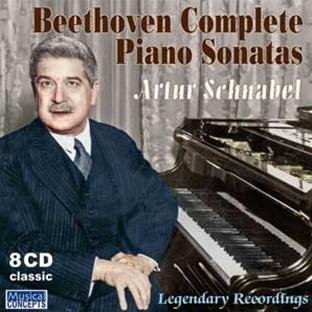 | Artur Schnabel (mono) 1932 - 1935 - HMV Artur Schnabel, the first pianist to record all 32 Beethoven sonatas, is still held in the highest esteem by many piano aficionados and his recordings are much sought after. You will know if or when you want Schnabel's complete set - which, to some, is key to understanding Schnabel and even Beethoven. It is not recommended for those who are just beginning to explore these works in depth as neither the recording quality nor the technical accuracy is up to modern standards. The sound is hampered either by high levels of noise or, when those were carelessly removed, a flat, thin, and tinny sound. Pearl leaves in the most noise but also the most piano sound. Your ears do the filtering which, for small listening sessions, yields the best results. Dante (oop) does the opposite, but at least they do it well. EMI, too, overfilters. Naxos offers a good compromise and is recommended ahead of EMI. I don't know the Regis re-mastering. Musical Concepts, certainly if all the sonatas in one set are an attractive proposition, would be my choice for their also very successful compromise of noise-filtering and leaving the original tone alive. Various other labels have received scathing reviews for their re-mastering efforts and are probably best avoided. Anything by Membran, espcially, should be avoided like the plague. Availability:
| |||||||||||||||||||||||||||||||||||||||||||||
  | Wilhelm Backhaus I (mono) 1950 - 1954 - Decca This first Beethoven cycle (mono) of Wilhelm Backhaus has long been a classic, and as is typical for mono cycles that are out of print, it is often regarded as superior to his later stereo cycle. Whether this is actually true or not Availability:
| |||||||||||||||||||||||||||||||||||||||||||||
 | Friedrich Gulda "0" (mono) 1953 - 1954 - Orfeo Austrian Radio air-to-broadcast recordings in better sound than the set that followed shortly thereafter. Dug out only in 2010, after "Gulda I" (Decca) and "Gulda II" (Amadeo) had already been established as such. This makes Gulda join Alfred Brendel and Daniel Barenboim in the club of pianists who have recorded the complete Beethoven Sonatas more than twice. Availability:
| |||||||||||||||||||||||||||||||||||||||||||||
  | Yves Nat (mono) 1953 - 1955 - HMV/EMI There were always great "German" Beethoven-cycles around so that a listener outside of France never really had to seriously consider a French sonata cycle. And while the French could not avoid the marvel that is Gieseking's Debussy, no French pianist ever championed Beethoven with such compelling excellence that anyone outside of France was forced to take note. None of this is to say that Yves Nat's cycle was not a great accomplishment (though in some way, every such cycle is), or that it isn't rewarding to seek this one out. Nat's very casual playing (a musical stroll, no climbing of looming mountains - most lovely in the op.14 sonatas) does have its attractions and followers. In an interview with Colin Clarke (Fanfare Magazine) Jean-Efflam Bavouzet, a student-of-a-student of Nat, extols the virtues of Nat's Beethoven, and Clarke agrees. Actually: The little I have heard of the early sonatas enthusiastically seconds those opinions. Availability:
| |||||||||||||||||||||||||||||||||||||||||||||
 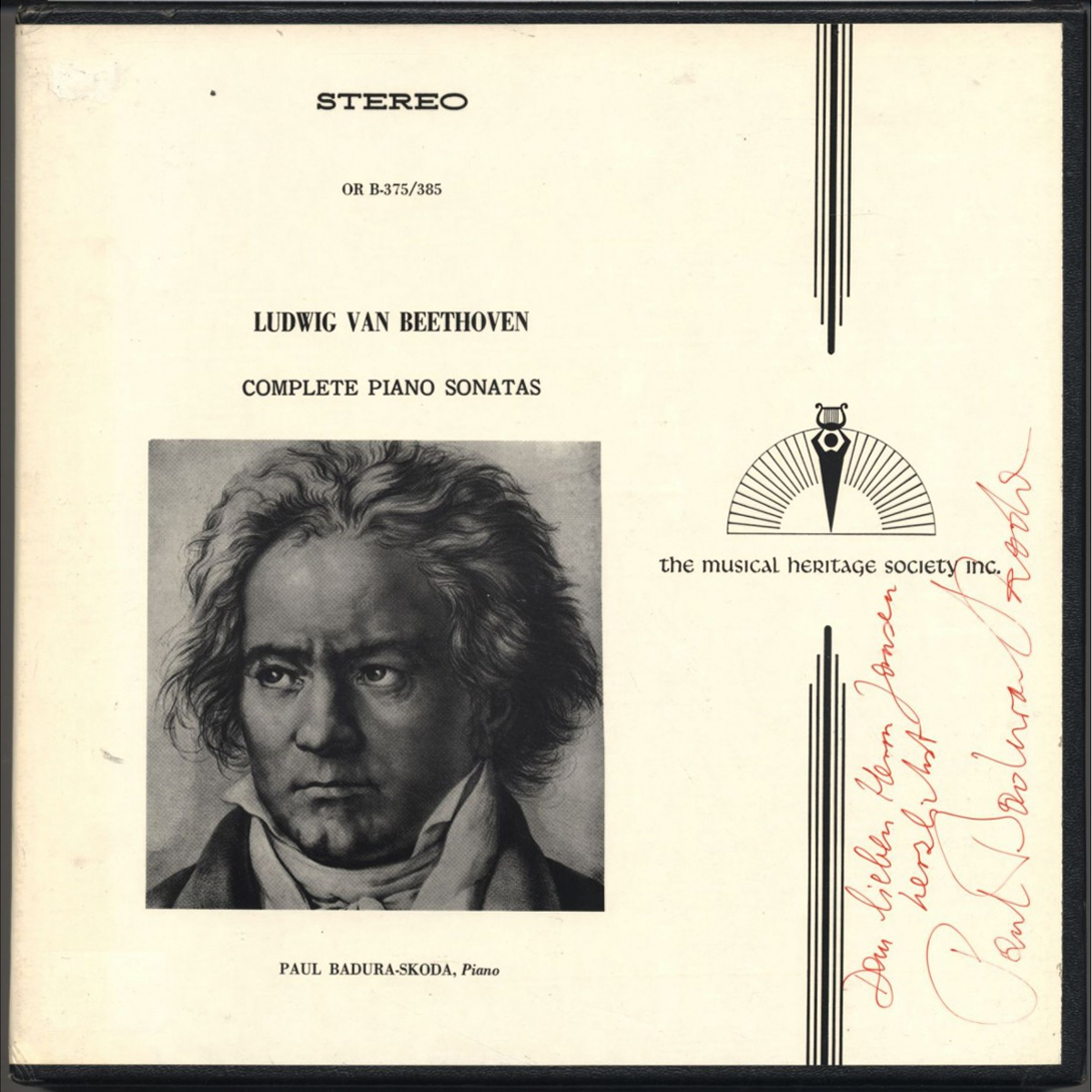 | Paul Badura-Skoda "0" 1955 (stereo?) 1955 Westminster??? Does, in in all likelyhood, not exist There is some uncertainty about this first cycle of Paul Badura-Skoda’s – which is neither his Vienna/Gramola cycle recorded between 1969 and 1970, nor the original instrument cycle recorded for Astrée between 1978 and 1989. I first wrote that "it appears to have been released in the 70s (12 LPs) by Intercord (707-09 Z, in two parts) and then re-released on Musical Heritage Society LPs (B-375/385). Intercord claims the cycle to be stereo." This is not the case. The Intercord cycle is identical with the 1970 cycle recorded in the Vienna Konzerthaus which was then edited by Rico Gulda und Albert Franz for CD release on Gramola in the early 2000s. Paul Badura-Skoda’s website, misidentifying the label as "Intercord", indicates that this early has been performed on Steinway and Bösendorfer pianos. Assuming such a cycle exists, it most likely was recorded for – but never entirely issued by – Westminster. A few (three) individual LPs (if they are identical) were issued back then. On the other hand, there is plenty suggestion that the Intercord cycle is actually identical or partly identical with the Gramola cycle… [Ed. as is the case!] in which case the Westminster cycle would never likely have been fully issued in any form. What is pretty certain is that it was never issued on CD. I will investigate and have more – hopefully definitive – information by the end of the year. The covers here depicted are therefore not correct; they belong to the Vienna/Gramola cycle which can be found here: Beethoven Sonatas - A Survey of Complete Cycles, Part 2, 1967 - 1975. Availability:
| |||||||||||||||||||||||||||||||||||||||||||||
  |  Wilhelm Kempff I (mono) 1951 - 1956 - Deutsche Grammophon Another of these early, great cycles. Mono again, a little difficult or at least expensive to get, and therefore much hailed? Re-listening to these recordings, it turns out that its merits--stand alone, but also comparatively--are really strong, indeed. Especially the early sonatas and lesser known sonatas Kempff comes across as having great fun with his footloose LvB. The mono sound is easily good enough to appeal even to those who don't like historic recordings. Re-issued on Regis, but apparently in considerably less pleasing re-mastered sound than the DG pressings. Caveat emptor! Availability:
| |||||||||||||||||||||||||||||||||||||||||||||
 | Friedrich Gulda I (mono/stereo) 1954 - 1958 - Decca Gulda's first cycle would probably be extolled as "even better" than his much and highly regarded second one if only it were out of print. But it isn't and while it is unarguably a very interesting set that Decca has brought back to life, there are spots of less fortunate sound quality and all in all it doesn't quite sound as liberated as his second traversal a good decade later. Availability:
| |||||||||||||||||||||||||||||||||||||||||||||
 | Wilhelm Kempff 1961 / Japan (stereo?) 1951 NHK / King International Uh-oh! What's this? An integral Beethoven Sonata cycle from the foremost Beethoven pianist of his time (by reputation, at any rate), recorded live on seven consecutive nights in 1961, at or near the height of his powers at 66? Recorded by the radio technicians of NHK, this event has been preserved (including even the encores) and released only now, only in Japan. It falls right between his two studio cycles for DG, but in order not to mess with the convention (if it's much of a convention) of naming the stereo cycle "Kempff II", I'll squeeze this between them as "Kempff 1961 / Japan". Availability:
| |||||||||||||||||||||||||||||||||||||||||||||
  | Alfred Brendel I (stereo) 1961 - 1964 - Vox-Turnabout When Brendel set our to record Beethoven for Vox-Turnabout, it wasn't just the complete sonatas but indeed the (more or less) complete solo works for piano that he put on record. Brendel wasn't always proud of his early recordings and he went on to record the sonatas twice more for Philips... though what I've heard of this set (some of which is also in the Brilliant Beethoven box) holds up quite nicely, actually. Availability: Licensed by Brilliant Classics and available in various sets, including below 'stand alone'.
| |||||||||||||||||||||||||||||||||||||||||||||
  | Wilhelm Kempff II (stereo) 1964/65 - Deutsche Grammophon Wilhelm Kempff "II" is the classic among Beethoven sonta cycles. Why exactly that is the case is difficult to say, because Kempff convinces through subtlety and superb accounts of all the lesser known and 'little' sonatas. In the bigguns, he is rarely outright impressive. Kempff is not as perpetually understated as Backhaus and he can even be quite playful. Solid, in the best, most empathetically positive sense of the word. Availability:
| |||||||||||||||||||||||||||||||||||||||||||||
  | Claudio Arrau I 1962 - 1966 - Philips To ears reared on Pollini, Arrau's Beethoven can take some time getting used to, in good part due to the deliberate tempos he often chooses. But it's incredibly musical stuff worth all that effort, even if some of the last five sonatas don't appear as grand as elsewhere. To many of its owners, the original Philips pressings set a new standard in piano reproduction. Availability: Deleted on Philips, revived on Decca.
| |||||||||||||||||||||||||||||||||||||||||||||
   | Wilhelm Backhaus II (stereo*) 1958* - 1969 - Decca To paraphrase myself (referring to a Beethoven Concerto DVD): There is purpose behind every note; purpose at the service of the music, not Backhaus' own ego. No unnecessary tone or emotion comes from this outwardly impassive man; there is no smudging to 'improve' individual instances. Like less-than-refined brush strokes in great painting, an almost barren tone with Backhaus emerges as an essential part of the unadulterated whole. Backhaus is “nobility but not ‘power’, seriousness without pompousness, devotion with no show of ‘piety’” and although it may be 'too little' for some, it amounts to 'everything' I ask of Beethoven. Availability:
|
The (Great) Incomplete Cycles
Part 2: 1967 - 1975
Part 3: 1977 - 1989
Part 4: 1990 - 1996
Part 5: 1996 - 1999
Part 6: 2000 - 2005
Part 7: 2006 - 2009
Ronald Brautigam Special
Part 8: 2010 - 2013
Part 9: 2014 - 2016
Part 10: 2017 - 20??
This listing of all Beethoven Sonata Cycles will continue as more sets reach completion or as I find more information about sets already completed.* There are certainly plenty sets under way that should or may reach completion soon: Among them Angela Hewitt (Hyperion), Igor Tchetuev (Caro Mitis), Jonathan Biss (Onyx), Akihiro Sakiya (DPIC Entertainment), Martin Roscoe (Deux-Elles), James Brawn (MSR), Paavali Jumppanen (Ondine) [Completed & Added], Yusuke Kikuchi (Triton) [Completed & Added] et al. I will also add a selection of historically important attempted cycles that were never finished but include
If you count, as I did, Backhaus II and Arrau II as complete, despite one and two (respectively) missing sonatas. I do not count Walter Gieseking (tapes of 4, 5, 7, 20, 22 for a radio cycle are lost, a studio cycle for EMI was missing seven sonatas when he died), Wilhelm Kempff "0" (Polydor, opp.2/3, 22, 27/1, 28, 31/2, 101 missing).
Invaluable research on this end done by Todd, resident Beethoven-Sonata expert (and addict) at the Good Music Guide Forum.
If you have additional information about recording dates, availability, cover art -- or corrections and additions -- your input is much appreciated.
This survey is meant to list all complete sets of Beethoven's Piano Sonatas and their availability in different markets, not to review them.
Discographies on ionarts: Bach Organ Cycles | Beethoven Piano Sonata Cycles I, II, III, IV, V, VI, VII, VIII, IX | Beethoven Symphony Cycles Index | Beethoven String Quartet Cycles | Bruckner Symphony Cycles | Dvořák Symphony Cycles | Shostakovich Symphony Cycles | Sibelius Symphony Cycles | Mozart Keyboard Sonata Cycles
Follow @ClassicalCritic




8 comments:
Nice-- looking forward to the rest, and your recent Mahler entry on Weta is helpful, as well-- I guess I'm not alone in finding Mahler difficult to wrap one's head around. Is it just me or do Rattle's Mahler records (and maybe others by him-- I don't have any to compare) forego classical industry norms in their use (or lack) of equalization? I don't have any other discs where the difference between soft and loud is so great-- I am constantly adjusting the volume and having my ears blown out with Rattle.
Kempff II is now available in a slightly cheaper reissue.
Hoping you'll overlook the incompleteness of Gould's Beethoven sonata journey on the basis of originality alone. I find Gould's Tempest 3rd movement and 13th sonata second movement so incredible that they seem to exceed the limits of human potential (to steal a phrase by Andre Breton in describing Lautreamont).
I wasn't going to include any incomplete cycles... but I suppose I will, in an addendum. So Gould will have to wait a little bit, but he will come. And I'll listen to it with alert ears (or that Tempest), meanwhile.
Best,
jfl
Thank you very much indeed for this effort!
Hope you'll continue your list someday. A few ideas:
Gerhard Oppitz (Oehms Classics, 2004/2005?)
Abdel Raham El Blacha II (Mirage, 2012/13, live)
Hj Lim (EMI/Warner, c 2012)
Jean Muller (Bella Musica, c 2010)
Francois-Frédéric Guy (ZZT, 2009-2011, live)
Rudolf Buchbinder II (RCA Red Seal c 2011, live)
Ronald Brautigam (BIS, 2004-2010, on several Fortepianos)
Stewart Goodyear (Marquis Classic, 2010-2012)
Mari Kodama (Pentatone, c 2014)
Good to be skeptical about the merits of hard to find recordings. Harold Shonberg used to say Josef Hofmann's best years were from 1924-1934 -- precisely when we have no recordings! But check out Kempff's incomplete pre-war Beethoven on Dante and perhaps elsewhere. It's less pointillist than the '50s set, more lyrical and flowing. Thanks for the blog.
Dear Anonymouses 1 & 2; many thanks for your comments; No.1:
All the ones you have mentioned are included on these pages. Brautigam even has his own section.
Gerhard Oppitz (Oehms Classics, 2004/2005?)
Abdel Raham El Blacha II (Mirage, 2012/13, live)
Hj Lim (EMI/Warner, c 2012)
Jean Muller (Bella Musica, c 2010)
Francois-Frédéric Guy (ZZT, 2009-2011, live)
Rudolf Buchbinder II (RCA Red Seal c 2011, live)
Ronald Brautigam (BIS, 2004-2010, on several Fortepianos)
Stewart Goodyear (Marquis Classic, 2010-2012)
Mari Kodama (Pentatone, c 2014)
Dear jfl,
Please note that the set by Konstantin Lifschitz on Alpha will be out real soon.
Regards,
Terence Wu
By "Claudio Arrau I," if you mean to imply he did another complete cycle (a common myth) he did not. He was working on a digital one for Philips in the 1980s before he died, and he'd started one with EMI in the 1940s-50s before he moved to Philips. Just FYI,
You'll find the answer if you browse on a bit further.
Post a Comment