CD Reviews | CTD (Briefly Noted) | JFL (Dip Your Ears) | DVD Reviews

18.4.26

Critic’s Notebook: Olivier Latry and Shin-Young Lee


available at Amazon
Olivier Latry & Shin-Young Lee,
Stravinsky, Heller, Alain
Trois danses
(BNL, 2013)

US | UK | DE

available at Amazon
Olivier Latry,
Transcriptions
Midnight at Notre-Dame
(DG SACD, 2004)

US | UK | DE

Olivier Latry and Shin-Young Lee Dance the Night Away

Organ Dances at the Konzerthaus's Rieger instrument

While early music is otherwise running riot at the Konzerthaus – it is, after all, “Resonanzen” time – one might intuitively expect an organ recital to be part of the baroque proceedings. For a good two minutes, that was indeed the case on Tuesday evening in the Great Hall, when Olivier Latry, titular organist of Notre-Dame, and Shin-Young Lee brought the Rieger organ to life with an arrangement of Rameau’s Les Sauvages. But the Rieger organ is anything but a baroque instrument, and so the remainder of the evening was devoted to (ballet) music that, while not written for the organ, was at least composed at roughly the same time as the instrument itself came into life.

The programme ranged from Béla Bartók via Maurice Ravel, Manuel de Falla and Alexander Borodin to the main course and undisputed high point: an arrangement of Igor Stravinsky’s Le sacre du printemps. Not such a far-fetched idea, given that The Rite of Spring also exists in a wildly percussive four-hand piano version by the composer himself. But everything before the Stravinsky amounted to little more than preliminaries – with the Rameau (surprisingly) perhaps the least satisfying of the lot: The organ sounded thick and dense in the Les Sauvages (recycled in Les Indes galantes and inspired by Reameau observering six Mitchigamea chiefs dance before King Louis XV. in the Théâtre-Italien in 1725) and in this arrangement – or rather in Latry’s and Lee’s registration – it clattered like a fairground carousel.

The Bartók miniatures, small musical playthings from the Romanian Dances, were never intended by the composer to court broad appeal and were unlikely to have acquired it in Latry’s arrangement either. Interesting, at least, was how the “Bagpipe Players” sonatina recalled 16-bit computer music. Cleanly and securely played, but at times somewhat laborious and monochrome in sound – whether for four hands or two – Lever du jour, Danza ritual and the Polovtsian Dances were hardly more invigorating.

But then! Almost from the very first note, Lee and her husband made it clear in the Stravinsky where all that effort in selecting organ stops had gone. The work gleamed, lively and colourful. The impudent little figures Stravinsky scatters throughout were wonderfully realised by four hands – as was, with two, three or even four feet, the underlying, driving rhythm. Altogether, this sounded far more natural, more organic, than, say, a Bruckner symphony on the organ and it kind-of salvaged the evening.


Critic’s Vault: Shipwrecked in Ireland


available at Amazon
eX presents:,
Music from "Shipwrecked",
De Cabez, De Morales, De Victor, Byrd et al
(Heresy Records, 2012)


US | UK | DE

available at Amazon
The Dublin Drag Orchestra,
Music from "Motion of the Heart" & "Viva Frida!"
Dowland, Lawes, Coperario, Ward et al.
(Heresy Records, 2012)


US | UK | DE

A musical journey with Francisco de Cuéllar

In 2009, a fascinating, even prescient production marrying theater to early music was mounted at Dublin's Royal Hopsital


Queen Elizabeth and Philip II are goofing around behind chairs to the left and right of the U-shaped stage before both break out in a dash through the marvelous Great Hall of the Royal Hospital Kilmainham in Dublin. What are Elizabeth and Philip doing in Dublin, and why is the former wearing ankle-high silver sneakers and a blue dress, and the latter waving a feather and making silly faces?

Abbey and Robert are actually eight years old, and they play their royal parts in “Shipwrecked”, a production of the early music ensemble eX which took place in the (truly) Great Hall of what is now the Irish Museum of Modern Art. The two are impossibly cute child actors who patiently sit through the long rehearsals—almost until midnight the day before the premiere – and they have quickly become the mascots of the production.

Later during the final rehearsal, Queen Elizabeth, who barely reaches up to Caitríona O’Leary’s belt, pipes the tune of Greensleeves in duet with O’Leary, which sounds absolutely adorable – and moderately musical. Then the little Queen gets her wig affixed while rummaging through her Hello Kitty bag and Philip II chats with Kate, the make-up artist, and crinkles his nose as her brush applies white powder to his face.

Shipwrecked is an early music jamboree, a soundtrack of the (literally) incredible journey of a Spanish captain of the Armada who strands in hostile 16th-century-Ireland, and is then chased, maltreated, and occasionally helped by murderous Englishmen and local savages until he – barely – makes it back to safety in the Spanish Netherlands. If only half of his account, a twenty-page letter, is true, Francisco de Cuellar is a mixture between Voltaire’s Candide and George McDonald Fraser’s Harry Flashman. Music directors Caitríona O’Leary (an expert researcher on – and performer of – early Irish music) and Lee Santana (lutist extraordinaire and Los Otros-founder) cobbled together the musical tapestry from lute books, 16th century Spanish composers, traditional songs, and improvisations.

Members of Los Otros, Sequentia, and the Harp Consort, fortified with Irish music experts, provided the music, breaking out into an early music jam session for the finale that had the pint-sized Queen and the King waving their hands in rhythmic excitement. Director Eric Fraad, meanwhile, had the performers – all in full costume – work out the semi-staged element of the performance which included actor Keith Dunphy, as one of three incarnations of Captain Francisco reading out (and sometimes shouting) excerpts of the actual letter, thus providing the story line upon which the pieces of music are hung.

The battle of the percussionists Mel Mercier and Francesco Turrisi and Steve Player*’s Renaissance tap-dance (a combination of brute force and Fred Astaire) rang in the conclusion of an early music spectacle that emerged, seemingly out of buzzing chaos just a few hours earlier, into something akin to perfection, delighting the 150 attendees who had found their way up to the Royal Hospital on a mild Dublin Sunday night. While the music was passionately played and the singers delighted – especially O’Leary’s early music soprano and genre-defying vocalist/guitarist Clara Sanabras – the costumes

17.4.26

Critic’s Notebook: Barokksolistene and their Alehouse Sessions at the Konzerthaus


available at Amazon
Bjarte Eike,
Barokksolistene
The Alehouse Sessions
(Rubicon, 2017)


US | UK | DE

available at Amazon
Bjarte Eike,
Barokksolistene
The Image of Melancholie
(BIS SACD, 2014)


US | UK | DE

Jolly Musicke Till You Drop

Hip vibes at the Norwegian baroque hoedown


For the most part, the crowds pouring into the Konzerthaus on Thursday evening surged up the grand staircase straight into the Great Hall: Mahler’s Ninth, Rattle conducting! The high temple of music was calling. Those who took a turn a little further down the foyer, meanwhile, found considerably lighter fare waiting behind the doors of the Mozart-Saal. Nothing lowbrwo, mind you—Bjarte Eike and his Norwegian Barokksolistene are a superb early music outfit. But their motto (“It’s just old pop music”) already hints at the fact that the promised Alehouse Sessions probably aren't too darn serious.

This baroque watering hole promised Henry Purcell, English shanties, dance, ballads, and traditional tunes. You’d need to have known your Purcell pretty well, though, to pick him out from the charming tangle of virtuosity, comedy, and kitsch. The dramatically—even theatrically—conceived program, about ten years old now, cheerfully plops Purcell’s "Virgin Queen" next to a sea shanty with a Bach riff rising suddenly from the hand harmonica. Bass, percussion, and guitar solos are handled the way they’d be in a jazz club.

The result is less "classical" than when Berlin’s Lautten Compagney tackles similar material, and not as relentlessly dramatized as comparable projects from Ireland’s Heresy Records. It’s just a bunch of cool old dads in mildly hipster=casual carb, noticeably graying hair, beers in hand, having fun with the music and goofing around a good deal. Who could possibly be curmudgeon enough to hold that against them—even if the slow-motion fight scene staged at the end finally tipped this early-baroque hoedown definitively into slapstick territory. Well, if clap-alongs and audience participation were not your thing, then you might have felt a sense of mild vicarious embarrassement. As it was, everyone got the right turn at the Konzerthaus; the crowd in the reasonably well-filled Mozart-Saal positivley lapped it up and responded with enthusiasm to everything that was on offer. So much so, Barokksolistene could almost have forgone the plants in the audience, that goated the audience into the right responses.


5.4.26

A (Very!) Fine Messiah From Václav Luks and Collegium 1704

available at Amazon
G.F.Handel
Messiah
Luks/Collegium 1704
Semenzato, Schachtner, Adam, Stražanac
Accent, 2019>


US | UK | DE

available at Amazon
G.F.Handel
Messiah
McCreesh/Gabrieli Consort
Röschmann, Gritton, Fink, Daniels, Davies
Archiv, 1997


US | UK | DE

available at Amazon
G.F.Handel
Messiah
Bernius/Stuttgart BO
Sampson Taylor, Hulett, Harvey
Carus, SACD, 2009


US | UK | DE

To say that there is no dearth of recordings of Handel’s Messiah is putting it mildly. Even granting that every generation needs its interpretations of the classics, there is a glut. On the downside, not all of them are very good. On the upside, choice is a beautiful thing and there is bound to be a recording out there for each taste. The recording at hand might be an interpretation for a listener who has heard Handel’s masterpiece one too many times and needs a deliberately fresh take. While Václav Luks and his Collegium (Vocale) 1704 are not yet international household names (though well on their way there), they certainly are a first-class ensemble, up there with the best and most famous… and they have a knack for finding and working with good and excellent singers. So, the fact that the recording features a quartet of unknown soloists does not make this release less promising.

And indeed the singers are very fine; not all of them impressive but all devoid of mannerisms or any ostentatious modi. Bass Krešimir Stražanac hasn’t the most sophisticated bass voice – it’s a little nasal, just a little barrely – but he certainly doesn’t spoil the party. Giulia Semenzato’s soprano is clear, clean and accurate… more like an operatic Mozart soprano than a baroque specialist, although these two fachs very much overlap in reality. Alto/Countertenor Benno Schachtner is a delight; in the duet with Semenzato (“He shall feed his flock like a shepherd”) his voice rings out with artless, unfussy beauty and his “He was despised” is touchingly natural, becoming a highlight of this recording. Tenor Krystian Adam remains a wee indistinct throughout because he blends nicely into the proceedings and never sounds strained or trying too hard. He might be unfairly overlooked: “Thy rebuke hath broken His heart”, for example, is exemplary for unaffected-yet-dramatic singing and very impressive in its subtle ways. The chorus is well drilled, usually easy to understand, and with five singers to a part offers thrilling energy and depth – for example in “Surely, He hath borne our griefs…” (Sound clip)

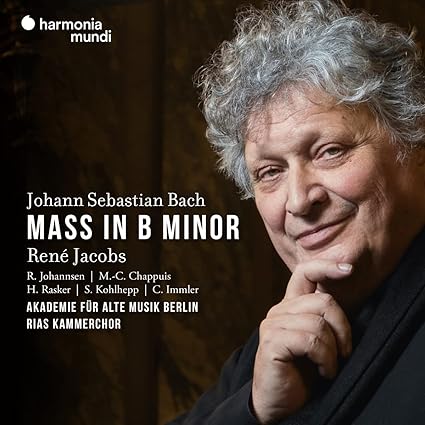
In Luks’ hands, the famous bits stand-out for being taken in various, slightly unusual ways: “For unto us a child is born” is not just fast which, for its own sake, could be tedious, but communicates splendid excitement and a tangible sense of joy. They sail right through the Halleluja, too. If you come straight from Malcolm Sargent, it must seem flippant but it has ripping, infectious energy to it. The opening of Part II, “Behold the Lamb of God” and the subsequent “He was despised”, makes René Jacobs and his Freiburgers seem positively glacial. (Sound clips) It’s one of Jacobs’ more extreme moments, granted, taking four and half minutes where well under three is HIP-standard. And while Jacobs can certainly please our every inner speed demon – he switches gears sometimes mid-number to press on like there is no tomorrow – there’s a generally heavier touch to the Freiburg Baroque Orchestra while the Collegium 1704 seems to be blown along on a light cloud. Breezy. Too breezy, for some. But after an initial double-take here or there, on repeat listening no part felt like it was being brushed over; what remains is just the impression of a good quick and steady pulse.

With Jacobs being a much more dramatic, downright operatic account with a far stronger interpretative stance, it might not actually make for the best comparison. Frieder Bernius’ fine, slightly matter-of-fact (sound clips) Messiah on Carus is a more similar take: strait-laced, similar tempi, good singing, no-nonsense. Both present a good modern HIP standard; neither outright demand to replace your reference versions, whatever those may be. (A little trivium: In the ten years between those two recordings, the aforementioned Schachtner had made it from choir member for Bernius to soloist with Luks.) The sound on the Accent recording is brighter and more transparent than that of the Bernius SACDs, and the more prominent harpsichord (Joan Boronat Sanz) adds welcome texture. (Bernius uses a positif organ.) You won’t notice that this is a live recording until the enthusiastic roar and applause erupts at the end – but it explains why the chorus is set a little further at the back in this recording than, say, Jacobs’ studio effort.


9/9


(Originally on ClassicsToday)