CD Reviews | CTD (Briefly Noted) | JFL (Dip Your Ears) | DVD Reviews

26.8.17

Forbes Classical CD of the Week: Schubert At His Secret Best With Four Hands


…Franz Schubert’s Fantasia in F minor for piano four-hands D940 from his last year (1828) is, in short, the composer’s most beautiful work for any number of pianos or hands. I am not alone in this opinion (although I admittedly express it more for effect thank for thinking it absolutely incontestable); the former German critic and ‘piano-pope’ Joachim Kaiser, too, deemed it “not just one of the most important compositions Schubert ever created, but even one of the greatest works in music history.”…

-> Classical CD Of The Week: Schubert At His Secret Best With Four Hands

25.8.17

A Survey of Bach Organ Cycles


An Index of ionarts Discographies


Like the Beethoven Piano Sonata Cycle Survey, the Sibelius Symphony Cycle Survey, the Bruckner Cycle Survey, and the Dvořák Symphony Cycle Survey this is a mere inventory of what has been recorded and whether it is still available. Favorites are denoted with the “ionarts’ choice” graphic. There are few cycles that I don't love or like or wouldn’t find a reason to recommend (the most charming Berlin Classics set for its use of different Gottfried Silbermann organs, for example, or the Weinberger set for its total, exhaustive, scholarly completeness). To restrict the wild throwing about of recommendations somewhat, they are limited to sets that are decidedly in print.


The sets are listed in (roughly) chronological order. If you can add or correct information, you are most welcome to do so. Where known, the organs used are added in ‘mouseover’ text on the set’s image.

The idea of “complete” Bach organ works, meanwhile, is a concept open to considerable interpretation. One can, in all genuineness, define Bach’s organ works in such a restrictive way, that they fill some 12 CDs. But one can throw in miscellany, transcriptions, concertos, and apocryphal works to reach (depending on spacing and speed) well over 20. Unless a Bach organ cycle sets out to be über-complete as a matter of principle, editorial decisions have to be made as to what gets included and what not.

Updated: 8/10/2023: David Goode's cycle on Signum has come out as a set in 2020.

Updated: 02/14/2019: I have dug a little, to see if I can't find out more about the alleged two sets of Lionel Rogg's that never appeared on CD. Turns out, firstly, that the man is very much alive, busily composing and performing at that! Secondly that he has a very nifty website. And thirdly very generous explaining the somewhat convoluted history of those three cycles, upon query. I am including those two cycles, unavailable though they are, below, for completeness' sake.

Updated: 02/10/2019: André Isoir has been re-issued again, this time the terrific La Dolce Volta label has included the Art of the Fugue, bringing the set to 17 CDs. Marie-Claire Alain's first cycle, hitherto never available on CDs, has been re-issued by Warner. Now all her three cycles are available from the label. Stefano Molardi snuck a complete cycle by me which exists on its own right and as part of a super-set of the complete organ works of the Bach family (Brilliant). Furthermore we have new cycles under way by David Goode (Signum; on vol.10) and Benjamin Alard (Harmonia Mundi - including all cross-platform keyboard works; on vol.2).

Updated: 03/15/2018: Hurford's cycle has been re-issued on Decca Italy!

Updated: 11/11/2017: Benjamin Alard is slated to record the complete organ works and the complete other keyboard works for Harmonia Mundi, with the first release coming out in 2018. If anyone can provide information about Anton Heiller's cycle (perhaps recorded for Amadeo? And was it ever issued as a set on LP? It seems never to have made it into the CD age...), that would be much appreciated.

Updated: 08/26/2017: Happily, Olivier Vernet's Bach cycle (a favorite cycle of many Bach organ lovers I know) has been re-issued by Ligia and is available as a CD-set (so far) from Amazon.de and .fr. and digitally elsewhere. It contains 15 discs omitting the four bonus discs of the original release that included "Clavier-Übung 0", the Concertos for 2, 3 & 4 organs, the disc with transcriptions and a Bach-Vernet CD which I've forgotten the contents of). The concerto disc is available seperately now; the box includes a coupon for this disc!

Kay Johannsen has a set available - if "available" is the right word, since it can only be bought at the info-point of the Stiftskirche in Stuttgart. Jacques van Oortmerssen died just before he could finish his cycle. Nine individual releases are available from his estate directly.

New sets are currently underway by David Goode (on the Trinity College Chapel Cambridge; Signum, 4 volumes), and Kei Koito (Claves, 5 volumes) which I like a lot, so far. (Special thanks to Karsten Unverricht, who seems to know absolutely everything about Bach organ cycles both ongoing and past.)

Updated: 04/24/2016: André Isoir and the Hänssler cycle have been put into chronological order on this list. The details of the organs used (on mouse-over, depending on your browser) are now included for Koopman, Alain III, Weinberger, Foccroulle and (partly) Phillips.

Updated: 01/25/2015: André Isoir has been re-issued by the terrific La Dolce Volta label and included below.

16.8.17

À mon chevet: 'Les deux poètes'

À mon chevet is a series of posts featuring a quote from whatever book is on my nightstand at the moment.

book cover
By the beginning of September, Lucien had ceased to be a printer's foreman; he was M. de Rubempré, housed sumptuously in comparison with his late quarters in the tumbledown attic with the dormer-window, where "young Chardon" had lived in L'Houmeau; he was not even a "man of L'Houmeau"; he lived in the heights of Angoulême, and dined four times a week with Mme. de Bargeton. A friendship had grown up between M. de Rubempré and the Bishop, and he went to the palace. His occupations put him upon a level with the highest rank; his name would be one day among the great names of France; and, in truth, as he went to and fro in his apartments, the pretty sitting-room, the charming bedroom, and the tastefully furnished study, he might console himself for the thought that he drew thirty francs every month out of his mother's and sister's hard earnings; for he saw the day approaching when An Archer of Charles IX, the historical romance on which he had been at work for two years, and a volume of verse entitled Marguérites, should spread his fame through the world of literature, and bring in money enough to repay them all, his mother and sister and David. So, grown great in his own eyes, and giving ear to the echoes of his name in the future, he could accept present sacrifices with noble assurance; he smiled at his poverty, he relished the sense of these last days of penury.

Ève and David had set Lucien's happiness before their own. They had put off their wedding, for it took some time to paper and paint their rooms, and to buy the furniture, and Lucien's affairs had been settled first. No one who knew Lucien could wonder at their devotion. Lucien was so engaging, he had such winning ways, his impatience and his desires were so graciously expressed, that his cause was always won before he opened his mouth to speak. This unlucky gift of fortune, if it is the salvation of some, is the ruin of many more. Lucien and his like find a world predisposed in favor of youth and good looks, and ready to protect those who give it pleasure with the selfish good-nature that flings alms to a beggar, if he appeals to the feelings and awakens emotion; and in this favor many a grown child is content to bask instead of putting it to a profitable use. With mistaken notions as to the significance and the motive of social relations they imagine that they shall always meet with deceptive smiles; and so at last the moment comes for them when the world leaves them bald, stripped bare, without fortune or worth, like an elderly coquette by the door of a salon, or a stray rag in the gutter.

-- Honoré de Balzac, Lost Illusions: The Two Poets (trans. by Ellen Marriage)
I am returning to an ongoing project to read all of Balzac's La Comédie Humaine, picking up where I had left off, near the end of the Scènes de la vie de province section. This excerpt is from the first part of a long novel that concludes that section, Lost Illusions. This features especially the advent of one of Balzac's most important characters, Lucien de Rubempré, who rises from the penury of a fallen quasi-aristocratic family through the sacrifices of his sister, Ève, and his best friend, David Sechard, a printer in Angoulême who hires Lucien to work for him. Although born as Lucien Chardon, the character takes on the aristocratic name of his mother's family, de Rubempré. The story mirrors the life of Balzac, who was also born into a modest family of artisans. He also worked as a printer early in his life, and he also changed his name (he was born Honoré Balssa) and added the noble particle "de" to it.

Lucien rises out of his low position because of his good looks, as a lonely woman at the top of the social ladder embraces his talent as a poet. It will ruin his life. The television show 30 Rock explored a comic version of the phenomenon Balzac is describing here. Liz Lemon's boyfriend, played by Jon Hamm, is so handsome that he lives in what she calls "the bubble" (related clip below). Everyone he meets bends over backwards to gratify and help him, and he has no idea that he is actually stupid and helpless.

25.7.17

À mon chevet: '1Q84'

À mon chevet is a series of posts featuring a quote from whatever book is on my nightstand at the moment.

book cover
The taxi's radio was tuned to a classical FM broadcast. Janáček's Sinfonietta -- probably not the ideal music to hear in a taxi caught in traffic. The middle-aged driver didn't seem to be listening very closely, either. With his mouth clamped shut, he stared straight ahead at the endless line of cars stretching out on the elevated expressway, like a veteran fisherman standing in the bow of his boat, reading the ominous confluence of two currents. Aomame settled into the broad back seat, closed her eyes, and listened to the music.

How many people could recognize Janáček's Sinfonietta after hearing just the first few bars? Probably somewhere between "very few" and "almost none." But for some reason, Aomame was one of the few who could.

Janáček composed his little symphony in 1926. He originally wrote the opening as a fanfare for a gymnastics festival. Aomame imagined 1926 Czechoslovakia: The First World War had ended, and the country was freed from the long rule of the Hapsburg Dynasty. As they enjoyed the peaceful respite visiting central Europe, people drank Pilsner beer in cafés and manufactured handsome light machine guns. Two years earlier, in utter obscurity, Franz Kafka had left the world behind. Soon Hitler would come out of nowhere and gobble up this beautiful little country in the blink of an eye, but at the time no one knew what hardships lay in store for them. This may be the most important proposition revealed by history: "At the time, no one knew what was coming." Listening to Janáček's music, Aomame imagined the carefree winds sweeping across the plains of Bohemia and thought about the vicissitudes of history.

In 1926 Japan's Taisho Emperor died, and the era name was changed to Showa. It was the beginning of a terrible, dark time in this country, too. The short interlude of modernism and democracy was ending, giving way to fascism. [...]

Eyes closed, Aomame listened to the music, allowing the lovely unison of the brasses to sink into her brain. Just then it occurred to her that the sound quality was too good for a radio in a taxicab. Despite the rather low volume at which it was playing, the sound had true depth, and the overtones were clearly inaudible. She opened her eyes and leaned forward to study the dashboard stereo. The jet-black device shone with a proud gloss. She couldn't make out its brand name, but it was obviously high end, with lots of knobs and switches, the green numerals of the station readout clear against the black panel. This was not the kind of stereo you expected to see in an ordinary fleet cab. [...]

Why, though, Aomame wondered, had she instantly recognized the piece to be Janáček's Sinfonietta? And how did she know it had been composed in 1926? She was not a classical music fan, and she had no personal recollections involving Janáček, yet the moment she heard the opening bars, all her knowledge of the piece came to her by reflex, like a flock of birds swooping through an open window. The music gave her an odd, wrenching kind of feeling. There was no pain or unpleasantness involved, just a sensation that all the elements of her body were being physically wrung out. Aomame had no idea what was going on. Could Sinfonietta actually be giving me this weird feeling?

-- Haruki Murakami, 1Q84 (trans. by Jay Rubin and Philip Gabriel), pp. 3-6
My traversal of Haruki Murakami's books -- Kafka on the Shore, The Wind-Up Bird Chronicle, What I Talk about When I Talk about Running -- has come up against the big kahuna, the sprawling, 1000-page 1Q84. Some reviews and other readers had put me off the book for a while, but it turns out to be a fascinating read that flows by easily. The title, it seems to me, should be read as "Q-teen Eighty-Four," which is the closest way to realize the concept from the book: the title of George Orwell's famous book, newly popular again in the Trump era, with the second digit replaced by the Japanese character kyu.

If you are not one of the "very few" who can imagine the sound of the opening fanfare section of Leoš Janáček's Sinfonietta as you read this book, listen to the embedded video several times and it will become indelible. The piece runs throughout this fascinating book, a dual narrative that follows two main characters in alternating chapters. All of the hallmarks of Murakami's other books are here, too: the suspension of the laws or reality (the reference to Kafka in this passage is not coincidental), the explosive violence, the sexual tension. I'll reserve judgment until I reach the end of the book, but I am surprised that some critics could have missed the boat on this one.

24.7.17

For Your Consideration: 'Dunkirk'


Mark Rylance in Dunkirk, directed by Christopher Nolan

Director Christopher Nolan's previous movies have ranged from the intriguing (Memento, The Prestige) to the over-budgeted and overblown (Inception, yet more installments of the Batman franchise). He has reportedly long wanted to make a film about the evacuation of British armed forces from the French beaches at Dunkirk in 1940, and his box office successes gave him the opportunity. The taut, simplified, but effective Dunkirk, which opened over the weekend, is the result.

Fitting the story into the film's 106-minute span required streamlining. The other participants in the vast battle and evacuation (French, Belgians, Canadians) are largely ignored, and we experience the events mostly through a chaotic tangle of unexpected characters, sometimes hard to keep straight. A hapless British soldier, Tommy, played both naive and level-headed by newcomer Fionn Whitehead, manages to get to the beach and tries like many of the characters just to save his skin and get away. A trio of Spitfire pilots takes off for Dunkirk, where they try to protect British craft in the waters from the air (thrillingly shot in low-tech splendor), with the exploits of Farrier (played expressively by Tom Hardy, in spite of having his face almost always covered by an oxygen mask in the cockpit) proving the most important. Nolan's terse screenplay is full of silences.


Other Reviews:

New York Times | Wall Street Journal | Washington Post | Los Angeles Times
David Edelstein | NPR | Christian Science Monitor

Representing the famous little ships of Dunkirk, the private watercraft requisitioned by the Royal Navy and mostly piloted by their officers, is Mr. Dawson. This older character, who pilots the English Channel in dress shirt and tie, is given life and depth by the incomparable Mark Rylance (Bridge of Spies, Wolf Hall), as he takes the helm of his own boat with his teenage son (another newcomer, Tom Glynn-Carney) and young friend (Barry Keoghan). The three narrative threads overlap, with characteristic Nolan-esque time shifts, unified especially around another fine performance, that of Kenneth Branagh as a naval commander overseeing the evacuation.

These little stories, though told in a compelling way, do not add up to an appreciation of the entire battle, leaving me feeling a little cheated at the end. The cinematography (Hoyte Van Hoytema) is unfailingly beautiful, shot in large format film for IMAX and capturing grand vistas better than intimate scenes. (Watching this movie on a large screen is essential.) The sound, especially the occasional screaming of fighter planes, is hard to take. Hans Zimmer's score struck me mostly as pedestrian, often little more than a pulsating unison in one instrument or another. The only moment of musical grandeur is stolen from Elgar's "Nimrod" movement from Enigma Variations, predictably perhaps but to powerful effect.

Dunkirk is playing at theaters everywhere.

23.7.17

'The Originalist' returns to Arena Stage


(L to R) Brett Mack (Brad), Edward Gero (Antonin Scalia), and Jade Wheeler (Cat) in The Originalist
(Gary W. Sweetman/Asolo Repertory Theatre)

When John Strand's new play The Originalist first ran at Arena Stage, two years ago, it ruffled audience feathers. The show returns this summer -- I saw it on Friday evening in Arena's Kreeger Theater -- after the election of Donald Trump has made Strand's character's appeal for a return to the political middle seem even less plausible as a dream.

Already making matters worse was the death of the title character, Justice Antonin Scalia, in 2016. He had become such a legendary figure to Republicans that, breaking with long-set precedent, the Senate declined even to give a hearing to and vote on President Obama's nominee to fill his seat. It is easy to understand this idolatry: Scalia was a brilliant jurist, a literate and cultured man who wrote some of the most colorful dissents in the court's history. He was the agitator-in-chief, a position apparently taken over by the current occupant of the White House, but without the learned polish and panache.


Other Reviews:

Nelson Pressley, Gero still rules as Scalia in ‘The Originalist’ (Washington Post, July 16, 2017)

Peter Marks, Scalia and his audience (Washington Post, May 9, 2015)

---, Coming to a theater near you: Scalia! The play! (Washington Post, February 26, 2014)
Edward Gero remains masterful as Scalia, his bluster-filled rants landing every punch. More remarkably he uses all the tools Strand's words provide to create sympathy for the often-maligned Scalia. The circumstances of the play, involving a left-leaning law clerk hired by Scalia as an ideological sparring partner, are entirely fictional, but the real-life Scalia's reverence for opera, literature, and the bonds of family comes through loud and clear. The other two roles have changed hands in this revival, beginning with the earnest, green idealism of Jade Wheeler as the law clerk, Cat. She hits the right notes, Cat's optimism and uncertainty, but Strand's play mostly uses the character only as a foil to the lead.

The role of Brad, a true-believer clerk from the Federalist Society, is a foil for the foil, played with smug satisfaction by Brett Mack, who like Wheeler is making his Arena debut. Molly Smith's production is minimal but effective: a large desk and starkly lit red curtains suggest Scalia's office, a simple frame is enough to show a shooting range, and so on. The focus remains, appropriately, on the larger-than-life figure seated at that desk.

The Originalist has been extended through August 6, at Arena Stage.

21.7.17

Touring production gives 'King and I' another shot


Mrs. Anna (Laura Michelle Kelly) arrives in Bangkok, The King and I (photo by Matthew Murphy)

It's a Rodgers and Hammerstein summer at the Kennedy Center. First, a touring production of The Sound of Music made a new case for the power of the last collaboration between Richard Rodgers and Oscar Hammerstein II. This week another touring production, directed by Bartlett Sher, tried to do the same for the duo's The King and I, from 1951. While it is a handsome production visually (sets by Michael Yeargan, lighting by Donald Holder) and restores some numbers and dialogue that are often cut, this story drawn from real life is still cringe-worthy for its colonial attitudes. One of the restored numbers, "Western People Funny" (!) at the start of Act II, does not help in this regard.

Laura Michelle Kelly was in beautiful voice as Anna Leonowens, the Welsh widow who arrives at the court of the King of Siam in the 1860s to teach the royal children. She had a charming, prickly interaction with the King of Jose Llana, whose humorous arrogance was a greater asset than his voice. Vocal contributions were less stable from Joan Almedilla's Lady Thiang, the King's primary wife (dignified but with some weakness at the top). Manna Nichols and Kavin Panmeechao did fine with the high vocal writing for Tuptim and Lun Tha, but they could not make me care about this secondary plot line, which is the musical's principal dramatic weakness, a poor substitute for a major love story.


Other Articles:

Peter Marks, Who ever wrote swoonier ballads than Rodgers and Hammerstein? (Washington Post, July 21)

Geoffrey Himes, ‘The King and I’ may be from 1951, but this production restored originally stricken lines (Washington Post, July 13)
Sher has done what he can to fumigate the show's fusty jingoism. He has restored some lines deemed too angry or risqué by the show's creators, and a significant number of Asian actors populate the cast. Christopher Gattelli's choreography goes back to the original movements created by Jerome Robbins, with gestures and costumes (generally beautiful, designed by Catherine Zuber) that recall Thai classical dance. It is hard to say if that faithfulness makes the second act's ballet, "The Small House of Uncle Thomas" (an error-ridden, garbled version of Harriet Beecher Stowe's famous, problematic novel) less offensive or more offensive.

Robert Russell Bennett has done the same job to the orchestral score that he did with The Sound of Music, a reduction to four string players and eight woodwind and brass players, augmented by unattractive synthesized sound managed by keyboard. This may help maximize profits, but audiences should feel cheated by the sonic element -- with only one-third of the live musicians compared to the original score -- despite competent mixing with the voices by Scott Lehrer. Given the state of most people's listening standards, they likely will not.

The King and I runs through August 20, at the Kennedy Center Opera House.

18.7.17

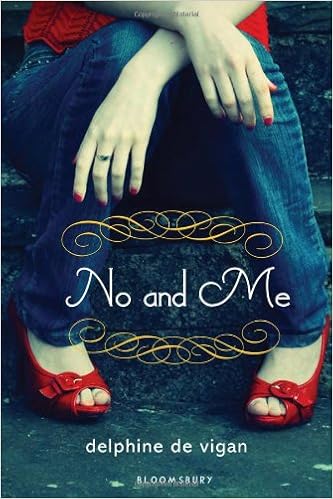
À mon chevet: No et moi

À mon chevet is a series of posts featuring a quote from whatever book is on my nightstand at the moment.

book cover
Lucas writes me little notes in class. He folds them over and slides them in front of me. 'Awful!' when the English teacher wears a strange skirt with fringes and pearls around the hem. 'He can sod off' when Mr Marin has given him his umpteenth zero. 'Where's the gnome?' because Gauthier de Richemont is absent (he's not particularly good-looking and Lucas has hated him since he grassed Lucas up to the principal one day when he was smoking in the toilets). In French class he stays quiet, even when we're doing grammar. It's the class where I'm most attentive. I hate being disturbed, I concentrate so as not to miss the tiniest thing. Mrs Rivery gives me special homework. French class is like a logic puzzle or a deduction, an exercise in dissection without a scalpel or a body.

People who think that grammar is just a collection of rules and restrictions are wrong. If you get to like it, grammar reveals the hidden meaning of history, hides disorder and abandonment, links things and brings opposites together. Grammar is a wonderful way of organising the world how you'd like it to be.

-- Delphine de Vigan, No and Me (trans. by George Miller), Ch. 30
Like so many excellent books, this novel by Delphine de Vigan was a recommendation from James Wood. Based on the experience I think I will be reading all of her books. She wrote this one and three books before it while holding down a day job in a business. The narrator, Lou Bertignac, has the same nickname as de Vigan, under which pseudonym (Lou Delvig) she published her first novel. What gripped me instantly was the individuality of that narrative voice: troubled, quirky, boundlessly intelligent, yet touchingly naive. There is nothing flowery about de Vigan's style, which is terse and rapid-fire, but there are marvelously diverting tangents, observations that are slowly unraveled in small lengths. The book's British translation is presented as a book for teenage girls, but don't let that put you off.