CD Reviews | CTD (Briefly Noted) | JFL (Dip Your Ears) | DVD Reviews
Showing posts with label cityscapes. Show all posts

16.4.10

Paris in Passing

Still sleepy from the over-night flight from Abu Dhabi to Munich the day before, I was en route to Paris two Wednesdays ago. Charles de Gaulle. Check. Gare du Nord. Check. Metro? Strike. A French welcome; a quintessential Parisian experience. And I haven’t even gotten off public transportation yet.

Having spent more or less 20 years of considerable guilt for not speaking French (though having gotten by reasonably well just on fumes—garbled phrases masqued by growling indistinctively being one of the main ingredients), I’ve finally decided to call quits my age of pretension and enter the town for two days consciously not speaking or attempting a word of French. “I learnt a foreign language to get about, so can you.” My plans broke down shamefully quickly when faced with an obdurate saleswoman in the train station’s newspaper shop who wasn’t having any of my English-only-attempts. So I swallowed one English four-letter word along with my ill-placed pride and exchanged it for a French one—Plan—to get the map of Paris I needed.

With Metros running at “40% probability” I set off to Montmartre on foot, coffee in hand and bag over my shoulder. Walking from train (or bus) stations to hotels is actually one of my favorite activities in any town as it gives a better sense of the place than just box-ticking the touristy spots. Unfortunately for Paris, the impressions thus gained are not necessarily flattering. As if reaffirmation was necessary, even in April Paris doesn’t all smell like roses. (Then again, after the squeaky clean, spic and span underpasses of Abu Dhabi, the pervasive stench of urine does come with overtones of freedom.)

Of great importance for the self-conscious foreigner in Paris is the idea of fitting in. There are several strategies that can help you with this: Strategic winking is very important, but not just at anyone; only at those who could know you, but not well enough to remember if. Select shop-keepers leaning against their fruit and vegetable stands, for example. Throw in the occasional weary smile, to underscore your casual familiarity. Make it a condescending one every one in five.

Paris is also a great place to start smoking. Chose something outrageously French, like filterless Gitanes. The fact that 99% of French smokers prefer Marlboros is easily ignored as you let the fag dangle from your lip with the cool of Lucky Luke. (Before political correctness deprived him of his ubiquitous butt). Does any of this help you to actually blend you in? No. But what’s important is not whether you will manage to look like a real Parisian (you never will), but whether you feel like you might. Psychology, and that the French could have told you right away, is what is all important.

Psychology is also at work when you look at the women of Paris. The principle at work here is the assumption of style and the amplification of grace. Because you are in Paris, you assume that women are fashion-aware, which colors all your judgments about dress, hairstyle, and other factors of appearance. Because you suppose the most stylish of intentions behind whatever the actual outcome, you will find seductive and ennobling qualities behind almost everything and anyone. What would be a dowdy old hag or a trampy termagant in the wrong part of Baltimore is suddenly the epitome of French cuteness. It’s a sophisticated variant on the “Emperor without cloths” syndrome.

I make my way to and through the 18th arrondissement to a perfectly lovely hotel with a view unto the Montmartre cemetery. That strange monstrosity of Sacre Cœur, somewhere between alien aberration and ethereal beauty, straddles the hill in this northern part of Paris. When the sun shines brightly, it looks as if the Taj Mahal had been plunked down and forgotten there; glanced by dull April sunlight it looks grayer, smaller, and much less imposing.

Apart from interviewing the director of Virgin Classics, Alain Lançeron, and the fairly recently appointed head of EMI Classics, Eric Dingman, I had been given private missions. 1. Place flowers on Dalida’s grave. 2. Light candles at Sacre Cœur. I took those excursions seriously and missed lunch with a friend at the Champs-Élysées over it. A shame, as one can’t live on music alone, not even a sublime Alexandre Tharaud recital at the Théâtre des Champs-Élysées the night before.


available at Amazon
F.Chopin, Journal Intime,
A.Tharaud
Virgin Classics

I might want to modify ‘sublime’. The first half of Schubert—in particular the 6 Moments Musicaux D.780 were not actually sublime, five of them were, in all truth, rather modest. Choppy, with unlovely piano tones especially in the higher register, lacking an underlying pulse that would have given shape to any rubato, rather than making tempo changes sound erratic... The sixth Moment was different: Tender, like a letter to a long-time, older friend. His own audacious transcription of the incidental music to Rosamunde came off better, too; the Andantino reminiscent of a lullaby, but in Tharaud’s ever-unsentimental way.

A pale young man, the lines on whose boyish face betray his real age (42) and a good deal of frailty, Tharaud later confesses at dinner to having been terribly nervous for the first of those five Moments Musicaux, even though—or precisely because—the Théâtre des Champs-Élysées means home field (dis)advantage to him. The crowd especially adores him there; the average age appears to be half that of the usual, other concerts at that venue. Regaling them with Chopin in the second half—a confident, delicately muscular E-flat Nocturne, an enthralling Fantaisie-Impromptu, a particularly delicious Ballade No.1, and various other bits—he was then forced to play one encore after another; Bach. Chopin. Rameau. Chopin again. Then Couperion’s Tic-Toc-Choc, ous Les Maillotins—his quintessential encore piece. Then, still, the crowd wanted more and he brought out Bach again. By this time, reveling in all these baroque miniatures in which I know no musician—never mind pianist—that can match him, I was thinking that if his next five albums for Virgin were all Scarlatti, I would be a very happy man. Sure enough, the reluctant seventh encore was Scarlatti. And later came better news, still: His next album—one, if not five— will be of Scarlatti. There was much inner rejoicing as I took in the good news and chucked another oyster.


Tharaud is now with Virgin Classics and no longer with Harmonia Mundi, after recording more than a dozen discs with the latter label, many of them wildly successful (for what it is worth: ionarts / WETA Best of the Year in 2005, 2006, and 2007). The move seems to have surprised the people at Virgin even more than me. “I have been friends with Alexandre for a long time, but I would have never asked or suggested he come over to our label” assures Lanceron believably. “When he called me recently and said he needed to talk immediately, I thought about anything—maybe medical problems, who knows. But not that he would want to join Virgin. In fact, I fought for Harmonia Mundi, because I can’t help to take the side of an artists’ label. But he wanted to join us, so in the end of course I was happy to welcome him to the Virgin family.”

Initially Tharaud, quietly tucking into his grilled sole, is reluctant to talk about his reasons for leaving Harmonia Mundi and joining Virgin. But once under way, it starts pouring from the weary, incredibly gentle and soft-spoken musician; Tharaud suddenly seems fragile, bordering frail. The family-aspect comes up again as Tharaud’s communicates, more than just verbally, his need to feel comfortable with the people he works with… his need to avoid conflict and agitation. Virgin—with the generous, vivacious Lanceron (he reminds me greatly of Roland Celette) at the center—is that family for him.

The next morning starts with a working breakfast to talk to Eric Dingman about EMI Classics and the future of the company. The financing struggle of Maltby Capital, the holding company of EMI) is acknowledged but not touched upon. (Not only is Maltby/EMI buckling under the $5 billion loan from Citigroup [with which it had to finance its own purchase], but now there’s a pensions gap that could shave off more than $300m of EMI’s future profits over the next decade. Even though the 2009 numbers for EMI look very good, with 2010 projected to be better, still, there is some uncertainty about the exact future of EMI.)


available at Amazon
Via crucis,
Pluhar / L'Arpeggiata
Virgin Classics [70:35]

With the interview—more a conversation about music and business—over and Dingman on his way to his home and family in Belgium, I attend to my Montmartre-missions. I buy three long-stemmed lilies, plop in one of the CDs that Lanceron had handed me the day before, and am on my way trying to find the entrance to the Montmartre cemetery. What becomes the soundtrack to my missions fits perfectly: Christina Pluhar’s “Via crucis”, a timely release for Easter.

Pluhar and her ensemble “L’Arpeggiata” take smaller spiritual pieces and laments of ‘lesser’ (in any case less well known) composers like Maurizio Cazzati, Giovanni Legrenzi, and Luigi Rossi and infuse them with such gusto and liberty that the result is the most rocking, uplifting, jazzy, and world-music infused musical depiction of the stations of the cross imaginable.


With soprano Nuria Rial and countertenor Philippe Jaroussky, Pluhar has singers at her side that are able—and willing—to explore the music in all directions. The difference between pop and early baroque becomes indistinct in the best sense; theorbo, harp, and lute player Pluhar, the “jam-session Domina of early music” (Kai Luehrs-Kaiser), transgresses all boundaries of popular and high-brow at one fell swoop. In a way, Pluhar is an outsider in her world, too. She’s learned with some of the greats of the historically informed performance movement, but she cares about the effect on audiences—the customer—more than pretensions of historical accuracy. Any idea of accuracy, she argues, becomes only vaguer as more and more academic-archeological effort is poured into the subject. Her answer with “Teatro d’Amore” and now “Via crucis” is clear: Music—any music, early music—must dare to entertain. Few entertain with as little compromise as does Pluhar and I continue listening to her for the rest of my trip. Sacre Cœur. The nonstop RER-B to Charles de Gaulle. And the flight to Munich, where a concert with Nagano and Radu Lupu waits. Over the last sounds of Gragnaniello’s “’Stú Criato” the Alps appear through the oval window of the uncomfortable Air France jet and Paris already turns into a fading memory in ashen blues, mauve, and gray.

See also "New York Soundtrack"
or "New York Vignettes"

7.9.06

New York Vignettes


Chinatown BusTaking the bus – any bus – from Washington, D.C., to New York is not the most dignifying experience, and it’s one of those things that just never get any better for trying it more often. That said, the slew of ‘Chinatown Buses’ that make this trip less expensive than a cab ride from D.C. to Alexandria have become fairly reliable, moderately punctual, and offer vehicles that meet all the basic hygiene standards that one could reasonably expect. A perennial drawback, however, is the unfortunate combination of opened lavatory doors and air-freshener, which invariably ends up smelling like someone fouled into a peach basket.

For years now I have been too lazy to fix my watch, so my time measures in units other than hours and minutes. From Downtown D.C. to the Holland Tunnel it takes two Shostakovich Symphonies No. 14 (Jansons, Rattle), one DSCH First (Rattle), one DSCH Third (Jansons), one complete Mahler Tenth (Inbal, Cooke II), and the Adagio of the same symphony (Gielen, Cooke III). By the time I seek timely shelter from the rain at the 24-hour Bagel Café on 87th and Broadway, the Gielen Tenth has whispered its last chords, too. A slice of mushroom pizza is of moderate quality by New York standards, but a delicacy compared to any and all such gustatory offerings available in D.C. after midnight. I only wish the drum beats were more muffled in Gielen’s last movement. Even if he and Inbal don’t exaggerate as much as Rattle or Sanderling (not even blunted, there), does anyone, apart from Barshai, get them quite right?


available at Amazon K.Saariaho, Cello Music
Aeon

UK | DE | FR
The gritty cello music of Kaija Saariaho – grinding through stone, ageless sounds, crumpled paper, blown glass sculptures (some of them broken) – befits a grey and misty day in New York and keeps my interest from 97th/Broadway all the way to Lincoln Center. Once there, a trip to Tower’s classical department is de rigueur. Even a quick visit would convince the most ardent apostles of Internet shopping that “store vs. Net” is not an either/or proposition but that the two are completely different experiences, both with advantages. The former, at its best, is a near-sensual event. Seeing and holding a CD, glancing (you can’t “glance” on the Internet - and even skimming through a few hundred titles would take hours) at a thousand different titles just strolling through the aisles. Getting into spontaneous discussions about Ferenc Fricsay and Clifford Curzon or the merits of Strauss’s Intermezzo and then eyeing a disc never seen in a store before... All those are experiences that underline the importance of good record stores in markets that can sustain them.

available at Amazon Boulez, Parsifal
DG

UK | DE | FR

available at Amazon Lohengrin, Kubelik
DG

UK | DE | FR
Sure enough, a few gems not available in any other store in the U.S. – nor easily gotten, much less ‘stumbled upon’ on-line – caught my eye. Since I can’t resist a new Wagner recording any better than Christopher Lowell fabulous-exotic window-dressings, I had to satisfy my urges on the spot: either with Kubelik’s studio Lohengrin with James King, Gwyneth Jones, Karl Ridderbusch, and Thomast Stewart on DG (made at the same time as his never-officially-released-on-DG Meistersinger and Parsifal) or Pierre Boulez’s 1970 Parsifal (also on DG, also with James King, Gwyneth Jones, Karl Ridderbusch, and Thomas Stewart). In part because I’d rather hear the composer’s than the armor-clad Heldentenor’s swansong after two recent Lohengrin DVD releases (review forthcoming) I opted for Parsifal. Gladly so: Gwyneth Jones in ’70 is a most pleasant surprise as Kundry. Franz Crass – he also booms himself into the unsuspected spotlight as Kubelik’s Pogner – is even more impressive (i.e., loud), if not as nuanced, than Hotter and Moll. The music glitters away moonlit rather than sun-drenched, and the pacing is so natural that only the best Knappertsbusch recordings rival it (despite a 40- to 50-minute difference between the two conductors’ interpretations). It is the perfect antidote to those who had to suffer through the cloyingly sweet and uncomprehending Gergiev performance in D.C. last year, or the elongated professional stickiness that is Levine’s Parsifal at every outing.

“Making more of Me – that’s why I go to NYU” can be read on the ads on the subway. For anyone in the New York region who wishes to engage in “Continuing and Professional studies,” this must be tempting. Except, well... one wonders about the strength of their English department.


Q, R, and W trains
available at Amazon
Wolf Songs, Bostridge / Pappano
EMI

UK | DE | FR

available at Amazon
Wolf Songs, Güra / Schultsz
Harmonia Mundi

UK | DE | FR
I can’t think of a work any less “New York” than Elgar’s Dream of Gerontius. Espresso-fueled and with the 57 Street Station exit spitting out and swallowing up people right in front of my nose, Gerontius’s melancholic, confident, consoling, beautiful, and utterly lukewarm oratorio is something for greener pastures. I’ll gladly watch a lonely cow lick her brown spots and swat flies with her tail. But city buzz is alien to it. David Rendall, the tenor on the new Colin Davis recording (LSO Live 0083) isn’t doing anything that might overcome a tame, indifferent feeling to it all.
available at Amazon Dream of Gerontius, Sir Colin Davis
LSO Live

UK | DE | FR
Of Davis’s only advantage over the stalwart Boult and Barbirolli recordings (EMI, both) – Anne Sofie von Otter’s immeasurably pleasing voice – there is too little to merit getting excited about this release. Expulsion from the CD player is the consequence. Enter Ian Bostridge in Wolf songs with Antonio Pappano earning his keep on the piano. Wolf / Mörike (add a little Goethe and Eichendorff) befit the city better than Elgar. In Wolf Bostridge is his typical self: if you know his Schumann and Schubert, you know what you get and you know whether you will like it or not. I do, but prefer Werner Güra. Off to Mostly Mozart’s curtain call… and then Louis Langrée’s symphonies washed down with an (overpriced) Kronenbourg 1664 at L’Express at Gramercy.

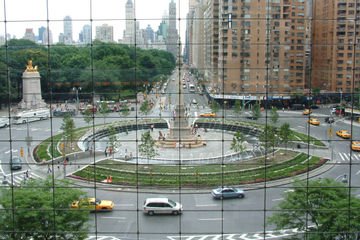
Columbus CircleThe nature and character of New York more than any other town I know is its constant change. Still, we bemoan the loss of favorite places or the character of a neighborhood as we once knew it fading. Columbus Circle has for some time been a glitzy affair, and the grit of the surrounding blocks is fast giving way to a clean, kempt, tourist- and business-friendly environment. The dark ‘piano seller’ cross-streets are still there, but I am dismayed at the exodus of a small, un-noteworthy Café-Restaurant-Bar half a block from the circle: “Cosmic.” Venti Java Chip Frappucino Blended Coffee DrinkA stone’s throw from the polished chrome and glass of the Times Warner Center sat this near-dingy hangout with mediocre espresso, decent burgers, cheap coffee, and cheaper soup. I have spent (and killed) many budget-friendly hours in one of its little wooden booths waiting for a performance at Lincoln Center or Merkin Hall or the Times Warner Center’s performance spaces – scribbling away wildly into little notebooks and emerging, caffeine-buzzed, with that slightly wily determination that besets out-of-towners when they start feeling like a “real New Yorker.” You can still read the faint letters “Cosmic” on the black façade where its sign once was. Next year it might be a bustling Starbucks. A Venti Java Chip Frappucino© Blended Coffee ($4.75) just around the corner.

See also "New York Soundtrack"
or "Paris in Passing"

6.8.05

New York Soundtrack


available at Amazon
S.Reich, City Life, New York Counterpoint, Eight Lines, Violin Phase..., Ensemble Modern
RCA

The soundtrack for New York is Steve Reich’s City Life / New York Counterpoint. It’s an accessible and very involving modern work, and if you want to find out where John Adams got his ideas for the Grammy-winning 9/11 memorial The Transmigration of Souls, go no further. The soundtrack of New York is the bustling of pedestrians, cars honking, tourists chattering, and (though less and less) someone screaming obscenities in broad daylight that would leave a Yugoslavian truck driver green with envy. I opted out and imposed my own audio-footprint onto the city.

available at Amazon
W.A.Mozart, Die Entführung aus dem Serail,
Gardiner
DG

UK | DE | FR
Thanks to my in-ear headphones that double as earplugs, I blocked out the sound of everything but the honking of those cars that almost ran me over (since I didn’t hear them coming while habitually jaywalking). Last week, Chinatown was transformed into a Seraglio from which J. E. Gardiner abducted me. Wiggling my head in infantile delight to “Martern aller Arten” (admittedly one of the lesser numbers of Mozart’s Entführung aus dem Serail), the walk to Gramercy Park received a janissary lilt that was most enjoyable. Part of DG/Archiv’s new “opera_House” line of budget reissues, the recording can’t be a first choice for lack of a libretto – but given the circumstances and the fair diction of Cornelius Hauptmann (Osmin), Stanford Olsen (Belmonte), Luba Orgonasova (Konstanze), Hans-Peter Minetti (Selim), Cyndia Sieden (Blonde) and Uwe Pepper (Pedrillo), that wasn’t an issue.

available at Amazon
W.A.Mozart, Don Giovanni, dir. Peter Sellars
Decca DVD

UK | DE | FR
The Mozartean New York experience inexorably evoked a living Peter Sellars production of one of Mozart’s Da Ponte operas, Don Giovanni, especially. Speaking of which… Don Giovanni is by far the best of the recently released three Sellars-DaPonte-Mozart collaborations. (As the Unitel archives are finally open to Universal, we saw and will see some very fine performances – not just in opera – appear on DVD for the first time!) From the overture over pictures of dilapidated areas in the Bronx to the brilliant depiction of Don Giovanni as a rapist (not one ounce of comedy here!) it is a must-borrow-and-watch-at-least-once kind-of DVD. Some find the singing good – I think it is pretty awful and not too well recorded, either. One very notable exception though: The bubblegum-chewing, second-generation Italian Donna Anna Elvira! The blonde singer/actress turns out to be none other than Lorraine Hunt (pre-Lieberson) and she’s splendid all around, with acting that stands out in a cast of mostly fine actors. I can’t believe it’s the Vienna Philharmonic playing, though… the band sounds scrawny at times, and underpowered. And the production is at a few points so dated, so 80s, that it hurts. Still, the portrayal, acting, and especially characterization make it one of the most important Don Giovanni’s to see, especially if you are interested in the interpretive possibilities this opera offers. How the Perry brothers' twin-pair Don Giovanni / Leporello leaves no humor in the second act's opening scene and rape, threaten, and bully their way through this most perfect of all operas will forever change your perception of Don Giovanni.

available at Amazon
G.Donizetti, L'elisir d'amore, Ferro
DG

UK | DE | FR

available at Amazon
Strauss/Wagner, Orchestral Works (rec. 1953), H. v. Karajan
Testament

UK | DE | FR
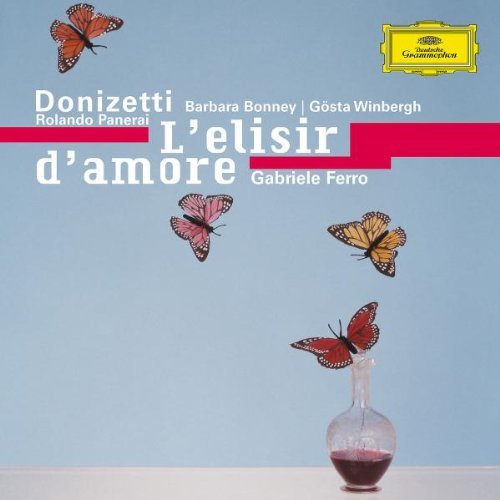
Keeping with the Mozartean spirit (roughly) was the most enjoyable L’Elisir D’Amore/Irving Street experience. I may come around to Italian opera yet, given how I took to Barbara Bonney, Gösta Winbergh, Bernd Weikl, Rolando Panerai and Antonella Bandelli under Gabriele Ferro’s leadership in the reissue on the mentioned opera_House line. Donizetti and Mozart both aided my operatic recovery after the “Shadowtime” experience the previous night that had already been treated with a late-night emergency download of Alfred Brendel’s late Beethoven sonatas (iTunes.com) the same night.

Before Marc-André Hamelin’s recital at the Mannes School, I gave my ears to Herbert von Karajan and the Philharmonia in Strauss and Wagner on a new Testament release. With a superb Till Eulenspiegel I took the L Train out of Greenpoint with the reasonable goal of 8th Ave./14th St. to then switch to the A or B train to 86th. Not quite, though. For lack of hearing anything other than Strauss (least of all any announcements over the intercom), I entered Union Square station and… before I had even heard the last note of a fine Don Juan, found myself back at 1st Avenue. The L simply refused to go further than Union Square. Still plenty of time, though, Tod und Verklärung played, and back again. Venus Mountain music (from Wagner’s Tannhäuser), the transfer bus 14D to 8th Avenue – and maybe a bit late for my meeting with an acquaintance to get good seats at the first-come/first-serve concert. Jumping on the train and listening to that Till again is one smooth move. Excellent. Times Square. Plush Strings, exquisite pacing. 59th Street. Great rhythmic energy in the Philharmonia’s playing. 125th Street. Shit. E-train was a bad (Express) decision.
available at Amazon
L.v.Beethoven / J.Brahms, Symphony No.2,
M.Jansons / Concertgebouw
RCO Live

Don Juan and back again on the next train. The D train, unfortunately, wasn’t a wise choice, either – as I reckon when I get off to T&V, rather annoyed, at 59th Street again. Maybe I’d get to the Mannes for the second half? The A train (good pick) back up and at 8.05 (two hours after my departure from a lovely Polish Bakery) I sat at the back of the stage, behind the Steinway, after all. I may forego music on future metro rides.

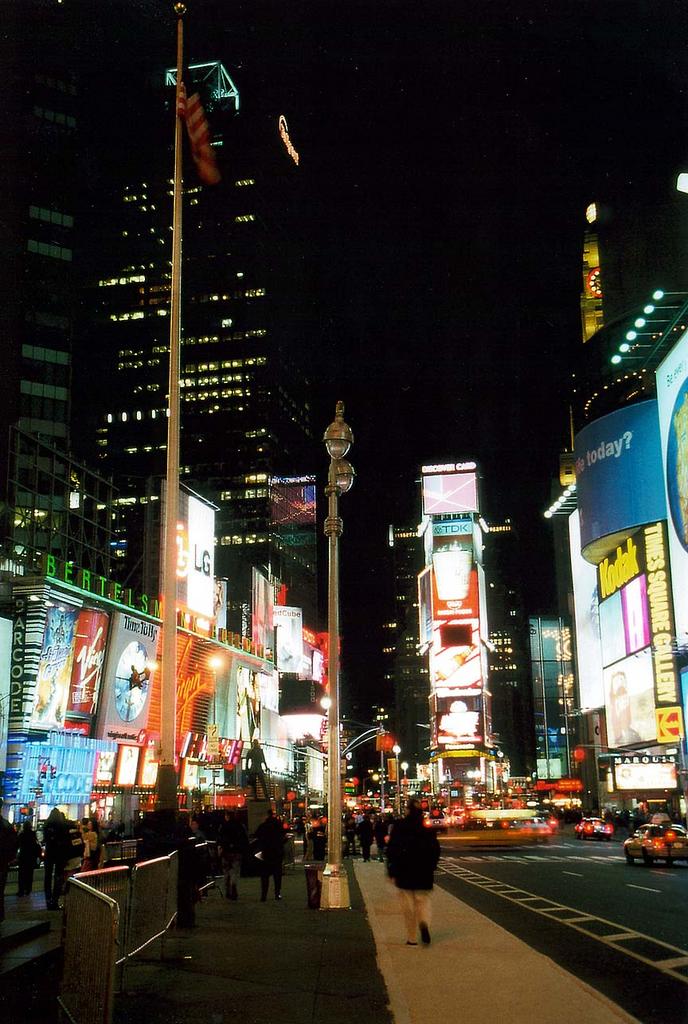
To be on the safe side altogether, I walked back from 85th to Gramercy – stopped at the Lincoln Center Tower classical department and cried. It’s a temple! They have CDs that are not even supposed to be available in the U.S. And a separate room for opera – tons and tons of opera and every available Parsifal recording under the sun. The rest of the way was Beethoven’s 2nd, which, in Mariss Jansons’s live recording with the Concertgebouw (to be released in early September) sounds like broad, flattened Mozart. Times Square at night to the second movement of that symphony is an experience – slightly on the surreal side – I recommend to everyone. I whistled (badly, probably) all the way to 37th, where Brahms’s second symphony took over. A tremendous performance under Jansons.
While the Beethoven is very good in its backwards-looking, robust way (pointing to the Jupiter more than the Eroica), the Brahms is energetic with great momentum that propels the listener through the first movement in no time. The strings sound excellent (they must sound even better if played on an SACD player) and the brass and woodwind have character on top of impeccable playing. It lasted until L’Express, a 24-hour Bouchon and alleged hang-out of Joshua Bell’s. The rest of the symphony was enjoyed many hours and several Ricards later at my pod around the corner.

See also "New York Vignettes"
or "Paris in Passing"