CD Reviews | CTD (Briefly Noted) | JFL (Dip Your Ears) | DVD Reviews
Showing posts with label James MacMillan. Show all posts

1.8.16

Latest on Forbes: James MacMillan In The Countryside


Contemporary Music Festival in Neuberg an der Mürz

…Usually it is chamber music that I seek when I make musical trips into the countryside… partly because Munich – if and when I am based there – is not a terribly good place for chamber music. When based in Vienna, the situation is not quite as dire, if only for the efforts of the Wiener Konzerthaus whose chamber music cycle(s) do all the heavy lifting and whose chamber music venues – the Mozart- and Schubert-Hall – are absolute jewels… acoustically and atmospherically better than the sarcophagus-like Brahms-Saal of the the Musikverein. There’s a bit of contemporary music going on in Vienna, too, but much of that either of the fig-leaf variety (done to satisfy the abstract notion that it should be done, but with little heart behind it) or in the damp prison cell of avant-garde niche-ism (“Wien Modern”, which has thus devolved). I’ve certainly never gone as far for a contemporary music festival as Neuberg an der Mürz – which is located somewhere between Vienna and the end of the world…

->James MacMillan In The Countryside

13.5.16

James MacMillan Leads the NSO

available at Amazon
J. MacMillan, The Sacrifice, C. Purves, L. Milne, Welsh National Opera, A. Negus
(Chandos, 2010)

available at Amazon
Vaughan Williams, Complete Symphonies, London Philharmonic, New Philharmonia, A. Boult
(Warner, 2012)
This month is all about the Wagner in Washington, but the area's two top orchestras are both offering excellent programs, too. Last night Scottish composer James MacMillan made his debut at the helm of the National Symphony Orchestra. As he did when he conducted the Baltimore Symphony Orchestra in 2008, MacMillan brought some of his own music, which the NSO last played in 2013, when they presented the local premiere of his third piano concerto.

Welsh National Opera gave the 2007 world premiere of MacMillan's second opera, The Sacrifice. The libretto by Michael Symmons Roberts, derived from the Mabinogion, the Welsh national folk epic, tells the story of a woman torn away from her love to be given in a politically advantageous marriage. MacMillan extracted Three Interludes from the opera to make a rather pleasing symphonic work, played here for the first time by the NSO. The large orchestration creates the impression of a tribal world, with violent twists provided by blaring low brass and plenty of percussion. The first movement ("The Parting") opens with a wild clamor of sound, after which a menacing melody rises through the orchestra. The second movement ("Passacaglia") presents the eponymous bass pattern in the pizzicato double basses, where it stays, eventually doubled by low brass. Heavy use of high woodwinds often gives a screeching effect, perhaps to evoke fifes or other folk instruments. The third movement is faster and martial, the low brass and reeds thumping away on a march pattern, ending in a Shostakovich-like finale accompanying the murder of the couple's young son.

Along with Scotland and Wales, the British program included pieces by two English composers, beginning with Elgar's poignant cello concerto. Alisa Weilerstein has played this concerto, so associated with Jacqueline du Pré, in recent years with the Baltimore Symphony Orchestra and also the NSO, in 2013. Cellist Alban Gerhardt brought an intense, moody approach to the solo part, rising up forcefully on the A string to bring in the full orchestra in the first movement, and with a big pizzicato sound in the transition to the faster section. He played fast and furious in the Allegro molto conclusion to the second movement, with MacMillan carving out enough sonic space and subtlety of color for his soloist's sometimes small sound. Gerhardt's strengths lay in a tender and introspective interpretation, rather than broad strokes, to which this concerto is nicely suited, making the third movement's delicate softness the high point rather than the heady sweep of the finale.


Other Reviews:

Anne Midgette, The NSO goes to Britain (Washington Post, May 13)
More performances of the Vaughan Williams symphonies are generally welcome, and MacMillan led the NSO's first performance of the composer's fourth symphony since Leonard Slatkin conducted it in 1999. (The last Vaughan Williams symphony played by the NSO was the 'London' Symphony in 2013.) The fourth is founded on a dissonance, a minor 2nd that opens the first movement with a bracing clash, part of a chromatic motif (F, E, G-flat, F) reportedly drawn from Beethoven's ninth symphony and disturbingly similar to the BACH name motif. MacMillan relished the general loudness of the piece, allowing the gnarled mass of lines to clot upon itself in the first movement, but also coaxed lush string playing and cooing brass accompaniment in the second theme.

The harmonic palette of the second movement sounded not unlike that used by MacMillan in his interludes from The Sacrifice, with a beautiful concluding flute solo over the movement's dying embers. The chromatic theme (and a second quartal theme) runs throughout all four movements, showing the influence of Beethoven as Vaughan Williams transformed it into a dancing scherzo theme in the third movement and a triumphant call in the fugato finale. MacMillan again marshaled the NSO forces impressively in the slightly maniacal fourth movement, with a hint of Shostakovich-style banality, as the chromatic theme was obsessively repeated and altered through many diminutions and augmentations, seething with tension.

This concert repeats tonight and tomorrow, in the Kennedy Center Concert Hall.

21.6.13

NSO Ends Season with a Modern Bang

available at Amazon
W. Lutosławski, Concerto for Orchestra (inter alia), Polish Radio National Symphony Orchestra, W. Lutosławski
(EMI)
The regular season of the National Symphony Orchestra came to a memorable close last night in the Kennedy Center Concert Hall. Before heading off for summer shits and giggles at Wolf Trap, the ensemble brought back Witold Lutosławski's virtuosic Concerto for Orchestra, not heard from the NSO since 1998, pairing it with the one-night-only local premiere of the new piano concerto by James MacMillan, Mysteries of Light, completed in 2008 and premiered by the Minnesota Orchestra in 2011. It was daring programming that rewarded the hard-working musicians, who gave one of their finer performances of the season.

It was a rare enough thing to have heard one Lutosławski piece performed this month, but two is pretty much unheard of around these parts. Where the later Trois poèmes d'Henri Michaux is experimental and just downright weird -- a good weird, but still -- the earlier Concerto for Orchestra is sheer delight, in harmonic adventure, melodic appeal, rhythmic complexity, and most of all, orchestrational variety. The word tour de force truly applies. Most of the melodic material comes from a collection of Polish folk songs, treated in a fragmented, repetitive, motivic way. Stasis is one of the piece's hallmarks, with an F# pedal in the opening of the first movement later pinged by the celesta in a section for woodwinds and high strings. The second movement's rushing runs were stunningly fast but with pleasing subtlety, down to the enigmatic coda in the double basses and percussion. The passacaglia of the third movement began suavely, shot through with bluesy touches, the many orchestral colors and metric shifts preventing the relentless triple meter from becoming monotonous.

This was the NSO debut of conductor Krzysztof Urbanski, who took over the Indianapolis Symphony Orchestra after Mario Venzago's contract was not renewed. He had a clear beat and a no-nonsense way of helping the musicians shape the music, rarely seeming at odds with them. He did have a regrettable tendency to use his cue hand to give showy gestures, like little finger flicks for trills or grace notes here and there, which were meant only for the audience's benefit. Still, he coaxed some murky pianissimi from the musicians in the second movement of the first suite from Grieg's music for Peer Gynt, "Åse's death." The strings, in particular, had a unified and pretty sound in this piece, leading a manic dance in "In the Hall of the Mountain King."


Other Reviews:

Anne Midgette, Polish conductor, Kennedy Center organ impress as NSO closes season (Washington Post, June 21)

Robert Reilly, Second Opinion: NSO with Tough MacMillan Nuts, Lutosławski Excitement (Ionarts, June 21)
MacMillan's new piano concerto struck me in much the same way as his second piano concerto did, its five movements, each representing one of the Luminous Mysteries added to the Rosary by Pope John Paul II in 2002, forming a multistylistic melange. MacMillan's Catholic devotion was on display in the quotation of Gregorian chant, most prominently the incipit of the Ave Maria chant, heard in increasingly dissonant settings, often hammered out like a motto (some of the rest of the chant is heard later). At the keyboard, Jean-Yves Thibaudet handled the often frenetic solo part with aplomb, a sort of commentary, sometimes urgent and sometimes reflective, on the mishmash of sounds from the orchestra. Each mystery had odd touches: the brass fanfare and trombone chorale of "Miraculum in Cana," the piano's atonal bird songs (a tribute to another Catholic modernist, Olivier Messiaen) against lush low string strings in "Proclamatio Regni Dei," a hymn tune that rose above multimetric chaos in "Transfiguratio Domini Nostri." It would be hard to meditate to this music while praying the Rosary, which was not MacMillan's goal, but it made for fun and diverting listening.

The evening was capped by only the second "Postlude" recital on the new Kennedy Center Concert Hall Organ this season, a series that the NSO hopes to broaden next season. At the console was Russell J. Weismann, whom I know from my time singing in the choir at the Basilica of the National Shrine of the Immaculate Conception, who charmed in both his spoken introductions to the pieces and how he played them. He brought out the instrument's many colors, including the rather awful "Filene" stop, the only set of pipes that was kept from the old instrument that this organ replaced. The brief recital concluded with a trashy showpiece, Dudley Buck's Concert Variations on the Star-Spangled Banner, which was everything I dreaded it would be. If you were wondering if the American national anthem's melody could be made into a fugue, wonder no longer.

This concert repeats tonight and tomorrow night, with Saint-Saëns's fifth piano concerto unfortunately replacing the MacMillan piece and no organ recital.

Second Opinion: NSO with Tough MacMillan Nuts, Lutosławski Excitement

Many thanks to Robert R. Reilly for this review from The Kennedy Center.


Thursday night, at the Kennedy Center,the National Symphony Orchestra welcomed Polish conductor Krzysztof Urbanski in a program of Edvard Grieg, James MacMillan, and Witold Lutosławski.

Grieg’s Suite No.1 from Peer Gynt made for a nice curtain raiser and warm-up piece. It also revealed the style of the very young conductor, who only graduated from the Chopin Music Academy in Warsaw in 2007. Mr. Urbanski kept the beat with his baton in his right hand, and did a good deal of expressive sculpting with his left hand—almost as if he was playing it as an instrument. I don’t think this was an affectation and even if it was, it seemed to produce very good results. I was particularly struck by the second movement, Ase’s Death, which is a threnody for strings alone, with all but the double basses playing with mutes. The NSO string section positively glowed with warmth and feeling, down to the final, exquisite pianissimo. In the last movement, In the Hall of the Mountain King, Urbanski showed that he knew how to build a movement with the whole orchestra to an impressive climax.


Other Reviews:

Charles Downey, NSO Ends Season with a Modern Bang (21.6.13)
I was very interested to hear MacMillan’s Piano Concerto No.3, which was composed for performing pianist Jean-Yves Thibaudet, who premiered the piece with the Minnesota Orchestra in 2011. It has taken some time for me to be won over by this Scottish Catholic composer, but the work that finally did it was his Seven Last Words, an ineffably moving Good Friday meditation. Still, much of his music is difficult, and so were parts of this Concerto. (I would suggest that those who have assimilated the musical and extra-musical language of French composer Olivier Messiaen would not have much of a problem with it. The programmers at the NSO must have known that this was the case [Ed. or simply don’t trust their audience], which is why they have placed Saint-Saëns’ Concerto No. 5 in lieu of the MacMillan, for the remaining two performances of the program. The piece is subtitled The Mysteries of Light. MacMillan said he wished “to revive the ancient practice of writing based on the structure of the rosary”. The Mysteries of Light title is a reference to the Luminous Mysteries of the rosary introduced by Pope John Paul II in 2002. They are, in English: the baptism of Jesus Christ; the miracle in Cana; the proclamation of the reign of God; the Transfiguration of our Lord; and the institution of the Eucharist.The five movements are played continuously.

20.6.13

Briefly Noted: MacMillan Piano Concerto

available at Amazon
J. MacMillan, Piano Concerto No. 2, W. Marshall, BBC Philharmonic, J. MacMillan
(Chandos, 2006)
Krzysztof Urbanski is conducting quite a program with the National Symphony Orchestra tonight, combining Grieg's Peer Gynt Suite No. 1, op. 46, and Lutosławski's Concerto for Orchestra. In between will be Jean-Yves Thibaudet playing a piano concerto, either the new third piano concerto by Scottish composer James MacMillan -- tonight only -- or the old Thibaudet standby, one of the Saint-Saëns concertos (no. 5, "Egyptian"). Urbanski is the chief conductor of the Trondheim Symphony Orchestra and, since the peremptory dismissal of Mario Venzago, the music director of the Indianapolis Symphony Orchestra. MacMillan's third piano concerto, premiered in 2011 by Thibaudet and the Minnesota Orchestra, is based on the structure of the Rosary, specifically the Luminous Mysteries added to the meditation of the Rosary by Pope John Paul II.

The third concerto has not been recorded yet, but tonight's local premiere sent me back to have another listen to MacMillan's second piano concerto, in a recording conducted by the composer. This score was expanded from a single-movement work, Cumnock Fair, which remains the first movement of the concerto, to serve as the accompaniment of a choreography by Christopher Wheeldon for New York City Ballet in 2004. The first movement begins with a frenetic orchestral unison, an introduction to a sometimes dissonant fantasy on 18th-century melodies by John French, a friend of Robert Burns who lived in Cumnock, with the piano often reflecting on them nostalgically. The slow movement has an old-fashioned, even schmaltzy quotation of the mad scene from Donizetti's Lucia di Lammermoor in the middle, which comes back like a nostalgic memory at the end of the third movement. The finale is a high-spirited reel, with all sorts of interesting percussive and harmonic effects laid over the top. It receives a fine if not all that remarkable performance by Wayne Marshall and the BBC Philharmonic on this Chandos disc, which is frankly overshadowed by the same soloist's rendition of MacMillan's hallucinatory organ concerto A Scotch Bestiary, from 2004, which is a wild ride worth your time. Hopefully, it is on Christoph Eschenbach's To-Do list.

The National Symphony Orchestra will play James MacMillan's third piano concerto only this evening (June 20, 7 pm), in the Kennedy Center Concert Hall. Also only tonight is one of the free recitals on the Concert Hall's new organ, just following the concert. This time, Russell J. Weismann, Associate Director of Music at the Basilica of the National Shrine of the Immaculate Conception, where we spent time imprisoned as a chorister, will play the Cortège et Litanie by Marcel Duprè, Herbert Nanney's Sonata in E minor, and Dudley Buck's Concert Variations on the Star-Spangled Banner.

12.1.08

Hope, MacMillan, and the Munich Philharmonic


Proof that good connections and aggressive management, astute choices of repertoire and collaborations are at least as important as talent in manufacturing a career is the rise of Daniel Hope. The violinist, one of whose greatest distinctions it was to have been Yehudi Menuhin’s last student (his mother was Menuhin’s assistant) and regular collaborator, was still a child when he played Bartók’s 44 Duos for Violin for German television (and a subsequent 60 concerts) together with the grand old master.

available at Amazon
F.Mendelssohn-B., Violin Concerto, Octet et al.,
D.Hope / ChOE / T.Hengelbrock
DG


available at Amazon
A.Berg, B.Britten, Violin Concerto(s),
D.Hope / BBC SO / P.Watkins
Warner

His popularity in Germany and the UK stems not the least from his work with Schnittke and the London Royal Academy, membership in the now retiring Beaux Arts Trio, projects with Klaus Maria Brandauer, Sting, and Uri Caine. Most recently a book about tracing his heritage (“a search for Hope's roots in Europe, Africa and beyond, weaving the disparate strands of his ancestry – prosperous assimilated German Jewish families who became refugees from Hitler, a young Irishman who sought his fortune in South Africa…”) was a most judicious move that garnered much of that all-important publicity.

Now he has an exclusive contract with the Yellow Label, Deutsche Grammophon, – and is in the company of violinists like Hillary Hahn, Gidon Kremer, and Vadim Repin. All superb artists that few experts would suggest Hope to be on the same level with. I, for one, had never been all that impressed with the recordings I had heard of Daniel Hope and only thought him “quite good”. My impression became much more favorable when I heard him twice at the National Gallery of Art in Washington DC with the Beaux Arts Trio where he displayed musicality and chamber-playing instinct, rather than just serving as a ‘violinist patch’.

Still, his signing with DG was more than a mild surprise. I’ve not heard the first result of this collaboration yet (the Mendelssohn Concerto, Octet, and arranged songs with the Chamber Orchestra of Europe under Thomas Hengelbrock), but all the more eager was I to hear him in concert again, now as a soloist.

The opportunity provided itself when the Munich Philharmonic, conducted by composer James MacMillan, took on a nicely challenging and interesting program of Giovanni Gabrieli choruses for eight to fourteen brass instruments, Britten’s Violin Concerto, and his own “Vigil” Symphony. After the bright and impeccable brass pieces had been gotten out of the way, Hope displayed that Britten. With a nice tone, clarity, accuracy, and inner tensions, there was little to take issue with except perhaps the pianissimos which were not all evenly beautiful.

There was a movingly lyrical touch that Hope gave to the concerto, whether above the timpani pounding away (Beethoven’s spirit calling) or amid the brass glory in the unbound joyous energy of the second movement. (No influence of the impending war in Europe to be heard here.) The great Elliot Carter, 99 years old and still kicking, very aptly called the concerto the English pendant to Prokofiev's and Shostakovich's.

There is a dark brass front towering over the end of the second movement (“Vivace”), just before the pizzicato studded cadenza, that briefly has a Shostakovichian, threatening quality. But even that is not in any way war-like – and leads anyway to the glorious transition to the Passacaglia of the final movement. The brass continued sumptuously, Hope with contemplation. This was clean, impeccable, and a little more than that, too. Emotionally riveting it was not, but with the Britten it did not need to be for great effect. The concerto needs first and foremost to be played beautifully to work well, and that it was beyond any doubt.

I was much enamored with the difficult but enjoyable, profound but listener-oriented music of James MacMillan when I heard his “Seven Last Words” live (more so than listening to it on record) with the Choral Arts Society of Washington. “Vigil”, the third part of his 1997 triptych “Triduum”, and consisting of three movements: “Light”, “Tuba Insonet Salutaris”, and “Water” received its German premiere with the Munich Philharmonic and it fascinated more listeners than it disturbed, although it did that, too, and plenty.

Out of silence appear sounds of dim color like bulbs that are then violently interrupted with percussion. There follows a soft orchestral passage before another, dark and brass colored, bulb with growling phrases grows. The phrases become shorter and then longer again, all awhile brutal sounds alternate with light, lofty lines: This stop’n’go strategy dominates MacMillan’s first movement, veering between dark and tender, snarling violence and gentle touches. The Philharmonic at the Gasteig was filled with eastern sounds, shy shimmers of metal, ominous swells and ever recurring moments of portentous silence -- silences so complete that the ticking of my automatic wrist watch seemed embarrassingly loud.


available at Amazon
J.MacMillan, Triduum III - Vigil,
O.Vänskä / Glasgow BBC SSO / Pendrill, Wallfisch
BIS 990


available at Amazon
J.MacMillan, Triduum I & II - The World's Ransoming, Concerto for Cello,
O.Vänskä / Glasgow BBC SSO / Pendrill, Wallfisch
BIS 989

A brass quintet’s chorale introduces another orchestral clash (again providing a link to the Gabrieli pieces first heard), there is more ‘storm and retreat’ going on before the brass lets it rip in the Easter proclamation Exultet – “(et pro tanti Regis victoria) tuba insonet salutaris.” ("...Sound the trumpet of salvation!") The violent climaxes before the celesta create a false (?) sense of calm and idyll only to be – again – violently and wildly interrupted at random intervals.

These interruptions were taken as a cue for many audience members to demonstratively leave the hall, with the third movement not even under way. These fair-weather listeners thus sent to the exit in scores, the third movement – “Water” – proved even and flowing at first, more passive, dark with calm brass passages, lots of col legno additions by the strings which only now entered the action in this work. There is an elemental, raw power that sweeps before it the listener into the cacophonous climaxes in “Vigil”. It compelled this listener to a happy, inner and delighted laughter about the work’s audacity but also about its effect on others (either completely enraptured or uncomfortably squirming in their seats). After about 16 minutes of darkness in the first two movements (despite the misleading title “Light” of the first), light only comes into play in “Water” where its refractions blink and shimmer to the surface amid the many sounds swirling about. Mad gallops toward the end of the third movement sent yet another wave of listeners out of the hall – and during the work’s end over faint, silver touches you could hear those patrons just outside, discussing angrily what they had just been made to listen to.

It was a fine day for good new music and a courageous triumph for the Munich Philharmonic (which offered professional, if not great, playing). But it was also a monument to the lack of curiosity of much of its clientele. The Munich audience had proved by virtue of its absence that it will only pretend to be interested in modern music to a certain extent… and that programming a “modern, little known composer” like Britten (that’s sadly his status among many attendees) with a contemporary piece and some obscure renaissance prelude is far too much for them to respond to. As rich as the cultural environment is in Munich, and as much as it prides itself in its diversity, it cannot deny a certain provincial attitude that is often coupled with a plain ignorant and dismissive attitude of all (cultural) things Anglo-Saxon and, indeed, foreign. Give the subscription holders of the Munich Philharmonic their Strauss (either), Mozart, Brahms and they shall be happy. Give them Britten and they won't come - or come and leave mid-concert. A pity.

Undeterred, laudably, the Munich Philharmonic will offer Thomas Adès’ Asyla from January 30th to February 1st. James Macmillan will also conduct the Baltimore Symphony Orchestra in Beethoven's second symphony, as well as his own second piano concerto and Stomp (April 3 to 6).


Directly Related: From today's (01/13/08) New York Times comes this article about Daniel Hope and his book: "How's the Family? Fascinating" by Matthew Gurewitsch.

17.4.06

Seven Difficult, Impressive Words From James MacMillan


The United States, country of paradoxes and riddles, has a funny (sometimes sad, at other times perplexing) way of dealing with its religious history. There are politicians who rule as if this were a Christian country when, politically, it isn’t… who are only too happy to exploit religious sentiment; pander to prejudice over reason. There are cultural administrators who develop paroxysms pretending this isn’t a Christian country, although given its cultural history, it is. Easter, however, the drive towards religio-cultural sterility stops for a while – and we can listen to works like Bach’s St. Matthew Passion (as we did last Thursday--and, unlike last year, thankfully without the political-correctness disclaimer) or, intriguingly, the native Scot James MacMillan’s Seven Last Words from the Cross last Friday at Strathmore.

Although a dozen years old, MacMillan’s work received its premiere performance in the region by Norman Scribner and the Choral Arts Society of Washington (ChASo). Composed for a BBC television series for Holy Week, it has recently gotten a shot in the arm with an – upon second hearing – excellent recording by Polyphony under Stephen Layton on hyperion. The work and the recording have received highest of praise; responding to it in ways I admittedly could not, after an initial hearing. All the more exciting to hear the work live then. If the ChASo and Scribner did not outright deliver the answer to the question as to why (or whether) MacMillan’s Seven last Words is indeed a great work, they handed over the key to it.

Far from being a self-explanatory, easily digestible piece of music (as suggested by a gushing American Record Guide reviewer), these seven words (the setting a choral tradition in line with Schütz, Haydn, and Dubois, who all found very different answers to the challenge of setting seven utterances coming to a total of some four dozen words) are purposely challenging, variously spiky and austere. At times even grating and harsh. But around every corner also lure beautiful and overwhelming moments. Whoever wouldn’t be moved by the outbreak of Pärt-reminiscent, crystalline beauty, showered with sudden rays of sunshine to the words of “Venite adoremus” in the third part, after “Verily, I say unto you…”? It follows and is followed by an ancient plainchant, two basses taking “Ecce Lignum Crucis” above a humming drone, then tenors repeating the same, then mezzos, and finally sopranos. All suggests the sound of what we think music in ancient Palestine might have sounded like. It is here that the music betrays its TV roots; it appeared, even without the knowledge of its first such use, a sophisticated soundtrack for The Passion of the Christ or somesuch other film.


available at Amazon
J.MacMillan, Seven Last Words From the Cross et al.,
S.Layton / Polyphony
Hyperion

Alas, here, as throughout the work, there are abrupt changes in vocal, choral, and sometimes orchestral line that don’t make for easy following of the music. Understanding what the composer aims for helps tremendously in appreciating it as music. (Much like you don’t understand a word if someone quickly spoke to you in English when you expected French but, knowing it to be English, naturally understand everything). The edges and corners MacMillan throws into the music ensure that repeated listening produces increasingly greater enjoyment. Rhythmically the work tends to be simple, the tension it builds comes from attacking tonality from all sides, never leaving it but rarely settling in it comfortably. In Bach’s Matthew Passion, Jesus loses his halo (in form of the first orchestra's strings that always accompany him) as he loses faith and utters the words “Eli, Eli lama sabachthani?” In MacMillan, surely influenced by that work, if less audibly so to my ears than other commentators, that scene is set to a dark, sharp-edged music, if not too different from most of the broodingly shimmering rest of the work.


Other Reviews:

Grace Jean, Choral Arts Society Bears 'Cross' Nobly (Washington Post, April 17)
The basses growl “I thirst” in the fifth section, the high voices shriek out the Good Friday reproaches. Part six, “It is finished,” displays the kind of doom that every commentator and MacMillan himself, perhaps, hear Shostakovich in – I hear Bernard Herrmann in it and the jagged attacks from the Psycho soundtrack hacking away like scavenging birds on a corpse. It ends with barely breathed, many small whimpers after which the composer specifically asked that no applause take place. Still holding his hands up, Norman Scribner walked off the stage, ensuring only a few ill contained bursts of applause.

Despite its difficulties, despite some curious choices (most of which become more logical upon repeated exposure), despite its stark nature, this may well be the best Anglo-American large-scale sacred composition I have heard since Adams’ El Niño and Lauridsen’s (somewhat sweet) Lux Æterna (both of which The Seven last Words actually predates). Far more inspired, inspiring, and moving than the samba, mambo, salsa-influenced, maracas-touting, semi-mediocre, pseudo-religious Masses and passions that have been performed and recorded in the last decade. The whole being greater than the sum of its parts, the ChASo’s performance made me revisit and thoroughly appreciate the recording with its more precise, clean, and better-defined chorus than this (still very good) live performance offered. The largest quibble: if you have to ask people not to applaud (because it’s such a very meaningful work, so sacred, oh-so moving), it’s probably a sign that you have failed on that account. It’s easily good enough a work to be enthusiastically or quizzically applauded. It’s not good enough for silence, reserved only for the most spiritual of Bruckner or most searing of Mahler performances.
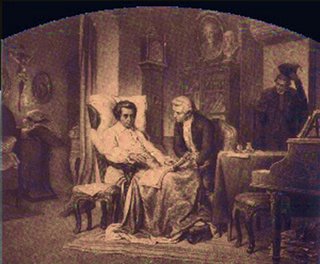

Süssmayer at Mozart's deathbedFollowing MacMillan came the mostly-Mozart Requiem, K. 626; myth-laden, ever popular. Backed by a nearly 200-throat strong choir, it got a smooth, well-oiled, supple, and moving performance from Introitus full circle to Lux Aeterna. The chorus was excellent, the orchestra did what it was asked to do and did it well: no more and, more importantly, no less. The soloists were a fine Elizabeth Keusch (soprano, big voice, pleasant, lightly veiled), an equally fine bass in Mark Risinger, mezzo Linda Maguire (faux-operatic, affected, ineffective), and the overtaxed, lost-sounding tenor John McVeigh, who presented his strapping good looks but sounded like the roasted swan in Carmina Burana. None of these shortcomings prevented Scribner and his forces to give an appropriately moving, beautiful performance to which the crowd gave an enthusiastic reception.