CD Reviews | CTD (Briefly Noted) | JFL (Dip Your Ears) | DVD Reviews
Showing posts with label ClassicsToday. Show all posts

5.4.26

A (Very!) Fine Messiah From Václav Luks and Collegium 1704

available at Amazon
G.F.Handel
Messiah
Luks/Collegium 1704
Semenzato, Schachtner, Adam, Stražanac
Accent, 2019>


US | UK | DE

available at Amazon
G.F.Handel
Messiah
McCreesh/Gabrieli Consort
Röschmann, Gritton, Fink, Daniels, Davies
Archiv, 1997


US | UK | DE

available at Amazon
G.F.Handel
Messiah
Bernius/Stuttgart BO
Sampson Taylor, Hulett, Harvey
Carus, SACD, 2009


US | UK | DE

To say that there is no dearth of recordings of Handel’s Messiah is putting it mildly. Even granting that every generation needs its interpretations of the classics, there is a glut. On the downside, not all of them are very good. On the upside, choice is a beautiful thing and there is bound to be a recording out there for each taste. The recording at hand might be an interpretation for a listener who has heard Handel’s masterpiece one too many times and needs a deliberately fresh take. While Václav Luks and his Collegium (Vocale) 1704 are not yet international household names (though well on their way there), they certainly are a first-class ensemble, up there with the best and most famous… and they have a knack for finding and working with good and excellent singers. So, the fact that the recording features a quartet of unknown soloists does not make this release less promising.

And indeed the singers are very fine; not all of them impressive but all devoid of mannerisms or any ostentatious modi. Bass Krešimir Stražanac hasn’t the most sophisticated bass voice – it’s a little nasal, just a little barrely – but he certainly doesn’t spoil the party. Giulia Semenzato’s soprano is clear, clean and accurate… more like an operatic Mozart soprano than a baroque specialist, although these two fachs very much overlap in reality. Alto/Countertenor Benno Schachtner is a delight; in the duet with Semenzato (“He shall feed his flock like a shepherd”) his voice rings out with artless, unfussy beauty and his “He was despised” is touchingly natural, becoming a highlight of this recording. Tenor Krystian Adam remains a wee indistinct throughout because he blends nicely into the proceedings and never sounds strained or trying too hard. He might be unfairly overlooked: “Thy rebuke hath broken His heart”, for example, is exemplary for unaffected-yet-dramatic singing and very impressive in its subtle ways. The chorus is well drilled, usually easy to understand, and with five singers to a part offers thrilling energy and depth – for example in “Surely, He hath borne our griefs…” (Sound clip)

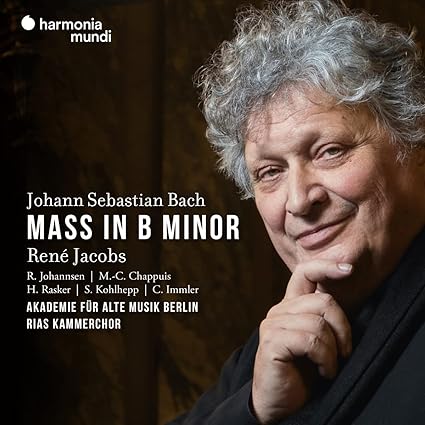
In Luks’ hands, the famous bits stand-out for being taken in various, slightly unusual ways: “For unto us a child is born” is not just fast which, for its own sake, could be tedious, but communicates splendid excitement and a tangible sense of joy. They sail right through the Halleluja, too. If you come straight from Malcolm Sargent, it must seem flippant but it has ripping, infectious energy to it. The opening of Part II, “Behold the Lamb of God” and the subsequent “He was despised”, makes René Jacobs and his Freiburgers seem positively glacial. (Sound clips) It’s one of Jacobs’ more extreme moments, granted, taking four and half minutes where well under three is HIP-standard. And while Jacobs can certainly please our every inner speed demon – he switches gears sometimes mid-number to press on like there is no tomorrow – there’s a generally heavier touch to the Freiburg Baroque Orchestra while the Collegium 1704 seems to be blown along on a light cloud. Breezy. Too breezy, for some. But after an initial double-take here or there, on repeat listening no part felt like it was being brushed over; what remains is just the impression of a good quick and steady pulse.

With Jacobs being a much more dramatic, downright operatic account with a far stronger interpretative stance, it might not actually make for the best comparison. Frieder Bernius’ fine, slightly matter-of-fact (sound clips) Messiah on Carus is a more similar take: strait-laced, similar tempi, good singing, no-nonsense. Both present a good modern HIP standard; neither outright demand to replace your reference versions, whatever those may be. (A little trivium: In the ten years between those two recordings, the aforementioned Schachtner had made it from choir member for Bernius to soloist with Luks.) The sound on the Accent recording is brighter and more transparent than that of the Bernius SACDs, and the more prominent harpsichord (Joan Boronat Sanz) adds welcome texture. (Bernius uses a positif organ.) You won’t notice that this is a live recording until the enthusiastic roar and applause erupts at the end – but it explains why the chorus is set a little further at the back in this recording than, say, Jacobs’ studio effort.


9/9


(Originally on ClassicsToday)


29.11.25

Dip Your Ears: No. 282 (Erkki-Sven Tüür’s Indelibly Interesting Symphonies)


available at Amazon
Erkki-Sven Tüür
Symphony No.5,
Prophecy (Accordion Concerto)
Nguyên Lê, Mika Väyrynen
Olari Elts, Helsinki PO
(Ondine, 2007)


US | UK | DE

Erkki-Sven Tüür’s Fifth for Orchestra, Big Band and Electric Guitar


Erkki-Sven Tüür’s ongoing cycle of interesting symphonies (in 2017 he arrived at No. 9) makes him – by quality more significantly than quantity – the premiere symphonist of our time. Always good for the inclusion of seemingly eclectic instruments (electric guitar, accordion, big band, percussion, tape, synthesizer) in his orchestral works, he expands the tonal palate much the same way a Gustav Mahler did when the latter threw the mandolin or guitar or castanets or xylophones or a hammer into his symphonies, all before perfectly unsuspecting audiences. (Happily, this is much easier on the ears than when other composers stick with the traditional instrumental apparatus only to then make these instruments generate every sound except those they were meant to produce in the first place.)

In this Fifth Symphony, premiered in 2005 at the Stuttgart Eclat New Music Festival, the electric guitar has some particularly lyrical quasi-cadenzas in the second movement. The fact that we might find it curious is only a consequence of our aural associations and expectations with and of an electric guitar. But all the rest of the symphony is pretty classical, down to the four-movements and their structure, which goes to show that there’s still much left in the old form and ‘old’ – i.e. tonal – modes, if only a composer can muster sufficient imagination.

Erkki-Sven Tüür does. In fact, his works are bursting with originality and phantasy, freed of all academicism and perceived “ought-to’s”. Not all of them as successful as this Fifth (or the Seventh) Symphony, perhaps, but always full throttle and never displaying originality for its own sake. The groove of the third movement is befitting any classical Scherzo; the Big band gets its moment in the spotlight, backed by a percussive, happy but firmly embedded, organic beat (sound clip) – not as artificially superimposed and faddish as large percussion sections can sound in too many contemporary works (Higdon, Sierra, Widmann, Golijov et al.).

It’s possible that connoisseurs of conventional symphonies wrinkle their brow in disapproval of these allegedly foreign ingredients. This brings to mind a beverage-related spoonerism of composer and linguistic genius Franz Mittler: “I would rather have a boot in my rear / Than a root in my beer.” But Tüür’s symphonies are not symphonies-in-name only, they are decidedly real beer; just a modern variant of the classic original. Maybe something Dogfish Head Brewery would concoct.

Rounding out a fabulous disc is the accordion concerto Prophecy, a substantial concerto in four continuous movements, which often ends up a swarm of sound with intermittent, hallmark Tüür moments (dry timpani before a canvas of dark quiet, for example). In it, the accordion is less folksy than it is grave; the whole thing more redolent of an organ concerto than a polka. As a card-carrying accordion-lover, I dig it muchly.


This review had been previously published on Classics Today.

30.9.21

On ClassicsToday: Bernard Labadie's Orchestra Goldberg Variations Re-Issued

 Goldberg Variations Variations (Les Violons du Roy Edition)

Review by: Jens F. Laurson

BACH_Goldberg-Variations_Violons-du-Roy_Labadie_ATMA_ClassicsToday_jens-f-laurson_classical-critic

Artistic Quality: ?

Sound Quality: ?

You name any instrument or combination thereof and I give you a recording of the Goldberg Variations to match it. Nearly, anyway. The good versions entice the ears or tug the heartstrings; here is a re-release that errs on the right side of success, adding its spin to old Bach’s perennial masterpiece. It’s the period band Les Violons du Roy performing an arrangement for strings and continuo, concocted and conducted by the orchestra’s founder/director Bernard Labadie. If this sounds familiar, it’s because this recording on Atma Classique was originally released on the Dorian label in 2000. It got a Classicstoday.com 10/10 rating then (see reviews archive) and the re-issue ... (Read the entire review at ClassicsToday)

5.5.21

On ClassicsToday: New Beethoven Concerto Cycle from Mitsuko Uchida

 Mitsuko Uchida’s Second Beethoven Concerto Cycle

Review by: Jens F. Laurson

Beethoven_Piano-Concertos_UCHIDA_Rattle_BPH_BPH-SACDs

Artistic Quality: ?

Sound Quality: ?

Mitsuko Uchida’s slightly-under-the-radar cycle of Beethoven Piano Concertos with the Bavarian Radio Symphony Orchestra and the artless Kurt Sanderling (Philips/Decca) is one of my favorites for its almost self-effacing musicality and the orchestral precision that translates into lightness without sacrificing oomph. On Classicstoday.com Jed Distler praised the “Emperor” as ranking “with Schnabel, Solomon, Kempff, Arrau, Fleisher, and Gieseking among [the] finest recorded versions.” Naturally, Uchida’s new cycle elicited my interest. (Read the entire review at ClassicsToday)

4.5.21

On ClassicsToday: A Vikingur Retrospective, Musicianship over Hype

 Triad: Víkingur Ólafsson’s Greatest Hits

Review by: Jens F. Laurson

BACH_GLASS_RAMEAU_Triad_Vikingur_DG_ClassicsToday_jens-f-laurson_classical-critic

Artistic Quality: ?

Sound Quality: ?

Triad, the latest release by Icelandic pianist Vikingur (Heiðar) Ólafsson, isn’t a new album. It’s simply a fancy repackaging of his last three main releases for Deutsche Grammophon. This wouldn’t be particularly noteworthy if all three of those releases weren’t absolute corkers. There’s a disc of Bach–transcriptions both original, third-party, and by Bach himself–that was an easy 10/10 choice when we reviewed it here (see reviews archive). Both of the other two albums are similarly lofty achievements... (read the entire review at ClassicsToday

3.5.21

On ClassicsToday: Wonderful Józef Elsner String Quartets


String Quartet Discoveries: A Polish Haydn?

Review by: Jens F. Laurson

ELSNER_Jozef_String-Quartets_Op1_NFM_CD-ACCORD

Artistic Quality: ?

Sound Quality: ?

This disc of the first-ever recordings of the String Quartets Op. 1 Nos.1-3 by Józef Elsner (1769-1854) is not the first disc of Elsner string quartets, but it marks the first time I took note of a name I’ll now never forget. They are such good works, much in the vein of Haydn, that I fell in love right away. But could they really be that good? Perhaps I was getting carried away. Yet on the tenth–or fifteenth–hearing they still hold up. These are varied, mature classical string quartets of the first order, not second tier also-rans... (read the entire review at ClassicsToday)

17.11.20

On ClassicsToday: Gimmick Instrument, Splendid Performances: "Mozart’s Violin"

Gimmick Instrument, Splendid Performances: Mozart’s Violin Concertos

Review by: Jens F. Laurson
Gimmick Instrument, Splendid Performances: Mozart’s Violin Concertos

Artistic Quality: ?

Sound Quality: ?

A new recording of Mozart‘s violin concertos should bring something special to the table. Musically, that goes without saying, but that’s not what the marketing department employees at record labels are paid to ensure. The thing better have a hook–or “USP”, to use their jargon. Here, that unique selling point–doubly necessary, since no one outside of Vienna has ever heard of the violinist (Christoph Koncz is one of the concertmasters of the Vienna Philharmonic and therefore Viennese royalty)–is the instrument. Mozart’s own instrument, to be sure. Dusted and despeckled from its museum slumber and with the life fiddled back into it, it is the nominal star of this production. You might be right to think that this bodes badly for the venture, because–PR blather aside–it matters exactly squat in the making of a recording of violin concertos by Mozart–or anyone else–even if it featured the most beautiful-sounding Guarneri ever made... [continue reading]

12.11.20

On ClassicsToday: Tartini Delights

Tartini Delights With Chouchane Siranossian

Review by: Jens F. Laurson
HAYDN_and-the-Harp_GLOSSA_ClassicsToday_ClassicalCritic_Jens-F-Laurson

Artistic Quality: ?

Sound Quality: ?

Giuseppe Tartini has two things working against him: He’s not Vivaldi; and when acknowledged at all, he is often reduced to his Devil’s Trill Sonata (incidentally referenced in the slow movement of the D. 56 concerto, featured on this disc). The Naxos Music Library–to use a random measuring stick–features a respectable 250 items of his (on most of which he is mere filler). Vivaldi: Eleven times as many (and on most he’s the star). But Tartini’s concertos are terrific and sufficiently different from Vivaldi’s that they ought to exert considerable pull on any music listener interested in baroque concertos... [continue reading]

10.11.20

On ClassicsToday: Matthew Passion in Treble-Trouble

Treble-Trouble: A Forgettable Matthew Passion From King’s College

Review by: Jens F. Laurson
A Forgettable Matthew Passion From King’s College

Artistic Quality: ?

Sound Quality: ?

From the pedestrian opening chorus with its questionably delightful mix of all-over-the-place choristers, this Matthew Passion is utterly non-competitive and of interest really only to the proud parents and relatives of the little performers. The pitch ambiguities and tempo of said opening chorus and the muffled sound might make you think you accidentally grabbed a recording by Günther Ramin (Thomanerchor, 1950s) from your shelves and they cast all that is to come in a mediocre light...

...And then there is bass William Gaunt, whose “Am Abend da es kühle war” and following aria (“Mach dich, mein Herz, rein”) are simply exquisite, as good as any on disc. He delivers it with just the right mix of a lyrical, natural, and gentle approach and melts your heart instantly...[continue reading]

8.11.20

On ClassicsToday: Splendid Contemporary B-flat Major Brahms Concerto

Splendid Contemporary B-flat Major Brahms Concerto From Lars Vogt

Review by: Jens F. Laurson
Lars Vogt Schubet Ondine

Artistic Quality: ?

Sound Quality: ?

Together with the Royal Northern Sinfonia, Lars Vogt–in his fifth year heading the orchestra across the shore from Newcastle–got to record the Brahms piano concertos for Ondine. Anyone who reads a chamber orchestra’s and Brahms’ name on the same CD cover and might briefly flinch, fearing undernourished, pseudo-historically informed performances with an economically expedient small band–conducted from the piano at that (another couple thousands in savings!)–need not worry... [continue reading]

6.11.20

On ClassicsToday: Schubert in Love (or gone Wild?)

Schubert Gone Wild

Review by: Jens F. Laurson
Schubert in Love

Artistic Quality: ?

Sound Quality: ?

Here’s a recording the success of which depends entirely on how you approach it. If you think of it as a classical Lied recital that experiments, you’ll likely regard it as an experiment gone wrong. Come to it as a folk-blues-country-jazz-crooner album (or whatever genre you might associate it with) that happens to pay homage to Schubert–or better still, with no expectation whatsoever–it might just tickle you in all the right places... [continue reading]

5.11.20

On ClassicsToday: Pierre Henry’s Epigonic La Dixième Symphonie

Pierre Henry’s Epigonic La Dixième Symphonie

Review by: Jens F. Laurson
Pierre Henry’s Epigonic La Dixième Symphonie

Artistic Quality: ?

Sound Quality: ?

Pierre Henry’s La Dixième Symphonie – Hommage à Beethoven is a work of the genre where a modern composer takes an ancient model and weaves a modern cloth around familiar and loved structures, hoping thereby to benefit from the soothing sense of the familiar and–ideally, maybe–opening the ears to a few new sounds courtesy of their own creation. It has become quite popular, too: It’s easier to sell–and play–such music to and for an audience that would otherwise be more skeptical of sheer avant-garde music. The old masters inspire respect from within; the audience’s tolerance increases notably... [continue reading]

3.11.20

On ClassicsToday: Fine Christmas Oratorio With Boys From Stuttgart

Fine Christmas Oratorio With Boys From Stuttgart

Review by: Jens F. Laurson
Bach Weihnachtsoratorium

Artistic Quality: ?

Sound Quality: ?

The easiest way of telling that Thanksgiving is near is when new releases of the Christmas Oratorio start rolling in. A look from desk to calendar quickly confirms this. Here we have Handel’s Company and the Stuttgart Hymnus Choirboys, along with a cast of lesser-known soloists. What have they to say about these six cantatas that we should listen up? Is this recording with trebles going to be as wet a squib as the just-reviewed Kings’ College Matthew Passion?... [continue reading]

15.7.20

On ClassicsToday: Another Vivaldi Edition Violin Concerto Must-Have

Another Vivaldi Edition Violin Concerto Must-Have

Review by: Jens F. Laurson
VIVALDI_Violin_concertos_8_CHAUVIN_NAIVE_jens-f-laurson_classical-critic

Artistic Quality: ?

Sound Quality: ?

Unless you are a cetologist, all whales of a species look alike to you. The seasoned eye, meanwhile, will take one glance at a disappearing dorsal fin and immediately conclude: “Oh, look, there’s Laura!” Same thing with Vivaldi violin concertos: The more we indulge, the greater the differentiation and joy. Having arrived at Vol. 63, Naïve’s Vivaldi Edition does just that with this exemplary disc: Six seldom recorded concertos, all of theatrical quality but for the calm and simpler RV 321, all late Vivaldi, written sometime after 1724... [continue reading]

13.7.20

On ClassicsToday: Best Recording of Hans Zender's Superb Winterreise

Best Remembrance Of Hans Zender

Review by: Jens F. Laurson
ZENDER_Winterreise_ENSEMBLE-MODERN_ClassicsToday_ClassicalCritic_Jens-F-Laurson1

Artistic Quality: ?

Sound Quality: ?

Composer/conductor Hans Zender, who died last October (2019), is better known for his “composed re-composition” of Schubert’s Winterreise than for any of his other work. That’s not to sell those other “original” compositions short, or his work as a conductor (a fine Mahler Ninth and excellent Schubert First, among them). It’s simply a credit to how spectacularly well-made his orchestral reworking of the Schubert classic is. Sure, there always will be those who find the idea of futzing with an original masterpiece objectionable. And in many cases where a mediocrity latches onto a work of genius, the critics have a point. Not here... [continue reading]

11.7.20

On ClassicsToday: Haydn & The Harp: Light Delights

Haydn & The Harp: Light Delights

Review by: Jens F. Laurson
HAYDN_and-the-Harp_GLOSSA_ClassicsToday_ClassicalCritic_Jens-F-Laurson

Artistic Quality: ?

Sound Quality: ?

“Haydn and the Harp” is a delightful disc of music written for the harp based on works and themes of Haydn by the composer’s contemporaries, as well as compositions of Haydn’s where the harp can (or was always meant to) be an alternative to the piano. All the music is tied in some way to Haydn, either biographically or musically. Exupère de La Maniere, for example, grabbed a theme from Haydn’s Symphony No. 63 (“La Roxelane”) and sent it through the variation-wringer for harp solo. Ditto Sophia Dussek with “God Save Emperor Francis”, the tune best known from the slow movement of the Op. 76/3 string quartet or the German national anthem. Nicolas-Charles Bochsa, meanwhile, created a virtuosic “Petite mosaique” of famous melodies from The Creation for harp solo... [continue reading]

9.7.20

On ClassicsToday: Mayseder, a Viennese Bridge Between Classical and Romantic

Mayseder: A Viennese Bridge Between Classical And Romantic

Review by: Jens F. Laurson
MAYSEDER_Mass_GRAMOLA_ClassicsToday_ClassicalCritic_Jens-F-Laurson

Artistic Quality: ?

Sound Quality: ?

The late classical/early romantic Viennese composer Joseph Mayseder is a wonderful discovery whose music is being methodically made available by the Gramola label. He was the concertmaster of the predecessor of the Vienna State Opera Orchestra and of the Wiener Hofmusikkapelle–an ensemble that still exists (albeit as a loose ensemble of singers and instrumentalists from the Vienna Philharmonic, the Vienna Boys’ Choir, and the State Opera Chorus) and that performs the musical duties on this disc that couples his musical legacy, a Mass in E-flat major, with an early violin concerto. [continue reading]

7.7.20

On ClassicsToday: Margherita Torretta's Bang-On Scarlatti

Margherita Torretta: Bang-On Scarlatti From Out Of Nowhere

Review by: Jens F. Laurson
SCARLATTI_Sonatas_Margherita-TORRETTA_Academy_jens-f-laurson_classical-critic

Artistic Quality: ?

Sound Quality: ?

Scarlatti recitals on the piano are no longer a rarity, but really great ones still are. Since Horowitz’s groundbreaking disc, outstanding recordings have been made by Mikhail Pletnev, bursting-with-wilful fantasy, Ivo Pogorelich absorbed in his dynamic wonder-world, and Sergei Babayan, with refined insight. More recent additions to the top of the heap, many reviewed on Classicstoday.com, have come from Alexandre Tharaud, Konstantin Scherbakov, Zhu Xiao-Mei, and Yevgeny Sudbin. A very recently received new recording of 20 Scarlatti sonatas did not look particularly promising, much less like it might break into the phalanx of a dozen superior discs–rather it seemed more likely to be just another vanity recording by yet another young artist. [continue reading]

6.5.20

On ClassicsToday: Strauss' Enoch Arden in a new Reference Recording

Granitic Enoch Arden From Bruno Ganz And Kirill Gerstein

Review by: Jens F. Laurson
ENOCH-ARDEN_Strauss_Gerstein-Ganz_MYRIOS_jens-f-laurson_classical-critic

Artistic Quality: ?

Sound Quality: ?

Monodramas are tricky to pull off. The text has to be very good and the music has to be better still, to fulfill its dual duty of underscoring the drama and offering enough interest on its own, when it does pipe up. The results vary: from the rare best, like the ingenious masterpiece that is Viktor Ullmann’s Die Weise von Liebe und Tod des Cornets Christoph Rilke, to the tawdry and banal, like Liza Lehmann’s The Happy Prince (based on one of Oscar Wilde’s lesser efforts). One of the few gems that works quite well is Richard Strauss’ Enoch Arden on Alfred Lord Tennyson’s ballad by that name. [continue reading]

5.5.20

On ClassicsToday: Josephine Knight in Lovely Piatti World Premieres

Self-Serving Schumann And Lovely Piatti World Premieres

Review by: Jens F. Laurson
Schumann_Piatti_Knight_DUTTON

Artistic Quality: ?

Sound Quality: ?

This new release of the Schumann Cello Concerto purports to be the premiere recording of its absolute original version–a faithful reconstruction of the 1850 “Concertstück”. After cellist Josephine Knight found the autograph in Krakow, she set about to discern the differences from the modern version we know, which apparently include some alterations made or suggested by Robert Emil Bockmühl on whom Schumann relied for advice, and several subsequent performers’ changes. She found “hundreds of differences”, mostly accents, dynamic markings, bowings. The notes, but for a handful, are the same, though. She’s since made this her vehicle and this recording is meant to propel the original version–and presumably her–into the limelight. [continue reading]