CD Reviews | CTD (Briefly Noted) | JFL (Dip Your Ears) | DVD Reviews
Showing posts with label American Ballet Theater. Show all posts

24.2.24

ABT returns to the Kennedy Center with "Swan Lake"

Daniel Camargo and Isabella Boylston in Swan Lake with American Ballet Theatre. Photo: Rosalie O’Connor

American Ballet Theatre brought its gorgeous version of Swan Lake back to the Kennedy Center Opera House this week. Last presented here in 2017, when it also sold out, Kevin McKenzie's choreography has not not been substantially altered in the Susan Jaffe. The only thing that stood out was in the introductory scene, which took place behind a scrim, when the evil antagonist, von Rothbart, seduced Odile. This bit of filling in the back story, during the otherwise unrelated orchestral introduction, is on its own merits a bad idea. Having the villain emerge from the cave, where he has taken the young woman, pretend wrestling with a stuffed swan added an unneeded note of absurdity.

Fortunately, most of the other elements of the ballet were in good hands. Isabella Boylston, a principal dancer since 2014, brought experience and subtlety to the leading role. Her Odette, the fragile white swan, was strikingly less human, more wild animal than woman in many ways. The swoops of her head in the tragic pas de deux of Act II, with gorgeous violin and cello solos from the Kennedy Center Opera House Orchestra, seemed a little stiff and unnatural. She was much more striking in Act III, flashy and seductive as Odile, the supposed daughter of von Rothbart who tricks Prince Siegfried into betraying Odette. Her sequence of thirty-some fouetté turns was impressively virtuosic.

The triumph of the evening went to Daniel Camargo, the Brazilian dancer who joined ABT as a guest artist in the 2021-2022 season. (Alexei Ratmansky had worked with Camargo at Dutch National Ballet, a connection that led him to approach Camargo about coming to New York when ABT had some injuries to deal with.) Named a principal dancer in the summer of 2022, he was something to behold as Prince Siegfried: an athletic presence with amazing vertical lift in his leaps, and a steady, upright axis in spins. This role is in many ways the dramatic focus of this ballet, and Camargo's emotional range was worthy of the spotlight.

The ABT corps continues to impress with the improved unity of its movements, particularly the women as the flock of swans, crisply coordinated and elegant in style. The men, featured in the divertissements, were uniformly strong as well, with an energetic turn by young dancers Jake Roxander and Takumi Miyaki in the Neapolitan dance of Act III. McKenzie's decision to split the character of von Rothbart into two personas remains as ill advised as before, with the monster version, rather cartoonish and silly, undermining the character's menace. Jose Sebastian's sebaceous performance as the human von Rothbart was way over the top: he seduced every woman on the stage, even Siegfried's mother along with all four princesses, and then leapt playfully onto Siegfried's throne. One may or may not need comic diversion in a ballet like Swan Lake, but there it was.

Swan Lake runs through February 25. kennedy-center.org
18.2.23

MacMillan "Romeo and Juliet" returns to the Kennedy Center at last

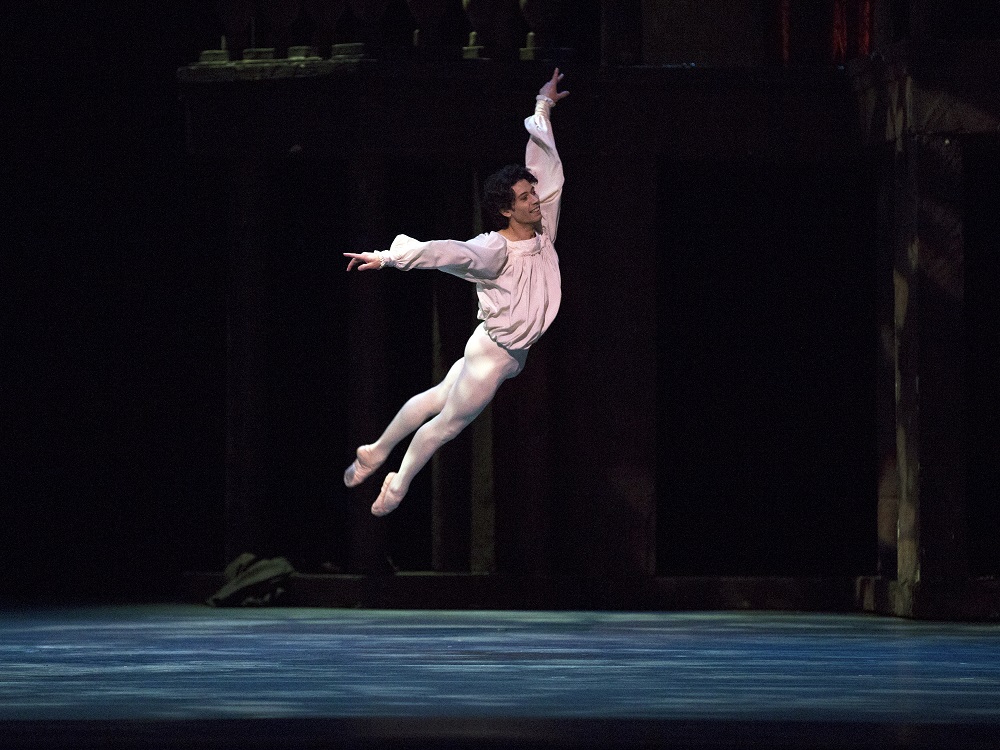
Herman Cornejo in Romeo and Juliet, American Ballet Theater. Photo: Rosalie O’Connor

Some fine versions of Sergei Prokofiev's beloved ballet Romeo and Juliet have appeared in Washington over the years: the Mariinsky Ballet in 2007, with Leonid Lavrovsky's Soviet-era choreography (also on DVD), and Julie Kent's revival of John Cranko's choreography for Washington Ballet in 2018, among others. Until this week's visit by American Ballet Theater, however, that company's classic staging by Kenneth MacMillan had eluded me. Margot Fonteyn and Rudolf Nureyev premiered it for the Royal Ballet, and then American Ballet Theater took it up for the first time in 1985, here at the Kennedy Center. This handsome production is back after a twenty-year absence, and the Kennedy Center Opera House, for a short time spared from the onslaught of Broadway musicals that have infested it, was filled to the brim to see it Friday night.

Kevin McKenzie and Susan Jaffe
Any time that American Ballet Theater comes to Washington, they are worth seeing, especially since Miss Ionarts and I missed their most recent production, last year's Don Quixote. Even more so since this is their first visit under the company's new artistic director, former prima ballerina Susan Jaffe. The much-missed critic Sarah Kaufman first advocated for ABT to appoint Misty Copeland to that position but then admitted that Jaffe could be the one to bring the company into the 21st century. It is a homecoming for Jaffe, who hails from Bethesda and has recalled that her first performance at the Kennedy Center was "when I was a child for the New York City Ballet as a big bug in A Midsummer Night’s Dream."

As it turns out, dancing Juliet at the second performance of ABT's Romeo and Juliet at the Kennedy Center in 1985 was one Susan Jaffe, paired with none other than Kevin McKenzie, her predecessor as ABT artistic director. Critic Alan M. Kriegsman noted of Jaffe's performance "a wonderful spectral quality in the duet she reluctantly dances with Paris in the last act," which seemed to resonate in that scene this time around as well.

ABT is fielding different principal dancers for each performance this week, a tribute to the depth of their bench. Last night's Romeo, the veteran Argentinian dancer Herman Cornejo, brought vast experience and emotion to the character. MacMillan demands remarkable strength from the dancer in this role, and Cornejo provided it through many lifts, sword fights, and athletic moves, seeming to flag just slightly only once during a long overhead lift in the first act. The evening's Juliet, Georgia-born Cassandra Trenary, has made noteworthy supporting appearances since joining the company in 2011. Her appointment to principal dancer came in 2020, and she made her debut in this ballet's title role last summer. She ravished the eyes, bursting with teenage energy and leggy awkwardness, floating en pointe as she backed away from unwelcome encounters with the tall, handsome Paris of Andrii Ishchuk. Her athletic strength allowed her to remain fixed in place in her many elegant lifts, as if we were seeing her as she saw herself flying in her dreams.


The muscular Mercutio of rising dancer Tyler Maloney led the supporting cast, abetted in his stylish combats with Joo Won Ahn's haughty Tybalt by the equally comic Benvolio of Luis Ribagorda. MacMillan went for the full Renaissance treatment in this ballet, with the dancers' bodies often weighed down with tapestry-like costumes and the action unfolding before candelabrae and lanterns on the dark-hued set (all designed by Nicholas Georgiadis). The crowd scenes filled the stage, both the heavy-handed court dances of the Capulet ball and the jealousy-laced street scenes, in which the sassy three harlots of Luciana Paris, Erica Lall, and Hannah Marshall sizzled.

Principal conductor Charles Barker, who often took the podium for Washington Ballet in the late, lamented Julie Kent era, presided over a fine rendition of Prokofiev's electric score. If there were a few intonation lapses in the string sections, fine solo work came from the dueling mandolin players, Neil Gladd and David Evans, and tenor saxophonist Dana Booher, guest spots that add remarkable color to the orchestration. The violent slashes of the Dance of the Knights and the biting fortissimo crush of the loudest moments, like the death of Tybalt at the end of Act II, were thrilling.

Romeo and Juliet runs through February 19. kennedy-center.org

13.2.20

American Ballet Theater's Gothic 'Giselle'


Hee Seo and Cory Stearns in Giselle. Photo: Gene Schiavone

American Ballet Theater returned to the Kennedy Center Opera House this week with a Giselle heavy on the supernatural side of this classic work. The Wilis, the angry spirits of jilted maidens, should inspire fear, something that many productions miss in their fluffy, white softness. The ABT Giselle, the Coralli-Perrot-Petipa choreography staged by Kevin McKenzie, definitely hit its stride in the ghostly second act.

Other Articles:

Sarah L. Kaufman, A ‘Giselle’ that whirls with unusual lyricism (Washington Post, February 12)

---, Ballet dancers have weird and quirky pre-show rituals that would put any sports star to shame (Washington Post, February 6)

Carolyn Kelemen, Former Howard County ballerina is back at the Kennedy Center, this time as a soloist in ‘Giselle’ (Baltimore Sun, February 12)

Gia Kourlas, Skylar Brandt: A Ballerina Invests in Herself (New York Times, February 6)
The company brought back the beautifully matched pairing of Hee Seo and Corey Stearns, who were so heart-breaking together in their Swan Lake in 2017. Seo had an ideal combination of characterizations for the role: pert yet shy as the lovestruck girl, unraveled and distraught when she learns that the lover who has stolen her heart is already engaged to another, and wispy as vapor as the cursed spirit. Besides the finely tuned dramatic sense, Seo's infallible technique put her among the finest Giselles seen here in the last decade, including EunWon Lee, Svetlana Zakharova, Aurélie Dupont, and -- still at the top -- Diana Vishneva.

Stearns was no less accomplished in either regard, his strong body lifting Seo effortless and forming beautifully delineated lines. The score, performed with panache by the Kennedy Center Opera House Orchestra, has rarely sounded this good, made more lush and polished in the orchestration by John Lanchbery, who died in 2003. Conductor Ormsby Wilkins, who did not seem in his element conducting a much more complex Strauss score in Whipped Cream in 2018, shaped each halting phrase of the love music with exquisite sensitivity, helping to make the Act II pas de deux so moving. At its climax, when Stearns held Seo perfectly still above him in effortless lifts, it was as if she floated above him in the spirit world, only temporarily visible to him.

The set design helped create the forbidding sense of a forest haunted by spirits, with lightning flashes behind a large hollow tree (scenery by Gianni Quaranta and lighting by Jennifer Tipton). It was the severe Myrta, Queen of the Wilis, of the tall and somewhat icy Devon Teuscher that brought out the harshness of the scene. The edge of her movements and sharp face seemed to inform the cold precision of ABT's well-drilled corps, all clad in the traditional white (costumes by Anna Anni). One could only feel sorry at the fate of Hilarion (the proud, defiant Roman Zhurbin) as he faced the implacable wall of these vengeful spirits.

Giselle runs through February 16 in the Kennedy Center Opera House, with different casts and conductors.

4.2.18

American Ballet Theater's surreal 'Whipped Cream' at the Kennedy Center


Whipped Cream (Act I), American Ballet Theater (photo by Gene Schiavone)

American Ballet Theater's visit to the Kennedy Center this week put a spotlight on new works by its most promising choreographers. After a mixed program of short works, it was time for the local premiere of Alexei Ratmansky's revival of Richard Strauss's lost ballet score, Schlagobers, seen on Friday night at the Kennedy Center Opera House. Ratmansky has dubbed the work by the English translation of Whipped Cream, and like that confection it floats light and fluffy on the tongue, quickly melts away to nothing, and may rot your teeth and upset your stomach.

Strauss apparently had plans for a third phase of his career, after symphonic tone poems and operas, as a ballet composer. The extravagant expense of Schlagobers, so soon in the wake of World War I, led to the end of his brief tenure at the Vienna State Opera's ballet company. The score is a frothy delight of decadent waltzes and phantasmagorical effects, worth studying for both balletomanes and Strauss lovers, a work that deserves to be heard again. Ratmansky did everyone a favor by resurrecting it, but he has likely not made the best version of the work possible.


Other Reviews:

Sarah L. Kaufman, American Ballet Theatre’s ‘Whipped Cream’: A fleeting sugar high (Washington Post, February 2, 2018)

Alastair Macaulay, Review: Alexei Ratmansky’s Ballet ‘Whipped Cream’ Is a Candyland Triumph (New York Times, May 23, 2017)

---, Review: Ratmansky’s Confectionery Shop Also Serves Ballet Poetry (New York Times, March 16, 2017)
The staging goes big, full frilly and pink, with a panoply of hallucinogenic costumes for the sweets that come to life in the indigestion nightmares of a Boy who overindulges in the candy shop while celebrating his first communion. Dancers playing the children are normal-sized, while the dancers playing adults wear large heads, some even seeming lifted up higher by their footwear (sets and costumes by Mark Ryden). After a series of dessert divertissements, Act I ends with a scene for the corps de ballet in veiled white bodysuits fluttering through a surreal whipped cream landscape, many of them entering humorously on a slide -- in what seems like a spoof of the Kingdom of the Shades scene in La Bayadère.

Ratmansky's choreography is antic and jam-packed with cutesy action and movement, to a fault. Precious few delectable moments for dance materialize. In the first act there was a lovely pairing for the Princess Tea Flower of Hee Seo and Prince Coffee of Cory Stearns, accompanied by flute and violin solos as light as a feather, including a tender pas de deux. The two other solos in the divertissment, for Prince Cocoa and Don Zucchero (sugar), were more comic and not as memorable. The many crazy costumes -- from Dr. Seuss-like long-necked giraffalopes to delightful miniature bouncing cupcakes -- are an endless source of hilarity.


Act II takes a turn for the humorously nightmarish, as the Boy (an energetic Jonathan Klein) awakens in a hospital room, watched over by sinister eyes, right out of a Salvador Dalí painting. The appropriately carnival-time lesson on gluttony switches from sweets to liquor, as the alcoholic doctor takes nips from the bottle in his pocket. In his own set of hallucinations, three liquor bottles come to life for another series of comic dances. Rising dancer Cassandra Trenary's Princess Praline was pert and adorable as she welcomed the still-delusional Boy into her kingdom of sweets. Some more space in the choreography, some room to breathe, would have been welcome, and the Kennedy Center Opera House Orchestra should probably have had a couple more rehearsal slots to pull this complex score together with more polish. Conductor Ormsby Wilkins's frantic gestures did not help at times, seeming to create more confusion among the musicians.

The next dance event at the Kennedy Center Opera House is the Washington Ballet's presentation of Romeo and Juliet, in the choreography of John Cranko made for Stuttgart Ballet, February 14 to 18.

1.2.18

American Ballet Theater: New Choreography at Kennedy Center


Blain Hoven and Daniil Simkin, Serenade after Plato's Symposium, American Ballet Theater (photo by Rosalie Connor)

American Ballet Theater has taken over the Kennedy Center Opera House this week, offering a smorgasbord of new ballets. The first program, seen on Wednesday night, was a combination of three choreographies from the last decade, plus a Jerome Robbins classic from 1976. The second night cast included some of the company's best dancers -- meaning that the usual vocal group of Misty Copeland followers was in the audience -- and some new discoveries.

The best part of the Leonard Bernstein anniversary celebrations, otherwise a seemingly endless sequence of celebrated mediocrities, arrived unexpectedly with Serenade after Plato's Symposium, perhaps Alexei Ratmansky's most important work to date, premiered by ABT in 2016. The music is Bernstein's, a rather gorgeous five-movement violin concerto premiered in Venice in 1954, setting to music the seven speakers of Plato's Symposium, invited to extol the virtues of love. Seven men, mostly from the group of rising soloists, brought this evening of conversation and intense philosophical argument to life, with Hee Seo taking the startling single female role, entering in a starkly lit rectangular opening in the rear curtain. Violin soloist Kobi Malkin struggled with intonation on the numerous double-stops of the solo part, but the Kennedy Center Opera House Orchestra supported him ably.

The Robbins piece, Other Dances, was originally a vehicle for Mikhail Baryshnikov, but it was the woman of the pairing, Sarah Lane, who most stood out for the grace and buoyancy of her movements. Emily Wong played the selection of Chopin pieces, four mazurkas and a concluding, spirited waltz, at a piano on stage.


Other Reviews:

Alastair Macaulay, Review: In Gala, American Ballet Theater Is Open to Debate (New York Times, May 17, 2016)

---, A Big House, Big Names, New Twists (New York Times, May 25, 2011)

Gia Kourlas, Review: At American Ballet Theater, Mostly Millepied (New York Times, October 26, 2017)
The most recent piece, premiered just last fall, was the spirited I Feel the Earth Move, with choreography by Benjamin Millepied set to music by Philip Glass. Stage hands cleared away all of the curtains and scrims from the stage, revealing the catwalks and bare walls, as well as the lighting instruments above. Danced to a rather loud recording, this ballet was hyperactive, seemingly in constant motion, perhaps an expression of individual freedom against repression, represented by the female corps, which appeared marching in step, bandannas over some of their faces.

Christopher Wheeldon's story ballets have not been my cup of tea for the most part, but this more abstract short choreography had greater appeal. Barbara Bilach took the solo part of Benjamin Britten's Diversions for Piano (left hand) and Orchestra, again conducted with abundant energy by Ormsby Wilkins. It was another beautiful score to discover, brought to life by dance, made better by it as the Bernstein had been earlier. The variations form worked elegantly for dance, as Wheeldon has crafted pairs, solos, and group numbers for each brief movement. Misty Copeland finally appeared on stage, for a time-stopping solo in the fourth variation ("Rubato"). Her pairing in the exquisite pas de deux for the tenth variation ("Adagio"), with Cory Stearns stepping in for Gray Davis, was the highlight of the evening, muscularity merged with poetry.

American Ballet Theater performs Whipped Cream, with a forgotten ballet score by Richard Strauss, tonight through February 4.

27.1.17

ABT's 'Swan Lake' @ Kennedy Center


Swan Lake, American Ballet Theater (photo by Rosalie O'Connor)

Swan Lake is such a perennial favorite that the run of performances by American Ballet Theater at the Kennedy Center Opera House sold out before it opened. The work's popularity may make it easy to forget just how powerful it is in dramatic terms. Even in the reconfigured choreography by ABT artistic director Kevin McKenzie, premiered in 2000, the combination of tragic love story and Tchaikovsky's masterful, poignant score is potent.

The focus in Swan Lake often tends to be on the character of Odette, the girl transformed into a swan by the evil sorceror von Rothbart. Principal dancer Hee Seo was extraordinary in the role at opening night on Wednesday, fragile and enigmatic in equal parts in the Act II pas de deux, to the accompaniment of the marvelous violin solo playing of concertmaster Oleg Rylatko. In Act III she was more seductive, with a naughty smile, as the Black Swan, quite striking in the infamous 32 fouetté turns. McKenzie's fourth act minimizes the centrality of Odette, but Seo again seemed like a creature from another world, only part woman.

At the center of this ballet, however, is really the role of Prince Siegfried, the only character to appear in all four acts, something that McKenzie's choreography made more apparent. Tchaikovsky's original inspiration for the character was King Ludwig II of Bavaria, another prince who would not marry as his family wanted him to do. Principal dancer Cory Stearns brought both remarkable strength and an aloof sadness to the role, a young man who seems uncomfortable in his skin, agonizing as the friends at his birthday party in Act I break off into couples.

Siegfried prefers to skulk into the darkness of the forest, where he finds this tragic creature neither fully woman nor something else. Ludwig II's homosexual inclinations, certainly known to Tchaikovsky, who struggled with the same yearning, make it easy to interpret Prince Siegfried's actions in this light. Ludwig was even found dead in a lake, having died in mysterious circumstances. In the original libretto, the story indicated by short references in Tchaikovsky's score, the lake rises up at the end and drowns both Odette and Siegfried, who fall into each other's arms. The famous B minor theme, the score's most famous motif, is associated with the flight of swans, a symbol of escape and freedom.

The ABT corps remains to these eyes one of the most disciplined and unified, and the scenes with the white swans were consistently beautiful, as the group of women responded as one to the movements of Odette in the second and fourth acts. McKenzie's most questionable decision in this choreography was to split the character of von Rothbart, with Patrick Ogle in the more character-dance role of the monster and Thomas Forster as the sorcerer's more seductive human form. Conductor Charles Barker led a flexible rendition of the score, with superlative playing by the Kennedy Center Opera House Orchestra, aside from a few horn bobbles in the opening scene.

Swan Lake runs through January 29, at the Kennedy Center Opera House, with different dancers in the lead roles.

28.1.16

Ratmansky Takes On 'The Sleeping Beauty'


Scene from The Sleeping Beauty, American Ballet Theater (photo by Gene Schiavone)

One of several revelations in Jennifer Homans's beautiful book Apollo's Angels: A History of Ballet was the line drawn between the classical ballet of our age with the court ballet of the French ancien régime. In Russia that continuity lasted up to a work like Marius Petipa's choreography for Tchaikovsky's music of The Sleeping Beauty. Premiered in 1890 in St. Petersburg, the ballet is set in an absolutist court like Versailles, and it even featured an appearance by a dancer costumed as Louis XIV in its Act III apothéose, a tableau pairing him with Helios, the god of the sun. After the Russian Revolution, Soviet authorities quietly removed all such glorifications of aristocracy and royalty, while still presenting Petipa's ballets to the world as "authentic" recreations of his work. Alexei Ratmansky has finally given the world something much closer to Petipa's original vision, in his new restoration of The Sleeping Beauty, made for American Ballet Theater's 75th anniversary season, which the company brought to the Kennedy Center Opera House on Wednesday evening.

available at Amazon
Tchaikovsky, The Sleeping Beauty, Czecho-Slovak State Philharmonic Orchestra (Košice), A. Mogrelia
(Naxos, 1994)
This approach lies somewhere between preserving a moldering corpse, as in the Mariinsky Ballet's version with Diana Vishneva seen in 2010 and the Royal Ballet's adaptation by Frederick Ashton seen in 2006, and the radical updating of Matthew Bourne's vampire version with New Adventures seen in 2013. Ratmansky learned Stepanov notation, used in the 19th century to write down choreography, to get as close as he could to Marius Petipa's original steps, and Richard Hudson based his designs on the version of Diaghilev's Ballets Russes by Léon Bakst. The burden of a considerable budget, reportedly around $6 million, was shared with La Scala in Milan. Ratmansky has stated that his goal was not purely that of historical reconstruction -- the Sun-King does not appear at that musical fanfare in Act III -- but to reveal what Marius Petipa's ballet was really like. If you would like to find out, see one of the performances this week.

Other Reviews:

Alastair Macaulay, Ratmansky’s ‘The Sleeping Beauty’ Has Premiere in California (New York Times, March 10, 2015)

---, ‘The Sleeping Beauty,’ Reawakened by American Ballet Theater (New York Times, May 31, 2015)

---, ‘The Sleeping Beauty’ Spurs American Ballet Theater to Work on the Details (New York Times, June 15, 2015)

Marina Harss, ‘The Sleeping Beauty’ Awakes to Vibrant Ballet Costumes (New York Times, May 28, 2015)

Sarah L. Kaufman, ABT’s ‘Sleeping Beauty’: Amazingly, this fairy tale becomes a love story (Washington Post, January 29, 2016)

Sadie Dingfelder, American Ballet Theatre brings a lush new ‘Sleeping Beauty’ to D.C. (Washington Post, January 28, 2016)

Joan Acocella, Ratmansky's Beauty Wakes Up (The New Yorker, June 8, 2015)

Judith Mackrell, Ratmansky's royal flush: the most authentic Sleeping Beauty I've seen (The Guardian, September 30, 2015)
Most of the choreography's broad shapes are familiar from other Petipa adaptations, like the fluttering, flute-playing hands of the Canary Fairy variation, but the details of the moves are sometimes quite different, especially in the extension of legs and amount of time spent en pointe. The overall effect is to link the movements more closely with the music, revealing connections to Tchaikovsky's score that are often muted in other versions. Isabella Boylston's Aurora was spunky and coy, if not always with the balanced stillness the choreography requires, and the Prince Désiré of Joseph Gorak was somewhat nondescript. Ratmansky has not changed his mind about the musical cuts he made to the score, removing most of the Sommeil scene, which makes Act II seem disappointingly short and robs the Lilac Fairy (a fine Stella Abrera stepping in for the indisposed Veronika Part) and Désiré of some dramatic weight, as the rescue of Aurora is now oddly instaneous. The most significant (and unexpected) star power came in the terrifying Carabosse of Marcelo Gomes, with his hooked nose and clawed gloves, the choreography now matching his cackles and menacing gestures with each musical motif.

Further down the cast were more delights, including the adorable Canary Fairy of Skylar Brandt in Act I, and the exquisite vertical alignment of Christine Shevchenko's Diamond Fairy in Act III, matched by the strongly unified Gold, Silver, and Sapphire trio of Brittany Degrofft, Lauren Post, and Melanie Hamrick. The comic parts of the Fairy Tale divertissement are given new humor and buzz, especially the White Cat and Puss-in-Boots of Elina Miettinen and Gabe Stone Shayer. Cassandra Trenary and Daniil Simkin were a virtuosic pair as Florine and the Bluebird, with Simkin's strength and grace causing a sensation. The corps showed exceptional unity and precision in the large numbers, especially the ballet blanc vision of Act II.

Richard Hudson's sets and costumes are a pastel Rococo blast, replete with towering wigs, broad plumed hats, boots and other foot-ware. If you have ever wondered what a ballet tutu would look like with a bustle in it, wonder no more. Ormsby Wilkins conducted a mostly good performance of the score by the Kennedy Center Opera House Orchestra, including excellent violin and cello solos but with some misses in the horn section.

This performance repeats through January 31, in the Kennedy Center Opera House.

27.3.15

Ashton's 'Cinderella' a Disappointment


American Ballet Theater is back in town, with a week-long residency at the Kennedy Center Opera House. After the rare delights of their 1940s triple-bill earlier this week, it was hard not to be disappointed by the main course, a sugar-sweet production of Frederick Ashton's Cinderella, set to Prokofiev's often acidic score. At least for the adult half of the Ionarts reviewing team, that is: for Miss Ionarts, this was the event of the month. Ashton's pretty staging, with sets and costumes by David Walker (loaned by the Joffrey Ballet) and directed in this incarnation by Wendy Ellis Somes and Malin Thoors, hit all the right buttons in that regard, from the immense train of blue gauze Cinderella arrives in at the ball, to the shining fantasy carriage that whisks her off at the end of the second act, to the shiny confetti that snows down in the final tableau.

Part of the problem has to do with Prokofiev's score, which relies heavily on caricature and grotesquerie. The two drag stepsisters in this production, Craig Salstein and Roman Zhurbin, ate this up, stealing several scenes. Prokofiev created the work in the 1940s, and there is a certain Soviet disdain of the luxury trappings of the aristocracy that filters through it. Scorn is heaped on the courtly dance, fine dresses, and jewels that the stepsisters covet so greedily. Only in the pas de deux at the heart of the second act's ball do the music and movement combine to show something beautiful. Gillian Murphy and James Whiteside were a beautiful pairing, he strong and serious, she vapor in his arms in the pas de deux, but also flitting about in the first act.


Other Articles:

Sarah Kaufman, ‘Cinderella,’ with a post-performance touch of happily ever after (Washington Post, March 29)

---, These star ballerinas are retiring — graceful, and grateful, to the last dance (Washington Post, March 20)

Cinderella:
James Kudelka (ABT)
Alexei Ratmansky (ABT)
Septime Webre (Washington Ballet)
Ashton's often cute and too often repetitive choreography makes things worse. This is most glaring at the end of the first act, where the Fairy Godmother (here the sweet and airy Veronika Part) forces Cinderella to wait for her magical transformation and watch a divertissement by the fairies of the four seasons. Of the four, Skylar Brandt's Spring Fairy and Melanie Hamrick's Winter stood out for their graceful presence. Rising dancer Arron Scott had a witty turn as the antic Jester in the second act, and Thomas Forster and Sean Stewart were pompous comic foils to the stepsisters. Whatever else one may have thought of Ashton's adaptation, he did well to cut most of the first scene from the third act, so that there was little time spent on the prince's search far and near for Cinderella. American Ballet Theater's other productions of Cinderella, by James Kudelka and Alexei Ratmansky, may be less traditional and therefore perhaps less appealing to some audiences, but this score seems to call for something more updated.

This production repeats through Sunday.

25.3.15

American Ballet Theater, 1940s Ballet Triple-Bill


Xiomara Reyes (Cowgirl) and cast, Rodeo, American Ballet Theater

Aaron Copland's Appalachian Spring, heard as a concert work, did not really mean much to me until I saw Martha Graham's choreography live. The same is now true of Copland's Rodeo, thanks to a rare performance of Agnes de Mille's original choreography, from 1942, by American Ballet Theater in the latest of the group's periodic visits here, seen last night in the Kennedy Center Opera House in a triple-bill of ballets from the 1940s. It was another reminder that the separation of ballet music from its choreography robs the listener of a large part of its meaning.

De Mille created a vocabulary of movements for her cowboy characters: they ride horses and are thrown from them, they square dance, they mosey around bow-legged. With its bright colors -- not sure how many cowboys favor this palette from pink to salmon to peach (costumes by Santo Loquasto) -- and glowing sunset backgrounds (scenery by Oliver Smith, lighting by Thomas R. Skelton), it has the feel of an idealistic Hollywood blockbuster. There is no hint of grit or lawlessness in this version of the American West. As the Cowgirl, which de Mille herself created, Xiomara Reyes was a spunky bundle of tomboy cuteness, slapping the men like a pal, thumbing her nose, pulling up her britches. (Reyes will reportedly retire from the company later this year, so it was a special delight to see her in this role before she does.) The Cowgirl falls for the Head Wrangler (a sturdy Roman Zhurbin), whose head is instead turned by the more conventional Ranch Owner's Daughter of Lauren Post, demure in her pretty dress. Down in the dumps at the Head Wrangler's obliviousness, the Cowgirl is cheered up by the handsome, slightly dopey Champion Roper of James Whiteside, who warms to her himself, after delivering a winsome tap solo in cowboy boots.

The company found a fine companion piece for Rodeo in Antony Tudor's Pillar of Fire, premiered in 1942. Set to the string orchestra arrangement of Arnold Schoenberg's Verklärte Nacht, the story also seems to be set in middle America. Gillian Murphy brought a compelling look of constraint and tension -- all frozen jaggedness --to the sexually repressed Hagar, a middle sister between the prim, maternal Eldest Sister of Stella Abrera and the obnoxious flirt of Cassandra Trenary's Youngest Sister. When the little sister comes between Hagar and her last chance at happiness, the steadfast Friend of Alexandre Hammoudi, she has an ill-advised liaison with the sebaceous Young Man from the House Opposite of Marcelo Gomes. Her pregnancy implied but not overtly shown, she is reconciled with the Friend, who accepts and forgives Hagar as they walk through a transfigured night (this is the tie-in with Richard Dehmel's poem Zwei Menschen, which is the story told by Schoeberg's gorgeous score.)


Other Reviews:

Sarah Kaufman, A sparkling start to American Ballet Theatre’s D.C. engagement (Washington Post, March 26)
The only slight disappointment was the company's revival of George Balanchine's Theme and Variations, set to the last movement of Tchaikovsky's third orchestral suite, from 1947. Balanchine later set this choreography as the final act of Suite, a setting of Tchaikovsky's complete suite, but it is the variations seen here that are the meat of the music and the dance. Isabella Boylston and Daniil Simkin made a lovely couple, alternating in duo or solo scenes with the corps and especially in the extended pas de deux (with a fine violin solo from concertmaster Oleg Rylatko), although Simkin was a little stiff, not quite steady in the spins, and a little knee-buckled in lifts, especially at the end. The women of the corps did especially beautiful work, especially in their arm-linked groups of three to the woodwind variation. Conductor Ormsby Wilkins seemed to take the finale at a pace that felt too fast for both dancers and the Kennedy Center Opera House Orchestra.

This triple-bill repeats tonight only. The company also dances Frederick Ashton's choreography to Prokofiev's Cinderella (March 26 to 29), with the chance to see Gillian Murphy and James Whiteside again as Cinderella and the Prince, on Thursday night only.

17.4.14

'Les Sylphides' and Ashton from ABT


Les Sylphides, American Ballet Theater (photo by Rosalie O'Connor)

American Ballet Theater is back at the Kennedy Center Opera House this week, only one year after its last visit. Before its main offering, Marius Petipa and Alexander Gorsky's choreography of Minkus's Don Quixote (April 17 to 20), the company is dancing a far more interesting triple-bill, seen on Tuesday night. It paired two classics of different kinds, Michel Fokine's Les Sylphides and Frederick Ashton's The Dream, with a brand-new work choreographed by ABT principal dancer Marcelo Gomes called Aftereffect. Of course, Don Quixote is fine and all, but I was really hoping to see the company's new choreography of The Tempest by Alexei Ratmansky.

Les Sylphides is a plot-less ballet blanc that Fokine created first in St. Petersburg, where it was known as Chopiniana -- in which form it was danced here by the Mariinsky Ballet in 2012. It is mostly about the corps de ballet, and thus it featured the outstanding discipline of the ABT's women, who moved with impeccable unity and precision through every graceful move and arboreal formation, down to the smallest arch of the back or port de bras, much of it en pointe. Relatively new principal dancer Hee Seo stood out among the soloists for her delicate solo in the Prelude (Chopin's Prelude in A major, op. 28/7). Stella Abrera, although lovely in the first Mazurka, was inhibited somewhat in the pas de deux by being paired with the less accomplished Joseph Gorak as the Poet, the only male dancer in the ballet. Fokine originally used an orchestration of these Chopin piano pieces by Glazunov, but ABT has reconstituted the orchestration by Benjamin Britten, which it commissioned in 1941 and was long thought lost. While perhaps not a masterful orchestration, it has lots of effects involving the harp, which added to the dreamy nature of the choreography.


available at Amazon
Mendelssohn, Ein Sommernachtstraum, La Chapelle Royale, Collegium Vocale Gent, Orchestre des Champs-Elysées, P. Herreweghe
(Harmonia Mundi, 2012)
In Aftereffect, Gomes created a sort of masculine counterpart to the willowy Les Sylphides. Opening with a burst of male energy, the choreography has eight male dancers, costumed in blue leggings and bare-chested, run across the stage. One dancer remains, convulsed by movements that are as much about agitation and restlessness as the first ballet was about stillness and floating. In an effect that recalls multiple-exposure series of photographs like those of Eadweard Muybridge, the lead dancer is eventually shadowed by a second, an augmentation that continues to include the entire group. It was intensely physical, at times whimsical, and even a little silly, in a good way, but it could have been danced in silence since it did not really match up to the music Gomes selected, the first movement of Tchaikovsky's Souvenir de Florence, in the roughest performance of the night from the string players of the Kennedy Center Opera House Orchestra.

Other Reviews:

Sarah Halzack, American Ballet Theatre puts on enchanting ‘Dream,’ but ‘Sylphides’ is lacking (Washington Post, April 17)
The most substantial work of the evening was The Dream, an adaptation of Shakespeare's A Midsummer Night's Dream), by Frederick Ashton, whose sentimental Les Patineurs charmed me last summer. Premiered in 1964, The Dream streamlines the play, drawing on only the central stories of the fairies and the four lovers. Ashton used Mendelssohn's charming incidental music, commissioned by King Frederick William IV of Prussia, when Mendelssohn was music director of the Leipzig Gewandhaus Orchestra. Mendelssohn included and adapted his own brilliant overture for the work, composed by itself in 1826, when the composer was only 17. Ashton's choreography puts the pairing of Oberon and Titania at the center, danced here by the elegant couple of Julie Kent and especially Marcelo Gomes, who was a menacing King of Shadows, making for a gorgeous pas de deux. Herman Cornejo made a capricious, satyr-like Puck, in his acrobatic leaps and pointed legs, and Alexei Agoudine an oafish, faux-delicate Bottom, who often tiptoes around when he is delighted. Ashton makes the four lovers into broadly comic, mostly pantomime roles, providing plenty of laughs. Mendelssohn composed several charming vocal numbers in this music, for soprano, mezzo-soprano, and women's chorus, sung here in English by Melissa Mino, Jennfier Cherest, and the Arlington Children's Chorus. The singing was diminished just slightly by being piped in by speaker from another room, and there was one early entrance from the choir in the final number, which was righted by conductor Ormsby Wilkins.

American Ballet Theater's production of Don Quixote opens tonight and continues through Sunday afternoon.

11.4.13

American Ballet Theater at the Kennedy Center


Marcelo Gomes and Julie Kent in The Moor's Pavane, American Ballet Theater (photo by Gene Schiavone)
American Ballet Theater is back in town for a week-long visit to the Kennedy Center Opera House, a company we last reviewed in their charming Nutcracker a couple years ago. The distinguished touring company, established to bring the best ballet to the citizens of the Unites States and once led by Mikhail Baryshnikov, is now under the artistic direction of Kevin McKenzie, with the talented, envelope-pushing choreographer Alexei Ratmansky serving as Artist in Residence. Its first program, a triple-bill of shorter, more abstract ballets, opened last night, with Anna-Marie Holmes's revision of the classic Marius Petipa choreography of Adolphe Adam's Le Corsaire to open tonight.

George Balanchine's choreography to the music of Georges Bizet's Symphony in C goes back to a 1947 production for the Paris Opera Ballet called Le Palais de Cristal. The more abstract version danced by ABT, premiered in 2001, has no set (staging by Merrill Ashley and Stacy Caddell, lighting by Mark Stanley), just a neutral gray screen as backdrop. The women, who open the work in a group of ten, are costumed in shiny white tutus, with the men in black, further enhancing the sense of a sort of abstract painting set in motion. Balanchine hewed closely to the music, bringing in his soloist in the first movement, here the lively Paloma Herrera, with the theme presented by the solo oboe, for example. She was paired with James Whiteside, who made her glide about elegantly in many lifts. The prettiest dancing was in the second movement, which begins with six women floating in en pointe, with Balanchine again delaying the entrance of his soloist (here Hee Seo) until the oboe solo. The six dancers stood motionless until the fugue, when the music activated them to follow the entrances of Bizet's contrapuntal subject. (For a student work, composed when the 17-year-old Bizet was studying with Gounod at the Conservatoire de Paris, it is a remarkably put-together piece.) Among the dancers Daniil Simkin, male soloist in the third movement, stood out for the height and ease of his leaps and turns and the overall litheness of his movement. The fluttery choreography of the fourth movement matches the agitation of the fourth movement's music, with a group of dancers appearing with each return of the rondo theme, ending up with a large corps at the conclusion.


Other Reviews:

Sarah Kaufman, American Ballet Theatre works at Kennedy Center attest to a company in fine fettle (Washington Post, April 11)

Alastair Macauley, Swirls and Shifts in a Kaleidoscope (New York Times, October 20, 2012)

Brian Seibert, For the Love of Shostakovich, the Destroyer (New York Times, October 12, 2012)
José Limón's ballet The Moor's Pavane was next, loosely based on the story of Othello and using appropriately courtly music by Henry Purcell (including Abdelazer, The Gordion Knot Untied, plus a pavane). It is not exactly Shakespeare's Othello but quite similar, a story of a jealous moor like that in the play The Moor's Revenge, for which Purcell wrote the Abdelazer music. Again there is no set, and the overall atmosphere is dark, a black background against which the tall, brutal Moor of Marcelo Gomes, in a rich burgundy robe, is turned against his wife (the white-clad, innocent Julie Kent) by the poisonous friend (danced by Cory Stearns with an almost predatory, homoerotic twist), in a trick that does involve a stolen handkerchief. Ballet's roots in courtly dance, which was the origin of Purcell's music, is continuously evoked by Limón as the four characters more often face one another, in approximations of court dances, than the audience.

While the playing of the small ensemble, with harpsichord, for the Purcell selections was quite beautiful, the Kennedy Center Opera House Orchestra sounded off-kilter in the Bizet symphony, with far too many splatted notes in the trumpets and horns especially. Perhaps more of the rehearsal time went to the closing work, Shostakovich's peppy ninth symphony, in a new choreography created for ABT by Alexei Ratmansky, which sounded forceful and fun. Shostakovich originally planned to write his ninth symphony as a celebration of Soviet victory in World War II, a work "about the greatness of the Russian people, about our Red Army liberating our native land from the enemy," as scholar Laurel Fay has quoted him. The struggle had been, he wrote, "a war of culture and light against darkness and obscurantism, a war of truth and humanism against the savage morality of murderers," but his plans for a massive work with chorus and solo singers were never realized. After the dreamed-of victory had actually been achieved, with official celebrations in Red Square in May 1945, Shostakovich abandoned what he had completed up to that point and produced a small-scale symphony -- five movements in 25 minutes -- "lacking all pretensions to gravity and majesty, [...] almost the antithesis of expectations," as Fay put it.

The very lightness of the work, its occasional grotesque turns, brought the composer all sorts of trouble from Soviet cultural authorities in the years after its premiere, but it is precisely that giddy wit that Ratmansky seized on in his striking choreography. He plans to integrate this choreography into a trilogy of Shostakovich ballets, to be premiered this spring in New York. Ratmansky told an interviewer that what draws him to Shostakovich is that "You can learn the history of the country from his music." This vigorous, often mysterious choreography, with its stark blacks and whites, its curious gestures -- dancers lying down and falling asleep mechanically, leaping and twisting, large groups in conflict -- holds great promise for the entire project.

The visit by American Ballet Theater continues this evening, with performances of Le Corsaire in the Kennedy Center Opera House, through April 14.

17.10.12

Cinderella in Manhattan

Unlike opera, the more traditional ballet is not updated or recontextualized as much by new choreographers -- with a few notable exceptions, like Alexei Ratmansky, formerly of the Bolshoi in Moscow and now of American Ballet Theater. In his choreography of Prokofiev's Cinderella, which the Mariinsky Theater brought back to the Kennedy Center Opera House last night (the troupe performed it here in 2005), Ratmansky has reconceived the classic Perrault fairy tale in modern Manhattan, centering the story on a benignly neglected, artistically sensitive kid bounced between an alcoholic, do-nothing father and a high-strung, fashion-obsessed stepmother -- in short, someone likely everyone in the audience knows, or perhaps is. The contemporary setting and more jagged, modern dance-influenced choreography suits Prokofiev's barbed score in many ways, but one waits a long time for some ballet itches to be properly scratched (the climaxes of both pas de deux are undermined, for example), and some never are, like a grand, satisfying scene for the corps de ballet.

As he did in his new Nutcracker for ABT, also heavy on pantomime and slapstick, Ratmansky turns back to the grotesquerie of early court ballet: the most memorable parts of the choreography are broadly comic. The erratic movements of Ekaterina Kondaurova's orange-wigged Stepmother are all sharp legs and elbows. The black-clad avant-garde dance teachers (Nadezhda Batoeva and Islom Baimuradov) are caricatures of arbiters of taste in trendy New York. The Four Seasons (Ilya Petrov, Alexey Popov, Maxim Zyuzin, and Andrey Solovyov) dart and peck in avian costumes and movements, and the fairy godmother is a hunched-over homeless woman on the street. On his search for Cinderella, the Prince -- a sort of nerd-in-chief who carries around the fallen glass slipper in a maroon fanny pack (a touch that got the loudest guffaws on Tuesday night) -- falls in with a squad of hard-talking prostitutes and a mincing crew of gay men in bright blue.


Other Reviews:

Sarah Kaufman, Mariinsky’s ‘Cinderella’: A hard-edged fairy tale (Washington Post, October 18)

Catherine Pawlick, American tours U.S. with Mariinsky Ballet (San Francisco Chronicle, October 9)

Paul Hodgins, Perfection eludes Mariinsky in 'Swan Lake' (Orange County Register, October 3)
Minimal sets, designed by Ilia Utkin and Yevgeny Monakhov, give the impression of New York, its steel girters and fire escapes, its monochromatic skyline of faceless tall buildings on the screen that marked off the three acts (with two intermissions making for a long evening in the theater). The only moment of backdrop beauty, sort of, was the neoclassical grandeur of the prince's palace, like a museum, although the corps was given only herky-jerky movements for laughs at their pomposity. The lead role was entrusted to a younger dancer, second principal Maria Shirinkina, who was pleasingly naive and girlish, able to show the transition to dancerly grace of this otherwise awkward, shy young woman. Principal dancer Vladimir Shklyarov was forthright and earnest as the prince, in his spazzy white formal wear and fanny pack, although Ratmansky's play at classical ballet was curious, having the Prince do a series of classical leaps only to peter out in bemused exhaustion. The musical score is not that easy to put together, as shown by the occasionally discombobulated performance by the Kennedy Center Opera House Orchestra, not quite galvanized by Mariinsky conductor Mikhail Agrest. Traditional balletomanes looking for a big wedding-cake confection will likely be disappointed, as Miss Ionarts was just a bit, but for anyone wondering about ballet outside the boundaries, this is something to see.

This performance will be repeated through October 21, in the Kennedy Center Opera House.

10.12.11

American Ballet Theater's 'Nutcracker'


Justin Souriau-Levine as Little Mouse in Alexei Ratmansky's The Nutcracker for American Ballet Theater (photo by Rosalie O'Connor)
One of the highlights of the year for Miss Ionarts is reviewing a new production of The Nutcracker. After taking in Septime Webre's Georgetown staging with the Washington Ballet, the sugar-sweet Balanchine version from the Pennsylvania Ballet, and the disappointing Moscow Ballet production, it was time to see Alexei Ratmansky's recently premiered production with American Ballet Theater, on tour at the Kennedy Center Opera House this week. It is an imaginative rethinking of the story, heavy on pantomime and charming vignettes, opening in the family kitchen where frantic preparations are under way for the Christmas party. Both the servants and the other residents of the house, an army of mice, are quite busy, the latter led by an adorable ragamuffin in a small mouse costume (on Thursday night, a boy with an appropriately musine name, Justin Souriau-Levine), who reappears throughout the ballet and effectively steals the show by his antics.

The central change to the story and characterization, akin to the recent adaptation from San Francisco Ballet, is to recast the Sugar Plum Fairy sequence for an adult "Princess" Clara and a grown Nutcracker prince. The older couple first appear moving in tandem with the younger pair and go on to act out the girl's dream of growing up and falling in love. Productions of this ballet tend to feel mainly aimed at either children or adults, and Ratmansky's seems to fall into the former category, emphasizing burlesque entertainment over more classical ballet sequences, seen in the addition of four male bees, for example, who buzz around the female corps in the Waltz of the Flowers. (Further illustrating the point, two of the company's dancers appeared on the satirical television show The Colbert Report on Wednesday night, sending up the ballet's pas de deux with the host prancing around in a suit jacket, tights, and prominent codpiece.) This is more shrewd calculation than anything else: for ABT, as for most companies, the slew of December Nutcracker performances is big business, as shown in a comprehensive article on the subject recently in the Wall Street Journal. This is a production that will charm children and adults, but the serious balletomane, hoping for more than a smattering of traditional choreography, may be disappointed. That group of people is not the sort a company depends on to fill the house in December, however, so this Nutcracker is likely to have a long and profitable run.


Other Reviews:

Sarah Kaufman, American Ballet Theatre’s ‘The Nutcracker” at the Kennedy Center (Washington Post, December 10)
Mice and children overrun much of the choreography, with a mob of gift-hungry kids ruling the Christmas party in Act I, well coordinated but still wild. The solo dances are inventively conceived, like a jumpy, pointy Harlequin and Colombine pair of spring-activated toys (Craig Salstein and Gemma Bond) and a brightly costumed Turkish soldier (Luis Ribagorda). The beginning of the dream sequence is strikingly surreal, as the Christmas tree grows and becomes large set pieces in the wing and Clara observes much of the battle from an enormous chair in skewed perspective (sets and costumes by Richard Hudson). The orchestra was perhaps the best part of this production, a generally refined performance led by Ormsby Wilkins, with only the battle scene sounding a little helter-skelter in terms of ensemble. The moment when the children's chorus enters, at a crucial point in the snow scene, is one of the most magical in the score: sadly, it is frequently omitted, but here it was sung with pleasing innocence by an unseen combination of singers from the Norwood Middle School Choir, the National Cathedral Schools Lower School Singers, and Pilgrim Lutheran Church Junior Choir.

The mysterious Drosselmeyer retains some of his menacing qualities here (danced by Victor Barbee), involved in the action throughout, including having to rescue Clara and her prince when the snow scene darkens into a blizzard, threatening hypothermia to the exposed children. Ratmansky gives away most of his ideas for the Land of the Sugar Plum Fairy right at the beginning of the second act, when all of the solo dancers appear on stage as a group. Most of these "solos" are really small group numbers: an acrobatic pair of Chinese dancers (Sarah Lane and Daniil Simkin), a cocky sultan (Sascha Radetsky) and four concubines from his harem for the Arabian dance, a trio of bouncy Russian dancers. What should be the climax of the second act, the pas de deux for the grown Princess Clara and Nutcracker Prince (a fine Veronika Part and Marcelo Gomes), is trivialized a bit by being linked to the charming child pair (Mikaela Kelly and Theodore Elliman), with too many cutesy and shy movements. At least here, in the Sugar Plum Fairy sequence, one hopes to have some classical ballet for adults, even in The Nutcracker.

The run of the American Ballet Theater's Nutcracker continues through Sunday, in the Kennedy Center Opera House.