CD Reviews | CTD (Briefly Noted) | JFL (Dip Your Ears) | DVD Reviews
Showing posts sorted by relevance for query trenary. Sort by date Show all posts

18.2.23

MacMillan "Romeo and Juliet" returns to the Kennedy Center at last
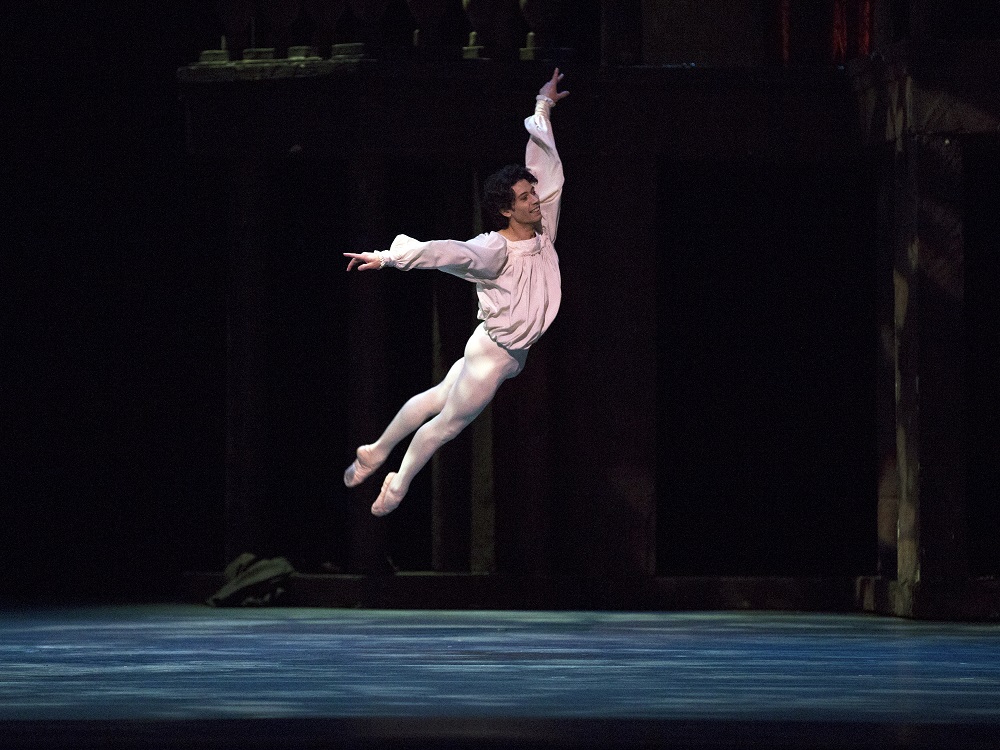
Herman Cornejo in Romeo and Juliet, American Ballet Theater. Photo: Rosalie O’Connor

Some fine versions of Sergei Prokofiev's beloved ballet Romeo and Juliet have appeared in Washington over the years: the Mariinsky Ballet in 2007, with Leonid Lavrovsky's Soviet-era choreography (also on DVD), and Julie Kent's revival of John Cranko's choreography for Washington Ballet in 2018, among others. Until this week's visit by American Ballet Theater, however, that company's classic staging by Kenneth MacMillan had eluded me. Margot Fonteyn and Rudolf Nureyev premiered it for the Royal Ballet, and then American Ballet Theater took it up for the first time in 1985, here at the Kennedy Center. This handsome production is back after a twenty-year absence, and the Kennedy Center Opera House, for a short time spared from the onslaught of Broadway musicals that have infested it, was filled to the brim to see it Friday night.

Kevin McKenzie and Susan Jaffe
Any time that American Ballet Theater comes to Washington, they are worth seeing, especially since Miss Ionarts and I missed their most recent production, last year's Don Quixote. Even more so since this is their first visit under the company's new artistic director, former prima ballerina Susan Jaffe. The much-missed critic Sarah Kaufman first advocated for ABT to appoint Misty Copeland to that position but then admitted that Jaffe could be the one to bring the company into the 21st century. It is a homecoming for Jaffe, who hails from Bethesda and has recalled that her first performance at the Kennedy Center was "when I was a child for the New York City Ballet as a big bug in A Midsummer Night’s Dream."

As it turns out, dancing Juliet at the second performance of ABT's Romeo and Juliet at the Kennedy Center in 1985 was one Susan Jaffe, paired with none other than Kevin McKenzie, her predecessor as ABT artistic director. Critic Alan M. Kriegsman noted of Jaffe's performance "a wonderful spectral quality in the duet she reluctantly dances with Paris in the last act," which seemed to resonate in that scene this time around as well.

ABT is fielding different principal dancers for each performance this week, a tribute to the depth of their bench. Last night's Romeo, the veteran Argentinian dancer Herman Cornejo, brought vast experience and emotion to the character. MacMillan demands remarkable strength from the dancer in this role, and Cornejo provided it through many lifts, sword fights, and athletic moves, seeming to flag just slightly only once during a long overhead lift in the first act. The evening's Juliet, Georgia-born Cassandra Trenary, has made noteworthy supporting appearances since joining the company in 2011. Her appointment to principal dancer came in 2020, and she made her debut in this ballet's title role last summer. She ravished the eyes, bursting with teenage energy and leggy awkwardness, floating en pointe as she backed away from unwelcome encounters with the tall, handsome Paris of Andrii Ishchuk. Her athletic strength allowed her to remain fixed in place in her many elegant lifts, as if we were seeing her as she saw herself flying in her dreams.


The muscular Mercutio of rising dancer Tyler Maloney led the supporting cast, abetted in his stylish combats with Joo Won Ahn's haughty Tybalt by the equally comic Benvolio of Luis Ribagorda. MacMillan went for the full Renaissance treatment in this ballet, with the dancers' bodies often weighed down with tapestry-like costumes and the action unfolding before candelabrae and lanterns on the dark-hued set (all designed by Nicholas Georgiadis). The crowd scenes filled the stage, both the heavy-handed court dances of the Capulet ball and the jealousy-laced street scenes, in which the sassy three harlots of Luciana Paris, Erica Lall, and Hannah Marshall sizzled.

Principal conductor Charles Barker, who often took the podium for Washington Ballet in the late, lamented Julie Kent era, presided over a fine rendition of Prokofiev's electric score. If there were a few intonation lapses in the string sections, fine solo work came from the dueling mandolin players, Neil Gladd and David Evans, and tenor saxophonist Dana Booher, guest spots that add remarkable color to the orchestration. The violent slashes of the Dance of the Knights and the biting fortissimo crush of the loudest moments, like the death of Tybalt at the end of Act II, were thrilling.

Romeo and Juliet runs through February 19. kennedy-center.org

25.3.15

American Ballet Theater, 1940s Ballet Triple-Bill


Xiomara Reyes (Cowgirl) and cast, Rodeo, American Ballet Theater

Aaron Copland's Appalachian Spring, heard as a concert work, did not really mean much to me until I saw Martha Graham's choreography live. The same is now true of Copland's Rodeo, thanks to a rare performance of Agnes de Mille's original choreography, from 1942, by American Ballet Theater in the latest of the group's periodic visits here, seen last night in the Kennedy Center Opera House in a triple-bill of ballets from the 1940s. It was another reminder that the separation of ballet music from its choreography robs the listener of a large part of its meaning.

De Mille created a vocabulary of movements for her cowboy characters: they ride horses and are thrown from them, they square dance, they mosey around bow-legged. With its bright colors -- not sure how many cowboys favor this palette from pink to salmon to peach (costumes by Santo Loquasto) -- and glowing sunset backgrounds (scenery by Oliver Smith, lighting by Thomas R. Skelton), it has the feel of an idealistic Hollywood blockbuster. There is no hint of grit or lawlessness in this version of the American West. As the Cowgirl, which de Mille herself created, Xiomara Reyes was a spunky bundle of tomboy cuteness, slapping the men like a pal, thumbing her nose, pulling up her britches. (Reyes will reportedly retire from the company later this year, so it was a special delight to see her in this role before she does.) The Cowgirl falls for the Head Wrangler (a sturdy Roman Zhurbin), whose head is instead turned by the more conventional Ranch Owner's Daughter of Lauren Post, demure in her pretty dress. Down in the dumps at the Head Wrangler's obliviousness, the Cowgirl is cheered up by the handsome, slightly dopey Champion Roper of James Whiteside, who warms to her himself, after delivering a winsome tap solo in cowboy boots.

The company found a fine companion piece for Rodeo in Antony Tudor's Pillar of Fire, premiered in 1942. Set to the string orchestra arrangement of Arnold Schoenberg's Verklärte Nacht, the story also seems to be set in middle America. Gillian Murphy brought a compelling look of constraint and tension -- all frozen jaggedness --to the sexually repressed Hagar, a middle sister between the prim, maternal Eldest Sister of Stella Abrera and the obnoxious flirt of Cassandra Trenary's Youngest Sister. When the little sister comes between Hagar and her last chance at happiness, the steadfast Friend of Alexandre Hammoudi, she has an ill-advised liaison with the sebaceous Young Man from the House Opposite of Marcelo Gomes. Her pregnancy implied but not overtly shown, she is reconciled with the Friend, who accepts and forgives Hagar as they walk through a transfigured night (this is the tie-in with Richard Dehmel's poem Zwei Menschen, which is the story told by Schoeberg's gorgeous score.)


Other Reviews:

Sarah Kaufman, A sparkling start to American Ballet Theatre’s D.C. engagement (Washington Post, March 26)
The only slight disappointment was the company's revival of George Balanchine's Theme and Variations, set to the last movement of Tchaikovsky's third orchestral suite, from 1947. Balanchine later set this choreography as the final act of Suite, a setting of Tchaikovsky's complete suite, but it is the variations seen here that are the meat of the music and the dance. Isabella Boylston and Daniil Simkin made a lovely couple, alternating in duo or solo scenes with the corps and especially in the extended pas de deux (with a fine violin solo from concertmaster Oleg Rylatko), although Simkin was a little stiff, not quite steady in the spins, and a little knee-buckled in lifts, especially at the end. The women of the corps did especially beautiful work, especially in their arm-linked groups of three to the woodwind variation. Conductor Ormsby Wilkins seemed to take the finale at a pace that felt too fast for both dancers and the Kennedy Center Opera House Orchestra.

This triple-bill repeats tonight only. The company also dances Frederick Ashton's choreography to Prokofiev's Cinderella (March 26 to 29), with the chance to see Gillian Murphy and James Whiteside again as Cinderella and the Prince, on Thursday night only.

4.2.18

American Ballet Theater's surreal 'Whipped Cream' at the Kennedy Center


Whipped Cream (Act I), American Ballet Theater (photo by Gene Schiavone)

American Ballet Theater's visit to the Kennedy Center this week put a spotlight on new works by its most promising choreographers. After a mixed program of short works, it was time for the local premiere of Alexei Ratmansky's revival of Richard Strauss's lost ballet score, Schlagobers, seen on Friday night at the Kennedy Center Opera House. Ratmansky has dubbed the work by the English translation of Whipped Cream, and like that confection it floats light and fluffy on the tongue, quickly melts away to nothing, and may rot your teeth and upset your stomach.

Strauss apparently had plans for a third phase of his career, after symphonic tone poems and operas, as a ballet composer. The extravagant expense of Schlagobers, so soon in the wake of World War I, led to the end of his brief tenure at the Vienna State Opera's ballet company. The score is a frothy delight of decadent waltzes and phantasmagorical effects, worth studying for both balletomanes and Strauss lovers, a work that deserves to be heard again. Ratmansky did everyone a favor by resurrecting it, but he has likely not made the best version of the work possible.


Other Reviews:

Sarah L. Kaufman, American Ballet Theatre’s ‘Whipped Cream’: A fleeting sugar high (Washington Post, February 2, 2018)

Alastair Macaulay, Review: Alexei Ratmansky’s Ballet ‘Whipped Cream’ Is a Candyland Triumph (New York Times, May 23, 2017)

---, Review: Ratmansky’s Confectionery Shop Also Serves Ballet Poetry (New York Times, March 16, 2017)
The staging goes big, full frilly and pink, with a panoply of hallucinogenic costumes for the sweets that come to life in the indigestion nightmares of a Boy who overindulges in the candy shop while celebrating his first communion. Dancers playing the children are normal-sized, while the dancers playing adults wear large heads, some even seeming lifted up higher by their footwear (sets and costumes by Mark Ryden). After a series of dessert divertissements, Act I ends with a scene for the corps de ballet in veiled white bodysuits fluttering through a surreal whipped cream landscape, many of them entering humorously on a slide -- in what seems like a spoof of the Kingdom of the Shades scene in La Bayadère.

Ratmansky's choreography is antic and jam-packed with cutesy action and movement, to a fault. Precious few delectable moments for dance materialize. In the first act there was a lovely pairing for the Princess Tea Flower of Hee Seo and Prince Coffee of Cory Stearns, accompanied by flute and violin solos as light as a feather, including a tender pas de deux. The two other solos in the divertissment, for Prince Cocoa and Don Zucchero (sugar), were more comic and not as memorable. The many crazy costumes -- from Dr. Seuss-like long-necked giraffalopes to delightful miniature bouncing cupcakes -- are an endless source of hilarity.


Act II takes a turn for the humorously nightmarish, as the Boy (an energetic Jonathan Klein) awakens in a hospital room, watched over by sinister eyes, right out of a Salvador Dalí painting. The appropriately carnival-time lesson on gluttony switches from sweets to liquor, as the alcoholic doctor takes nips from the bottle in his pocket. In his own set of hallucinations, three liquor bottles come to life for another series of comic dances. Rising dancer Cassandra Trenary's Princess Praline was pert and adorable as she welcomed the still-delusional Boy into her kingdom of sweets. Some more space in the choreography, some room to breathe, would have been welcome, and the Kennedy Center Opera House Orchestra should probably have had a couple more rehearsal slots to pull this complex score together with more polish. Conductor Ormsby Wilkins's frantic gestures did not help at times, seeming to create more confusion among the musicians.

The next dance event at the Kennedy Center Opera House is the Washington Ballet's presentation of Romeo and Juliet, in the choreography of John Cranko made for Stuttgart Ballet, February 14 to 18.

28.1.16

Ratmansky Takes On 'The Sleeping Beauty'


Scene from The Sleeping Beauty, American Ballet Theater (photo by Gene Schiavone)

One of several revelations in Jennifer Homans's beautiful book Apollo's Angels: A History of Ballet was the line drawn between the classical ballet of our age with the court ballet of the French ancien régime. In Russia that continuity lasted up to a work like Marius Petipa's choreography for Tchaikovsky's music of The Sleeping Beauty. Premiered in 1890 in St. Petersburg, the ballet is set in an absolutist court like Versailles, and it even featured an appearance by a dancer costumed as Louis XIV in its Act III apothéose, a tableau pairing him with Helios, the god of the sun. After the Russian Revolution, Soviet authorities quietly removed all such glorifications of aristocracy and royalty, while still presenting Petipa's ballets to the world as "authentic" recreations of his work. Alexei Ratmansky has finally given the world something much closer to Petipa's original vision, in his new restoration of The Sleeping Beauty, made for American Ballet Theater's 75th anniversary season, which the company brought to the Kennedy Center Opera House on Wednesday evening.

available at Amazon
Tchaikovsky, The Sleeping Beauty, Czecho-Slovak State Philharmonic Orchestra (Košice), A. Mogrelia
(Naxos, 1994)
This approach lies somewhere between preserving a moldering corpse, as in the Mariinsky Ballet's version with Diana Vishneva seen in 2010 and the Royal Ballet's adaptation by Frederick Ashton seen in 2006, and the radical updating of Matthew Bourne's vampire version with New Adventures seen in 2013. Ratmansky learned Stepanov notation, used in the 19th century to write down choreography, to get as close as he could to Marius Petipa's original steps, and Richard Hudson based his designs on the version of Diaghilev's Ballets Russes by Léon Bakst. The burden of a considerable budget, reportedly around $6 million, was shared with La Scala in Milan. Ratmansky has stated that his goal was not purely that of historical reconstruction -- the Sun-King does not appear at that musical fanfare in Act III -- but to reveal what Marius Petipa's ballet was really like. If you would like to find out, see one of the performances this week.

Other Reviews:

Alastair Macaulay, Ratmansky’s ‘The Sleeping Beauty’ Has Premiere in California (New York Times, March 10, 2015)

---, ‘The Sleeping Beauty,’ Reawakened by American Ballet Theater (New York Times, May 31, 2015)

---, ‘The Sleeping Beauty’ Spurs American Ballet Theater to Work on the Details (New York Times, June 15, 2015)

Marina Harss, ‘The Sleeping Beauty’ Awakes to Vibrant Ballet Costumes (New York Times, May 28, 2015)

Sarah L. Kaufman, ABT’s ‘Sleeping Beauty’: Amazingly, this fairy tale becomes a love story (Washington Post, January 29, 2016)

Sadie Dingfelder, American Ballet Theatre brings a lush new ‘Sleeping Beauty’ to D.C. (Washington Post, January 28, 2016)

Joan Acocella, Ratmansky's Beauty Wakes Up (The New Yorker, June 8, 2015)

Judith Mackrell, Ratmansky's royal flush: the most authentic Sleeping Beauty I've seen (The Guardian, September 30, 2015)
Most of the choreography's broad shapes are familiar from other Petipa adaptations, like the fluttering, flute-playing hands of the Canary Fairy variation, but the details of the moves are sometimes quite different, especially in the extension of legs and amount of time spent en pointe. The overall effect is to link the movements more closely with the music, revealing connections to Tchaikovsky's score that are often muted in other versions. Isabella Boylston's Aurora was spunky and coy, if not always with the balanced stillness the choreography requires, and the Prince Désiré of Joseph Gorak was somewhat nondescript. Ratmansky has not changed his mind about the musical cuts he made to the score, removing most of the Sommeil scene, which makes Act II seem disappointingly short and robs the Lilac Fairy (a fine Stella Abrera stepping in for the indisposed Veronika Part) and Désiré of some dramatic weight, as the rescue of Aurora is now oddly instaneous. The most significant (and unexpected) star power came in the terrifying Carabosse of Marcelo Gomes, with his hooked nose and clawed gloves, the choreography now matching his cackles and menacing gestures with each musical motif.

Further down the cast were more delights, including the adorable Canary Fairy of Skylar Brandt in Act I, and the exquisite vertical alignment of Christine Shevchenko's Diamond Fairy in Act III, matched by the strongly unified Gold, Silver, and Sapphire trio of Brittany Degrofft, Lauren Post, and Melanie Hamrick. The comic parts of the Fairy Tale divertissement are given new humor and buzz, especially the White Cat and Puss-in-Boots of Elina Miettinen and Gabe Stone Shayer. Cassandra Trenary and Daniil Simkin were a virtuosic pair as Florine and the Bluebird, with Simkin's strength and grace causing a sensation. The corps showed exceptional unity and precision in the large numbers, especially the ballet blanc vision of Act II.

Richard Hudson's sets and costumes are a pastel Rococo blast, replete with towering wigs, broad plumed hats, boots and other foot-ware. If you have ever wondered what a ballet tutu would look like with a bustle in it, wonder no more. Ormsby Wilkins conducted a mostly good performance of the score by the Kennedy Center Opera House Orchestra, including excellent violin and cello solos but with some misses in the horn section.

This performance repeats through January 31, in the Kennedy Center Opera House.