CD Reviews | CTD (Briefly Noted) | JFL (Dip Your Ears) | DVD Reviews
Showing posts with label Felix Mendelssohn. Show all posts

15.9.26

Notes from the 2026 Salzburg Festival ( 3 )
Sol Gabetta & Kristian Bezuidenhout

Salzburg Festival • Soloists Concert • Sol Gabetta & Kristian Bezuidenhout


Also published in Die Presse: Salzburg: Sol Gabetta kredenzt hübsche Violoncello-Zuckerl


available at Amazon
Brahms / Mendelssohn
Cello Sonatas
♥ Starker/Sebők ♥
Mercury, 1996

US | UK | DE

Gabetta and Bezuidenhout: Well-behaved German Romanticism

Pretty Cello Bonbons and a Trio for Piano, Cello and Hearing Aid


Tuesday at the Mozarteum she was still part of Patricia Kopatchinskaja’s quintet, on Wednesday she was back as the headliner: Sol Gabetta – with fortepianist extraordinaire Kristian Bezuidenhout, in the Haus für Mozart. Schumann’s Fantasiestücke, sonatas by Brahms (No. 1) and Mendelssohn (No. 2), garnished with arrangements for cello and piano of various smaller melodic confections. The two concerts could scarcely have been more different. Gabetta fits in beautifully when Kopatchinskaja sets the agenda – wild, unruly, tussled. When the Argentine star is in charge herself, different principles apply. Here she plays with lyrical assurance, always nice-sounding, dutifully beautiful to the point of cooing. In the golden depths of her cello, she is tonally at home; as the register rises, the tone seems to lose color. Somehow Bezuidenhout went along with all of this and appeared to recede into the background.

This exquisite music-making – take Gabetta’s honeyed sweetness in the slow Allegro non troppo of the Brahms Sonata, and Bezuidenhout's sparkling-delicate accompaniment – is all a pleasure and music-making at the highest level. Objectively there is nothing to fault in the trim attack with which Gabetta draws her notes from the cello. Nor in her intonation or phrasing. And yet… Perhaps it was the vast acoustic of the Haus für Mozart itself, which resists the intimacy her playing needs – swallowing any and all of the energy that didn’t come directly from the chosen tempos. Fast tempos, however, had to wait until the concluding Mendelssohn Sonata. For everything before it – entirely in keeping with Johannes “ma non troppo” Brahms’s own prescription – was awfully tasteful and measured.

And yes: as if something had been building up, the Mendelssohn was, if not exactly exuberant, at least somewhat uberant. The applause after the first movement felt natural, necessary, and was considerably more welcome than awkward embarrassed coughing would have been. Then, at the close, a rogue hearing aid joined the ensemble persistently – at times louder than the cello. Gabetta was not notably displeased. Friction arrived at last. She threw herself into the notes with good deal of bite and fury: The best three minutes of the evening.

Sol Gabetta (Cello), Kristian Bezuidenhout (Piano) © SF/Marco Borrelli


31.7.24

Notes from the 2024 Salzburg Festival ( 4 )
Ouverture Spirituelle • Lobgesang • Vienna Philharmonic

Lobgesang • Mendelssohn • Vienna Philharmonic • Blomstedt


Also reviewed for Die Presse: In Salzburg feiert Herbert Blomstedt Geburtstag


ALL PICTURES (DETAILS) COURTESY SALZBURG FESTIVAL, © Marco Borrelli. CLICK FOR THE WHOLE PICTURE.


A Hymn of Praise to Old Age


On July 11th, Herbert Blomstedt turned 97 – ninety-seven (!) – years old. And when you turn 97, you get to celebrate your birthday twice, no problem! First with a Bruckner Ninth and the Bamberg Orchestra (see also “ The Subtle Miracle Herbert Blomstedt And Bamberg's Cathedral Tour Of Bruckner”) and a good fortnight later with Mendelssohn’s Second Symphony – the “Hymn of Praise” – and the Vienna Philharmonic at the Salzburg Festival.

Of course, age takes its toll, at this advanced hour of one’s life – and the stiffly moving but self-propelled Blomsted looks a bit like a marionette. His physical conducting is reduced in expressiveness and breadth of motion. But the key to an inspired performance is not forcing one’s will onto 190 musicians (counting the 111 singers of the Vienna Singverein), but to make them want to dance attendance on his every musical wish. And this, Blomstedt manages with ease, thanks to his charisma, earnestness, reputation, quiet enthusiasm, and devout charm, and that’s why his concerts are still such musically miraculous moments.

The Compleat Mendelssohn


Brahms’ Schicksalslied (Song of Destiny), op.54, with the disciplined, restrained choir, was a masterclass in matters gentility, sensitively performed by the Philharmonic for Blomstedt. This was the overture to Mendelssohn’s Second Symphony, long considered something of a problem child among Mendelssohn’s symphonies, with three short instrumental movements that are then – supposedly – squashed by the vast Cantata that follows. It’s an unfortunate, perhaps finally waning reputation, given that the work contains everything that makes Mendelssohn. The earnest, imposing music of the oratorios. Some of the fairy-dust music he is best known for. And even some of the tragedy and dissonance we can find in the F minor String Quartet.

The quick pace of the opening was invigorating for not trying to artificially impose more weight on the movement in search of some elusive balance but simply content in praising God – a concrete matter for Blomstedt and not just some abstract concept. The calm pianissimos that Blomstedt got from the orchestra (“Nun danket alle Gott”) were particularly touching.

The quick pace of the opening was invigorating for not trying to artificially impose more weight on the movement in search of some elusive balance but simply content in praising God – a concrete matter for Blomstedt and not just some abstract concept. The calm pianissimos that Blomstedt got from the orchestra (“Nun danket alle Gott”) were particularly touching.

available at Amazon
F. Mendelssohn-B
The Symphonies
C.v.Dohnányi, Vienna Philharmonic
Decca, 2010

Save Thyself!


Not everything went as smoothly. Towards the end, the performance lacked the crucial impulse, that would have imbued this “Hymn of Praise” with the needed pulse. Nor were the ‘almost-dissonant’, which can add a welcome bitter-sweet fragrance, particularly tended to. When the chorus nearly threw a fugato passage (“Die Nacht ist vergangen”), there was no help to be gotten from Blomstedt. The Singverein managed to rescue itself splendidly.

The soloists were right in line with the high quality and character of the performance – namely the level-headed, narrative, perfectly singing of tenor Tilman Lichidi (despite a weaker, flat moment later in the duet) and the effective, nicely enunciating Christina Landshamer, with a tastefully increasing but never overly dramatic vibrato on the held notes – and contributed to this wholly untroubled, Lord-praising eleven-AM performance. Grateful ovations when Blomstedt was led off and back on the stage, by concertmaster Rainer Honeck.


Photo descriptions:

Picture No.1: Wiener Philharmoniker · Blomstedt 2024: Herbert Blomstedt (Dirigent), Wiener Philharmoniker

Picture No.2: Wiener Philharmoniker · Blomstedt 2024: Elsa Benoit (Sopran II), Christina Landshamer (Sopran I), Herbert Blomstedt (Dirigent), Tilman Lichdi (Tenor), Wiener Philharmoniker, Wiener Singverein


8.3.24

Critic’s Notebook: Too much beauty from the Dresden Staatskapelle and András Schiff?


Also reviewed for Die Presse: Retro-Schönklang im Konzerthaus: So hat man Bach und Mozart lange nicht gehört

An excess of gorgeousness, if that is possible


I’ve never been to a concert where an orchestra played so well and annoyed me as much. The travel-contingent of the Dresden Staatskapelle was in Vienna with Sir András Schiff conducting and playing with them, and it was a bath of beauty, mostly. But was something amiss?

Throwback-Bach

Certainly with Bach’s Brandenburg Concerto No.5 (taking on the part of the overture in this most classical of overture-concerto-symphony sandwich concerts). Not necessarily the very old-fashioned sound and style from the interpreters, concert master Matthias Wollong and solo flute Sabine Kittel, who played next to Schiff while the latter who was operating on his gorgeous, shiny, red-and-black Mahagony Bösendorfer. While t’s a matter of taste (and certainly not to mine), hearing Bach performed as if by Karajan, it might posisbly have been neat enough to hear that kind of throwback-sonority (but at reasonably brisk tempi), had it not been for the balance being completely off, usually with Schiff drowning out his colleagues - or the soloists together the little orchestra.

Retro-Mozart

A similar kind of retro-prettiness hung over Mozart’s Piano Concerto No.23 in A major, played with a flawlessness and beauty that is rare and impressive, but that also felt spelled-out, rather than impetuous or spontaneous, and had its share of sentimental moments that bordered mawkishness. If anyone found it too slow, Schiff made up for it with a racing encore of the first movement of Bach’s Italian Concerto.

Confectioner’s Mendelssohn

Mendelssohn’s “Italian” Symphony raced out the gates like a horse possessed. Or, as I wrote in my German review, “chattering like a stork on cocaine”. (This I had better kept to myself, as it prompted a slew of sternly worded letters to the editor, not all of which stayed clear of invective and several suggesting that it was not the storks that were under the influence of the mentioned substance.) The well-oiled machine that was the Dresden Staatskapelle played gorgeously. András Schiff seemed to enjoy it as much as the audience, happily waving his arms before them. With the speed determined at the outset, the symphony seemed to uncoil inexorably, quite independent of any further movemenet on the part of Schiff's. Every group was clean, the sections together, and the strings shone with a noble, dark timbre. Beauty goes a long way, not the least in Mendelssohn, but at least to these ears, there was something curiously unsatisfactory about the relentless loveliness. It rang a little hollow, giving the Symphony a Midsummer Night's Dream-esque, fairy-like character. The orchestral encore – Mozart’s Figaro overture, didn’t undo that impression. Suggesting that, after so much sugar and beauty, "a beer and a cigarette were what was needed in order to return to the real world", also did not go over well with the reader who thought the suggestion “disgusting, classless, repulsive, objectionable” and altogether unworthy of the fine newspaper I write for. I wonder if it had been better, had I suggested instead that after a concert such as this, the only thing to do was to wake up – and bow before such skill.

Photo © Manuel Chemineau


6.12.23

Dip Your Ears: No. 270 (Shadowy Cello Sonatas)


available at Amazon
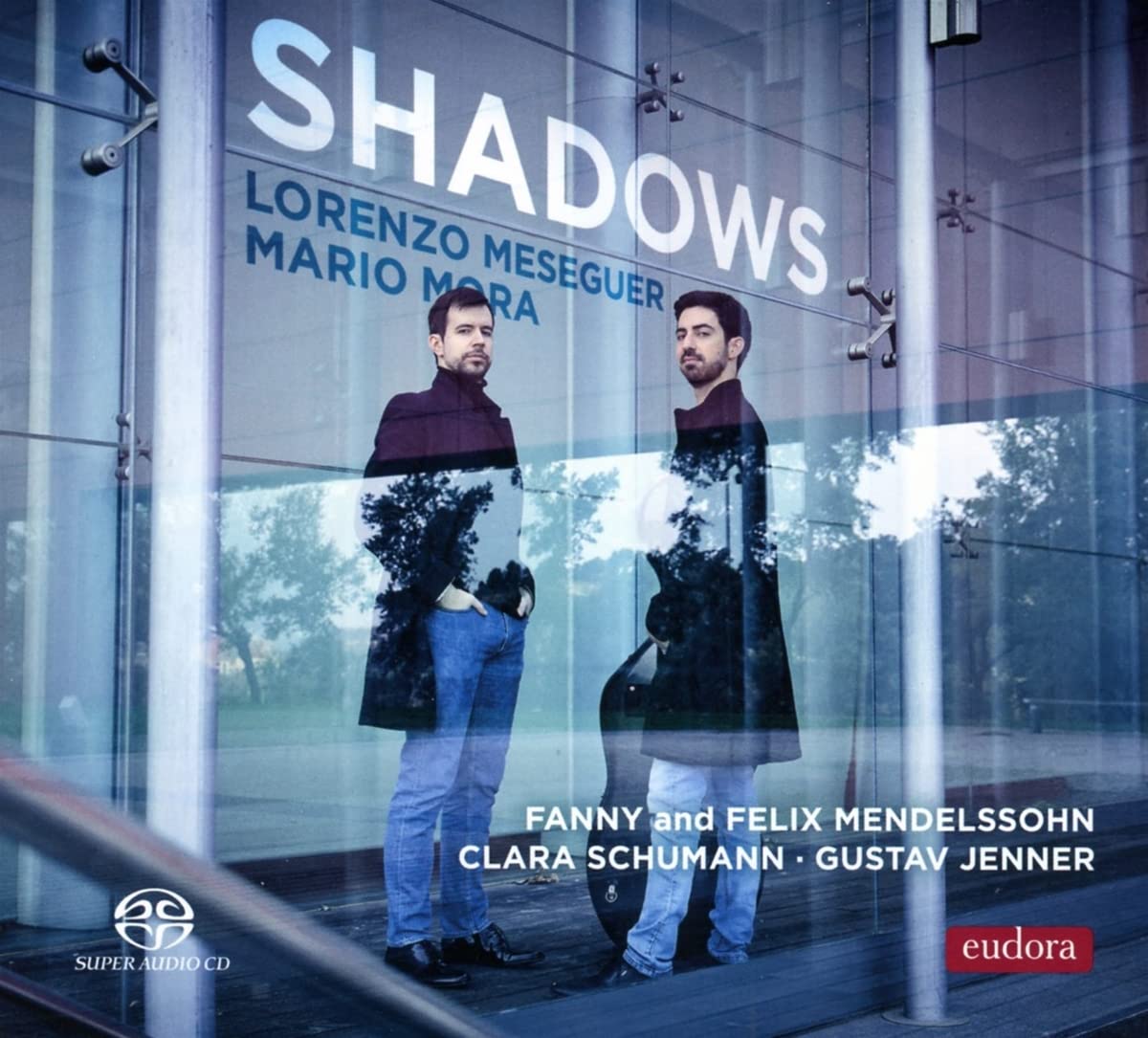
C.Schumann, Mendelessohn Frère et Sœur, G.Jenner
Shadows
Lorenzo Meseguer (c), Mario Mora (pf)
(Eudora SACD 2204)

Clara, Fanny, and Gustav in the Shadows


“SHADOWS” is an album combining two single-movement works for cello and piano by Fanny Mendelssohn (Fantasia in G minor) and Clara Schumann (Three Romances op.22) with two cello sonatas, Felix Mendelssohn’s Second Sonata and that of the Brahmsian Gustav Jenner (also in D major). The title of the CD, goes the argument in the booklet, comes from the fact that each composer lived in the shadow of another. The gals in that of their brother and husband, respectively, and Jenner in that of Brahms, whose only student Jenner had been. Fair enough: While it might be argued that Clara Schumann was not much less – if at all – famous than her husband at the height of her concertizing career, at least as a composer she certainly wasn’t a known quantity. With Felix Mendelssohn, the claim is stretched too far. Only because he was “denigrated by some European musicologists in the early 20th century, in part because of his Jewish origins”, doesn’t mean that Mendelssohn, the man who invented classical music as we know it (from the conservatory system to the figure of the conductor to the idea of repertoire; salvaging Bach as a bonus) and who wrote a slew of masterpieces that were never not loved and acclaimed, has, for all the accusations of an excess of facileness or not pushing musical boundaries, ever been in anyone’s shadow.

But no matter, the music matters, not the title of the CD. And the performances are splendid, indeed. Cellist Lorenzo Meseguer has a surefooted, none-too-sweet tone and gorgeous round low notes that come out very nicely on the Eudora recording, which is proximate to the instruments (more so than, say, the fine Naxos recording with Maria Kliegel and Kristin Merscher) but leaves enough air. The second-movement pizzicatos are nearly as coy as those of Pieter Wispelwey’s (with Paolo Giacometti on Onyx) while Mario Mora’s piano part – naturally, given he is playing a modern Steinway – is more supple than Giacometti’s 1837 Érard. The tempi are not extreme in either direction, although the Adagio is certainly milked for its wistful beauty… if not as wickedly as Christophe Coin and Patrick do, who make it sound as though Tzimon Barto broke into a fortepiano shop. (In a good way, I suppose, although that’s bound to be rather subjective.) The finale is a nicely contrasting firecracker and the contrast. Comparison to a golden-oldie favorite of mine, János Starker and György Sebők on Mercury, make Meseguer’s cello appear comparatively prominent – perhaps more a question of engineering than playing.

The Mendelssohn may be the main ingredient of this CD, but the USP is probably the shadowy composers in front and after him, where there’s little competition. Only two other recordings exist of the fine Jenner sonata; only four of the beautiful Fanny Mendelssohn Fantasia which is here given all its considerable worth. Both, Jenner’s work, which is very obviously (but also very deftly) post-Brahmsian, and Fanny’s piece, are reasons to tune in. The key is not to be turned off by the Three Romances which, after a few minutes of vapid beauty, become so obviously trite that they’re hard to bear: ambling melodies in the cello connected by clichéd phrases and clumsy chords. Don’t say you haven’t been warned.

8/10


10.6.22

New York City Ballet Returns to the Kennedy Center

New York City Ballet performed Suspended Animation, choreography by Sidra Bell (photo: Erin Baiano)

New York City Ballet has been through a disastrous period in the last four years. In 2018, the company's long-time artistic director, Peter Martins, resigned in disgrace, following accusations of sexual abuse. NYCB scrambled to find a stable way forward, naming Jonathan Stafford as its new artistic adviser, but with Wendy Whelan as associate artistic director and Justin Peck as resident choreographer and artistic adviser. As the company founded by George Balanchine, Lincoln Kirstein, and Jerome Robbins struggled to address its history of sidelining the contributions of women and people of color, the coronavirus shut all of its performances down. NYCB was finally able to present a season over the past year, a selection of which the company brought to Washington for its first appearance at the Kennedy Center since 2019.

Other Articles:

Sarah L. Kaufman, In a terrible week, the much-needed balm of ‘Midsummer Night’s Dream’ (Washington Post, June 10)

Jason Fraley, New York City Ballet’s first Black female choreographer comes to Kennedy Center (WTOP, June 6)

Gia Kourlas, A Farewell and the Promise of a New Future at City Ballet (New York Times, May 31)

---, City Ballet Gets a Modern Dance Fix (New York Times, February 4)

---, At City Ballet, Giving Voice to the Body, With Sneakers (New York Times, January 28)

Marina Harss, At City Ballet, Jamar Roberts and Dancers Find a Common Language (New York Times, January 27)

Roslyn Sulcas, Justin Peck and Collaborators Combine Gravitational Universes (New York Times, January 25)

Madelyn Sutton, Sculptor Eva LeWitt on Designing the set for Justin Peck's Partita (Playbill, May 2)

Jennifer Homans, Ballet Is Back, but All Is Not As It Was (The New Yorker, November 1, 2021)
The first two performances this week were devoted to three new choreographies, all premiered this season, seen on Tuesday evening. The first two were created by African-American choreographers, beginning with Emanon—in Two Movements by Jamar Roberts, resident choreographer of Alvin Ailey American Dance Theater. The work, whose title is "no name" spelled backwards, is set to two pieces by jazz composer Wayne Shorter, “Pegasus” and “Prometheus Unbound.” The choreography was active but in many ways repetitive, aside from a striking solo moment for Jonathan Fahoury. The music from the pit and the dancing on stage did not always seem to line up ideally, although the visuals were beautiful, especially Jermaine Terry’s cool-purple costumes.

With her much more engaging Suspended Animation, Sidra Bell became the first black woman to choreograph a work for New York City Ballet. It opened in a whimsical way with dancers attired in technicolor costumes by the young black fashion designer Christopher John Rogers, something like Dr. Seuss characters strutting on a parody of a 1960s fashion show walkway. The dancing became more visible as the performers lost these extravagant outer layers, like birds molting their feathers. Set to music by Dosia McKay (the string quartet Is Now Not Enough? and Unveiling for strings), Oliver Davis (Solace for strings), and Nicholas Britell (The Middle of the World from his score for the film Moonlight), the piece turned from surreal to serious with an extended solo accompanied only by silence.

NYCB saved the best for last, a dynamic abstract ballet by Justin Peck, inspired by Caroline Shaw's ground-breaking Partita for 8 Voices, heard as accompaniment to the performance in the recording by Roomful of Teeth. Eight dancers, clad in white sneakers and variously colored workout clothes, moved in response to the score's often unconventional sounds. In a noteworthy tie-in, sculptor Eva LeWitt designed the sets for the ballet, hanging backdrops made of brightly colored ropes forming large discs above and behind the dancers. LeWitt is the daughter of minimalist artist Sol LeWitt, whose instructions for anyone executing his work Wall Drawing 305 were quoted extensively in Shaw's piece. Peck, who is one of the more musical choreographers working today, created a compelling work that translated music into motion, somewhat heavy-handed at times but seamless.
Sara Mearns and New York City Ballet in George Balanchine’s A Midsummer Night’s Dream (photo: Paul Kolnik)

The last four days of the run at the Kennedy Center are devoted to a recent classic, George Balanchine's innocent, child-centered story ballet based on William Shakespeare's A Midsummer Night's Dream, seen on Thursday evening. Premiered in 1962, the work weaves together Mendelssohn's overture and incidental music for the play with other selections by the composer, to make a convincing whole, a first act with most of the action plus a compact second act consisting largely of a divertissement. The Pennsylvania Ballet brought its utterly charming version of this Balanchine ballet to the Kennedy Center a few years ago, and this was a welcome chance to see it in the hands of the company that premiered it. (One thing that NYCB should have imitated from Pennsylvania Ballet was the placement of the singers, women from the local choir Choralis, for the vocal selections in the pit: the piping in of those performers from another location was less than satisfying.)

One of NYCB's best dancers, Sara Mearns, was a warm, almost glowing Titania, easily the stronger of the royal pairing with Daniel Ulbricht's Oberon, all vanity and strength in his tantrums and athletic leaps. Taylor Stanley made an antic, caprine Puck, running with manic exaggeration and even soaring suspended on wires in the striking final tableau. Georgina Pazcoguin displayed her own virtuosic strength as Hippolyta, bounding in impressive leaps as she hunted a pack of dancer-animals. The most gorgeous moment of the night came in the Act II pas de deux, danced with time-stopping grace by Tiler Peck and Tyler Angle. The swarms of faeries, especially the local children in their delightful insectoid costumes, stole the show during the scenes where they appeared.

A Midsummer Night's Dream runs through July 12.

9.4.22

Briefly Noted: Mendelssohn Violin Sonatas

available at Amazon
Mendelssohn, Violin Sonatas, Alina Ibragimova, Cédric Tiberghien

(released on March 4, 2022)
Hyperion CDA68322 | 67'04"
Both violinist Alina Ibragimova and pianist Cédric Tiberghien got into my ears through their recordings of the music of Bach. Neither performer has made the trip to Washington in several years, so it has been a delight to keep up with their musical partnership on disc, which has extended into Romantic music. After their wonderful Brahms album was briefly noted a few years ago, this collection of the Mendelssohn violin sonatas now gets a mention. Washington classical music presenters, if you are reading, someone needs to bring this duo here soon.

As one is reminded in the superb program notes by preeminent Mendelssohn scholar R. Larry Todd, Mendelssohn was a child prodigy not only as a composer and pianist but as a violinist. He began to study the instrument at age 10, forming a long friendship with his teacher, the virtuoso Eduard Rietz. According to Mendelssohn's composition teacher, Carl Friedrich Zelter, the composer became a violinist "of professional calibre," taking part as both violinist and violist in a number of public performances. Mendelssohn dedicated to Rietz, who died of consumption at only 30 years old, the only violin sonata he ever published, his Op. 4, as well as the brilliant, youthful String Octet, with its extra-florid first violin part as a tribute to his teacher.

This disc includes excellent renditions of Op. 4 and of the two complete violin sonatas in F major that Mendelssohn never published. All three pieces are worth hearing, but the second one, from much later in Mendelssohn's life, stands out. He drafted the piece in 1838, when he held the director's post in Leipzig, intending it for the hands of Ferdinand David but ultimately abandoned it. Mendelssohn's two original autograph versions of the piece's first movement, one a revision of the other, remained unpublished until the Mendelssohn anniversary in 2009: this recording uses the initial, unrevised first movement. The other curiosity is the fragment of a violin sonata in D major, left incomplete after 367 measures of its first movement. It opens oddly, with a probing violin melody over quiet chords, leading to a fast theme that turns toward minor. An unexpected return to the major key feels like a temporary solution to make some sort of ending, after which the music trails off.

26.12.19

Dip Your Ears, No. 260 (Mendelssohn Delight)

available at Amazon
F.Mendelssohn-B., Piano Concertos et al.
Jan Lisiecki (piano)
Orpheus Chamber Orchestra
(DG)

In the course of listening to Roberto Prosseda’s recording of the Mendelssohn Piano Concertos (ClassicsToday review here) and re-listening to some key competition (Brautigam, Helmchen, Perahia (polite), Schiff (terrific), Serkin, Thibaudet (playful) et al.), I also came across Jan Lisiecki’s account with the Orpheus Chamber Orchestra. *Hello Felix!* This is an extraordinarily sensitive account… subtle and nuanced and with nice shading throughout: It stands out for its little darling turns of phrases (none ostentatious) while keeping the clichéd big picture intact. The is a supple pliability in the Orpheus’ orchestral playing that you don’t get from the competition (although the slightly more broad-shouldered Schiff/BRSO connection is terrific, too) and a light, flirty festiveness about the proceedings. The cut is classical, nicely tapered, of light summer wool. But someone snuck some velvet detailing into the lining, too, giving Mendelssohn the dressing he needs. The addition of smartly pearled-off Rondo capriccioso and the Variations sérieuses op.54, is a very nice touch. Treat yourself!

10/10


16.9.19

On ClassicsToday: Roberto Prosseda in the Deceptively Un-Rare Mendelssohn Piano Concertos

Prosseda Splashes Sunshine Over Mendelssohn’s Piano Concertos

by Jens F. Laurson
Mendelssohn_Piano-Concertos_PROSSEDA_deVriend_DECCA_Jens-f-Laurson_ClassicsToday
Felix Mendelssohn’s First Piano Concerto in G minor is hardly a youthful effort, seeing that at 22 Mendelssohn was already a grizzled veteran and roughly one third into his entire compositional career. Still, it’s a brilliant, frothy little thing that fits right in there with... Continue Reading


11.3.19

On ClassicsToday: Technical Finesse From The Sitkovetsky Trio in Mendelssohn

Superbly Played Mendelssohn From The Sitkovetsky Trio, But Something’s Missing

by Jens F. Laurson
MENDELSSOHN_Piano-Trios_Sitkovetsky_BIS_jens-f-laurson_classical-critic
The Mendelssohn Piano Trios live an existence in fame-limbo: not neglected but not quite part of the hard core of piano trios that the works of Mozart, Beethoven, Brahms, Schubert, Dvořák, and Schumann occupy. Within Mendelssohn’s œvre they don’t have the beaming geniality of the... Continue Reading

5.3.19

On ClassicsToday: Elijah @ Theater an der Wien with Calixto Bieito & Christian Gerhaher


Tearing Through Wet Cardboard: Calixto Bieito & Christian Gerhaher Take On Elijah In Vienna

March 5, 2019 by Jens F. Laurson
Vienna, February 20, 2019—For opera that’s lightly coated by the dust of centuries, Vienna’s State Opera House is just the thing: A marvel of a musical museum with mainstay works in workmanlike productions and with – all too often – surprisingly shoddy musical contributions. Anyone looking...  Continue Reading

Pictures from the production below:

26.2.19

On ClassicsToday: John Elliot Gardiner's LSO Mendelssohn

CD From Hell: Gardiner’s Bloodless Mendelssohn Symphonies

Review by: Jens F. Laurson
MENDELSSOHN_Gardiner_LSO_LSO-LIVE_jens-f-laurson_classical-critic

Artistic Quality: ?

Sound Quality: ?

Mendelssohn is sometimes given short shrift for being a “nice” composer: Harmless, untroubled, and glib. That’s partly because the well-adjusted, prosperous, level-headed, and successful Mendelssohn doesn’t conform to our still ruling romantic ideal of the troubled, struggling, excess-driven, or mad genius. Mozart would have made the better Romantic composer; Mendelssohn the better Classical. On the Beethoven-Schumann-Liszt scale of romanticism, about the only thing Mendelssohn got right was dying young.... continue reading [insider content]

Sound samples below:

7.5.18

Forbes Classical CD Of The Week: Rocking The Mendelssohn String Symphonies


...It starts with the coy, tip-toeing first movement with light but sharp attacks of the String Symphony No.7 (“Minerva”, 1822). The way the L’Orfeo Baroque Orchestra under Michi Gaigg rips into that symphony’s finale with great gusto, blowing all ears before it. Here, as in the Symphonic Movement in C minor (“Symphony No.13”), the fortepiano (a reconstruction of the type that little Mendelssohn most likely used during the home performances of these works) adds a welcome, creatively expanded sonority. Or the Andante of Symphony No.12 (1823) is of a sensual gorgeousness that belies the youthful composer as much as it prides the orchestra...

-> Classical CD Of The Week: Rocking The Mendelssohn String Symphonies


6.9.16

Dip Your Ears, No. 214 (The Final Abbado Dud)


available at Amazon

F.Mendelssohn-B., 'Dream',
H.Berlioz, Symphonique fantastique
C.Abbado / Berlin Philharmonic et al.
Berlin Philharmonic


available at Amazon

H.Berlioz, Symphonique fantastique
(E.Varèse, Ionisation)
M.Jansons / BRSO
BR Klassik

You wouldn’t buy this luxurious, $62 set – “Claudio Abbado – The Last Concert” – for the music it contains: One disc of Mendelssohn’s Midsummer Night’s Dream and one of Berlioz’ Symphonique fantastique. So does it make sense to review the performances as if they competed with all the others that are out there? It doesn’t: If just the music were your concern, this set would not competitive because it is a.) very expensive, b.) designed specifically so as not to fit any CD-, book-, or DVD- shelf, and c.) because the performances are, pace Claudio Abbado, middling and very boring. I’m sure the orchestra played their hearts out for him, but it doesn’t amount to any sort of excitement, which is almost shocking, given the repertoire – especially the Berlioz. (Compare this to Mariss Jansons’ recent account with the Bavarian Radio Symphony Orchestra, for maximum contrast.) The reason to get this might be the enjoyment one gets out its impeccable presentation, the accompanying essays and photos, or the DVD of said concert. But, speaking of the music, you might be tempted to get the $15 mp3 version that Amazon et al. offer. This brings us back to reason C:

The limply conducting Abbado manages the unimaginable and sucks all the life out these two works. They are sapped of energy and zest and fall on the floor like a limp squid; it never sparks any fireworks -- like a damp squib. In the Mendelssohn it’s perhaps less surprising; I’ve always found those London recordings of his – especially the symphonies, however much praised by others – on the boring side (compare those to Dohnanyi/Decca, for example, and Maag/Decca for the ‘Dream’). But even then, not nearly as boring as this. If you want to do yourself and your memory of Abbado a favor, pick any one (or all) of the recordings George Pieler and I assembled in this tribute on Forbes: The 13 Best Recordings of Claudio Abbado: A Remembrance and give this a pass.