CD Reviews | CTD (Briefly Noted) | JFL (Dip Your Ears) | DVD Reviews
Showing posts with label Chamber Music. Show all posts

18.11.25

Notes from the 2025 Salzburg Festival ( 5 )
Cuarteto Casals in Shostakovich

Salzburg Festival • Chamber Music • Cuarteto Casals


Also published in Die Presse: Serenade zum Todestag von Schostakowitsch: Cuarteto Casals in Salzburg


available at Amazon
D.Shostakovich,
The String Quartets (v.1),
Cuarteto Casals
Harmonia Mundi


available at Amazon
D.Shostakovich,
The String Quartets (v.2),
Cuarteto Casals
Harmonia Mundi


available at Amazon
D.Shostakovich,
The String Quartets (v.3),
Cuarteto Casals
Harmonia Mundi


Death Becomes them: Shostakovich Quartets in Salzburg

The Cuarteto Casals scored with dark sonority rather than hard edges in their DSCH-dedicated chamber music recital


Monday evening at the Salzburg Festival brought another birthday serenade for Shostakovich’s 50th death anniversary at the Mozarteum Hall – from the Cuarteto Casals. They promised three string quartets. Only three? After all, the Mandelring Quartet (CD reviews here, here, and here) still played all 15 quartets at the Festival back in 2011! (Reviewed on ionarts here.) But one doesn't want to be immoderate, and with Quartets 1, 8, and 15 – i.e. the first, last, and most famous – the selection was promising enough.

All the more so since there are no “early” string quartets with DSCH: When the 32-year-old Shostakovich took his first crack at the genre, with op.49, he was already an experienced composer with one suppressed and four performed symphonies plus two operas under his belt. The Lady Macbeth scandal that had brought him to the edge of the Gulag, and the ‘resurrection’ thanks to the Fifth Symphony, lay behind him. It should not surprise, then, that this first quartet is immediately a masterwork – as if it had sprung, Pallas-Athena-like, from Zeus’s head.

Right away, the Cuarteto Casals’ gloriously solid, perpetually beautiful, expressive sound – from top to bottom, first violin to cello – makes quite an impression. Cellist Arnau Tomàs (check out his Bach!!!) handled his part with resonant, bearish authority. Wonderful, the woody, round-cheeked timbre of Cristina Cordero’s viola. Fascinating the mediating work of second violinist Abel Tomàs. And fitting excellently into the picture: the dark-timbred first violin of Vera Martínez Mehner. One doesn’t miss the rougher approach that has a long tradition in these works at all, because the Spanish quartet’s lyricism, while luxurious, never seems superficial. Nor did it ever feel like the quartet was rounding the edges too much – a criticism that might be (though it doesn’t have to be) made of the Mandelrings. Small and infrequent intonation wobbles couldn’t distract amidst the astonishment over the sound.

That the Eighth Quartet is so much better known than the others does, in a way, surprise, since they all seem equally good. Or more evenly superb than the symphonies, anyway. On the other hand, it doesn’t take much to make the difference between hit and rarity, icon and footnote. (Are, for example, Mozart’s symphonies really as much better than those of Vanhal and Mysliveček as the fame gradient would have us believe?) But perhaps it’s also the dark vein of op.110 – so fitting the clichéd image of DSCH – that fascinates us, seeing that it appears to reflect the composer’s suffering and disguised resistance in Soviet terror…

And it was melancholy-gripping, what the Cuarteto Casals – currently recording all the quartets for Harmonia Mundi (see the Shostakovich String Quartet Survey) – delivered. “If his 15 symphonies are, according to the composer, ‘gravestones’”, writes Robert Reilly in Surprised by Beauty, “then the quartets are the flowers he lays on the graves.” The Cuarteto Casals’ tone – sadly beautiful and mellow – suits this poetry of suffering well.

One could title the six slow, relentless, embittered movements of op.144 with: “The Six Last Words of the Survivor”. Even more so than with Haydn, this deceleration on Shostakovich’s part is a gutsy, deliberate, and pointed imposition on the listener. The interpreters’ long lines made concentration easy, though, thanks to the unremitting inner tension amid this sustained slowness, and the pinch of Haydnesque mischief. The encore from the Third String Quartet, meanwhile, was merciless and had a symphonic earthiness about it. Fabulous, all, and very promising as far as their recordings are concerned.

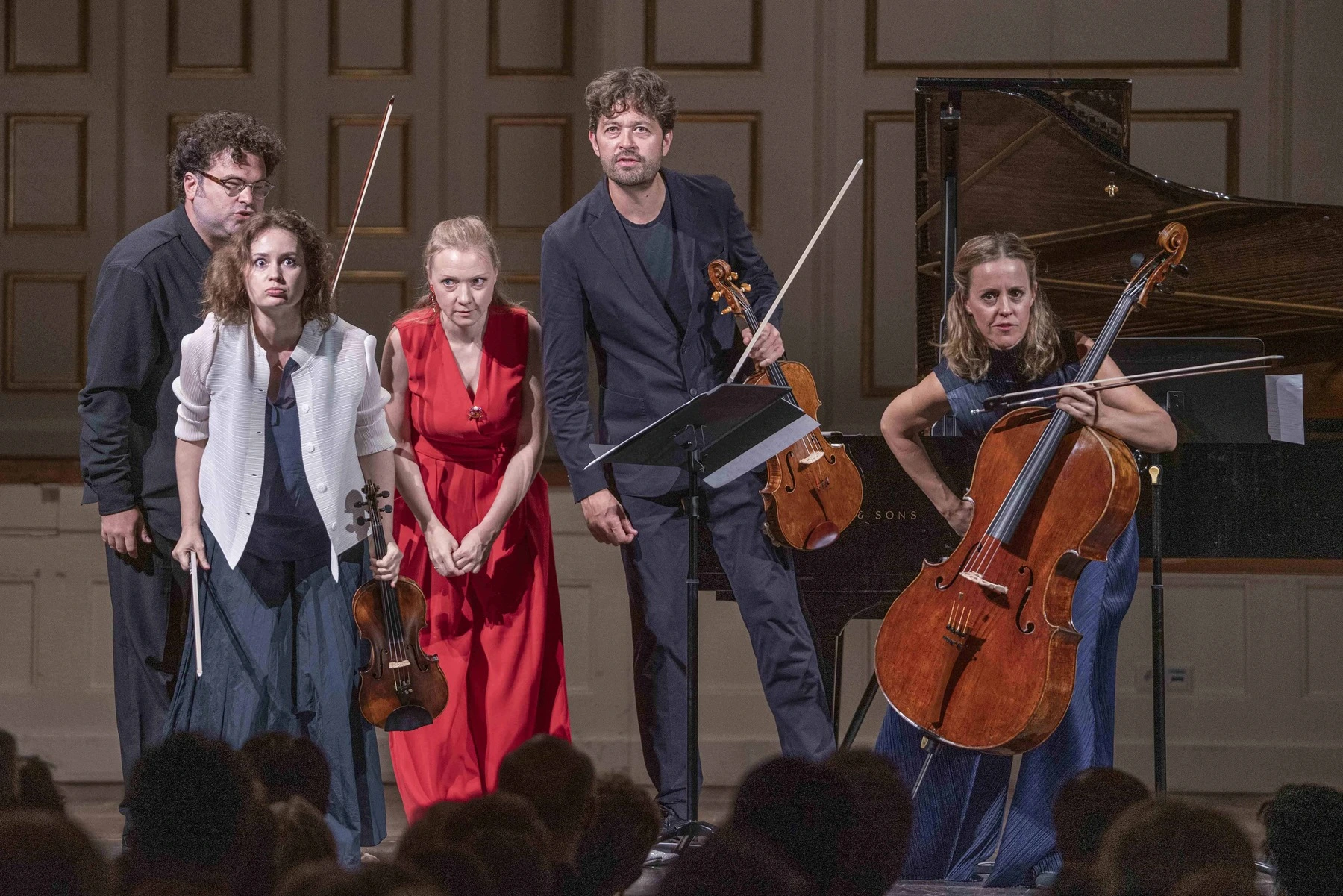
Vera Martínez Mehner (Violine), Abel Tomàs (Violine), Arnau Tomàs (Violoncello), Cristina Cordero (Viola). SF / Marco Borrelli


10.11.25

Critic’s Notebook: Superstar Trio on Chamber-Music Tour


Lisa Batiashvili,© Chris Singer


Also published in Die Presse: Kammermusik: Diese Kombo hat es in sich

My favorite recording of these works. Still golden.

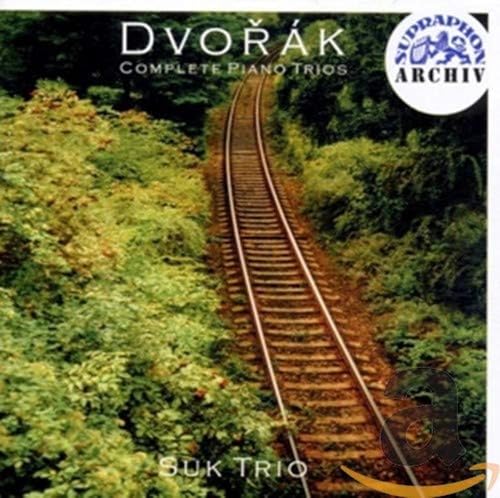
Antonín Dvořákr
Complete Piano Trios
Panenka/Suk/Chuchro
Supraphon


US | UK | DE

Classic Recording!

Antonín Dvořákr
Complete Piano Trios
Beaux Arts Trio
Philips/Decca


US | UK | DE

Modern standard for these gems.

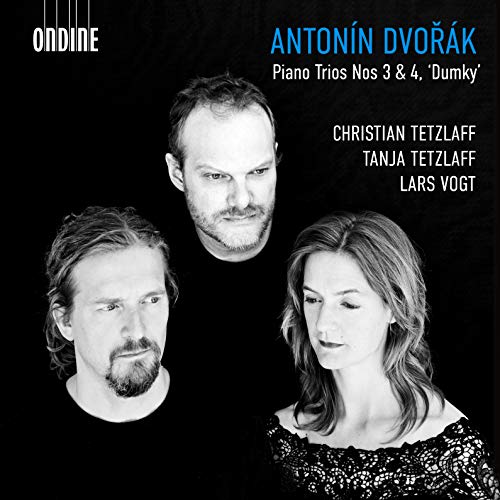
Antonín Dvořákr
Piano Trios Op.65 & 90
Tetzlaff2/Vogt
Ondine


US | UK | DE

Lisa Batiashvili, Gautier Capuçon, and Jean-Yves Thibaudet make a better-than expected Trio


It doesn’t always work: superstars doing chamber music in the grand halls of classical music. This combo, though, had something going for itself.


Chamber music in large halls is, on the one hand, a wonderful thing — a sign that this genre, hard to sell but the beating heart of classical music, can still draw a crowd. On the other hand, such music is usually less at home in places like the Great Hall of the Konzerthaus than, in it would be in its smaller, perfectly suited Mozart Hall, for example. But when soloists with the star power of Lisa Batiashvili, Gautier Capuçon and Jean-Yves Thibaudet appear together, compromises must be made.

That this one turned out not to be much of a compromise at all was remarkable — and owed to the trio’s balanced playing. No one held back, no one dominated, there were no hiearchic shenanigans, and no one got lost in precious detail. Whether in the youthful works of the first half — Debussy and Shostakovich’s early trios — or in the second, devoted entirely to Dvořák’s mature F-minor Trio Op. 65 (who was, after all, a venerable 42 when he wrote it).

The Dvořák, cleanly and spiritedly played, served as another reminder that his chamber music never really disappoints — at least not when, as here (no small feat for a team of soloists), the playing is genuinely ensemble-minded: relaxed in the Poco adagio, varied in the finale, and fleet in the Mendelssohn-like scherzo of the encore, which was played entirely in keeping with Dvořák’s spirit.

Even more intriguing were the first two pieces, however, where Batiashvili and Capuçon could truly shine: she full-bodied and rhytmically steady-as-a-rock, he slightly sentimental, bittersweet, elegant — both superbly attuned to each other. That Thibaudet sometimes drifted toward the role of accompanist rather than full creative collaborator, or that his clarity occasionally suffered from the brisk tempos, mattered little at this level of overall excellence.


27.9.25

Notes from the 2025 Salzburg Festival ( 2 )
Alexander Malofeev and María Dueñas in Recital

Salzburg Festival • Recitals • Malofeev & Dueñas


Also published in Die Presse: Begeisternd: María Dueñas und Alexander Malofeev im Mozarteum

Unlikely Duo at the Mozarteum

On paper, Alexander Malofeev and María Dueñas have only their age in common. In concert, though, the quiet, pale-blond Russian at the piano and the savvy Spanish violinist made for an unexpectedly effective musical pairing.


Kids at work: Malofeev is 23, Dueñas 22, and when Karol Szymanowski wrote his Violin Sonata in D minor, Op. 9, the Polish composer was just 21. The three met , not for the first time, at the Salzburg Festival soloist recital in the Great Hall of the Mozarteum – and they delighted the audience. Dueñas, with her wild, expressive tone — a touch of viola-like smokiness, high intensity, and more than a hint of risk (or at least the impression of it) — threw herself irresistibly into her part, lips pursed, eyes shut tight. A bit of show? Surely. But who would begrudge her.

The lanky, long-limbed Malofeev, sitting at the Steinway like the Peanuts’ Schroeder, fingered a surprising amount of music from his score. One wanted to listen to him every bit as much as to her, as seemingly simple accompaniments were turned into impressionistic studies or sounded as if he were improvising them on the spot.

That the young man would impress was no surprise, after causing a stir at the Musikverein last February (“Critic’s Notebook: Alexander Malofeev gives his recital debut in Vienna”). He is surely one of the most exciting, promising pianists of his — already well-stocked with good pianists — generation. María Dueñas, on the other hand, had so far made her mark with a meticulously planned and marketed career, stoked by media hype and record contracts, helped by rich parents and dusted with pristine “vanilla cupcake” playing (“Wiener Symphoniker: 16er-Blech und die ‚Fünfte von Brahms‘“). Musical character, however, less so.

That this combination should succeed was by no means a given when the concert was booked — though a nearly identical program intermittently performed in New York’s Weill Recital Hall had raised hopes. In any case, this recital (like most in the “Soloists’ Concerts” series) is not an indigenous Festival event but at best an ornamental garnish, that pretty much anyone can garnish their musical with, assuming they knock at the right agency’s door. That’s neither good nor bad per se; it all depends on the combination. Any Wiener Schnitzel with potato salad benefits from a touch of parsley. But only parsley — musical commodity fare — makes for a dull plate. See Grafenegg.

After the youthfully-exuberant Szymanowski — already cheered frenetically by the (nearly as) youthful crowd on the balcony — things continued promisingly with Debussy’s swan song, his G minor Sonata, written just before the composer’s death. An earthy note came into play, here, not the cliché of ether, but variety and depth. In this work, as in the first two movements of the concluding, massive César Franck A-major Sonata, Dueñas impressed not only with the energy of her playing but also with her kaleidoscope of timbres: smoky, delicate, hefty by turns.

The third movement’s hectic episodes seemed a bit aimless, and in the finale Dueñas’s personal touch — the variety that had benefited the music so far — gave way to a clean, somewhat sharp and loud tone, as if she were intent on bringing the final stretch home without mishap. But this did not diminish the overall impression — and the vociferous audience refused to let the duo go until after a third encore, among them Piazzolla, and an arrangement of Richard Strauss’s “Morgen”, tenderly, almost hesitantly accompanied by Malofeev.


26.9.25

#ClassicalDiscoveries: The Podcast. Episode 018 - Penderecki: A Life in Four Quartets


Welcome to #ClassicalDiscoveries. Here is a little introduction to who we are and what we would like to achive at the first (or, in a nod to Bruckner, "double-zeroëth" episode). Your comments, criticism, and suggestions remain most welcome, of whatever nature they may be. Now here’s Episode 018, which I believe might be our best one yet! It attempts to cover the whole stylistic world of Krysztof Penderecki in just over 70 minutes! Fear not, that’s not the length of our podcast today, it’s the time it takes to perform all his compositions involving string quartet and string trio. And they conveniently trace the composer’s startlingly divergent stylistic output, from the wild-as-it-comes 1960 String Quartet No.1 via the masterly String Trio to the romanticism of the Third and beyond..


29.1.25

Dip Your Ears: No. 280 (DSCH, dogmatically pumped up)


available at Amazon
D.Shostakovich
24 Preludes op.34, Chamber Sy. op.110a
dogma chamber orchestra
Mikhail Gurewitsch (CM)
(M|DG SACD, 2013)

Shostakovich Strung Up


It’s rare enough to hear Shostakovich’s Twenty Four Preludes op.34 on disc (much less in recital). Much rarer still, but no less interesting, is it to hear the work—not to be mistaken for the increasingly popular 24 Preludes and Fugues, op. 87—set for string orchestra. The all-lower case dogma chamber orchestra took on the task and recorded Grigory Kochmar’s arrangement to marvelous, delightfully unsettling effect: A new angle on an unfamiliar work gives us de-facto brand new Shostakovich. Compared to that, the String Quartet No.8 in its souped-up version (basically a simpler version of Chamber Symphony op.110a), is familiar territory in which dogma faces and proudly meets the competition.


25.11.23

Briefly Noted: Schumann for Four and Five (CD of the Month)

available at Amazon
Schumann, Piano Quartet/Piano Quintet, I. Faust, A.K. Schreiber, A. Tamestit, J.-G. Queyras, A. Melnikov

(released on November 24, 2023)
Harmonia Mundi HMM902695 | 52'42"
Many musicologists have described Robert Schumann's youthful piano quartet and piano quintet as twin works, not least because they were composed in the same key, E-flat major, and within a few weeks of one another. Neither of these pieces, early experiments by Schumann with pairing his favorite instrument, the piano, with different combination of string instruments, lasts over a half-hour, but the young composer, still only 19 years old, laid the foundations for many later examples of both of these still relatively rare genres.

This delectable new release assembles a dream team for these exemplary works: violinist Isabelle Faust, violist Antoine Tamestit, cellist Jean-Guihen Queyras, and pianist Alexander Melnikov. All play on historical instruments, with the strings all made roughly around the year 1700, as early as 1672, in the case of Tamestit's Stradivarius viola. Melnikov plays on a historical fortepiano made by Ignace Pleyel (Paris, 1851), technically constructed after Schumann composed these pieces, but that is a minor point.

Even though it was composed slightly later, the quartet is the lesser work to my ears, but its slow movement, with ardent cello solos here played subtly by Queyras, is nothing short of gorgeous. Schumann's piano quintet, however, has always struck me as one of the most perfect pieces of chamber music ever written. This performance, with Anne Katharina Schreiber joining on second violin, is going to be rather difficult to improve on, and it is certainly in competition with Melnikov's own recording of the same pairing from a decade ago (with the Jerusalem String Quartet) and the version made around the same time by the Takács Quartet and Marc-André Hamelin. The second movement surprises, both by the detached, somewhat brisk pacing of the funeral march and the understated rubato of the B section. The use of historical instruments and the individual strengths of each player put this disc a notch above.

Follow me on Threads (@ionarts_dc)
for more classical music and opera news

23.8.23

Briefly Noted: London, Circa 1740 (CD of the Month)

available at Amazon
London, circa 1740: Handel's Musicians, La Rêveuse, F. Bolton, B. Perrot

(released on August 18, 2023)
Harmonia Mundi HMM902613 | 68'57"
Gambist Florence Bolton and theorbist Benjamin Perrot, who co-direct the early music ensemble La Rêveuse, continue to survey the lesser-known corners of 18th-century music in England. The concept for the first half of their latest release is to bring together music of Handel with other pieces by the virtuosos who performed under him during his English period.

Flutist Carl Friedrich Wiedemann and oboist (and flutist) Giuseppe Sammartini both became principal players in Handel's orchestra. Both were likely featured in humorous engravings by William Hogarth: Sammartini's notorious bad temper was lampooned in The Enraged Musician. Traverso player Oliver Riehl and soprano recorder player Sébastien Marq contribute remarkable solo playing in concertos by Wiedemann and Sammartini, respectively.

Violinist Pietro Castrucci, whom Handel met when they both worked for the Ruspoli family in Rome, later came to London and became the concertmaster of Handel's opera orchestra. Florence Bolton takes the solo part in a gamba sonata by Castrucci, as well as contributing a wide-ranging booklet essay giving a vivid portrayal of musical taste in the period. Handel is represented by a fine trio sonata, featuring the gorgeous, intertwined violins of Stéphan Dudermel and Ajay Ranganathan. As lagniappe, there is the Hornpipe that Handel wrote for the budding concert series at Vauxhall Gardens, organized by the entrepreneur Jonathan Tyers at one of the summer retreats from London for the nobility. (The Prince of Wales, who used his artistic patronage in his ongoing campaign for popularity against his father, King George II, was a patron and even maintained a Prince's Pavilion there.).

The second half of this pleasing disc goes in a completely different, folk music-influenced direction. Cellist and composer James Oswald, although not directly connected to Handel, was a Scotsman active in London from the 1740s on, later even becoming chamber composer for King George III. Born in Crail, a town in Fife (the region where my own Scottish ancestors lived for a time), he made many arrangements of Scottish folk tunes, beginning with a popular Sonata of Scots Tunes in five movements. The recording also features a selection of melodies from his Caledonian Pocket Companion, an anthology of twelve volumes, rounding out this diverting late-summer delight.

16.8.23

Briefly Noted: A Trio of 20th-century Piano Trios

available at Amazon
Montsalvatge / Tailleferre / Korngold, Piano Trios, Andrist-Stern-Honigberg Trio

(released on August 4, 2023)
Centaur CRC4037 | 57'11"
Audrey Andrist has been a long-time fixture at Washington-area concerts, particularly in contemporary repertoire. The Canadian-born pianist plays often with her husband, violinist James Stern, as a duo and, with National Symphony Orchestra cellist Steven Honigberg, as the anchor of a rather fine piano trio.

While beautifully played, the new disc from the Andrist-Stern-Honigberg Trio, released by Centaur Records, is of interest primarily because of its intriguing combination of music. First is the Piano Trio by Xavier Montsalvatge, dating from the 1980s, when the Catalan composer was in his 70s. This suave, refined work, infused with jazz and folk elements, feels like a love letter to Spain. Its first movement is a "Balada a Dulcinea," infused with tender sweetness for Don Quixote's imagined sweetheart, followed by a "Diálogo con Mompou," referring to another composer, Montsalvatge's contemporary from Barcelona.

Adding to the recent rediscovery of Germaine Tailleferre's piano music is her Piano Trio, composed during World War I, when it went unnoticed and unpublished. The French composer took the piece up again in 1978, when she was in her 80s, and the revised version is a mixture of early and late styles, as she wrote a new second movement and added a fourth-movement finale. With each of the four movements clocking in at a balanced three minutes each, the piece has a pleasing unity.

Erich Korngold composed the final Piano Trio on this disc, the longest of the three works, when he was only twelve years old. The piece was among the fruit of his tutelage with Zemlinsky, study recommended by Gustav Mahler, who had heard a cantata the boy had written. A child prodigy, Korngold had already had a ballet score performed professionally in Vienna, and Artur Schnabel was performing his piano sonata around Europe. This trio is a tour de force for the pianist, and Andrist rises to the occasion, especially in the rollicking Scherzo, an hommage to the Viennese waltz redolent of both Strauss and Mahler.

11.2.23

Briefly Noted: Lars Vogt swan song (CD of the Month)

available at Amazon
Schubert, Piano Trios Nos. 1 and 2, Christian Tetzlaff, Tanja Tetzlaff, Lars Vogt

(released on February 3, 2023)
Ondine ODE1394-2D | 136'45"
I was lucky to have heard the late German pianist Lars Vogt at his one local appearance in recent years, an extraordinary Beethoven first piano concerto with Markus Stenz and the Baltimore Symphony Orchestra in 2016. We have noted a number of his fine recordings over the life of this site, most recently an odd but satisfying one of rarely heard Romantic melodramas, made with his daughter Isabelle. As recounted in a beautiful article by David Allen for the New York Times, Vogt delayed checking into a hospital in 2021 for further analysis of the cancer that would eventually take his life last September, in order to travel to Bremen to make the first part of this double-album of Schubert's chamber music with Christian Tetzlaff and his sister Tanja Tetzlaff.

The resulting set is a remarkable testament to Vogt's sensitivity as a chamber musician. At their sessions (the second was after Vogt had started chemotherapy) the group recorded all of Schubert's piano trios, except for the Sonatensatz, D. 28, a work of juvenilia, as he composed it when he was just 15 years old. This performance of Piano Trio No. 2 is distinguished by its restoration of a section later cut from the Finale by Schubert, among many musical qualities, especially in the dark-hued slow movement. (There is an odd sound I can't identify at the 10:52 mark in the finale of Piano Trio No. 2.)

In addition to the two numbered trios is the Notturno, a single slow movement possibly composed for and then removed from the first piano trio, with which it has a related home key. It is this piece that stands out on the first disc, especially the graceful, unhurried performance of the hushed main theme. The more heroic contrasting sections sound defiant and determined, but it is that hovering, bliss-filled lead subject that haunts the ears. Schubert composed all three of these works for piano trio in 1827 and 1828, not long before his death, adding an element of wistfulness. What I heard first in the performance was confirmed in the emotional recollections of the Tetzlaffs, included in the booklet:
(Tanja) When Lars listened to this recording, he wrote in our trio chat: “Now I immerse myself in the miracle, too. Feels a little bit like everything, at least in my life, has developed toward this Trio in E flat major.” What again and again was heard from him was this ‘Now we’ve done it, recorded these trios; now I could go too.’ And I find that in the recording one notices that deep inside he already knew that in all likelihood he wasn’t going to be able to live very much longer.

(Christian) The recording was made shortly before the diagnosis. But after every session he lay on the sofa and had horrible stomach pains. And he knew that something catastrophic had happened. When he mentioned this piece, then what went along with it was that it very clearly deals with departure and death, very differently than the B flat major trio.
Vogt also recorded Schubert pieces with each Tetzlaff individually: the Rondo brillant in B minor with violinist Christian and the "Arpeggione" sonata in A minor with cellist Tanja, from 1826 and 1824, respectively. The Tetzlaffs had intended to make a concert tour with Vogt this year, which included one of the Schubert trios. The tour will go ahead, with Kiveli Dörken, a beloved students of Vogt's, taking his place. The tour's local stop will be at Shriver Hall in Baltimore on March 26. shriverconcerts.org