A Survey of Bruckner Cycles

► An Index of ionarts Discographies
Like the Beethoven Piano Sonata Cycle Survey, the Dvořák Symphony Cycle Survey, the Bach Organ Cycle Survey, and the Sibelius Symphony Cycle Survey, this Bruckner Symphony Cycle Survey started life a mere inventory of what has been recorded and whether it is still available. It has become more ambitious, since, and the February 2023 update (see details below) reflects this, bringing the format up to the type used in the Beethoven- and Bartók String Quartet- Cycle Surveys, for example. Favorites are still denoted with the "ionarts' choice" graphic.
[Even after this latest update, there] are several incomplete, out-of-print, hard-to-get, and just plain obscure (at least in the West) Bruckner Symphony cycles that are probably not listed below, because I've found it impossible to get adequate information on them. This includes all but the third of six (!) complete and partial cycles of the Japanese conductor, founder of the Osaka Philharmonic Orchestra, and Furtwängler-inspired Bruckner-nut Takashi Asahina. That also includes the once ultra-inclusive Gennadi Rozhdestvensky cycle on Melodiya, a selection of which can be found digitally as a sketchy MP3 offering on Amazon. While some incomplete and unboxed cycles have been included (Norrington, because I think his traversals are worthwhile), others (Roegner, on Edel) have not. [Ed. It has now.] There is no particular logic to that decision.
Bruckner wrote 11 Symphonies (counting the Study Symphony in F minor, or "00", and the retracted Symphony in d, "0"). Ten of them are complete, and the unfinished "Ninth" exists in various performance versions. The inclusiveness of a set is indicated: 00-9* would mean all 11 Symphonies including a completed 9th; 1-9 would indicate the conventional nine, with only the three finished movements for the Ninth. There are no cycles that include "00" but not "0". Where the Te Deum is included in a set, it is mentioned; "Te Deum (F)" means that the Te Deum directly follows the third movement of the Ninth in the make-shift completion suggested by Bruckner. There are a few different 'performing editions' of the finale, most prominently William Carragan's (in three revisions) and those based on the work of Nicola Samale and Giuseppe Mazzuca (1984). With John A. Phillips and Benjamin-Gunnar Cohrs included on their team, they produced the 1992 Samale/Mazzuca/Phillips/Cohrs Completions below abbreviated SMPC, along with the year of the particular revised version. Gerhard Schaller has also produced a finale of his own - although everyone attempting this feat is invariably hampered by the looming lawsuits of those who have attempted this before and who are ready to assume plagiarism on principle. (It is, therefore, impossible to have a best-of-all-versions Finale until the copyrights of the current versions run out.)
For the truly dedicated Brucknerians, I have added the information of which versions the various cycles use in the Alt-Text which you can find if you mouse-over the cover image.
A note on Bernard Haitink: Haitink recorded a Bruckner Symphony cycle with the Concertgebouw for Philips, which is usually out of print. [Ed.: It can be had as part of the catch-all "Haitink Symphony Edition" box set, along with his Beethoven, Brahms, Schumann, Tchaikovsky, and Mahler {[Ed.: ...but that's out of print already, as well, as is the Bruckner-only Blu-ray version that had come out.] It's a tame cycle, as early Haitink was wont to be (though the 1967 analog 7th ought to be sampled!) and maybe not that great a loss. Meanwhile, he was busily recording with his favorite orchestras (BRSO, CSO, Dresden Staatskapelle, LSO, and RCO of course). From those recordings, many in the Super Audio format, one can cobble together an incomplete Bruckner cycle of astounding quality, as Haitink became ever more interesting in old age.

[Oct. 26] Expanded the Haitink-section to include his Vienna and his late live recordings. You will see plenty entries still with placeholder text ("Lorem ipsum dolor sit amet..."). These will be removed, one by one (I started by giving Skrowaczewski his due), as I find time and inspiration.
[Ed. Feb. 23 through Oct. 26] This is the update you've been waiting for. The format has been brought into line with the most recent discographic surveys, allowing for commentary and alternate editions to be displayed. And I have scoured enough information to bring all seven (!) Asahina-cycles into the fold! I have kept the alphabetical ordering by conductor out of convenience and because it is quite interesting to see which conductors have recorded Bruckner multiple times. I have become more accepting of partial cycles (Klemperer, Celi III, van Beinum, Norrington and I have included all the most recent cycles (Ballot, Gergiev, Jansons, P.Järvi, Nelsons, Poschner, Schaller, Thielemann), orchestra-centric cycles (Berlin and Vienna Philharmonics, Bavarian Radio Symphony Orchestra), and numerous re-issues of extant cycles.
.
[Ed.08/03/18] I've now added Ivor Bolton's cycle - the third to appear on Oehms! Somebody loves Bruckner overe there!
[Ed.03/03/18] Yannick Nézet-Séguin's cycle has just been released and added below. The mostly-Kurt Eichhorn-cycle of the Bruckner Orchester Linz has also been added, at last.
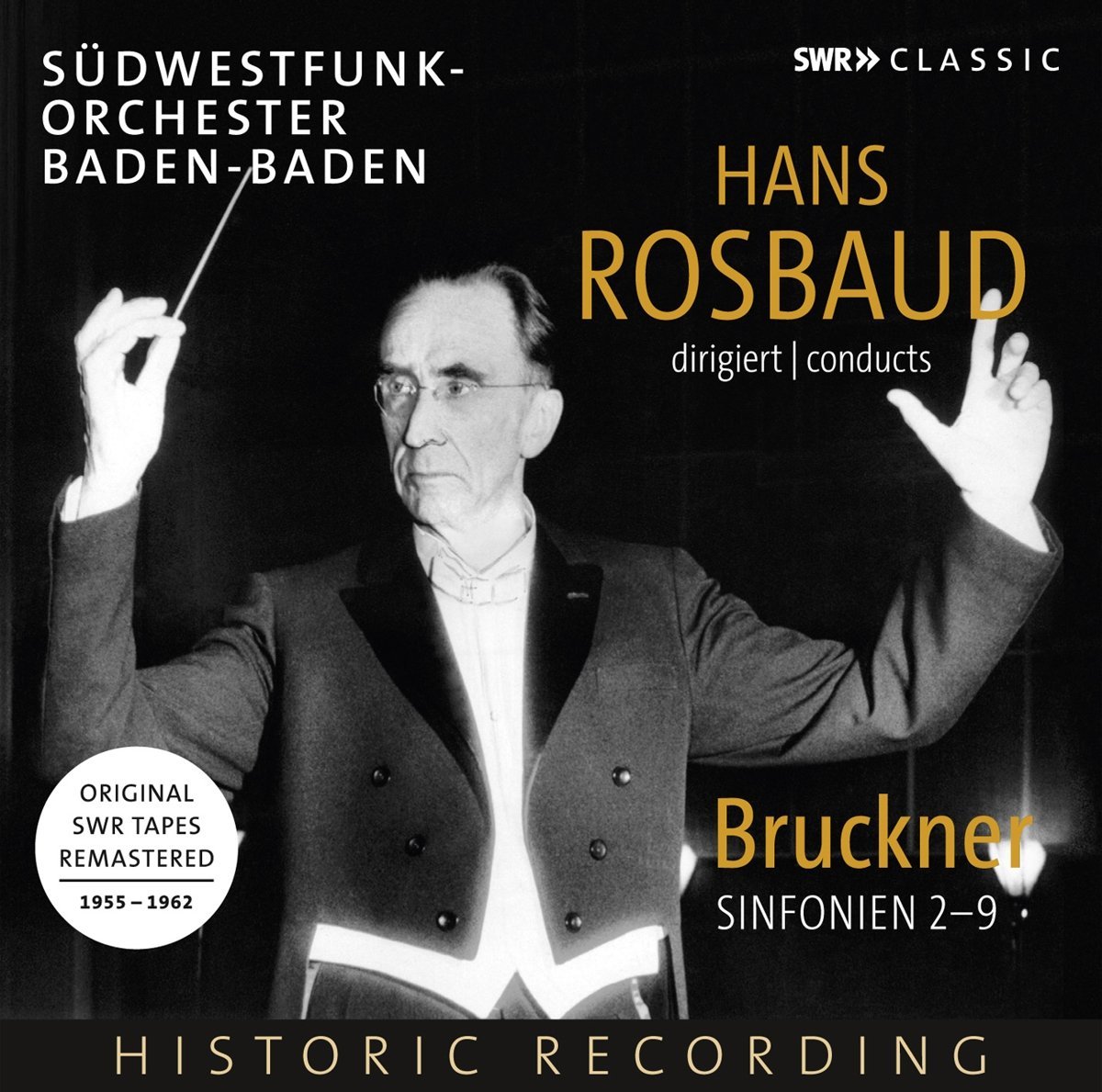
[Ed.10/09/17] A massive, much overdue update: SWR Classic has at last issued Hans Rosbaud's near-complete cycle (2-9) in never before achieved sound quality. Kurt Masur's Bruckner has been re-issued. Daniel Barenboim has recorded a third cycle, now, for the first time with "his" orchestra, the Berliner Staatskapelle. I have reviewed the 7th on Forbes: "Classical CD of the Week: Bruckner for DG" and the 4th here on ionarts: "Dip Your Ears, No. 163 (Visual Bruckner)". Jaap van Zweden had his excellent Bruckner cycle issued on Challenge Records on SACDs. The Korean Symphony Orchestra has recorded a cycle for Korean Decca under Hun-Joung Lim. The Riccardo Chailly cycle has been re-issued cheaply on Decca/Eloquence. Mario Venzago finished his controversial cycle on CPO. Brilliant Classic has put all of Heinz Rögner's Bruckner with the RSO Berlin together and made a complete cycle out of it by adding contemporary East German performances of Vaclav Neumann, Kurt Sanderling, and Franz Konwitschny to it. The Bruckner Orchestra Linz' cycle with Dennis-Russell Davies will be re-issued by Sony in December of this year. And Simone Young completed her very complete set ("00" + "0"), which has been released on Oehms. Global Amazon links have been added in all the lines I had to edit. The incomplete cycles of Dohnanyi & Harnoncourt will be added in the next round of edits...
[Ed.4/25/16] Out of the vaults from the SWR (South West German Radio) comes a new-old cycle with Michael Gielen. The picture is included below; a functioning link will be added when available.
[Ed.5/18/15] Speaking of the superlative Skrowaczewski cycle: It has been re-released at a budget price where it might be anybody's first choice now!
[Ed.1/30/13] Curiously the smallish Oehms label is working on two concurrent Bruckner cycles, adding to their superlative Skrowaczewski cycle. One on SACDs with the Hamburg Philharmonic Orchestra, conducted by Simone Young (1-4 & 8 so far; "0" will appear in April of 2013, the rest—including "00"—will be recorded by 2014/15; past experiences with this conductor have me made avoid this cycle, so far), and another with the Salzburg Mozarteum Orchestra and the genial Ivor Bolton who is only Symphony 1 & 2 away from the standard 9. (No timetable yet, when, but planned.) These cycles will be included here when completed.

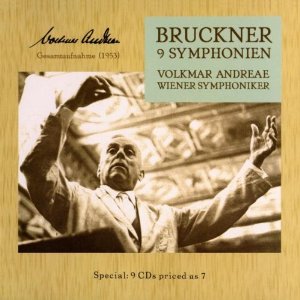
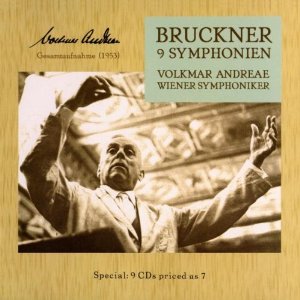
Volkmar Andreae
(1953, monaural)Vienna Symphony Orchestra, 1-9TMusic & ArtsVolkmar Andrae's cycle with the Vienna Symphony was (or rather: would-have-could-have been) the first cycle of Bruckner symphonies to appear on record, after Andreae had already done live cycles with his Zurich Tonhalle Orchestra. It is Bruckner from the proto-romantic age (Andreae had been asked to succeed Mahler at the NY Phil!), which, despite the sonic limitations, is refreshing. "Anti-Zen", if you will. It had begun its life on Philips but was never released in its time as it was eventually superseded by more contemporary cycles of Jochum's and Haitink's. That's not too surprising: compared to those stunningly polished efforts, the orchestra here does somewhere between "admirably" and shoddy. If you desperately need street cred with one of the Brucknerian posses, having this set will get you there, part of the way. Everyone else may safely pass. MusicWeb review here.
The Te Deum's soloists are: Emmy Loose, Hilde Rössel-Majdan, Anton Dermota, Gottlob Frick.
The Te Deum's soloists are: Emmy Loose, Hilde Rössel-Majdan, Anton Dermota, Gottlob Frick.

Takashi Asahina [朝比奈 隆] (I)
(1976-78)Osaka Philharmonic, 1-9, liveJean-JeanTakashi Asahina was the Bruckner-guru No.1 in Japan and in great part responsible for making Bruckner so popular in that country. He recorded unbelievable amounts of Bruckner with various orchestras, mainly "his" Osaka Philharmonic and the Tokyo Symphony Orchestra, but also the Japan Phil, New Japan Phil, and Tokyo Metropolitan Symphony Orchestra. To give you an idea: He apparently recorded the 8th and 7th symphonies 13 times (!), the 5th nine times, the 9th eight times. This is Takashi Asahina's first cycle, from the late 70s, with the Osaka Phil. Proper out-of-print, as far as I can tell.

Takashi Asahina [朝比奈 隆] (II)
(1978-89)Tokyo Metropolitan SO (2,5), Osaka PO (0,3,4,7,8), Tokyo SO (6), Japan PO (1), New Japan Phil (9), liveVictor? 10+1 CDsIf I am not mistaken, this is Asahina's second cycle, after his initial Osaka cycle (1976-78), which was recorded in various places and with various orchestras, four of which (5, 7, 8, 9) took place in Tokyo's St. Mary's Cathedral. There are also sets that combine just those recordings made in St. Mary's and/or those that were made there but not included on this (?) set. I admit to being confused but perhaps someone can shed light on this.

Takashi Asahina [朝比奈 隆] (III)
(1992-95)Osaka Philharmonic, 1-9, livePony CanyonThis is Takashi Asahina's third and last complete cycle, live, with his Osaka band in alleged top form, and including, depending on the edition, a rehearsal-CD. It is the most readily least un-available cycle and it is said to be the most important one. It has been re-issued by Exton on SACD.
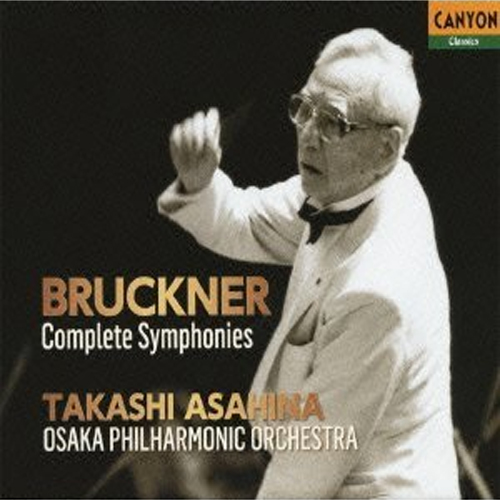

Takashi Asahina [朝比奈 隆] (IV)
(1991-1996)Tokyo Symphony Orchestra (5, 7, 8, 9T), liveExton/TowerThis is Asahina's Bruckner with the Tokyo Symphony Orchestra from the 90s with the 9th being concluded by the Te Deum.

Takashi Asahina [朝比奈 隆] (V)
(1992-1996)New Japan Philharmonic (3, 4, 5, 7, 8), liveFontec/Tower, 2 SACD-onlyThis is Asahina's Bruckner with the New Japan Phil, recorded around the same time as his TSO and Osaka II cycles. This one appears to have been filmed, too, and it is available on Blu-ray. The performances, live as always, took place at Suntory Hall (5, 7, 8) and Bunka Kaikan hall (3, 4). Note that this release on just two SACDs is not a SACD/CD Hybrid, so a dedicated SACD-player will be necessary. But if you're that much into Japanese Bruckner, you should have one or more already.


Takashi Asahina [朝比奈 隆] (VI)
(1993-2001)Tokyo Metropolitan Symphony Orchestra (5, 7, 7, 8, 9), liveFontec/TowerAnother orchestra, another incomplete Asahina Bruckner cycle. This one with the Tokyo Metropolitan Symphony Orchestra, containing only four symphonies but, to make up for it, the 7th twice. Asahina was between 85 and 92 years old, when he made these recordings. The later of the two 7th is his last performance of that work and is said to summon particular urgency. Parallels to Karajan, anyone? Note that this release on just two SACDs is also not a SACD/CD Hybrid, so a dedicated SACD-player will be necessary. Good thing you got one to play the "Asahina V" cycle.

Takashi Asahina [朝比奈 隆] (VII)
(2001)Osaka Philharmonic (4, 5, 7, 8, 9), liveExton/Tower"The last recordings" of Asahina brought him back to his Osaka Philharmonic... the farewell of a truly grand career. The recordings were made between November 27th, 2000, and September 24th, 2001, at Osaka Symphony Hall, Osaka Festival Hall (No.7), and Suntory Hall in Tokyo (8th).

Rémy Ballot
(2013-23)Altomonte Orchestra St. Florian / Upper Austrian Student Orchestra, 0-9, liveGramolaThe Bruckner of Vienna-based French conductor (and violinist) Rémy Ballot, recorded at his annual appearances at St. Florian's Brucknertage Festival, has been some of the most divisive stuff appearing in the Brucknerverse since Mario Venzago's and Roger Norrington's efforts. Some critics in the French Press have made verbal summersaults, suggesting his Bruckner puts Jochum's to shame. Others, notably Classic Today's Bruckner-crank David Hurwitz, have called it the worst Bruckner on record. Which, if it were true, would kind of make one want to listen to it even more so. Unlike those two aforementioned conductors, however, Ballot, who fashions himself "Celibidache's last student", didn't do so with senza-vibrato or chamber-like swift performances but rather with elaborate, well... sort-of Celibidachian performances. Having witnessed many of these recorded performances live, in concert, and having seen how a young student orchestra (not, by any stretch of the imagination a conservatory's or proper youth orchestra!) was transformed into a solid, well-playing Bruckner-machine, I remain impressed if not always convinced. I have written about the live experience of the Ninth and the recording of the Third for Forbes.com, and come away with positive impressions. Certainly, the "great silences and organic flow" (in the "grand" symphonies 3, 5, 8, 9) are the most daring on record. This is partly because the performances were tailored to audiences in St. Florian's and its (frankly terrible) acoustic. This accounts for the deliberation and the pauses. (For recording, the acoustics there are actually quite good, if you know where to place the mics, which is why not all recordings made there sound the same or are as drawn out.) In any case, it's certainly a unique cycle and ought to be sampled. The box contains, very sensibly, the 10 great symphonies of Bruckner, including the wonderful "Zeroëth" while skipping the negligible F-minor/"Double-Zero". The Ninth is the unfinished version.


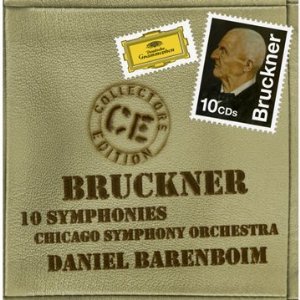
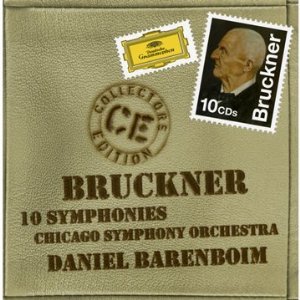
Daniel Barenboim I
(1973-80)Chicago Symphony, 0-9, T+Deutsche GrammophonIf you hadn't just scrolled past seven Asahina-cycles, you might be impressed by Daniel Barenboim's Bruckner-profligacy, having recorded the symphonies three times! First with the Chicago Symphony, which is a "youthful brash and stridently impressive" cycle, with the brassiest 4th ever put on record. (ionarts review here). It's been a long time since I listened to the two earlier of Barenboim's cycles, but I remember really liking the Zeroëth and appreciating the inclusion of Helgoland, the Psalm 150, and a fine Te Deum. First boxed in 1993, it took until 2011 for it to see a re-release as a set. Been oop for a while but has recently (2024?) been given a nice re-issue.
The Te Deum's soloists are: Jessye Norman, Yvonne Minton, David Rendall, Samuel Ramey.
The Te Deum's soloists are: Jessye Norman, Yvonne Minton, David Rendall, Samuel Ramey.


Daniel Barenboim II
(1990-1997)Berlin Philharmonic, 1-9+, liveTeldec/WarnerBarenboim's second cycle with the Berlin Philharmonic (live recordings made in coproduction with German Television) never made as much a splash as one might have supposed it would or should. Having been disappointed at the time, I called it "polished and strangely listless", but remember an exquisite 1st and 9th. It also includes Helgoland. After its initial run on Teldec, it saw a second life on Warners budget line Elatus before showing up as one of those Barenboim-boxes. In 2021 it was re-issued.


Daniel Barenboim III
(2010-2012)Berlin Staatskapelle, 1-9, liveDeutsche GrammophonIn 2010, Barenboim set about to record the Bruckner Symphonies a third time, this time finally with his Staatskapelle. Symphonies 4 through 9 were recorded in concert in 2010 and released by Accentus on DVD and Blu-ray. The missing three were added in 2012 and Barenboim released the cycle on his label through DG. I have reviewed the 4th in its Blu-ray iteration here which I found "brawny and brassy, sage and warm and patient", with the qualities of the orchestra - the warm strings and supple brass - coming though very nicely indeed. Much the same goes for the 7th (reviewed for Forbes here): "The Staatskapelle plays well shaped, broad Bruckner for their conductor, with a sure sense for drama (including the triangle-climax) but no outrageous interpretative fingerprints."


Eduard van Beinum
(1953-1959)Concertgebouw Orchestra (5, 7, 8, 9)Decca EloquenceVan Beinum's "noble, warm" Bruckner from the 50s (the 7th is live) has been put together and happily re-issued by Eloquence.

Herbert Blomstedt
(2005-2011)Leipzig Gewandhaus, 1-9Querstand, 9 SACDsHerbert Blomstedt was just in the process of attaining his 'autumn gold' reputation when this Bruckner cycle appeared, one by one, on SACD, on the fairly obscure Querstand label from Leipzig. It had everything going for it: Some lesser performed editions of the symphonies, that modern sage of a conductor, Herbert Blomstedt (who knows his Bruckner), the burnished tone of the gorgeous Leipzig Gewandhaus, great sound, limited availability. And yet, and yet, it never quite gelled with my ears. I shall give it another try, now that it has been cleverly re-issued (in a much, much nicer box but not on SACD anymore) on the savvy Accentus label, but the initial impression of uninvolvedness does not bode well. Notable editions include the Second and Third, where he springs for the first version Carragan and Nowak editions, respectively.


Ivor Bolton
(2004-2015)Mozarteum Orchestra Salzburg, 1-9OehmsIvor Bolton came out of the early music realm, but they all arrive at Bruckner, sooner or later! The cycle's impression has been, overall, a "Meh!", receiving robust and polite praise from Gramophone and MusicWeb, and total derision from Hurwitz. The symphonies I have heard from this cycle (3, 4, 9) have not left much of an impression on me.

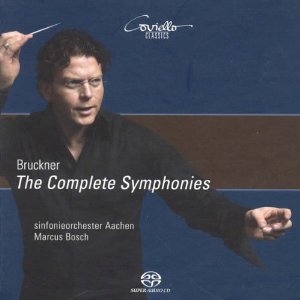
Marcus Bosch
(2003-2012)Aachen Symphony Orchestra, 00-9*, liveCovielloOne of the first cycles to appear on SACD and one of the most complete ones, too, in that it includes the F-Minor Symphony, the Zeroëth, and a 'complete' Ninth (with the Samale-Phillips-Cohrs-Mazzuca 2005 Finale). Aachen is a provincial orchestra, but it has history and form, with its former music directors including Fritz Busch, Herbert von Karajan, Paul van Kempen, and Wolfgang Sawallisch, who all started their career in the deep West of Germany. From 2002–2012 Marcus Bosch was in charge and he also made his name there, not the least with his Bruckner. These recordings were made live, in Aachen's St.Nikolaus church, over the course of his tenure.
From what I have heard myself, they are better than their lack of a reputation might suggest but also not exactly life-changing. These are generally swift readings, with the orchestra sometimes playing the music up to the hilt, sometimes just drifting along. There aren't a lot of reviews out there; a MusicWeb rave of No.2 that rings hollow, a friendly review by Colin Anderson of Nos. 7 & 8, and in Gramophone Rob Cowan likes No.2 as well, but only compared to Dausgaard, whose approach he finds lacking. Interesting editions used: The Second in the 1872 Carragan "first concept version", the Third in the 1873 version, and the Fourth in the 1874 first version.
From what I have heard myself, they are better than their lack of a reputation might suggest but also not exactly life-changing. These are generally swift readings, with the orchestra sometimes playing the music up to the hilt, sometimes just drifting along. There aren't a lot of reviews out there; a MusicWeb rave of No.2 that rings hollow, a friendly review by Colin Anderson of Nos. 7 & 8, and in Gramophone Rob Cowan likes No.2 as well, but only compared to Dausgaard, whose approach he finds lacking. Interesting editions used: The Second in the 1872 Carragan "first concept version", the Third in the 1873 version, and the Fourth in the 1874 first version.
Sergiu Celibidache I
(1971-1981)SWR Stuttgart RSO (3, 5, 7, 8, 9), Swedish RSO (4)Deutsche GrammophonHere comes the Bruckner-Guru! Except at this phase in his life, he wasn't the Celibidache we have come to know (and love?!) from the EMI recordings with the Munich Philharmonic. The performances are smooth, homogenous, not nearly as slow, and not quite as well played as the Munich Phil's.

Sergiu Celibidache II
(1987-1995)Munich Philharmonic, 3-9, T+Teldec/Warner, 12 CDs
This is the hot tamale! Even if you don't worship at the altar of Celibidache and even if not every of his takes on the symphonies makes your jaw drop, this is still one of the most staggeringly played sets. For better or worse, Celi set the standard for the "celebrated" Bruckner style of our age, glacial and incense-laden. That's a problem with other conductors, often, but not with Celi, who really knew how to celebrate this music and who could keep the tension where it would long have slacked with others. Certainly the Third, Fifth, and Sixth need to be in every Brucknerian's collection. When it was finally released as a set in 2011, after being hard to get for the longest time, it immediately jumped to the top of my Best Recordings of 2011 list.
The soloists of the Te Deum are: Margaret Price, Christel Birchers, Claes-Håkan Ahnsjö, and Karl Helm. Also included is the Mass No.3.
The soloists of the Te Deum are: Margaret Price, Christel Birchers, Claes-Håkan Ahnsjö, and Karl Helm. Also included is the Mass No.3.

Sergiu Celibidache 2.5
(1989-1991)Munich Philharmonic (4, 6, 7, 8), liveSonyWhat was better, for devoted Brucknerians, than slightly hard to get Celi-in-Munich recordings? Why, even harder-to-get Celi-with-Munich-in-Japan recordings, where this combination had an unrivalled fan base. Originally, some of these performances had come out on Sony LaserDiscs and VHS cassettes and then went out of print due to copyright issues. Together with the Berlin 7th, which had enjoyed a similar fate, these were the hottest items a few years back. Now they're available-ish again, on Sony, as imported Japanese SACDs (commemorating the 100th anniversary of the birth of Serge Celibidache) and DVDs. Seven and Eight are from Suntory Hall in 1990. The Fourth (on CD even in the DVD set) was recorded at Vienna's Musikverein in 1989, and the Sixth is identical to the one in the set above. (The set could be nicely supplemented with a 1986 Suntory Hall Fifth on an Altus SACD, if you can find a copy. Apparently there's a Japanese LP version available, for the time being.) Yes, this really doesn't qualify as a cycle by any stretch, but for Celi and his devotees we'll make an exception.


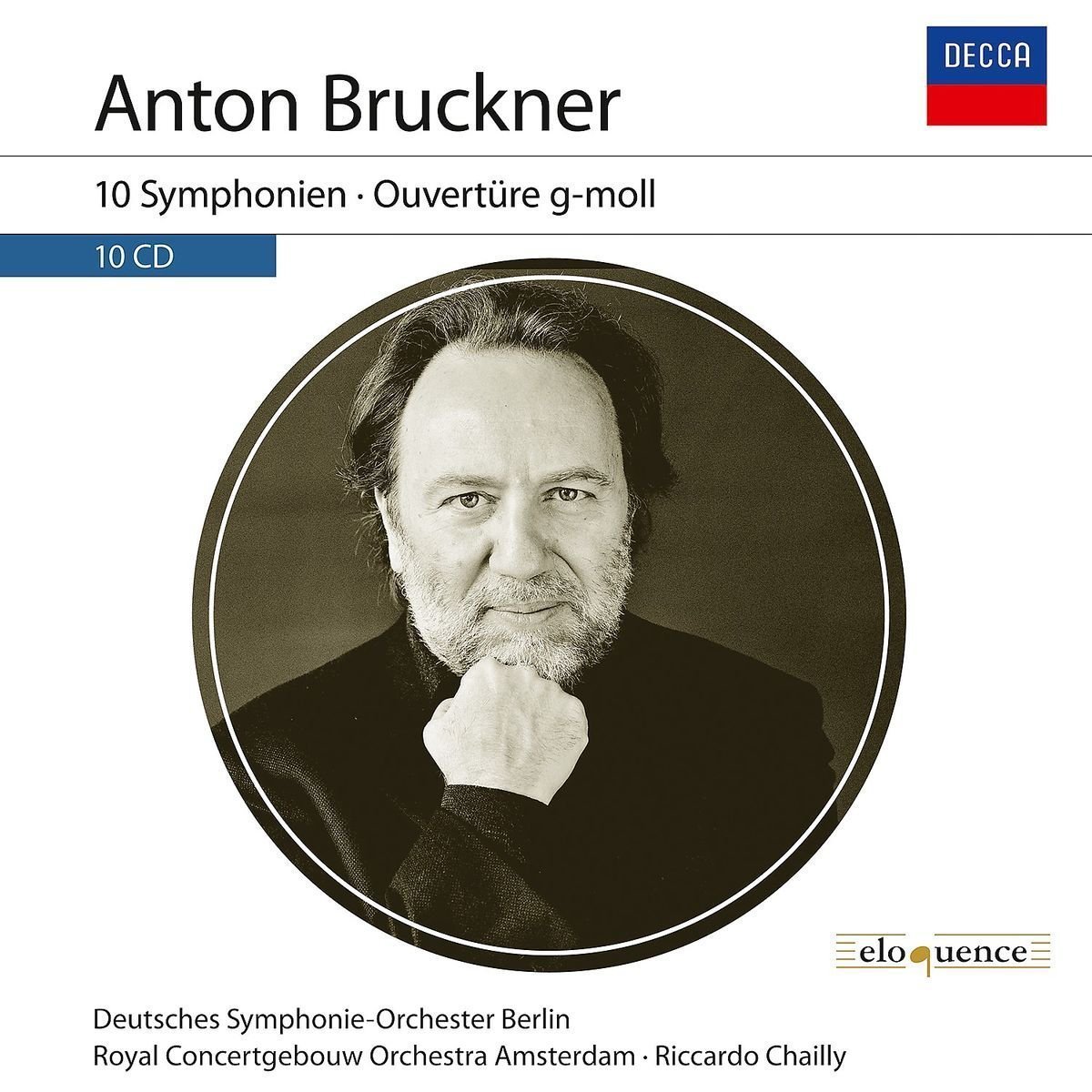
Riccardo Chailly
(1984-1999)Concertgebouw Orchestra, RSO Berlin, 0-9DeccaRiccardo Chailly was 31 years young when he started recording Bruckner with the Berlin Radio Symphony Orchestra in 1984 and he knocked it out of the park with a terrific Seventh. His Zeroëth from 1988, his last year in Berlin, was a revelation at the time and for many years the obvious choice. He also recorded Nos. 1 & 3 with that orchestra, before moving on to Amsterdam, where he recorded the rest, starting with the 4th the year he arrived. I remember when his 8th - the last in the bunch, from 1999 - came out (my second recording of that symphony but not yet the one that would unlock the Bruckner-mystery for me). The cycle has a reputation as being never anything less than good and never particularly glorious, either: High quality, low voltage. Perhaps that's underselling it; it does benefit from the energy of his RSO days in the 80s and the glorious sound of the RCO in the 90s. The Eloquence-reissue forgoes the AMSI-remastering, for better or worse; perhaps the former, since not everyone was keen on the "Ambient Surround Imaging".


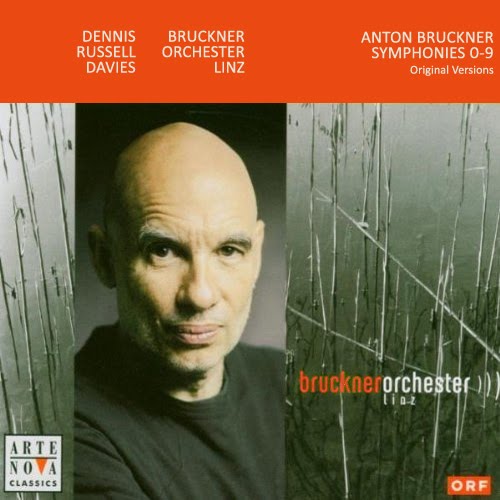
Dennis-Russell Davies
(2003-2008)Bruckner Orchester Linz, 0-9, liveArte NovaDennis-Russel Davies recorded the Bruckner symphonies with the Bruckner Orchestra in concert, between 2003 and 2008. The performances were somewhat notable for having included original versions of 1st, 4th, and 8th – and being released on the super-budget-label Arte Nova, but that's probably about it.

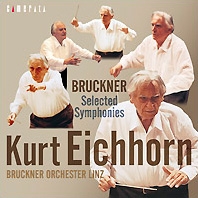
Kurt Eichhorn (+T.Guschlbauer & M.Sieghardt)
(1981-1995)Bruckner Orchestra Linz, 0-9*CamerataAnother cycle - the first - from the Bruckner Orchester Linz, recorded mainly by their regular guest conductor Kurt Eichhorn, who was 73 when he got started with the project but died (in 1994) before he could finish it. This set, meant to commemorate the centennial of Bruckner's death in 1996, was completed with the recordings by Theodor Guschlbauer (who had been the BOL's chief conductor in the 70s) and Martin Sieghart (who held that job in the 90s). Guschlbauer recorded the Zeroëth, Sieghart symphonies 1, 3, and 4. Eichhorn's Bruckner was and remains very highly regarded and the rarity of the oddball Japanese Camerata recordings added their part to the perceived desirability. The set was, especially back then, notable for being very inclusive, featuring not only the Zeroëth but also a Finale of the Ninth (SPMC 92). When the respective discs of the 2nd in Carragan's 1872 Version and the 9th with the Samale-Philips-Mazzuca+Cohrs Finale came out, they were world premiere recordings. There's also a (Japanese) release that includes just the Eichhorn recordings of Nos. 2, and 5 through 9.

Wilhelm Furtwängler
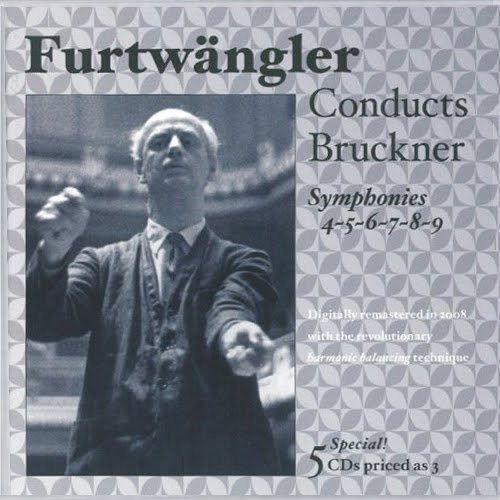
(1942-1951)Berlin and Vienna PhilharmonicsMusic & ArtsOne of the great advantages of the Furtwängler recordings is the terrible sound, most of them come in, which leaves lots of opportunity to wishcast any amount of genius into the performance as one might desire. There isn't a one-stop place for his Bruckner recordings, many of which are airchecks, but Music & Arts' set is the closest we get to it, including most of the more or less famous, official DG recordings of the 1951 Vienna 4th, '42 5th, '51 7th, '44 Vienna 8th, and '44 9th. The only recording of a Furtwängler 6th, missing the first movement, is also included. Not included are for example the later (1949, 51) EMI recordings of the 5th, 7th, and 8th.
Do not be fooled by "The Complete Wilhelm Furtwängler on Record" box, which isn't at all complete (in fact, it only contains the Adagio from the 7th, as far as Bruckner is concerned). The Complete Recordings on DG & Decca would get you all but the incomplete 6th from this selection, at least, and the Decca 4th, taped a week after the DG version. But it's totally out of print and you'd be getting rather more than you bargained for with 35 CDs of all-Willy.
Do not be fooled by "The Complete Wilhelm Furtwängler on Record" box, which isn't at all complete (in fact, it only contains the Adagio from the 7th, as far as Bruckner is concerned). The Complete Recordings on DG & Decca would get you all but the incomplete 6th from this selection, at least, and the Decca 4th, taped a week after the DG version. But it's totally out of print and you'd be getting rather more than you bargained for with 35 CDs of all-Willy.
Valery Gergiev
(2017-19)Munich Philharmonic, 1-9, liveMPhil labelUffdah. The project of recording all of Bruckner's Symphonies at St. Florian - with the spirit of Bruckner looming - with their new music director Valery Gergiev was supposed to be a big prestige project for the orchestra. They got to release all nine symphonies on their relatively new own label (founded, in part, for that reason) and released a lavish DVD set for the Japanese market - and one Russian invasion later they're not allowed to be proud of the set anymore. That has got to suck. "No loss", might the cynic say, wondering what business Gergiev ever had conducting Bruckner in the first place. It's not, indeed, the composer anyone would associated him with. But Gergiev came to Munich in part to absorb Bruckner and he got better at it, quick and the result is a lot better than the above-imagined cynic could ever have guessed. (You can read my take on Gergiev, Munich, and Bruckner in a series of posts here.) Not surprisingly, the set is on sale as of writing. Maybe dip your ears. It will be delivered to your home in an unmarked box.


Michael Gielen
(1968-2013)SWR SO Baden-Baden & Freiburg, RSO Saarbrücken, 1-9SWR MusicLorem ipsum dolor sit amet, consectetur adipiscing elit. Sed do eiusmod tempor incididunt ut labore et dolore magna aliqua. Ut enim ad minim veniam, quis nostrud exercitation ullamco laboris nisi ut aliquip ex ea commodo consequat. Duis aute irure dolor in reprehenderit in voluptate velit esse cillum dolore eu fugiat nulla pariatur. Excepteur sint occaecat cupidatat non proident, sunt in culpa qui officia deserunt mollit anim id est laborum. Michael Gielen was one of the great conductors of the 20th century, and his Bruckner, recorded over more than four decades, is a testament to his lifelong engagement with this composer. The SWR cycle, assembled from recordings spanning 1968 to 2013, offers an unusually long cross-section of one conductor's relationship with the Bruckner symphonies. Some of these are electrifying; others more analytical. Overall, the cycle rewards close listening.

Bernard Haitink
(1963-1972 / 2008)Royal Concertgebouw Orchestra, 0-9Philips/DeccaBernard Haitink recorded a Bruckner Symphony cycle with the Concertgebouw for Philips, which has since reappeared as part of the "Haitink Symphony Edition" box set, along with his Beethoven, Brahms, Schumann, Tchaikovsky, and Mahler. Meanwhile he continued recording with his favorite orchestras (BRSO, CSO, Dresden Staatskapelle, LSO, and RCO). From those recordings, many in the Super Audio format, one can cobble together an incomplete Bruckner cycle of astounding quality.


Bernard Haitink
(1993-2000)Vienna Philharmonic, 3, 4, 5, 8, TDPhilips (oop)Bernard Haitink, having recorded all the Bruckner symphonies with the RCO for Philips, went on to perform lots and lots more Bruckner, of course. As with his Mahler, where the initial set on Philips was expanded upon with the live "Kerstmatinee" recordings and then another cycle with the Berlin Philharmonic, that wasn't finished (it exists as a box on a Tower-Japan/Decca release and it is part of this Haitink-non-RCO-Philips-Box, there seems to have been a foray into, maybe?!, another cycle, this time with the Vienna Philharmonic. This came towards the end of the great classical CD recording expansion and, like so many other big-name projects at the time (Bach Cantatas, Haydn Symphonies, Mozart Piano Concertos, the aformentioned Berlin Mahler-cycle), got the ax. Whether intended as a full set or not, we ended up getting Nos. 3, 4, 5, and 8. This was the end of the "planned" recordings but Haitink had only just begun. I list them below; the expansive Third (1877 Version Ed. Leopld Nowak w/the Scherzo coda) is definitely worth hearing.


Bernard Haitink
(2000s-2010s)Various Orchestras, late live recordingsLSO Live / BR Klassik / Profil / CSO Resound / RCO LiveA new way of recording and running labels had cropped up with the advent of trail-blazers like "LSO live" and "RCO Live" and before long, many orchestras would either plan, record, and release in-house recordings (like LSO live) or, especially in the case of radio orchestras, simply decide later, which performances among all the material that they had been recording as a matter of course, was worth putting out there. And this is how we got almost another Bruckner cycle from late Haitink. Dave Hurwitz likes to bash Haitink, in particular, for "recording the same works over and over", but of course that's not how it worked. He simply performed these works and whether or not they were recorded and/or published was rather out of his hands. If a label decided that it was worth it to them, they'd do it. Presumably, Haitink could have vetoed it, but why would he have. It would have upset his musical partners and if they wanted to publish it and he didn't think there was a musical reason to do otherwise, why not let them go ahead. And a good thing he did, too!
It turns out that in Bruckner (and perhaps in general), old Haitink tended to be more interesting, more daring, less restrained, than youngish Haitink. And his orchestras responded to the wizened, charming Haitink with great performances. The live quality added its part and as I mentioned in the introduction, you could cobble together one of the great early 21st century sets (most on SACDs, even) of Bruckner just from these late Haitink performances with his favorite orchestras. (Bavarian Radio SO, Chicago Symphony Orchestra, Dresden Staatskapelle, London Symphony Orchestra, and the RCO of course). The Bruckner 6th with Dresden is one of my favorite Bruckner-recordings altogether, though there is one with the BRSO that rivals it. (See also "Dip Your Ears No. 80b"). The 7th with Chicago made it onto my "Best Recordings of 2008" list. And the 5th with the BRSO is wonderful, too. The RCO-8th and the London-4th do not, to my ears, quite live up to those other three (four) recordings. In any case, here they are, because this list can't be too complete and because I love old Haitink in Bruckner.
It turns out that in Bruckner (and perhaps in general), old Haitink tended to be more interesting, more daring, less restrained, than youngish Haitink. And his orchestras responded to the wizened, charming Haitink with great performances. The live quality added its part and as I mentioned in the introduction, you could cobble together one of the great early 21st century sets (most on SACDs, even) of Bruckner just from these late Haitink performances with his favorite orchestras. (Bavarian Radio SO, Chicago Symphony Orchestra, Dresden Staatskapelle, London Symphony Orchestra, and the RCO of course). The Bruckner 6th with Dresden is one of my favorite Bruckner-recordings altogether, though there is one with the BRSO that rivals it. (See also "Dip Your Ears No. 80b"). The 7th with Chicago made it onto my "Best Recordings of 2008" list. And the 5th with the BRSO is wonderful, too. The RCO-8th and the London-4th do not, to my ears, quite live up to those other three (four) recordings. In any case, here they are, because this list can't be too complete and because I love old Haitink in Bruckner.


Eliahu Inbal
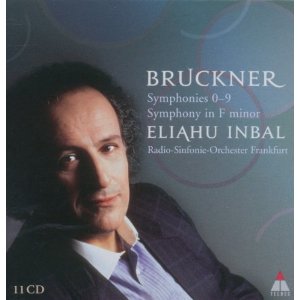
(1982-1989)RSO Frankfurt, 00-9*Teldec/WarnerLorem ipsum dolor sit amet, consectetur adipiscing elit. Sed do eiusmod tempor incididunt ut labore et dolore magna aliqua. Ut enim ad minim veniam, quis nostrud exercitation ullamco laboris nisi ut aliquip ex ea commodo consequat. Eliahu Inbal's traversal of the complete Bruckner symphonies with the RSO Frankfurt for Teldec/Warner is among the most comprehensive available, including both the "Study Symphony" (00) and the completed Ninth.
Marek Janowski
(2011-2015)Orchestre de la Suisse Romande, 1-9Pentatone SACD ~$80Lorem ipsum dolor sit amet, consectetur adipiscing elit. Sed do eiusmod tempor incididunt ut labore et dolore magna aliqua. Ut enim ad minim veniam, quis nostrud exercitation ullamco laboris nisi ut aliquip ex ea commodo consequat. Marek Janowski's Bruckner cycle with the Orchestre de la Suisse Romande on Pentatone SACDs is a polished, well-recorded set that came as something of a surprise from this conductor, more closely associated with the German repertoire in opera and oratorio.

Jochum Brothers (Georg Ludwig & Eugen)
(1944-1980)Bruckner Orchestra Linz, RCO, Stuttgart RSO, RIAS SO, 1-9Tahra (oop)Lorem ipsum dolor sit amet, consectetur adipiscing elit. A collected edition of both Jochum brothers' Bruckner recordings, assembled on Tahra. Historic war-time and slightly newer radio recordings from both Georg Ludwig and Eugen Jochum. Now out of print.

Eugen Jochum
(1958-1980)Berlin Philharmonic / BRSO / Dresden Staatskapelle, 1-9DG ~$48Lorem ipsum dolor sit amet, consectetur adipiscing elit. Eugen Jochum was one of the great Bruckner conductors of the 20th century and recorded two complete cycles. The first, for DG, was made with the Berlin Philharmonic and later the Bavarian Radio Symphony Orchestra (1958–78) and is rightly considered a classic. The second was recorded in Dresden for EMI (1975–80). Both cycles are available as box sets.


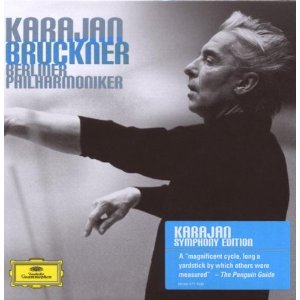
Herbert von Karajan
(1975-1981)Berlin Philharmonic, 1-9DG ~$25Lorem ipsum dolor sit amet, consectetur adipiscing elit. Herbert von Karajan's Bruckner with the Berlin Philharmonic for DG remains one of the most commanding traversals of this repertoire — majestic and sonically spectacular, though occasionally criticized for imposing Karajan's own aesthetic over Bruckner's more rugged architecture. But as a document of one of the most powerful conductor/orchestra partnerships in recorded history, it is essential.
Otto Klemperer
(New)Philharmonia Orchestra, 4-9EMI ~$19Lorem ipsum dolor sit amet, consectetur adipiscing elit. Otto Klemperer's Bruckner recordings with the (New) Philharmonia for EMI are remarkable documents: slow, grave, and utterly uncompromising. Klemperer recorded six of the symphonies (4-9), never a complete cycle, but the set has been assembled for EMI into a partial collection that remains essential listening.

Hans Knappertsbusch
BSO / BPh / Munich Phil. / Vienna Phil., 3-5, 7-9Music & Arts ~$50
Lorem ipsum dolor sit amet, consectetur adipiscing elit. No Knappertsbusch Bruckner collection is truly "integral" — all are cobbled from various recordings at various orchestras. This Music & Arts compilation is one of several available configurations. Kna's Bruckner is legendary for its titanic slow tempos, powerful silences, and absolute architectural weight. Any collection of this conductor's Bruckner is worthwhile.

Lim Hun-joung
Korean National Symphony Orchestra, 1-9Korean Decca
Lorem ipsum dolor sit amet, consectetur adipiscing elit. The Korean Symphony Orchestra under Hun-joung Lim recorded a Bruckner cycle for Korean Decca — an unusual entry in the Bruckner discography from an orchestra not previously known for this repertoire. The set uses the editions noted in the mouse-over and comes in individual SACD issues.

Lorin Maazel
Bavarian Radio Symphony Orchestra, 0-9BR Klassik ~$70
Lorem ipsum dolor sit amet, consectetur adipiscing elit. Lorin Maazel's complete Bruckner cycle with the BRSO on BR Klassik is a well-produced set from a conductor not always associated with this repertoire. Recorded live, it captures the orchestra at its considerable best.

Kurt Masur
(1970s)Leipzig Gewandhaus Orchestra, 1-9Eurodisc/RCA ~$50 (oop)Lorem ipsum dolor sit amet, consectetur adipiscing elit. Kurt Masur's Bruckner cycle with the Leipzig Gewandhaus Orchestra was recorded for Eurodisc/RCA and has been reissued by Sony. Masur was a distinguished Bruckner conductor and this set, recorded in the warm acoustic of the Gewandhaus, has aged well.


Yannick Nézet-Séguin
(2006-2017)Orchestre Métropolitain de Montréal, 1-9ATMA Classique ~$40Lorem ipsum dolor sit amet, consectetur adipiscing elit. Yannick Nézet-Séguin's Bruckner cycle with the Orchestre Métropolitain de Montréal on ATMA Classique was released in 2018 and came as something of a revelation: a cycle full of youthful energy, clear textures, and structural transparency — a lighter-weight approach that nonetheless takes Bruckner seriously.

Roger Norrington
SWR Stuttgart RSO, 3, 4, 6, 7, 9Hänssler (individual releases)
Lorem ipsum dolor sit amet, consectetur adipiscing elit. Roger Norrington's Bruckner with the SWR Stuttgart RSO applies his period-inflected approach — vibrato-free strings, airy textures, close attention to dynamics — to Bruckner's gargantuan structures with provocative and often revelatory results. His traversals of the Fourth, Seventh, and Ninth in particular are among the most distinctive available.

Roberto Paternostro
(1997-2006)Württemberg Philharmonic Reutlingen, 0-9Antes (1997-2006) ~$20Lorem ipsum dolor sit amet, consectetur adipiscing elit. Roberto Paternostro's complete Bruckner cycle with the Württemberg Philharmonic Reutlingen on Antes is a budget-priced entry recorded live in a cathedral. The acoustic lends the readings an appropriate grandeur, if not always optimal clarity.

Markus Poschner
(2021–2024)Bruckner Orchester Linz / ORF RSO Vienna, Symphonies 0–9Capriccio / NaxosFor the "Bruckner-Year 2024", Markus Poschner recorded all – and I mean all! the Bruckner Symphonies for Capriccio label. How many can there be? Well, there are 11 Symphonies, counting the “00” Study-Symphony and the “0” or “Zeroëth” – and then there are, by the current official count (and you could really get into the minutiae of it, but we won’t, because we are not hopeless geeks, just regular geeks!) two versions of the 1st, 2nd, and 8th Symphonies and a whopping three each of the 3rd and 4th ones. And that’s not counting a Fourth with the “Volksfest/Countryfair-Finale” as a separate one; that’s appended to the Fourth’ 1878-80 Version. I got to translate the fantastic liner notes by Yale-based Brucknerian-par-excellance Paul Hawkshaw into German and never before was I so into all those different versions and never again do I plan to get far into it. If the performance rocks, I’ll even take a ridiculous, very much un-sanctioned and mauled version like that of Knappertsbusch’s 5th on his Vienna recording. (That’s “1896 Schalk”, in case you were itching to know.)
Even before that, I had heard Poschner in Bruckner’s Zeroëth in 2018, and I was so blown away by it (see my review for Forbes), that I suggested to Capriccio, that they had to release the performance on record. Another concert, close on the Zeroëth’ heels, with the Eighth, was almost as impressive.) Little did I know that they would record & release ALL the symphonies with him – a project I am assuming had been under way at the time. (I should really just ask the Capriccio-chief about it – after all, he’s my podcast-buddy!) Apart from containing some very, very fine performances (generally on the swift and punchy side, this set and especially the individual releases, are an amazing resource for anyone who really wants to compare the various versions of the different symphonies, to determine if they actually favor one over another. Go forth and explore!
Btw, here's a fine MusicWeb review of the box with links to all the indivudal reviews on MusicWeb.


Heinz Rögner
(1980-1985)RSO Berlin, (1-3) 4-9*Brilliant (Edel)Lorem ipsum dolor sit amet, consectetur adipiscing elit. Brilliant Classics has assembled Heinz Rögner's Bruckner with the RSO Berlin into a complete cycle by adding contemporary East German performances of Vaclav Neumann, Kurt Sanderling, and Franz Konwitschny for the first three symphonies. Rögner himself recorded 4-9 (with a completed Ninth). An interesting document of East German Bruckner performance.

Hans Rosbaud
(1955-1962)SWR Südwestfunk SO, 1-9SWR ClassicLorem ipsum dolor sit amet, consectetur adipiscing elit. SWR Classic has at last issued Hans Rosbaud's near-complete cycle (symphonies 2-9) in exceptional sound quality — a long-overdue release of this historically significant conductor's Bruckner. The Südwestfunk (SWF) Sinfonie-Orchester Baden-Baden subsequently became the SWR Sinfonieorchester Baden-Baden und Freiburg.
Gerd Schaller
(2009–2016)Philharmonie Festiva, Symphonies 0–4, 7, 9 (+*Carragan/2010)PROFIL HänsslerLorem ipsum dolor sit amet, consectetur adipiscing elit. Sed do eiusmod tempor incididunt ut labore et dolore magna aliqua. Ut enim ad minim veniam, quis nostrud exercitation ullamco laboris nisi ut aliquip ex ea commodo consequat. Duis aute irure dolor in reprehenderit in voluptate velit esse cillum dolore eu fugiat nulla pariatur.
Giuseppe Sinopoli
(1997–2000)Staatskapelle Dresden, Symphonies 3–5, 7–9Deutsche GrammophonLorem ipsum dolor sit amet, consectetur adipiscing elit. Sed do eiusmod tempor incididunt ut labore et dolore magna aliqua. Ut enim ad minim veniam, quis nostrud exercitation ullamco laboris nisi ut aliquip ex ea commodo consequat. Duis aute irure dolor in reprehenderit in voluptate velit esse cillum dolore eu fugiat nulla pariatur.

Stanisław Skrowaczewski
(1991–2001)Saarbrücken Radio Symphony Orchestra, Symphonies 1–9Oehms ClassicsStanisław Skrowaczewski: Long one of the great “sleeper cycles”, when it had still been on the little cheapo, unlauded ArteNova label. Arte Nova was then purchased by Sony BMG to become their budget-line (with a far better design); some Arte Nova artists made it to the Sony label (most notably Christian Gerhaher). I still remember those old Euro-ArteNova discs of Skrowaczewski’s Bruckner coming into the cut-out section at our Tower Records (the 8th was given the nickname “Apolyptica” on the cover) and, on a mere whim, sending them off to various Bruckner-loving acquaintances across the country and then getting delighted and surprised feedback.
The founder of ArteNova, in any case, went on to found Oehms and he took the rights to that Bruckner-cycle with him and on re-issuing five years later, the name “Skrowaczewski” became a known quantity among Brucknerians. Despite being on a label no one had heard of and performed by an orchestra no one outside Germany knew even existed (it has since merged with Kaiserlautern and is the “Deutsche Radio Philharmonie Saarbrücken-Kaiserlautern”), led by a conductor only people from Minnesota and Manchester seemed to remember (Minneapolis Orchestra Hall wouldn’t exist without him), this was quite suddenly the bee’s knees. It is now – and very rightly so – among the absolute top recommendations for a complete Bruckner cycle. It might be pointed out that Andrew Clements, for The Guardian, was an early adopter, writing already at the time of the ArteNova release in 2001 that this cycle was “a force to be reckoned with: Intense and rigorous, these recordings of Bruckner’s orchestral music are a revelation.”
I’ve only heard Skrowa conduct live once (The BRSO, in 2012), and it was magical. I love his quote on loving Bruckner: “For me, Bruckner is one of the greatest composers, even though I cannot exactly say why.” The orchestrated Adagio form the F-major String Quartet that he played in that concert is also included in the box, as is Bruckner’s G-minor Ouverture, making this set even more complete. Skrowa is unmannered, unfussy, does not leave fingerprints… and yet he manages never to sound middle-of-the-road or tepid or, worst of all, boring. It remains a prime Brucknerian choice to this day.


Georg Solti
(1966–1981)Chicago Symphony Orchestra, Symphonies 0–9DeccaLorem ipsum dolor sit amet, consectetur adipiscing elit. Sed do eiusmod tempor incididunt ut labore et dolore magna aliqua. Ut enim ad minim veniam, quis nostrud exercitation ullamco laboris nisi ut aliquip ex ea commodo consequat. Duis aute irure dolor in reprehenderit in voluptate velit esse cillum dolore eu fugiat nulla pariatur.

Georg Tintner
(1994–1999)Various Orchestras, Symphonies 0–9NaxosLorem ipsum dolor sit amet, consectetur adipiscing elit. Sed do eiusmod tempor incididunt ut labore et dolore magna aliqua. Ut enim ad minim veniam, quis nostrud exercitation ullamco laboris nisi ut aliquip ex ea commodo consequat. Duis aute irure dolor in reprehenderit in voluptate velit esse cillum dolore eu fugiat nulla pariatur.


Mario Venzago
(2012–2014)Various Orchestras, Symphonies 0–9cpoLorem ipsum dolor sit amet, consectetur adipiscing elit. Sed do eiusmod tempor incididunt ut labore et dolore magna aliqua. Ut enim ad minim veniam, quis nostrud exercitation ullamco laboris nisi ut aliquip ex ea commodo consequat. Duis aute irure dolor in reprehenderit in voluptate velit esse cillum dolore eu fugiat nulla pariatur. Excepteur sint occaecat cupidatat non proident. Five different orchestras, 2012–2014, with Making-Of DVD.

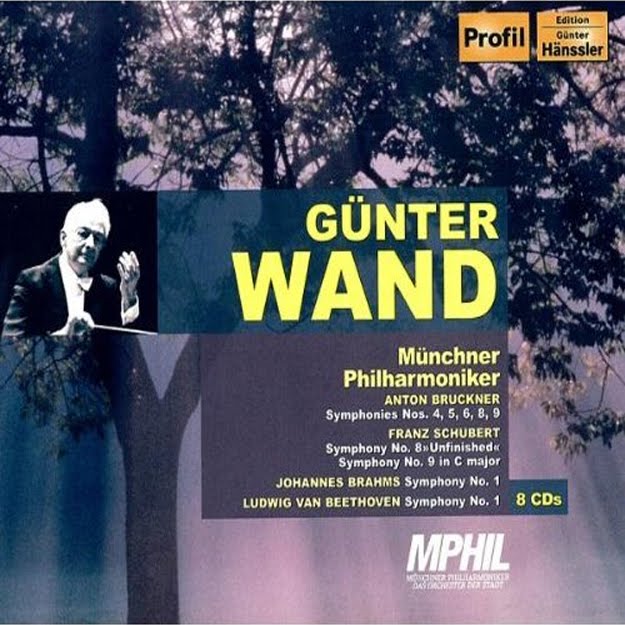
Günter Wand
(1974–2001)Various Orchestras, Symphonies 1–9RCA Red SealLorem ipsum dolor sit amet, consectetur adipiscing elit. Sed do eiusmod tempor incididunt ut labore et dolore magna aliqua. Ut enim ad minim veniam, quis nostrud exercitation ullamco laboris nisi ut aliquip ex ea commodo consequat. Duis aute irure dolor in reprehenderit in voluptate velit esse cillum dolore eu fugiat nulla pariatur. Multiple cycles spanning Cologne, NDR Hamburg, and Berlin Philharmonic, plus two DVD releases.


Simone Young
(2002–2009)Philharmoniker Hamburg, Symphonies 00–9Oehms ClassicsLorem ipsum dolor sit amet, consectetur adipiscing elit. Sed do eiusmod tempor incididunt ut labore et dolore magna aliqua. Ut enim ad minim veniam, quis nostrud exercitation ullamco laboris nisi ut aliquip ex ea commodo consequat. Duis aute irure dolor in reprehenderit in voluptate velit esse cillum dolore eu fugiat nulla pariatur.

Jaap van Zweden
(2006–2013)Netherlands Radio Philharmonic Orchestra, Symphonies 1–9Challenge RecordsLorem ipsum dolor sit amet, consectetur adipiscing elit. Sed do eiusmod tempor incididunt ut labore et dolore magna aliqua. Ut enim ad minim veniam, quis nostrud exercitation ullamco laboris nisi ut aliquip ex ea commodo consequat. Duis aute irure dolor in reprehenderit in voluptate velit esse cillum dolore eu fugiat nulla pariatur. Recorded in SACD.








14 comments:
Schallers, Youngs and Venzago cycles are also complete now :)
Thanks for the reminder! I shall add them before long... when I've recovered from updating and revamping the Sibelius cycle survey. :-)
just see there are also some uncompleted cycles (Sinopoli, Norrington, etc.). maybe you should also add the uncomplete cycles from Harnoncourt and v.Dohnanyi (Symphonies 3 - 9 )
...and a new complete set from Barenboim/Staatskapelle Berlin (download only) has also just dropped, available on iTunes.
http://smarturl.it/BrucknerComplete
Matt: This Barenboim is presumably the audio-version of his live cycle so far issued on DVD/bluray by Accentus?! I will include it when it is available in toto in some hard copy format.
Yes, Dohnanyi & Harnoncourt probably deserve their inclusion... 3-9 is (sadly, esp. as No.2 is wonderful) basically a cycle in Bruckner.
Upcoming is also Dausgaard on BIS... and Schaller is now complete but for the "00" which he will presumably add, too. Thanks for all the tips & hints!!!
Jens
One more thing, Cambreling and SWR Baden-Baden und Freiburg (now disbanded and form with SWR Stuttgart together into a new SWRSO) finished 3, 4, 6, 7, & 9. However, not only the orchestra but also the record label Glor has been cut, sadly.
Thanks for the comment re: Cambreling!
Might I suggest adding the terrific (if incomplete) Sawallisch/Bavarian State Orchestra digital set on Orfeo (1,5,6,9)? Wonderful stuff (you could even supplement it with a 3 and 5 he did with the Philadephians)...
You might also include Eichorn's set with the Bruckner Orchestra Linz (00, 3, and 4 were conducted by Martin Sieghart), also in digital. Supplemented by his extraordinary live 5th with the BRSO in St. Florian's Cathedral.
Thanks for your work - you're doing a wonderful thing. I will continue to read your writing with interest.
Thanks for the comment and the suggestion and the kind words! Will consider and put something together along those lines.
(And sorry to get back so tardily; I don't get notice of comments, so it takes my searching for them to find them. But I always do, as I try to keep these discographies fairly updated.)
Cheers & best,
Jens
There are also now the multi-conducter cycles from the Bavarian RSO on BRKlassik, the VPO on Decca Eloquence, and the Berlin PO on their house label.
And now also....Poschner, the new VPO and RCO cycles, Thielemann, Nelsons...
Absolutely. These need to be added! (And I did the translations of the liner notes for the Poschner cycle, so I am quite aware of it. Learned a lot in the process.)
I'd love to see a real review of the recent RCO Live box. There are some real gems in there (Sanderling 3rd, Jochum 5th, Haitink 7th)...
I'd love to see a real review of the recent RCO Live box, there are some great performances in there (Sanderling 3rd, Tennstedt 4th, Jochum 5th, Haitink 7th...)
Post a Comment