CD Reviews | CTD (Briefly Noted) | JFL (Dip Your Ears) | DVD Reviews

29.9.12

Head Butt

The Centre Pompidou opens an exhibit of works by Adel Abdessemed this coming Wednesday: Adel Abdessemed Je suis innocent (through January 7). As part of the show, he has installed a bronze sculpture (Coup de tête) in front of the museum depicting Zinedine Zidane's infamous head butt to the chest of Marco Materazzi during the final match of the World Cup in 2006, after which Italy went on to defeat France. Monumental in scope, at over five meters high, the sculpture may seem to immortalize what most people see as the final catastrophic failure of one of the world's great soccer players -- called by some commentators, without any sense of hyperbole, a Greek tragedy. The sense of anguish in the voice of the play caller for TF1, recorded here -- "Oh no, Zinedine, not now, not here, Zinedine, not after everything you have done" -- is heartbreaking, as they watch Zidane receive a red card and walk off the field of the final match of his career, in disgrace. I am not sure that I like the sculpture all that much, without seeing it in person, but it has provoked a lot of remembering and with its outdoor placement will be seen by a vast number of people.


(courtesy of Le Monde)

28.9.12

An Inspired New Home for Islamic Treasures

Untitled
It's the largest expansion project since I. M. Pei designed the pyramid in front of the Louvre some twenty years ago. The Cour Visconti, a lavish interior courtyard at the Louvre, has been transformed into the new Department of Islamic Art, complete with an undulating, golden mesh roof -- referred to as a “dragonfly wing” by architects Mario Bellini and Rudy Ricciotti.

The new wing is home to more than 3,000 works from throughout the Islamic world. The collection ranges from the seventh to the nineteenth centuries, from the founding of Baghdad in 762, through the rein of Gangis Kahn, and to the Sufi mystics.

Islam's history and tradition is complex and incredibly diverse, more than I ever realized. With some 8.8 million visitors a year, apparently many of them there during my visit, the Louvre, the most popular tourist attraction in Paris, is about to become a leading institution for Islamic study in Europe. It's a timely gift in a turbulent period and quite impressive. More images on my Flickr.


UntitledUntitledUntitled

27.9.12

More of Tallis Scholars' Josquin Cycle

Complete Josquin Edition:
available at Amazon
M. Pange Lingua / M. La Sol Fa Re Mi / L'homme armé Masses
(2006)

available at Amazon
M. Sine nomine / M. Ad fugam
(2008)
[Review]

available at Amazon
Missa De beata virgine / Missa Ave maris stella
(2011)
[Review]
available at Amazon
Josquin Des Prez, M. Malheur me bat / M. Fortuna desesperata,
Tallis Scholars

(released on March 10, 2009)
Gimell CDGIM 042 | 75'27"
I somehow missed one volume in the Tallis Scholars' excellent complete set of the Masses of Josquin Des Prez. In these works, Josquin exhausts all of the techniques for reusing preexisting material in a setting of the Latin Ordinary. To go with the Masses recorded so far -- organized using paraphrases of one or more Gregorian chants or of a secular tune, soggetto cavato (a technique that Josquin innovated), strict canon, or quotation of earlier chants or polyphonic melodies in cantus firmus -- the 2009 installment presents two Masses in which Josquin helped innovate the so-called "parody" or imitation Mass technique. In both of these settings, Josquin uses a 3-voice secular work of polyphony -- the expressive French chanson Malheur me bat, once attributed to Josquin's teacher Ockeghem but now thought to be the work of an obscure Flemish composer named Malcort, and the Latin-texted Fortuna desperata attributed (but not decisively) to Antoine Busnoys -- as the basis for each movement of the Mass. Far from being merely derivative, the imitation technique is just another way to take pre-composed material and wring out its contrapuntal possibilities, especially in Josquin's hands.

The booklet essay by the ensemble's director, Peter Phillips, lays out most of the striking parts of these Masses. The Missa Malheur me bat, believed by scholars to be the later of the two, is an absolutely gorgeous piece, beauty that is only heightened by an understanding of what Josquin was up to formally. As is often the case, Josquin was writing for three male voices plus probably trebles (or falsettists) on the top part. He uses the parts of the chanson in close polyphony, while sometimes also setting the superius in his top voice in longer note values. There are some glorious bicinia in the Sanctus and especially the Agnus Dei (the second invocation of the text, set for two tenors in close imitation), and in the Hosanna sections some exciting mensural shifts into triple time. In the final Agnus Dei, Josquin adds an extra altus and bass part, which follow their counterparts in strict canon by one beat. It is both contrapuntally ingenious and stunningly beautiful listening. The Missa Fortuna desperata is also set for four voices, but in it Josquin has not quite been able to square contrapuntal complexity -- in the Credo, for example, he quotes the source work in mensuration signs that gradually speed up the piece throughout the long text -- with the same ease of musical beauty, ending up with writing that is more austere.

26.9.12

À mon chevet: The Satanic Verses

À mon chevet is a series of posts featuring a quote from whatever book is on my nightstand at the moment.

book cover
On the shelf of Changez Chamchawala's teak-lined study, beside a ten-volume set of the Richard Burton translation of the Arabian Nights, which was being slowly devoured by mildew and book-worm owing to the deep-seated prejudice against books which led Changez to own thousands of the pernicious things in order to humiliate them by leaving them to rot unread, there stood a magic lamp, a brightly polished copper-and-brass avatar of Aladdin's very own genie-container: a lamp begging to be rubbed. But Changez neither rubbed it nor permitted it to be rubbed by, for example, his son. "One day," he assured the boy, "you'll have it for yourself. Then rub and rub as much as you like and see what doesn't come to you. Just now, but, it is mine." The promise of the magic lamp infected Master Salahuddin with the notion that one day his troubles would end and his innermost desires would be gratified, and all he had to do was wait it out; but then there was the incident of the wallet, when the magic of a rainbow had worked for him, not for his father but for him, and Changez Chamchawala had stolen the crock of gold. After that the son became convinced that his father would smother all his hopes unless he got away, and from that moment he became desperate to leave, to escape, to place oceans between the great man and himself.

-- Salman Rushdie, The Satanic Verses, pp. 36-37
The coverage of Salman Rushdie's new book, Joseph Anton: A Memoir (next on my chevet), has been feverish. The new book, a memoir of the author's years of hiding from the Iranian fatwa over his excellent novel The Satanic Verses, is written as a novel, about Rushdie as a third-person character. Rushdie has said in more than one instance that, in the present climate of fear about the direction the Muslim world is taking, he does not think The Satanic Verses would see the light of day if he had written it now.

25.9.12

Nathan Gunn Celebrity Recital

An opera star recital can be a wonderful thing, which is why Plácido Domingo established the Washington National Opera's Celebrity Series. One can present a first-tier singer, whom the company could probably never engage for a full production, and it brings in revenue with a minimum expenditure. It really only works when the singer is of the caliber to drive ticket sales -- in the last two seasons, Angela Gheorghiu, Bryn Terfel, and especially Juan Diego Flórez have fit that bill -- and when the music on the program is associated with the singer's best achievements. On neither account, really, did Sunday's Celebrity Recital by baritone Nathan Gunn succeed. We did not expect it to, which is why it did not appear among either our picks for the year or for the month of September, and the sparse audience -- padded with some listeners who did not behave like opera regulars -- showed that plenty of people agreed with our assessment. Having half of the selections consist of Broadway music by Sondheim and Loewe, I note with some sense of Schadenfreude, did not bring in the huge crowds of people wanting to hear opera singers sing music theater.

Gunn has been resting on his laurels for some time: his last solo performance to reach these ears, at Shriver Hall in 2008, fell just as flat as this uneven recital did. The voice, once mellifluous, sounded faded and gritty at times, and other than in the comic pieces, which obviously engaged him much more, he sang without much charm. The operatic roles he chose to feature seemed beyond his voice: Figaro's high notes in selections from The Barber of Seville at the edge of control and strained, the French in music from Bizet's The Pearl Fishers mostly incomprehensible (his Italian was better), and the toast aria from Ambroise Thomas's Hamlet a little skittish rhythmically and not uproarious in tone. More and more, Broadway musicals are taking over Gunn's schedule, including Francesca Zambello's Camelot at Glimmerglass next summer. He would not be the first singer to make that transition -- Ezio Pinza and Todd Duncan are a couple examples -- but it makes him far less interesting a performer for my money.


Other Reviews:

Robert Battey, Verve and versatility at Washington National Opera’s concert series (Washington Post, September 25)
Gunn was outshone by his recital partner, tenor William Burden, who floated above Gunn in the famous duet "Au fond du temple saint" from The Pearl Fishers and showed up his French and his emotional connection to the audience in "Ah, lève-toi, soleil" from Gounod's Roméo et Juliette (the only piece to elicit much cheering from the audience up to that point). Soprano Emily Albrink, who had an admirable WNO Domingo-Cafritz Young Artist outing as Sophie in last spring's Werther, did not sound quite as comfortable in this recital. A lack of breath support at the end of long lines dragged her intonation flat, but the top of her voice sounded just as effervescent and she was a charming Zerlina in "Là ci darem la mano" and Susanna in "Crudel, perchè fin'ora." Conductor Ted Sperling was obviously more comfortable in the music theater selections, but he kept himself largely out of the way in the overtures from Barber of Seville and Marriage of Figaro, pieces the WNO Orchestra could probably play in their sleep.

The lack of supertitles limited the audience's reactions to the funnier moments in the foreign-language pieces. It was good, however, to remember that this was how opera was before supertitles: either you understood the language or you relied on the singer's expressions and gestures to understand. This drew attention to Gunn's often emotion-less demeanor -- here there was no supertitle machine to deliver the punchline. The biggest laughs of the evening came from unplanned accidents, as when Gunn nimbly incorporated a loud audience sneeze into his performance of "Largo al factotum." The lighting system in the Kennedy Center Opera House went haywire before and during Gunn's performance of Goundod's Queen Mab aria, cycling through all of its color specials and spotlights, caused by a computer malfunction we were told by departing director of artistic operations Christina Scheppelmann (perhaps it was Queen Mab up to her usual tricks). After stopping mid-aria at the first incident, Gunn and the orchestra bravely soldiered on when it happened a second time, with some players using their mobile phones to light their standmates' music.

24.9.12

Shaham Plays Barber with the BSO

Style masthead

Charles T. Downey, At Strathmore, BSO’s Americana optimism
Washington Post, September 24, 2012

available at Amazon
Barber / Korngold / Walton, Violin Concertos, J. Ehnes, Vancouver Symphony Orchestra, B. Tovey
At the Baltimore Symphony Orchestra’s first subscription concert of the new season, heard at Strathmore on Saturday night, the orchestra played a program of classic Americana with grace and power. The music, from the 1930s, ’40s and ’50s, all sounded much the same, a reminder of the era before serialism and experimental composition had taken over classical music.

The symphonic suite from the film score for Elia Kazan’s “On the Waterfront” was the first offering. It includes some of Leonard Bernstein’s most polished and searing music — from the suite’s plaintive opening horn solo and lonely wail of the saxophone, through the savage intensity of its percussion-driven fast sections to its fragile love theme massed into a raging surge. Conductor Marin Alsop led a convincing performance throughout. [Continue reading]
Baltimore Symphony Orchestra
With Gil Shaham, violin (Violin Concertos of the 1930s)
Music Center at Strathmore

23.9.12

In Brief: Start of Fall Edition

Here is your regular Sunday selection of links to online audio, online video, and other good things in Blogville and Beyond. (After clicking to an audio or video stream, press the "Play" button to start the broadcast.)

  • From the Festival de Sablé, listen to Caligula, an opera by Giovani-Maria Pagliardi from 1672, performed by Le Poème Harmonique and a troupe of marionnettes. [France Musique]

  • From the Grand Théatre de Genève last May, Diana Damrau and Sophie Koch star in Ambroise Thomas's Mignon. [Österreichischer Rundfunk]

  • Watch conductor Paavo Järvi and pianist Rudolf Buchbinder join the Orchestre de Paris for Dvořák's Symphonic Variations and eighth symphony, plus Beethoven's third piano concerto. [Cité de la Musique Live]

  • From the Festival Sinfonia en Périgord, a program of madrigals sacred and secular by Schein and Monteverdi, performed by Ensemble Sagittarius. [France Musique]

  • Watch the piano duo of Márta and György Kurtág perform a program of music by Johann Sebastian Bach and György Kurtag. [Cité de la Musique Live]

  • The Accademia Bizantina performs music by C.P.E. Bach, W.F. Bach, and Mozart at the Mozart Festes Würzburg. [Österreichischer Rundfunk]

  • From the Concours Reine Elisabeth in Brussels last June, the gala concert featuring performances by violinists Andrey Baranov (1er Prix), Tatsuki Narita (2ème Prix), and Hyun Su Shin (3ème Prix). [France Musique]

  • The Piatti Quartet and pianist Clare Hammond play music by Haydn, Ravel, Satie, and others. [Österreichischer Rundfunk]

  • The Philharmonia Orchestra and Chorus perform Brahms's German Requiem, with soloists Susan Gritton and Simon Keenlyside, and Beethoven's fourth symphony. [France Musique]

  • Two older performances of the Vienna Philharmonic: Beethoven's seventh symphony with Nikolaus Harnoncourt in 2003 and Schubert's fourth symphony with Harnoncourt, also in 2003. [Österreichischer Rundfunk]

  • Listen to the Orchestre Philharmonique de Radio France perform Schnittke's Faust cantata and Tchaikovsky's sixth symphony. [France Musique]

  • From the Schwarzenberg Festival, chamber music by Brahms and Schubert performed by Baiba Skride, Sol Gabetta, Bertrand Chamayou, and others. [Österreichischer Rundfunk]

  • Two concerts of early music from the Festival Les Méridiennes. [France Musique]

  • Sarah Chang plays the Brahms violin concerto with the Orchestre National de France at the Théâtre des Champs-Elysées, under Kurt Masur, with Brahms's first symphony. [France Musique]

  • A recording of Verdi's La Forza del Destino made in Rome in 1955. [Österreichischer Rundfunk]

  • Hear violinist Nicolas Dautricourt, cellist Alexander Dmitriev, and pianist Jean-Frédéric Neuburger in pieces for women's chorus by Schnittke, Pärt, and others, from the Festival de Radio France Montpellier-Languedoc Roussillon. [France Musique]

  • From the Musiktage Mondsee, the Benyounes Quartett and clarinetist Gerald Pachinger perform music by Schubert and others. [Österreichischer Rundfunk]

  • Karine Deshayes joins the Orchestre Philharmonique de Radio France for Berlioz's Les nuits d’été, plus music by Wagner and Elgar. [France Musique]

22.9.12

From the 2012 ARD Competition, Day 7

Day 7, String Quartets, Semi Finals

Six string quartets (performers) and 18 string quartets (compositions) in just under nine hours is something you will not likely experience anywhere outside the ARD Music Competition. It’s a marathon, exhausting and gratifying, and particularly insightful when it comes to the ARD commissioned competition that participants of the semi final are required to play.

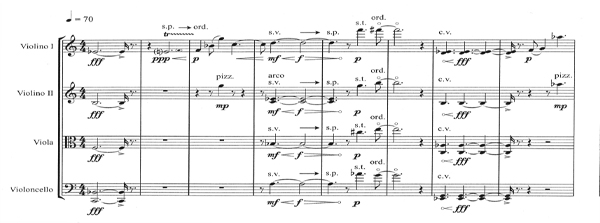
For the String Quartets in 2012, that was a composition by Erkki-Sven Tüür, Lost Prayers—his second string quartet, which is quite easy on the ears, comprehensible, not all too novel, and full of musical references that the ear consecutively grasps after one, two, three hearings. Notably there is a general kinship with Gregorian, or Schütz-like sentiments (not surprising if you know his Wanderer's Evening Song), there are long dramatic arches that emerge, and also hints—but just half a second long—of extreme romanticism. It’s a work that pays homage to the string quartet tradition, and continues it… written expressively for the instruments, not against them. If it’s a little tedious in its constant stymied run-ups that are lost in flageolet notes before the whole shebang starts over again until it finally reaches fruition after the eleventh or so time… well, it’s also a lot better than this commissioned piece could have been. The voices—this year and those from 2009—should know what I mean.


The Acies Quartet (Benjamin Ziervogel & Raphael Kasprian, violins, Manfred Plessl, viola, Thomas Wiesflecker, cello), experienced favorites, were the first to go—which meant the world premiere performance for Lost Prayers. Every hearing of a new work is a learning experience, even with the very readable score on one’s lap, but the Acies’ transparent, nuanced, gently lit account was just about ideal for a first listening. Rather than single-mindedly reciting the text in front of them, they made their own (though perhaps not Tüür’s) musical sense of it, even if that meant not slavishly following every dynamic marking, or lack thereof.

The Novus Quartet (Jae-young Kim & Young-Uk Kim, Violins, Seung-won Lee, Viola, Woong-whee Moon, Cello – from the Korea National University of Arts) went about it differently, informed perhaps by a desperate instinct to get as much sentiment out of the work as it lends itself to—which is a