CD Reviews | CTD (Briefly Noted) | JFL (Dip Your Ears) | DVD Reviews
Showing posts with label Washington National Opera. Show all posts

25.9.16

A Traditional 'Marriage of Figaro'


Joshua Hopkins and Lisette Oropesa in The Marriage of Figaro, Washington National Opera (photo by Scott Suchman)

Many thanks to Robert R. Reilly for this review from the Kennedy Center.

On Saturday night, September 24, 2016, the Washington National Opera’s performance of Mozart’s The Marriage of Figaro was simulcast to Nationals Park for the annual Opera in the Outfield. In addition to a full opera house at the Kennedy Center, there were some 8,000 people in the ballpark pitching for Mozart. The evening began with the playing of the National Anthem.

Then came something unique in my many years of opera experience. After an overture played with punchy rhythms, conductor James Gaffigan led the WNO Orchestra in the opening orchestral measures to the duettino between Figaro and Susanna. Then the music stopped, and Gaffigan turned to the audience and exclaimed, “There’s supposed to be singing here.” But there wasn’t, because there was no Figaro or Susanna in sight. In fact, there was nothing in sight because the lights were down and the curtain had not been drawn. The culprit turned out to be a glitch with the automated curtain apparatus. The problem was soon resolved and Gaffigan and his forces began again – this time with Figaro and Susanna present on a stunningly handsome set of a neoclassical palace room.

The affair was handled with good humor, and thus began an evening filled with hilarity. The Marriage of Figaro was the musical Marx Brothers of its time. Da Ponte’s libretto, taken from Beaumarchais’s play of the same name, is a precursor to a French bedroom farce. The love spats, the impersonations, the cross-dressing, the endless conniving to entrap unfaithful lovers, the near-escapes, and the bald-faced lies combine to great comic effect. Part of the fun – the main part – is taking the terrible silliness of it all seriously, which is exactly what Mozart’s music does, though it is hardly lacking in effervescence. And it is what this excellent production does, as well. As Buster Keaton once said, comedy is a serious business. Only the audience should know that it’s funny. That was the case here, with hardly any moments of self-consciousness within the production to spoil the fun.

It is clear that director Peter Kazaras trusts that Mozart and Da Ponte knew what they were doing and so he played it straight, which is why it worked so well. (Why fight 230 years of success?) The sets and costumes are contemporaneous with the time in which the opera is set. Perhaps this is thought to be unoriginal today, but I was relieved to see a traditional production – particularly when done as attractively as this – because I am tired of seeing operas set anachronistically by directors for whom this substitutes as imagination. I’m not suggesting that there is only one way to do an opera, but do we really learn anything worthwhile from seeing Don Giovanni set in fascist Spain (as I recently experienced)? Or is Richard Wagner more correctly understood as an environmentalist who would wish us to recycle, as was suggested in the WNO’s superbly sung but sadly misconceived toxic-dump setting of the Ring Cycle this spring? Please, spare us! So often, productions such as these are calling attention away from the operas and toward the producers and directors – “Look at me!”

In any case, there was no solipsism in sight during this delightful evening of Figaro. All the principals sang and acted well. At first, bass-baritone Ryan McKinny seemed to lack the ultimate energy and ease with which to put over the role of Figaro, but he was simply warming up. He quickly grew in these departments until he clearly took command of the role and much of the opera. Soprano Lisette Oropesa’s Susanna sparked right from the beginning. Her singing was as fine as her lively characterization of the maid.

Baritone Joshua Hopkins as Count Almaviva and soprano Amanda Majeski as Countess Almaviva were paired well in the troubled marital relationship that drives the whole opera. With a good sense of stage presence, he was lecherous without being ridiculous, which made his repentance real. He was vocally strong. Majeski, in terms the Nationals Park audience would understand, hit her arias, particularly Dove sono, out of the ballpark. (I shall forgo saying it was pitch-perfect.) She was an affecting Countess. Mezzo-soprano Aleksandra Romano’s portrayal of the erotically eager pageboy Cherubino was fun and deft, though there seemed at times a slight wobble in her voice.

Keith Jameson’s tenor voice, deployed in the character role of Basilio, was one of the few able to slice through the orchestra when conductor Gaffigan swamped his singers, as he tended too often to do, particularly in the first act. Jameson’s acting captured the delicious superciliousness of Basilio. Mezzo-soprano Elizabeth Bishop as Marcellina and bass-baritone Valeriano Lanchas, who also sang Dr. Bartolo in the May 2010 WNO Marriage, made for another wonderful pairing. They were spot on as character actors with perfect voices for their roles. Lanchas, however, struggled in a few spots when the pace of the parlando singing quickened to warp speed.

I have already praised set designer Benoit Dugardyn’s stunning neo-classical conception, forested with handsome Doric columns. Costume designer Myung Hee Cho’s costumes splashed the stage with strong colors against the off-white stone columns. The effect was striking and helped project the characters forward.

If the four acts of The Marriage of Figaro have demonstrated anything it is the universal human fallibility of its characters. Mozart, however, does not simply laugh at them. Rather, he expresses a touching compassion that ends things with an act of forgiveness that provides the basis for the restoration of the broken relationships he portrays. Marriage not only presents the problem; it presents the solution.

In short, this is a good production of a great opera. There is no reason not to go see The Marriage of Figaro when it repeats on September 26, 28, 30, and October 2.

24.5.16

The Proverbial Fat Lady Sang


Daniel Brenna (Siegfried) in Siegfried
(photo by Scott Suchman for WNO)
Washington National Opera's first complete Ring Cycle came to a fiery conclusion this weekend. Musically so many things were excellent in this production, beginning with Philippe Auguin's revolutionary reading of the scores. The final performance of an opera's run is often a special night in the theater, charged with extra emotion as the performers go the extra mile and leave some blood on the stage. This was true of all four of the last Ring performances, given an extra bump of energy by the new Brünnhilde, Swedish soprano Nina Stemme. By the end of the last Götterdämmerung on Sunday evening, we were all more than a little sad to realize that it was all over.

Stemme's characterization of Wotan's renegade daughter, vocally and physically, was remarkable, a photon of girlish energy that became warmer and more powerful as hour succeeded hour. Her Siegfried, the outstanding Daniel Brenna, responded to her in new and striking ways, too, making the end of Siegfried on Friday night the most memorable of the three cycles. The joy of youth and laughter bubbled through their ecstatic duet at the close of Act III, as they pushed each other to new heights vocally. One could only treat this perhaps silly moment with utter seriousness as a result.

The sincerity of that moment made the crushing betrayal of the final opera all the more tragic, as Stemme experienced all the emotions of the Siegfried duet in reverse, first in the chilling end of Act I of Götterdämmerung -- the darkest moment in the cycle, with music that incarnates the evil of Siegfried's action -- and Brünnhilde's later realization of Siegfried's deception. The standout performances in the cast remained the same throughout the three cycles: the volcanic Erda of Lindsay Ammann (also memorable as the First Norn), the fluttery Forest Bird of Jacqueline Echols, and the long-awaited and triumphant debut of Jamie Barton (as both the Second Norn and Waltraute).

Sometimes multiple viewings of a new opera production cause me to change my opinion of the staging for the better. Inevitably, you see things the second and third time around that you did not see on opening night, or you understand the director's ideas from a new angle. To my surprise, the reverse happened with Francesca Zambello's American Ring Cycle, as what I had found intriguing or at least passable the first time around bothered me more and more. My disappointment did not stem from the transposition of time or location, as long as the meaning of Wagner's libretto and music remained legible in the scenery and action. The Valkyries as WWII WASPs worked because the Valkyries were still landing on the rock as brave warrior maidens.


Ring Reviews:

Cycle I: Charles T. Downey, Das Rheingold (May 2) | Die Walküre (May 4) | Siegfried (May 6) | Götterdämmerung (May 7)

Cycle II: Robert R. Reilly, Second Opinion: WNO Re-Cycle of 'The Ring of the Nibelung' (Ionarts, May 16)

Charles T. Downey, One Brünnhilde to Rule Them All (Ionarts May 17)

Cycle III: Anne Midgette, The Three Sopranos, “Ring” style (Washington Post, May 19)

--- and Philip Kennicott, A historic ‘Ring’ at a historic moment: Two critics’ thoughts (Washington Post, May 23)

Charles T. Downey, WNO 'Ring' Cycle III: Nina Stemme (Ionarts, May 20)

Alex Baker, A choice, not an ecosystem (Parterre Box, May 26)
In Götterdämmerung, the staging came off the rails because Zambello forced her political message too far to the forefront, at increasing odds with the music and text, which no staging can silence. The place naturally to assert the theme of environmental damage is in the Norn scene, where the Norns sing about how they used to spin by the World Ash-tree. When Wotan cut off a branch to form his spear, they say, the tree withered and the waters dried up in the spring that fed it. Wotan orders the branches stripped away and placed as logs, ready for the burning at the end he knows is inevitable. Instead Zambello turned that prelude into the business with the fiber-optic cables.

Zambello instead forced her environmental theme on the transition music for Siegfried's journey down the Rhine, where in the accompanying videos the water dries up and the river is replaced by images of a strip mine. This is so audibly in opposition to the beauty of the music, which does not turn dark until the opening of Act I, that it just made no sense. Nowhere was this problem more evident than the final scene of Götterdämmerung, where Zambello makes a wholesale replacement of Wagner's libretto and tries to shoehorn the music into her political theme, as the oppressed women of the Gibichungs establish a gynarchy, suffocating Hagen with a plastic bag, and a girl plants a tree.

Unfortunately, Wagner's music tells you exactly what is supposed to happen, what is written in the libretto. Brünnhilde sings the Liebeserlösung theme, hearkening back to Sieglinde's ecstatic recognition of Brünnhilde in Die Walküre, as her last expression of love before she throws herself on the pyre and ignites the flames. The Rhinemaiden music is heard as they reclaim the Ring; the curse theme as Hagen becomes the last victim of the curse. We hear the Valhalla music because the last thing we are supposed to see is Valhalla ("in which gods and heroes sit assembled, just as Waltraute described them in the first act," Wagner writes) being engulfed in flames, with the Liebeserlösung soaring in the violins as Brünnhilde's love burns in the fire ("helles Feuer das Herz mir erfaßt," she sings). There are echoes of Wotan's farewell from Die Walküre ("Leb wohl!") in the orchestra, and then the curse is broken musically, with the curse theme played incomplete in a triumphant moment. As the fire burns, the last theme heard is that of Brünnhilde's love, finally completing what her father could not.

In all three performances of Götterdämmerung, Catherine Foster (Cycles I and II) and Nina Stemme (Cycle III) seemed to fall short, not able to power the scene to its expected heights. At the end of Cycle III, it became clear to me why the musical performance seemed to fall short but in fact had not. The fault was not in the orchestra, the conductor, or the two sopranos: it was in the visual element. The temptation to mess with the ending of this opera has brought more than one director to a bad end, and it did here, too. The failure of that final scene and of most of Götterdämmerung was due to Zambello's mishandling of the staging.

20.5.16

WNO 'Ring' Cycle III: Nina Stemme


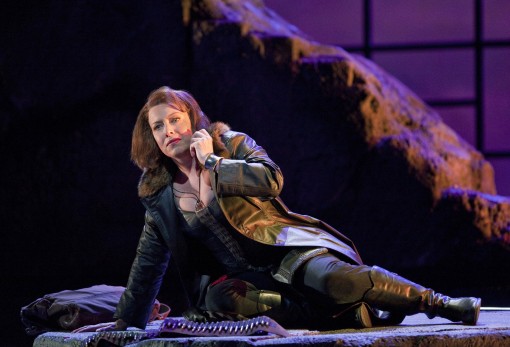
Nina Stemme as Brünnhilde, San Francisco Opera (photo by Cory Weaver)

In most regards, Washington National Opera's first complete performances of Richard Wagner's Der Ring des Nibelungen have been an astounding success for the company. By the time the first cycle got under way, two weeks ago, tickets had been sold out, in spite of a pricing protocol that raised the prices higher than normal due to the demand. A few days before the start of Cycle III, with Das Rheingold on Tuesday night, some standing room tickets went on sale at the not particularly bargain price of $50 per opera; they also sold out in almost no time. It has been exciting to see the Kennedy Center Opera House full and abuzz at these performances, and I have been to all of them except the second performance of Das Rheingold. The excitement will have to tide us over through the lackluster lineup recently announced for next season -- three over-performed chestnuts, the jazz piece Champion, and Jake Heggie's Dead Man Walking, last heard from Baltimore Opera in 2006.

With the third performance of Die Walküre on Wednesday came the cycle's third Brünnhilde, Swedish soprano Nina Stemme. Fresh off a triumphant run as the title character in Strauss's Elektra, which ran through May 7 at the Metropolitan Opera, Stemme reverted easily to the role in which she triumphed in San Francisco in 2011. The differences with her two predecessors this month began with her wig, red rather than platinum blond, but really boiled down to an effervescent quality announced immediately when she bounded on stage. Lifted up by Alan Held's Wotan in a bear hug, she kicked out her legs high in the air and later even bounded onto the board room table. Diminutive in stature, this was a girlish, pixie Brünnhilde, with a voice that started slowly, a little hesitant in the early high notes of the first scene, but then blossomed into an extraordinary sound.


Ring Reviews:

Cycle I: Charles T. Downey, Das Rheingold (May 2) | Die Walküre (May 4) | Siegfried (May 6) | Götterdämmerung (May 7)

Cycle II: Robert R. Reilly, Second Opinion: WNO Re-Cycle of 'The Ring of the Nibelung' (Ionarts, May 16)

Charles T. Downey, One Brünnhilde to Rule Them All (Ionarts May 17)

Cycle III: Anne Midgette, The Three Sopranos, “Ring” style (Washington Post, May 19)
A special energy suffuses the final performance of an opera's run, and one sensed many in the cast going for broke in a way that is not usually heard earlier in a production. Elizabeth Bishop made me forget any misgivings I had about her Fricka earlier in the run, as she cowed Wotan with her withering glance and powerful voice. David Cangelosi remains a spastic but effective Mime, and William Burden's vivid performance of Loge ranks up there with Heinz Zednik's puppet master Loge in Patrice Chéreau Centennial Ring Cycle and Loge zipping around on a Segwaytype scooter in the staging with La Fura dels Baus.

Alan Held understands the role of Wotan very well and acted it quite beautifully, particularly pathetic in the farewell to Brünnhilde this time around. Parts of the role in terms of pitch and volume he could only approximate, though, earning a loud ovation nevertheless for the strength of his characterization. The other shortcomings in the casting -- Gordon Hawkins's Alberich, both Donner and Froh -- remained shortcomings, especially the Fasolt of Julian Close, who still could not find the beat or the exact pitch very well. Fortunately, so many other parts of the casting, including the Rhinemaidens, the Erda of Lindsay Ammann, the Freia of Melody Moore, and the parachuting Valkyrie ensemble, remained excellent throughout all three cycles. Philippe Auguin, who has already performed the cycle many times, carefully considered every aspect of these scores, with gorgeous results in the sound. Das Rheingold was almost perfect this time around, while the new energy of Stemme seemed to throw off the concentration of both conductor and orchestral musicians just a bit here and there in Die Walküre.

Cycle III continues tonight with Siegfried.

18.5.16

Reader Comment: 'Second Opinion: Ring Cycle'

We received the following long comment from reader Dennis Teti, in reaction to Robert R. Reilly's review of Washington National Opera's Ring cycle, which we publish separately here.

Robert R. Reilly’s review of the Washington National Opera’s Ring of the Nibelung is on the mark. I have seen the Ring cycle in three different versions over the years (including Herbert Von Karajan’s), plus the earlier WNO performances under the baton of the late Heinz Fricke. I was deeply impressed with the balance of powerful voices and magnificent orchestra under both Fricke and Phillippe Auguin.

As musically satisfying as this “American” version is, director Francesca Zambello’s botched misconception of Wagner’s intention is both ugly and insolent.

For example, I had thought the final “Immolation” scene of Twilight of the Gods, focused on the transcendent farewell of Brünnhilde, could not be spoiled. Yet Zambello managed to make a travesty of it, distracting attention from the suffering heroine with a cast meandering around, hurling plastic garbage bags from the back of the stage, and the Rhinemaidens joyfully executing a hooded Hagen down stage. Valhalla with the gods in flames was never seen, but a mysterious little girl with a small potted plant emerged from somewhere. In Wagner’s conception, nature is restored by the cleansing of the overflowing river as the maidens capture the fateful ring from Hagen.


Ring Reviews:

Cycle I: Das Rheingold | Die Walküre | Siegfried | Götterdämmerung

Cycle II: Robert R. Reilly, Second Opinion: WNO Re-Cycle of 'The Ring of the Nibelung' (Ionarts, May 16)
The Ring cycle is replete with Wagner’s thoughtful musical and representational symbolism. Yet the director superimposed her own alien ideas on the final visual and throughout. Maybe she thought History has moved beyond Wagner, so we should as well. I found it almost repulsive — even more so because Catherine Foster’s Brünnhilde was glorious, perhaps the best I have ever heard.

The director has a right to her ecological viewpoint, but by turning the Ring into propaganda, she despoiled Wagner’s myth. Zambello took a beautiful work of creative nature, Wagner’s incomparable telling of the ultimate things — nature, will, gods, good and evil — and made it ugly, a pollution of art as much as the belching smoke she depicted is a pollution of nature. This was not an “environmental allegory,” it was an act of artistic spite.

17.5.16

One Brünnhilde to Rule Them All


Catherine Foster (Brünnhilde) and Alan Held (Wotan) in Die Walküre (photo by Scott Suchman for WNO)

The second cycle in Washington National Opera's first complete production of Wagner's Der Ring des Nibelungen ended in flames on Sunday night, reviewed by Robert R. Reilly. A quirk of fate meant that Cycle II was the first complete performance by Catherine Foster in the crucial role of Brünnhilde. The British soprano had injured her foot during rehearsals, leading to a completely unexpected but delectable substitution in the role by Christine Goerke in Die Walküre in Cycle I. Foster has sung the role many times, more than once at the Bayreuth Festival, but this was her debut in the role in an American production, as described in a preview article by Adam Wasserman in Opera News (By Way of Bayreuth, April 2016).

Goerke's presence infused Cycle I with a burst of energy, and although Foster was still hesitant physically when she took the stage in the last two operas, she was extremely strong of voice. In Cycle II Foster continued to gain confidence in her movements, although she did not jump on any tables in Die Walküre (as pictured above at the dress rehearsal). Vocally she reached her peak at the conclusion of the Cycle II Siegfried, the ecstatic duet scene with the man who breaks through the ring of fire to awaken her. That climax was almost matched by the bloodthirsty vengeance with which she attacked the end of Act II in Götterdämmerung, followed by a mysterious slackening of vocal strength in the final act, not to say total collapse by any means, but lacking the oomph one was hoping for from her final moments on the stage this season.


Other Reviews:

Cycle I: Das Rheingold | Die Walküre | Siegfried | Götterdämmerung

Cycle II: Robert R. Reilly, Second Opinion: WNO Re-Cycle of 'The Ring of the Nibelung' (Ionarts, May 16)
Foster shared some of her thoughts about the role with that Opera News interviewer, and some of it came across in her performances the last two weeks, that "Wagner wrote for three different vocal types." Die Walküre, she said, "was intended as a speaking-singing type of thing," likening it to "chit-chat and discussion." Goerke, perhaps because she was brought in to sing only Die Walküre, went for broke in a way that Foster did not. Siegfried, written after the break to compose Tristan is, by contrast, "as lyrical as you could possibly get. You have to get the light colors to convey the lyricism." The part also lies much higher, the part of her tessitura where Foster really excels, with her chest range sometimes going slightly pale.

With WNO's third performance of Die Walküre, we will have our third Brünnhilde. As originally planned, Nina Stemme takes over the role in Cycle III, which opens this evening at the Kennedy Center Opera House. Based on the reviews of her 2011 cycle in San Francisco, the third Brünnhilde could be the best.

16.5.16

Second Opinion: WNO Re-Cycle of 'The Ring of the Nibelung'


Gordon Hawkins (Alberich, center), David Cangelosi (Mime, right), and Nibelungs in Das Rheingold,
Washington National Opera (photo by Scott Suchman for WNO)

Many thanks to Robert R. Reilly for this review from the Kennedy Center.

Until now, I have never seen Richard Wagner’s Ring cycle straight through. I’ve only experienced some of the individual operas. I decided to approach the production of The Ring of the Nibelung by the Washington National Opera (cycle II: May 10, May 11, May 13, and May 15) cold turkey. I did not want to carry in any preconceptions, though I had heard it has a modern setting. I was hoping that this production, ten years in the works, would not be as misguided as the one I partially experienced back in the late 1980s when Deutsche Oper Berlin brought its Ring to the Kennedy Center as part of the celebration of the 40th anniversary of the founding of the Federal Republic of Germany. (How nice that the GDR did not live long enough to celebrate its 50th.) Its Ring was set in an underground subway station. Go figure, though the gray drabness comported with my experiences in East Germany.

I did not emerge from the experience of this Ring unscathed. First, I should generally state what went exceptionally well: the splendid singing and the superb orchestral playing, under conductor Philippe Auguin. That’s a lot; it puts us two-thirds of the way to a big success. One could’ve shut one’s eyes and been perfectly happy throughout (as I would be with a live recording of what I heard). The problem with the final one-third of the formula was the overall conception of the production. Famously, George Bernard Shaw argued that the Ring was Wagner’s attack on capitalism. His thesis gained at least some plausibility from the fact that Wagner was a socialist, though we may be grateful that Shaw did not mount a production of the Ring based upon his interpretation (though others have).

But was Wagner an environmentalist? Would he have recycled? This may seem an exceedingly silly question, and it is. However, Francesca Zambello's production posed it, and answered in the affirmative. Kip Cranna writes in the program notes, the “theme of mankind’s devastation of nature is of course extraordinarily relevant to our own time, and the Washington National Opera production vividly reflects that.” The problem is whether it was relevant to Wagner. Had it been so, Wagner could have cast his conception in its terms, but he did not. (In fact, it is non-humans who cause the destruction in the Ring, not humans.) Is that because Wagner was limited to and by his own times? Any good German historicist would say that this was so and suggest that this is why Wagner needs to be made “relevant” to us, who, after all, live in our own times. In other words, to buy fully the premise of this production one should be an historicist. Wagner cannot be understood on his own terms, but only on ours. I find this approach condescending both to Wagner and to ourselves.

I think it has also shaped a somewhat schizophrenic production that is occasionally painful in its inappropriateness and in its obviousness. Why schizophrenic? Because when the production is not straining against the mythical quality that Wagner strove so hard to give the Ring (including with his deliberately archaic German, rendered in completely prosaic English in the super titles), the production works very well, indeed. When it insists upon superimposing its modern environmental relevance upon it, it comes up a stinker. It takes us from the mythic to the mundane. The scenes or acts least affected by the production’s misconceptions go best because they have nothing to distract from the singing and the music. In fact, they often enhance them. I hope to make this clearer as I briefly give some examples through the four operas, without recounting much in the way of plot, which can be easily found elsewhere.

For instance, the opening scene of The Rheingold is very successful. It does not try to locate itself in America (where apparently this Ring takes place) or anywhere else for that matter – its ambiguity allows for the mythical. The back projections of falling water are majestic and the river is imaginatively rendered. The Rhine maidens are well portrayed, and the fact that Alberich shows up in a vaguely modern miner’s outfit needn’t cause any disquiet.

The next scene is a disaster. Wotan, ruler of the gods, is introduced lying on a lawn-furniture chaise lounge on a terrace somewhere in the mountains. He is wearing riding jodhpurs and a double-breasted jacket – what looks like a late 1920s movie director’s outfit. In fact, his stock gestures seem to be out of a silent movie. The rest of the gods and goddesses are also in 1920s garb. The theatrical body language of Wotan’s introduction leaves him so diminished that I thought his character would never recover sufficient stature to carry off his role in the remaining operas. (He did, but not till The Valkyrie.)

7.5.16

WNO 'Ring' Cycle I: 'Götterdämmerung'


Marcy Stonikas, Lindsay Ammann, and Jamie Barton as the Norns in Götterdämmerung (photo by Scott Suchman for WNO)

Washington National Opera's first complete production of Richard Wagner's Der Ring des Nibelungen is in the books. While it was disappointing to see Francesca Zambello's American-themed staging be deferred and then premiered first in San Francisco, what finally reached the stage of the Kennedy Center Opera House this week is ultimately much stronger and more beautiful than its first incarnation. Most of the directorial missteps and occasional scenic ugliness have been ironed out, and the casting generally improved. Most of all, the promise of Philippe Auguin's tenure as music director, earned at least partly on the basis of the incendiary concert performance of Götterdämmerung that he led in 2009, came to full flower in a revelatory reading of some of the most beautifully orchestrated scores in music history. The largest ovation at the end of last night's opening of Götterdämmerung came at the appearance of Auguin and the orchestra on stage.

Since I was not able to see Götterdämmerung the first time around, the chronological progression of Zambello's American Ring cycle, described in my previous three reviews, had eluded me. The final opera opens with a prelude featuring the three Norns, who in Germanic legend wove together the three-stranded rope of time, one seeing the past, one the present, and one the future. Zambello seats them in front of a mass of piled-up fiberoptic cables, which they struggle to tease apart and connect. A scrim shows video projections that look like data flowing through a world-wide web of information woven by the Norns, indicating that the United States has arrived in the Internet Age. Lindsay Ammann, Jamie Barton, and Marcy Stonikas were a particularly beautiful trio vocally, costumed as green-uniformed technicians with aprons, gloves, and goggles. The scene ends when the cable suddenly breaks and the thread of information is broken, signaling the end times.


Other Reviews:

Anne Midgette, ‘Twilight of the Gods’ confirms the triumph of WNO’s ‘Ring’ (Washington Post, May 9)

SEE ALSO:
Das Rheingold | Die Walküre | Siegfried
The world that Siegfried bursts into looks modern, perhaps in a dystopian near-future of the United States. Eric Halfvarson was a stentorian menace as Hagen, the son of Alberich who is now the power behind Gunther and Gutrune, the siblings who preside over Gibichung Hall. Halfvarson chilled the blood as he glowered his way through the Hagen's Watch monologue in Act I, the lighting and video turning blood red behind him. The Gibichungs are costumed as a fascist secret police force, sung with admirable force by the men of the WNO Chorus. Daniel Brenna and Catherine Foster continued to excel as Siegfried and Brünnhilde, overshadowing the tentative Gunther of Ryan McKinny and the ditsy Gutrune of American soprano Melissa Citro, the latter in her company debut.

Although much improved, this staging of the Ring still falls short of greatness. Zambello's worst miscalculation was the opening of Act II, where Hagen, half-asleep, is supposed to talk with Alberich at the edge of the Rhine. Here Hagen watches television in his bed, making awkward passes at Gutrune, and there are cheap laughs as they use a remote to try to change the static-filled channel. The theme of environmental damage caused by the patriarchal society of the Gibichungs is extended in the pollution-charged video footage, culminating at the point when Siegfried has one last chance to return the Ring to the Rhinemaidens in the first scene of Act III. The shadow of a highway bridge looms over the scene, as the Rhinemaidens, now in filthy dresses soiled by pollution, try to collect discarded plastic bottles into bags, swimming around a pickup truck cap thrown into the river. When Siegfried becomes part of this male oppression, in the conclusion of Act I, he turns on Brünnhilde, the Tarnhelm sparkling on his head in the darkness, one of the more disturbing moments of the cycle.


Eric Halfvarson (Hagen, center) and Chorus in Götterdämmerung (photo by Scott Suchman for WNO)

This sets up the transcendent ending, after Hagen kills Siegfried in an attempt to steal the Ring. Wagner asks the impossible with the end of the Ring cycle, requiring a director to create visually some sense of not only the destruction of the world but its rebirth through the sacrifice of Brünnhilde. Wagner took this idea of the Ewig-Weibliche as saving principle from the work of Goethe and others, and while it is not exactly a philosophical concept admired by feminist writers, Zambello tries to make it work as a metaphor for the beginning of "herstory." The oppressed women from Gibichung Hall rise up, including Gutrune (who dies before the Immolation Scene according to the libretto), using the piles of garbage to light the fires. It is they who kill Hagen, suffocating him with a plastic bag, instead of the Rhinemaidens, who are supposed to drown Hagen in the Rhine. Zambello's final image shows a young girl crossing the light-filled stage to place a sapling in the earth. That idea might seem trite on the surface -- Plant a Tree and Save the Planet -- but maybe not, given the coincidence with the forest-consuming conflagration in Canada right now. Little matter because Wagner's music, especially the Liebeserlösung theme (first heard from Sieglinde back in Die Walküre) soaring in the violins, makes it work.

Two complete performances of the WNO Ring Cycle remain in the coming two weeks. Ionarts will have reports on both of them.

6.5.16

WNO 'Ring' Cycle I: 'Siegfried'


David Cangelosi (Mime) in Siegfried, Washington National Opera (photo by Scott Suchman for WNO)

When Washington National Opera mounted Francesca Zambello's Ring cycle the first time, Siegfried was as far they got. Musically it was a bit of a disaster, and it was where Zambello's ideas for her American Ring seemed to unravel. Raised by Mime in a beat-up trailer in what looked like a junkyard, this was a white-trash hero who had not only no fear but no class. As I wrote then, "No Siegfried has probably come from so far on the wrong side of the tracks to win the daughter of the richest man in town."

Seen as part of the complete cycle on Wednesday night, even though there were fewer changes to the production, the tone of the staging has changed. What strikes me this time around is that Zambello has cast the four operas in the context of American history, beginning with the first amassing of wealth in the 19th century and continuing to the present day. By Siegfried, we appear to have reached the 1970s, a period in which industrialization and pollution reached the breaking point, in turn sparking the ecological movement. Videos show clear-cut forests and factories belching out fumes, and the dragon form of Fafner is a large excavating, land-clearing sort of machine. The Forest Bird, incarnated here with ideal lightness by Domingo-Cafritz artist Jacqueline Echols, is costumed as a sort of flower child, and Alan Held's Wotan looks like a failed hippie, with greasy hair that could be in a ponytail and a duct tape-mended trench coat.


Other Reviews:

Anne Midgette, After ‘Ring’ rehearsal injury, a soprano finally gets her U.S. debut (Washington Post, May 6)

Terry Ponick, ‘Siegfried’: Catherine Foster returns to WNO’s ‘American Ring’ (Communities Digital News, May 5)

Alex Baker, That '70s Show (Parterre Box, May 9)

SEE ALSO:
Das Rheingold | Die Walküre | Götterdämmerung
Siegfried is perhaps the oddest score in the tetralogy, with the smallest number of characters and an emphasis on intensely focused music. It opens quietly and has long stretches of quiet, the better to be disturbed by the noisy bustle of its restless title character. Tenor Daniel Brenna made a heroic company debut in the role, not always right on the money but tirelessly energetic and often incredibly powerful. The characterization of Siegfried is still brutish and brewski-cracking, but Brenna gave him a humorous edge that was much more winning. Soprano Catherine Foster finally made her first appearance as Brünnhilde, and in generally excellent vocal form. Her continuing trouble with the injury to her foot, which kept her sidelined for the first performance of Die Walküre, made her movement on stage a little awkward, but there were no complaints about the power of her voice to carry those triumphant moments in the score.

David Cangelosi's Mime became even more active, to a fault, with his cute antics growing tiresome long before he did a few actual cartwheels. It makes sense to have a little comic relief in this long, rather serious work, but Zambello went a little too far in this opera. Held's final take on Wotan was still powerful, with just some of the outlying parts at the top and bottom revealing some struggle. Lindsay Ammann was again magnificent as Erda, and Soloman Howard was on solid footing as the Teamster giant running the forest-clearing Dragon. Philippe Auguin and the orchestra continued to excel, not perhaps on the level achieved in Die Walküre but combining plenty of power with subtle transparency.


Daniel Brenna (Siegfried) and the Dragon in Siegfried, Washington National Opera (photo by Scott Suchman for WNO)

4.5.16

WNO 'Ring' Cycle I: 'Die Walküre'


Alan Held (Wotan) and Catherine Foster (Brünnhilde) in Die Walküre, Washington National Opera (photo by Scott Suchman for WNO)

The first cycle of Washington National Opera's first complete performance of Wagner's Der Ring des Nibelungen continued on Monday evening. Zambello has not altered much of her production of Die Walküre since its 2007 performance here, beyond some freshening up of the video projections, all to the better. The American timeline in this part of the tetralogy has advanced to the 1940s and 1950s (sets by Michael Yeargan, costumes by Catherine Zuber). From the boardroom of his Rockefeller Center-like Valhalla, Wotan plots how to outwit Alberich's plans to regain the ring, with a black-and-white view of Manhattan through the clouds. Women in this society are beginning to assert themselves in many ways. Complacent housewife Sieglinde dares to defy her abusive husband and run off with Siegmund. Brünnhilde and her Valkyrie sisters are costumed like Women Airforce Service Pilots (WASPs) and parachute down to what looks like a World War II pillbox in the famous Ride of the Valkyries at the start of Act III. President Eisenhower's interstate highway system crisscrosses the landscape, and the death of Siegmund happens in one of those forgotten urban ex-neighborhoods marooned under an overpass.

Musically, this performance came together almost perfectly, as the promise of Philippe Auguin's strong hand in Wagner came to fruition. The occasional jitters in the orchestra heard in the opening night of Das Rheingold were resolved, a few woodwind intonation woes aside. With the action focused on fewer singers, and more experienced ones at that, the ensemble unity the whole evening was rock solid. Catherine Foster, the scheduled Brünnhilde for Cycles I and II, injured her foot in rehearsals last week, and she was not well enough yet to take the stage. As WNO announced on Monday morning, the company engaged the exemplary Wagnerian soprano Christine Goerke to replace her, flying her in from Houston, where she had just sung the character in Siegfried. Her performance not only saved the day; it made the evening. She was saucy and bold in her stage presence and absolutely fearless vocally. While we still want to hear Foster sing the role, if Goerke could complete the first cycle, no one in the house Monday night would complain.


Other Reviews:

Anne Midgette and Philip Kennicott, Two critics trade thoughts on Wagner’s ‘Ring’ in D.C. (Washington Post, May 3)

Alex Baker, Special guest Heldenreizerin (Parterre Box, May 4)

SEE ALSO:
Das Rheingold | Siegfried | Götterdämmerung
Elizabeth Bishop hit her stride as Fricka, more imperious and venomous in her characterization, backed up with great vocal force. Reservations about Alan Held's Wotan also faded in the second opera, as he led one of the best second acts, another place that the cycle can bog down dramatically, in recent memory. Zambello gives us a look into Middle America in the first act, with Meagan Miller's Sieglinde imprisoned in a clapboard A-frame house, with an interior like any number of hunting lodges I have visited in the Midwest, decorated with wood paneling and taxidermy. Miller and her Siegmund, Christopher Ventris, were not the most powerful singers for these roles, but their pair of love arias (Siegmund's Winterstürme and Sieglinde's Du bist der Lenz) was a beautifully intense moment, accompanied by the dramatic opening of the back of the set to reveal a large rising moon. Raymond Aceto did not have the same snarling menace as Gidon Saks, who sang the role of Hunding last time around, but he was a convincing villain, shadowed by what looked like members of the local militia.

Again lighting played a role in storytelling, highlighting Sieglinde when Miller sang the Liebeserlösung theme ("O hehrstes Wunder!"), the Leitmotif said to represent woman's redeeming love that comes back at the end of Götterdämmerung, in Act III. One wished for a more gut-wrenching sound and expansiveness from both orchestra and singer, as it is one of those moments in the tetralogy where time should just be suspended. The musical high point instead was the Ride of the Valkyries, with an excellent group of singers, including Lindsay Ammann, Melody Moore, Catherine Martin, and Renée Tatum, who have all proven their worth in other roles already, plus Daryl Freedman, one of the most promising members of the current class of the Domingo-Cafritz Young Artists. Between the Valkyries appearing to parachute onto the stage from the fly space above and the thrilling sound of all those powerful voices amassed -- one of the rare ensemble scenes in the whole cycle -- all the elements that make opera so absorbing came together. The dramatic arc continued to rise during Held and Goerke's heart-breaking parting scene, as he kissed away the immortality of his daughter and encircled her in flames.

2.5.16

WNO Ring Cycle I: 'Das Rheingold'


(L to R) Alan Held (Wotan), Elizabeth Bishop (Fricka), Richard Cox (Froh), Melody Moore (Freia), and Ryan McKinny (Donner)
in Das Rheingold, Washington National Opera (photo by Scott Suchman for WNO)

Washington National Opera's first complete Ring Cycle has finally arrived. Francesca Zambello began mounting her "American" production of Wagner's tetralogy in 2006, with a not fully thought out version of Das Rheingold. The company's debts came due in the housing meltdown of 2007 and 2008, much as they do for Wotan when he builds Valhalla on a mortgage he cannot afford to pay, and the company deferred the complete cycle until this season. The four operas have played in San Francisco, and now that Zambello has had some time to rethink what she got wrong a decade ago, the first performance of this Ring Cycle got under way on Saturday night in the Kennedy Center Opera House.

If the execution has improved significantly, the ideas remain more or less the same. Zambello recasts the German mythology and history of Wagner's libretto in American parallels, showing the growing divide of wealth and poverty. Wotan begins Das Rheingold as a privileged landowner, but he will soon expand his holdings by profiting off the backs of others, both exploited workers despoiling the earth of its natural resources (the Nibelungs) and those who get tangled in the contracts engraved on his spear (the Giants). Alberich appears on the banks of a river somewhere in the American West as a prospector panning for gold, but he ends up losing his stake, including the magical Rhine gold, to the cheating gods. In this grand swindle, Wotan is aided by Loge, who is cast as the shyster who will ultimately defend Wotan before the grand jury. Loge does not belong among the super-rich — he will not join them in their new gated community (Valhalla) or set sail on their luxury yacht (the Rainbow Bridge) — but at the end he is the one who sets fire to Wotan's contract with the giants, in an ingenious final flourish.

Some of the cast has remained the same since those first performances, and perhaps this Ring could have used some burnishing in that area, too. Gordon Hawkins is a convincing Alberich, just without the vocal force sometimes needed, and Alan Held's Wotan and Elizabeth Bishop's Fricka have lost some of their vocal luster but remain compelling. Success in the role of Loge is more about acting than singing, and William Burden has plenty of fun as the slimy legal mouthpiece of the gods. Character tenor David Cangelosi is fine as the simpering Mime, while both Richard Cox and Ryan McKinny, as Froh and Donner, are a little wimpy in tone and character.


Das Rheingold, Washington National Opera (photo by Scott Suchman for WNO)

The pleasing changes are the passionate Freia of soprano Melody Moore and the vivid characterization, in terms of both acting and singing, of Lindsay Ammann, who made a sensational company debut as Erda. When she rose out of the earth, at a moment when the opera comes dangerously close to losing dramatic forward motion, Ammann compelled the attention of both eyes and ears. The Rhinemaidens were the highlight of the supporting cast, with Catherine Martin (Wellgunde) and Renée Tatum (Flosshilde) standing out, while the Giants had difficulty staying with the beat, Julian Close's Fasolt more than Soloman Howard's Fafner.


Other Reviews:

Anne Midgette, The 'Ring' gets off to a good start (Washington Post, May 2)

Terry Ponick, WNO’s American Ring: A vastly improved ‘Rhinegold’ debuts (Communities Digital News, May 2)

Alex Baker, Burden of gilt (Parterre Box, May 3)

SEE ALSO:
Die Walküre | Siegfried | Götterdämmerung
Zambello's changes to the first scene were extensive, softening the gold rush imagery of the 2006 production. The orchestral introduction was magnificent in the orchestra, with only one minor horn gaffe in what was a roiling crescendo. A scrim showed a video that began with drops frozen in motion, changing gradually into water, and then into the river scene, almost chemical blue, that is revealed on stage as the scrim is raised. Another scrim remains at the edge of the proscenium, which held in the copious fog that covered the raked stage, creating the impression of the water where the maidens are swimming. The gold itself is still depicted as a piece of cloth, but it has lost its identity as cloth, which works much better. Music director Philippe Auguin had a few struggles after that marvelous first scene, mostly with singers who were not paying attention to his beat, but the orchestra sounded mostly magnificent.

The unionized giants still have their memorable entrance, flown in on a girder from the construction site above, with costumes based on the iconic photograph Lunch atop a skyscraper, taken by Charles C. Ebbets in 1932. With the skyscraper of Valhalla, Wotan will make the jump from landowner to titan of capitalism. Zambello also softened the interpretation of the Nibelungs, with no more possible reference to slavery, focusing instead on the struggle of workers for fair wages and safe working conditions. The best part of this new Rheingold is a first-rate upgrade to the lighting, designed by Mark McCullough: not only is the Rainbow Bridge scene now strikingly prismatic, but lighting intensity and color play a more important role in the storytelling.

WNO announced today that Catherine Foster has not recovered enough from a foot injury, sustained during dress rehearsals, to sing as Brünnhilde in tonight's performance of Die Walküre. Soprano Christine Goerke will substitute.

28.2.16

Ionarts Exclusive: Leah Crocetto in Recital

This review is an Ionarts exclusive.


Leah Crocetto (photo by Fay Fox)
Leah Crocetto made an excellent debut at Washington National Opera last season, in the company's first production of Poulenc's Dialogues of the Carmelites. The company brought back the American soprano, who hails from the town of Adrian, Michigan, for a recital in the Kennedy Center Terrace Theater on Friday night. Before it began, WNO artistic director Francesca Zambello hinted that Crocetto will return to the company next season, in an opera by a composer whose name begins with a letter near the end of the alphabet. Judging by Crocetto's recent engagements, that letter is likely to be V for Verdi, but judging by this evening's successful repertoire, one could also wish it were S for Strauss.

The top of Crocetto's voice is exceptionally strong, able to level the room with the ff high A in Zueignung (op. 10/1) but also able to float angelically on the pp high G in Die Nacht (op. 10/3) with a transparent, sighing clarity. The middle range is the only undeveloped part of the tessitura, but the thrilling swell of sound in Cäcilie, supported with orchestral fullness by pianist Mark Markham, more than made up for that. Somehow Markham has not appeared in these pages before, but he has a remarkably beautiful touch at the piano: this was the first performance of Strauss's Morgen I have ever heard where one wished the singer would not come in, just to keep listening to the pianist.

Markham upstaged his singer in some of the songs of Duparc and Liszt as well, but Crocetto's silken high notes and purring legato gave an apt languor to songs like Extase and Soupir in the French set. She went for urgency more than finesse in L'invitation au voyage, a mood that carried into Liszt's Tre sonetti di Petrarca, especially the miniature opera scene of the first of these songs, Pace non trovo. This was where she finally opened up to notes higher than A, taking the optional high D-flat toward the end, while Markham had a few tiny slips in the more challenging piano part. The only opera aria on the program was a strong Ain't it a pretty night? from Carlisle Floyd's Susannah, which introduced a more contemporary and American second half.

Crocetto also performed Eternal Recurrence, a new song cycle composed for her by Gregory Peebles, formerly a singer with Chanticleer. Peebles is obviously a big fan of Crocetto's voice, judging from the whooping and hollering he made for her in the audience, and the writing put her in the best light. There were jazzy overtones and pop gestures, a nod perhaps to Crocetto's earlier work singing in cabarets and bars, but there were dissonant colors as well, and a mesmerizing overtone effect, as Crocetto's high note made the sympathetic strings of the piano resonate in echo. Crocetto has described the piece as about an artist's life and having great personal significance for her, but the texts, not credited to any source, remained mostly mysterious. She concluded with a set of torch songs, extended by two encores of the same ilk.

9.1.16

American Opera Initiative: Snoozy 'Better Gods'


Rexford Tester (Lorrin Thurston), Timothy J. Bruno (Judge Albert Judd), Daryl Freedman (Queen Liliʻuokalani), Ariana Wehr (Kahua), and Hunter Enoch (James Miller) in Better Gods (photo by Scott Suchman for Washington National Opera)

Many Americans likely do not know the ugly details of how Hawaii became our 50th state. Part of the world's shameful history of colonialism, the annexation began with the forced abdication of the islands' last monarch, Queen Lili'uokalani, the ancestor of the family in Alexander Payne's film The Descendants. This is the subject of Better Gods, the latest new opera presented by Washington National Opera's American Opera Initiative, which has been guiding new works by developing American composers to the stage since 2012, an hour-long work by composer Luna Pearl Woolf and librettist Caitlin Vincent. This is the first contribution to the program by Woolf, who is married to cellist Matt Haimovitz, while Vincent wrote the libretto to Joshua Bornfield's Uncle Alex in 2013, sadly not reviewed by Ionarts.

Other Articles:

Anne Midgette, Deposed queen leads valiant but flawed ‘Better Gods’ at WNO (Washington Post, January 11)

Alex Baker, Throne away (Parterre, January 11)

Jeanette Kelly, Montreal composer Luna Pearl Woolf writes first opera, Better Gods (CBC, January 7)

Steven Mark, Washington opera brings Liliuokalani’s story to stage (Honolulu Star-Advertiser,

American Opera Initiative:
2015 | 2014 | 2013 | 2012
The musical contributions were excellent, led by conductor Timothy Myers, who has impressed us over the years at the Castleton Festival and Wolf Trap Opera. Impressive mezzo-soprano Daryl Freedman was dignified and regal as Queen Lili'uokalani, with the sneering Lorrin Thurston of tenor Rexford Tester, who leads the coup against the queen, as a foil. Baritone Hunter Enoch was strong as a journalist who covers the events in Hawaii, although his role seemed largely superfluous to the story. Fine supporting performances came from bass Timothy J. Bruno (the judge who decides the queen's fate), bass Wei Wu (the royalist general who leads a rebellion in support of the queen), and soprano Ariana Wehr (the queen's ward).

Even with so much going for it, the opera was a disappointment. Vincent's libretto had its ponderous moments, saying a lot of things more than once that could have been left unsaid. Woolf's score had some appeal, tarted up with the sounds of traditional Hawaiian flutes and percussion, the latter played by Greg Akagi, one of the orchestra's percussionists, on stage. Queen Lili'uokalani was also a musician and composer, known for the song Aloha 'Oe, among many others, and Woolf weaves her melodies in with her own, as well as an ill-advised use of The Battle Hymn of the Republic. Ethan McSweeny's production was functional if somewhat plain (sets by Daniel Conway, costumes by Lynly A. Saunders), with a static quality that drew attention to the static qualities of the opera.

This performance will be repeated this evening, in the Kennedy Center Terrace Theater.

22.12.15

Sensory-Friendly 'Hansel' a Success


Cast members Daryl Freedman (Mother), Ariana Wehr (Gretel), and
Aleksandra Romano (Hansel) with Master Ionarts (photo by CTD)
From a critic's point of view, I had reservations about Washington National Opera's most recent revival of their holiday production of Engelbert Humperdinck's Hansel and Gretel. At the same time, also noted in my review, enough of this gorgeous score's charm comes through, even in the reduced orchestration, for most listeners to enjoy. Miss Ionarts certainly did on opening night, and even Master Ionarts, who has not been to a musical performance in a few years, had the chance to appreciate it on Saturday afternoon.

Although Master Ionarts went to many kids concerts with me when he was small, including to the first WNO Hansel in 2007, in recent years he has balked at going to performances in theaters. Diagnosed on the high-functioning end of the autism spectrum, he has pronounced sensitivity to auditory and visual stimuli. When WNO announced that they were going to host their first-ever sensory-friendly performance on Saturday afternoon, Master Ionarts agreed to give it a try. We can report that both the musicians in the pit and the singers made an effort to lower the volume of the music, with only a few moments that bothered sensitive ears. The lights in the theater were kept on but dimmed, so that kids could move around or leave the theater as they needed. The only slight misstep was to keep the flashing lights used for the explosion of the witch's oven: although the sound of the explosion was dampened, the light flash was too much for many of the kids.

Just knowing that this was a performance intended for kids like him put Master Ionarts at ease. As the show began, he smiled as he heard kids shifting in their seats and asking questions loudly, sometimes getting up from their seats and moving around the theater, knowing that all of this was OK during this performance. He himself asked me several questions about the story and the characters, relating it to his favorite topics in math and science, including noting that given the shape of the earth in relation to the sun, the Sandman and the Dew Fairy would always have to be on opposite sides of the planet. During most of the second half, one young girl paced nervously at the edge of the orchestra pit, moving her hand back and forth in the repetitive behavior known as "stimming." All of the performers, and most of the audience members, took all of this in stride.

Master Ionarts insisted that we stay after the performance for the chance to meet some of the performers. He especially wanted to ask Keriann Otaño, who kept her Witch's magnificent cackling to a minimum, what it was like to play such an evil person, but since she could not make an appearance he was happy to speak to the other cast members. Best of all, near the end of the performance, he put his hand on my arm and said he was glad that he came to see the opera because he had "forgotten how enjoyable this was." To see him back in a theater was the best early Christmas gift this father could have received, so the Ionarts family thanks the WNO family for being open to giving this special performance. It meant a lot to many kids and their parents.

The Kennedy Center has announced two more sensory-friendly performances this season. Master Ionarts and I will try to make it to the National Symphony Orchestra concert in April.

14.12.15

Holiday Opera: WNO's Half-Baked 'Hansel and Gretel'


Aleksandra Romano (Hansel) and Ariana Wehr (Gretel) in Hansel and Gretel (photo by Scott Suchman for Washington National Opera)

Washington National Opera tried two new holiday operas in recent years, and both of them were disappointing flops. It seemed like a good sign that the company was returning to Engelbert Humperdinck's evergreen Hansel and Gretel this year, but it has missed the mark by sticking with the chamber ensemble reduction of the score it used in 2007 and 2012, by Kathleen Kelly (strings one on a part, horn, clarinet, flute, and piano). While I have complained about this pale imitation of Humperdinck's rather wonderful Wagner-tinged score before, the third time around was the final straw. The opera frankly sounds pretty awful without the four horns, percussive touches, and symphonic sweep of the full score, especially in the interludes, and there is certainly more room in the Kennedy Center Terrace Theater pit, if perhaps not enough for the full orchestration. As heard at the second performance on Saturday night, the musicians play well, but the effect falls far short.

This time around, the voices were all fairly large in scope, which made the imbalance with the mealy-mouthed sound from the pit more evident to the ears. The title roles featured the same pairing of Domingo-Cafritz Young Artists who played Mercédès and Frasquita in this fall's Carmen, with similar results. Mezzo-soprano Aleksandra Romano's Hansel was more sure if a little pushy in the smaller theater, and Ariana Wehr's Gretel was absolutely adorable and with enough power, if slightly unclear at the top. Soprano Kerriann Otaño, whose voice was not quite right for the Countess in Wolf Trap's Marriage of Figaro last summer, here made a delightfully poisonous, overbearing witch, with a cackle that terrified Miss Ionarts. Impressive mezzo-soprano Daryl Freedman was a viperous Mother, with Aleksey Bogdanov's happily tipsy Father lightening the mood. Soprano Melissa Mino was appropriately flowery of tone as the iridescently costumed Dew Fairy, while Raquel González's Sandman was the only voice occasionally eclipsed by the small instrumental consort.


Other Reviews:

Anne Midgette, WNO fires up ‘Hansel and Gretel,’ in a polished but uninviting performance (Washington Post, December 14)
The opera remains an easy sell for kids, especially in this kind of lollipop-flavored staging, with off-kilter sets that are cartoonish and fun (designed by Robin Vest) and equally multi-colored costumes (Timm Burrow). Sarah Meyers directs this time around, with a different spin but similar feel to how David Gately did it last time. The supernumerary animals that menace the children in the forest -- a wolf, boar, vulture, all rebuffed by a protecting owl -- were a particular treat, as was the sound of the WNO Children's Chorus. While there is none of the disturbing imagery aimed more at adults seen in the productions from Virginia Opera and the Metropolitan Opera, for example, there was still enough menace in this version to keep Miss Ionarts on the edge of her seat.

This production is repeated on December 18, 19, and 20, in the Kennedy Center Terrace Theater. In a praiseworthy move, WNO is offering the 2 pm performance on December 19 as a sensory-friendly event, for families with children on the autism spectrum or with other sensory sensitivities. This is a most welcome development for families of special-needs kids, a community that includes Ionarts Central.

3.12.15

American Opera Initiative: Three More Miniatures


Leah Hawkins in Alexandra (photo by Scott Suchman for Washington National Opera)

One of the best things that the folks at Washington National Opera did after the merger with the Kennedy Center was to create the American Opera Initiative. With access to the other spaces of the Kennedy Center, the company has commissioned three composers each year to produce 20-minute operas, with the latest installment offered on Wednesday evening in the Kennedy Center Terrace Theater. Some of these composer-librettist pairs go on to create an hour-long opera in the second part of the program, all with coaching from more established composers and librettists. It is important work, providing the pleasure of hearing new operas with some regularity.

An operatic miniature, if anything, is more difficult to create than something in a longer format. It is a specialized undertaking with only a few successful examples to study, and it should be no surprise that most of the 20-minute operas presented by the program are duds. Fortunately, a failure in this genre likely has little to do with ultimate success: Douglas Pew and Dara Weinberg left me underwhelmed with their contribution to the first such 20-minute program, in 2012, but their one-hour opera, Penny was more effective.

The work that was most successful at creating a dramatic arc within compact restrictions was the middle opera, Alexandra. Librettist Joshua McGuire drew a sharply defined story, involving a young woman who has just lost her husband. Alexandra takes a book that her husband stole back into their university library; following an inscription in its pages into other books, she unravels a mystery about her husband, who kept the book because it contained communications from a man with whom he was in love. In a short space, composer David Clay Mettens weaves together Alexandra's present with the forbidden past of her husband, Ray, and another student, Alex, making the voices overlap in duets and a trio. His use of the small orchestra -- three woodwinds, three brass, strings, piano, and percussion -- was by far the most inventive, too, abounding in unusual colors. Mezzo-soprano Leah Hawkins offered an instrument of rich tone, especially at the bottom, in the title role.


Other Articles:

Anne Midgette, Opera as bourgeois drama: 20-minute pieces at WNO (Washington Post, December 4)

Alex Baker, Slice of life (Parterre Box, December 4)

Sadie Dingfelder, A triumphant return across the pond (Washington Post, November 25)

American Opera Initiative:
2015 | 2014 | 2013 | 2012
Sarah Hutchings and Mark Sonnenblick went for cheap laughs and doggerel rhymes in Twenty Minutes or Less, about three neurotic workers in a pizza shop. Its jazzy score, complete with two back-up singers billed as the Pizza Queens, had hints of Puccini, but not much more than the fine mezzo-soprano of Daryl Freedman, with spot-on intonation and expressive line in her aria "I wake up, put on my mother," to recommend it.

Freedman was also matched nicely with baritone Hunter Enoch in Service Provider, with music by Christopher Weiss and libretto by John de los Santos. This last piece also had a somewhat glib, music-theater sensibility to it, about a truly annoying couple having dinner out for their anniversary. The score is littered with the sounds of text notifications and cell phone rings, to symbolize the obsession that makes this annoying couple even more annoying. Tenor Rexford Tester took the best role, a snarky waiter named Dallas, and ran with it, especially in the patter song about the pork belly.

15.11.15

Glass's New 'Appomattox' a Long Battle

Charles T. Downey, Glass’s revised “Appomattox” proves even more unwieldy at Washington National Opera (The Classical Review, November 15)

In some ways, the United States is still fighting the Civil War. Political divides, even now, often fall along similar fault lines, and the wounds caused by the conflict, Tristan-like, refuse to heal.

This was the premise of Philip Glass’s opera Appomattox, premiered at San Francisco Opera in 2007, which connects the Civil War to the Civil Rights era. Although critics hailed it as unwieldy...
[Continue reading]

Philip Glass, Appomattox
Washington National Opera
Kennedy Center Opera House

SEE ALSO:
Corinna da Fonseca-Wollheim, Review: ‘Appomattox’ at the Kennedy Center (New York Times, November 15)

Anne Midgette, ‘Appomattox’: A superb night at the opera (The Washington Post, November 15)

---, The war that would not end: Race relations take the opera stage (Washington Post, November 14)

Alex Baker, Glass Warfare (Parterre Box, November 16)

Seth Colter Walls, Appomattox review – Philip Glass's revised opera considers race in America (The Guardian, November 15)

Tim Smith, Philip Glass opera 'Appomattox' addresses Civil War, civil rights (Baltimore Sun, November 12)

Michael Cooper, Seeing Voting Rights Under Siege, Philip Glass Rewrites an Opera (New York Times, November 10)

Charles T. Downey, Virginia Opera Does It Again (Glass, Orphée) (Ionarts, February 11, 2012)

---, Philip Glass at the Phillips Collection (The Washingtonian, October 4, 2011)

---, Nothing but Dance (Ionarts, April 25, 2011)

---, Ionarts at Large: Satyagraha at the Met (Ionarts, April 21, 2008)

Joshua Kosman, Philip Glass opera 'Appomattox' both impressive and inconsistent (San Francisco Chronicle, October 6, 2007)