CD Reviews | CTD (Briefly Noted) | JFL (Dip Your Ears) | DVD Reviews

19.8.07

In Brief: Last Vacation Edition

LinksHere is your regular Sunday selection of links to good things in Blogville and Beyond.

  • If you want your personal life to remain private, do not become a famous artist. Ask Frida Kahlo: her agonizing confessions to her doctor about the pain of not being able to bear Diego Rivera a child -- "a little Dieguito," as she put it -- have just been published. [The Guardian]

  • Maury D'Annato recommended this version of Der Erlkönig, not because it was orchestrated. Or in French. But because -- well, listen to it yourself. [My Favorite Intermissions]

  • Bob Shingleton has a Sunday show on Future Radio, and you can listen to it online, but only in real time. This week he features Boulez's Rituel in Memoriam Bruno Maderna and Bach conducted by John Eliot Gardiner. The webcast is from 5 to 6 pm British Summer Time, which if my calculations are correct (and you should not assume that they are) would be noon to 1 pm Eastern Daylight Time. Today! [On an Overgrown Path]

  • Happy Blog Birthday to Brian in Los Angeles, who has given his site a new look to celebrate. [Out West Arts]

  • The same week that the compact disc celebrated its 25th birthday, others were planning its funeral. [BBC News and San Francisco Chronicle]

  • Composer James MacMillan wants to put Scotland back on the musical map. His essay sparked some fascinating comments. [The Guardian]

  • Sieglinde is back from an extended absence. Operatic dish can be expected. [Sieglinde's Diaries]

18.8.07

Revisiting Le Grand Siècle

On August 17, 1661, Nicolas Fouquet gave an infamous party to end all parties -- and this was in the Baroque excess of the 17th century -- at his new home of Vaux-le-Vicomte, which included the world premiere of Molière's play Les Fâcheux. His intention was nominally to honor Louis XIV, but the sense that the Finance Minister was trying to out-king the king became apparent even to the king. Shortly afterward, Louis XIV had Fouquet arrested and his château seized by the state. He also hired the team that had created Vaux-le-Vicomte -- the architect Louis Le Vau, the painter Charles Le Brun, and the garden designer André Le Nôtre -- to build his new home at Versailles. Voltaire, always ready with the perfect quip, wrote that "On August 17, at six in the evening Fouquet was the King of France: at two in the morning he was nothing."

For the 346th anniversary of that evening, the château hosted a grand evening for thousands of guests, who came from England, Germany, Italy, the United States. An article by Jean-François Caltot (Vaux-le-Vicomte retrouve son palais des plaisirs, August 19) in Le Monde does not tell much of what happened:

Hundreds of Parisians arrived in filled buses, 400 blue and silver coaches (the colors of the period), 200 actors in costume, a courtyard decked out in finery, and thousands of torches gave witness to the fact that a Grand Siècle festival can still fascinate in our republic.
This is all part of the financial master plan of Jean-Charles de Vogüé, who also supervised the mass-media wedding of French basketball player Tony Parker with the American actress Eva Longoria, on July 7.

17.8.07

Gerhaher's Schubertiade

Available at Amazon:
available at Amazon
Abendbilder (Schubert Lieder), Christian Gerhaher, Gerold Huber
(March 6, 2007)
Gerhaher/Huber:
available at Amazon
Winterreise (2007)


available at Amazon
Mahler/Schoenberg (2007)


available at Amazon
Die schöne Müllerin (2006)


available at Amazon
Schwanengesang (2006)


available at Amazon
Dichterliebe (2005)
Christian Gerhaher's Papageno was recently under review in the Salzburg Zauberflöte, as was his Orlando Paladino with Harnoncourt, and Jens reviewed him live last year in the St. Matthew Passion under Helmut Rilling. Gerhaher is most celebrated as a Lieder singer, however, and his latest recital CD, again with pianist Gerold Huber, makes it clear why that is the case (charming critics at Opera News and Gramophone, among others). The exquisite program is a selection of 17 Lieder from Schubert's vast corpus of hundreds of songs (only one song, Auf der Bruck, overlaps with the Ian Bostridge Schubert selections, for example), with recourse thankfully to only one or two of the usual suspects, including a sublimely gentle and still Du bist die Ruh.

The perceptive and innovative essay by Prof. Dr. Klaus Hinrich Stahmer in the liner notes points the listener to some of the themes in the songs presented here and how they relate to the composer's life and love of the poetry he set. This is more than simply good listening; it is a new way to think about the songs of Schubert. The poems return again and again to images of night, the title of the CD, which was taken from the Lied on a poem by Johann Peter Silbert: fragrant breezes, cool groves, moonlit churches. The tolling of the bells calling monks to Vespers is memorably echoed in Huber's piano in the third verse of that poem. Gerhaher's care for the words is precise but in no way pedantic, and Huber's delicate approach to the piano allows a broad space for Gerhaher's supple and subtle voice to spread itself. The sound is close and faithful, a proximity that the listener never regrets, wallowing in the clarity of poetry and that musical expansion of the words at which Schubert so excelled.

The only spot on the achievement of this superlative disc is a relatively minor matter, but one that should not go unremarked. The English translations of the Lieder, which have been left uncredited in the booklet, are copied verbatim from the translations offered online at Emily Ezust's Lied and Art Song Texts Page. The German texts, of course, are in the public domain, but the English translations, by Ezust and other volunteers, are most definitely copyrighted. We often link to Ms. Ezust's database, which is an invaluable resource, and hate to see her work abused by a company that should be paying for its own English translations.

RCA Red Seal (Sony BMG) 82876777162

You should not miss the opportunity to hear Christian Gerhaher and Gerold Huber live this fall, in an enticing all-Schumann program, at the University of Virginia's Cabell Hall in Charlottesville (October 9, 7:30 pm) and/or at a recital sponsored by Vocal Arts Society, at the Austrian Embassy (October 11, 7:30 pm) here in Washington.

Max Roach (1924-2007)


Max Roach Quartet, Jazz Middelheim, 1995, Photo Credit: Jacky Lepage

Maxwell Lemuel Roach, January 10, 1924-August 15, 2007. He made it look so easy. One of the founders of bebop, he played with the best: Dizzy Gillespie, Charlie Parker, Miles, Mingus, and the Duke. What an amazing career! Rest in peace, Max Roach.

See Peter Keepnews, Max Roach, Master of Modern Jazz, Dies at 83 (New York Times, August 17)

16.8.07

Palio dell'Assunta

LeocornoYesterday was the Solemnity of the Assumption, one of the most important summer holidays in Catholic countries -- and mostly ignored in our own. That means only one thing, that right now in Siena, an insane number of people are crowding into the Piazza del Campo to watch the Palio dell'Assunta, held every year on the day after Assumption. Il Palio is a horse race -- well, it is really so much more than a horse race. It is a way of life, it is an excuse for a huge party. If you missed it, read my report on the Provenzano Palio last month.

The regular reports from Elitre at his Palio blog leading up to the race were that Leco (which means Leocorno, the contrada where my apartment was located in Siena) won the fourth prova and the big test race, the Prova Generale. The news has just arrived that Leco's rookie jockey, Scompiglio ( Jonatan Bartoletti) rode a veteran horse name Brento to victory in the Palio. Leco took the lead at the first curva di S. Martino and held on to win. It is a bitter day for the contrada of Civetta, which not only sees its enemy win the Palio but remains the nonna, or grandmother, the contrada that has not won a Palio for the longest time (since July 2, 1979). As the Sienese say, winter begins tonight in Siena, except for the two contrade that won the Palio this year, Oca and now Leocorno.

In related news, you will be able to see footage of this Palio in the new, as yet untitled James Bond film. Richard Owen has the story (Bond has activists on his tail over new film's 'brutal' horse race finale, August 13) for The Times:

The next Bond film is to reach its climax in a chase against the background of the Palio, the centuries-old and controversial bareback horse race in the historic Tuscan hill town of Siena. The cameras start to roll this Thursday, when the Palio is due to be run. [...] The plot is being kept under wraps. However, the town council at Siena has given permission for a climax in which Bond chases the villain through the steep and narrow cobbled streets and then pursues him across the rooftops and through the underground medieval aqueducts, while the horses thunder round the Campo, the main square.

The film-makers have agreed to “strict conditions” obliging them to treat the race with “full respect”, according to Il Giornale. They are forbidden from showing any violence “involving either people or animals” that may occur. This week’s filming will focus on the race, with scenes involving actors inserted later. There will be 14 cameras placed at strategic positions around the arena but helicopters have been banned.
I guess I will have to see that. There is a Palio di Siena photo pool on Flickr, for the obsessed. Where's the grappa?

UPDATE:
Well, it didn't take long for the Palio video to end up on YouTube (a few hours, in fact). The collision and fall on the first curva di S. Martino is a doozie.


Palio dell'Assunta (August 16, 2007)

15.8.07

Opera on DVD: Salzburg Marriage of Figaro

This is a continuation of a review of the M-22 collection, the DVD set of all of Mozart's operas, produced at last summer's Salzburg Festival. Recently, I also reviewed the Salzburg Magic Flute.

available at Amazon
Mozart, Le Nozze di Figaro, directed by C. Guth, Salzburger Festspiele, N. Harnoncourt
(released June 12, 2007)
Le Nozze di Figaro
The blockbuster event of last year's Salzburg Festival was the devastating new production of Marriage of Figaro, not only for its stellar cast but for the challenging and pointed staging -- Opera Chic memorably labeled it "bafflingly Strindbergian" -- by the young German director Claus Guth (b. 1964). Even if the full box set is beyond your budget, the single DVD of Figaro is worth buying for anyone who is ready to have his thoughts about this most popular of Mozart operas shaken up a bit. (The production is on the Salzburg stage again this month, with a largely different cast.) The action has been updated to a wealthy mansion at the turn of the 20th century, and the modern costumes and sets (by Christian Schmidt) make the social strata of the opera immediately perceptible in a way that 18th-century ones do not to modern eyes. Susanna is instantly recognizable as a servant, in a maid's uniform. True, this is not exactly what Susanna's function was, to clean house, but it is crucial to the story to understand that Susanna and her mistress, the Countess, do not walk through the same doors or use the same staircase.


Non so più cosa son, Christine Schäfer, Salzburg Festival 2006
Also -- Voi che sapete

Cherubino is subjugated in a different way, costumed in the short pants and high socks of a private school brat. The adolescent's crazed sex drive -- if no one is around, I will sing of love to myself (whatever you do, do not watch this video) -- pervades the story, literally, as Cherubino's Doppelgänger, the actor, juggler, and acrobat Uli Kirsch, costumed just like the singer but with Cupid's wings (credited as Cherub). He appears periodically, pulling the characters about like a puppet master, sometimes seeming to wake others up from a trance or put them into one, even choreographing little show-choir routines. The entrance on a unicycle, showering the ensemble singers with confetti, was a bit much.

Some critics have called the staging too depressing, and it is true that the comedy takes a back seat to the dark undertones of the scenario. While I would not recommend this for anyone wanting to get to know Figaro for the first time, let us remember that the eponymous marriage is not at all assured. The story occurs at the uncomfortable nexus between the ruling and servant classes, and in many ways Guth is taking Mozart back to his source text, La folle journée, ou Le mariage de Figaro, the middle play in Beaumarchais's acidic, revolutionary trilogy. In the French plays, the Countess ends up having Cherubino's bastard child. It only strengthens the story that the Count's anger actually leads to physical violence against Cherubino (the page gets cut with a knife during Non più andrai, farfallone amoroso -- see video below), or that the Count may indeed bed Susanna before Figaro can.


Non più andrai, farfallone amoroso (Act I), Salzburg Festival 2006

Christine Schäfer is boyish and dulcet as Cherubino, and Dorothea Röschmann is a dusky and neurotic Countess, her vibrato a shade too fluttery for my taste. She and the tall, menacing Bo Skovhus as the Count make quite a couple -- think of Jeremy Irons and Glenn Close as the amoral blue bloods in Reversal of Fortune. Anna Netrebko is not going to become my favorite Susanna, but she sings well and looks beautiful. In dark vocal color she is matched well with Ildebrando d'Arcangelo, who is the most desperate, angry Figaro I have seen. The rest of the cast is notable more for their acting abilities, although they all sing well, too. At the podium of the Vienna Philharmonic, Nikolaus Harnoncourt made some extremely unconventional tempo choices, both on the fast and slow side of what you might expect. Still -- pace Opera Chic -- how boring music would be if there were only one way for it to be performed. It is always interesting to hear a new take on an old classic, even if you end up not liking it. In many cases, Harnoncourt's slow tempi encourage, even force, the singers to draw attention to important words. Many other videos are available on YouTube, so you can see if you like it before you buy.

Decca DVD 073 4245

14.8.07

Desiderio da Settignano


John the Baptist as a youth (Goupil San Giovannino), c. 1455,
Musée du Louvre
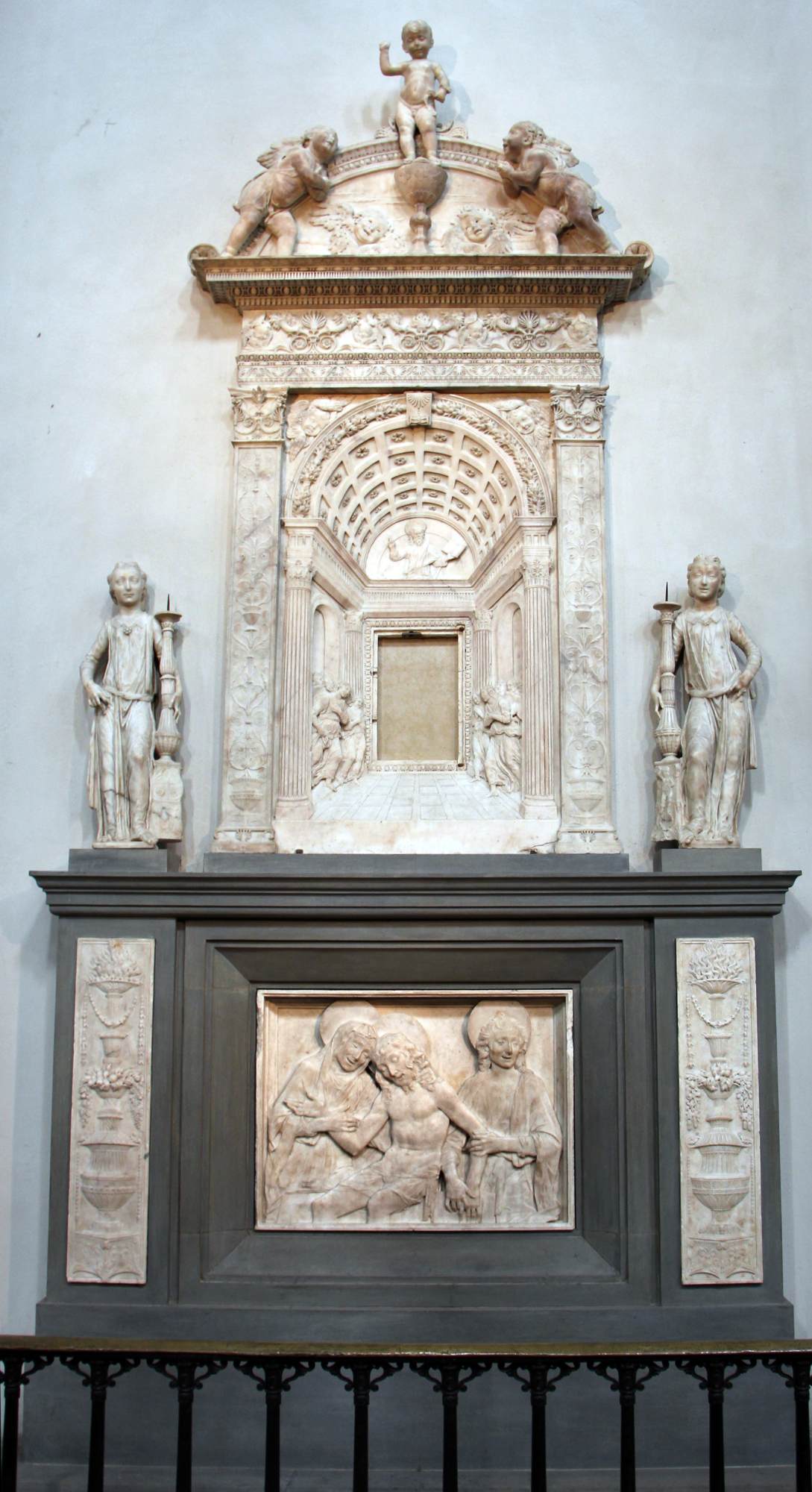
For many years I have admired the sculpted heads of children by Desiderio da Settignano in the collection of the National Gallery of Art. During my recent trip to Italy, I revisited two of his large-scale works, the tomb of Carlo Marsuppini in Santa Croce and the tabernacle of San Lorenzo, both in Florence. (The tomb of Blessed Villana in Santa Maria Novella, attributed by Vasari to Desiderio -- "in such a manner that she appears not dead but asleep" -- is now thought to be by Bernardo Rosselino.) The exhibit that opened on July 1 at the National Gallery -- Desiderio da Settignano: Sculptor of Renaissance Florence -- is the first international exhibit devoted to the elusive sculptor. It draws together pieces from three major collections, the Bargello in Florence, the Louvre, and the NGA, as well as other museums. Although it is modest in size, occupying only two small galleries in the West Building, this show is a knockout in terms of what is in those two rooms. The exhibit also offers a perspective on Desiderio's career, including large-scale photographic reproductions of the two major sculptures mentioned above.
Very great is the obligation that is owed to Heaven and to Nature by those who bring their works to birth without effort and with a certain grace which others cannot give to their creations, either by study or by imitation. It is a truly celestial gift, which pours down on these works in such a manner, that they ever have about them a loveliness and a charm which attract not only those who are versed in that calling, but also many others who do not belong to the profession. And this springs from facility in the production of the good, which presents no crudeness or harshness to the eye, such as is often shown by works wrought with labor and difficulty; and this grace and simplicity, which give universal pleasure and are recognized by all, are seen in all the works made by Desiderio.

Circle of Desiderio da Settignano, Saint Constance ("La Belle Florentine"), Musée du Louvre
That was how Giorgio Vasari introduced his brief biographical article on Desiderio in Lives of the Artists (trans. Gaston C. DeVere, put online by Adrienne DeAngelis). Vasari states that Desiderio died at age 28, but it is now accepted that he lived into his 30s. He did not live long enough to produce that many sculptures, but what he did create, as Vasari perceptively noted, was the result of an incredible gift. He is probably the least widely known great sculptor active during the latter years of Donatello's life, and if he had lived to the same age as Donatello, it is possible that Michelangelo's career would have been pushed in a different direction. The pieces in this exhibit are the best examples of his work, excepting only those works that cannot be moved. At the entrance to the show is a gorgeous linden wood sculpture formerly known as La Belle Florentine (shown at left). Rather than simply a portrait of a pretty Florentine woman, this sculpture has recently been identified as Saint Constance (because of an inscription uncovered in restorative cleaning). A compartment at the top of the head originally functioned as a reliquary.

Other Articles:

Roderick Conway Morris, The subtle Desiderio: Breathing life into cool marble (International Herald Tribune, April 27)

Blake Gopnik, In His Hands, the Spirit Lives (Washington Post, July 15)

Slide Show of exhibit

Holland Carter, Sonnets in Marble (New York Times, August 10)
One of the most beautiful pieces in the show is an excellent example of Desiderio's skill in capturing a neoplatonic ideal of youthful innocence, the Goupil San Giovannino from the Louvre (shown above). It is in many ways the sculptural counterpart of Botticelli's later neoplatonic paintings, as profound a sculptural rethinking of a Biblical hero as Donatello's David, which forms the other wing of the diptych of Florentine heroes. The subtlety of the features is remarkable, the wisps and ringlets of hair echoed by the swirls of the saint's hair-shirt, the hooded eyes, the delicate lines and curves of the face. Many great sculptors achieved mind-blowing textural surfaces, but few polished the stone to such a glowing quality. When you stand in front of it, the temptation to run your hand over it to see if it is skin or stone -- the dream of Pygmalion -- is hard to resist.

If the Goupil San Giovannino is one of the early signs of Desiderio's genius, the exhibit lines up several masterpieces from the last ten years of the sculptor's life, all tantalizing glimpses of what could have been. From the church of San Lorenzo in Florence, there is a stunning portrait of a young deacon, thought to be Saint Lawrence, the patron of the church, or possibly Saint Leonard. I do not recall ever seeing it before. Desiderio was also accomplished as a relief sculptor, with one of his most sensitive portraits of a man often thought to be Julius Caesar, from the Louvre. The most outstanding example is the Arconati Visconti tondo, a roundel sculpted with an image of Christ and John the Baptist as boys, mentioned by Vasari as a particularly fine example of Desiderio's reliefs in marble. Master Ionarts and his best friend have conversations with the same intensity.


Arconati Visconti tondo (Christ and Baptist as boys), c. 1457, Musée du Louvre

Perhaps the most famous Desiderio sculpture, the Laughing Boy now in Vienna, seems to show the last stage of the sculptor's development. The dreamy expression of his earlier faces, like the relief of the young John the Baptist from the Bargello, is supplanted by one of the most striking faces sculpted in the 15th century, the Laughing Boy (see below). One of the pieces missing in the Washington installment of the exhibit (the last of three venues, after the other sponsoring museums, the Louvre and the Bargello) was another example of the late Desiderio face, the Bust of Marietta degli Strozzi (c. 1460, Staatliche Museen, Berlin). Vasari uses that sculpture to make the point that, contrary to previous sculptural practice, Desiderio sometimes sculpted from a live subject: "he portrayed from life, likewise in marble, the head of Marietta degli Strozzi, who was so beautiful that the work turned out very excellent." It is possible that the Laughing Boy was a life portrait of one of Desiderio's own children. Whoever he was, it was a face that Desiderio studied closely and over a long period of time. Even without the Marietta degli Strozzi bust, the chance to see all of these small pieces together is not to be missed.

This exhibit is open to the public until October 8. Admission to the National Gallery of Art is free.


Young John the Baptist, c. 1453, Museo Nazionale del Bargello, Florence

Laughing Boy, c. 1462, Kunsthistorisches Museum, Vienna

13.8.07

Manhattan Diaries at Wolf Trap


Anne-Carolyn Bird, Jeremy Little, Joshua Jeremiah, and Sasha Cooke, Manhattan Diaries recital, Wolf Trap, photo by Kim Witman
Steven Blier's recital last year at Wolf Trap, on the theme of Four Islands, ended with the island of Manhattan. Picking up where he left off, Blier put together a Manhattan Diaries recital on Saturday night, again showcasing four singers in the Wolf Trap Opera program. In his work for New York Festival of Song and places like Wolf Trap, Blier has few equals in encyclopedic knowledge of the song repertoire and savvy in putting together satisfying programs. This is what makes singers so happy to work with Blier, even though he might ask a tenor to sing a part written for a low-voiced woman (which he did, describing the sex-changed role as a "post-op tranny") or ask two male singers to sing a love song about setting up house. That he could even make me enjoy a program principally comprised of Broadway songs is a testament to the man's skills. In fact, the focus of the recital initially made me decide not to cover it. So, here was the music critic at a concert, intending not to write a review at all.

Writing about music in this forum for four years now has had some impact on how I listen to music. Because I also play (piano and organ) and sing, I have always been an analytical listener, a tendency only heightened by years in graduate school for musicology. Essentially, when you listen to as much music as I do, live and in recordings, it boils down to trying to distinguish the excellent, even heart-stopping, from the merely good. This can seem cruel, no matter how much I try to be respectful of all the musicians I hear. Listening to this recital without having to think about writing a review did alter my experience. It was not that any of my tastes or opinions changed, or that I stopped listening critically, but the experience became much more centered only on the five performers on stage at that moment, without that analytical part of my brain making comparisons to other performances. The fact that I was seated between the sister of one of the singers and the mother of another, who were holding a conversation around me, further took me out of my normal reviewing mode.

As always with a Steven Blier recital, there were major discoveries: David Heneker (Peg), Ricky Ian Gordon's What Shall We Remember?, Harry Ruby's The Sheik of Avenue B, and John Musto's Litany (extraordinary poem by Langston Hughes). As always, there was excellent singing and not a little stage foolery. Anne-Carolyn Bird displayed consummate vocal control and shimmering tone in Ned Rorem's The Lordly Hudson; baritone Joshua Jeremiah and mezzo-soprano Sasha Cooke (both noteworthy voices) gave a hilarious rendition of the taxi duet from Leonard Bernstein's On the Town; tenor Jeremy Little gave a sweet reading of Richard Rodgers's A Tree in the Park from Peggy-Ann. Some selections were less pleasing to my ear (Sondheim), others were right up my alley (Bernstein and Ferlinghtetti's The pennycandystore beyond the El), and there were many classics from the golden age of music theater (Irving Berlin, Cole Porter). There was even a tribute to Evelyn Lear, seated a couple rows in front of me, who was cast as the lead in Reuben, Reuben, a failed musical by Marc Blitzstein. And the critic has no more criticism to offer. For that, you will have to read Grace Jean's review in the Post.

The Wolf Trap Opera concludes its season with a production of Mozart's The Magic Flute (August 17 and 18) in the Filene Center.