Warhol Wins!

Available at Amazon: Don Quixote, new translation by Edith Grossman (released on October 21, 2003) Don Quixote (online version, English translation) Don Quijote (online version, Spanish original) Ruta de Don Quijote (pilgrimage route following Don Quixote around Spain)  Don Quijote de La Mancha: Romances y Músicas, Montserrat Figueras, Hespèrion XXI, La Capella Reial de Catalunya, Jordi Savall (released on January 10, 2006) |
Donning all his armor, mounting Rocinante, adjusting his ill-contrived helmet, bracing his shield on his arm, and taking up his lance, he sallied forth by the back gate of his stable yard into the open countryside. It was with great contentment and joy that he saw how easily he had made a beginning toward the fulfillment of his desire. (Part I, Chapter 2)We are soon introduced to the habit of el ingenioso hidalgo to quote or paraphrase from his extensive reading of chivalric romances. Often, Quixote cites a few lines of a ballad, and in this chapter, he does so first to the innkeeper, saying, "Arms are my only ornament, / My only rest the fight." These are lines from the words of the Moor in the Ballad of Moriana: With a start the Moor awoke, an anonymous text which Savall has provided in the setting by Luys Milán. The innkeeper, who Cervantes tells us has seen something of the world, recognizes the text and answers with the next two lines, changing the text so that he addresses Don Quixote, "Your bed will be the solid rock, / Your sleep, to watch all night."
Savall gives us a beautiful arrangment of this Sephardic ballad, with his wife, Montserrat Figueras, and daughter singing. The way that this CD vividly recreates the sonic life of Don Quixote is extraordinary.
Original Text:
For never was there any knight
so served by damsel or dame,
as brave Sir Lancelot du Lac,
when he from Brittany came:
damsels ministered to him;
His horse was tended by dames.Don Quixote:
Never was knight
so honored by ladies
as Don Quixote
when he rode forth from his town:
damsels ministered unto him;
and princesses took charge of his steed.
Robert R. Reilly, music critic for CRISIS and author of Ionarts-recommended Surprised by Beauty, was at the Kennedy Center for Ionarts, testing the child-friendliness of the NSO's Family concert with the help of his own son.
I thought I was cheating. The National Symphony Orchestra Web site suggested that children be at least seven years old to attend the family concert, The Magic of the Firebird, on Sunday, June 18th. My youngest son is six. I snuck him in anyway. I was making allowances not only for his height – he could easily pass for seven or eight – but also because my children are thoroughly immersed in classical music as a kind of amniotic sound in and ex utero. They instinctively know what bad music is because of their exposure to good music.
As an opposite kind of Gresham’s law, good music actually drives bad music out. My oldest son – then 10 – after being forced to listen to run-of-the mill, low-quality rock in a friend’s father’s car, vented his frustration. Why, I asked, didn’t you like it? “It is irritating to the mind,” he replied. Exactly.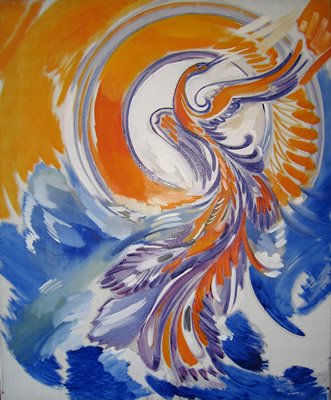 This concert was part of a laudable effort by the National Symphony Orchestra to expose kids to musical quality, thus inoculating them against these inevitable irritations from a lobotomized pop culture. At least they will know that they are irritations. Also, my six-year-old insisted on a concert because his older brother and sister had already been to the Kennedy Center. This was the solution.
Before the conductor appeared, I asked my son if he would like me to read to him the story of the Firebird, neatly provided in a colorful cue sheet for families by the Kennedy Center. He declined. “I’d rather listen to the music,” he said, displaying a preference for the absolute over the descriptive.
Conductor Emil de Cou took the stage, however, and told the story anyway. First, however, he introduced and conducted an excerpt from Sleeping Beauty. This seemed to transfix my son sufficiently that he never removed two fingers thoughtfully poised on his lips. Then came the Sinbad excerpt from Rimsky-Korsakov’s Scheherazade, with the wonderful crashing waves and wrecked ship.
Finally, De Cou recited the Firebird narrative, illustrating it with orchestral excerpts. He succeeded in his delicate mission because he did not try to be cute, a terminally fatal attitude afflicting condescending adults. Then he and the NSO engagingly played the Firebird Suite (1919 version).
My son was reasonably attentive. He was also attracted by the overhead screen that displayed occasional figure drawings showing what the prince and Firebird were up to, as well as live close-ups of the featured instrumentalists. I could see he was flagging as the Firebird lulled the ogres into a deep sleep, but he was bolt upright when King Kastchei attacked. “When the music got rough, it really got my attention,” he reported.
My son has not asked to listen to more Stravinsky, but I think this was a success nonetheless. It seemed so for the general audience that included many children at least as young if not younger than my son. I saw only one baby removed. In fact, the kids were remarkably well behaved.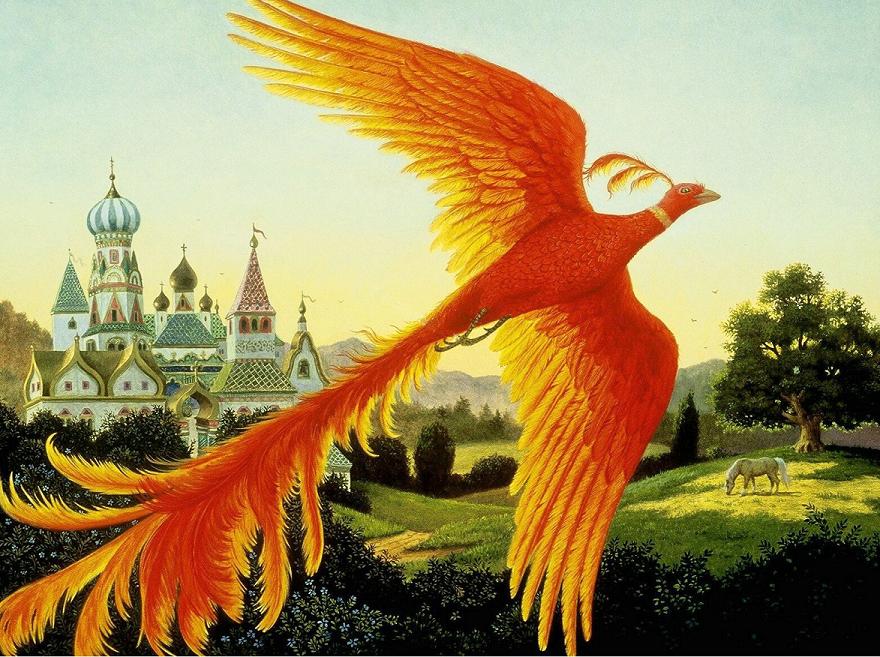 What about the adults, you are wondering? The family behind me was, I hope, not typical. Before that concert began, the mother announced to herself that this was their first time in the concert hall. As she examined the surroundings, she exclaimed to her daughter, “Look, dear, the whole ceiling is made of octagons.” I looked up. They are hexagons.
The father of this family never saw fit to inform the boy behind me that kicking the chair in front of him was gauche. The boy was trying to be quiet in his paper folding exercises but was ceaseless in them as well. Dad saw no problem with this, and only interrupted to read to the boy from the sous-titres on the overhead projector during the performance. Mom also thought that whispering was part of the fun, modulating her voice to follow the volume of the sound. Orchestral tutti provided opportunities for near normal conversational levels.
But this is carping. The NSO is doing the right thing, and doing it well. How about some family concerts for parents on etiquette?
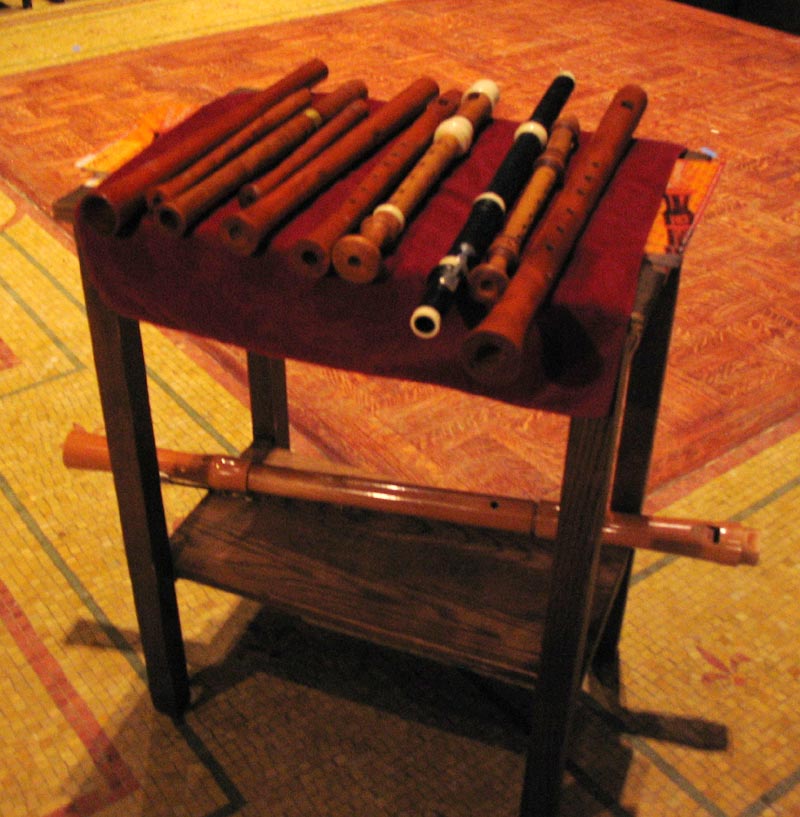 After a concert on Monday night with Modern Musick, recorder virtuoso Matthias Maute was back at St. Mark's Episcopal Church on Capitol Hill, where the Washington Early Music Festival is in residence all this week. As Keith Reas, the director of music at St. Mark's put it in his brief introductory remarks, this was a solo recital, nothing but "a man and a table full of recorders." Does anyone really want to hear two hours of recorder music and nothing but one man playing a recorder, or rather twelve of them? If anyone could make this work, I felt sure, it was Matthias Maute, whose praises I have sung before. Whenever I like a performer's playing this much, that music critic voice in my head starts accusing me of complacency, lazy listening, being a fan. So I took Mrs. Ionarts, a flutist and one-time teacher of the recorder to children, along last night to hear him play. She was just as impressed as I have been.
Available at Amazon: Shades of Red (Vivaldi concerti), Matthias Maute, REBEL Ensemble (released on May 31, 2005) |
Charles T. Downey, Modern Musick and Matthias Maute (June 20) Jens F. Laurson, Cavalli, "La Didone" (June 18) Charles T. Downey, Mozart, "Idomeneo" (June 4) |
Please note that earlier today, I misidentified the lead dancers in this review. Irina Golub and Andrian Fadeyev (neither seen nor reviewed) must be considered innocent. Olesya Novikova and Leonid Sarafanov, the other alternative couple, were reviewed (together with Pavleko/Kolb) by Jean Battey Lewis for the Washington Times.
The Kirov-slash-Mariinsky, fond of spreading its cultural riches far and wide – and surely not unaware of the benefits of hard currency – makes Washington, D.C., a regular stop on its tours. We are thankful, especially if Gergiev himself manages to lead the main band in enthralling performances (Verdi Requiem); truth be told, Washington is usually just as grateful even if they give us something from a lower shelf. And the Kirov knows that. Or so it seemed when they sent the Kirov Ballet to D.C., except that they forgot to ship the best soloists in.
We are not a culturally discriminating town and ought not complain that the best is withheld from us in favor of London, St. Petersburg, or Vienna – perhaps even New York – performances. The indiscriminate applause for just about any “scene” of Giselle (even at the fact that there was “fog” on stage for the second act), last Sunday, seemed to underscore that point. If, however, some audience members were curiously unmoved or not entirely convinced that Giselle is in fact one of the best, certainly most dramatic, classical (well, Romantic) ballets there is, well, it may have had something to do with Daria Pavlenko in the title role and Igor Kolb as Count Albrecht, the male lead.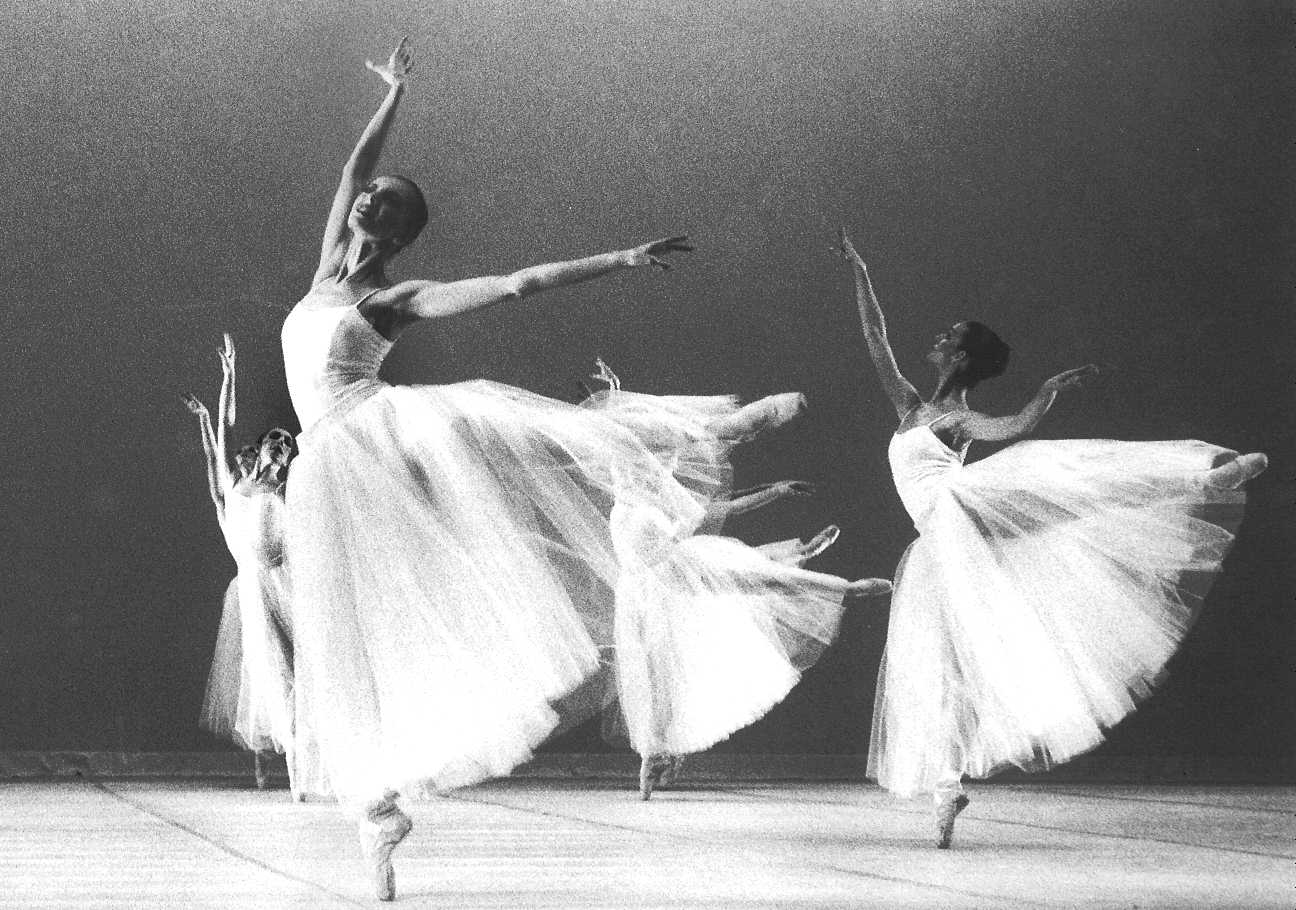 The two displayed the kind of dancing that an expert ballet watcher will find full of flaws, fraught with sloppy execution, insufficient extension, insecure landings, and too little air. The more casual observer – and I count myself among them – merely wonders what the whole dancing business is all about; why people get quite so excited about Giselle, or any other ballet, for that matter, in the first place. Giselle has everything that should make it at the very least enjoyable: for a ballet of its time (1842), it has superior music (by Adolphe Adam; inferior still to Delibes or Tchaikovsky, but leagues above the kind professional hacks like Minkus churned out), suffers from a hackneyed story no more than ballets all tend to do (the fewer humans involved – Mandarin, Coppelia – the better it usually is for a ballet’s story-line; but that’s based on a rather flimsy survey of mine) and comes with its tried and true, ever popular Marius Petipa choreography (with a little Jean Coralli here, a little Jules Perrot there) from 1884, in a reconstruction of which the Kirov presented this work.
I need not be detailed in my particular feelings about any interpretive art form (like ballet or theater or opera) being offered in a way that carefully excised any and all hints of new ideas over the last 130 years – but in the combination with sub-par dancing it didn’t help the appreciation of this production. The morticians who applied the lovely (cliché-expectation fulfilling) set and costume design are Igor Ivanov and Irina Press. In this form, ballet has only an accidental relation with other art forms we cover at Ionarts, namely being the off-and-on paymaster – and occasionally inspiration – of some composers. Indulging so deliberately in the artificial, its stylized ways can be either entrancing to the newcomer, or more off-putting than the haughty, pompous, screeching world of opera. In fact, it makes your average Donizetti opera look like a study in dramatic realism.
Jean Battey Lewis, Kirov bows after 'Giselle' (Washington Times, June 19) Sarah Kaufman, From the Kirov, A Bright and Buoyant 'Giselle' (Washington Post, June 19) |
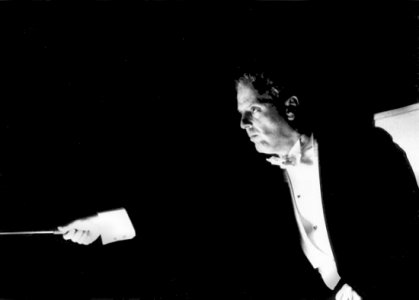 Daniel Barenboim, outgoing Music Director of the Chicago Symphony, bowed out with an unusual gesture: three final one-off performances, each dedicated to a valedictory 9th Symphony by three greats of the Austro-German repertoire: Mahler, Bruckner, and Beethoven.
Mahler. The first of these Abschied-concerts, Thursday night at Chicago's Orchestra Hall, showed this conductor-orchestra combination at their mind-bending best. When a great orchestra with an often-great leader actually performs greatly, all bets are off: and so it proved with Mahler's 9th.
Barenboim's reading was trenchant and distinctive, cueing off Mahler's fade-out ending to color the entire performance. The opening bars of the Andante comodo had a vague, grey sound, string tone stripped of color to devastating effect. The movement's exposition and development were executed in crisp, muscular style but with no harshness, the textures fully transparent even in the loudest climaxes. Almost a blend of Walter's intensity (1938) and Karajan's technical control (1982 -- both live recordings!), but distinctly Barenboim.
The second-movement Ländler (three Ländlers in distinct tempi) was tightly integrated, introducing a bit more color into the playing, with a wonderful chamber-like balance at the end. The Rondo-burleske took it up a notch, controlled intensity but with more overt expression from the players. This carried into the final Adagio, which swept everything away, somewhat fast but with unerring feel for tension-and-release. The fortissimo climax had X-ray clarity, the brass burnished, not brilliant, clearing the way to Mahler's morendo ending, the quietest possible string playing tangible in the air, the sense of relaxation as the music expires achieved by the tightest control from the podium. This was risk-taking live performance at its best.
Daniel Ginsberg, Barenboim Bids Chicago Adieu in Classic Fashion (Washington Post, June 19) James R. Oestreich, Barenboim's Warm Farewell to Chicago (New York Times, June 19) Wynne Delacoma, Barenboim's farewell is a memorable feast (Chicago Sun-Times, June 19) Andrew Patner, CSO lauds departing Barenboim as 'conductor for life' (Chicago Sun-Times, June 19) John van Rhein, Barenboim, Beethoven rule (Chicago Tribune, June 19) Michael Henderson, Goodbye Chicago, hello world (The Telegraph, June 20) Jeremy Grant, Indelible stamp on Chicago Symphony (Financial Times, June 20) |
Jens F. Laurson, Cavalli, "La Didone" (June 18) Charles T. Downey, Mozart, "Idomeneo" (June 4) |
 The audience was of a respectable size, many of them drawn, most likely, by the name of recorder virtuoso Matthias Maute, who joined the group for two concerti as soloist. I heard him last year as a soloist, also on an all-Vivaldi program, with the REBEL Ensemble at the Library of Congress and was mightily impressed. After this concert, he remains the most talented recorder player I have heard live in recent years. His first concerto was an adaptation of a violin concerto (B-flat major, RV 375), which offered plenty of opportunities for Maute to show off his many skills. He can riff off incredible spirals of detached runs, almost all individually set off in astounding clarity, and immediately switch to soaring long high notes, impeccably tuned and unchanging, all with extraordinary breath control. He has great flair in ornamentation as well -- for example, in the second movement of this concerto -- which is crucial in Baroque music, and not all players are created equal in this respect. He was no less impressive in his second concerto (C minor, RV 441). Because it was actually composed for the recorder, its demands seemed to fit more naturally under Maute's fingers.
Gail Wein, Washington Early Music Festival (Washington Post, June 21) |
Available at Amazon: Various works, Atlanta Symphony Orchestra Chamber Chorus, Norman Mackenzie (released on February 28, 2006) |
 Various works, Atlanta Symphony Orchestra and Chorus, Hila Plitmann, Nancy Maultsby, Robert Spano (released on October 25, 2005) |
 Leonard Bernstein is one of those composers who knew his musical voice very early on, and the Lamentation movement from his "Jeremiah" Symphony, submitted for a student composition contest during the World War II years, is recognizably Bernstein. The glistening jazzy chords, the wind dyads, and the sensitive orchestration with soaring violin lines all make this enjoyable listening. In particular, the lengthy instrumental portions of this movement sound great. Mezzo-soprano Nancy Maultsby has enough heft in the Hebrew text, but perhaps too much vibrato and not enough cleanness at the ends of lines.