CD Reviews | CTD (Briefly Noted) | JFL (Dip Your Ears) | DVD Reviews
Showing posts sorted by date for query christophe coin. Sort by relevance Show all posts

6.12.23

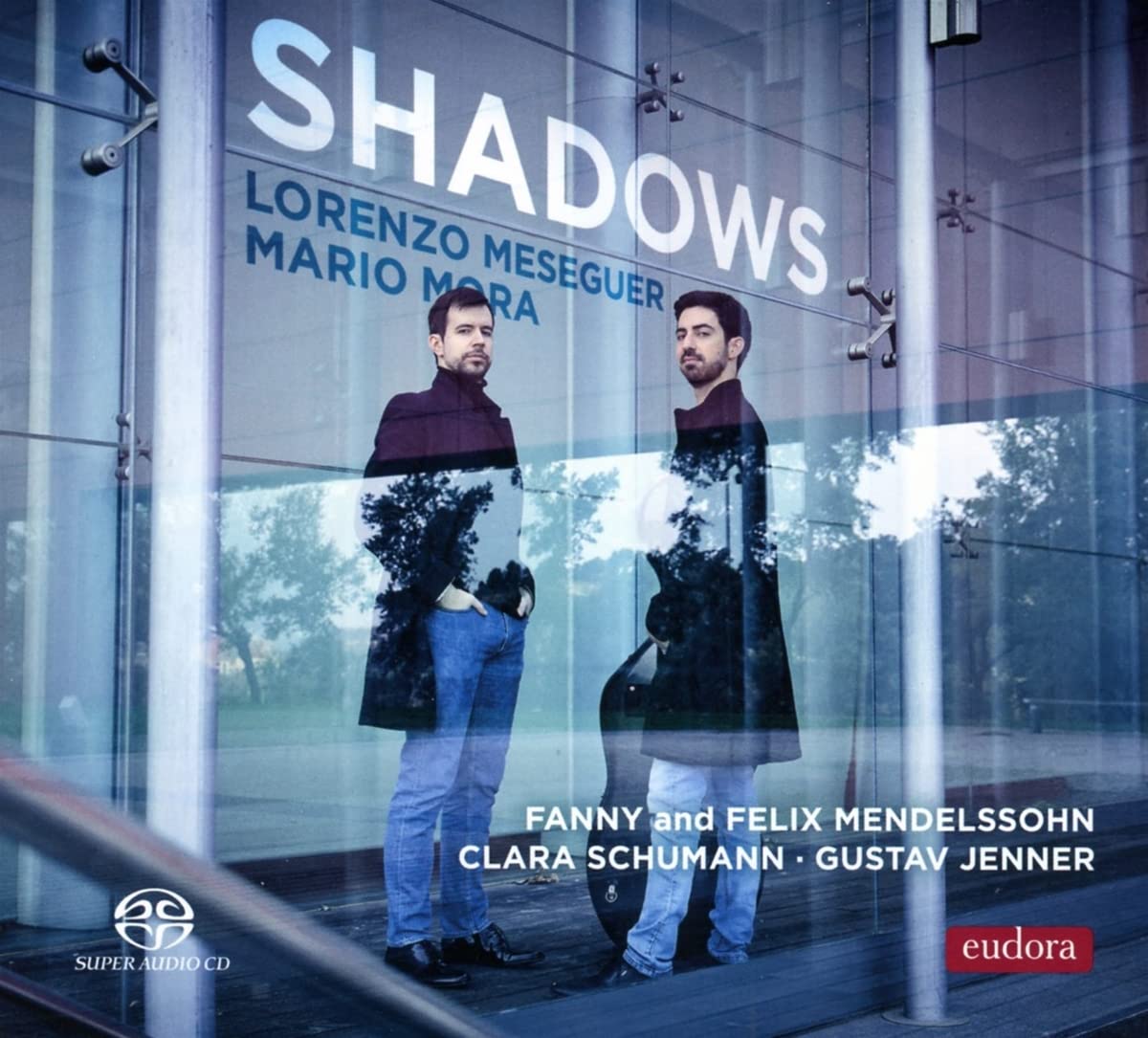
Dip Your Ears: No. 270 (Shadowy Cello Sonatas)


available at Amazon
C.Schumann, Mendelessohn Frère et Sœur, G.Jenner
Shadows
Lorenzo Meseguer (c), Mario Mora (pf)
(Eudora SACD 2204)

Clara, Fanny, and Gustav in the Shadows


“SHADOWS” is an album combining two single-movement works for cello and piano by Fanny Mendelssohn (Fantasia in G minor) and Clara Schumann (Three Romances op.22) with two cello sonatas, Felix Mendelssohn’s Second Sonata and that of the Brahmsian Gustav Jenner (also in D major). The title of the CD, goes the argument in the booklet, comes from the fact that each composer lived in the shadow of another. The gals in that of their brother and husband, respectively, and Jenner in that of Brahms, whose only student Jenner had been. Fair enough: While it might be argued that Clara Schumann was not much less – if at all – famous than her husband at the height of her concertizing career, at least as a composer she certainly wasn’t a known quantity. With Felix Mendelssohn, the claim is stretched too far. Only because he was “denigrated by some European musicologists in the early 20th century, in part because of his Jewish origins”, doesn’t mean that Mendelssohn, the man who invented classical music as we know it (from the conservatory system to the figure of the conductor to the idea of repertoire; salvaging Bach as a bonus) and who wrote a slew of masterpieces that were never not loved and acclaimed, has, for all the accusations of an excess of facileness or not pushing musical boundaries, ever been in anyone’s shadow.

But no matter, the music matters, not the title of the CD. And the performances are splendid, indeed. Cellist Lorenzo Meseguer has a surefooted, none-too-sweet tone and gorgeous round low notes that come out very nicely on the Eudora recording, which is proximate to the instruments (more so than, say, the fine Naxos recording with Maria Kliegel and Kristin Merscher) but leaves enough air. The second-movement pizzicatos are nearly as coy as those of Pieter Wispelwey’s (with Paolo Giacometti on Onyx) while Mario Mora’s piano part – naturally, given he is playing a modern Steinway – is more supple than Giacometti’s 1837 Érard. The tempi are not extreme in either direction, although the Adagio is certainly milked for its wistful beauty… if not as wickedly as Christophe Coin and Patrick do, who make it sound as though Tzimon Barto broke into a fortepiano shop. (In a good way, I suppose, although that’s bound to be rather subjective.) The finale is a nicely contrasting firecracker and the contrast. Comparison to a golden-oldie favorite of mine, János Starker and György Sebők on Mercury, make Meseguer’s cello appear comparatively prominent – perhaps more a question of engineering than playing.

The Mendelssohn may be the main ingredient of this CD, but the USP is probably the shadowy composers in front and after him, where there’s little competition. Only two other recordings exist of the fine Jenner sonata; only four of the beautiful Fanny Mendelssohn Fantasia which is here given all its considerable worth. Both, Jenner’s work, which is very obviously (but also very deftly) post-Brahmsian, and Fanny’s piece, are reasons to tune in. The key is not to be turned off by the Three Romances which, after a few minutes of vapid beauty, become so obviously trite that they’re hard to bear: ambling melodies in the cello connected by clichéd phrases and clumsy chords. Don’t say you haven’t been warned.

8/10


7.10.17

A Survey of Beethoven String Quartet Cycles


An Index of ionarts Discographies


Continuing my discographies, this is a survey of - hopefully - every extant recorded cycle of Beethoven's String Quartets. As of September 2017, it includes 63 different cycles (one incomplete, one that may not be finished, and another soon to be finished) spanning 70 decades of recording history. I am sitting on the data for several new discographic entries under work. Ring cycles, Mahler, Nielsen, Martinů and Beethoven symphony-cycles, as well as Bartók and Shostakovich string quartet-cycles. They just take an awful lot of time to research and then put into html-presentable shape and even then they are rarely complete or mistake free. Neither will this one be, and every such post is also a plea to generously inclined readers with more information and knowledge of the subject than I have to lend a helping hand correcting my mistakes or filling data-lacunae. I am explicitly grateful for any such pointers, hinters, and corrections and apologize for any bloomers. Unlike some earlier discographies, this one does intend to be comprehensive. So I am especially grateful if I have sets that I have missed are pointed out to me. I have not listened to them all, of course, but about 20. Favorites are indicated with the "ionarts choice" graphic. With nearly 2000 links in this document, there are, despite my best efforts, bound to be some that are broken or misplaced; I am glad about every correction that comes my way.


Edit 04/22/26: Added the Quatuor Ébène DVD cycle (2020), the second volume of the Ariel Quartet's cycle, the complete Verus String Quartet cycle (2017-2025), and the complete box set of the Calidore cycle. Work on adding the Shanghai, and Quartetto Classico cycles is also under way. The Arianna Quartet has finished their cycle (2011-2020); I have added it, pending more exact information. Thanks again to Merl for great tips & links in the comment section!

Edit 05/01/25: Added information on the difference between the Suske Quartet releases.

Edit 05/01/25: Added the 2019 Japanese re-release of the Barylli Quartet, the new release of the Quatuor Ysaÿe's live 2008 cycle (La Dolce Volta), the complete box of the Dover Quartet, the just-finished set by the Calidore Quartet, the and Narratio's brand new set, and the cycles that are currently under way by the Ariel and Doric Quartets. Also the new (first - but only LP) boxing of the Alban Berg Quartett's live Konzerthaus-cycle.

Edit 12/01/23: The latest update brings the survey actually up to date? The Dover Quartet's cycle on Cedille saw its final installment published. Quite some scrolling, until you get there, as this is the 81st cycle added.

Edit 08/12/22: Thanks to @PaulgThomas84's prompting, the Elias String Quartet cycle, which had been concluded, is now listed in full and in the right chronological position.

Edit 07/12/22: A special moment for these "Cycle Surveys:" I have added (belatedly) the Melodiya cycle of the Beethoven String Quartet's recording. This first release on CD was the direct result of research for this survey and my asking the good people at Melodiya about the recordings... to which they answered: "We found the recordings in the archive which you writing about. At the next editors meeting will discuss the possibility to release box-set with Complete Beethoven quartets in the performance of the Beethoven Quartet including digital release." Well, here it is (and today I received it in the mail, which was the kick in the pants I needed for an update)! Of course it remains the most difficult set to search for on the internet, right along with the Shostakovich Quartet's Shostakovich quartets, the Shostakovich Quartet's Beethoven quartets and the Beethoven Quartet's Shostakovich quartets. But I've done that part for you below. :-)

New cycles added: The Quatuor Ébène's around-the-world cycle (with echoes of Kubelik's such cycle of the Symphonies), the Miró Quartet's, the Kuss Quartet's, Quatuor Stanislas, and the Cuarteto Casals'.

New re-issues of cycles of the Lindsay, Alban Berg, Juilliard I, Pascal, and Smetana quartets.

Historical cycles newly added: Dimov Quartet (a.k.a. Quatuor Bulgare)

Edit 03/03/19: Deutsche Grammophon has luxuriously re-issued the Amadeus Quartet's classic cycle on CD/Blu-ray. Comments below.

Edit 28/05/18: Thanks to Barry Lyons for pointing out that the Wihan Quartet (Wihanovo kvarteto) has in fact recorded a first cycle. Solidly oop but added below.

Edit 20/05/18: The Budapest 1951/52 cycle has been re-issued on Sony and the Cremona Quartet cycle will be boxed for the first time. Both have been added below.

Edit 20/01/18: The Wihan Quartet cycle on Nimbus Alliance, hitherto overlooked (thanks to Mark Wilson who alerteshd me to that fact in the comments!), has been added. It brings this list to 66 (68, if you count the kind-of-cycles of the Peterson and Hagen Quartets) to cycles.

Edit/News 10/07/17: Melodiya has, after being contacted by ionarts, found the tapes for the Beethoven String Quartet's Beethoven String Quartet cycle (try searching for that one on Amazon or Google!) in their archives and is considering giving it a first-ever digital release. More news here if and as they develop.

Edit 09/29/17: Many thanks to "Bill" who alerted me to the Cleveland Quartet's first cycle on RCA, which has now been added. I am also trying to find more information on other alleged cycles, including a stereo cycle of the Russian Beethoven Quartet (app. recorded between 1969 and 1972 for Melodiya). The cycle by the German Schäffer Quartett (Le Club Francais du Disque/Muridire; early stereo), re-issued by ForgottenRecords, will be added shortly.

Edit 09/20/17: I am adding links to MusicWeb-Intl. reviews of complete cycles for further reading, wherever they have a well-written review up.

Edit 09/18/17: Already the first corrections come in: It's been pointed out to me that I have missed the Romanian "Cvartetul de Coarde Voces" and their 1998 cycle on Electrecord. Will be added tomorrow. And the Brilliant re-issue of the Guarneri cycle is not the RCA cycle, but the Philips/Decca one, after all.


22.10.16

CD Review: Rediscovered Couperin Cantata


Charles T. Downey, CD reviews: Two rediscoveries of Brahms and Couperin
Washington Post, October 21

available at Amazon
F. Couperin, Ariane consolée par Bacchus (inter alia), S. Degout, Les Talens Lyriques, C. Rousset

(released on November 11, 2016)
Aparte AP130 | 107'03"
The musicologist, harpsichordist and conductor Christophe Rousset has published a new book on the composer François Couperin (Actes Sud/Classica), and during his research, he made a singular discovery. In a manuscript collection of mostly anonymous French cantatas was an unknown cantata devoted to the story of Ariadne rescued by Dionysus on the island of Naxos. Many would not have given it a second look, but Rousset immediately thought of an unresolved mystery of Couperin’s oeuvre, a lost Ariadne cantata.

The manuscript in question had belonged to the Count of Toulouse, the son of Louis XIV and his mistress, Madame de Montespan, and the count’s music teacher was none other than Couperin. Rousset made the connection and substantiated the find, identifying elements of the composer’s musical signature in the work. He then assembled an all-star team to record it, including Christophe Coin on viola da gamba and baritone Stéphane Degout. Laura Mónica Pustilnik plays the lute, and Rousset himself leads from the harpsichord. As Rousset admits in his booklet essay, this cantata is far from a masterpiece, but the performance makes a strong argument for hearing it.

Also interesting are the two “apothéoses” by Couperin that Rousset includes on the disk: instrumental tributes to two deceased composers he admired: Lully and Corelli. Although the cantata was recorded in the church of Saint-Pierre in Paris, in sound that’s not exactly ravishing; these two pieces sound better as captured in the acoustic of the Les Dominicains de Haute-Alsace, a friary converted into a concert space. The “Plaintes” by Lully’s jealous contemporaries, here given to two delicate flutes, is one of many high points.
FURTHER THOUGHTS:
Rousset does not address one small problem, that the cantata he has found is titled Ariane consolée par Bacchus. In both the catalogue of Couperin's publisher, Etienne Roger, and the Parnasse Français by the chronicler Évrard Titon du Tillet, the missing cantata is called Ariane abandonnée par Thésée.

PREVIOUSLY:
Charles T. Downey, Christophe Rousset in concert (Ionarts, April 12, 2013)

17.1.16

Perchance to Stream: MLK Edition

Here is your regular Sunday selection of links to online audio and online video from the week gone by. After clicking to an audio or video stream, you may need to press the "Play" button to start the broadcast. Some of these streams become unavailable after a few days.

  • From St Paul's Church, Knightsbridge, in London, the BBC Singers perform music for the season of Epiphany by German composers of the early Baroque period. [BBC3]

  • Watch Alexandre Tharaud play Bach's Goldberg Variations. [ARTE]

  • Watch Hugh Wolff conduct the Frankfurt Radio Symphony Orchestra in Sibelius's fifth symphony, plus music of Mozart and Messiaen with clarinetist Jörg Widmann. [ARTE]

  • Watch a concert by the London Philharmonic, with Simon Rattle leading music by Ravel, Delage, and Dutilleux. [ARTE]

  • Listen to a double-bill of Tchaikovsky's Iolanta and Stravinsky's Persephone, recorded last July at the Festival d'Aix-en-Provence. [RTBF]

  • A performance of Handel's Israel in Egypt by Concerto Copenhagen, Lars Ulrik Mortensen, and the Nederlands Kamerkoor, with Joanne Lunn and other soloists, recorded in Vienna. [ORF]

  • The Akademie für alte Musik Berlin performs Handel's Water Music. [Avro Klassiek]

11.1.15

Perchance to Stream: Wheels of Justice Edition

Here is your regular Sunday selection of links to online audio and online video from the week gone by. After clicking to an audio or video stream, you may need to press the "Play" button to start the broadcast. Some of these streams become unavailable after a few days.

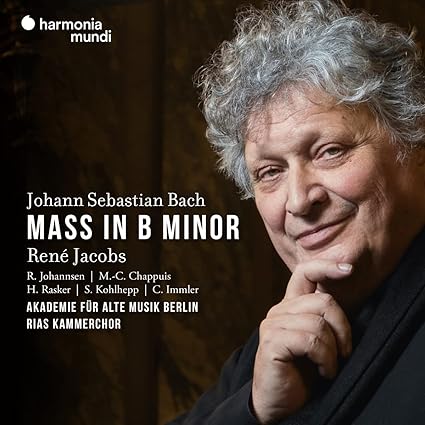
  • From the Cité de la Musique, René Jacobs leads Concerto Vocale, the Akademie für Alte Musik, and the Berlin Staatsoper Chorus in a performance of the Rappresentatione di Anima e di Corpo by Emilio de' Cavalieri. [France Musique]

  • Elina Garanca and Juan Diego Florez star in a performance of Donizetti's La Favorite, recorded last August at the Salzburg Festival. [ORF]

  • Puccini's Manon Lescaut from the Bavarian National Opera in Munich, with Alain Altinoglu conducting a cast led by Kristine Opolais and Jonas Kaufmann, recorded last November. [RTBF]

  • Watch the Krzysztof Warlikowski production of Mozart's Don Giovanni from the Théâtre de la Monnaie in Brussels. [De Munt]

  • Listen to a performance of Rossini's Semiramide, recorded in November at the Théâtre des Champs-Elysées in Paris, with the forces from the Opéra de Lyon conducted by Evelino Pidò. [France Musique]

  • Daniel Harding conducts the Orchestre Philharmonique de Radio-France in music of Beethoven and Berg, with pianist Lars Vogt, violinist Christian Tetzlaff, cellist Tanja Tetzlaff, and soprano Barbara Hannigan (Wozzeck fragments). [France Musique]

  • Simon Rattle conducts the Berlin Philharmonic in Schumann's fourth symphony and Brahms's fourth symphony, at a concert recorded last September in Berlin. [ORF | Part 2]

  • From Madrid, a performance of Ernst Krenek's Reisebuch aus den österreichischen Alpen with baritone Florian Boesch and pianist Roger Vignoles. [Radio Clásica]

  • Violinist Vilde Frang and pianist Michail Lifits perform music by Grieg, Lutoslawski, and Strauss, recorded last month at the Palais des Beaux-Arts in Brussels. [RTBF]

  • Music of Wagner, Toshio Hosokawa, and Mahler's fourth symphony from the Orchestre National de France, with Robin Ticciati conducting, harpist Xavier de Maistre and soprano Camilla Tilling. [France Musique]

  • Listen to Mariss Jansons conduct a concert honoring the 100th birthday of his father, recording at the Latvian National Opera in Riga last November. [ORF | Part 2]

  • Listen to a recital by pianist Alice Sara Ott, with music by Liszt and Musorgsky. [RTBF]

  • The National Orchestra of Belgium performs at the Palais Des Beaux-Arts in Brussels, with music by Strauss and Prokofiev. [Radio Clásica]

  • From the Cité de la Musique cellist Steven Isserlis joins La Chambre Philharmonique for music by Brahms, Dvorak, and Schumann, under conductor Emmanuel Krivine. [France Musique]

  • Kenneth Montgomery leads the Orchestra of the 18th Century, with pianist Nelson Goerner, in music of Beethoven and Mozart, recorded last August in Warsaw. [ORF]

  • Listen to Evgeny Kissin play Rachmaninoff's second piano concerto, with the Orchestre Philharmonique de Radio France and conductor Myung-Whun Chung. [RTBF]

  • Edward Gardner leads the Netherlands Radio Philharmonic in the third symphony of Brahms, plus Walton's viola concerto with Lawrence Power as soloist. [RTBF]

  • The Orchestre Philharmonique de Radio-France celebrates the music of composer Peter Eötvös, joined by percussionist Martin Grubinger, cellist Jean-Guihen Queyras, and violinist Midori. [France Musique]

  • Vivaldi concertos performed by the Basel Chamber Orchestra and violinist Giuliano Carmignola. [Avro Klassiek | Part 2 | Part 3]

  • From the Wigmore Hall in London, Garrick Ohlsson gives a recital of Scriabin's piano music. [BBC3]

  • From the Wigmore Hall, recorded last September, Marc-André Hamelin plays music by Schubert and Godowsky. [Radio Clásica]

  • From a concert recorded last November in Hanover, Andrew Manze leads the NDR Radiophilharmonie in music by Strauss, Sibelius (the violin concerto, with Frank Peter Zimmermann as soloist), and Nielsen (second symphony). [ORF]

  • A song recital by mezzo-soprano Janina Baechle and pianist Marcelo Amaral, recorded at the Auditorium du Musée d'Orsay, with music by Mendelssohn, Bach, Peter Cornelius, Max Reger, and Brahms. [France Musique]

  • From last summer's Verbier Festival, a recital by pianist Marc-André Hamelin, with music by Haydn, Field, Debussy, Liszt, and Hamelin. [ORF]

  • Antonello Manacorda conducts the BBC Philharmonic in Mahler's fourth symphony, plus music by Bach and Berg. [BBC3]

  • Baritone Christian Gerhaher and pianist Gerold Huber perform songs by Schumann, Fauré, and Widmann, in a concert recorded in 2013 at the Wiener Konzerthaus. [ORF]

  • The Soirée violoncelle at the Salle Gaveau brings together cellists Anne Gastinel, Christophe Coin, Xavier Phillips, and Raphaël Pidoux. [France Musique]

  • A recital by pianist Maurizio Baglini, recorded in the Auditorium du Musée d'Orsay, with music by Bach, Busoni, Liszt, and Scarlatti, in transcriptions for piano. [France Musique]

3.11.13

In Brief: Toussaint Edition

Here is your regular Sunday selection of links to online audio, online video, and other good things in Blogville and Beyond. (After clicking to an audio or video stream, press the "Play" button to start the broadcast.) Some of these streams become unavailable after a few days.

  • Evelino Pido conducts Gaetano Donizetti's Anna Bolena at the Wiener Staatsoper, with Luca Pisaroni (Enrico), Krassimira Stoyanova (Anna Bolena), Sonia Ganassi (Giovanna Seymour), and Stephen Costello (Precy). [ORF]

  • From the Salle Pleyel, violonist Sergey Khachatryan joins the Orchestre National du Capitole de Toulouse and conductor Tugan Sokhiev in music by Liadov, Khatchaturian, and Elgar. [France Musique]

  • Raphaël Pichon leads the Ensemble Pygmalion in motets by Jean-Philippe Rameau, Jean-Joseph Cassanéa de Mondonville, and Georg-Philipp Telemann, recorded in the Chapelle Royale at Versailles. [France Musique]

  • Peter Dijkstra conducts Rossini's Petite messe solennelle in Munich with the Bavarian Radio Chorus. [BR-Klassik]

  • The Orchestra Philharmonique de Radio France plays the Musikverein in Vienna, with violonist Renaud Capuçon, organist Christophe Henry, and conductor Myung-Whun Chung in music by Weber, Bruch, and Saint-Saëns. [France Musique]

18.6.13

Montserrat on Montserrat

available at Amazon
Llibre Vermell de Montserrat, M. Figueras, Hespèrion XX (inter alii), J. Savall

(re-released on October 25, 2010)
Virgin 628658 2 1 | 59'18"
Hard as it is to believe, this fine little disc was recorded 35 years ago, in the heyday of the early music movement. In it Jordi Savall offers alternately mysterious and earthy performances of the ten pieces notated in the Llibre vermell, a 14th-century codex from the Abbey of Santa Maria de Montserrat in the mountains of Catalonia. This monastery was often frequented by pilgrims, as a final destination or as one of the stops along the route to Santiago de Compostela. A note in the margins of the "red book," as it came to be known because of the red velvet cover made for it in the 19th century, specifies that these ten pieces are for the use of pilgrims keeping vigil in the abbey church or in the square in front of it. Instead of singing inappropriate folk songs, they should sing and dance to this more pious music. (One of the pieces was also recorded by John Eliot Gardiner recently, in the context of a selection of music for the pilgrimage to Santiago de Compostela.) Jordi Savall and his instrumental ensemble Hespèrion XX -- at this time including Christophe Coin and Hopkinson Smith, among others -- give a folksy twist to the dance and popular song-like pieces. The late Montserrat Figueras leads a large consort of voices, both men and women in various combinations, to give the impression of a large group of pilgrims united on the cammino, of both washed and unwashed varieties.

The only drawback of this re-release, priced to move, is that the booklet contains neither texts nor translations of the fascinating texts, some in Latin and some in Catalan, but you can find both here and they are worth reading, intense in their pious sentiments and specific to the mountaintop monastic house for which they were composed, like a vivid slice of late medieval life. Perhaps only in the "calamitous 14th century," as historian Barbara Tuchman termed it, could such dancing enthusiasm be matched to lyrics about hastening toward death ("You will become a vile cadaver, why will you not avoid sin?") in the final piece. In a nice touch, the male schola reprises the opening piece at the end of the disc, the serene chant O virgo splendens hic in monte celso miraculis serrato (O virgin, shining brightly, on this high serrated mountain -- Montserrat), which fades into the distance as the pilgrimage continues.

13.7.10

Quatuor Mosaïques Continues with Schubert

available at Amazon
Schubert, String Quartets D. 173 / 810, Quatuor Mosaïques

(released on April 27, 2010)
Laborie (Naïve) LC06 | 65'21"

Online scores:
Schubert, D. 173 | D. 810
We have attested to the fine Haydn, Mozart, and Beethoven -- both live and on disc -- played by Quatuor Mosaïques. The group, formed in the 1980s by cellist Christophe Coin and other members of Nikolaus Harnoncourt's historically informed performance (HIP) ensemble Concentus Musicus, plays on 18th-century instruments (the Joseph Guarnerius in the hands of first violinist Erich Höbarth is slightly older, dating from 1683) with gut strings. As noted of the group's recent work on a disc of music by Boëly, this is not a performance for listeners who do not enjoy the typical aspects of HIP sound. The leaner, warmer sound does produce some remarkable effects in these Schubert pieces, however, especially in the variations on Schubert's song Der Tod und das Mädchen in D. 810, which gives that quartet its nickname. The four instruments create a halo of amber sound in this hushed movement that seems like Death's welcoming embrace -- that is, not the terrifying apparition of the "wilder Knochenmann" the maiden perceives (poem by Matthias Claudius), but the friend come to offer rest rather than punishment. Even as some of the more active figuration percolates through the movement, the gentle tread of Death's feet always shines through the ensemble, a sense of comfort that reaches its apogee in the G major ppp conclusion of the movement.

The HIP sound also plays very well in the third and fourth movements, where the greater soft side of the spectrum creates other unexpected textures. As always, one misses some of the heft of the modern strings at more forceful movements (all those fz markings, for example), especially in the first movement of D. 810, for which the really fine recent recording by the Jerusalem Quartet is better by comparison. While the quartet audibly knows D. 810 very well -- a career-long obsession for some of the players, a matter touched on in the liner essay -- D. 173 seems less familiar, judging by some minor ensemble disagreements (made worse by a sound capture that is at times too close, making possible the hushed wonder of D. 810's slow movement but also revealing all the flaws in D. 173). The slender D. 173 is a nice piece but nowhere near the achievement of D. 810. The combination of a late quartet with an early one -- if such a distinction makes any sense for a composer who died so young -- follows the formula of the quartet's "first volume" of Schubert, released over a decade ago and now not so easy to find. If a complete Schubert quartet set is a goal, it could be competitive and at the very least an interesting choice.

24.4.10

Chamber Music by Boëly

available at Amazon
Boëly, Chamber Music, Quatuor Mosaïques, Ensemble Baroque de Limoges, C. Coin, E. Lebrun

(released on April 27, 2010)
Laborie (Naïve) LC05 | 74'26"
We warmly recommend the recordings and live performances of Quatuor Mosaïques, for anyone not immediately turned off by the sound of period instruments and historically informed performance practice. In this new release, Christophe Coin brings in some musicians from his larger ensemble, the Ensemble Baroque de Limoges in a selection of chamber music by Alexandre Pierre François Boëly (1785-1858). Recorded on the group's private label, Laborie Records (distribution by Naïve), the sound is lush and detail-oriented, not too close for comfort but including the sharp breaths of the musicians and some extra-musical sounds of bow attacks. Boëly grew up in Versailles (his birthday, April 19, was just celebrated earlier this week) and the musical life of its court, as the son of a singer in the Chapelle Royale who also taught the harp in Versailles. A classicist in the age of Romanticism -- worse, a champion of the outmoded contrapuntal music of Couperin, Frescobaldi, and J. S. Bach -- his reputation suffered, but the music heard here justifies a reexamination (there are some online scores, including music for piano, organ, and a Mass for Christmas Day).

We owe the opportunity to the research of the Centre de musique romantique française in Venice, and to a conference devoted to Boëly's music at the Sorbonne in 2008, in commemoration of the 150th anniversary of his death. (This is the second recent release we have noted to be inspired by the recently founded CMRF, after the Onslow disc from Quatuor Diotima reviewed earlier this week.) One of the selections featured here has been edited in a modern edition: for the others, the musicians worked from their own transcriptions or directly from manuscript sources, adding to the sense of historical discovery. Boëly's music might be compared to Schubert's, in that he continued to use traditional forms but while enlivening his harmonic idiom with more adventurous chromatic diversions.

The D major sextet, arranged by the composer from his own symphony, and the single movement for string quartet, a tender Adagio sostenuto, are certainly worth discovering. Three melodies, Mendelssohnian songs without words "for cello with the accompaniment of expressive organ" (unearthed in a library in 2005 by Florence Gétreau, and performed here by Eric Lebrun on the colorful, recently restored Cavaillé-Coll organ in the Chapelle de Conflans) are sprinkled through the selections. Listening to the fine trio and quartet also included on this disc, it is charming to think that, like Haydn, Mozart, and a few other composers, Boëly (a fine pianist and organist) was also known to play the viola part in his own chamber works. Do not be disappointed by the very slender printed booklet, at least as long as you do not bridle at the thought of downloading the extended liner notes [all in French] online.

21.4.09

Quatuor Mosaïques Worth the Wait

Quatuor Mosaïques:
available at Amazon
Haydn op. 20


available at Amazon
Haydn op. 77


available at Amazon
Beethoven op. 18/1,4


available at Amazon
Mozart Quartets
Ionarts has been recommending the recordings of the Haydn quartets by the Quatuor Mosaïques for years, but we had the first chance to review them live on Saturday night in an exceptional concert at the Library of Congress. The group was formed in the 1980s by cellist Christophe Coin and other members of Nikolaus Harnoncourt's historically informed performance (HIP) ensemble Concentus Musicus. Over two decades, their recordings of Classical string quartets, performed on historical instruments with gut strings, have changed the way we hear Haydn, Mozart, and Beethoven. Two Haydn quartets on the first half had all the superlative qualities expected from the group's recordings: rhythmic clarity, impeccable balance among parts, and clean intonation partially due to a sparing use of vibrato. The G minor quartet (op. 20, no. 3) had a crisp first movement, a wistful yearning treatment of the second movement (with a more dance-like trio), Venetian glass-like layering of sound in the third movement, and an active, energetic finale (albeit with a few squeaks here and there in the first violin).

Even more pleasing was the last published of Haydn's complete string quartets, the F major (op. 77, no. 2), in which the clever handling of the formal outlines of each movement was noteworthy, like the transition from development to recapitulation in the first movement. The jokingly clumsy return from the trio to the minuetto, like a sputtering engine trying to get started (in a coda that haltingly gets us back from D-flat major to the home key), played right into the hemiola games of duple versus triple that unsettle the second movement. In general, second violinist Andrea Bischof seemed a little too retiring and could have brought out her occasional solos with more flair, while the perceptive and sonorous playing of cellist Christophe Coin marked him as the group's leader.


Other Reviews:

Robert Battey, Quatuor Mosaïques at the Library of Congress (Washington Post, April 20)

Vivien Schweitzer, Thankful and Soulful on the Road to Recovery (New York Times, April 20)

Alan G. Artner, Satisfying debut for the Mosaïques (Chicago Tribune, April 20)

David Patrick Stearns, Early-music quartet at the Kimmel (Philadelphia Inquirer, April 18)
Beethoven's C minor quartet (op. 18, no. 4) was of the same approximate vintage as the later Haydn example, Beethoven's op. 18 set having been commissioned by Prince Lobkowitz at the same time as Haydn's (unfinished) op. 77 set. The comparison of the two quartets side by side highlighted the basic qualities of the young Beethoven's compositional style: the restless character of the first movement's main theme, the hammered tonic and dominant chords (as in the rewrite of the bridge of the first movement), the fugal writing of the second movement, and all of those sforzandi on third beats in the menuetto. Gut-stringed 18th-century instruments cannot produce the same violence of sound as later ones, but there is such a thing as way too much sound in a Beethoven string quartet, and what is gained in the soft end of the spectrum makes the overall range of dynamics still very broad, just more subtle. The nature of the instruments also makes it much less easy for the first violin to dominate the texture, making the triplet accompaniment figure of the third-movement trio more transparent, for example. The Quatuor Mosaïques played with remarkable physical energy in the final movement, cranking up the wattage with each return of the rondo theme and then exploding in the Prestissimo coda.

The feast of HIP ensembles continues at the Library of Congress, with a concert by the Geringas Baryton Trio this Friday (April 24, 8 pm).

11.1.08

Revisiting Sara Mingardo's Vivaldi

Available at Amazon:
available at Amazon
Vivaldi, Concerti e cantate, Sara Mingardo, Francesca Vicari, Luigi Piovano, Concerto Italiano, Rinaldo Alessandrini
(re-released October 30, 2007)
Having already expressed delight at the mysterious, edgy contralto of Sara Mingardo in Concerto Italiano's Orfeo, I likely surprise no one by waxing rhapsodic over more of her recordings. Jens has already recommended a disc of Vivaldi's Dixit Dominus, featuring La Mingardo and others with the Dresden forces of Peter Kopp (video on YouTube), and this re-release offers the chance to revisit more of her magnificent Vivaldi. Along with five concertos, the meat of the program, are two secular cantatas (RV 683 and 684) that offer sublime vehicles for Mingardo's reedy, dramatic voice, alternately fleet and thick-stroked. Both set Arcadian texts, with shepherd lovers complaining of the unfaithful nymphs Clori and Dorilla. Vivaldi scholar Michael Talbot, in his concise liner notes, estimates that both were composed at some point after 1726.

These cantatas are somewhat unusual in that Vivaldi notated string parts for them, including the recitatives, and they hold up to repeated, obsessive listening. In particular, two arias stand out for the beauty of the vocal line and the allure of their instrumental ritornelli. The fast Passo di pena in pena (RV 683) evokes a ship being tossed on the wild waves of passion, and the slow, lashing Ah, ch'infelice sempre (RV 684) the hope of death as a release from unrequited love's torments. This disc was originally released in 1997, but the re-release (nothing but the original disc and booklet in a new sleeve) has been reduced in price by a quarter, so it is a good time to add it to your collection if you missed it the first time around. Mingardo's recent solo release, from 2003, was nothing but a collection of previously recorded tracks, and it has only part of one of these Vivaldi cantatas, Cessate, omai cessate, on it.


Vivaldi, "Ah, ch'infelice sempre" (Cessate, omai cessate, RV 684)
Sara Mingardo, Concerto Italiano, Rinaldo Alessandrini

Amor, hai vinto (RV 683)
Recitativo: Amor, hai vinto
Aria: Passo di pena in pena
Recitativo: In che strano e confuso
Aria: Se a me rivolge il ciglio


Cessate, omai cessate (RV 684)
Aria: Nel'orrido albergo

The appeal of this disc is further enhanced by the instrumental selections, including three of the concerti per archi, pieces for strings alone without a prominent solo part: RV 117, 134, and a vivid, rural RV 151, "Alla rustica." From Vivaldi's ground-breaking cello concerti, there is a bubbly performance of RV 422, not one of the concerti recorded on the first volume of Christophe Coin's ongoing complete set with Il Giardino Armonico (reviewed this summer). Luigi Piovino impresses with meaty tone and agile flourishes on the challenging solo part. Violinist Francesca Vicari also has a solo concerto, RV 249, and her sound is as mercurial and steely as it was in the group's remarkable Winter concerto. A most satisfying combination.

Naïve/Opus111 OP 30181

3.11.07

Reflexio

Available at Amazon:
available at Amazon
Bach, Flute Sonatas, L'Ensemble Baroque de Limoges
(released on May 29, 2007)
Ionarts is a long-time fan of the Ensemble Baroque de Limoges, and Jens has recommended some of the recordings released on their personal label, Laborie (distributed by Naïve), Brossard's grands motets and Lalande's Les Folies de Cardenio. Unfortunately, the group had to cancel its last scheduled appearance in Washington, back in April 2005, at the Library of Congress. This recent EBL release is also worthy listening, with the delicate sounds of the group's featured soloists, Maria Tecla Andreotti (traverso), Jan-Willem Jansen (harpsichord), Christophe Coin (cello), and Sergio Azzolini (bassoon).

The program, the Bach flute sonatas, is hardly rare or unknown, which added to the appeal of some of EBL's earlier releases. There are too many recordings of these pieces to make any sort of assessment of their relative merits. For these pieces, as for most of Bach to these ears, the best account will be on historical instruments, in this case Coin's late 17th-century German viola da gamba, as well as modern copies of 18th-century instruments for the others. The breathy whistle of the traverso recorded here is probably close to what Bach had at his disposal at Cöthen, when most of this music was written. The same is true of the Lautenwerk heard on two of the sonatas, two examples of which Bach owned. If you already own these pieces in another good version, it would be hard to justify adding this to your collection, but if you are looking for a first copy and you like the HIP sound, take a listen to this disc.

Laborie LC04

22.7.07

Christophe Coin's New Vivaldi

Available at Amazon:
available at Amazon
Vivaldi, Concerti for Violoncello I, Christophe Coin, Il Giardino Armonico, Giovanni Antonini
(released May 29, 2007)
Vivaldi Edition:
available at Amazon
Griselda (2006)


available at Amazon
Arie d'opera, with Sandrine Piau (2005)


available at Amazon
La verità in cimento (2003)
A recent release in the growing Vivaldi Edition from Naïve, vol. 34, contains the first installment of the Venetian composer's concerti for cello. Christophe Coin, a recent favorite at Ionarts, joined Il Giardino Armonico for five cello concerti, as well as one for violoncello piccolo and an unusual double concerto for cello and bassoon. Coin, playing an instrument made by Alessandro Gagliano around 1720, has a lean but flavorful sound graced by tasteful embellishments. Over half of Vivaldi's output of concerti is intended for solo violin, and it is always good to be reminded that he did compose for other instruments. In fact, the Red Priest was one of the first composers to write concerti for the cello (about 30 of them) in the early 18th century. As is generally true of Vivaldi's corpus, especially the concerti, some of the works selected for this recording are better than others, but all are performed well.

The A minor concerto (RV 419, first on the disc) has exciting outer movements, particularly the last movement, a series of variations on an ostinato bass pattern. The continuo section of Il Giardino Armonico stands out from the ensemble by creating pleasing textures, alternately suave and crunchy. In the first movement of RV 410, Riccardo Doni's harpsichord and the Baroque guitar of Luca Pianta offer percussive backgrounds to the melody. The slow movement of the D minor concerto (RV 406) is one of the most melancholy pieces, with soft and daring theorbo realization of the continuo line, again by Luca Pianta. Conductor Giovanni Antonini encourages active sounds, without seeming to opt for fast tempos only for the sake of virtuosity, although there are some daringly fast movements. As in the first movement of RV 398, Antonini seems concerned only with finding the just tempo for each character. When the Vivaldi edition is completed, we will have a much more complete understanding of this extraordinary, sometimes maligned composer.

Naïve OP 30426

10.12.06

Dip Your Ears, No. 72

available at ArkivMusic
S. De Brossard, Les Grand Motets, EBL, Christophe Coin
Touches of Charpentier again – but also German baroque can be found on the second recording of the Laborie label. This time the Ensemble Baroque de Limoges under Christophe Coin comes up with the three Grand Motets of early musicologist Sébastien de Brossard (1655 – 1730). “In Convertendo Dominus”, “Miserere”, and “Canticum Eucharisticum Pro Pace” are three works by this French/Alsatian composer that add up to over an hour of very fine early baroque music, bound to please anyone who wishes to look beyond Bach cantatas and Charpentier’s Te Deum. The singing is excellent (especially basses Olivier Lallouette and Jérôme Corréas) – and so is the playing of the Ensemble Baroque de Limoges. Not essential, of course, but a delightful second issue from this enterprising label and group. (That it is in fact a re-issue doesn't deter... although that factoid is more hidden than offered. This disc originally came out on the Astrée label in 1997.)

LABORIE LC02. You can read the review of LABORIE LC01 here.

18.11.06

Dip Your Ears, No. 71 (With Touches of Charpentier)

available at Amazon
M.-R. de Lalande,
Les Folies de Cardenio, EBL, Christophe Coin
Laborie

Touches of Charpentier and South American baroque – that’s what comes to mind listening to wonderful new release of Michel-Richard de Lalande’s Les Folies de Cardenio on the new Laborie label. Recording the Ensemble Baroque de Limoges (EBL Laborie is their own label) under Christophe Coin, they dug deep into the vault to exhume a neglected, if not forgotten, composer’s charming, wily ballet. The research and necessary restoration work has paid off handsomely.

Based on a story from Cervantès’ Don Quixote, the ballet composed for Louis XV is a foot-tappingly infectious baroque music with a few vocal elements (to the extend they survived or were possible to reconstruct) and, in accordance with the madness that goes on in the story, all kinds of percussion instruments are thrown in at various points – clinking and scattering and thumping about in a gay frenzy. The baroque guitar adds the Spanish flavor. It may not be great music – but it’s music that (given a predilection for baroque music and, e.g. the work of Jordi Savall – whose Don Quixote recording Charles discussed at length) is great to listen to if you want something outside the Telemann-Bach-Handel-Vivaldi fare. There is much and much more to discover out there – but this very fine recording, attractively presented, is an excellent place to start.


LABORIE LC01

1.6.06

Just What Are the Bach Cello Suites?

Other Bach Suite Recordings on Ionarts:

Yo-Yo Ma (1983 and 2000, heard live in 2006)

Mischa Maisky (1985 and 2000, heard live in 2004)

Matt Haimovitz (2000)

Pierre Fournier (1977)

Pieter Wispelway (1998)
Following on our monumental assault on the Goldberg Variations, I wanted to write about some more recent recordings of the Bach solo cello suites. I wrote recently about the recordings of Yo-Yo Ma and Matt Haimovitz, and Jens has reviewed several others (see the links at right). They are seminal works, and it is really not unusual for people to own more than one version. I have been listening to two more that are off the beaten path but that I think are worth serious consideration. Of course, if we are to believe one recent theory, J. S. Bach did not even compose the cello suites. As reported by Vivien Schweitzer (Australian Academic Claims Bach's Wife Wrote the Cello Suites, April 24) for PlaybillArts, an Australian scholar named Martin Jarvis is proposing that they are actually the work of the composer's second wife, Anna Magdalena Bach:
Jarvis first studied the Bach Cello Suites as a student at the Royal Academy of Music in London. Speaking about the works in an interview on Australia's ABC radio, he said, "[The suites] don't sound musically mature. It sounds like an exercise, and you have to work incredibly hard to make it sound like a piece of music." In 2001, Jarvis, the son of a policeman father, learned how to conduct forensic testing of the handwriting on Bach's manuscripts. In the radio interview, he said he "found things that didn't make sense, and seemed to go in conflict with the current thinking on Bach's handwriting. I found Anna Magdalena's handwriting in places where it shouldn't have been. In other words, assuming that the idea that it's her handwriting is correct, then it's in places where we really shouldn't be finding it."
Most musicologists who have expressed an opinion agree that this theory is untenable, so we don't have to give up another Bach work to some other composer quite yet. Yes, the suites are found in a manuscript written by Anna Magdalena (and named for her), but she copied lots of her husband's works. The suites are found in other manuscript sources, as well. However, Yo Tomita, who is a very respected authority on Bach, is reportedly waiting to hear more, so that is worth considering, especially since Jarvis implicates not only the cello suites as possibly composed by Anna Magdalena, but also the aria of the Goldberg Variations and the first prelude of the Well-Tempered Clavier first volume. Can we live in a world where those pieces were not composed by J. S. Bach?

Available on Amazon:
available at Amazon
J. S. Bach, The Six Cello Suites, Paolo Pandolfo, viola da gamba (released on September 25, 2001)
Bach actually wrote works for the viola da gamba, an instrument that was definitely at the declining end of its lifespan in the first half of the 18th century. He composed the six suites for the cello, or rather for a few variations of the Baroque cello, most for four strings in different tunings, and one suite for an instrument with five strings. The precedents for these pieces, however, are in the virtuosic solo works for viola da gamba, especially those by French composers. (This is probably why the annotations in the Anna Magdalena manuscript are in French.) For this ingenious CD, viola da gamba virtuoso Paolo Pandolfo (whom I heard at Dumbarton Oaks in January) decided to play the Bach cello suites as if they were pieces for the viola da gamba. As he acknowledges in the liner notes, he has transposed the keys of some of the suites, to make them more suitable for the viola da gamba. This is a little anachronistic -- transcribing a work for an instrument that antedates the score -- and there are sections that do not work well. However, I have the sense listening to this recording that Bach was indeed writing for an instrument (or instruments, more on that below) significantly different from the modern cello, and the viola da gamba can realize many of those sounds.

For example, the deepest notes that Bach writes, often as pedal notes or even chords and written as short notes at the start of each measure, often sound very dry and short on the cello. The French viola da gamba, after Monsieur de Sainte-Colombe, often had an extra seventh, very low string, and suddenly those low notes in the ring out and hang in the air underneath as Bach wanted (good examples are in the prelude of the first suite, where the initial notes of each arpeggiated group continue to resonate, and that famous extended pedal G toward the end of the third suite's prelude). Much of the arpeggiated figuration can be handled much faster on the viola da gamba, too, where the sound is much lighter and more spidery (as in the preludes of the second and fourth suites). This fleetness serves Pandolfo quite well in the courantes (as in the first suite). All of the special dance movements -- menuets in nos. 1 and 2, bourrées in nos. 3 and 4, and gavottes in nos. 5 and 6 -- are particularly light-footed and balletic.
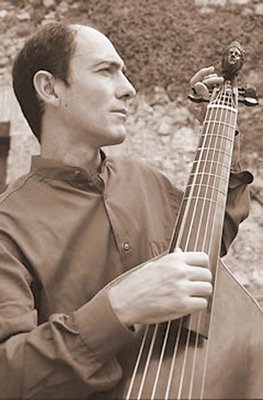
Paolo Pandolfo, viola da gambaThe strings and bow of Pandolfo's viola da gamba allow for much greater possibilities than the cello at the soft end of the dynamic spectrum. Pandolfo uses this advantage to create contrast on repeats, which he usually takes (as in the very soft Gigue of the first suite, repeated in a louder and filled-out version). One of the most effective contrasts is in the sarabande of the fourth suite, where the first statement of both sections is in the most charming pizzicato (not marked in the score, of course, but I don't care). Another good example where the softness is an advantage is in the difficult allemande of the sixth suite, a page clouded with 32nd notes, rendered so lightly and effortlessly by Pandolfo, as is the similarly difficult gigue.

Pandolfo calls his versions "adaptations," and he has changed quite a few parts of the score, often actually adding rather than taking away. Single notes often become thirds, and he tends to add chords where Bach could only imply them on the cello (lots of examples in the allemande of the third suite). It all sounds like it comes from the score. This is a highly ornamented performance, too, which is something I miss in all those repeats on many recordings. Years of playing Baroque music lead Pandolfo, quite appropriately, to double dot the French ouverture of the fifth suite prelude and to modify to notes inégales in that suite's courante. The only part of this recording that I could do without is the lengthy extra booklet that contains a text by Pandolfo, Un Libro Antico, an "imaginary dialogue between a violincello and a viola da gamba." The idea is interesting and has plenty of Baroque antecedents, but it is ultimately unnecessary.

The sixth suite is the one that causes real problems, and some of the very high notes, especially in the prelude, are difficult to realize (it was written for a violoncello piccolo). However, in that same prelude, Pandolfo is able to realize the big chords toward the end, which are written as eighth notes, as whispers. His is one of the few performances I know where those chords are actually rendered as eighth notes. I can attest from hearing Pandolfo live -- at Dumbarton Oaks, where I was so close that I could have reached out and pulled the instrument from his hands -- that this is a soft instrument. It would never carry in a room like the Kennedy Center Concert Hall, where Yo-Yo Ma recently played three of the Bach suites. So, the mikes are placed close to Pandolfo, and we hear a lot of noise from the fingerboard and the player's sighs and breathing sounds. For that reason, the sound may not please everyone. For any listener obsessed with the Bach cello suites, however, these discs are worth hearing.

available at Amazon
J. S. Bach, The Six Cello Suites, Bruno Cocset (released on October 13, 2003)
Bach composed the sixth suite for an instrument that is definitely not like the modern cello, an instrument with five strings, as indicated by the open-string annotation that precedes the score in the manuscript. What Bach had in mind was probably the violoncello piccolo, a small version of the cello that had a fifth, high melodic string. In listening to many performances of the suites, I have often thought that it would certainly be better to hear the sixth suite on the instrument Bach wanted rather than forcing it to work on the modern cello. French cellist Bruno Cocset, a former student of Christophe Coin, took this impulse to an extravagant degree, performing the six suites on four different instruments. He worked with luthier Charles Riché, advising him on choices of instruments on which modern reconstructions could be based, matching the sounds and set-up of each instrument to the demands of particular suites. The recording is apparently no longer available in the United States, but it can be acquired directly from Europe.

The main problem with this recording is the sound, because the microphones were close enough to bring us every breath -- fortunately, Cocset does not sing along with himself, but he is a heavy sigher -- and the often distracting clack of Cocset's fingers on the fingerboard. If that sort of auditory intimacy with the performer bothers you, then you will not enjoy this disc. However, the performance captured here is like no other and has an immediacy to it that I find appealing.

Bruno Cocset, cellist, image by CríticoThe other detail, albeit a minor one, that I like about this recording is that the suites are presented in numerical order, which is not always the case in complete recordings. With all that we know about the encyclopedic nature of Bach's collections, the order of pieces in the manuscript must be important (if for nothing else to preserve the ordering of the special dance pieces mentioned above). When listening to the entire set, I think it is better to hear them in the manuscript order or risk losing some of the artifice Bach intended.

For the first and fifth suites, Cocset plays Charles Riché's 2000 copy of a cello built by Gasparo da Salo around the year 1600. Cocset chooses some of the fastest tempi I have heard and does so in a rhythmically vital way, which is exciting to hear. His attack, therefore, is often brusque -- no quasi-Romantic lines here -- and some of the notes come across more as tight-lipped growls than anything else. His ornamentation is fairly limited -- in general, Cocset is very faithful to the score -- but there are some nice changes on the repeats. This instrument makes a lovelier sound on the extensive prelude of the fifth suite, especially in the opening slow section. He has a nice touch on the fifth suite's sarabande, too, one of the most enigmatic dances in the whole set, although the uniform tone is a little gloomy. The gavottes pulse with earthy excitement.

For the second and fourth suites, Riché modeled his 2001 copy on an instrument much closer to the time of the suites' composition, a Pietro Guarneri made in 1734. It has a rich sound, although the big chords of the second suite's prelude and other pieces sound weak played broken up as they are. As with most performances on the cello, the low notes often cannot be held for their full duration: the score often indicates that Bach wanted them to continue to sound longer than a single note of the upper melody. In this suite, Cocset's very rapid tempo in the courante betrays him in terms of accuracy on the A string, and some of the highest notes are off the mark. Most of the sarabandes on this recording are dreary because of the slow tempi, and this one is no exception. The menuets are also not pleasing because the rhythmic flow is slightly off-kilter. In the fourth suite, I do like the beautifully sensitive sarabande, including the nice ornamentation on the repeats, and the agile bourrées.

In the third suite, the instrument is Riché's 1996 copy of an Antonio Stradivari cello made in 1700, which has a lighter sound. The prelude twirls by at quite a clip, especially the long G pedal, which has an ultrarhythmic impetus to it, as do the allemande and charming bourrées. The musette effect in the gigue, also at a rather fast tempo, is unlike any I have heard elsewhere, a little rough and ready and definitely folkish. Certainly, for the sixth suite, in many ways the piece finally makes musical sense, when all those very high melodies can not only be played exactly as Bach wrote them down but also sound full-throated on the tension of that high string not found on the modern cello. The violoncello piccolo Cocset plays is a copy of an instrument built around 1600 by Antonio and Girolamo Amati, and it has the most beautiful sound on these discs.

Having heard many fine cellists sound strangled on the high stretches of the sixth suite, this performance is revelatory. The melancholy sarabande is more stunning than any other performance I have heard, because that high melody is no longer so precarious. The challenging gigue seems to roll off the page more easily, because the nature of the instrument corresponds better to what the composer put on the page. The recording is worth hearing for the sixth suite alone.

30.7.05

Le Zapping

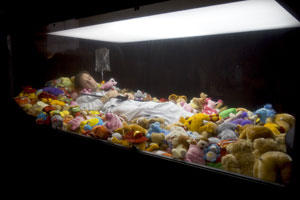
Jean Lambert-Wild, My Story is not a Loft, July 2005, photograph by Christophe Raynaud de LageI wrote a little post (New Piece by Jean Lambert-Wild, July 20) on the performances of Jean Lambert-Wild at the Avignon Festival. Apparently, I misunderstood exactly what Lambert-Wild had planned for his final performance there, where he is enclosed in a sarcophagus watching television. The piece is called My Story is not a Loft, a reference to the terrible French reality TV show called Loft Story. Lambert-Wild is enclosed in a sarcophagus for 48 hours, he is fed intravenously, and he does watch a television, and only the visitors can change the channel. However, if you pay 1 euro to change the channel and do so, you will also be administering a small electric shock to the artist through electrodes attached to his skin, as I learned in a review (Lambert-wild s'inflige le supplice du zapping, July 26) by Bruno Masi for Libération (my translation):

It is 9 pm on Sunday, and the director Jean Lambert-Wild is readying himself to go into his bottle, a glass sarcophagus three meters long. He will live inside it for 48 hours, while being fed intravenously. The mattress is covered with stuffed animals of all colors. Above he bid, there is a television. In front of the sarcophagues, there is a large red button: the visitor slides a euro coin into the slot and pushes the buzzer to change the channel. For one or two minutes, he can choose whatever program he likes. Each use of the remote control generates an electric charge that runs through the guinea pig's body. [...]

Seated on the edge of the fountain in the Saint-Louis cloister, Jean Lambert-Wild stares at the many photographers who have come to immortalize his submersion. Silent, he glues electrodes to his neck and stomach. Someone brings him a glass of water, and then he goes to his bed. Once the glass is sealed, the game can begin. As a sort of introduction to the project, Jean Lambert-Wild has written these sentences: "The media are not a medium for any life. Our television screens are the mirrors of a starved city that nourishes its children on the dejection of their parents. Thus are we drawn into an endless life of humiliation, where we haggardly never turn off our televisions, for fear of disappearing."
For some reason, he is also carrying a military rifle. I am surprised that anyone has had the guts to do this, but apparently they have. According to this article, people do change the channels, even though the shocks cause Lambert-Wild to writhe and grimace. Yikes.

29.6.03

Ionarts CD Reviews


Gluck, Le Feste d'Apollo (Aristeo / Bauci e Filemone), Les Talens Lyriques, Christophe Rousset (November 18, 2006)
Dip Your Ears, No. 71: M.-R. de Lalande, Les Folies de Cardenio, Ensemble Baroque de Limoges, Christophe Coin (November 18, 2006)
Mozart, Violin Concertos 1/2/5, Julia Fischer, Netherlands Chamber Orchestra, Yakov Kreizberg (November 16, 2006)
Penderecki, Symphony No. 7: Seven Gates of Jerusalem, Warsaw National Philharmonic Choir and Orchestra, Antoni Wit (November 12, 2006)
Vivaldi, Griselda, Marie-Nicole Lemieux, Verónica Cangemi, Simone Kermes, Ensemble Matheus, Jean-Christophe Spinosi (November 11, 2006)
Thomas Quasthoff, Consider, My Soul, Staatskapelle Dresden, Sebastian Weigle (November 9, 2006)
Beethoven, Piano Concertos 2/3, Martha Argerich, Mahler Chamber Orchestra, Claudio Abbado (November 9, 2006)
Mozart, Fantasias and Rondos, Richard Egarr, fortepiano (November 3, 2006)
Hélène Grimaud, Reflection, Truls Mørk, Anne Sofie von Otter (November 2, 2006)
Osvaldo Golijov, Ainadamar, Dawn Upshaw, Atlanta Symphony, Robert Spano (October 30, 2006)
Dave Brubeck, Nocturnes, John Salmon (October 29, 2006)
Sting, Songs from the Labyrinth, Edin Karamazov (October 23, 2006)
Domenico Scarlatti, Sonatas, Kenneth Weiss, harpsichord (October 18, 2006)
Antonio Vivaldi et al., Bajazet, Ildebrando d'Arcangelo, David Daniels, Patrizia Ciofi, Europa Galante, Fabio Biondi (October 7, 2006)
Steve Reich, Different Trains and other works, Orchestre National de Lyon, David Robertson (October 3, 2006)
Violin Sonatas by Franck and Debussy, Schumann Fantasiestücke, Dora Schwarzberg and Martha Argerich (September 30, 2006)
Vicente Martín y Soler, La Capricciosa Corretta, Les Talens Lyriques, Christophe Rousset (September 28, 2006)
Intégrale des pièces de clavecin, Michel Kiener, harpsichord (September 24, 2006)
Rameau: Les Cyclopes - Pièces de Clavecin, Trevor Pinnock, harpsichord (September 24, 2006)
Alexandre Tharaud joue Rameau (September 24, 2006)
A Basket of Wild Strawberries, keyboard works by Rameau, Tzimon Barto (September 24, 2006)
Portrait of the Artist: Enchantment, Magdalena Kožená and various artists (September 17, 2006)
G. Onslow, Nonet/Quintet and other cpo releases (September 14, 2006)
Heroes and Heroines: Handel, Sarah Connolly, Symphony of Harmony and Invention, Harry Christophers (September 12, 2006)
Kaija Saariaho, Cello Works, Alexis Descharmes (September 10, 2006)
Wolf Lieder, Ian Bostridge, Antonio Pappano (September 9, 2006)
Natalie Dessay, Delirio, Handel Italian Cantatas (September 5, 2006)
Vivaldi, Concertos for the Emperor, Andrew Manze, English Concert (September 1, 2006)
Italian Violin Sonatas, Fabio Biondi, Europa Galante (September 1, 2006)
Monteverdi, Combattimento di Tancredi e Clorinda, Les Arts Florissants, William Christie (August 31, 2006)
Monteverdi, Sixth Book of Madrigals, Concerto Italiano, Rinaldo Alessandrini (August 31, 2006)
Monteverdi, Fifth Book of Madrigals, Delitiæ Musicæ, Marco Longhini (August 31, 2006)
Dip Your Ears, No. 70: Chopin, Waltzes, Alexandre Tharaud (August 25, 2006)
Nuove Musiche, Rolf Lislevand (August 24, 2006)
Glory of Byzantium, Melodi Choir (August 23, 2006)
Dip Your Ears, No. 69: Telemann, Komm Geist des Herrn, L. Rémy (August 21, 2006)
Gautier and Renaud Capuçon, Face à Face (August 19, 2006)
Palestrina, Canticum Canticorum, Capella Dvcale Venetia (August 17, 2006)
Vivaldi, Sacred Music, Dresdner Instrumental-Concert (August 13, 2006)
Vivaldi, Concerti di Archi, Venice Baroque Orchestra (August 13, 2006)
Vivaldi, Violin Concerti, Giuliano Carmignola (August 13, 2006)
Roberto Alagna, Berlioz Arias and others (August 8, 2006)
Vivaldi, Motezuma, Il Complesso Barocco (August 2, 2006)
Mozart, Magic Flute, Mahler Chamber Orchestra, C. Abbado (August 1, 2006)
Dip Your Ears, No. 67: Alexander Zemlinsky, Die Seejungfrau, Danish NSO (July 31, 2006)
Gustav Mahler, Symphony No. 8, Boston Symphony Orchestra, Seiji Ozawa (July 26, 2006)
Giacinto Scelsi, Natura Renovatur and other works, Frances-Marie Uitti, cello, Münchener Kammerorchester, Christoph Poppen (July 20, 2006)
Giacinto Scelsi, Suite No. 10 (Ka) and No. 9 (Ttai), Markus Hinterhäuser, piano (July 20, 2006)
Dip Your Ears, No. 66: J. Brahms / C. Saint-Saëns, Sonata for Two Pianos et al., G. and S. Pekinel (July 19, 2006)
C. Loewe, Passion Oratorio, and other recent releases from Naxos (July 18, 2006)
Dip Your Ears, No. 65: G. P. Telemann, Suites & Concerto for recorder and orchestra, Akamus / Maurice Steger (July 6, 2006)
Dip Your Ears, No. 64: J. Haydn, Symphonies Nos. 44, 95, 98, Ferenc Fricsay, RIAS SO Berlin (June 30, 2006)
P. Glass, Symphony No. 8, D. R. Davies / Bruckner Orchestra Linz (June 24, 2006)
G. Mahler, Symphony No. 2, WPh / P. Boulez / Schäfer, DeYoung (June 22, 2006)
Various works, Atlanta Symphony Orchestra Chamber Chorus, Norman Mackenzie (June 19, 2006)
Various works, Atlanta Symphony Orchestra and Chorus, Hila Plitmann, Nancy Maultsby, Robert Spano (June 19, 2006)
Dip Your Ears, No. 63: J. Brahms, R. Schumann, Violin Concerto, Fantasy for Violin and Orchestra, Mutter / Masur / NYPhil (June 19, 2006)
A. Dorman, Piano Sonatas, and other new releases from Naxos (June 17, 2006)
Don Quijote de La Mancha: Romances y Musicas, Montserrat Figueras, Hespèrion XXI, La Capella Reial de Catalunya, Jordi Savall (Part 1 of several parts) (June 17, 2006)
Dip Your Ears, No. 62: G. Mahler, Symphony No. 4, BPh / Abbado / Fleming (June 16, 2006)
Essential Recordings of György Ligeti (June 15, 2006)
Benjamin Britten, String Quartets No. 1-3, Three Divertimenti, Belcea Quartet (June 13, 2006)
Dip Your Ears, No. 61: L. van Beethoven, Piano Sonatas 16-18, Mari Kodama (June 10, 2006) [Ionarts Review No. 150]
J. S. Bach, The Six Cello Suites, Paolo Pandolfo, viola da gamba (June 1, 2006)
J. S. Bach, The Six Cello Suites, Bruno Cocset (June 1, 2006)
Karol Szymanowski, Concerto No. 1 for Violin and Orchestra (op. 35), Nicola Benedetti, London Symphony Orchestra, Daniel Harding (May 27, 2006)
R. Wagner, Parsifal, Thielemann / Meier, Selig, Domingo, Struckmann, Anger, Bankl (May 25, 2006)
Dip Your Ears, No. 60: A. Bruckner, Symphony No. 4, P. Herreweghe / Orchestre des Champs-Elysées (May 21, 2006)
J. S. Bach, English Suites (BWV 806-811), Angela Hewitt, piano (May 16, 2006)
Franz Schubert, Piano Sonata (D major, D. 850) and Lieder (poems by Schulze and Schlegel), Leif Ove Andsnes, Ian Bostridge (May 13, 2006)
Juan Diego Flórez, Sentimiento Latino, Fort Worth Symphony Orchestra, Miguel Harth-Bedoya (May 11, 2006)
Lang Lang, Memory (Mozart, Chopin, Schumann, Liszt) (May 10, 2006)
Dip Your Ears, No. 59: Canciones Argentinas, Bernarda and Marcos Fink, Carmen Piazzini (May 7, 2006)
Dip Your Ears, No. 58: J. S. Bach, Concertos Italiens, Alexandre Tharaud [second review] (May 7, 2006)
One Hundred Roses (works by various composers), Paula Robison, Charleston Symphony Orchestra, David Stahl (May 6, 2006)
Dip Your Ears, No. 57: J. Sibelius, Symphonies, Violin Cto., Tone Poems, Ashkenazy/LPO/Belkin (May 5, 2006)
J. S. Bach, Goldberg Variations, Richard Egarr and several other recordings (April 25, 2006)
Dip Your Ears, No. 56: Alexander Zemlinsky, Various Recordings (April 25, 2006)
Violetta: Arias and Duets from Verdi's La Traviata, Anna Netrebko, Rolando Villazón, Thomas Hampson, Vienna Philharmonic, Carlo Rizzi (April 14, 2006)
D. Shostakovich, Symphonies 2 and 12, Bavarian Radio Symphony, M. Jansons (April 5, 2006)
J. S. Bach, Solo Cello Suites, Yo-Yo Ma / Matt Haimovitz (April 4, 2006)
Kaija Saariaho, L'aile du songe and other works, Camilla Hoitenga, Finnish Radio Symphony Orchestra, Jukka-Pekka Saraste (March 30, 2006)
Dip Your Ears, No. 55: W. A. Mozart, Piano Sonatas, K. 330, 331, 332, 457, Mikhail Pletnev (March 2, 2006)
F. Schubert, Music for Piano, Four Hands, Evgeny Kissin and James Levine, live concert at Carnegie Hall (March 2, 2006)
Dip Your Ears, No. 54: F. Schubert, Octet, Mullova Ensemble (February 17, 2006)
Dip Your Ears, No. 53: J. Haydn, Scottish Songs, v. 1, Anderson, MacDougall, Haydn Trio Eisenstadt (February 12, 2006)
Stravinsky, Orchestral Works, Stuttgarter Kammerorchester, Dennis Russell Davies (February 11, 2006)
F. Schubert, An den Mond, Dietrich Henschel / H. Wolf, Mörike Lieder, Werner Güra (February 9, 2006)
Osvaldo Golijov, Ayre / Kronos Quartet, You've Stolen My Heart (February 7, 2006) [Ionarts Review No. 125]
Alfred Brendel, Artist's Choice: Haydn and Mozart (February 6, 2006)
W. A. Mozart, Piano Sonatas, K. 281, 282, 576, and Fantasia in C minor, K. 396, Alfred Brendel (February 6, 2006)
Scriabin, Symphonies, Poème de l’Extase, Prométhée, Ricardo Muti, Philadelphia Orchestra (February 4, 2006)
William Bolcom, Songs of Innocence and of Experience, University of Michigan School of Music and associated musicians (February 2, 2006)
Viktoria Mullova, Five Vivaldi Violin Concerti, Il Giardino Armonico (January 30, 2006)
Handel, Radamisto, Il Complesso Barocco, Alan Curtis (January 28, 2005)
Sandrine Piau, Haendel Opera Seria, Les Talens Lyriques, Christophe Rousset (January 26, 2006)
Dip Your Ears, No. 50: Beethoven, Violin Concerto, Romances, Zehetmair / Brüggen (January 25, 2006)
Lorraine Hunt Lieberson, Handel Arias, Orchestra of the Age of Enlightenment (January 20, 2006)
Ives, Concord Sonata, Pierre-Laurent Aimard (also the version by Marc-André Hamelin) (January 16, 2006)
Hilliard Ensemble, Gombert, Missa Media Vita in Morte Sumus (January 15, 2006)
Birgit Nilsson on Disc (January 15, 2006)
Verdi, Missa Da Requiem, Nikolaus Harnoncourt (January 14, 2006)
Shostakovich, Eighth Symphony, Netherlands RPO, Mark Wigglesworth (January 12, 2006)
András Schiff, Early Beethoven Sonatas (January 9, 2006)
Anne Sophie Mutter, Mozart Violin Concerti (December 31, 2005)
Cédric Tiberghien, Bach Keyboard Partitas (December 29, 2005)

Best of 2005: Addendum (December 24, 2005)

The Best Recordings of 2005 (December 21, 2005)
Mahler, Seventh Symphony, SFSO, M. T. Thomas (December 19, 2005)
Trio Mediæval, Stella Maris (December 13, 2005)
Don Quijote de la Mancha: Romances y Musicas, Jordi Savall (December 8, 2005)
Osvaldo Golijov, Ayre, and Luciano Berio, Folk Songs, Dawn Upshaw (December 6, 2005)
Enescu, Octet and Piano Quartet, Kremerata Baltica (December 3, 2005)
Mahler, Sixth Symphony, Budapest FO, Iván Fischer (November 28, 2005)
Dip Your Ears, No. 49: Rachmaninov, Preludes, Boris Berezovsky (November 25, 2005) [Ionarts Review No. 100]
Bruckner's Third Symphony, transcribed for two pianos by Mahler (November 23, 2005)
Andreas Scholl, Arias for Senesino (November 21, 2005)
Mitsuko Uchida on Record (November 18, 2005)
Gidon Kremer, Bach Violin Sonatas and Partitas (November 17, 2005)
Bach, Alles mit Gott und nichts ohn' ihn, John Eliot Gardiner (November 16, 2005)
Bach, Klavierbüchlein für Wilhelm Friedemann, Christophe Rousset (November 2, 2005)
Dip Your Ears, No. 48: Beethoven, Mendelssohn, Violin Concerti, N. Znaider (October 21, 2005)
Strauss, Daphne, Renée Fleming (October 19, 2005)
Universal Releases, Fall 2005 (October 19, 2005)
Topping the Rostrum: Recordings by Iván Fischer (October 6, 2005)
Cecilia Bartoli, Opera Proibita (October 6, 2005)
Dip Your Ears, No. 47: Bach Family et al., Lamento, MAK, Goebel, Kožená (September 27, 2005)
Dip Your Ears, No. 46: Mozart, Symphonies nos. 35 "Haffner" & 36 "Linz," Prague Philharmonic, J. Bélohlávek (September 25, 2005)
Dip Your Ears, No. 45: C. Franck, In Spiritum, O. Latry (September 22, 2005)
Renée Fleming, Sacred Songs (September 19, 2005)
Centennial Ring, Chéreau / Boulez (September 2-21, 2005)
Dip Your Ears, No. 44: Shostakovich, Stravinksy, Scriabin, Prokofiev, Messe Noire, A. Lubimov (September 12, 2005)
Dip Your Ears, No. 43: Schnittke, Bach, Webern, Faust Cantata, Ricerar et al., Boryeko, Hamburger Symphoniker (September 4, 2005)
Dip Your Ears, No. 42: J. Strauss II, Waltz Transcriptions, Berliner Streichquartet et al. (September 1, 2005)
Dip Your Ears, No. 41: Alexandre Tharaud, Bach's Italian Concerto (August 7, 2005)
New York Soundtrack (August 5, 2005)
Dip Your Ears, No. 40: Bach Cantatas, John Eliot Gardiner (August 2, 2005)
Dip Your Ears, No. 39: Bach, Keyboard Concerti, vol. 2, Angela Hewitt (July 31, 2005)
Beethoven's Ninth Symphony (July 29, 2005)
Amieta Sole, Rostropovich (July 28, 2005) [Ionarts Review No. 75]
Shostakovich 8th with Rostropovich on LSO live (July 27, 2005)
Recordings by Marin Alsop (July 26, 2005)
Mahler's Sixth Symphony (July 21, 2005)
An die ferne Geliebte, Schwanengesang, Matthias Goerne, Alfred Brendel (July 18, 2005)
Budget Picks No. 3: Violin Concerti, Nathan Milstein (July 16, 2005)
Operas on Archiv (July 12, 2005)
Budget Picks No. 2: Beethoven, Violin Sonatas, M. Vengerov (July 10, 2005)
Live Recordings of Mahler's Eighth (July 8, 2005)
Dip Your Ears, No. 37: Richard Strauss, Rosenkavalier Waltzes, Capriccio Sextet (July 7, 2005)
Budget Picks, No. 1: J. S. Bach, Goldberg Variations, A. Schiff (July 6, 2005)
Dip Your Ears, No. 36: Klassizistische Moderne, Christopher Hogwood (July 2, 2005)
Twang, Twang, Twang: Scarlatti with Alain Planès (June 30, 2005)
Horsing around with Wagner (June 27, 2005)
Dip Your Ears, No. 35: Bach Cantatas, John Eliot Gardiner (June 25, 2005)
Dip Your Ears, No. 34: Telemann, Flute Quartets, Musica Antiqua Köln (June 20, 2005)
Dip Your Ears, No. 33: L. van Beethoven, Die Geschöpfe des Prometheus, C. Mackerras (June 9, 2005)
Dip Your Ears, No. 32: F. Chopin, Sonata No. 2, Barcarolle op. 60, Études op. 10, Nelson Freire (June 6, 2005)
Dip Your Ears, No. 31: A. Dvořák, Symphony No. 6, LSO / Sir C. Davis (June 3, 2005)
Dip Your Ears, No. 30: F. Mendelssohn, String Quartets, Vol. 3, Eroica Quartet (May 31, 2005)
A. Vivaldi, Le Quattro Stagioni, Concerto Italiano, R. Alessandrini (May 28, 2005)
Michael Tilson Thomas, Mahler's Ninth Symphony (May 7, 2005)
A. Bruckner, Symphony No. 5, Thielemann / MuPhil (April 24, 2005)
D. Shostakovich, Symphony No. 4, M. Jansons / Bavarian Radio Symphony Orchestra (April 21, 2005)
DG Originals: A Review (March 29, 2005)
Hélène Grimaud, Chopin / Rachmaninov (March 27, 2005) [Ionarts Review No. 50]
F. Schubert, Piano Works for Four Hands, M. J. Pires and R. Castro (March 24, 2005)
Dip Your Ears, No. 29: Igor Stravinsky, Le Sacre du Printemps, Fazil Say (February 16, 2005)
Dip Your Ears, No. 28: Bach / Stravinsky, Leonidas Kavakos and Péter Nagy (February 13, 2005)
Dip Your Ears, No. 27: E. Grieg, Violin Sonatas no. 1–3, Henning Kraggerud and Helge Kjekshus (February 12, 2005)
Dip Your Ears, No. 26: D. Scarlatti, Keyboard Sonatas, M. Pletnev (February 8, 2005)
Dip Your Ears, No. 25: J. S. Bach, Suites for Unaccompanied Cello, Pierre Fournier (January 30, 2005)