CD Reviews | CTD (Briefly Noted) | JFL (Dip Your Ears) | DVD Reviews
Showing posts with label Mieczysław Weinberg. Show all posts

12.3.19

On ClassicsToday: The Finest Modern Recording of the Mieczysław Weinberg Piano Quintet?

The Stamic Quartet’s Great Weinberg & Bloch Combo

by Jens F. Laurson
WEINBERG_BLOCH_Piano-Quintets_Stamic_AnimalRecords_jens-f-laurson_classical-critic
For it being one of the absolutely great chamber works of the 20th century, there aren’t actually that many good recordings of the Mieczysław Weinberg Piano Quintet. I have yet to listen to the Attacca Quartet’s and the Silesian String Quartet’s most recent releases, but... Continue Reading

6.12.15

Best Recordings of 2015 (#10)


Time for a review of classical CDs that were outstanding in 2014 . My lists for the previous years: 2014, 2013, 2012, 2011, (2011 – “Almost”), 2010, (2010 – “Almost”), 2009, (2009 – “Almost”), 2008, (2008 - "Almost") 2007, 2006, 2005, 2004.


# 10 - New Release


Wartime Consolations, Linus Roth (violin), José Gallardo (piano), Ruben Gazarian, Württemberg CO Heilbronn, Challenge SACD


available at Amazon
K.A.Hartmann, M.Weinberg, D.Shostakovich
Concerto funebre, Moldavian Rhapsody, Concertino, Unfinished Violin Sonata
Ruben Gazarian / Württemberg CO Heilbronn
L.Roth, J.Gallardo (piano)
(Challenge SACD)

Linus Roth has fared well with Mieczysław Weinberg. After a notable recording of the Violin Sonatas his recording of the Violin Concerto (coupled with Britten’s) was a hit that received glowing reviews from dozens of magazines, including an always coveted “Gramophone Magazine Editor’s Choice”. He’s done it again, as far as quality of performance and quality of incoming reviews are concerned. This time he has coupled the Karl Amadeus Hartmann concerto (a dark, war-anticipating masterpiece among 20th century concertos) with two relatively lighter works by Weinberg, the Rhapsody on Moldavian Themes op.47 and the Concertino for Violin and Strings which displays lyrical sweep (subtly guarded by a wistful air against any joyous excess) and tender gracefulness. The purely orchestral Rhapsody was such a success that Weinberg also set it for violin and piano (included on Roth’s recording of the Sonatas) and for violin orchestra. That version (presumed to exist) is lost, so Roth performs Ewelina Nowicka’s re-arrangement from the chamber version. The “Moldavian” themes of this Rhapsody are of course decidedly Jewish themes from Moldavia… but Weinberg knew better than to advertise that openly, after the still recent attacks on his “cosmopolitanism” and imprisonment and state-murders of Jews around the USSR, including that of his father-in-law’s.

The disc is again a Gramophone Magazine Editor’s Choice (“an eminently collectable disc”) that arts editors took turns lauding as “a strikingly rewarding programme” (The Telegraph) and commending Roth for unearthing the “fascinating find” (The Observer) of the unfinished first movement of a Shostakovich Violin-Sonata-to-be. (Of which this is the world premiere recording.) I would pipe up to suggest that the Württemberg Chamber Orchestra Heilbronn plays nearly as well as the DSO Berlin did on the last disc, or that the soloist finds just the right balance between dark and light, sorrow and twisted joy. But I must recuse myself, having written the liner notes for this release. 


# 10 – Reissue


D.Shostakovich, A.Glazunov, Violin Concertos, Itzhak Perlman (violin), Z.Mehta, Israel PO, Warner

22.9.15

Ionarts-at-Large: Involuntary Exclusivity At Mozart’s Home


Violist Julia Rebekka Adler and pianist Axel Gremmelspacher presented a program—and their latest CD—in the sub-basement of the Mozart House in Vienna, just in the shadow of St. Stephen’s Cathedral. The program and disc are titled “Viola in Exile”, concocted of composers, threatened, prosecuted, and eventually forgotten, that they all huddled at the very back of the alphabet: Leo Weiner, Karl Weigl, Mieczysław Weinberg, and Erich Zeisl.


available at Amazon
K.Weigl, E.Zeisl, H.Gál Viola Sonatas,
J.R.Adler / A.Gremmelspacher
Gramola


available at Amazon
M.Weinberg, Complete Sonatas for Solo Viola,
J.R.Adler / J.Nemtsov
Neos


available at Amazon
M.Weinberg, Complete Works for Violin & Piano,
L.Roth / J.Gallardo
Challenge

I’ve followed the projects of Mme. Adler (assistant principal viola of the Munich Philharmonic, in her day job) with keen interest ever since writing a feature interview about her and her Weinberg solo viola project for the pages of Fanfare, some years ago. As part of that project, she had found and arranged Weinberg’s Sonata for Clarinet and Piano for the viola, one of the catchiest piece of this often thorny composer and the opening work of this evening’s proceedings.

Viola in Exile

It was an unusual concert in that it took place before an audience of seven or—deducting the record producer, his wife, the music critic, friends of the performers and the page turner—zero: Empty chairs to the right of them, empty chairs to the left of them, empty chairs in front of them, was there a man dismay’d? Not tho’ the artists knew… someone had blunder’d.

Weinberg, so injected very directly into the ear as in the intimate acoustic of the little Bösendorfer Saal (it used to be Mozart’s wine cellar, almost guaranteeing that the vibes are good!), is always an ear-opening, not to say ear-splitting experience. A fragile-looking pale and ginger wisp of a woman, Julia Rebekka Adler’s sound is—for all the dance it contains—like a giant redwood falling on your roof: Big, and anything in its way better watch out. It’s just the thing for Weinberg who must be able to disturb as much as he must occasionally smile.

Karl Weigl’s Viola Sonata has more Shostakovich in its first movement than all of Weinberg (who is routinely, if lazily, accused of being a pocket-size Shostakovich, due to his close friendship and collaboration with the iconic Soviet composer). Smokey, throaty beauty with edges, it was given a terrific and intense performance here and in the folk-music embracing second movement and the lyrical third movement, and thanks to it, was able to convince as music as I hadn’t known it could. It is also included on the two artists’ recording (and I have to re-listen), but my ears were opened to the very considerable quality and beauty of the work only on this occasion.

Also included on the CD and present on the program was Eric Zeisl’s Violin Sonata. Eric Zeisl, like Weigl and Weinberg, is a 20th century composer who has a chapter dedicated in the upcoming second edition of Robert Reilly’s “Surprised by Beauty (A Listener’s Guide to the Recovery of 20th and 21st Century Music)”. He’s one of those fascinating neglected minor-yet-wonderful composers I love to write about (I contributed that particular chapter to Reilly’s book). Insiders know that his daughter married Arnold Schoenberg’s son, and that they two men were close, but that is about the closest Zeisl’s music gets to Schoenberg’s in a sentence. Zeisl’s music is post-romantic, sometimes naïve, and perfectly Austrian (though after 1940 increasingly imbued with Hebrew overtones, as he watched the horrors from California, having escaped Hitler-Europe himself). It lacks all pretensions and this viola sonata is one of the more astounding, powerful and tensely melodious pieces of 20th century chamber music. A jewel, not only within the viola repertoire, and haunting with its shivering slow movement that never fails to get under my skin or that insistent, forceful and exotic edge of the modal third movement. Leo Weiner’ Csárdás Peregi Verbunk, which was wedged into the program, is a uplifting mix between a variation-movement viola sonata and a send-up of Brahms’s Hungarian dances. A little soufflé to lighten the mood.

If a concert takes place and there is no audience to hear it, does it make a sound? Most certainly, as it turns out. And what a sound, indeed. It was a performance to end all viola jokes (if that were possible) and caused such a surprising amount of clapping noise from the 14 enthused hands, that the performers indulged the 14 attached ears in an encore of Paul Ben Haim’s Sepphardic Melody.


MORE MIECZYSŁAW WEINBERG ON IONARTS.

20.1.15

Trifonov and Kremer in Charm City

available at Amazon
M. Weinberg, Symphony No. 10 (inter alia), Kremerata Baltica, G. Kremer
(ECM New Series, 2014)
While Daniil Trifonov has dazzled in solo recital, the Russian pianist's appearances with orchestras, most recently with the NSO, showed the same daring but not always a natural aptitude in ensemble situations. This did not augur well for Trifonov's local debut as a chamber musician, at Shriver Hall on Sunday night, doubts that were borne out in an otherwise intriguing selection of music performed with violinist Gidon Kremer and cellist Giedrė Dirvanauskaitė.

There were no questions about Trifonov's technical accomplishment, although what he did with the first piece, Mozart's slender D minor fantasia (K. 397), was not really about that. Faced with a lack of technical challenge, Trifonov pushed and pulled the music in every which direction, with enigmatic and slow arpeggiation followed by a poignant rendition of the tragic arioso, the contrasting sections shifting moods on a dime. Kremer, who was last in Baltimore ten years ago (but with the National Symphony Orchestra in 2011), did similar things with Mieczysław Weinberg's second solo violin sonata, op. 95. Each of the seven short movements received a different emphasis of tone: a deliberate, even clumsy straightness in Monody, frenetic sawing attacks in Interval, a gorgeous vibrato-heavy sound in Repliques, and a fragile deference in Accompaniment. Kremer hit his stride in the last two movements, producing that full-throated biting sound in the intense, even strident Invocation and giving a folk-flavored fiddle drive to the final movement, Syncopations.


Other Reviews:

Tim Smith, Gidon Kremer, Daniil Trifonov in brilliant form at Shriver Hall (Baltimore Sun, January 21)

Niels Swinkels, Kremer and Trifonov Deliver Rewards with Challenging Program (San Francisco Classical Voice, January 18)

Mark Swed, Gidon Kremer shares a performance of a lifetime (Los Angeles Times, January 15)
Schubert's C major fantasy, D. 934, is a bear of a piece, especially for the pianist, most recently heard from James Ehnes and Orion Weiss last year. Trifonov was astounding from a technical point of view, although ensemble challenges like balances and a shared rubato were not always in hand. He achieved some remarkable lightness of tone, although not everywhere he needed to do so, while Kremer floated on his arching lines in the first movement, although his high flautando sound was a little perilous at times. There was one moment in the second movement that sounded like a misalignment, although the duo quickly recovered from it, but the variations were sentimental in nature, without turning overly sappy.

The low point of the concert was Rachmaninoff's Trio élégiaque No. 2 (D minor, op. 9), a youthful work composed just after hearing the news of Tchaikovsky's death. The performance was appropriately steeped in gloom, with songful playing from Dirvanauskaitė, but the obsessive repetition of motivic cells in the melodic themes of the first movement, for example, made me wonder if the popularity of Rachmaninoff's music might not be due to the same qualities observed in successful pop songs. The theme at the heart of the middle variations movement is truly banal, and the qualities the composer harps on in each variation did not make things any better. The piece is centered almost exclusively on the keyboard pyrotechnics, and at this Trifonov excelled. Two encores rewarded strong ovations: a Scherzo by Shostakovich (the second movement from the second piano trio, I think), and the second of Rodion Shchedrin's Three Funny Pieces, titled Let's Play an Opera by Rossini.

The fine season at Shriver Hall continues next month with a concert by the Jerusalem Quartet (February 15, 5:30 pm), playing music by Haydn, Schulhoff, and Schubert.

23.12.14

Best Recordings of 2014 (#9)


Time for a review of classical CDs that were outstanding in 2014 (published in whole on Forbes.com). My lists for the previous years: 2013, 2012, 2011, (2011 – “Almost”), 2010, (2010 – “Almost”), 2009, (2009 – “Almost”), 2008, (2008 - "Almost") 2007, 2006, 2005, 2004.


# 9 - New Release


Mieczysław Weinberg / Benjamin Britten, Violin Concertos, Linus Roth (violin), Mihkel Kütson (conductor), Deutsches Symphonie-Orchester Berlin, Challenge SACD 72627

available at Amazon
M.Weinberg / B.Britten, Violin Concertos
L.Roth / M.Kütson / DSO Berlin
(Challenge SACD)

Linus Roth’s concerto disc to follow up the complete Mieczysław Weinberg Violin Sonatas has critics raving. It became a Gramophone Magazine Editor’s Choice with David Fanning comparing Roth favorably to Lenoid Kogan and Maxim Vengerov, extolling the subtlety, range of color, imagination and summing it up: “In short: an outstanding disc.” In the Financial Times Andrew Clark hones in on the Britten, which he writes “has never sounded so soft, sensuous or soul-bearing—and [this disc] reveals its stature like no other.” Graham Rickson from the artsdesk.com fawns “if any performer can popularize the [Weinberg concerto] it has to be the phenomenal Linus Roth, whose unflagging energy makes this CD one of the best concerto discs in years… [The Britten is] helped by gloriously rich, dark-toned orchestral playing… Unmissable, and recorded in sensational sound too.” I would love to say much the same about the performances (only so much: the Deutsches Symphonie-Orchester Berlin (formerly RIAS) under Mihkel Kütson does play the hell out of both works!), but must recuse myself, having written the liner notes. Instead I limit myself to praising the composer, who has been experiencing one of the most deserving and enduring re-discoveries over the last 15 years.


# 9 – Reissue


Anton Bruckner, Symphony No.2 (1877 version), Carlo Maria Giulini (conductor), Vienna Symphony Orchestra, (Wiener Symphoniker)

7.1.14

Best Recordings of 2013 (#5)


High time for a review of classical CDs that were outstanding in 2013. My lists for the previous years: 2012, 2011, (2011 – “Almost”), 2010, (2010 – “Almost”), 2009, (2009 – “Almost”), 2008, (2008 - "Almost") 2007, 2006, 2005, 2004.

# 5 - New Release


Mieczysław Weinberg, Complete works for Violin and Piano, Linus Roth (violin), José Gallardo (piano), Challenge Classics 72567


available at Amazon
M.Weinberg,
Works for Violin & Piano
L.Roth / J.Gallardo
Challenge Classics

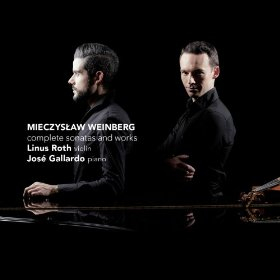
I make no pretensions of being partial about this set: I love Weinberg and I love the fact that the complete* works for violin and piano were recorded in one fell swoop, with the Sixth sonata discovered in the process (one of two world premieres on this set). The Strad writes: “Recorded in exemplary, perfectly balanced sound, Roth and Gallardo capture the sense of despair that underpins the composer’s later music with nerve-jangling precision, most hauntingly the Sixth Sonata… It is their exploration of the lower end of the dynamic spectrum that particularly grips the imagination here—at times Roth appears to be merely breathing on his 1703 ‘Dancla’ Stradivari as he fearlessly probes Weinberg’s harrowing cries of anguish. Not an easy listening experience by any means, but a profoundly moving one.”

By way of disclaimer (to be honest, not to be pretentious): I wrote the liner notes for the release. There’s an ongoing cycle on Toccata Classics with Yuri Kalnits and Michael Csányi-Wills that’s most excellent, too, and includes the works for solo violin (and may include the Two Songs Without Words, which was discovered shortly after the above set was finished), but it’s going to be a while in the making.

* The set was complete at the time of recording. The unpublished Two Songs Without Words for violin and piano from 1947, though known to exist, had not yet turned up. Now Weinberg expert David Fanning has found them, in a Moscow archive over Easter 2013.


# 5 – Reissue


Ludwig van Beethoven, The Very Nearly Complete String Quartets, Amadeus Quartet, Audite 21424

25.7.13

Mieczysław Weinberg’s Idiot
Awe-inspiring Masterpiece Unearthed in Mannheim

Click excerpts to see entire picture.
All pictures above and below courtesy Mannheim National Theater, © Hans Jörg Michel


A transfixing experience and the discovery of one of the major operas of the second half of the 20th century


Just a decade ago the name “Mieczysław Weinberg” drew a blank from music lovers. In record stores, which still existed then, you weren’t likely to find an index card with his name, or else five differently spelled ones, as every publisher seems to have had different ideas as to how his name should be written. On offer were: Vainberg, Vaynberg, Vajnberg, Wajnberg, and Weinberg for last names; Moishei, Moishe, Moissei, Moisey (Samuilovich), and Mieczysław for first names. Among the combined 25 possibilities only one is correct: the Polish “Mieczysław Weinberg” that the composer used and preferred. His friends called him Mietek.

Weinberg’s time hadn’t come then, but it is fast approaching now, almost 20 years after his death in 1996. At last count, there are at least sixty releases dedicated to his music available. His Symphonies and chamber music are well under way now, with a heartening number of releases and performances, but his six, seven, eight, nine operas (depending on how you count) are only now being rediscovered. The finally-famous Passenger (op.97, 1968) has shot to fame thanks to the production and subsequent DVD/Bluray from Bregenz which has since travelled successfully. (See Best of 2011, Interview with Michelle Breedt.) Now The Idiot, op.144, written in the mid-80s and premiered in a reduced chamber version in 1991, was at last given its first full performance in Mannheim on May 9th.

And what an opera it is! Even with my high expectations of Weinberg, who I first encountered thanks to Bob Reilly’s Surprised by Beauty (then still as “Vainberg”) and have sought out and tried, in whatever small ways, to champion since, this was astonishingly good—indeed great—music, well over three hours of it, and nary the temptation to nod off during any of it. Just as incredulous is the ingenious libretto, in which Alexander Medvedev (he already wrote the text for Weinberg’s Passenger) miraculously managed to tame Dostoyevsky’s sprawling Idiot and turn it into a cohesive story suited for the stage.


But since even equipped with the best music and a great story, inept hands can snatch missed opportunity from the jaws of triumph, it was upon the artists to make sure this would be an operatic experience of the absolutely first order. And indeed, on July 17th, with three performances already under their belt, every participant looked, sounded, played, and conducted, as if they had all waited their entire careers for this moment.

Thomas Sanderling (a Weinberg champion like his father Kurt) and the orchestra of the National Theater Mannheim sounded as though had they practiced all year long. The production by director Regula Gerber paid great attention to details, told the story economically and efficiently, conveyed all the emotions, and vividly portrayed all the characters. It was my first time at the Mannheim opera, but it sure seemed as though she made the very most of the house’s abilities and the undoubtedly limited budget. And then there was the matter of the cast of singers, an assembly of strengths and delights.

Co-First among equals in this cast were Dmitry Golovnin as Prince Myshkin—perfectly secure, strong, clear while convincingly performing all stages of innocence, reticence, and intimidation, and always at total ease with the demanding part and the text. And Myshkin’s dark alter ego Rogozhin, portrayed by Steven Scheschareg as intense and dark and lustrous and animalistic both in offense and retreat. Right with them were Lars Møller as the amended Lebedev and Ludmila Slepneva as the ravishing and ravished Nastassya Filippovna.

The relatively small rôle of the rogue Lebedev was fashioned into a (literally) intriguing composite character by librettist Medvedev. Regula Gerber took the cue and turned him fully into a devilishly delightful Mephistophelean presence who comments on, and manipulates, and drives the action—out of his own lowly, here pecuniary, there voyeuristic motives. A discarded red glove that he snatches greedily from Filippovna along the way is his only prop, and it went such a long way in visualizing perfectly his newfound rôle.


Both Lars Møller and the darkly, lusciously seductivex Ludmila Slepneva are Mannheim Opera ensemble-members which I found astounding at first. Being spoiled by performances in Munich, Salzburg, Vienna, Berlin, London, New York, and even Frankfurt or Paris, one is tempted to think of places like Mannheim as the opera boondocks. I might not have been surprised that the opera had such a strong cast to provide from its ensemble if I had recalled then and there the history of the house, and that its ensemble has included, at various times and early stages in their careers, singers like

22.7.13

Through Labor and Love: Weinberg, War and Persecution
Interview with Julia Rebekka Adler


[July 2010] An article about violist Julia Rebekka Adler could easily, rewardingly turn into an article on Mieczysław Weinberg instead. For one, it is Weinberg to whom she has pinned her hat, whose viola sonatas she has now torn from obscurity into the (narrowly focused) spot-light of well-regarded niche repertoire, and to whose music she very obviously responds. Further, she is genuinely diffident and prefers to talk just about anything but herself. And even her engaging husband and de-facto manager (an immunologist at the National Research Center for Environment and Health during daylight hours), who is supposed to make up for his wife’s self-effacing reluctance, feels so passionately about Weinberg’s music—and music in general—that he can’t praise her achievements at the exclusion of others’, or without getting side-tracked by his excitement for this or that composition or musical discovery. Thank goodness—because there is nothing more tedious than having to sit through the professionally deluded, tunnel-visioned ravings of a mother-manager, parent-publicist, or spousal spinmeister.

Happily I don’t even have to do the raving about her Weinberg CD—although I enjoy and admire it very much—because Jerry Dubins has already done that in his review for Fanfare. He also repeats, with hyperbolic enthusiasm, the basic information on Weinberg and the press-kit ready quotes (if she had one) about Mme. Adler, including very kind ones from Hartmut Rohde, her onetime teacher. She’s won lots of competitions, of course, and has studied with Kim Kashkashian and Yuri Bashmet. But what does that count for, if you are only a violist? She’s the assistant concert master of the Munich Philharmonic and that seals her reputation. Being an orchestra violist must necessarily—?—define the way audiences, critics, colleagues look at her and her playing. After all, back-benching in an orchestra, even if it is in the ‘assistant solo viola’ position, and not actually in the back, is the safe way out for those who don’t dare strive for more. For those who think good is good enough. For those who prefer the comfort of a 9-5 job (unfireable, at that) over the adventure that is music.

None of that is actually true in the case of Julia Rebekka Adler, but such convenient stereotypes—all of them exist for a reason—can only be overcome by better getting to know the person behind the symbolism of position, instrument, and career. Julia Mai, then still performing under her maiden name, was into competitions, and successfully. But eventually she saw herself faced with the choice between the alluring opportunity of the job at the Munich Philharmonic or taking out substantial loans to be able to afford to…

4.1.13

Best Recordings of 2012 (#1 - 10)


Time for a review of classical CDs that were outstanding in 2012. My lists for the previous years: 2011, (2011 – “Almost”), 2010, (2010 – “Almost”), 2009, (2009 – “Almost”), 2008, (2008 - "Almost") 2007, 2006, 2005, 2004.


# 1 - New Release


H.Purcell et al., Dorothee Mields, Lautten Copagney Berlin,
Wolfgang Katschner, Carus 83371


available at Amazon
H.Purcell, “Love’s Madness”
D.Mields / W.Katschner / Lautten Copagney Berlin
Carus

How much is early musicke allowed to rock? Christina Pluhar and L’Arpeggiata do funky things, but the liberties they take receive frowny faces from the purists. Dorothee Mields and the Lautten Copagney don’t need to stray from the score to achieve the same and more. In this medley of songs by Purcell and contemporaries, all about the effects of love, Mields & Co. so dig into their instruments that they bring the house down and blow the cobwebs off decades of well behaved performance practice. Positively addictive and joy-giving, it was days before my CD player yielded to another disc.


# 1 – Reissue


D.Scarlatti, 19 Keyboard Sonatas, Sergei Babayan, Piano Classics 0024