CD Reviews | CTD (Briefly Noted) | JFL (Dip Your Ears) | DVD Reviews
Showing posts with label Emerson Quartet. Show all posts

3.6.16

Fleming and Emerson Quartet's Austrian Evening


available at Amazon
A. Berg, Lyric Suite / E. Wellesz, Five Sonnets, R. Fleming, Emerson Quartet
(Decca, 2015)
Charles T. Downey, Renée Fleming, Emerson String Quartet present a rapturous recital of Austrian songs (Washington Post, June 3)
Renée Fleming will soon draw the curtain on her mainstream operatic career, as productions of “Der Rosenkavalier” at Covent Garden and the Metropolitan Opera next season will be the American soprano’s last. On Thursday night in the Kennedy Center Terrace Theater, Fleming teamed up with the Emerson String Quartet to reprise pieces by Austrian composers Alban Berg and Egon Wellesz they recently recorded for Decca.

A musicologist and composition student of Arnold Schoenberg, Wellesz composed his “Five Sonnets” for soprano and string quartet in 1934, before the Nazi annexation of Austria forced him to flee to England. Set to selections from Elizabeth Barrett Browning’s “Sonnets From the Portuguese,” these songs are strikingly dissonant and violent... [Continue reading]
Renée Fleming, soprano
Emerson String Quartet
Fortas Chamber Music Concerts
Kennedy Center Terrace Theater

13.1.15

Emerson Quartet Starts the Year

This review is an Ionarts exclusive.

available at Amazon
Shostakovich, String Quartets, Emerson Quartet
(DG)

Live Shostakovich Cycle:
2007 | 2008
Hearing an ensemble multiple times in a season is different from the occasional concert. One has a different listening relationship with the National Symphony Orchestra (229 concerts reviewed, at the time of this writing) or the Baltimore Symphony Orchestra (108 concerts) than one does with a group that visits once every other year. With international-caliber string quartets, this situation is even rarer. At the dawn of Ionarts, the Juilliard Quartet was still playing regular concerts at the Library of Congress. While some local quartets play a regular series, the Smithsonian Associates series featuring the Emerson Quartet (21 concerts reviewed, not nearly as many as I would have liked) is one of a kind. As the group's former cellist once put it, the Emersons have played more concerts at the Smithsonian's National Museum of Natural History than in any other venue, likely performing at one point or another every quartet they have ever learned. The latest one, on Saturday night, offered more evidence of an evolution of the Emerson sound, in both good ways and bad ways.

Mozart was not really an Emerson specialty, at least to my ears, but as in another recent concert a Mozart quartet, K. 387, proved a pleasing surprise. It took some time for the intonation and ensemble to cohere in the first movement, which did not seem all that remarkable, but by the second movement, Philip Setzer's tone on first violin, sweet and long on finesse, came to the fore in a Menuetto set at just the right tempo. Except for some more forceful playing in the trio, the musicians did not overdo the movement's reeling chromatic motif either, with its off-beat accents, and the slow movement, pushed perhaps a little more slowly than its Andante marking, was lush and lovely. The finale, tart and a little abrasive in old-school Emerson style, had the feel of a burbling comic opera overture.

Shostakovich's quartets always seemed to suit the Emerson temperament, and this reading of the slender seventh quartet (F# minor, op. 108), apart from what seemed like a slight misalignment over a cello entrance somewhere in the first movement, was moody and somber, casting a tense spell in the second movement especially, thanks to Lawrence Dutton's mournful viola solos. Once the piece hit its furious, obsessive stride in the third movement, the edge of turmoil and anguish was sharp indeed. Also as in other recent concerts, it was the Beethoven (op. 127) that proved the only disappointment, partly due to the slightly raspy tone and occasionally sour intonation of Eugene Drucker on first violin but also because a tendency towards brashness was too pronounced. For this concert, we happened to sit on the right side of the auditorium, a decision rewarded by Dutton's rich viola sound and some burnished A string playing by cellist Paul Watkins, especially in the gorgeous second-movement variations. At the same time, Watkins's propensity for rushing the downbeat just a bit undermined the solidity of the scherzo movement, especially in the ultra-fast trio. A raucous finale was enough to bring the crowd to its feet.

More late Beethoven in the next concert by the Emerson Quartet (April 18), paired with Haydn and Berg, at the National Museum of Natural History.

9.12.14

Emerson Quartet and the Fugue

available at Amazon
Bach, The Art of Fugue, Emerson Quartet
(DG, 2003)
Bach's Art of Fugue can be played on a keyboard instrument, but the composer's notation of each voice on an individual staff seems to encourage performance by four instruments, or even a consort of instruments. The Emerson Quartet's recording of the work is over a decade old now, but the current formation of the group, with cellist Paul Watkins, returned to it for their Sunday evening concert at the National Museum of Natural History, on the series presented by the Smithsonian Associates. In a nod to the unwieldy nature of the work, the Emersons made a selection of eleven movements -- Bach seems to have to intended the piece for counterpoint study, making an incomplete performance quite appropriate -- pairing it with Beethoven's op. 130. To draw the program together around the compositional process of the fugue, they performed this quartet with its original conclusion, the monumental Große Fuge, numbered separately as op. 133.

The trick with Art of Fugue is to provide as much variety as possible, to prevent a performance from slipping into a dry academic exposition. This the Emersons did, limiting vibrato for the most part, to keep the lines and intonation clean, but keeping a sort of cool, almost flavorless approach only in Contrapunctus 1. In the other four-part contrapunctus movements, chosen to feature as many different forms of the subject (inversion, decorated, etc.) as possible, the tempo and style of attack and articulation varied and the different voices became more individuated. By including three of the four canons, out of order and dispersed throughout, different combinations of instruments were also featured: viola and cello in fluid runs in the canon at the octave; viola and second violin in the canon at the tenth; second violin, viola, and cello in the emphatic canon in augmentation and contrary motion, balanced against first violin, viola, and cello in the mirror fugue of Contrapunctus 13. The set was then tidily concluded by the unfinished final contrapunctus, for which the musicians returned to mostly straight tone, with a slower and more delicate approach that set up Bach's signature, the B-A-C-H theme woven into the fabric, and the trailing off of the various voices, the composer's gesture to the infinite.


Other Reviews:

Simon Chin, Emerson String Quartet at Baird Auditorium masters the ‘Art of Fugue’ (Washington Post, December 9)
The Beethoven was more problematic, but not in the opening movement, where there was a feeling of the quartet coming back to something much more comfortable for them. On first violin here, Eugene Drucker's intonation was not always on the mark, and but it seemed that the lighter tone favored by Watkins on cello was leading the group to explore softer dynamic territory, not overpowering Drucker, for example, in the fiddle reel of the second movement and the genteel sweetness of the other dance movement. The first slow movement was not too fast, paced like an easy ride through the country, while the fifth movement had an inward-turned, prayerful quality. The Große Fuge, on the other hand, was played savagely, perhaps to jar us out of the hymn-like stasis of what preceded it, and it was unpleasantly brutal, except for the quieter middle section.

The next concert by the Emerson Quartet on this series (January 10, 2015), will feature quartets by Mozart, Shostakovich, and Beethoven.

10.12.13

Emerson Quartet, Warmth in the Ice

This review is an Ionarts exclusive.

available at Amazon
Journeys (Tchaikovsky, Schoenberg), Emerson Quartet, P. Neubauer, C. Carr
The Emerson's current season in Washington, the first with new cellist Paul Watkins, began in October at the Kennedy Center. After missing the first of their concerts on the Smithsonian Associates series, I braved the icy weather for the second one, Sunday evening at the National Museum of Natural History. In October, there were minor intonation inconsistencies heard from Watkins, but encouraging signs of a breakthrough towards a new group sound in the Britten quartet they played. Once again here, the Emersons seemed to be moving away from their strident, forceful way with the music towards a warmer palette of sound. The opening work, Mozart's sixteenth quartet (E-flat major, K. 428), was the best example of this, with just the right tempos and the overall tenor of the work set by the mysterious opening unison melody. There were tiny problems, including what sounded like a slipped beat in the first movement, but all were covered nicely, and the golden color of the ensemble sound seemed to strike into new territory, especially in the inner movements, with Eugene Drucker's sweet-toned first violin complemented nicely by the spicier second violin of Philip Setzer.

The Emerson Quartet's Bartók quartets have generally ranked somewhere below our favorite, the Takács Quartet, but the modified sound from the group turned their performance of the second quartet more in that direction, drawing out the softer, speech-like, folkish elements in the first movement, including some beautiful murmuring textures. The more discordant parts were still hammered and clashing, but nicely voiced rather than just walloped, with a second movement that still sounded savage without being overpowered, flurries of notes played with gravitas and nerve, and a particularly effective mutes-on section. Setzer's more powerful tone better suited to first violin here, in the burning, moody lament of the third movement, marked by an intensity that never flagged.

Beginning with their November concert at the Smithsonian and concluding with the next concert in January, the Emersons are performing all three of Beethoven's op. 59 ("Rasumovsky") quartets. With no. 2, in E minor, the group seemed to return more to its normal, more strident sound, pushing the tempos to the fast side just a bit, forcing the tone a little bit, which caused some intonation issues, especially in the first movement. The second movement, at a tempo that did not seem quite slow enough for Adagio Molto, had some lovely moments, while the third movement was the most satisfying, a relaxed Allegretto with playful syncopations and a more controlled sound, especially in the rollicking major-key trio. The finale hit the Emersons in the wheelhouse, with its jaunty dotted rhythms driving the piece to a thrilling conclusion.

The next concert by the Emerson Quartet's Smithsonian Associates series will be on January 12, 2014, at the National Museum of Natural History.

3.10.13

Emerson Quartet: Tan, Rested, Ready?

available at Amazon
Journeys, Emerson Quartet


available at Amazon
Beethoven, String Quartets, Emerson Quartet
A string quartet, especially one that has been around as long as the Emerson Quartet, operates according to a delicate chemistry. Change one part of the equation, as the Emerson did when cellist David Finckel left last season, and the balance will be upset. While the group's farewell concert last spring was an unforgettable moment in my listening life, the first time hearing the quartet's new formation, on the Fortas Chamber Music Concert series at the Kennedy Center Terrace Theater on Wednesday night, was not exactly that. This is hardly a surprise, as it may take all or a large part of the season for the new cellist, Paul Watkins, to settle in comfortably.

Mendelssohn's F minor quartet, op. 80, revealed some of this discomfort, with some intonation issues heard from Watkins, as well as from Philip Setzer on first violin in the the concert's first half. Not that the experience was bad, as Mendelssohn's first movement was stirred up as it should be, but the second movement, not as fast as one might like, did not really build on that tension. Likewise, the third movement did not quite feel Adagio enough, which robbed the music of much of its tenderness, but this is not unusual for the Emersons, whose performances often sound a little overly clinical. Certainly the fourth-movement finale was a tour de force of steely technique all around. Watkins seemed to blend into the texture more than his predecessor, although at times he disappeared a little too much.


Other Reviews:

Anne Midgette, Revised Emerson plays with fresh vitality (Washington Post, October 4)
The most encouraging part of the evening was the middle piece, Benjamin Britten's third string quartet, op. 94. This was not because of the coincidence with the composer's anniversary year, which was nice, but because the Emersons have not yet recorded the composer's three string quartets, and on the basis of this performance, they will do that well. The tempos felt just right, with all of the parts featured beautifully in solo and duet moments, with the exception of some dicey moments high on the E string for Setzer. The Shostakovich-like qualities of the second and fourth movements, in particular, hit the group right in their wheelhouse, all growling energy and grotesque effects. Eugene Drucker was in the first violinist seat for the second half, devoted to Beethoven's ingenious C major quartet, op. 59/3, one of the "Razumovsky" quartets. Drucker's warmer, quieter sound set the tone for a performance that was turned inward, especially the gently rocking serenade of the second movement, not really a slow movement but with the pizzicato cello accompanying the singing of the upper three instruments. The third movement was bathed in honeyed tone, the warmest and most legato sound from the ensemble all evening, with a contrasting but not overly boisterous trio, and the concluding fugue was a marvel of speed and athleticism.

The Emerson Quartet's regular series, sponsored by the Smithsonian Resident Associates at the National Museum of Natural History, begins on November 3 (a program that includes Britten's second quartet). Hopefully, the shutdown of the Federal government, which has shuttered the Smithsonian Museums, will be resolved by then.

13.5.13

Farewell to David Finckel

Emerson Quartet:
available at Amazon
Haydn, String Quartets


available at Amazon
Bartók, String Quartets
David Finckel has left the Emerson Quartet, with whom he has performed as cellist since 1979. The group gave their last performance with Finckel on Saturday evening, the conclusion of their Smithsonian Associates concert series at the National Museum of Natural History. As Finckel explained in brief remarks before the second half, the Emersons have played more concerts at the Smithsonian than any other venue, likely performing at one point or another every quartet they have ever learned. He also saluted one faithful listener, Carl Girshman, who has heard the Emersons some two hundred times. So it was fitting that the group marked the end of this chapter here in Washington.

That the next chapter has opened is a reassuring thought, for if we have had some complaints about their sound in the last few years -- including very minor blemishes of intonation and a tendency toward stridency of tone, heard again here -- the Emerson Quartet is an American institution. They opened this time with a Haydn quartet (D major, op. 20/4), one that the group has not yet recorded. While their Haydn would not be one of my first choices, the Emersons gave the accents of the first movement a crunchy bite, with some rushing over fast bits accounting for occasional ensemble issues, and playful metric ambiguity in the slender third Menuetto. The second movement was moving, not too gloomy and played without their accustomed zing in the tone, with a variation that featured Finckel nicely in a solo. They also had fun with the finale, its funny false starts and squawking motifs.

The Emerson's recording of the six Bartók quartets is not among my favorites either, but their take on this composer has improved over the years. This time they returned to the third quartet, and it was just as sharp and unified as when they performed it in 2008: the buzzes of the night music section, the ethereal serenade, the sighing glissandi, the folksy trills of the second movement, the lush and perfectly tuned dissonances of the third, the thrilling and ultra-fast precision of the finale. One might wonder how Finckel's successor, Paul Watkins, could possibly fit into this music, so lived in over so many years. It will take time, but it is possible, as violist Geraldine Walther showed when she joined the Takács Quartet.


Other Reviews:

Philip Kennicott, With a new member, Emerson String Quartet is still masterful (Washington Post, May 13)
It was ingenious to end the Finckel era with Schubert's glorious C major quintet (D. 956), a piece that allowed Finckel and Watkins to be seated next to each other, in identical chairs on the same platform, playing the twin cello parts. The piece opens with the first cello (Finckel) alone, with the second (Watkins) waiting in the wings in silence. Thinking about this performance last week, I looked forward most to the first movement's B theme, where the two cellos begin together on a high G, then gradually split to sing that gorgeous melody in thirds. It was indeed the high point of the entire concert, a bittersweet moment that you know cannot be sustained -- both Finckel and Watkins as cellists in the Emerson Quartet -- so soft and seeming stretched out, although there is no tempo change marked in the score, the other three instruments receding into the background, as if to savor it. Indeed, Schubert seems to underscore the ephemeral beauty of the moment, switching the theme into the viola and first cello at the parallel point in the recapitulation. The sense of benediction extended into the opening section of the Adagio, a wonder of stasis that lifts the listener heavenward, with the three inner instruments in suspended harmonies, the first violin trading thoughts with the pizzicato second cello (Watkins), an angelic contemplation then disturbed by the more urgent howl of the middle section and never quite regained. The scherzo and especially the trio seemed deflated by comparison to what came before it, alternately furious and lushly soft, followed by an Allegretto finale a little too amped up in tempo, but with another memorable two-cello passage, a last moment for the other three instruments to say good-bye before the drive to a thrilling conclusion, capped by elegant turns of phrase. To a huge ovation, Finckel took a couple of bows and then disappeared.

The Smithsonian Associates will continue to host the Emerson Quartet's series at the National Museum of Natural History next season.

19.3.12

Emerson Quartet Gives Thanks

This review is an Ionarts exclusive.

available at Amazon
Beethoven, String Quartets,
Emerson Quartet


available at Amazon
Mozart, Prussian Quartets,
Emerson Quartet
David Finckel, cellist of the Emerson Quartet since 1979, recently announced that he will be retiring from the group at the end of next season. At the group's concert on Saturday evening, the latest in their Smithsonian Resident Associates series at the National Museum of Natural History, one again had the impression of a group possibly pulling apart at the seams, musically speaking. Playing in a string quartet can be a contentious affair, the possible acrimony aggravated by the rigors of international touring and the pressures of close collaboration, something that some musicians, like Arnold Steinhardt of the Guarneri Quartet, have written about in their memoirs. (The Emerson Quartet featured in a piece by Norman Lebrecht on this subject for The Strad a couple years ago.) The Emerson Quartet, formed in 1976, has already named a successor to Finckel, so the group obviously has every intention of enduring. Slight inconsistencies in this performance, of intonation, of ensemble, of balance, hinted at some discord in the group, or at least fatigue, but that is only speculation.

The high point of this concert, a pairing of two late Beethoven quartets, was the middle movement of the second of the two, op. 132. Having been restored to health after a life-threatening illness, Beethoven inscribed this movement with the words "Sacred Song of Thanks to the Divinity by a Convalescent," setting the music not in major or minor but in the Lydian mode, to heighten the sense of a formal piece of liturgical music. Where most of the other movements had a stridency that seemed to come from disquiet or disagreement, this central movement felt calm, steady, reverent, with the intonation and blend all even and true, as cooperation and control were foremost, with some of the most assured, silky playing from first violinist Philip Setzer. By contrast, the first movement was marked by an urgent, edgy tone and the second had a folksy, pleasant gentility, while the fourth movement's march had crunch, more hammered than vivace. The fifth movement concluded the concert on a turbulent, chest-heaving note, even a little overblown in the middle section. It was intensity for intensity's sake.

This week's battle of the late Beethoven quartets -- the genre-bending compositions occupying the composer in the last two years of his life -- began with an op. 131 from the Takács Quartet, which was a model of clarity, a performance, as Joseph Kerman once described op. 131 itself, "effortlessly in control of itself." (I enjoyed it much more than the Emerson's last performance of op. 131, a year ago. For comparison, you can listen to the third movement of the "Heiliger Dankgesang" played by the Takács Quartet, warmer and less disembodied than how the Emerson played it.) The Emerson opened this concert with op. 127, a quartet in the key of E♭ major, "often a key of grand rhetoric and symphonic gestures," in the words of critic Michael Steinberg. While this puts the Maestoso opening of op. 127 in the company of the Eroica symphony and the Emperor Concerto (its opening motto is just as recognizable, its nuances analyzed cogently by Steinberg -- hear it performed by the Talich Quartet), it did not really justify the overwrought, even acerbic sound applied by the Emersons. Eugene Drucker had a sweet tone on first violin in the softer moments, but his E string was not quite reliable and his left hand a little rusty, with tuning and accuracy issues in the third movement.

The Emerson Quartet will repeat this program on Wednesday night (March 21, 7:30 pm) at Lincoln Center's Alice Tully Hall, augmented by one of the Mozart Prussian quartets from their new CD. In Washington, the survey of Beethoven's late string quartets continues next month, when the Emerson Quartet will perform opp. 131 and 135 (April 28, 6 pm).

10.5.11

Emerson Quartet, New Jalbert No. 5

Style masthead

Read my review published today in the Style section of the Washington Post:

Charles T. Downey, Emerson String Quartet is pleasingly unpredictable at Smithsonian
Washington Post, May 10, 2011

available at Amazon
Beethoven, Complete String Quartets, Emerson Quartet


available at Amazon
The String Quartets of Beethoven, ed. W. Kinderman (includes Joseph Kerman, "Opus 131 and the Uncanny")
The trademark sound of the Emerson String Quartet is long on muscularity and precision, but sometimes short on warmth and subtlety. At their season finale in the Smithsonian Resident Associates series at the National Mu­seum of Natural History on Sunday night, the foursome was true to its strengths but also showed a surprising and pleasing unpredictability.

In the Washington premiere of American composer Pierre Jalbert’s fifth quartet, created for the Emerson and debuted in Houston last month, the sound was rarely pushed to the edge. A vocabulary of otherworldly effects — gently squealing harmonics like electronic feedback, spidery glissandi, microtonal bends, all with Eugene Drucker’s pure, sweet tone on first violin at the fore — were handled with consummate virtuosity but always at the service of the overall musical shape, inspired by the migrations of French-speaking people to and within the New World. The group attacked the anxious, machine-like scherzo (“Upheaval”) with strident accuracy but also gave an understated, lush radiance to the third-movement variations on an Acadian folk song. [Continue reading]
Emerson Quartet
Mendelssohn, Andante and Scherzo, op. 81
Pierre Jalbert, String Quartet No. 5 (2011)
Beethoven, String Quartet in C# minor, op. 131
Smithsonian Resident Associates
National Museum of Natural History

PREVIOUS REVIEWS:
May 2010
February 2009
November 2008
January 2008
Et cetera

18.5.10

Emerson Quartet's Bohemian Rhapsody

This review is an Ionarts exclusive.

available at Amazon
Janáček, String Quartets / Martinů, Three Madrigals for Violin and Viola, Emerson Quartet

(released on May 19, 2009)
Deutsche Grammophon 477 8093 | 55'10"

available at Amazon
Dvořák, String Quartets / Quintet, Emerson Quartet

(released on April 13, 2010)
Deutsche Grammophon 477 8765 | 55'10"
The Emerson Quartet closed out its Smithsonian Residents Associates series, at the National Museum of Natural History, with a concert on Saturday evening. The program drew its focus from the quartet's recent recordings, music by Czech composers, which has been much at the center of their concert programming, too. The first half was taken entirely from the Emerson's Janáček and Martinů CD from last year, beginning with Martinů's Three Madrigals for Violin and Viola ("Duo No. 1," H. 313). The quartet's sound has always been more sinewy, even metallic, than glowing, and some stridency and imprecise intonation crept into the playing of violinist Philip Setzer, who took the upper part. This was especially true in the outer fast movements, like the first-movement moto perpetuo, in which a few pauses in each part were seemingly inserted only to accommodate page turns. The dreamy second movement was mysterious in its folk-steeped inflections: fiddle effects, chromatically odd scales, cimbalom-like pizzicati. The recording, also with the group's superb violist Lawrence Dutton, is more even across the three movements, with fewer clashes in the fast movements but less mystery in the second movement.

Janáček was represented by his second string quartet, known as "Intimate Letters," for its mode of passionate epistolary confession. The subtitle refers to the billets doux that the elder composer wrote to the much younger Kamila Stösslová: because of his invigorating love for this inspirational muse, we have many of the composer's late masterpieces. Intonation issues continued for Setzer on first violin (especially hair-raising on the first movement's final fortissimo chord, for example) and the rest of the quartet in the Janáček. The eerie sul ponticello solos and the forlorn viola solo were highlights of the first movement, with the second movement marked by a plangent tone, even biting and acerbic. Again, it was the slow passages, with their ethereal effects, that were most pleasing, like the passionate but elegiac serenade of the third movement, here wistful and here anguished. The strident Emerson sound, born of an apparent willingness to push the tone near ugliness for dramatic effect, served the ecstatic conclusion of the fourth movement well. These problems are less pronounced in the recording, which is hardly surprising.


Other Reviews:

Allan Kozinn, Stirring the Sweetly Melodic Into the Darkly Intense (New York Times, May 17)

Steve Smith, In Dvorak’s Folk Works, Elegance, Too (New York Times, May 10)

John Terauds, Emerson String Quartet makes Dvorák sing (Toronto Star, May 5)

Edward Reichel, Emerson Quartet breathes some life into Dvorak (Deseret News, April 28)
For the second half the quartet turned to its latest release, a set of Dvořák quartets (and one quintet) called Old World-New World, to round out the Czech holy trinity. Dvořák was also featured in the quartet's performance of Cypresses last season, and while one hears one of the composer's quartets every once in a while, there are many delightful discoveries to be made. Paul Neubauer joined the quartet as second violist for the third quintet (E♭ major, op. 97), as he did on the recording: he actually is the first to play, as if to announce his presence. Eugene Drucker was primarius for the quintet and played with a lovely tone in the second movement especially, but in many ways the two violas lead the piece, as in Dutton's first viola solo in the second movement and with both instruments coloring the third-movement Larghetto variations in a gloomy penumbra. The ensemble sound was full-throated and well balanced. The fourth movement's chipper dotted-rhythm motif is an unshakable ear worm, replayed in my head for hours afterward, alternating with some more folk fiddle-inspired sounds.

The Emerson Quartet's series at the National Museum of Natural History will continue next season, with five concerts from September 26, 2010, to May 8, 2011. More Dvořák will be on offer, this time paired with Mozart, and Haydn, Berg, Schubert, Webern, Debussy, Bartók, Mendelssohn, Jalbert, and Beethoven will be represented. One of the concerts will feature only cellist David Finckel in recital (January 15, 2011).

2.2.09

Emerson Quartet under the Cypresses

This review is an Ionarts exclusive.

The Emerson String QuartetEven though we had plans to cover the National Symphony Orchestra later in the evening, it was impossible to turn down the chance to hear the latest intriguing program from the Emerson Quartet, on their Smithsonian Resident Associates series at the National Museum of Natural History on Saturday. The all-Haydn and Dvořák program that was originally announced was changed quite a bit by performance time (they actually did play that program the following day in Schenectady), but it still included a complete performance of Dvořák's Cypresses, split into two halves. These twelve pieces are string quartet arrangements of sentimental songs the composer wrote for one of his piano students, Josefina Čermáková; he ended up marrying Josefina's younger sister. They can be quite effective as encore piece, played singly, but could they stand on their own?

Not in this performance, at least, in which a lack of familiarity with the score (the Emersons have not recorded the work) reinforced the work's episodic nature, a series of pretty tunes, some tender, other more agité, and many just plain schmaltzy. There is not much interest spread around the four instruments in Cypresses, although Lawrence Dutton gave ardent and silken readings of the several viola solos. After some intonation disagreements in the first half, as the group warmed up, the second half was stronger, with some more striking movements -- the muted warmth of Thou Only Dear One, but for Thee and the faster tempo of Nature Lies Peaceful in Slumber -- that engaged the Emersons more.

The dreamy simplicity of Cypresses, in which no ideas are really developed, was thrown into relief by the other selections, starting with a B-flat major quartet by Haydn (op. 64, no. 3 -- online score). A not terribly fast tempo in the first movement allowed the cascades of notes in the closing theme to be carefully arched, but it was the second movement that showed the finest, best-coordinated playing. Its daring harmonic shifts gave way to a folksy Menuetto, with a playful approach to its hemiola tag, while cellist David Finckel kept the Trio from slowing down at all by pressing ahead insistently with this whirring pulse of notes. The fourth movement returns several times to a deceptive harmonic surprise, a repetition of a cadential chord that suddenly shifts to an unexpected harmonic area (by mediant relationship), handled in a more and more sotto voce way by the Emersons. With the final work on the program, Beethoven's op. 95 quartet (F minor, "Serioso"), the self-assured, muscular sound one expects of the Emersons returned, in a score very familiar to the group.

The next concert in this series (March 22, 6 pm) will actually be a solo concert by violinist Philip Setzer, a program of Mozart, Ives, and Ravel with pianist Gilbert Kalish, combined with Paul Epstein's Dream Sonata, with the composer himself at the piano.

8.11.08

Emerson Quartet Concludes Shostakovich Cycle, Part 2

This review is an Ionarts exclusive.

The Emerson String QuartetShostakovich wrote in his "memoirs" (Solomon Volkov's widely disputed Testimony) that “fear of death may be the most intense emotion of all. I sometimes think that there is no deeper feeling.” The Emerson Quartet’s Kennedy Center Terrace Theater performance Thursday evening of the composer’s final three string quartets (nos. 13 to 15) was overly laden with a lifetime of baggage and fear. (This concert concluded a live Shostakovich cycle from the previous evening, reviewed by Charles.) For a composer whose years of good health were marred by political suppression, later years by wretched health and why not throw into the mix of a stereotypical Russian and artistic temperament, it might not have been so surprising to see weak audience attendance. Shostakovich, as the program notes state, also wrote that the process of creating these compositions created a “positive effect” in that he later did not fear death so obsessively.

Quartet no. 13 (B-flat minor, op. 138) was most concise and musically compelling. The work’s meaningful depth is found in its discomfort, yet lack of tragedy. The dark long notes of the first movement contrasted with the jazzy contrapuntal second movement, and piercing viola solo of the third. No. 14 (F-sharp major, op. 142) opened with a folksy, neoclassical Allegretto movement. The final two movements darkened, never finding light at the end of the tunnel through much seemingly wasted lyricism and solo work. No. 15 (E-flat minor, op. 144) uniquely comprises six continuous Adagio movements unified by a rhythmically-varied, unison-three-note motif. While the work’s fascinating textures and string techniques were appreciated, being faced with a composition written purely for selfish release was challenging in that Shostakovich’s pursuit of artistic ideals perhaps took take a backseat. In fairness, perhaps the composer should be lauded for successfully attaining such musical dreariness. The Emerson Quartet is wonderful; however, they lack the near-perfect precision in intonation and ensemble of the soon-to-retire Guarneri Quartet.

The Emerson Quartet's next concert in Washington will continue its Smithsonian Resident Associates series at the National Museum of Natural History (January 31, 6 pm), with a program devoted entirely to Dvořák and Haydn.

7.11.08

Emerson Quartet Concludes Shostakovich Cycle

Shostakovich Quartets:

Available from Amazon
Complete (Emerson)


Available from Amazon
Complete (Beethoven)


Available from Amazon
No. 9 (Jerusalem)


Available from Amazon
No. 11 (Jerusalem)

Where were the crowds of Washington's devoted chamber music lovers for the Emerson Quartet's Wednesday night concert at the Terrace Theater? The group regularly sells out its Smithsonian series at the National Museum of Natural History, so it must be a post-election quirk that the fan base did not buy more tickets to the cheaper Fortas Chamber Music Series at the Kennedy Center. It may not have helped that this concert was the first part of the completion of the Emerson Quartet's complete cycle of the Shostakovich string quartets, left half-finished in 2007 (see our reviews).

The Emerson's strengths were as evident as always, live as on disc, a muscular leanness and an almost Spartan control of tone and dynamic balance. For all that, the group's take on no. 9 was, pleasingly, not particularly acerbic, with subdued, motoric playing in the first movement and a sweet, warm opening to the second. The second half of this quartet, admittedly not one of my favorites (last reviewed live from the St. Petersburg Quartet and on disc from the Jerusalem Quartet and the Mandelring Quartett), was much darker, with a sardonic theme in the second violin in the middle movement and an absolutely rabid fugue in the last. As Shostakovich revisited the music of his earlier movements in the last one, it became a barbaric bloodthirsty romp.

The last time we reviewed no. 10 live, it was with the Jerusalem Quartet. By contrast, the Emersons again took a more subdued approach, applying a gentle insistence to the repeated-note counter-melody of the first movement and a buzzing, outer-space feel to the sul ponticello section. There was greater physicality in the axe-chopping detached second movement, the throaty first violin of Philip Setzer (who sat primarius for both nos. 9 and 10) reinforcing the knife-edge brutality of this rather obsessive interpretation. Chromatic neighbor tones destabilized the more triadic and traditional harmonic progressions of the third movement, and the quartet added a comic bite to the neurotic character with the buffoonish viola melody played memorably by Lawrence Dutton in the final movement.

Other Reviews:

Daniel Ginsberg, Emerson String Quartet (Washington Post, November 7)
Lawrence Drucker brought a clearer tone to the first violin part in the second half of the concert, not as searing as Setzer but with more twinkle and agility. No. 11 (F minor, op. 122) was Shostakovich's memorial to Vasily Shirinksy (d. 1965), the second violinist of Beethoven Quartet. Its seven short movements, linked together without pauses, suited the Emerson's carefully calibrated approach, with the sounds of toy music and cat-meow glissandi (second movement), whining mosquitoes (fourth), and a humoresque more acidic than jocose, except for the second violin's deadpan cuckoo motif (fifth). By contrast, no. 12 was the least involving emotionally for the Emerson Quartet, presented with impressive coordination among the four players in the call-and-response motifs passed around the group. The wild runs came off as technically astounding, if clinical and cold, and the athletic edge of the final movement's driven coda sounded a little too hammered.

The next concert in the Fortas Chamber Music Series will feature the Perlman-Schmidt-Bailey Trio next Wednesday (November 12, 7:30 pm), in the Kennedy Center Terrace Theater.

21.1.08

Emerson Quartet's Brahms and Bartók

The Emerson String QuartetA concert by the Emerson Quartet would likely be well attended under any circumstances. Little wonder, then, that the group's Saturday concert on the Smithsonian Resident Associates series was almost completely full, with a program consisting of two string quartets by Johannes Brahms and one by Béla Bartók. The Baird Auditorium, on the lower level of the Smithsonian National Museum of Natural History, is a quirky little venue. A circular hall with a tiled ceiling that is part YMCA and part railroad station, it has a pleasing and resonant acoustic. Ionarts has been tireless in reviewing the Emerson Quartet series, which we have covered exclusively up to this point in the season: the first concert in September featured a new work by Kaija Saariaho, and the second concert last month included a new quartet by Bright Sheng. The third concert focused on more familiar territory, completing an integral performance of the Brahms string quartets, recently recorded by the group, and returning to their truly extraordinary (and Grammy award-winning) complete Bartók set.

As the quartet's recordings indicate, at least to these ears, the Bartók third quartet was the apex of the program. A terse tour de force without movement breaks, it is perfectly suited to the Emerson's intense, muscular style. Through all of the work's buzzing insect calls, folk cantillations, spiky dissonant chords, and eerie glissandi, the four players were united in scalpel-like precision. While the Bartók quartets may be a hard sell to first-time listeners in recording (as Jens has pointed out before), the appeal of a live performance, especially as icily robust as this one, is visceral (meaning that it has the effect of a punch in the guts). This is probably true even if it did, by one report, give the impression of hearing your parents fight and not being able to say anything. If anything, the Emerson's interpretation of this quartet is stronger, more refined than their recording, made almost 20 years ago.

Emerson Quartet:
available at Amazon
Brahms


available at Amazon
Bartók
The two remaining Brahms op. 51 quartets (the op. 67 quartet having been performed at the December concert) bookended the Bartók. For part of the first movement of no. 2, the four players struggled to settle into agreement of intonation. By the time violist Lawrence Dutton had his turn at the main melody in the recapitulation, the group had resolved those issues. On first violin for the first half, Philip Setzer lent his great strength, a sweet and focused tone especially in soft passages, to the second movement. The rondo theme of the fourth movement, handled by all four players in faultless unity through all of its stops and starts, appeared in a range of multiply colored guises.

Other Reviews:

Anne Midgette, The Allusionist (Washington Post, January 22)
In both of the Brahms quartets, what stood out in this concert were the third movements: the Emerson Quartet has a characteristic grasp of the Brahms dance. For all of Brahms's seriousness (not to mention his personal tendency toward stoutness), one may not be inclined to think of Brahms as a dancer, but his waltzes and dance movements tend to be some of my favorites. The Quasi minuetto of no. 2, as on the recording, was a warm and muted affair, giving the impression of a dance imagined inside someone's mind, although the trio was brash and not quite aligned. The lilting third movement of no. 1 is not labeled as a dance, but its graceful main section serves as interlude to contrasting sections, including a lovely, understated waltz that caps it off. Switching to first violin, Eugene Drucker was laser-precise in no. 1, insistently pushing the intense Romanze second movement to the fast edge of Poco Adagio. His ability to produce a clearer but still searing E string tone at full volume also served the fourth movement well.

There is only one Emerson Quartet concert remaining in the Smithsonian Resident Associates series, featuring both Brahms string sextets (May 10). Violist Lawrence Dutton will also give a solo recital, with violinist Elizabeth Lim-Dutton and pianist Marija Ilic (February 2). All concerts begin at 6 pm, in the auditorium of the National Museum of Natural History.

15.12.07

Emerson Plays Sheng

This review is an Ionarts exclusive.

The Emerson String QuartetThe second of the Emerson String Quartet’s concerts for the Smithsonian Resident Associates, at the National Museum of Natural History, was similarly programmed as its first one in September. Two war horses framed a composition where the ink was hardly dry. Co-commissioned for the Emerson Quartet by SUNY-Stony Brook, Stanford University, and the University Musical Society at the University of Michigan, Bright Sheng’s 2007 String Quartet No. 5: The Miraculous is inspired by Bartók’s Miraculous Mandarin Suite. The piece opens with pizzicati vibrantly dotting the vivid texture and wily off-putting rhythms. The instrumentalists seemed to play in different tempi, while unisono passages in one pair of strings contrasted with the other couple playing harmonics. Later, a dialogue of gentle glissandi was heard. The form of The Miraculous was difficult to decipher as the texture changed at least every few minutes, which succeeded in keeping the audience alert. Sheng’s attractive work ended with a single, distinctive pizzicato note from first violinist Eugene Drucker (who has recently published a novel), much like it had begun with one such note plucked by cellist David Finckel.

Available at Amazon:
available at Amazon
Brahms, String Quartets and Piano Quintet, Emerson Quartet, Leon Fleischer
(May 8, 2007)
Beethoven’s String Quartet in C Minor, op. 18, no. 4, purveys the serious, often dark nature many composers associate with that particular key. The first of the two middle-movement allegrettos, the Scherzo: Andante scherzoso quasi allegretto features a charming fugal opening and proved a nice contrast to the dark first movement. The Emerson’s choice of tempo seemed perfect. The third movement Menuetto: Allegretto is more vigorous, with its fun accents driving the movement with increased speed and intensity to the end. The final Allegro movement contains beautiful suspensions and an ornamented folk-like tune. The Emersons conveyed plenty of humor and joy as the work accelerated to its end. Alas, first violinist Eugene Drucker’s intonation was troublesome.

Philip Setzer assumed the role of first violinist in Brahms’s String Quartet in B-flat, op. 67. (The Emerson Quartet's recording of the Brahms quartets has been reviewed at Ionarts and by Jens Laurson for WETA.) Setzer sparkled in the first movement and soared beautifully above the rest of the ensemble in the second. Featuring the characteristic restlessness often present in Brahms’s works, violist Lawrence Dutton put his rich tone to an involving, story-telling effect.

The remaining concerts by the Emerson Quartet on the Smithsonian Resident Associates series are scheduled for January 19 and May 10. Violist Lawrence Dutton will give a solo recital on February 2. All concerts begin at 6 pm, in the auditorium of the National Museum of Natural History.

19.9.07

Emerson Quartet Plays Saariaho

The Emerson String QuartetThe Emerson String Quartet presented a concert of their trademark high quality at the National Museum of Natural History Saturday night (reviewed exclusively by Ionarts), as part of the Smithsonian Resident Associates series. Back to a more standard programming format than last season’s Shostakovich half-cycle, the quartet offered works of Haydn, Finnish composer Kaija Saariaho (b. 1952), and Beethoven. Saariaho’s Terra Memoria, dedicated to “those departed,” was premiered by the Emerson Quartet just last June at Carnegie Hall.

The one-movement work contains persuasive writing for string quartet. One heard the quartet performing mostly as one musical unit in this work, which is a testament to both the quartet’s vast experience as an ensemble and Saariaho’s precise compositional approach. Making one long phrase – perhaps a life-cycle – Terra Memoria held the interest of the audience by keeping a very delicate textural balance; its own musical eco-system, if you will. Often the four instruments would play in a kind of heterophony, when each player would begin on different notes and move in similar rhythmic and intervallic direction. One wonders if the National Museum of Natural History specifically requested the programming of this work, or if it was a striking coincidence. Place Nymphea (1987), Saariaho’s first work for string quartet, and her two operas -- L’Amour de loin (2000) and Adriana Mater (2006) -- on your listening lists.

Haydn’s String Quartet in C Major (op. 20, no. 2) came off blandly due to a lack of strong downbeat and the quartet’s regretful approach of emphasizing characterless long lines over interesting musical figures. Considering the intonation issues in the slower bits, perhaps only the more complex material was fully rehearsed. Beethoven’s first Rasumovsky string quartet (op. 59, no. 1) was full of character, optimism, and cunning. With seemingly perfect tempi, lots of punctuation, and even gradation of dynamics, the Beethoven was nothing but pleasing.

The next concert in the Emerson Quartet series at the National Museum of Natural History (December 9, 6 pm) features Beethoven's fourth quartet (op. 18, no. 4), a new quartet by Bright Sheng, and the third Brahms quartet. The latter features on their latest recording, of the Brahms quartets and the op. 34 piano quintet.

10.9.07

Emerson Quartet's Brahms

Available at Amazon:
available at Amazon
Brahms, String Quartets and Piano Quintet, Emerson Quartet, Leon Fleischer
(May 8, 2007)


Online Scores:
String Quartet No. 1 (C minor, op. 51, no. 1)

String Quartet No. 2 (A minor, op. 51, no. 2)

String Quartet No. 3 (B-flat major, op. 67)

Piano Quintet (F minor, op. 34)
We have reviewed the Emerson Quartet in concert several times, most recently in a Shostakovich half-cycle and in a concert with Menahem Pressler at Shriver Hall. Their new recording of the complete Brahms string quartets has been in my MP3 player for a few months now, and in spite of doubts about the importance of the Brahms quartets to my musical life, it has provided very good listening regularly. It is not that these works are underexposed on CD, although they are not heard in concert as much as some: in our archives, we find the Atlantic Quartet this year, the Mandelring Quartet in 2006, and the Shanghai Quartet in 2005, from which we can piece together the whole set. This recording is still not preferable to its main competition, the two discs made in the 1980s by the Takács Quartet with András Schiff on the F minor piano quintet (two other good options are listed with it below). For the exact same program, however, the Emerson's 2-CD set comes in at one-third of the price of the Decca re-release. The excellent liner notes by respected Brahms scholar Walter Frisch are an added incentive.

Brahms Quartets:
available at Amazon
Takács Quartet (with András Schiff)


available at Amazon
Alban Berg Quartet


available at Amazon
Borodin Quartet (1 and 3 only)
Like many composers who lived after Beethoven, Brahms had a neurotic complex about the string quartet, a genre in which he abandoned twenty-some drafts in his desk drawer. (Heinz Becker identified this tendency of Brahms as "his horror of immature work.") The sense of competition with Beethoven seems to have hamstrung Brahms, in both formal and melodic terms, in a way that is not true of the chamber works with piano especially. As a result, the three quartets he did allow to see the light of day, although they have brilliant moments like the Romanze second movement of op. 51, no. 1, are not essential works even for fans of Brahms's chamber music. The Emerson Quartet has presented a worthy recording, but moments of stridency that distort some of the tunings among instruments mar some of the movements. That is a result of the Emerson's tendency -- formidable but vulnerable to emptiness -- toward pressing rhythmic drive, as in the opening movement of the C minor quartet.

The quartet continues its honorable tradition of alternating the seats of the violinists, and Philip Setzer drew the first violin straw for the second quartet of op. 51 (superior for the mournful third movement if nothing else). Eugene Drucker has a searing, almost electrified tone in the red-hot fortes of no. 1's forceful final movement, while Setzer gives a more mellow sound in no. 2. In the first movement of the A minor quartet, Brahms based the lead melody on the musical theme derived from Joseph Joachim's personal motto, "Frei Aber Einsam" (Free But Lonely, to which Brahms famously riposted that his motto was Frei Aber Froh -- Free But Happy -- which also became a musical theme, in the third symphony, for example). It was reportedly often due to Joachim's collegial but ruthless critique of Brahms's writing for strings that led the composer to shelve so many string quartets. What better tribute could there be to that brutally honest editorial voice in your life?

The last Brahms quartet, op. 67, is the latest piece, composed and published in 1876, on this recording. Only in this quartet does the first movement cease to dominate in length and meatiness, equaled by the elaborate variations of the fourth movement, on that happy Poco Allegretto theme. Although op. 67 is pleasant listening, given the choice, most of us would much rather hear the op. 34 piano quintet, which began life as a string quintet (with two cellos) and was also worked out by Brahms in a two-piano version (great fun to play). It is the crowning achievement of this recording, the result of a fruitful partnership with pianist Leon Fleisher. The latter's temperament is well suited to the Emerson Quartet, making this a match we hope to hear live one day soon.

Deutsche Grammophon B0008718-02

The Emerson Quartet will play all three of the Brahms string quartets on their Smithsonian Resident Associates series this season at the National Museum of Natural History (split between the December 9 and January 19 concerts). No F minor piano quintet on the horizon, though.

10.2.07

Two Nights of Shostakovich, Two Emerson String Quartets


The Emerson String QuartetThe Emerson String Quartet finished their belated demi-cycle of Shostakovich Quartets 1 – 8 (out of 15) at the Kennedy Center’s Terrace Theater last Tuesday and Wednesday – after an auspicious but not necessarily rousing start on Monday night. Tuesday saw three even-numbered quartets: The Second, Fourth, and the Eighth, widely considered to be DSCH’s finest of them all, and one of the finest string quartets altogether.

There is no doubt that this grand, highly personal work is a stupendous contribution to the genre. Every listener may have his own, emotional favorites, but the music of the Eighth is bound to awe anyone who hears it, especially live. From the musical DSCH quotation in the calm opening to the ripping, aggressive frenzy of a folk/gypsy (some say Jewish) dance in the Allegro molto, the Mahlerian Allegretto followed by the mourning of the first of the two final Largo movements - packed with musical self-quotations - to the final slow movement through which breathes the ghost of Beethoven: This is tremendously moving music and it was played by the Emerson Quartet with the intensity, skill, and dedication that it deserved; altogether better than any of the preceding works – despite continued rough patches from Eugene Drucker, who took all the first violin parts on Tuesday.

Quartets Nos.4 (one of my perennial favorites along Nos. 1, 3, and 9) and 2 also offered a few sloppy moments (notably in their respective first movements) and were covered, like on Monday, with a sense of a muted mood, a somber and almost shallow touch. That was appropriate (if not the singularly satisfying way in which to perform it) for Quartet No.4 in D-Major, op.83 with its long pedal points (harking back to the second movement of the Second Quartet) underneath a firm pulse; its beautifully orchestral and melodic second movement, the subtle nervousness and two gently irresistible pulses tip-toe-galloping over more open string pedal points of the Allegretto third movement, before cumulating in the pizzicato-heavy Allegretto finale.

Quartet No. 2 in A-Major, op.68 offered density (Overture: Moderato con moto), a soft-spoken cantilena (Adagio – so aptly described as “mingling the voice of the cantor with that of the Bachian evangelist” by Ian MacDonald in his The New Shostakovich, which otherwise teems with unbearable conjecture), a dark, Russian waltz (Valse: Allegro), and mono-chromatic grace in the finale (Theme with Variations: Adagio – Moderato con moto).

Playing the quartets Nos. 3 and 6 on Wednesday night, followed by the sublime Piano Quintet, the Emerson String Quartet sounded like a different group. Now with Philip Setzer on first violin for the entire night, there was the engagement and passion that was missing in the first two nights. There was a spring in the step of the beautifully played well-tempered Quartet No.6, op.101, accurate from the start (faux-Johann Strauss shimmers through), a more cohesive sound for the quartet altogether, cellist David Finckel digging into the music; all four gentle and good-humored in the pizzicato-happy bliss of a second movement – and swelling and ebbing in unison in the two last movements.


Other Reviews:

Charles T. Downey, Half-Cycle of Shostakovich Quartets (DCist, February 8)

Stephen Brookes, Emerson Puts a Warm Finish on Shostakovich (Washington Post, February 7)
-- first concert only
Quartet No.3 in F-Major, op.73, was played with feeling (not always the expected mode from the Emersons). A light mouse-dance with teasing twists first, a musical floor ripped out of the notes underneath it all, merging into a fatalistic dance of the first violin before the excited, communal frenzy breaks out. Two sonorous last movements, mild, bitter touches were all part of this performance with the four players finally taking their gloves off.

Finally, the Quintet in G-minor, op.57 is one of the best chamber works written – composed by Shostakovich for himself and the Beethoven quartet (which premiered 14 of his 15 quartets). Shostakovich was a fine concert pianist himself, but even so, the work does not demand the most prodigious technique… it demands bell-like tones, assertion, power, feeling. Fortas Chamber Music Series Artistic Director Joseph Kalichstein joined the Emerson Quartet for the performance and he managed some to incorporate some of these elements – but not enough, and amid too many technical errors to allow for unalloyed enjoyment of an otherwise very assertive and engaged performance. Mr. Kalichstein played with conviction, wrong notes and correct ones, but more practice (or even facility) would have been helpful to round out these three concerts in their deserved glory.


available at Amazon
Beethoven Q4t
available at Amazon
Jerusalem Q4t
One of the finest single discs of Shostakovich Quartets is the young Jerusalem Quartet's second recording for Harmonia Mundi. No other quartet - certainly not of their generation - puts as much emotional investment into their playing, combined with the technical wizardry that you'd expect from a group these days. Expensive but apparently in better-than-expected sound - and superb and surely "authentic" performances come from the Beethoven Quartet which premiered all but one or two of the DSCH quartets. I didn't include them in the list of cycles the last time and was promptly reminded of that omission.

6.2.07

Shostakovich String Quartet (Mini-) Cycle at the Terrace Theater

available at AmazonEmerson SQ4t
DG

UK | DE | FR

available at AmazonFitzwilliams SQ4t
Decca

UK | DE | FR

available at AmazonShostakovich SQ4t
Regis

UK | DE | FR

available at AmazonBrodsky Quartet
Warner

UK | DE | FR

available at AmazonRubio Quartet
Brilliant

UK | DE | FR
available at AmazonSorrel Quartet
Chandos

UK | DE | FR

available at AmazonDanel Quartet
Fuga Libris

UK | DE | FR

available at AmazonSt.Petersburg SQ4t
Hyperion

UK | DE | FR

available at AmazonBorodin I
Chandos

UK | DE | FR

available at AmazonBorodin II
Melodiya

UK | DE | FR
The Shostakovich Centenary comes late to Washington, but it comes hard. No complaints on our part for experiencing the baffling giant of Russian composers four times in a row at the Kennedy Center. The Emerson String Quartet’s concert Monday night at the Terrace Theater was, after the Kirov’s Lady Macbeth of Mtsensk on Sunday, the second of those nights. Playing Shostakovich’s quartets 1, 5, and 7 they opened a mini series that will present the first eight of DSCH’s fifteen quartets and his phenomenal piano quintet. Nominally sold out on Tuesday and Wednesday, the current weather makes last minute availability of tickets a little more likely and worth a try. The performances (so much can already be judged from Monday’s concert) as well as the very opportunity to hear these works live, certainly is worth braving sub-zero temperatures.

There is no String Quartet that thinks itself greater than the Emerson String Quartet. Admittedly Eugene Drucker, Philip Setzer, Lawrence Duttion, and David Finckel have had unprecedented success for a chamber group – and many recordings on Deutsche Grammophon (and a few Grammys and Gramophone Awards) to show for it. That said, they are not everyone’s favorite and often cited for a distinct lack of warmth or passion in their playing. Often they are more likely impress than endear. With Quartet No.1 op.49 they did neither. Curiously underplayed, almost laconic, and – most unusual for these four perfectionists – with pitch oddities, they played this 1948 work (Shostakovich started late with string quartets and although this first one was just supposed to be a test run, it is extraordinary, indeed!) with routine; presented it, but didn’t live it.

The gentle tock-tock-tock opening of Quartet No.7 was more convincing: calm and with single instruments shining through the sparse writing of the Allegretto. Following the haunting Lento, the third movement’s Allegro-Allegretto opened with an appropriate hollow-metallic atmosphere – its frenzied continuation before the quasi-Bachian, and then ironic, final elements was impressive in its precision.

Quartet No.5, its three movements played attacca (i.e. without pause between them), has a typical Shostakovich-like ‘strive’n’drive’ attitude in the Allegro non troppo while its motor was kept running by the Mr. Dutton’s viola (no audible or visible effects from his torn rotator cuff any more). The thin Andante middle movement, almost sweet (except in Shostakovich there is always something eerie in the slow movements), was perhaps the best moment of the evening’s performance. The ensemble work was flawless and its mood hit just right and – together with the third movement – made for a promising conclusion to this first of three exciting nights.

The Emerson String Quartet’s award winning (live!) Shostakovich Cycle has been reissued by DG for the Centenary. When it came out, it was the only complete modern cycle on a big label and it blew people away for its painfully acute precision and cleanliness. It competed only with the aged Fitzwilliams cycle on Decca and the spottily available second cycle of the Borodin Quartet (variously available on Melodiya, EMI, BMG and currently out of print.) If you can somehow get your hands on that Borodin cycle, do it. It’s a set of such a quality, it could make thieves out of honest men. Warmth and Russian flair, sometimes raw, sometimes sweet but always with pure emotions... all this is of paramount importance in these works and few quartets knew or know them better than the Borodin. The Quintet together with a certain Sviatoslav Richter also sweetens the deal. The Emerson set's assets, however, are no longer quite as impressive as the competition has increased manifold. Now there are the Brodsky Quartet cycle on Warner Classics, the Sorrel Quartet on Chandos (the same company also re-issues the first Borodin cycle, recorded before quartets 14 and 15 were composed), the St. Petersburg Quartet on hyperion, Brilliant Classics’ acclaimed Rubio Quartet cycle, the Danel Quartet (on Fuga Libera), Shostakovich Quartet (re-issued on Regis), the Eder on Naxos, and the Manhattan String Quartet cycle on Ess.a.y Recordings. You can find any range of technical precociousness and perfection coupled with different levels of gutsy, emotional playing. Top recommendations are (if you can’t find “Borodin II”) the Rubio, Danel, Shostakovich, and Borodin I cycles.


See also: Mandelring String Quartet in Shostakovich

17.10.06

Emersons and Pressler at Shriver Hall

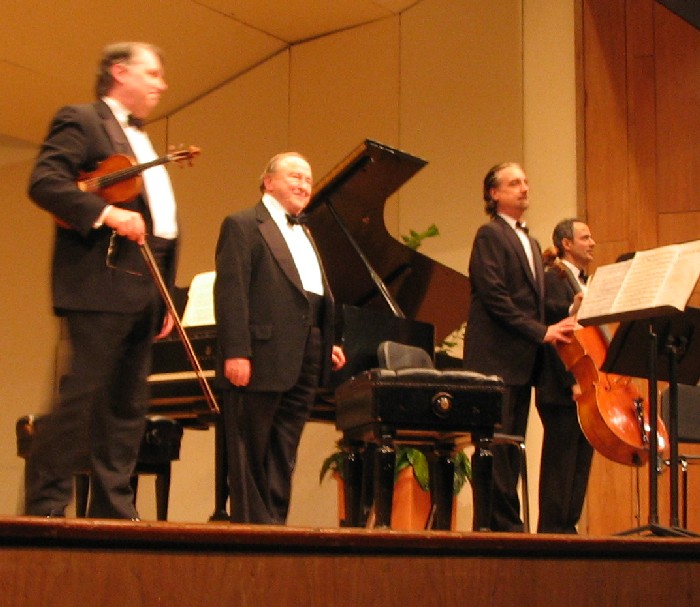
Philip Setzer, Menahem Pressler, David Finckel, and Eugene Drucker, Shriver Hall, October 15, 2006On Sunday's concert at Shriver Hall, it was topsy-turvy night, as members of the Emerson String Quartet joined forces with pianist Menahem Pressler, whom we heard earlier in the week with the Beaux Arts Trio at the Library of Congress. The Emerson's second violinist, Philip Setzer, played the sole violin part, ending up on the top of the ensemble (as he does sometimes, when the two violinists exchange seats), while first violinist Eugene Drucker played viola (in Lawrence Dutton's absence, as he recovers from shoulder surgery undergone in July). Wisely, Menahem Pressler and cellist David Finckel remained in their expected positions. Each half of the concert consisted of one long work, both monuments in the history of chamber music, which the very full auditorium audibly appreciated.

The first half was for the three Emersons only, Mozart's Divertimento in E-flat Major, K. 563, with Setzer and Drucker standing on either side of the seated Finckel. The piece seemed to get off to an uncertain start, perhaps due to under-rehearsing, although the long lines and phrasing were lovely. By the second movement, however, the performance came together, making sense of the strange harmonic vagaries with which Mozart experimented in the development. The substantial fourth movement, a theme and variations was superb, its sense of finality provoking a brief flurry of applause. The variation in the minor mode recalls the contrapuntal style of J. S. Bach and the searing suspensions of Corelli, showing the influence of Mozart's study of Baroque music in this period. (The divertimento was completed in 1788, but there is a similar Baroque moment in The Magic Flute, for example, in the duet by the Zwei Männer, "Der, welcher wandert diese Strasse.") The two minuets were cheery, and the finale had admirable rhythmic drive, with Philip Setzer acquitting himself well as the dominant voice.

Other Reviews:

Tim Smith, Emerson plus/minus (Baltimore Sun, October 17)
Far superior musical shaping came in the second half, with Pressler joining the other three for the first piano quartet (G minor, op. 25), composed by Johannes Brahms when he was still in his 20s. The Allegro first movement was earnestly emotional, with an arcanely severe development and a brooding mass of harmonic shifts in the coda. The second movement, Intermezzo, was all hushed, interior monologue, with mutes and soft pedal, energized by Finckel's buzzing, constant pulse of eighth notes. The coda here, recalling the lively trio, was an angelic whisper of joy in C major. In the third movement, a heroic tone returns, with that big piano part (I have always found the music of Brahms very difficult, because the texture is just so massive).

Pressler is still technically impressive and able to cover dropped notes like an illusionist. Drucker brought a lyrical sound to the many solo moments in both the Mozart and Brahms viola parts, but he also seemed slightly unsure at moments, looking at the fingerboard to check his position when tuning was not quite right. The famous fourth movement of the Brahms quartet was a wild ride, playing on the feeling of Hungarian improvisatory folk music, speeding up and slowing down tempestuously. The second episode sounded appropriately Schumannesque -- Brahms stopped just short of actually plagiarizing the Davidsbündler theme -- and the coda was a heart-racing stampede. Jokingly, Philip Setzer introduced the encore with the remark, "Now that we're warmed up, we'd like to play..." The slow movement of the C minor piano quartet, op. 60 (based on the story of Werther), allowed the audience to recover its senses, in a tender, almost tortured outpouring of the emotions of the quintessential Romantic hero.

The next concert at Shriver Hall is a highly anticipated recital by pianist Hélène Grimaud (November 5, 5:30 pm). A review of her latest CD, Reflection, is forthcoming. The entire Emerson Quartet will hopefully be back in form for their three-concert series of Shostakovich quartets at the Kennedy Center on February 5 to 7, 2007.