CD Reviews | CTD (Briefly Noted) | JFL (Dip Your Ears) | DVD Reviews
Showing posts with label Corcoran. Show all posts

29.1.11

Ariel Quartet Full of Noises in Berg

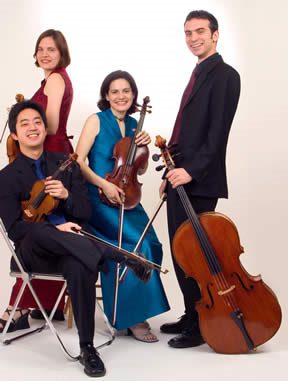
It occurred to me last night, as I approached the door of the Corcoran Gallery of Art's Hammer Auditorium, that Ionarts had not been there since the last time we reviewed the Klavier Trio Amsterdam, back in 2009. Furthermore, although we have reviewed violist Roger Tapping playing the Mozart quintets with string quartets (like the Auryn, Jupiter, Parker, and Daedalus) over the years, we had also not managed to review one of his concerts with the Ariel Quartet, although they have been playing at the Corcoran and other Washington venues on a fairly regular basis. The Corcoran has perhaps the finest auditorium for chamber music in the city, but its concert series has been cut back to just a few events each season. The Ariel Quartet was back on Friday night to put some energy back into chamber music at the Corcoran, playing quartets by Beethoven and Berg, plus one of the exquisite string quintets of Mozart, joined by ex-Takács violist Roger Tapping. After some trouble with the light settings for the stage, forcing the group to play the Beethoven in crepuscular darkness, the group gave a knockout performance of the Berg.

The Ariel Quartet, formed in Jerusalem in 1998, hit the American classical music world around 2006, coming out of the New England Conservatory of Music with a full head of steam. They managed a third prize at the Banff Competition in 2007 (the year that the TinAlley Quartet took first and the Zemlinsky Quartet took second) and ultimately graduated from NEC last year, moving on to further studies at the Musik Academie in Basel, but critics -- like Robert Battey for the Post in 2008 -- have not always been impressed by much beyond their obvious technical skill. The group literally sunk its teeth into Beethoven's third quartet (op. 18, no. 3), with a violence of attack and a tone that was more searing than glowing, a performance that was all frenetic energy and sharp edges. The tempo of the outer movements was pushed so fast that most rhythmic details had to be glossed over, most disturbingly in the closing Presto, and the third movement tripped over itself in much the same way. The second movement oozed a little more expansively but felt more precious than profound.

Since the Ariels did win the Székely Prize, for the best performance of a Bartók quartet at the Banff Competition, it was probably not a surprise that their performance of the Berg string quartet (op. 3) was the concert's high point. The range of tone color, shape of phrase, and clarity of form not only showed the group's predilection for more biting, dissonant harmony, not to mention the greater independence of the parts, but revealed their indifference -- contempt is probably too strong -- for the Beethoven quartet. Here the four musicians listened more to one another, not as in the Beethoven straining so much against their parts that they pushed first violinist Alexandra Kazovsky into a forced, acidic sound. The various effects of Berg's score, like harmonics and raspy sul ponticello playing, all served as part of a well-conceived drama that arched over the two movements.


Other Reviews:

Stephen Brookes, Ariel Quartet (Washington Post, January 31)
The presence of Tapping on the second viola part in Mozart's fifth string quintet (D major, K. 593) seemed to mollify the younger musicians, with the high strings in a purely blended ensemble answering each of the opening phrases of the cello in the first movement's introduction (a dreamy section that returns memorably in the movement's coda). Freed by the second viola part taking some of the accompanying motifs, Mozart gave the first viola greater independence, revealing the sinewy tone of violist Sergey Taraschchansky, especially in the many sections given to the two violas with cello in the slow movement. The suave trio of the Menuetto movement had a bubbly quality, driven by the arpeggiated flourishes introduced by the first violin, although Gershon Gerchikov, who sat first violin for the second half, was not quite clean enough in the many passages of detached notes of the somewhat lightweight final movement.

You have to wait only a week for the next concert at the Corcoran, featuring the return of Klavier Trio Amsterdam next Friday (February 4, 8 pm), including two Beethoven trios (op. 1/3, and the 'Kakadu Variations', op. 121a) and the second piano trio of Saint-Saëns.

5.5.09

Klavier Trio Amsterdam: The Klára Würtz Show

Style masthead
Read my review in the Style section of the Washington Post today:

Charles T. Downey, Klavier Trio Amsterdam In Good Form At Corcoran
Washington Post, May 5, 2009

Klavier Trio Amsterdam
Corcoran Gallery of Art

Beethoven, Piano Trio in E-Flat Major (op. 1, no. 1)
Martinů, Bergerettes
Brahms, Piano Trio No. 2 in C Major (op. 87)

N.B. The editors thankfully soft-pedaled my rant about the page-turner for this concert, whom I also witnessed sabotaging the Triple Helix Trio in a much worse way back in January. He seems like a nice guy, but page-turning at a concert at this level is too important to entrust to someone who makes that many mistakes.

27.1.09

Triple Helix at the Corcoran

This review is an Ionarts exclusive.

Available from Amazon
Triple Helix Piano Trio, A Sense of Place (Shostakovich, Ravel, Bright Sheng)

The Triple Helix Piano Trio, since its founding in 1995, has made contemporary music for this combination of instruments its focus, and that was the best part of their concert at the Corcoran Gallery of Art on Sunday afternoon. Of several performances of Shostakovich's second piano trio (E minor, op. 67) recently in our ears -- by Natalia Gutman and colleagues, the Beaux Arts Trio, and the Amadeus Trio -- this was the most viciously savage and bloodthirsty rendition (also featured on Triple Helix's 2004 recording, A Sense of Place, from MSR Classics). The ironically Pollyanna-ish tune of the first movement had an acerbic tone biting behind it, and there was nothing humorous about the danse macabre had nothing remotely funny about it, marked by machine-gun motifs and martial trumpet calls. The harmonics that placed Rhonda Rider's cello above the violin line in the surreal opening passage of this work were a little brittle and unsure, as was the E string playing of violinist Bayla Keyes, although her opening lament in the third movement was gorgeous.

Pianist Lois Shapiro struggled to shoehorn the music on this program into a theme that tied it to the Corcoran's exhibit of Richard Avedon's photographs, identifying the theme as "Voices from the Flames: Music That Reaches toward Transcendence." This worked in the second half of the concert, because the Shostakovich E minor trio was composed as a reaction to the death of the composer's friend at Treblinka, tying in to the theme of powerlessness as the obverse of Avedon's theme of Portraits of Power. It tied in well with the work that opened the second half, too, Abu Ghraib, a 2006 duo for cello and piano composed by John Harbison (b. 1938) for Rhonda Rider. The work opens with the cello and piano in heterophonic dissonance, and much of its two movements is focused on the lamenting wail of the cello, which opens the second half, or Prayer, of each movement. Harbison's style is often dissonant but not stridently or exclusively so, with a music box-like use of the piano in the first movement and the sing-songy adaptation of an Iraqi folk song and percussive strikes on the keyboard cover in the second. It is a worthwhile piece of music, a profound statement in response to the Abu Ghraib scandal, and hopefully the group will record it soon.

That is where the theme broke down, as the first half was completely unconnected, in spite of Shapiro's attempts to make connections. Arno Babadjanian's 1953 piano trio made some general references to, not citations of, Armenian folk song, but it mostly sounded like a folksy version of Rachmaninov, sugary harmonies with a few flat sevenths and flat thirds thrown in. It would have probably been enough for the first half, since it ran long to my ears and could have benefited from some judicious cutting. Shapiro's hammering touch at the piano worked well in the modo barbaro 5/4 last movement of the Babadjanian trio, as it did in the Harbison and Shostakovich, but it was far too harsh in the opening Mozart selection, the G minor piano quartet, K. 478, as in the first movement's development section, where its part has so little interest. There were some technical issues, too, a slight gumminess in the right hand figuration at points (some of the tempo choices were overly ambitious). It made one think that the program would have been improved by omitting the Mozart altogether, but that would have obviated the need to invite an Ionarts favorite, violist Roger Tapping, to join the group. Not only was his contribution to the Mozart valuable, but as it turned out, another expertise of his was required when, in the second half, he was called on to replace a disastrous page-turner.

The next concert in the Corcoran's Musical Afternoon Series will feature the Auryn Quartet in an all-Beethoven program (February 8, 4 pm).

11.11.08

The Takács Quartet at the Corcoran

Our thanks to guest critic Robert R. Reilly for contributing another review, this time from nearer to home: the Corcoran Gallery.

available at Amazon
B.Bartók, String Quartets 1-6,
Takács Quartet
Decca

Few things can be as pleasant on a late afternoon in the fall than to sit in the intimate neo-classical Hammer auditorium in The Corcoran Gallery of Art and listen to a world-class string quartet playing Haydn. Such was the treat on Sunday afternoon when the Takács Quartet began their program with Haydn’s String Quartet in F Major, Op. 77, No. 2.

The dog-eared score visible on the first violinist’s stand bespoke a great familiarity with this work. The deep comfort level allowed for a delicious sense of play within the quartet, and the enjoyment of the Takács members was evident in the joy with which they played it. The middle movements were conveyed with especially great warmth. In fact, an autumnal glow permeated the whole piece. However, the Takács could be rollicking and rousing when called for in the Presto movements, and meltingly lovely in turn. They darted about each other in the Finale: Presto like musical starlings. I know this quartet only from recordings, and I did not know it was as good as this until I heard the Takács perform it.

The program included classical, romantic and modern works, but not in that order. The Bartók Quartet No. 2 was sandwiched between the Haydn and the Schumann Quartet in A minor, Op. 41, No. 1. The Takács Decca recordings of the Bartók Quartets are famous and highly revered. After they were made, Geraldine Walther replaced Roger Tapping as violist. In the three years since then, she has obviously gelled with her confreres. Karoly Schranz, violin, and Andras Fejer, cello, have been with Takács from the beginning; they have now played together for some 33 years. The superb first violin, Edward Dusinberre, joined in 1993.

I confess that, while musical friends whom I respect love the Bartók Quartets dearly, I have not yet reached that level of affection or understanding. Nonetheless, it was clear to me that, in the first movement of the Second, the Takács took it very much as a romantic work, though from a world in which something had clearly gone wrong. That much was certain from the disorientation of the uncertain tonality and the brooding sadness. The slashing attacks in the second movement were riveting in their ferocity. This was tremendously exciting playing with hair-trigger precision. It is hard to think that the Lento movement could be played more expressively.

The Schumann Quartet was a joy, from the keening loveliness of the opening theme, through the wonderfully skittish, Mendelssohnian scherzo to a finale with a marvelously hushed, magically delicate coda, rounding off into an energetic climax. Watching and listening to the Takács instruments ricocheting off one another in the fugal tumble of wonderful melody was a treat.

19.9.08

Benoît Delbecq Makes Some Noise

This review is an Ionarts exclusive.

Benoît Delbecq, pianist (photo by Roderick Packe)
The Alliance Française de Washington partnered with the Corcoran Gallery of Art to sponsor a concert by unclassifiable French pianist Benoît Delbecq on Wednesday night. The Corcoran presented Delbecq as a jazz pianist, which he is, but his unusual style of improvisation draws on many other styles and genres, including African traditional, classical, and European experimental. In his hour-long program, Delbecq subjected the Frances and Armand Hammer Auditorium's walnut Steinway to preparation with all manner of foreign objects wedged among the strings. The forest of twigs, eraser pieces, screws, clarinet (and other) reeds, strips with thumbtacks, and other bits of detritus produced sounds like that of pitched drums, cymbals, a sistrum or other rattle, plucked strings, xylophone, and empty thumps and thuds.

Delbecq's basic formula is to create an ostinato pattern, generally with the left hand in the lower range of the piano, where the sounds are left pitched but altered to have a faster decay. He then improvises over that pattern, to which rhythmic values can be added or subtracted to relieve the regularity of the ostinato, in the middle range, left unmanipulated to sound like the piano. He then adds accents from time to time in the instrument's upper octaves, where the most percussive alterations have been made. The sonic allusions include the minimalists in the ostinato patterns, John Cage in the preparation of the piano, jazz harmonies in the central piano register (Duke Ellington in a piece called Heptases and a reworking of Thelonious Monk's Misterioso), the whimsy and exoticism of Satie (Oliveira et la Sybille, named after characters in a novel, and Ando-san, a reference to the Japanese architect Tadao Ando).

Another earlier composer who came to mind while hearing these improvisations was Olivier Messiaen, in the dissonant, static color chords at the end of Le sixième sceau (named by analogy to Bergman's The Seventh Seal), which followed bubbling major second clusters that recalled Debussy's prelude Des pas sur la neige (Book 1, no. 6). Yompa, the piece that followed it with no break (which meant changing the preparation bits on the fly), was only one of the improvisations that recalled similar pieces by Fazil Say such as Black Earth, which draws on Turkish folk music. These influences, if they were there, Delbecq did not acknowledge, but he did give a brief description of a pygmy tribe in the central African rain forest, whose chanting inspired his piece Aka. This was not music I would probably choose to listen to again and again, but it was a welcome diversion for an evening.


Benoît Delbecq - piano solo
Uploaded by sextant-revue

The next concert at the Corcoran is the first in the series presented by the Contemporary Music Forum, on Sunday afternoon (September 21, 4 pm).

30.3.08

Jupiter Twilight at the Corcoran

In the interest of full disclosure, the author's undergraduate piano teacher is the mother of Nelson Lee, the first violinist of the quartet under review.

Jupiter Quartet
Jupiter Quartet (L to R: Nelson Lee, Meg Freivogel, Liz Freivogel, Daniel McDonough)
Since the New England Conservatory-trained Jupiter Quartet burst onto the scene, by winning the Banff Competition in 2004, the group has become an Ionarts favorite. They were back in Washington on Friday night, for another concert on the Musical Evening Series at the Corcoran Gallery of Art. This program combined three autumnal masterpieces, all composed in the final years of their composers' lives. As a result, it was an evening of consummately crafted music, which nonetheless could have benefitted from at least a moment of levity.

Mendelssohn's final string quartet (F minor, op. 80) was a frenzied expression of the composer's grief at the death of his beloved sister. Its opening was a dramatic yowl, anxious tremolos over which the first violin's high-pitched keening was heard. The first movement never settled into a unified tempo, seemingly from a minor conflict between the driving impetus of cellist Dan McDonough and the other players. The second-movement Scherzo hit a sound, upbeat pace, the steady pulse reminiscent of Schubert's relentless Lied Der Erlkönig, contrasted with a somber, drone-centered trio. By the third movement, the Jupiter hit its stride, with a mournful melody passed around among exquisite solos from both violins and viola. The chromatic shudders pervading the fourth movement prepared the ground for the searing lament of Nelson Lee's first violin.

Other Reviews:

Robert Battey, Jupiter String Quartet (Washington Post, March 31)
The second Britten quartet was the high point of the Jupiter Quartet's first concert at the Corcoran in 2005. (We also reviewed their 2005 concert at the Library of Congress but had to miss their debut at the Kennedy Center in 2007.) Here it was Britten's third quartet, one of his most austere and mournful works, the twin of his final opera, Death in Venice, a lament not for Aschenbach's decline but Britten's. The Jupiter's comfortable and well-considered way with Britten raises hopes that they will one day make a great recording of the composer's three quartets. This performance captured the sense of world-weariness, as well as the sounds of Britten's last visit to Venice, the lapping waves, the wailing gulls, the cosmic calm of the small canals, the trembling air of crystalline harmonic-topped chords. Bartókesque folk parlandi and meditative recitatives contrasted with the gently propelled passacaglia that concludes the quartet, during which especially the throaty but not barking viola of Liz Freivogel distinguished itself.

Senior violist Roger Tapping and cellist Natasha Brofsky joined their younger colleagues for Brahms's Sextet No. 2 in G major. A warm, gentle comity prevailed over this performance, capturing the interior anguish and joy. The Scherzo was set at a gently bubbling pace, allowing the interplay of duple and triple groupings. The Presto trio had a similar shpae but transformed into a barroom waltz spinning out of control from its raucous opening. The third movement was well contained and then allowed to blossom in a burst of color and sound over the pedal point in the cello, leading to a rollicking fourth movement of rousing, almost convulsive rhythms responding to the call of folk fiddle tuning.

The next concert on the Corcoran's Musical Evening Series will feature the Walden Chamber Players (April 25, 8 pm).

24.2.08

Takács Quartet @ Corcoran

Takács Quartet, photo by Lin Wang

The second installment of the Washington concert appearances by Ionarts favorite the Takács Quartet, following a beautiful concert at Wolf Trap last October, was at the Corcoran Gallery of Art on Friday night. It was a closely matched program (the same one they played at Carnegie Hall the night before), intended really to be Part 2 to the Wolf Trap concert, but offered as a benefit concert on behalf of the Corcoran's Musical Evening Series.

The group opened with a Haydn quartet (op. 74, no. 2), following up on op. 74, no. 1, at Wolf Trap. Their Haydn this time was jolly, reflected in the sunny, sharp tone of Edward Dusinberre's first violin. The group set the tempo of the first movement (Vivace) one notch too fast, catching the viola a little unawares, at its solo moment transitioning to the second theme (an issue resolved in the repeat of the exposition). The second movement, a graceful theme with variations set at just the right pace, featured lovely, pensive solo playing from the two remaining Hungarian founding members of the quartet, cellist András Fejér and second violinist Károly Schranz. The third and fourth movements returned to the light-hearted mood, with a cheery menuetto and a finale in the spirit of a country reel.

Takács Quartet:
available at Amazon
Haydn (op. 76)


available at Amazon
Bartók


available at Amazon
Brahms, op. 51
In the modern slot (instead of Janáček's second quartet at Wolf Trap), it was Béla Bartók's fifth quartet. The 20th century was dominated by three great sets of string quartets -- six by Bartók (1909-1939), fifteen by Shostakovich (1938-1974), and five (so far) by Elliott Carter (1951-1995). Hopefully, the Takács will one day give a complete performance of Bartók's cycle of six string quartets here in Washington, as their interpretations of his quartets, live and in recording, remain the most illuminating. Yes, we have heard them play no. 2 and no. 3 in recent years at the Corcoran, but not enough to justify you calling us greedy for wanting more.

In no. 5 once again, it was the quartet's unity that impressed as it rocketed through the vast palette of colors -- folk songs hummed in the night, a perverse tango, barbaric yapping, machine-gun unisons, in the first movement alone. Forms crystallized beautifully, like the chiasmic return of the pure and sad folk recitative in the first violin that opens and closes the second movement. The lopsided Bulgarian dance of the third movement contrasted with the insect and frog calls growing to an angry buzz in the fourth. The fifth movement, opening starkly and driving furiously to its end, capped an extraordinary performance.

Other Reviews:

Tom Huizenga, Takács Quartet (Washington Post, February 25)

Dean Bevan, Takács Quartet’s communication leads to sensitive performance (Lawrence (Kans.) Journal-World, February 19)
Washington is enjoying a surfeit of the Brahms quartets this season, driving Anne Midgette at the Post to distraction, with a complete cycle from the Emerson Quartet and now an almost-complete one from the Takács. After op. 51, no. 1, at Wolf Trap it was time for op. 51, no. 2, with similar results. The first movement opened at a restrained tempo but seemed overall flexible, the push and pull creating a sense of introspection, which continued into the ardent, sustained second movement. Having heard this performance side by side with the Emerson Quartet last month, I think that the Emerson owns the third movement, with a cool, gloomy minuetto, while the Takács' rendition was a little scattered, especially the trio, which was at the edge of control. However, the Takács gave a much more satisfyingly gutsy performance of the fourth movement, holding back the tempo slightly (it is marked Allegro non assai) and digging into the score with weight. "After that light program," as Edward Dusinberre put it, it was time for a little Shostakovich encore, the delightfully acidic Polka from The Golden Age, no less welcome because it had also been the encore at Wolf Trap in October.

The closest that the Takács Quartet's third program -- with Haydn's op. 74, no. 3, and the third Brahms quartet -- will get to Washington is the Pittsburgh Chamber Music Society (April 28, 8 pm), which also includes the Franck Piano Quintet with Jean-Yves Thibaudet. Road trip, anyone? The next, equally anticipated concert at the Corcoran features the Jupiter Quartet (March 28, 8 pm).

14.5.07

Amsterdam Klavier Trio at the Corcoran Gallery

KTA at Ionarts:

Jens F. Laurson, Tapping Along With the Klavier Trio Amsterdam (Ionarts, January 22, 2006)
On Friday evening the Amsterdam Klavier Trio presented a compelling program of piano trios by Haydn, Liszt, Berkhemer, and Tchaikovsky at the Corcoran Gallery of Art. With almost twenty years since joining forces, the Dutch ensemble performed with a cool assurance that may be obtained only through experience.

Haydn's Trio in C major, Hob. XV-27, with the witty Presto movement, was full of charm. In the Andante movement, the flourishes on the piano where the tempo eases were very natural; though, throughout the evening pianist (Klara Wϋrtz) never seemed to play truly softly. This reminds me of a Rostropovich proverb from one of his obituaries that roughly quipped, "one can never have forte without first experiencing piano."

Orphée, Poème Symphonique (transcribed by Saint-Saëns), by Liszt, had loads of atmosphere. The rolling arpeggios of the piano combined with the deep, rich cello tones (Nadia David) evoked Orpheus and lute. Near the end of the work, in an effort to emulate the forces of a full orchestra, all of the musicians had long tremolo notes that filled the room with waves of sound.

A piano trio in one movement written in the year 2000 by Joan Berkhemer, the group's violinist, featured the special effects of an echo chamber. For example, a two-note figure on the piano would be played that would then be echoed immediately four to five times on the violin, each time more softly. Later, long slow notes overlapped with one another to create a still atmosphere that allowed the mind to wander off in a pleasant way. Then there were more echoes with various instruments, and an unresolved ending.

The musical treasure of the program lay in the Tchaikovsky Piano Trio in A Minor. With its poetic tunes and collection of contrasting variations, this piece – when well played – is unforgettable. In a Romantic style similar to that of the Heifetz/Piatigorsky/Rubenstein Trio, the Amsterdam Klavier Trio embraced the challenges of this work and performed it with great dignity. The unhurried tempo of the first movement left time for true dialogue between the violin and cello, while the tempo relationships between the variations were cohesive. Having immense power in ff sections, the pianist sometimes over-pedaled through multiple phrases. At the mournful, lugubre ending, again, the pianist did not achieve a true pianissimo.

The concert had a rather clumsy beginning: unintroduced, a lady seated in the front row took to the stage with her cane and brought up questionable politics. This was unfortunate in that the last thing most members of the audience in the neighborhood of the State Department, White House, Bank-Fund, and Fed are keen to be lectured on is politics. Following that episode, a representative of the Gallery pitched the upcoming season, briefly. Astonishingly following this, as the representative was exiting the stage, a member of the audience bellowed at him to tell the audience to resubscribe for next season’s series. The representative then muttered something else and soon after, thankfully, the artists took over.

When the Corcoran publicly announces its season announcement, we will let you know. The last classical concert of the Corcoran's season is the Jenny Lind concert, featuring this year's Royal Swedish Academy of Music contest winners, soprano Paulina Pfeiffer and pianist Inese Klotina (June 14, 7 pm).

9.12.06

Nicholas Angelich at the Corcoran


Nicholas AngelichA black, shiny surprise awaited the audience in the sparsely filled Hammer Auditorium of the Corcoran Gallery Wednesday night when, instead of the raggedy Steinway of debatable quality, a Yamaha concert grand greeted them from the stage. Working on it that night, as part of the “Les Grands Pianistes” series that the Corcoran Gallery and the Maison Française co-present, was the U.S.-born French pianist Nicholas Angelich. The second of originally four (but after Alexandre Tharaud’s cancellation only three) pianists in that series, his performance was going to be measured against the considerable standard set by François-Frédéric Guy, the pianist who went first in this line... and it measured up nicely.


available at Amazon
Brahms Piano Works


available at Amazon
Brahms Violin Sonatas


available at Amazon
Brahms Piano Trios


available at Amazon
Beethoven Sonatas


available at Amazon
Liszt "Années de pèlerinage" (currently out of catalog)
The piano had the typical Yamaha sound: Responsive, clean, angular, and always accentuating brightness over roundness. A good and sensitive pianist can elicit wonderful things from it; bangers are mercilessly exposed. Nicholas Angelich is certainly a sensitive musician and more than merely “good” – as he proved in the quintessentially romantic program of Schumann and Brahms, starting with the former’s 1838 Arabesque in C Major, op.18. Round, delicate, but with meat on the bones, and deeply felt: This was what the ears expect Schumann to sound like. Mr. Angelich delivered all that, and more, again in the op. 12 Fantasiestücke. “Des Abends” was calm and moody; slow but always cohesive. Hearing “Aufschwung” (hesitancy next to impetuosity) it is difficult not to sense the vast influence over Schumann’s œuvre for piano must have had on impressionist composers like Chopin, Debussy, and Field.

Brahms came with a crystalline sound whenever bolder tones were struck in the Fantasien, op. 116 – namely the opening and closing Capriccios in D Minor… in between Angelich returnd to his languid, nocturnal style of interpretation. A little pedal heavy at times and always with some inflection (imagine Backhaus as the polar opposite of this style), the Brahms was personal, woolly, comforting to most, and perhaps too obsessive or wrought with sedative romanticism for a few dissenting ears. The four Klavierstücke, op. 119 (three Intermezzi in B Minor, E Minor, and C Major; Rhapsodie in E-flat Major), made the preceding “Capriccios” seem more important: Amid all that Brahms and Schumann (a complacent, meandering mélange of on-the-sleeve romanticism) they represented a jolt of life. How a dry, crisp two-movement Beethoven sonata might have provided desirable contrast!) But if romantic monochromaticism is no deterrent to one's musical palate, the Klavierstücke will have been keenly enjoyed. Especially the C Major Intermezzo (where brevity aids inventiveness to great effect) and the E-flat Major Rhapsodie that came like a needed breath of fresh air to the recital.

If the Rhapsodie was a “breath of fresh air,” though, the two Bach encores (the Allemande from the Second Partita and the Gigue from the Second English Suite) were like musical detoxification or at least a ‘taking to the baths’ at a Spa. They were indeed beyond ‘welcome’: They were a necessity of enormous grace and beauty – not all of which was due just to the ingenuity of Bach’s music, either. Rarely was it more true or plain that encores are indeed “gifts” from the performer to the audience.

A repeat performance of this or a similar recital took place at the Maison Française on Thursday night. The next performance in this series will be that of Pierre-Laurent Aimard in May.

17.11.06

A Sunday with the Contemporary Music Forum and Young Concerts Artists

Young Concert Artists


Hearing works by Benjamin C.S. Boyle more and more often and in more and more prestigious venues is very gratifying. (Although my musical tastes tend to a more modern idiom than Boyle usually delivers, the quality of the music itself and its play with traditions and contemporary influences has fascinated me ever since first hearing his Kreutzer Concert-Variations.) The Young Concert Artists’ recital at the Kennedy Center’s Terrace Theater, last Sunday, offered such an opportunity. Now in his second year as composer-in-residence for YCA, he was commissioned to write a piece for the young harp virtuoso Emmanuel Ceysson. The resulting Suite Sylvanesque adds only another work to a string of successes. Being just about the least notably modern work I have heard of Mr. Boyle’s, most of the audience would probably not have thought the Suite any younger a work than the Fauré, Ravel, Renié, or Grandjany works that were also offered by Mr. Ceysson.

Were Boyle’s Suite lulls the ears with beauty rather than piquing it with little reminders of ‘music in 2006’ – and assuming that one might consider that a shortcoming, not an asset, in the first place – it won its laurels on brevity, that most underrated but essential skill that makes a good composer. (The grand-master of brevity, Anton Webern, was present in spirit, if not at all in sound.) Five sparkling, generally gentle movements – each supplied with a short epigraph – make for music that sounded genuinely tailored to the harp and the romantic stereotype we often associate with it.

Mr. Ceysson, in his very early twenties, played this with the same flair and impeccable, impressive skill as he did the other works. During a transcription of Bach’s French Suite No. 3 BWV 814 his red-cheeked, angelic face with puckered lips ecstasy under a well cared for mop of soft, long, dark hair made that ‘romantic abandon’ impression that is especially annoying with pianists but more forgivable with the engaged, flair-burdened harpist.

Fauré’s Une chatelaine en sa tour, op.110, consisted of muted, melting tones, Marius Constant’s Harpalycé showed that the harp need not necessarily be angelic but that it can be a raw instrument, too. In Marcel Grandjany’s Rhapsody for harp and string quartet the magnificent Jupiter String Quartet was sadly underutilized. Henriette Renié’s Ballade fantastique on Edgar Allen Poe’s “The Tell-Tale Heart” would have been just as extraordinarily effective music if one were blissfully unaware of the story (and that beating heart) that motivated it.

Ravel’s Intro & Allegro for Harp, accompanied by String Quartet and Clarinet makes no pretense of being a septet – the partners here hare decidedly not equal, especially with the String Quartet relegated to provide the orchestral carpet for the harps solo performance.

Amid all this, the prodigious technique and talent of Mr. Ceysson was in full display. The only criticism: He should not have talked at all… not introduced a work nor read the poetry that goes along with the Suite Sylvanesque. His thick accent rendered it completely incomprehensible, awkward… even embarrassing. The effect was one that detracted, rather than added to the music.


contemporary music forum


If the YCA concert was six seventh 20th century music, it still could not have been more different from the second cmf concert of the season at the Corcoran Gallery of Art where five sixths were also from the 20th century (with one piece from the 21st) but the soundscape worlds apart. The recently deceased James Tenney – unknown to most audiences but a favorite composer of Ligety’s and well respected by his colleagues Feldman, Cage, and Reich – came first with the Chromatic Cannon in the version for piano and tape (a pre-recorded piano track that would otherwise fall to a second player). An intriguing work that sounds like minimalism but hardly betrays its (loosely applied) 12-tone technique, builds slow but irresistible climaxes, and plays with different pulses running through the two piano parts. Jenny Lin, who played ‘with herself’, made the Chromatic Cannon appear a downright elegant piece.


Other Reviews:

Daniel Ginsberg, Contemporary Music Forum (Washington Post, November 13)
Tom Lopez’ Underground (2004) is probably not music in the conventional sense but the soundtrack (ambient noise, crashes, rhythms, occasional tones) to a modern, curiously appealing short-film-cum-documentary on the London Underground by director Nate Pagel – a second in a planned series that plans to explore subway systems around the world. With graphics and ‘sound’ (like an industrial remix with a Moby beat) very professionally put together, the clip could as well have been screened at the Hirshhorn as a ‘video sculpture’.

Lawrence Moss’ “Korea for Kwartludium” (1999) for violin (Lina Bahn), clarinet (Kathleen Mulcahy), percussion (Svet Stoyanov), and piano (Ms. Lin) is based on the interesting concept of recreating or emulate an electronically assembled earlier composition of his (Korea). The same principle as on the “Accoustica plays Aphex Twin” CD, but with Korean folk elements, instead of Richard D. James’ brand of electronica. Interesting, but lacking: There was no sense of improvisation or spontaneity in this performance, only theatrical, self-important sound-reproduction which had its low points in the instrumentalists half-yelled ‘uuuuuhs’ and ‘ooohmms’.

Transfigured Wind IV for flute and audio fared better but could have been half as short. Carole Bean played this overlong 1985 work by Roger Reynolds (a Pulitzer Prize winner in 1988) which began with subtle piccolo interjections from the audio source which sounded like someone practicing in the room next door. The taped part became more complex, before lower, earthy flute chatter entered the ears. “Climax” is too much a word for it – but halfway through Transfigured Wind IV there came a particularly busy and pleasing passage before everything mellowed out into a bland, occasionally interrupted, modernist mélange. It did, fortunately, avoid most of the histrionics that other contemporary works for flute are prone to.

The Khan Variations by Alejandro Viñao for solo marimba were an impressive showcase for Mr. Stoyanov who proved great athleticism and musicianship alike in this Nusrat Fateh Ali Kahn based musical exploration. Migrations from 1997 by Alexandra Gardner, a D.C. native, closed the concert with a wild ride for percussion/marimba and piano strings (hit directly) around flute, clarinet, cello, and the piano, more conventionally steered. There was plenty thunder but melancholy underneath; the aggressive and abrasive outbursts of the music didn’t scare even Ms. Bahn’s tiny little daughter who, after escaping her minder, progressively climbed towards her mother; reaching her just in time to take bows with the musicians. It was the most human touch of the evening.

6.11.06

Quatuor Ébène at the Corcoran Gallery of Art


Extolling the virtues of the Corcoran Musical Evening Series brings me, by now, dangerously close to self-plagiarism. Even after a point deduction for the insistent inclusion of the Peabody Trio, there simply isn’t a series that offers the same consistent quality of chamber music performers and – more importantly – no one has a better hand in picking young string quartets that measure up to the very highest standards. (The Jupiter, Dædalus, and Parker String Quartets, for example – and hopefully soon the Minetti Quartett.) So if you hadn’t heard of the Quatuor Ébène (I certainly hadn’t, before Friday night), there need not have been any worry about the excellence of the offered Haydn, Ravel, and Bartók.

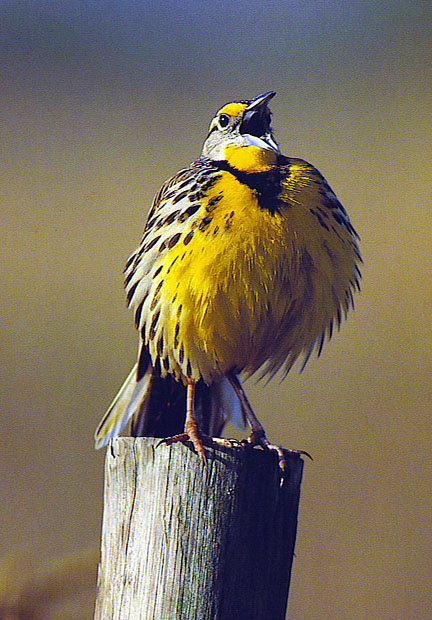
Meadow LarkHopefully Haydn will receive a grand 275th birthday season in 2007. He is a composer that the ear cannot overdose on andm wrote so much music of equally great merit that there would be no need to ever play a work twice in a year’s worth of performances. Meanwhile we will have to content with the bits and pieces of this quintessential Austrian composer that performers – usually string quartets – are willing to provide us with. Courtesy of the Quatuor Ébène came quartet op.64, no.5, the “Lark Quartet”, with its fun ride of a first violin part, especially in the short, all-out fourth movement. Vivace, indeed!

Adagios in Haydn are always special (Menuetts not always). Sheer beauty and musical loveliness was the logical consequence of the Quatuor Ébène’s playing, which favored the lyrical aspect of the work over the gay and light mood that is Haydn’s trademark in most of his faster movements. (The late-comer management – understandable and lamentable necessity that it is – during the Haydn could probably have worked a bit more smoothly. Otherwise, there was no distraction from music that makes “charming” a bona fide compliment.)

Bartók’s Second Quartet at the end of a program would make sense; paraphrasing words of the Takáčs Quartet’s first violinist Edwin Dusinberre: ‘When you have finished playing a Bartók quartet and you gave it all, it seems like you just can’t play any music after that.’ And if you can program Bartók as the last piece anywhere, it’s at the Corcoran where the audiences come for the Bartók, rather than despite it. The quartet was moved ahead of the now concluding Ravel, however – and perhaps intermission is sufficient for both, musicians and audience, to recover from the riveting musical impact the Bartók quartets – the second, op.17 in this case – ideally have.

Quatuor ÉbèneMessrs. Colombet (first violin), Le Magadure (second violin), Herzog (viola), and Merlin (cello) bowed and plucked and strummed away at the work in the finest fashion. This was passionate and energetic playing (a particularly appropriate viola-like, boxy sound on Pierre Colombet’s G-string added atmosphere) and it paid huge dividends in each of the three movements. From aggression to wispy (in the sharp edged second movement - Allegro molto capriccioso) to lament and restrained anguish in the third (Lento), the Ébène-performance ticked off all the boxes that makes for superb Bartók. If elderly gentlemen stomping their feet during the applause is any indication, the audience appreciated it every bit as much.

Ravel’s String Quartet in F Major is a load of good fun and great music. A strident, almost brash first movement (Allegro Moderato – Très Doux) ending on gentle notes led right into the impossibly enchanting pizzicato-dominated Assez Vif – Très Rhythmé that vacillates between pastoral sadness, ‘romping about’, and a numinous in-between. Très Lent is not supposed to be jolly, of course, and perhaps my own mood did its part in coloring the Quatuor Ébène’s performance, but I’ve never heard either this movement or, indeed, the entire quartet in such a sweet, gentle, and hauntingly melancholic light. Only more delicate pianos and pianissimos might have been an element to improve upon in these very fine renditions.

A Jazz encore (Chick Corea’s “Spain”) topped things off in style… jazz renditions for string quartet being one of the Quatuor Ébène’s specialties. (They played a concert of Jazz music at the Library of Congress on Saturday, which should have been great entertainment. Alas I had already agreed to see Queensrÿche, instead. A grave mistake, as it turned out.)

18.9.06

Moravec and More at the Contemporary Music Forum


Contemporary Music ForumThe first Contemporary Music Forum concert of the season got under way last Sunday at the Corcoran Gallery. James Mobberly, Kaija Saariaho, Paul Lansky, and Paul Moravec were featured by Audrey Andrist (piano), Lina Bahn (violin), Tobias Werner (cello), Barry Dove (marimba), and David Jones (bass-/clarinet). Although the concert was not billed as such, it might well have been titled “Introduction to Contemporary Classical Music”… with all works easy on the novice ears, easy on our mood, and suitable even for children.

Most accessible and fun of them was the aptly named Hop, Paul Lansky’s 1993 contribution to the underdeveloped field of silly, toyful [sic!] music scored for marimba and violin. A wonderful example that decidedly modern contemporary classical music can still perform the essential (if not sole) function of all music: entertain. It did that with humor, coy sounds, and clap-along rhythms – but never by pandering. Lisa Bahn and Barry Dove (whose blues playing in the respective section might have been a little ‘too behaved’) were responsible for the warmhearted, immaculate performance.

Opening the concert was Mobberly’s Caution to the Winds, a duet for piano and tape. Recorded and sampled piano sounds (spat back out from what is now, in 2006, a CD player) engaged with Ms. Andrist’s piano playing. It reminds a little of György Kurtág’s Játékok (Games), and the computer sounds betray their 1987 vintage. But whereas the limitations of electronic sound production on a computer in the '80s (perhaps impressive at the time) were soon thereafter an acoustic embarrassment to our ears, they have by now acquired a patina of nostalgia and a humorous twang. In its race against and collaboration with the piano, it becomes a droll affair of (wo-)man vs. machine; a machine that sounds like a cross between R2-D2 and a saloon upright. That the whole thing is rich with musical ideas made it a happier affair, still.

Kaija Saariaho’s Petals, as of late available on CD (see ionarts review) appeared between the two works as apt contrast. Modern music like Petals (with general, rather than precise instructions to ‘create sounds’, not play certain notes at certain values) often leaves more room for interpretation and alteration as part of the performance than standard repertoire. The live experience is therefore alive… always changing and somewhat unpredictable. This not only adds to the occasion of hearing the music (whether for the first or fifth time), it predestines this kind of music for live performance. Recordings can help us understand such works better – but there is a touch of the silly involved, just like it is both cute and stupid to make a recording of aleatory music.


Other Reviews:

Charles T. Downey, Contemporary Music Forum (DCist, September 19)
Whether you hear grinding glaciers, gray stones, and glass pebbles in Petals or something else altogether, it is a highly evocative score. Cellist Tobias Werner – supported by the computerized alterations that shadowed him – made the most of it. An impressive performance that would have deserved to delight more ears than found their way to the Francis and Armand Hammer Auditorium.

Paul Moravec’s Tempest Fantasy (for piano trio and bass-/clarinet) was introduced by the composer himself. It would be failure on the part of the composer not to make a work of that title sound tempestuous and failure on part of the critic to find no other description for it. Alas, Mr. Moravec himself described the opening of the fifth and last movement (Fantasia) so and quoting him is my excuse for not coming up with descriptive prose more purple.

Fantasia, which might well have been titled “Prospero Prevailing,” sums up the Puliter Prize-winning Tempest Fantasy’s first four movements: a spiky-joyous and flighty characterization of Ariel; the melancholic cello that is a lamenting Prospero; the limping dance of Caliban in the third movement (Peter and the Wolf just around the corner). And Sweet Airs, exposed on ‘Ariel’s’ violin and inspired by Caliban’s speech “The Isle is Full of Noises” (III.ii.130–138). G-D-A-E (the violin’s open strings) dominate Ariel, the Prospero cello-theme is prominantly summoned in the Fantasia - but now imbued with the jazzy beat the first movement hinted at. Caliban, a “misshapen monster” (Moravec) is portrayed by David Jones’s bass clarinet. Apt, too – since the description “misshapen monster” equally applies to that absurd-looking instrument... a Three-Mile-Island love-child between a clarinet and a saxophone.

Enough critics have commented on just how splendid (if backwards looking) a work the Tempest Fantasy is (it really is an attractive combination of cogent, sometimes challenging, melodic, lyrical, wild music with fun and high spirits packed into it). I don’t think that either the third or fourth movement would be hurt if they were a tad briefer, but whenever played as impressively as on Sunday (it may be easy on the ears but seems cruelly difficult to play), it is all too easy to see why Terry Teachout has for so long been an ardent champion of Paul Moravec’s music.


Be not afeard; the isle is full of noises,
Sounds and sweet airs, that give delight and hurt not.
Sometimes a thousand twangling instruments
Will hum about mine ears, and sometime voices
That, if I then had waked after long sleep,
Will make me sleep again: and then, in dreaming,
The clouds methought would open and show riches
Ready to drop upon me that, when I waked,
I cried to dream again.

15.5.06

Well above Water, Not Too Close to the Sun


A musical cleansing ritual was necessary for the Corcoran’s Frances and Armand Hammer Auditorium after it had been defiled (aesthetically speaking) last week. This was done so in superb fashion by the final concert in the Corcoran’s Musical Evenings Series, which, ionarts cannot tire of pointing out, consistently offers the highest-quality chamber music season in the by far and away best acoustic of venues around town. The talent and quality of performers simply isn’t matched by anyone else, even considering the occasional lapse into mediocrity.

Last Friday it was for the Dædalus Quartet to show if they were such stuff as dreams are made on: again a very young string quartet who knew how to play everyone’s socks off. Better yet, they got to finish the season off with the third in the Corcoran’s remarkable series of Mozart string quintets courtesy of the ingenious collaborator Roger “Tapping-ex-Takács-one-word.”

Bruegel: Landscape with the Fall of Icarus

First things first, though: “Dædalus Quartet” is a curious name for any group that aspires to excellence. ("I charge you to keep at a moderate height, for if you fly too low the damp will clog your wings, and if too high the heat will melt them. Keep near me and you will be safe.") One hopes them to soar… alas, naturally hesitates to wish them a spot in the sun. Coincidentally the group consisting of siblings Min-Young and Kyu-Young Kim (violins), Jessica Thompson (viola), and Raman Ramakrishnan (cello) found an exact medium between excelling but not too much, avoiding Dædalus, Jr.'s fate. They established their great enthusiasm in the Mendelssohn quartet, op. 44, no. 1. Granted, there were a number of infelicities (Min-Young Kim’s first violin) present – and the energy came in bursts rather than one long, sustained thrill, but that quibble can only be made in comparison to the perversely high standards the two preceding young groups – the Jupiter and the Parker Quartets – have set.

Although coming out of the Marlboro Music Festival school of “loud is better,” the Dædalus’s tone was not as brazen as I had feared. (That sound is a very subjective matter; other, very fine-tuned ears very much like the style that has been encouraged there, with its straightforward, big, and bold quality.) Especially cellist Raman Ramakrishnan convinced with a superb soft touch and the ability to let his cello sing on its own, to blend in warmly with the other players when called for.

Mendelssohn is fortunately well taken care of, now, both in repertoire and on disc, and we have been able to extol his string quartets' virtues several times over the last years. There never was a reason for the long neglect of these works (easily the equal of Schubert’s and Dvořák’s as well as – in my opinion – superior to Schumann's and Brahms’s such works) and whether from the op. 44 set or the haunting op. 80, the music is superb and gladly heard.

Following came another goodie and ionarts favorite: Bartók’s String Quartet No. 3. That’s just the way to tickle my fancy: well-played Bartók in concert is consistently one of the most rewarding experiences of a (passive) musical life. Only the speech by Kyu-Young Kim (who took over at first violin for this work) before the Bartók was probably certainly not necessary given the Bartók-hungry, veteran crowd at the Corcoran. Jessica Thompson contributed very nicely to the success that was the Bartók. After vital and splendidly executed performance, there would have been little to do but praise – but it might have been the Dædalus’s misfortune that they played Bartók amid recent memories of some superlative, superior Bartók performances (Shanghai, Takács, Juilliard, Chilingirian) given that the result did not stand out – whereas it might have been the season’s highlight in its own right, someplace else or at a different time.

If someone wanted to claim Mozart’s String Quintet No. 6 in E-flat Major, K. 614, to be the primus inter pares among the string quintets (already among the best chamber works Mozart composed)… well, I wouldn’t argue. What a joy to hear the music right before one’s eyes and ears. Next to Roger Tapping, who swayed with the music all léger, Ms. Thompson seemed a touch stiffer and tense than before, causing her viola to emit some metallic sounds here and there. Still, that didn’t prevent a most amiable realization of the work. Indeed, it was a gentle, pleasing way out into the summer lull – and our little life, is rounded with a sleep. Alas, with the end of the season comes the promise of great things next season. Most intriguingly, the Takács will return to the Corcoran’s series, the Amsterdam Klavier Trio will be closing it. (Speaking of the latter, the AKT will perform Shostakovich and Mendelssohn at the Lyceum in Alexandria on Saturday, May 27th.)

6.5.06

May I Introduce: Festa della Voce, Insult to Music


Approximating how I felt, exposed to 'Festa della Voce'Friday evening, Festa della Voce presented a “Liederabend” at the Corcoran Gallery. It was the kind of musical performance that could have turned anyone off classical music, indefinitely. Festa della Voce claim to be “Washington’s premiere vocal chamber ensemble.” Observing truth in advertising one might add: Washington’s only vocal chamber ensemble. Their program consisted of songs for one to four voices, in the course of which they managed to tarnish the reputation of Johannes Brahms, Kurt Weill, Franz Schubert and – presumably – Hugo Wolf, Richard Strauss, and Robert Schumann, although by the time they got to those composers I had already brought my ears into safety.

The less said about the concert, the better. The performers shall, for their sake, remain nameless; suffice it to say that none of them had any business singing in public. They are listed in order of increasing offensiveness: mezzo soprano (the only singer with any redeemable quality, although she had no control or sense of tasteful employment for her huge, wobbly voice) – baritone – soprano (a pathetic, squealing sound in the vocal quartets of Brahms), and finally, the tenor. The latter delivered what must be the worst music performance I have ever heard live (and I've heard some horrible stuff); six selections from Die Schöne Müllerin that were travesties of unspeakable (but apparently singable) proportions. Had he treated a physical work of art as he did Schubert’s songs (like taking a knife to a Rubens, acid to a van Gogh, or a hammer to the statue of David), he would have been arrested – and rightly so. A comically painful (but mostly painful) nasal mess without even the most rudimentary understanding of Lieder-singing, much less text, much less pronunciation, much less actual ability. The pianist, a merciless hack whose treatment of the piano was a disgrace, had the good fortune of being overshadowed by the tenor’s superior awfulness. Anyone with any musical sensibility whatsoever will have experienced the sensation of physical pain at this crime against art. How anyone stayed even after the Schubert is beyond comprehension.

Co-conspirators in this assault on music were the German Embassy, the Goethe Institut, and Arts America. Absence of judicious artistic judgment (never mind taste!) is a hallmark of the German Embassy’s cultural events – but the disaster that was this Liederabend surprised even me. The only thing left to do was take a long shower and burn one’s clothes.


P.S. The only thing worse than the performances was the following review in the Washington Post. Either a bold-faced lie or barefaced incompetence.

4.5.06

Weilerstein, Dvořák, Corcoran (Wait for Piazzolla)


available at Amazon
A.Dvořák, Trios,
Weilerstein Trio
Koch

Musical families may be rarer these days than they once were; after all there were times when music had to be made in order to be heard. And if you were a second child, you got a viola for your third birthday; as a forth, the tuba. Nowadays: iPod. Still, there are such families – some making music at home, others exploiting their talents with gimmicky (not to say: brazenly trashy) products such as “The Five Browns,” yet others somewhere in between, but on a professional level. One such family is the small Weilerstein clan which involves Alisa Weilerstein (reviewed with the NSO at the beginning of this season) bringing her parents – Donald, violin, and Vivian, piano – along for assorted trios and duos.

Friday they were at the Corcoran Gallery of Art in an all-Dvořák program – no doubt to restore the Czech composer’s good reputation that had suffered so much the night before. Sans daughter, Mrs. Hornik-Weilerstein and Mr. Weilerstein gave a taste of the slight side of Dvořák with three of the Romantic Pieces, op. 75. The Allegro moderato was well played, Allegro appassionato and Largetto (less interesting than the others) exposed some of the difficulties Father Weilerstein (a renowned violin teacher) had, his sound being harsh and ‘scrubbed’ too often. Here as in the following Trio in G minor, op. 26 (the earlier, lesser, G minor trio), Mother Weilerstein outdid herself as an engaging accompanist, receiving for her efforts as much as music and instrument (the Corcoran’s Achilles’ heel) would yield.

With his daughter setting the bar for expressive and technical sufficiency several notches higher, Mr. Weilerstein improved notably in the trio (intonation still being off, here and there) while the cello impressed with a generous, round sound. Felt, strong, and reliable, she may have looked to her father for cues, but it was the parents who might well have looked to her for expression and engagement. That the cherubic Ms. Weilerstein looks at every longer held note as though she was playing Metamorphosen or Tod & Verklärung added a distinct visual (and perhaps audible) element to the refreshingly bold, brazen performance of the trio.

Quiet Woods for cello and piano proved a wonderful satin tone growing into resin-rich wood at Alisa’s will; the lovely short work being a charming vehicle for her to shine. Whether because of the absence of the violin or despite, it proved the most enjoyable piece on the program up to that point and including the following Dumky trio, op. 90.


available at Amazon
A.Dvořák, Cello Concerto, "Dumky" Trio,
J.-G. Queyras (I. Faust, A. Melnikov) / Prague PO / J.Bělohlávek
Harmonia Mundi

The Lento maestoso, this work’s beginning, was lugubrious – but once jolted into the famous theme (Allegro quasi doppio movimento) the three were more in their element which, generally, they were more often in fast, lissome moments rather than those that called for lyricism, which the Weilerstein trio just never seemed able to sustain properly. Too often then did the melodies seem pulled apart, long lines started and decayed all in the same manner; notes did not float seamlessly into others. Mr. Weilerstein’s relapse to an earlier state of raspy scrappiness did not help to show this masterpiece from its best side; tellingly even the pizzicatos sounded like they came from a toy violin; soft passages were not pleasing. But with the music this beautiful, it’s difficult to quibble. (Those who wish to hear an absolutely sublime version of the Dumky slow movement ought to turn to a relatively new disc of Jean-Guihen Queyras, Alexander Melnikov, and Isabelle Faust. It comes coupled with the Dvořák Cello Concerto [Prague/Belohlavek], which, too, contains the best slow movement there has been since the Du Pre/Celibidache collaboration.)

This might have made for a mixed impression going into the night – had it not been for the three to give an encore by Astor Piazzolla (“Fall” from his Four Seasons) and do so in grand style. All three were in their element: they seemed to have at last as much fun playing as the audience listening.