CD Reviews | CTD (Briefly Noted) | JFL (Dip Your Ears) | DVD Reviews
Showing posts sorted by relevance for query roger tapping. Sort by date Show all posts

18.1.22

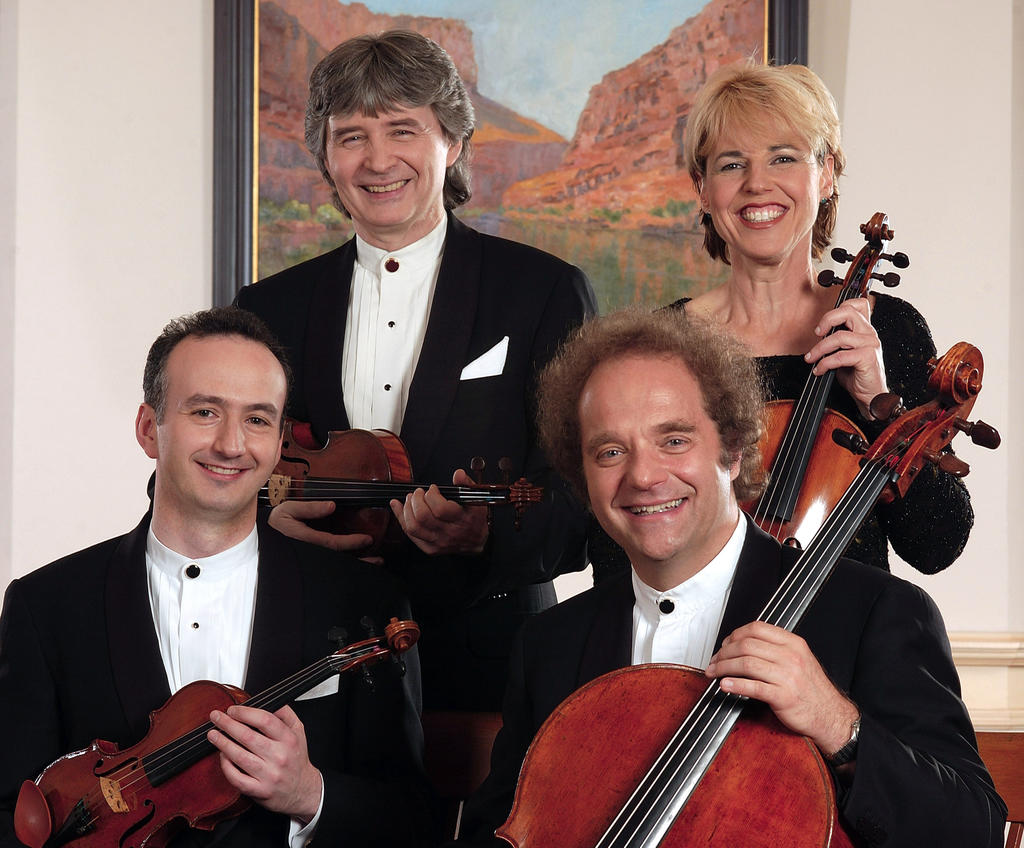
In Very Loving, Admiring, Cheery Memory of the Wonderful Roger Tapping

Roger Tapping was instrumental in my falling in love with the viola. I owe Roger countless hours of peerless chamber-music education, courtesy #TakácsQuartet (and a bit of @theJSQ). I admired him as a person and as a player. Roger Tapping has passed away. I will always remember him very warmly.

Here's a conversation with him from a few years back that hopefully conveys a small bit of how much I have cherished Roger Tapping.

---

Life After Takács – Roger Tapping’s Washington Recital


Roger Tapping is a known quantity among chamber music aficionados in Washington – especially those who have followed the Takács Quartet’s performances when he was on violist-duty for that formidable group. Since leaving the Takács Quartet in 2005 to spend more time with his family, Roger Tapping has continuously shown up in performances with (often very young) quartets at the Corcoran Gallery and Bethesda Music Society where he performed all of Mozart’s String Quintets with the JupiterParkerDaedalus, and Auryn Quartets. Last January he joined the Klavier Trio Amsterdam for the Fauré Piano Quartet.

available at Amazon Beethoven, String Quartets op.18,
Takács Quartet
Decca

UK | DE | FR

available at Amazon Beethoven, String Quartets opp.59, 74,
Takács Quartet
Decca

UK | DE | FR

available at Amazon Beethoven, The Late String Quartets,
Takács Quartet
Decca

UK | DE | FR

available at Amazon Bartók, The String Quartets,
Takács Quartet (II)
Decca

UK | DE | FR

available at Amazon Korngold / Schoenberg, Sextet / Verklärte Nacht,
Raphael Ensemble
Hyperion

UK | DE | FR

available at Amazon Dvořák, Quintet, Sextet,
Raphael Ensemble
Hyperion

UK | DE | FR
Retiring from playing in a professional chamber group must be tantamount to enjoying a new life. Instead of being on tour four, five weeks at a time, Tapping – who had previously served in the Raphael Ensemble and the Allegri Quartet – is now away from home for only a few days at a time. This not only means that Tapping can enjoy family life and focus more on teaching at the New England Conservatory but also that he can observe other string quartets he performs with from a detached point of view. Being one step removed, the intricacies of quartet–life become “sociologically interesting”: to see how four young players approach musical problems or react to new music; to observe how veteran groups resolve their differences in as many different – and the same – ways as, for example, married couples might approach theirs.

Though the occasional, wistful pangs of nostalgia for the Takács days still occur, Tapping – who recently spoke to me about his current activities and plans – seems to quite enjoy his newfound peace and the ability to moonlight with great chamber groups, both young and established. For example the Pražák Quartet which Tapping attested to feeling immediately comfortable with – perhaps because their wonderful balance of vigor and warmth is, at least to my ears, related to the playing of the Takács.

For the future we can expect lots of Mozart, Brahms, and Beethoven Quintets with Tapping and a host of fine string quartets but also the Beethoven String Trios, the type of chamber music formation that Tapping generally considers the ‘scariest’ to play because they offer no place to hide. Beethoven’s op.9, specifically, he described as particularly honest, unsentimental exponents thereof – in short: “The real thing”. (In so elucidating these works – works that I have hitherto not responded to with much enthusiasm – Tapping makes me want to seek out the Leopold Trio’s recordings that he recommends.)

Roger Tapping also plans on doing more viola recitals – such as will take place this Friday, the 29th at La Maison Française (7.30PM) where Tapping and pianist Judith Gordon will present a diverse program of Bach (a Gamba Sonata) , Fauré (Après un rêve), Hindemith (Sonata for solo iola), Schumann (Adagio & Allegro op.70), and Shostakovich (Sonata op.147). These recitals (and concerts) are an aspect of a non-chamber violist’s life he finds most pleasing, not the least because getting to play the melody for more than just two bars at a time is a completely new experience.

After talking about his present and future plans, I could not help harking back once more on his time in previous chamber groups. With the Raphael Ensemble from 1983 until 1990 he played alongside composer/performer Sally Beamish and participated in highly regarded recordings on Hyperion, including the BrahmsDvořák, and KorngoldSextets. With the Allegri Quartet he got to play next to the Pablo Casals student Bruno Schrecker who Tapping recalls fondly as the best bass line player he’d met. With this longest continually performing of British string quartets he played from 1990 until 1995 when, seeking a clean break in his private life, he auditioned for the Takács Quartet who needed to fill the violist’s seat after Gábor Omai had passed away.

He joined Károly Schranz, András Fejér, and Edward Dusinberre (who had himself just become a Takácsi 18 months before Tapping’s arrival), and contributed what was doubtlessly a golden age for the quartet, culminating in CD surveys of the complete Bartók and Beethoven quartets. They are widely considered first choices among modern digital recordings of either. Tapping mentions both when asked about his favorite recordings from that time. When he recently put on the Beethoven (which he had not listened to for a while, in part to avoid overt nostalgia) to see how his group had solved certain problems back then, he found himself “pleasantly surprised” how, despite the continuous development and evolution of how the Quartet approached these works, very nicely the Beethoven still held up. When pressed to chose between them, though, he points to the Bartók as their proudest achievement. (I’m not surprised: I fell in love with that recording nearly four years ago and that love has never ceased.)

The finest way to enjoy Mr. Tapping’s art, short of attending his recitals and concerts in the region, is through his recordings with the Takács Quartet and Raphael Ensemble. On the right I have listed some of my favorites in which he participates – none of which I would want to be without.


The recital at La Maison Française will be recorded by WETA and broadcast later in the year.

26.2.08

Life After Takács – Roger Tapping’s Washington Recital

Roger Tapping is a known quantity among chamber music aficionados in Washington – especially those who have followed the Takács Quartet’s performances when he was on violist-duty for that formidable group. Since leaving the Takács Quartet in 2005 to spend more time with his family, Roger Tapping has continuously shown up in performances with (often very young) quartets at the Corcoran Gallery and Bethesda Music Society where he performed all of Mozart’s String Quintets with the JupiterParkerDaedalus, and Auryn Quartets. Last January he joined the Klavier Trio Amsterdam for the Fauré Piano Quartet.

available at Amazon Beethoven, String Quartets op.18,
Takács Quartet
Decca

UK | DE | FR

available at Amazon Beethoven, String Quartets opp.59, 74,
Takács Quartet
Decca

UK | DE | FR

available at Amazon Beethoven, The Late String Quartets,
Takács Quartet
Decca

UK | DE | FR

available at Amazon Bartók, The String Quartets,
Takács Quartet (II)
Decca

UK | DE | FR

available at Amazon Korngold / Schoenberg, Sextet / Verklärte Nacht,
Raphael Ensemble
Hyperion

UK | DE | FR

available at Amazon Dvořák, Quintet, Sextet,
Raphael Ensemble
Hyperion

UK | DE | FR
Retiring from playing in a professional chamber group must be tantamount to enjoying a new life. Instead of being on tour four, five weeks at a time, Tapping – who had previously served in the Raphael Ensemble and the Allegri Quartet – is now away from home for only a few days at a time. This not only means that Tapping can enjoy family life and focus more on teaching at the New England Conservatory but also that he can observe other string quartets he performs with from a detached point of view. Being one step removed, the intricacies of quartet–life become “sociologically interesting”: to see how four young players approach musical problems or react to new music; to observe how veteran groups resolve their differences in as many different – and the same – ways as, for example, married couples might approach theirs.

Though the occasional, wistful pangs of nostalgia for the Takács days still occur, Tapping – who recently spoke to me about his current activities and plans – seems to quite enjoy his newfound peace and the ability to moonlight with great chamber groups, both young and established. For example the Pražák Quartet which Tapping attested to feeling immediately comfortable with – perhaps because their wonderful balance of vigor and warmth is, at least to my ears, related to the playing of the Takács.

For the future we can expect lots of Mozart, Brahms, and Beethoven Quintets with Tapping and a host of fine string quartets but also the Beethoven String Trios, the type of chamber music formation that Tapping generally considers the ‘scariest’ to play because they offer no place to hide. Beethoven’s op.9, specifically, he described as particularly honest, unsentimental exponents thereof – in short: “The real thing”. (In so elucidating these works – works that I have hitherto not responded to with much enthusiasm – Tapping makes me want to seek out the Leopold Trio’s recordings that he recommends.)

Roger Tapping also plans on doing more viola recitals – such as will take place this Friday, the 29th at La Maison Française (7.30PM) where Tapping and pianist Judith Gordon will present a diverse program of Bach (a Gamba Sonata) , Fauré (Après un rêve), Hindemith (Sonata for solo iola), Schumann (Adagio & Allegro op.70), and Shostakovich (Sonata op.147). These recitals (and concerts) are an aspect of a non-chamber violist’s life he finds most pleasing, not the least because getting to play the melody for more than just two bars at a time is a completely new experience.

After talking about his present and future plans, I could not help harking back once more on his time in previous chamber groups. With the Raphael Ensemble from 1983 until 1990 he played alongside composer/performer Sally Beamish and participated in highly regarded recordings on Hyperion, including the BrahmsDvořák, and KorngoldSextets. With the Allegri Quartet he got to play next to the Pablo Casals student Bruno Schrecker who Tapping recalls fondly as the best bass line player he’d met. With this longest continually performing of British string quartets he played from 1990 until 1995 when, seeking a clean break in his private life, he auditioned for the Takács Quartet who needed to fill the violist’s seat after Gábor Omai had passed away.

He joined Károly Schranz, András Fejér, and Edward Dusinberre (who had himself just become a Takácsi 18 months before Tapping’s arrival), and contributed what was doubtlessly a golden age for the quartet, culminating in CD surveys of the complete Bartók and Beethoven quartets. They are widely considered first choices among modern digital recordings of either. Tapping mentions both when asked about his favorite recordings from that time. When he recently put on the Beethoven (which he had not listened to for a while, in part to avoid overt nostalgia) to see how his group had solved certain problems back then, he found himself “pleasantly surprised” how, despite the continuous development and evolution of how the Quartet approached these works, very nicely the Beethoven still held up. When pressed to chose between them, though, he points to the Bartók as their proudest achievement. (I’m not surprised: I fell in love with that recording nearly four years ago and that love has never ceased.)

The finest way to enjoy Mr. Tapping’s art, short of attending his recitals and concerts in the region, is through his recordings with the Takács Quartet and Raphael Ensemble. On the right I have listed some of my favorites in which he participates – none of which I would want to be without.


The recital at La Maison Française will be recorded by WETA and broadcast later in the year.

3.10.05

Takács Addiction


Takács Quartet Concerts in the Area:

October 14, Carnegie Hall, NY
Mozart Quartet K. 465 ("Dissonance")
Debussy Quartet
Mozart Viola Quintet in g minor, K. 516 (w/James Dunham)

October 16, Foundation for the Advanced Education in Sciences
Bethesda, MD
(same program as Carnegie)

October 23, National Gallery, Washington
Haydn Op. 76 No. 3
Borodin No. 2
Beethoven Op. 127

February 25, Carnegie
Schubert a minor, D. 804
Bartok No. 2
Mozart Viola Quintet in C Major (w/James Dunham)

February 25, People’s Symphony Concerts New York, NY
Mozart K. 465
Bartok No. 2
Schubert a minor, D. 804

March 25, Duke University
Mozart K. 465
Beethoven Op. 127
Brahms Piano Quintet (w/Garrick Ohlsson)

March 31, Corcoran Gallery, Washington, D.C.
Mozart Quartet K. 465
Bartok No. 2
Schubert d minor, D. 810

April 1, East Islip Arts Council, Long Island, NY
Mozart Quartet K. 465
Bartok No. 3
Schubert d minor, D. 810

April 2. Colden Center, Queens College Queens, NY
Mozart Quartet K. 465
Bartok No. 3
Schubert d minor, D. 810

April 4, Philadelphia Chamber Music Society
Mozart Quartet K. 465
Bartok No. 3
Schubert d minor, D. 810

April 21, Carnegie Hall
Bartok No. 3
Mozart Clarinet Quintet K. 581 (w/Richard Stoltzman)
Schubert d minor, D. 810
When the Takács Quartet plays, Ionarts leaves wife and child behind, drops the ball on all other concerts (whether Lang Lang or Midori), and "With whip and spur we by the chantry [fly], In uncouth race." They are one of the best (if not the best) string quartet around these days - and in Beethoven and Bartók they are simply unparalleled. They are also a tremendous joy to watch, which contributes immensely to the live experience. The group has lost their violist, Roger Tapping, to the latter's domestic responsibilities and gained Geraldine Walther (formerly with the San Francisco SO) in his stead.

Unfortunately, it was an "uncouth race" (Wordsworth) to Baltimore indeed. Traffic jams, closed rail-way crossings, and detours kept us from our goal - perhaps we should not have made fun of these guys? Only after the Mozart Quartet K. 465 ("Dissonance") and Garrick Ohlsson's B minor Chopin sonata did we arrive at Shriver Hall. Slightly unnerved we may have been, but we knew that a treat would await us still - the Brahms Piano Quintet in F Minor.

Hearing the Takács I expect to be blown away. I don't expect "excellent" - I expect much more. I expect to hear a piece anew, I expect to access an element of joy and love for the performed repertoire that I had not yet discovered, I expect my jaw to drop and my soul to soar. I expect to get maudlinly effusive. Unfortunately, the performance of the quintet was only excellent. And it probably wasn't even that for the first two movements. The dry acoustic of Shriver hall swallowed the players a bit, and it took until the ravishing finale for the sparks to really fly. Garrick Ohlsson's dutiful contribution to the music was amiable but a bit stiff. Nor did unflexible translate into flawless. With the new violist, the quartet may have yet to find its former cohesion. It was interesting (if perhaps a coincidence) that the players' position made them look like a three-against-one formation - with Ms. Walther a little isolated out on the right (stage left). Her tone was strong, almost wailing at times, technically at the highest level, and individualy pleasant to hear. However, there was a trying feeling to it, also - and something un-chamber-like about it.

Shriver Hall, Johns HopkinsThe Takács are a joy to watch, all the same. The communication among the players, the always palpable joy with which they play their music sets them apart from all other quartets I have seen. Watching them brings the string quartet experience another, very important, level. And musically, the furious finale was almost what I had come to expect. First voilinist Edward Dusinberre set a merciless pace for the violist and the energy that went into the music could be felt coming out of it. It was a tremendous finish that made up for two hours of road rage.

In its new formation, the quality of the Takács Quartet has not noticeably suffered, although Mr. Tapping is surely missed. Or, as Charles put it very well after the concert: "I know Roger Tapping. Roger Tapping was my friend, and you, Ma'am, are no Roger Tapping." Well, she's not supposed to be - and I fully expect the Takács to form a singular unit very soon. They certainly have enough concerts to work on that - and luckily plenty in the region (see list on the right). As for Roger Tapping fans: there will be ample opportunity to hear him play in D.C. when he plays second viola to three different Mozart quintets at the Corcoran.

Additional Comments by Charles T. Downey:

When Mrs. Ionarts heard that her undergraduate flute teacher, Ethan Stang, had died this past summer, it made me think about my piano teachers and how I have been a neglectful former student. I had not contacted my own undergraduate teacher for years, ever since she had left Michigan State University, to return to Korea, where I assumed she had stayed. She was the strictest (read "best") teacher I ever had, introducing me to and making me love a much broader range of piano literature than I had ever known before. Imagine my delight when, after the comedy of errors recounted by Jens that made us so late (memo to self, never try to drive through Baltimore down Charles Street when the Ravens and the Orioles have just finished games), I should run into my teacher, who is now teaching at the Peabody Institute in Baltimore.

All in all, it is probably the longest time I have spent in the car to hear a single piece of chamber music, but I can't think of many pieces that would be more worth such trouble than the Brahms piano quintet. It was a fine performance, especially the third and fourth movements, when the quartet seemed to come to life, at least judging by the smiles that bloomed on all their faces. Looking at the schedule of upcoming concerts at Shriver Hall, we are going to be driving up to Baltimore, hopefully not under the same dreadful conditions, a lot, especially in the winter: the St. Lawrence String Quartet (December 4, 5:30 pm), the Capuçon brothers (January 29, 5:30 pm), the Vienna Piano Trio (February 26, 5:30 pm), Jordi Savall with Hesperion XXI (March 19, 5:30 pm), Krystian Zimerman (April 7, 8 pm), Fazil Say (April 9, 3 pm), and Angela Hewitt (May 14, 7:30 pm).

22.10.05

By Jove, That Jupiter Quartet


That Ionarts loves the Corcoran Gallery of Art's Frances and Armand Hammer Auditorium is no secret, and since the Corcoran’s is also one of the highest-quality chamber series, we usually love the content, too. Little wonder that the first concert of the season this Friday with the Jupiter Quartet (fairly unknown, still – but not likely for much longer) should have turned out well. Since the Jupiter Quartet is a ‘repeat offender’ at the Corcoran, it was not likely just the substantial cameo of ex-Takács Roger Tapping that filled the auditorium’s round to near capacity. The Schubert Quartettsatz stood out for the quartet’s ability to let the first notes swell from eerie sul tasto-like notes to a ff in four bars.

Maybe you can love Britten quartets when listening to them on CD. But you certainly cannot fall in love with them. For that you need as felt and accomplished a performance as the Jupiter Quartet delivered. The speech of cellist Dan McDonough before it was good, could have been shorter, and turned out to be entirely unnecessary as the powerful performance spoke volumes. The intertwined lines of the long last movement (Chacony: sostenuto) were presented in a rich sound, extremely well played with a wide palette of expressive dynamics, that made the Britten a most welcoming and lyrical work, a real pleasure for the ears.

Roger Tapping, who incredibly chose family over art when he left the Takács, is one of the finest (chamber-) violists around. Seeing this éminence grise among four players, all of whom could be his children, was charming. Nelson Lee (first violin), Meg Freivogel (second violin), Liz Freivogel (viola) and Dan McDonough at least didn’t appear intimidated and continued in the Mozart Quintet No. 4, K. 516, where they had ended in the Britten while Mr. Tapping visibly enjoyed the enthusiasm of his music-making junior colleagues. Liz Freivogel’s supple tone had already stood out in the Schubert and the Britten. In the Mozart (with an Adagio ma non troppo that was grave rather than lamenting) where she emitted first-viola-sounds right next to Tapping, it was even more impressive, both on its own account and in comparison. None of the boxiness that viola players often tickle out of their instruments but instead very burnished – a tonal quality that the quartet as a whole may also claim among their assets. Helped by the superior acoustic as compared to the Landon School’s Auditorium, I cannot say that I missed the Takács for a moment, even with their performance of K. 516 still in my ears from last week. That is – as those who know how I feel about the Takács – as high praise as I can muster.


Jupiter Quartet with Roger Tapping, Corcoran Gallery of Art, October 21, 2005

available at Amazon
B.Britten & D.Shostakovich, String Quartets 2 & 3,
Jupiter String Quartet
Marquis


To correct the imbalance of having mentioned the Takács twice as often as the quartet that actually did the playing: Jupiter Quartet, Jupiter Quartet, Jupiter Quartet. (That may incidentally have been the crowd’s reaction to the performance, had the average age not been above 60. Instead, they opted for sustained applause and standing ovations.) The quartet's accomplishment – some very minor slips in the Mozart only added a human face to it; not even the beeping of a hearing aid diminished the pleasure much – was deeply impressing and would have been so for a quartet of any age or, for that matter, with hands bigger than the notably filligrane paws of at least the three fiddlers of the Jupiter.

Upcoming performances at the Corcoran are the Garth Newel Piano Quartet on November 18th (notable for piano quartets by Arthur Foote and Joaquín Turina) and the Klavier Trio Amsterdam in Beethoven, Brahms, and the Fauré (which triggers Roger Tapping alert at Ionarts). The Jupiter Quartet’s next performance in the region is on December 16th at the Library of Congress. To hear their Sunrise (Haydn), Ainsi la nuit (Dutilleux), and Razumovsky no. 1 (Beethoven) I might even give up my boycott of that particular venue.

More ionarts reviews from the Corcoran

2.3.08

Roger Tapping @ Maison Française

This review is an Ionarts exclusive.

Roger TappingOn Leap Day, the list of possible concerts to attend was shortened by one when the Guarneri Quartet had to postpone their planned all-Beethoven program at the Clarice Smith Center due to an injury. This made it possible to attend the equally alluring recital by violist Roger Tapping at La Maison Française, which was previewed by Jens Laurson for WETA (including an interview with Tapping). Unfortunately, the recording made by WETA, and much of the live experience of the inventive program, was spoiled by the unbelievable racket from the embassy's malfunctioning heating system. It sounded like an army of interns was shifting around office furniture on an upper floor, or like gerbils rolling in cylindrical metal cages through a long crawlspace. Unable to stop or shut off the heating system, a staff member apologized at intermission and offered an early glass of wine to calm the audience's nerves, a palliative that was eagerly accepted.

The was doubly a shame because Tapping, the former violist of the Takács Quartet, had selected such an unusual, inviting program. Although he has freed himself from the demanding duties of touring with one of the best quartets around, Tapping is far from retired. Within the last year or two, we have reviewed him playing the Mozart quintets with the Auryn, Jupiter, Parker, and Daedalus quartets, and this is the second season in a row that he has given a solo recital at the French embassy with pianist Judith Gordon. The most appealing part of the program was the pair of Romantic bon-bons that framed the intermission. Schumann originally composed the Adagio and Allegro, op. 70, for horn and piano, but it has been adapted for several other instruments. It worked beautifully on the viola, especially with the elasticity of rhythm by the two performers, who made their best collective sound of the evening in this work. It was followed by Gabriel Fauré's Après un rêve, a delicate performance of this mélodie as melancholy and wistful as its poem.

If those were the sweet courses, the savory was provided by two modern masterpieces. Tapping's gentle, charming narration framed Hindemith's sonata for solo viola (op. 25, no. 1) perfectly. His performance of the wild, spastic fourth movement was a Stravinsky-esque romp, but it was the starkly introspective third and (especially) fifth movement that made the performance memorable, an exploration of somber melodies over gray, open intervals. The final composition of Dmitri Shostakovich's life was his viola sonata, op. 147, which opened here with a tense, intermezzo-like Moderato followed by a giocoso, grotesquely accented scherzo. The third movement, with its distorted quotation of Beethoven's "Moonlight" sonata, was plaintive and somber. Happily, with the Shostakovich, pianist Judith Gordon finally seemed willing to unleash the power of the embassy's Bösendorfer, which had sounded strangled for much of the evening. The opening Bach, an adaptation of the G minor viola da gamba sonata (BWV 1029), was the only musical disappointment, because the fast movements, rushed slightly, did not quite hang together.

The next concert at La Maison Française features the Chamber Orchestra of Philadelphia (March 11, 7 pm), in an all-French program.

13.3.07

Two Parts Mozart, One Part Britten

Auryn Quartett with Roger Tapping
Auryn Quartett with Roger Tapping, with apologies to Manfred Esser (photo credit)
On the recent occasions when Ionarts has heard ex-Takács violist Roger Tapping, he has been playing Mozart quintets with the Jupiter Quartet, the Parker Quartet, and the Daedalus Quartet. One could do worse things with one's retirement than playing the Mozart quintets repeatedly with every quartet possible. This month, Tapping is at it again, with the Auryn Quartett, in a series of three consecutive Sunday concerts sponsored by the Foundation for Advanced Education in the Sciences at Bethesda's Congregation Beth El. Throw in all three of Britten's quartets with all six of the Mozart quintets, and you've sold me.

Why are Mozart's quintets so much more interesting than his admittedly fine string quartets? Scholars have hypothesized that compositionally Mozart worked better in the five-part format, more Baroque (think Lully), than the four-part one of the quartet, more Classical. By electing to have the fifth instrument be a second viola, Mozart frees up the often maligned instrument's melodic potential, because the other viola can take up the considerable role of harmonic filler. Many of the main themes in the Mozart quintets begin in the first violin and are answered not by the second violin but by the first viola. For a composer with a contrapuntal mind like Mozart, that extra voice opens up countless surprising possibilities.

Auryn Quartett (selected):

available at Amazon
Grieg Quartets (2001)


available at Amazon
Braunfels Quartets (1998)


available at Amazon
Wolf Quartet / Intermezzo (2001)


available at Amazon
Britten Quartets 2 /3 (1996)
This first concert last Sunday opened with the first quintet (B-flat major, K. 174), composed in 1773 while Mozart was still in Salzburg. What seemed like a rough start -- intonation disagreements, the pacing not quite unified -- to this performance was smoothed over by the time the Auryn Quartett + Tapping repeated the exposition. The second movement, con sordini, was simple and understated in style, with lovely dialogue between the first violin and viola. When Mozart revised this quintet, he gave the Menuetto a trio section dominated by a charming echo effect. The sonic differentiation of statements and echos was superb in this performance, followed by a last movement pushed to the fast side of Allegro, combining technical assurance with clear understanding of form.

After intermission, it was what would likely be my favorite Mozart quintet, if forced to answer the question on most days, the G minor, K. 516. I would have expected this sublime work to have been reserved for the final concert, probably paired with its sunnier twin from the same period, K. 515 (both completed in 1787), which is indeed scheduled for the third Sunday. Yet here it was, in the key shared by some of Mozart's most expressive works. The best parts of the first movement are in the development, especially when at one point all of the instruments play the theme in a closely overlapping stretto, and in the dark-hued coda. At these contrapuntal moments, the players' eyes lit up as they translated the form into sound. The Menuetto and its briefly clarified major-key trio, shifted to the second movement, had a well-paced dance character. By the time the somber third movement and the suddenly hopeful G major conclusion struck our ears, the group had long ago hit its stride.

It is a brilliant programming coup to sandwich the Britten quartets with something as universally appealing as the Mozart quintets. These are works that more listeners should know and might take a chance on when packaged like this. The Britten quartets have impressed me deeply, both in the recording by the Belcea Quartet and in live performances by the Jupiter Quartet (no. 2) and the Brodsky Quartet (no. 1). This performance was no different, a combination of intense colors, especially in the tragic, gorgeous slow movement, and vigorous technique, with scherzo-like intensity in the second movement, characterized by short jabs of sound. The only false note was in the memorable opening music, steely chords played very high on the upper three instruments, which never quite sounded effortless. All is forgiven, however, because of the playful opening of the fourth movement, with a very fast, take-no-prisoners conclusion. This is Britten that will make converts.

There were plenty of seats left unoccupied. Do not miss the remaining two performances by the Auryn Quartett -- two Mozart quintets and one Britten quartet on each program -- on the FAES series at Bethesda's Congregation Beth El: March 18 (3 pm) and March 25 (4 pm).

22.1.06

Tapping Along With the Klavier Trio Amsterdam


The program notes to the Klaviertrio Amsterdam’s (KTA) performance at the Corcoran Gallery of Art this Friday, ever lucid and intelligently written by the Musical Evening Series’ chairwoman, Dr. Susan Joseph, opened with the bold claim that “[m]usic is not about progress.” I propose you wade through an entire year of ubiquitous Mozart and then reconsider, but meanwhile the three works on the program were supposed to support that point. Yet, highlighting the continuous appeal of Beethoven’s op. 70, no. 1 (“The Ghost”) with its innovative form – especially the first movement – vis-à-vis the later Brahms trio (no. 1, op. 8) and Fauré piano quartet, op. 15 (works much and justly beloved in their own right) only underscored the extraordinary position of Beethoven among composers… presumably because his music pushed new modes of expressiveness. It is our very 20th- and 21st-century understanding of classical music as a repertory art form that has, to a certain degree, divorced our appreciation of music from its progress.

The KTA’s performance, at any rate, did not concern itself with these matters – at least not on the surface of their stimulating rendition. A softly surging Largo in the Beethoven was especially appealing in a performance that was all one might expect (if lacking that wondrous ‘extra’ that makes for ultimate bliss) and compared favorably to the Peabody Trio’s performance last year. Although I would have loved to hear Klára Würtz (the nominal pianist and founding member of the KTA), it is questionable if she could have gotten more out of the Corcoran’s rickety Steinway B (an instrument that is more liability than asset for the Corcoran’s concerts, with its flattened and somewhat hazy, uneven sound) than her much appreciated substitute, Rob Mann – himself a founding member of the Amsterdam Piano Trio. His colleagues that night, who, together with Mme. Würtz are the founding members, were Joan Berkhemer (violin) and Nadia David (cello). Minor waywardness in individual notes not withstanding, the Brahms, too, was an assured joy. The Allegro con brio of this one trio alone would qualify Brahms for the pantheon of chamber music. The Andante celebrated the long melodies and led nicely to a busy closing Allegro.

Ludwig van Beethoven, op.70 / 1, First page of first movement, Piano Part


available at Amazon
G.Fauré, Piano Quartets,
Florestan Trio
Hyperion

The second half was dedicated to a work that is as beautiful as it is rarely performed: Fauré’s piano quartet. Adding his viola to the mix was none less than Ionarts-favorite and ex-Takács Roger Tapping. I noticed no deviation from his usual excellence, and everyone around him, too, seemed to have performed at a level that was another notch higher. The Scherzo, not easy to keep together with its cross-rhythms, bubbled with coherence.

With performers like the KTA/Tapping combination, the above argument of music and progress rephrases itself: music may still be insisted upon as being about progress – but everyone should on occasion be retrogressive and smell the flowers!

Roger Tapping will be back at the Corcoran for the remainder of the great Mozart quintets on March 3rd with the Parker String Quartet (Tower, Schumann) and May 12th with the Daedalus Quartet (Mendelssohn, Britten no. 2). The Takács will play at the Corcoran on March 31st (Mozart “Dissonance,” Bartók no. 2, Schubert “Death & Maiden”).

29.1.11

Ariel Quartet Full of Noises in Berg

It occurred to me last night, as I approached the door of the Corcoran Gallery of Art's Hammer Auditorium, that Ionarts had not been there since the last time we reviewed the Klavier Trio Amsterdam, back in 2009. Furthermore, although we have reviewed violist Roger Tapping playing the Mozart quintets with string quartets (like the Auryn, Jupiter, Parker, and Daedalus) over the years, we had also not managed to review one of his concerts with the Ariel Quartet, although they have been playing at the Corcoran and other Washington venues on a fairly regular basis. The Corcoran has perhaps the finest auditorium for chamber music in the city, but its concert series has been cut back to just a few events each season. The Ariel Quartet was back on Friday night to put some energy back into chamber music at the Corcoran, playing quartets by Beethoven and Berg, plus one of the exquisite string quintets of Mozart, joined by ex-Takács violist Roger Tapping. After some trouble with the light settings for the stage, forcing the group to play the Beethoven in crepuscular darkness, the group gave a knockout performance of the Berg.

The Ariel Quartet, formed in Jerusalem in 1998, hit the American classical music world around 2006, coming out of the New England Conservatory of Music with a full head of steam. They managed a third prize at the Banff Competition in 2007 (the year that the TinAlley Quartet took first and the Zemlinsky Quartet took second) and ultimately graduated from NEC last year, moving on to further studies at the Musik Academie in Basel, but critics -- like Robert Battey for the Post in 2008 -- have not always been impressed by much beyond their obvious technical skill. The group literally sunk its teeth into Beethoven's third quartet (op. 18, no. 3), with a violence of attack and a tone that was more searing than glowing, a performance that was all frenetic energy and sharp edges. The tempo of the outer movements was pushed so fast that most rhythmic details had to be glossed over, most disturbingly in the closing Presto, and the third movement tripped over itself in much the same way. The second movement oozed a little more expansively but felt more precious than profound.

Since the Ariels did win the Székely Prize, for the best performance of a Bartók quartet at the Banff Competition, it was probably not a surprise that their performance of the Berg string quartet (op. 3) was the concert's high point. The range of tone color, shape of phrase, and clarity of form not only showed the group's predilection for more biting, dissonant harmony, not to mention the greater independence of the parts, but revealed their indifference -- contempt is probably too strong -- for the Beethoven quartet. Here the four musicians listened more to one another, not as in the Beethoven straining so much against their parts that they pushed first violinist Alexandra Kazovsky into a forced, acidic sound. The various effects of Berg's score, like harmonics and raspy sul ponticello playing, all served as part of a well-conceived drama that arched over the two movements.


Other Reviews:

Stephen Brookes, Ariel Quartet (Washington Post, January 31)
The presence of Tapping on the second viola part in Mozart's fifth string quintet (D major, K. 593) seemed to mollify the younger musicians, with the high strings in a purely blended ensemble answering each of the opening phrases of the cello in the first movement's introduction (a dreamy section that returns memorably in the movement's coda). Freed by the second viola part taking some of the accompanying motifs, Mozart gave the first viola greater independence, revealing the sinewy tone of violist Sergey Taraschchansky, especially in the many sections given to the two violas with cello in the slow movement. The suave trio of the Menuetto movement had a bubbly quality, driven by the arpeggiated flourishes introduced by the first violin, although Gershon Gerchikov, who sat first violin for the second half, was not quite clean enough in the many passages of detached notes of the somewhat lightweight final movement.

You have to wait only a week for the next concert at the Corcoran, featuring the return of Klavier Trio Amsterdam next Friday (February 4, 8 pm), including two Beethoven trios (op. 1/3, and the 'Kakadu Variations', op. 121a) and the second piano trio of Saint-Saëns.

11.10.12

Roger Tapping Joins the Juilliard Quartet

In the world of string quartets, this is big news: Roger Tapping, much beloved at ionarts for his musicianship—as part of the Takács Quartet (where he played viola for a decade and shaped the group's extraordinarily successful 'Decca - period') and as an add-on violist to many young quartets (which stopped by the Corcoran Gallery when it still had the best chamber music series in town), the Auryn Quartett, the Klavier Trio Amsterdamwill be the new violist of the Juilliard Quartet.

Currently a faculty member at New England Conservatory, Tapping will also join the Juilliard’s viola faculty beginning with the fall 2013 semester. As violist of the Juilliard he succeeds Samuel Rhodes, who has been a member of the Juilliard  Quartet since 1969 and is the most senior member of the group. Rhodes will continue to teach and remain the Chairman of the Viola Department at Juilliard.

His fellow members of the quartet are, in order of Juilliard senority, Joel Krosnick (cello, since 1974), Ronald Copes (second violin, since 1997), and Joseph Lin (first violin, since 2011).

21.12.17

Best Recordings of 2017


Time for a review of classical CDs that were outstanding in 2017 (published in whole on Forbes.com here and here (Part II)).

My lists for the previous years: 2016, 20152014, 2013, 2012, 2011, (2011 – “Almost”), 2010, (2010 – “Almost”), 2009, (2009 – “Almost”), 2008, (2008 - "Almost")
2007, 2006, 2005, 2004.


# 1 - New Release


Franz Schubert, Die Schöne Müllerin, Christian Gerhaher, Gerold Huber, Sony Classical

available at Amazon
Franz Schubert, Die Schöne Müllerin,
Christian Gerhaher, Gerold Huber
Sony Classical

Hyperbole has little room in classical music – it’s too blunt, usually inaccurate, ever unsubtle, mostly unsuitable, and a bit in bad taste. But it gets eyeballs.

And in this case, some hyperbole might just apply. Christian Gerhaher and Gerold Huber, that perfect symbiosis for all matters Lied, mélodie, and artsong (but especially Lied), have… has re-recorded Franz Schubert’s song cycle Die Schöne Müllerin after putting their first go at it on record 14 years ago (Arte Nova).

I had been counting the days, for years. GerhaherHuber (one word) is to Lied what Willie Mays and Babe Ruth, rolled into one, were to Baseball. (Read the full review here: Review: Oh, Only The Best Schöne Müllerin Ever!)...


# 1 – Reissue


Ludwig van Beethoven, String Quartets +, Takács Quartet, Decca

available at Amazon
Ludwig van Beethoven, The String Quartets +,
Takács Quartet,
Decca

...taking everything into consideration, across all 16 ¼ quartets, my favorite so far remains the Takács Quartet. And not just mine: Their interpretations have long been the rightly forerunner among modern interpretations of the Beethoven String Quartets. Interestingly these recordings – jewels in the Decca catalogue – were long treated more like step-children. The line-up in those years was that of Edward Dusinberre, Károly Schranz, Roger Tapping, András Fejér, which was an 11-year golden period for the quartet (Roger Tapping left in 2005).

The recordings had to be financed because Decca wouldn’t front the bill, despite their great success. (Admittedly, Decca couldn’t have known who successful they’d become… at least not before the first box had hit the market.)...


The complete list of the "Best Classical Recordings of 2017 on Forbes.com can be found here, for new releases. For re-issues, the link is here