CD Reviews | CTD (Briefly Noted) | JFL (Dip Your Ears) | DVD Reviews

10.12.06

Dip Your Ears, No. 72

available at ArkivMusic
S. De Brossard, Les Grand Motets, EBL, Christophe Coin
Touches of Charpentier again – but also German baroque can be found on the second recording of the Laborie label. This time the Ensemble Baroque de Limoges under Christophe Coin comes up with the three Grand Motets of early musicologist Sébastien de Brossard (1655 – 1730). “In Convertendo Dominus”, “Miserere”, and “Canticum Eucharisticum Pro Pace” are three works by this French/Alsatian composer that add up to over an hour of very fine early baroque music, bound to please anyone who wishes to look beyond Bach cantatas and Charpentier’s Te Deum. The singing is excellent (especially basses Olivier Lallouette and Jérôme Corréas) – and so is the playing of the Ensemble Baroque de Limoges. Not essential, of course, but a delightful second issue from this enterprising label and group. (That it is in fact a re-issue doesn't deter... although that factoid is more hidden than offered. This disc originally came out on the Astrée label in 1997.)

LABORIE LC02. You can read the review of LABORIE LC01 here.

In Brief

LinksHere is your regular Sunday dosage of interesting items, from Blogville and beyond:

  • Musicologist Martin Geck writes book on Bach. Professional stuffed shirt William F. Buckley reviews it. It's War of the Worlds. Musicologist Phil Ford explains what Buckley got wrong. [Dial M for Musicology]
  • Anne-Carolyn Bird buys some scores at Patelson's, that famous temple of music in Manhattan. [The Concert]
  • What are the top five American orchestras? According to Fred Kirshnit, in no particular order, Pittsburgh, Boston, Cincinnati, Los Angeles Philharmonic, Chicago. [NY Sun] Hat tip to Poor Richard's Anorak
  • After a year of speculation, Nicolas Joel, director of the Théâtre du Capitole in Toulouse, has indeed been tapped to replace Gérard Mortier as head of the Opéra National de Paris, effective in 2009. [Bloomberg]
  • Some exciting news about contemporary operas to be produced soon in the United States. The Met will mount Philip Glass's Satyagraha in Spring 2008 (in conjunction with an avant-garde theater company? -- we are talking about the Metropolitan Opera here, right?), and Ionarts favorite Santa Fe Opera will give the American premiere of Kaija Saariaho's Adriana Mater in Summer 2008. Both are excellent operas, which I have only heard and not seen (the former on recording and the latter by radio broadcast). I would probably have opted for Akhnaten instead of Satyagraha, if it were up to me. [Out West Arts]
  • Jessica Duchen wants you to sign a petition if you like the music of Erich Korngold, or rather, she wants you to leave your name with the Web site of the Korngold Society, to petition Amadeus Press to reprint Brendan Carroll's Korngold biography, in time for next year, the 50th anniversary of Korngold's death. [Jessica Duchen]

9.12.06

OAE @ LOC

Mozart, Gran Partitta, K. 361, holograph score, Library of Congress
A near-capacity crowd filled the seats of Coolidge Auditorium on Thursday night, for the latest free concert from the Library of Congress. The draw was the chance to hear members of the Orchestra of the Age of Enlightenment, one of the best-regarded historically informed performance ensembles, give a rare live performance of Mozart's Gran Partitta. At the last minute, the group of eight woodwind players, accompanied by four horn players and a double bassist, traveled to the U.S. without their first bassoonist, Andrew Watts. Fortunately, American bassoonist Andrew Schwartz, of the Little Orchestra Society and other groups, stepped in to make the concert happen.

Other Reviews:

Daniel Ginsberg, Orchestra of the Age of Enlightenment (Washington Post, December 9)
The evening opened with another wind serenade, K. 375, a wind octet version of a piece that Mozart composed shortly after he arrived permanently in Vienna. The work was intended for the group of crack wind players at the Imperial Court, the Kaiserlich Königlich Harmonie, which included clarinetist Anton Stadler. All eight players are tested by demanding passages, and the evening featured some remarkably virtuosic technique, especially given the unruly nature of the older instruments involved. In particular, the materials involved tend to create more problems with condensation, something that was commented upon by first clarinetist Antony Pay to explain the players' frequent "mopping out" of their instruments. The Masonic key of this serenade, E-flat major, and the chordal knocking motif of the opening bars reminded me, obliquely, of The Magic Flute. (Mozart and Stadler were members of the same Masonic lodge, and Mozart wrote a number of parts for him, including obbligati in La Clemenza di Tito.) The OAE gave a jolly reading of the piece, with a melancholy trio in the first menuetto and a fast, almost carnivalesque rondo in the finale.

Basset horn
"The basset horn, which sounds with a diffuse golden tone and looks like a broken clarinet with a nozzle at the base."
-- Daniel Ginsberg, Washington Post
The basset horns, three of them, did not appear until the second set of pieces, five terzetti for basset horns by Anton Stadler. The older version of the instrument is mellow, with the chalumeau smoothness of its relative, the clarinet. Stadler was probably writing these little badineries for himself and perhaps students, as the first part mostly dominates. The accompaniments spun out by the subservient lower parts are often little more than music-boxy hurdy-gurdy sounds, supporting chipper, if pedestrian melodies. The five movements are based on dance rhythms, but there are few surprises, except for the chromatic, almost bluesy coloring at the end of the final phrases in the last movement.

The inferior nature of these compositions was made explicit by the little bon-bon the three players offered as dessert, Mozart's Canonic Adagio (F major, K. 484d [410]). If the Gran Partitta, now dated to 1784, shows leagues of development in Mozart's compositional style over K. 375, this enigmatic miniature, from late 1785 (actually scored for two basset horns and bassoon but played here with the three basset horns), is even more striking. Certainly shaming Stadler's little ditties, the Adagio feels quite like a sort of personal experiment, Mozart exploring the counterpoint and adventurous harmony he had been studying in the music of J. S. Bach. One audience member called out for the little piece, over in a minute or two, to be played again, but he was not obliged.

The Library of Congress owns the holograph score (page shown above) of the Gran Partitta (Serenade in B-Flat Major, K. 361), and they have published a facsimile edition of it. The critical edition, edited from the holograph and other primary sources by Neal Zaslaw and Daniel Neeson for the Neue Mozart-Ausgabe, finally dispelled the misconceptions about this work, which date back to "editions" made in the years after the composer's death. It added a level of significance to see the page in Mozart's hand in a case outside the auditorium. While the intellectual and technical qualities of this concert certainly impressed, musically one sensed something missing at times. This was typified in the Gran Partitta's glorious Adagio movement (which makes a memorable appearance in the film Amadeus), dashed off at a tempo closer to Andante than Adagio. The result was disappointingly prosaic. All, or almost all, of the surface details were there, but at times like this it was only an outside sheen.

The next concert in the Library of Congress series (December 15, 8 pm) is an all-Schumann program played by Joshua Bell (violin), Paul Neubauer (viola), Steven Isserlis (cello), and Jeremy Denk (piano).

Nicholas Angelich at the Corcoran


Nicholas AngelichA black, shiny surprise awaited the audience in the sparsely filled Hammer Auditorium of the Corcoran Gallery Wednesday night when, instead of the raggedy Steinway of debatable quality, a Yamaha concert grand greeted them from the stage. Working on it that night, as part of the “Les Grands Pianistes” series that the Corcoran Gallery and the Maison Française co-present, was the U.S.-born French pianist Nicholas Angelich. The second of originally four (but after Alexandre Tharaud’s cancellation only three) pianists in that series, his performance was going to be measured against the considerable standard set by François-Frédéric Guy, the pianist who went first in this line... and it measured up nicely.


available at Amazon
Brahms Piano Works


available at Amazon
Brahms Violin Sonatas


available at Amazon
Brahms Piano Trios


available at Amazon
Beethoven Sonatas


available at Amazon
Liszt "Années de pèlerinage" (currently out of catalog)
The piano had the typical Yamaha sound: Responsive, clean, angular, and always accentuating brightness over roundness. A good and sensitive pianist can elicit wonderful things from it; bangers are mercilessly exposed. Nicholas Angelich is certainly a sensitive musician and more than merely “good” – as he proved in the quintessentially romantic program of Schumann and Brahms, starting with the former’s 1838 Arabesque in C Major, op.18. Round, delicate, but with meat on the bones, and deeply felt: This was what the ears expect Schumann to sound like. Mr. Angelich delivered all that, and more, again in the op. 12 Fantasiestücke. “Des Abends” was calm and moody; slow but always cohesive. Hearing “Aufschwung” (hesitancy next to impetuosity) it is difficult not to sense the vast influence over Schumann’s œuvre for piano must have had on impressionist composers like Chopin, Debussy, and Field.

Brahms came with a crystalline sound whenever bolder tones were struck in the Fantasien, op. 116 – namely the opening and closing Capriccios in D Minor… in between Angelich returnd to his languid, nocturnal style of interpretation. A little pedal heavy at times and always with some inflection (imagine Backhaus as the polar opposite of this style), the Brahms was personal, woolly, comforting to most, and perhaps too obsessive or wrought with sedative romanticism for a few dissenting ears. The four Klavierstücke, op. 119 (three Intermezzi in B Minor, E Minor, and C Major; Rhapsodie in E-flat Major), made the preceding “Capriccios” seem more important: Amid all that Brahms and Schumann (a complacent, meandering mélange of on-the-sleeve romanticism) they represented a jolt of life. How a dry, crisp two-movement Beethoven sonata might have provided desirable contrast!) But if romantic monochromaticism is no deterrent to one's musical palate, the Klavierstücke will have been keenly enjoyed. Especially the C Major Intermezzo (where brevity aids inventiveness to great effect) and the E-flat Major Rhapsodie that came like a needed breath of fresh air to the recital.

If the Rhapsodie was a “breath of fresh air,” though, the two Bach encores (the Allemande from the Second Partita and the Gigue from the Second English Suite) were like musical detoxification or at least a ‘taking to the baths’ at a Spa. They were indeed beyond ‘welcome’: They were a necessity of enormous grace and beauty – not all of which was due just to the ingenuity of Bach’s music, either. Rarely was it more true or plain that encores are indeed “gifts” from the performer to the audience.

A repeat performance of this or a similar recital took place at the Maison Française on Thursday night. The next performance in this series will be that of Pierre-Laurent Aimard in May.

8.12.06

(Air-)Wave the Last Classical Notes Goodbye

WGMS LogoWGMS, Washington’s Classical Station (the moniker, insinuating “primary” or “first”, became true by default when WETA abandoned their mission and classical music last year), will soon send its last bit of classical music over the Washington region airwaves. The station, owned by the Bonneville Inc. is about to be sold to Red Skins owner Dan Snyder who has plans to convert it into one of his “Red Zebra” Redskins sports stations. (If you didn’t have much sympathy for Snyder to begin with, add to his list of achievements that he took Classical Music off the air in Washington.)

WGMS, no doubt, was not the ideal classical radio station. Far from it. They played the seemingly same music up and down the “greatest Hits” list; there was rarely an intriguing surprise; the commercials were beyond annoying. It was “Classical Music for Dummies” – but at least it was classical music. And it was a successful, profitable (!), classical radio station. (Having learned about the difficulties that go into assessing a classical station’s listenership, I have gained much respect for the efforts – if not always the results – of stations like WGMS.)

Viva La Voce LogoAfter being downgraded from the stronger 103.5 signal (now broadcasting the higher revenue Bonneville’s WTOP), WGMS was to address the holes of its coverage (ironically you couldn’t receive the WGMS signal at the WGMS station itself) with a booster. Moreover, WGMS was working on a very exciting project that would have had any Ionarts reader’s ears perk up: A Digital Radio Channel – traveling on the 103.5 frequency together with the digital “twin” signal of WTOP – was being worked on. Rather than simply copying WGMS’ program and spewing it out in a digital format (which means CD quality sound at the receiver’s end, among other benefits), it was to be an entirely different program. Under the working title “Virtuoso”, it was to be a “hard-core” classical channel – on the air as soon as February or March. Imagine late Beethoven String Quartets. Complete Bruckner Symphonies. Music by living composers, like Paul Moravec.

Other Articles:

Paul Fahri, Redskins Owner Set to Buy Last Classical Station (Washington Post, December 8)

Alex Ross, WGMS says goodbye to good music (The Rest Is Noise, December 8)

David Hughes offers continuous coverage and updates on DCRTV.com
Unlike with satellite radio, HD Radio is free and only requires a digital receiver. Unlike Internet Radio, HD Radio is not terribly expensive to send out to a large group of listeners. (Streaming costs became so prohibitively expensive that WGMS’ Internet Vocal Classical Music Station, “Viva La Voce”, had to move from a free, to a subscription model. Not to make money from the subscription – at $5 a month only a nominal fee, anyway – but simply to reduce the number of listeners to assure the station could afford to keep Viva La Voce alive until a new financing model would have been found.) The future of Viva La Voce and Virtuoso are probably as dim as that of WGMS’ regular program. Especially the presumed, prenatal death of the latter is the true, hidden, tragedy of the takeover of WGMS.

Under their current general manager Dan DeVany, WETA is not likely to go back to classical music because it would be tantamount to admitting complete failure of the move that he fought so hard for. WETA’s ratings are down, since; as are individual contributions. The minority audience share has, to my knowledge, not gone up… although it was a large part of the justification for the switch. (Unfortunately Mr. DeVany seems to see classical music through a racial prism.) This leaves Baltimore's WBJC as the entire Washington/Baltimore region’s classical music station. Unless you live in Silver Spring or Bethesda or have a high quality receiver and a huge roof-antenna, however, you won’t reap those benefits.

P.S. Good news for entrepreneurs? If Dan Snyder gets rid of the classical format, Bonneville is allegedly offering to donate the WGMS music library to any station that will preserve the format in the DC market.

Stocking Stuffers

MoMa 4I’ve been remiss with my postings as this is always a busy time of year at my house; add to that a spousal book tour in full swing. That said, I will have a few more posts before the year ends. Not from the hipper-than, Miami scene, but as good and with cheaper accommodations.

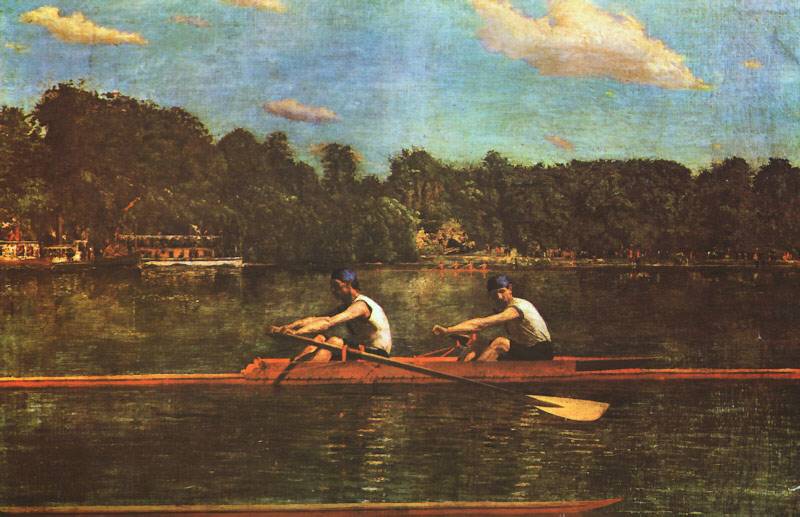
I’m on the train from Baltimore to NYC, passing through Philly, and I just had an Eakins moment, a lone rower on the river, with a bright sun cast on the water; thank you, Amtrak.

Since I’m in a thankful mood, let me also start my end of year string of thank you’s; this may take a few postings, as I’m a very lucky blogger. Thanks to Charles for his insightful and patient editing. My postings go into the hopper looking like Oprah, without make-up, before a cover shoot, and come out looking quite logical. It’s all a mirage, people. [It's not THAT bad. ;-) -- Ed.]

Several shows have been on my wish list, and they are about to close. Sean Scully at the Met, John Currin porn at Gagosian, and Manet’s incredible three versions of Execution of Maximilian at MoMA. Once the holidays hit, I’ll be wishing only for more food, drink, food, and hopefully sunscreen; so this is perfect timing.

The Manet reminded me of Goya’s 3rd of May, so he’s on my mind. We haven’t publicly heard any follow-up on the recent theft of a Goya painting, Children with a Cart, en route from the Toledo Museum to NYC for exhibit at the Guggenheim. Luckily the painting was recovered, but the situation surrounding the theft remains a mystery. How could a painting of such value end up in an unguarded truck, in a motel parking lot, over night? Was the air temperature regulated? Why didn’t an alarm sound? Why wasn’t the trip made nonstop? This painting is a public treasure, and I think any investigation of these events should be transparent and thorough. Would the public be surprised by the conditions that many works of art travel around the world, or by how much art is in transit daily, by Fedex?

IMG_0199.JPGSean Scully’s Wall of Light series at the Met did not disappoint. I have only had the opportunity to see a few of his paintings, and to see a selection like this is great. He’s a real lover of paint and takes great pleasure with the action that happens on the edges of and between the colors; this creates a liveliness of floating cloud-like grids of color. A smaller gallery has a selection of his watercolors, pastels, and prints.

Also at the Met, a must-see show if you're in town, Cézanne to Picasso, Ambrose Vollard, Patron to the Avant-Garde. Vollard was the most influential dealer in turn-of-the-century Paris. A promoter of artists and publisher of prints and books. Through his exhibits he established the reputations of Cézanne, Van Gogh, and Picasso; he gave Matisse his first solo show.

In 1895, the year of Van Gogh’s death, at the age of 24, he opened his first gallery. Van Gogh’s friend Emile Bernard suggested his inaugural show be of Van Gogh's work. Unable to find enough of his work in Paris, six days before the show, he contacted the family. Theo had died in 1891, but his widow, Johanna, sent him ten paintings to exhibit. The first show was a bust, but soon after the work began to sell, and eventually Vollard made a nice profit.

Gauguin

He also had a lot to do with an artist named Gauguin and this show has some fabulous Cezanne figurative compositions, worth the vist alone. Ever wonder, as I have, how Picasso got to make so many etchings and aquatints? The Suite Vollard, over 100 plates printed in 1939, is also on display. Art dealers, sometimes they do great things, too.

John CurrinI made the uptown gallery runs while I was there: Allan Stone, Cheryl McGuinnis, Lesley Heller, and then Acquavella, to see Lucian Freud’s latest work. I was interested in, Before the Fourth, a smallish etching, approximately 18x20 in an edition of 46, only $20,000. The Ionarts bonuses should be in the mail.

Freud’s naked portraits warmed me up for John Currin's hilarious twist on porn, which gets everyone in the Gagosian Gallery door, but theres‘ more to it. Currin is a very good painter, not only because he has told us so, it’s true. But he’s got a wonderfully twisted imagination, I’m hooked for more. An ode to Courbet?

My MoMA membership has proven to be a wise investment this year. I get to cruise right in and see three versions of Manet's Execution of Maximilian. Max, the Archduke of Austria, was persuaded by Napolean III to lead a campaign in Mexico to oust Benito Juarez, the first indigenous, elected president of Mexico; Napolean disliked his liberal beliefs, the L word. The invasion was sucessful, but Maximillian was inept and oppressive. Juarez organized a guerrilla insurgency and regained power, and Maximilian and his generals were executed.

Execution of MaximilianAs differing accounts of the event slowly reached Paris, Manet got to work. The first version (1867, shown), which is now in the collection of the MFA, Boston, is my favorite: it's a loosely painted, intense, moody scene. The firing squad is wearing sombreros -- the first reports were of a peasant uprising -- Maximilian and his staff are shrouded by the smoke of the gun fire. The second version, 1867-68, shows a more mannered, conservative approach (with traditional military attire and the victim visible), was damaged in the studio. The damaged sections were destroyed and the remaining sold separately by his heirs. Edgar Degas sought them out and reassembled them.

Eventually purchased by the National Gallery, London, it wasn't until 1992 that they were assembled onto one canvas, as in this exhibit. The third version, 1868, from the Kunsthalle, Mannheim, is similar to the second: in this version the background is more involved, an audience of peasants are witness from behind a wall, the uniforms are of professional soldiers, Maximilian and his generals are in full view, holding hands, awaiting their fate. This is one of those rare opportunities to have three versions of an iconic image in the same gallery, with a host of supporting materials, photos, prints, and paintings. As if you need more reason to visit NYC at this time of year, wear a hockey outfit as you walk the streets though: lots of dazed pedestrians with flailing shopping bags.

Shanghaied Into Beethoven

Shanghai QuartetThe Shanghai Quartet is an institution at the Freer/Sackler Gallery by now – and they are not only regular guests in Washington but also a chamber-music highlight of the season. The proved to be so much in the first movement of Barber’s String Quartet op.11, which has the tantalizing quality of keeping you on your toes, always apprehensive of what might come next – but always rewards with rich, unexpected beauty. On top of that it has plenty rhythmic drive. In short, the two-movement quartet – at least in the hands of the Shanghai Quartet – impressed far beyond what one might expect from a work that had the unfortunate fate of getting its slow movement culled and transmuted into the (usually saccharine) “Adagio for Strings”. Of the latter, any self-respecting ear will grow tired, soon. As part of the String Quartet, however, it (thankfully) takes on a “new” guise: Delicacy and haunting tones instead of the listener being smothered with syrup. (Even if you still think you’ve heard that work too many times, it’s worth it just for that first movement.) The short Molto Allegro (much of it rather slow, actually) of the second movement’s finale harks back to that first movement and ends with a nice kick to the Adagio-complacent ears.

The Shanghai Quartet on Ionarts:

Shanghai Quartet and a Taste of China (April, 2005)

Shanghaied at the Freer (May, 2006)

Just like the Shanghai Quartet’s appearances are a tradition at the Freer, so is their habit of programming one Chinese work and one Beethoven Quartet for the evening. This time it was Ge Gau-ru’ Four Studies of Peking Opera for String Quartet and Piano. The work contains sweeps on the first violin, aggressive, toneless pizzicatos on the second violin and cello, high pitch pizzicato chirping on viola, and the sound from the prepared and amplified piano (which rattled like someone had forgotten their knitting-needle collection in the bowels of the Steinway). And that was just the Prologue. The whole thing is so foreign to Western ears that nothing of it will be perceived as “classical” in style – (classical Chinese sounds though it approximates) but a slightly exotic mesh of sound and noise that reminds more of our own avant garde rather than cultural exchange.

After Ge Gau-ru’s work, Beethoven’s op.131 sounded very different than it usually does. The lean but sinew sound of the Shanghai Quartet can offer a lot with its lithe violins and viola (Weigang Li, Yi-Wen Jiang, Honggang Li, respectively) and the brazen, brutally sonorous, romantic sound of cellist Nicholas Tzavaras. But it is not an approach that seeks beauty of tone above everything else. The seven-movement behemoth that is Beethoven’s string quartet is full of music that takes time and exposure in order to appreciate its greatness. Performances like the Shanghai Quartet’s – even if a good bit south of perfection – are just the thing to get newcomers to the Beethoven truth and offer more seasoned ears some enjoyment, too.


7.12.06

All That Jazz. Again.

Tord Gustavsen TrioIonarts rarely ventures outside the classical realm publicly (if plenty, privately) - but the Tord Gustavsen Trio has been worth mentioning twice before here - and it's worth mentioning again, especially since they have a gig in town today,as part of the free Kennedy Center Millennium Stage concerts.

Their performance will take place in the Terrace Theater, not on the side stages of the Kennedy Center's main hallway. To find out all about the Dialectical Eroticism of Improvisation that Gustavsen champions, be there at 6PM. You can also listen to a live internet broadcast. If Jazz in general (and Keith Jarrett in particular) is your thing, you don't want to miss it.