As I mentioned previously, Eugene Leake has a posthumous exhibit at the C Grimaldis Gallery, with work from 1911 thru 2005. Gene was well known in this area as a great painter of the countryside north of Baltimore, but he was also president of the Maryland Institute College of Art for 13 years. Mica blossomed under Leake’s charge, doubling enrollment and tripling the faculty size, earning a national reputation.
This is a sizable show of 36 works, many removed from his studio and cleaned after his death. There are some fine examples of his work here, including a rare landscape with a figure, Red Nude with Green Background, reminiscent of Fairfield Porter. Also rarely seen watercolors, from a 70s trip to Ireland, and a beautiful small black night scene, Light on a Winter Forest Stream.
Mr. Leake was one of the first artists I became aquainted with, when first moving to Baltimore some 20 years ago. In that time I watched as he would go from loose, simplified imagery to more formally structured and then veer a bit towards the abstract; always searching. He produced a series of night scenes a few years ago that were stunning, those late-in-life paintings that for me, go beyond formal boundaries; they have an inner life to them. Some of Monet’s waterlilies have that same presence: they become celestial.
He was also a late bloomer, not really finding his stride until his late 50s: now that’s inspiration.
On Sunday evening, Canadian pianist Louis Lortie gave one of the best recitals in recent memory on the National Gallery of Art's free concert series (he gave the same program last week in Santa Fe, reviewed by one D. S. Crafts). Lortie has appearances in Washington from time to time, most recently at the National Gallery three years ago, but this was the first time I had heard him play. The program combined three of his strengths -- Liszt, Chopin, and modern music -- executed with overpowering strength and graceful finesse on a gorgeous Fazioli piano loaned to the museum.
It was a gutsy move to open with a piece as technically demanding as Liszt's showy transcription of Wagner's overture to Tannhäuser. Liszt tried to capture as much of Wagner's score as he could, and with that many notes on the page, it is hardly surprising that Lortie may have missed one or two. Still, what was marked in this stunning performance of a viciously difficult work was the orchestral sound, from the booming sound of the Wagnerian brass to the chromatic voluptuousness of the Venus music. A second Liszt selection, the "Vallée d'Obermann" from the first volume of the Années de pèlerinage. The longest piece in that book, "Obermann" is based on an episode in a once-famous, now largely forgetten book by Étienne de Senancour (1770-1846), Oberman (1804). The title character is a Romantic hero, and Liszt typically represents him in a melodic theme that is transformed over the course of the piece, which relates his visionary experience in a valley. The first half is not all that technically challenging, but Lortie showed his extraordinary skill at voicing the complicated harmonic twists around the theme. Lortie's virtuosity was tested again at the end of the piece, when he responded with sweeping, ecstatic gestures in the repeated chord section. This was truly mind-blowing Liszt.
Truth be told, I went to this concert primarily because Lortie was going to play some of the piano music of Thomas Adès. I was impressed by this composer's latest opera, The Tempest, when I heard it at Santa Fe Opera this summer, but Adès got his start as a pianist, often playing his own pieces. Lortie gave revelatory performances of two works, beginning with Darkness Visible, from 1992, a piece derived from a 1610 lute song by Dowland:
In darkness let me dwell, the ground shall sorrow be, The roof despair to bar all cheerful light from me, The walls of marble black that moisten'd still shall weep, My music hellish jarring sounds, to banish friendly sleep. Thus wedded to my woes, and bedded to my tomb, O, let me, living, living, die, till death do come.
In a quasi-pointillistic texture, a shimmering inner voice drips out rapidly but gently repeated notes, while ultra-high notes and bass rumbles pierce the gloom. Once again, Lortie expertly voiced each level of the texture, creating a murky nocturne of the cosmos. Adès has described the second piece on the program, Traced Overhead (1996), the following way (quoted in Danielle DeSwert's program notes):
Imagine a recording device sent up into space, then making a transcription of the data it brought back, in the form of sounds heard above our heads. The three pieces that make up the work describe a journey of increasing distance from earth, and, accordingly, of drastically increasing perceptual length.
The three movements describe the regions of space we pass through: Sursum (the leap through the earth's atmosphere), Aetheria (the ether of the outer spheres of the universe), and Chori (the realm of the celestial choirs). It is more dissonant than Darkness Visible in its harmonic fabric, although it shares the composer's fascination with the piano's upper octaves and with strata of sound. For anyone really interested in this composer, there will be a festival devoted to the music of Thomas Adès, Traced Overhead, in March and April 2007 at the Barbican Centre in London, coordinated with the revival of The Tempest at Covent Garden in March.
The recital concluded with two pieces by Chopin, a rhythmically very free rendition of the B major nocturne (op. 32 62, no. 1). Lortie's abundant use of pedal and soft touch made this piece sound so hazy and distant, like music heard from far away on a foggy night. In the return of the A section, in which the melody is washed out in constant trills, the sound was like a flock of birds twittering in a distant tree. Without any break for applause, Lortie launched into the B minor sonata, op. 58, breaking the nocturne's haze with loud, maestoso chords. Lortie can moderate his immense power (used to greatest effect on the loud conclusion of the Liszt transcription) so that his right hand is nothing but a gossamer web. Here the lovely fragility of the feminine melody in the first movement had lovely bel canto embellishments. The Scherzo had a light, airy opening, with wisps of arpeggiation ceding to a somewhat murky section with loud articulated bell rings. The Largo's main melody had the character of a melancholy dance on a salon piano, moving ahead as the Scherzo had been on the reserved side. The Finale also seemed on the reserved side in terms of tempo, which allowed Lortie to sculpt big booming octaves and careful voicings. An impressive performance, capped off by a single encore, a sparkling performance of a Chopin étude (op. 25, no. 1, in A-flat).
Next Sunday at the National Gallery of Art (October 15, 6:30 pm) there will be a free recital by powerhouse soprano Alessandra Marc and pianist David Chapman, a program of French opera arias by Gustave Charpentier and other composers.
Writing aboutNoontime Cantatas is more a reminder to myself to attend this mid-day refuge from stress and worries around us than it is a reminder for others… even though the benches of the Church of the Epiphany at 13th and G Street could well accommodate more listeners.
For the otherworldly effect that these concerts can have, I’d prefer less (or no) talking before the music (and I’d rather not hear applause, either – but I am probably fairly alone with this opinion). At least the introductory talk that does take place is not usually excessive and thanks to J. Reilly Lewis' enthusiasm easy to listen to. Easier to listen to, still, was his rendition of the Organ Prelude and Fugue BWV 543. A dedicated concert organist might have brought more out of it but he played with admirable facility and great passion.
Kate Vetter Cain (soprano), Naomi DeVries (alto), Ole Hass (tenor), and Steven Combs (bass) were the soloists in In allen meinen Taten BWV 97 – a 1734 gem among the many gems of Bach’s cantatas which featured a magnificent and substantive solo violin obligato from the concertmaster. The young Ms. DeVries had the most beautiful voice among the four soloists but didn’t sing particularly well; perhaps because she still only at the very beginning of a (very promising) career? Her colleague Ms. Cain sounded like a seasoned veteran compared to her: expertly and faultless - but with a lesser instrument at her disposal. Ole Hass impressed a little more than Mr. Combs who sounded challenged by the music on occasion.
It is the nature of these concerts and perhaps Mr. Reilly Lewis’ deft hand at mixing and matching players and voices that the result was much more than the nitpicky critique of individual aspects could ever convey. The choir, which included the soloists, sounded every bit as lovely as the orchestra and it is difficult to imagine anyone whose spirits were not quickened by the performance. The next performance will take place on November 7th with Mache dich, mein Geist, bereit BWV 174.
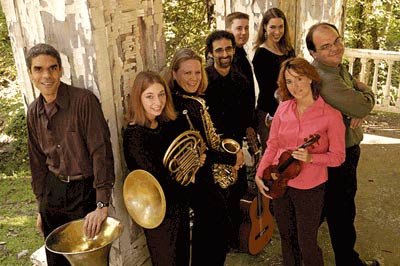
On Tuesday, American composer Steve Reich turned 70. New Yorkers are enjoying a month-long festival of performances of Reich's music, Steve Reich @ 70, much of which will be commented on by Alex Ross and others. Here in Washington, there was only one opportunity, a concert last night by the recently formed Great Noise Ensemble at the Unitarian Universalist Church in Silver Spring.
The program began with a favorite of mine, Music for Pieces of Wood, for five claves players. The piece, from 1973, uses pure rhythm as a way to reduce Reich's phasic layering to its most basic level. It is a good example of how, even with the simplest musical materials, Reich composes music that is extraordinarily complex and difficult to realize. This was a good performance, with a minimum of glitches, a few uneven rhythms. The only truly noticeable concern was the stray beat that marred the piece's sudden ending. Concluding the first half was a landmark piece in Reich's phasic style, Electric Counterpoint (1987), for electric guitar and recorded tape. Not unlike Violin Phase and New York Counterpoint, the performer records himself in several tracks and then plays the final part live against himself on the recording. Guitarist D. J. Sparr could be seen counting silently, his lips moving, as he navigated the live part's entrances, but the performance was generally solid, especially in the third movement, where the jagged theme makes much sharper, shorter phases. Later this month, at an October 21 concert at Carnegie Hall as part of Steve Reich @ 70, Pat Metheny will play Electric Counterpoint, nearly 20 years after he premiered this piece composed for and in consultation with him.
The Psalms are words that are written on the bones of everyone in the Judeo-Christian world, whether they know it or not. They are durable texts that have been sung and continue to be sung in every conceivable form, as Latin chant, as Renaissance polyphony, and in every modern language. It was probably inevitable that Steve Reich should confront the Psalms in his music and that, having been born into the Jewish faith, he do so in the original Hebrew. Inevitable perhaps, but not habit-forming, since Tehillim is one of only two Reich settings of the Psalms. It is frenzied, with combinations of four treble voices overlapping in often ecstatic and incomprehensible exclamations. The instrumentation is suggested more or less by the text of the work's last movement, Psalm 150: "Praise him with timbrel and dancing, praise him with strings and winds, praise him with clanging cymbals." While Reich appears to have ignored the third verse -- "Praise Him with the blast of the horn; praise Him with the psaltery and harp" -- he uses a favorite percussive sound, clapping hands, as if drawn from other psalms: Psalm 47 ("O clap your hands, o you peoples") and Psalm 98 ("Let the floods clap their hands").
I appreciate the piece, which I actually heard for the first time, and it has a lot of pretty effects, especially the crotales sounds in the last movement and the vibraphone and marimba sounds in the third movement (Psalm 18). For me, the piece falls flat, as it is kind of monochromatic in terms of tempo and color. The combination of texts could mean a lot of things (the other movements are based on Psalm 19 and Psalm 34), but Reich has not said much about it, except that the musical content is not at all based on Jewish themes. It is perhaps uncharitable to criticize the performers, who did such a service by bringing us Reich's music this week, but the music's construction makes rhythmic coordination very difficult. Instruments on sustained parts, especially the strings, did not always line up with the active parts, and tuning when the writing went into the stratosphere was sometimes sour. It was a valiant performance, whose imperfections did not mar the audience's general enjoyment of Steve Reich's birthday celebration.
The next concert by the Great Noise Ensemble will be on November 17 at 8 pm at the Sumner School (1201 17th Street NW), featuring music by the group's music director, Armando Bayolo, Heather Figi, Blair Goins, and the group's guitarist, D. J. Sparr.
As regular readers know, I grew up in the Great State of Michigan. You can take the boy out of Michigan, but you can't take Michigan out of the boy. Even after living in Washington for 15 years, when it comes to sports, I still root for the teams of my youth. Here I was getting ready for the Detroit Red Wings season, without Steve Yzerman, while the Detroit Tigers had actually made it into the postseason. Imagine my delight tonight as the Tigers even managed to send the hated New York Yankees home early.
Of course, I remember the 1984 Tigers from when I was in high school, but recent history has not been too kind to us Tigers fans. So, with apologies to Vilaine Fille, Sieglinde, and you other New Yorkers, allow me to have a hearty laugh at the expense of the wealthiest team in major league baseball.
When Marie-Aude Roux reviewed this new recording of Vivaldi's opera Bajazet in such glowing terms, I knew that I would be acquiring it one way or the other. Ever since it arrived in the mail a couple weeks ago, I have given a lot of time over to listening to it and have yet to tire of the beautiful sound of both instruments and the marvelous cast of singers. This is the first full opera recorded by Europa Galante, the historically informed performance (HIP) ensemble led by violinist Fabio Biondi. (I recently reviewed their disc of Italian violin sonatas.) Judging from this remarkable achievement, I hope it is the first of a series of opera recordings.
The battle of the Ottoman emperor Bayezid I, who once boasted that his horse would use the Throne of St. Peter as its manger (an anecdote related by Gibbon in The History of the Decline and Fall of the Roman Empire), and the Tartar emperor Timur Lenk in 1402 has been recounted numerous times. Famously, Jean Racine made the story into a French classical tragedy (Bajazet, 1672), and not long after that operas were being staged that told versions of the final downfall of the arrogant sultan, usually titled either Bajazet or, as in the version that Handel created, Tamerlano. Stories of Bayezid's humiliation while he was Tamerlano's prisoner -- Tamerlano used him as a footstool, kept him caged like an animal, made his wife dance naked for his court -- and resultant suicide from despair are probably apocyphal, but they make for great drama. It is a strange twist of fate that in Italy, directly threatened by Bayezid I and the Ottomans, opera should largely depict him as a sympathetic figure.
At this point in his career, Venetian opera had ceded its primacy to the newer style from Naples. For Bajazet, premiered in Verona in 1735, the composer created a pasticcio, composing some new pieces and recycling others from his own operas and those of rival composers. In this recording's liner notes, Frédéric Delaméa hypothesizes that Vivaldi saw him own struggle against Neapolitan composers in the storyline:
The thought of identifying his own artistic fate with the political fate of the noble Bajazet, and the arrogance of the Neapolitan victors with that of the conquering Tartars, was too tempting for Vivaldi to resist, and he created in this pasticcio a kind of musical parable: all the arias for the strong-minded, loyal characters (Bajazet, Asteria, and the faithful Idaspe) are the work of Vivaldi himself, while the arias for the characters representing oppression (Tamerlano, Andronico, and Irene) are for the most part written by Neapolitan composers.
If we follow that musical division, then I can begin with the startling performance of Ildebrando d'Arcangelo, who puts his remarkable bass-baritone into a Bajazet of extraordinary power and resonance. In the second act, he gives a riveting performance of the dramatic accompanied recitative "Odi, perfida," confronting his daughter Asteria. Most striking is the excellent rage aria "Dov'è la figlia" (borrowed from Vivaldi's own Motezuma), with a rafter-shaking high A. Marijana Mijanović brings her coffee-rich low range -- gorgeous but also light, almost countertenorish -- to the sweet little aria "La cervetta timidetta" in Act II (borrowed from Vivaldi's Giustino), with transparent continuo provided by harp. Soprano Patrizia Ciofi is ravishing in the small role of Idaspe, Andronico's friend. Her pure voice, not nearly colorless like Emma Kirkby, for example, but measured and scaled even when the part goes very high, as in the luscious "Nasce rosa lusinghiera" (Act I, recycled from Vivaldi's Farnace).
As for the characters singing other other composers' music, David Daniels turns in another fine performance as Tamerlano. It is strange to modern ears that Vivaldi created the role of the conquering Tartar for a female singer, Maria-Maddalena Pieri, to be contrasted with the low part of Bajazet. Daniels is particularly good in the beautiful first-act aria "Vedeste mai sul prato," stolen from Hasse's Siroe Re di Persia. Mezzo-soprano Elina Garanča has a husky sound, not overburdened with active vibrato, as Andronico, Tamerlano's ally. She is evocative in the minor-mode "Quel ciglio vezzosetto" (Act I) and a little Marilyn on the low notes of "La sorte mia spietata," also stolen from Hasse's Siroe Re di Persia.
American mezzo-soprano Vivica Genaux is delicious as Irene, the princess betrothed to Tamerlano, especially on the role's most famous aria "Sposa, son disprezzata" (Act II, stolen from Giacomelli's Merope). Via YouTube above, you can see and hear a young Cecilia Bartoli sing that aria. Genaux's career is on the rise, and New York readers may have heard her as Juno/Ino in Handel's Semele at New York City Opera with Elizabeth Futral. I will be reviewing her next weekend when she joins Futral again as Neocle in Rossini's L'assedio di Corinto at Baltimore Opera. Next spring she will join another dream cast (Danielle de Niese, Sandrine Piau, Angelika Kirchschlager, Ildebrando D’Arcangelo) for performances of Handel's Ariodante with Christophe Rousset and Les Talens Lyriques. I hope they record that.
Right from the first track, the sinfonia announces the hearty and dynamic tone that Biondi and Europa Galante will maintain, alternating with delicate playing of impressive soavità, where the theorbo and strummed guitar shimmer through. Even the horns sound good. That sinfonia, a three-movement gem, should be played as much as the Seasons or other Vivaldi concerti, with which it has marked similarities. A bonus DVD, shot during the recording sessions, does not add anything to the cost of this 2-CD set and is an entertaining look behind the curtains. All around, this recording is highly recommended.
In August, Jens reported with a mixture of dread and hope on the financial problems at Tower Records. When the company filed for bankruptcy, it seemed like a ray of hope might be breaking out from the clouds. Tower began negotiations with potential buyers, who would not have to assume the company's weight of debt, meaning that the new owner might decide to keep some of the most successful stores open. This evening, the Associated Press is reporting (Group plans to liquidate Tower Records, October 6) that most of the bidding parties had dropped out of negotations. This left the field to Great American Group to purchase Tower's assets with the ultimate plan of liquidating Tower Records immediately:
Peter Gurfein, an attorney representing Tower Records, said the company will be sold for an aggregate of $150 million, including the sale of various leases and properties. [...] But Jay Indyke, an attorney for Great American, said Trans World and its bidding partners had discussed liquidating inventory and closing about two dozen Tower stores, and that they would not say how many stores they would continue to operate.
I am afraid that they have finally shot Ol' Yeller.
Rossini overtures in concerts are like little tarts: impeccably delicious appetizers, sufficiently light to leave room for the following courses. The Semiramide is a little on the big-boned side but offers enough moments where the full orchestra has to tiptoe through delicate passages.
The National Symphony Orchestra played through it amiably (if without particular distinction) this Thursday; opening what was essentially a Sir James Galway Night in a gay and inviting way.
Following Rossini it was Norwegian composer Fred JonnyBerg’s Flute Mystery that took over, receiving its world premier by the famous flutist. The young (33) autodidact from north of the Arctic Circle finished this work for flute, string orchestra, and harp before offering the dedication to Mr. Galway. Mr. Galway’s acceptance is already telling about the work: melody and tunefulness are more important than wilful exploration of random sound-worlds while challenging the soloists to the very limits of his technical abilities. (Galway is said to have suggested to a composer of just such a modern piece that he pay him – Galway – for his practice time if he was to accept the dedication.)
Flute Mystery is one long lyrical, even sedate, passage that leads into a bird-fluttering, friendly-busy section (it comes across like sitting around with a somber Norwegian all night and then catching him laugh out loud, suddenly) before receding into calm. Romantically lapping against conservative musical shores, it is a work in which beauty exceeds harmlessness and comfort, innovation. If it will hold up to repeated hearing isn’t obvious quite yet – but it will be, because the work in its immense initial appeal is bound to get many repeat hearings. The comparison to film music would be an obvious one to make (especially since the composer also works extensively with video), if only there was high quality film music these days. And although accurate, the suggestion that Mr. Berg’s tone poem for flute is a not-too distant relative of New Age music would be selling his work short.
A Mozart Flute Concerto performance and mentioning that Mozart hated the flute (but that you wouldn’t be able to tell from the music) are as ubiquitous as mentioning the riot when talking about Le Sacre du Printemps. With that task artfully out of the way, I am left to mention hardly less obvious points: That Mozart’s concertos for flute – here it was no. 2 K. 314 which started life as an oboe concerto – are so damned beautiful that you can’t help but like it. And that Sir James’ technique is as prodigious as ever. Whereas in the Berg there was a lot of air in his alto-flute sound, the soloists steered its smaller cousin, the C-flute, with routine bordering flawlessness. A flourish-laden cadenza only further underlined that impression.
As far as I care, the NSO can’t play enough Mozart. Not because they are so good at it but because they get better every time and because it is such important music to play for therapeutic reasons. Enough Haydn and Mozart assures that the musical blood of the orchestra doesn’t coagulate as it would with a too-rich, gluten rich all-Romantic diet. That’s not to say we ought not enjoy the sumptuous, reach meal of a work like Also sprach Zarathustra which lured the audience back from intermission.
Few works – not even Beethoven’s Fifth Symphony – suffer as much from one all-too-famous opening as does this tone poem of Richard Strauss’. Expecting, recognizing, enjoying the massive “Sunrise” / creation-of-the-world opening and slowly tuning out to the rest is one smooth movement of the ears. It’s a pity, too, because even though less iconic, the rest of Also sprach Zarathustra has much and arguably more to offer than the other Strauss tone poems save the late Tod und Verklärung.
Richness of sound (alas with occasionally drowned out harps) and variance of timber were in full display with the NSO. It’s a work with which Maestro Slatkin can hit his stride – although trading a little more flavor and a more even flow for acrobatics and theatricality on display might have suited the performance well. Concert Master Nurit Bar-Josef stood out in the solo violin section and came close to the Bavarian-Austrian folk-music spirit in these parts. (Strauss’ Zarathustra happens to wear Lederhosen.)