Dip Your Ears, No. 237 (A Stickler for Clapping Along - Steve Reich)

 Steve Reich, Sextet, Music for Pieces of Wood, Clapping Music London Symphony Orchestra Percussion Ensemble (hands) (LSO Live)  |

Follow @ClassicalCritic

Steve Reich, Sextet, Music for Pieces of Wood, Clapping Music London Symphony Orchestra Percussion Ensemble (hands) (LSO Live) |
 S. Reich, Music for 18 Musicians, Ensemble Signal, B. Lubman (released on May 12, 2015) HMU 907608 | 59'17" |
 S. Reich, WTC 9/11 / Mallet Quartet / Dance Patterns, Kronos Quartet, Sō Percussion, et al. (released on September 20, 2011) Nonesuch 528236-2 | 36'32" |
 American contemporary music is supposed to be difficult to program in Europe. It’s still too modern for the traditional concert clientele, but too bourgeois for the avant-garde-happy audience reared on—and expecting—the heavyly intellectual fare of Boulez, Stockhausen, or Ferneyhough. The listenable, downright popular (shudder!) American contemporary music of Glass, Reich, Adams, Del Tredici, Argento, Corigliano et al. is too “middle brow” an attendee sympathetic to these composers suggested, “and European culture just doesn’t do ‘middle brow’. Only extremes.”
 But perhaps times are changing and the ears are regaining primacy over the mind when it comes to music, because the Herkulessaal in Munich was not only very well filled, but the response was also wholly positive after what amounted to “Easy Listening Night” at the 7th Musica Viva concert in 2009. Steve Reich’s Three Movements for Orchestra (1986), the oldest work on the program, was the curtain raiser. Full of the pleasing predictability of Reich’s propulsive beat it was just the work to warm up the ears for Elliott Carter’s 2001 Cello Concerto. The searching and confused solo cello opening—courtesy Jan Vogler—is pierced by orchestra stabs that are as short as they are vigorous, which then mellow considerably as they travel through the orchestral sections one by one. The orchestra has one surprising moment approximating lyricism, the cello part is often barely played, timidly screeching like cats at night with broken hearts. Atypical for Carter, the meandering work makes it difficult to perceive any musical purpose or goal, though the end has a coy smile that gives Carter, even when at his most modern, a human touch that many of his modernist colleagues lack.
The dashing, ever-suave Kristjan Järvi led the Bavarian State Orchestra through all works with panache, his looks, self-consciously sexy stance, and debonair movements conveying the air of a young, classical Jon Bon Jovi on the rostrum. John Adams’ Doctor Atomic Symphony (2007) was more notable for the incredibly well played solo trumpet part and the finale’s bracing build-up than for the music itself. While it’s easy to get a bad suite out of a great opera (Rosenkavalier!), it’s rather difficult to get a good suite out of a modest opera. A competent botch job that benefits from the omission of vocal parts, the Doctor Atomic Symphony nearly manages that feat, though.
The surprise of the evening was Udo Zimmermann’s Cello Concerto “Songs from an Island” which received its world premiere performance. Zimmermann is in charge of the Musica Viva series, so seeing a composition of his—the first in over a decade—wasn’t terribly surprising. The work itself, its quality and listenability, was, though. It starts with lengthy, fragmented quotes from Schumann’s “Ich hab im Traum geweinet” (Dichterliebe, op.48) which allow the cello to do what it can do best: sing. While the cello is almost incidental to Carter’s concerto (any instrument—a dulcimer, for example—might have served equally well), here it is stipulated by Zimmermann’s music. Purpose, the little cousin of Truth, is established and the mind can begin to grasp and the ears can go on a journey with the composer.
Zimmermann seems to feel naughty for throwing this tonal bone to the listener. The liner notes spend considerable time justifying the daring occurrence of harmony. As a truly modern European composer one would not want to be considered a reactionary, after all. Perhaps Zimmermann is right about being worried. (“Is that allowed? Is this an Anti-Concerto” the notes disingenuously question and eagerly postulate. ) After all, this ‘taking the listener by the ear’, gently, and harmonically pulling him his way… this acknowledgment of purpose (in instrumentation and structure) is the very negation of Zimmermann’s (and the whole avant-garde music scene’s) underlying and often trumpeted notion of the “paradigm shift” that had allegedly occurred in our listening habits.
The concerto is gorgeous, even when it gets busy, noisy, and tangled. The heartfelt reception and genuine applause must have been quite different than the usual, cool admiration. Via perceptible ideas and motifs, through recognizability and musical craftsmanship Udo Zimmermann has arrived, if not at truth, so at least in reality. A warm “welcome back”.
 eighth blackbird |
Anne Midgette, Eighth Blackbird's 'Only Moving Thing': Gaining Altitude (Washington Post, May 15) ---, Intensely Innovative (Washington Post, March 28) Kelly Jane Torrance, Blackbird remains new (Washington Times, May 9) Allan Kozinn, A Night of Collaboration and Energetic Activity (New York Times, April 19) Mark Swed, 'Blackbird,' by the numbers (Los Angeles Times, April 17) Paul Bodine, Reich's pulsing pleasures sung by blackbird (Orange County Register, April 16) |
Mobtown Modern
Washington Post, May 12, 2008
Mobtown Modern Music series, Contemporary Museum (Baltimore, Md.)
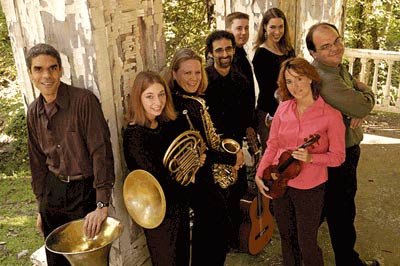 On Tuesday, American composer Steve Reich turned 70. New Yorkers are enjoying a month-long festival of performances of Reich's music, Steve Reich @ 70, much of which will be commented on by Alex Ross and others. Here in Washington, there was only one opportunity, a concert last night by the recently formed Great Noise Ensemble at the Unitarian Universalist Church in Silver Spring.
The program began with a favorite of mine, Music for Pieces of Wood, for five claves players. The piece, from 1973, uses pure rhythm as a way to reduce Reich's phasic layering to its most basic level. It is a good example of how, even with the simplest musical materials, Reich composes music that is extraordinarily complex and difficult to realize. This was a good performance, with a minimum of glitches, a few uneven rhythms. The only truly noticeable concern was the stray beat that marred the piece's sudden ending. Concluding the first half was a landmark piece in Reich's phasic style, Electric Counterpoint (1987), for electric guitar and recorded tape. Not unlike Violin Phase and New York Counterpoint, the performer records himself in several tracks and then plays the final part live against himself on the recording. Guitarist D. J. Sparr could be seen counting silently, his lips moving, as he navigated the live part's entrances, but the performance was generally solid, especially in the third movement, where the jagged theme makes much sharper, shorter phases. Later this month, at an October 21 concert at Carnegie Hall as part of Steve Reich @ 70, Pat Metheny will play Electric Counterpoint, nearly 20 years after he premiered this piece composed for and in consultation with him.
Charles T. Downey, Steve Reich at 70 (October 3, 2006) Charles T. Downey, Music for Pieces of Wood (November 7, 2005) Jens F. Laurson, City Life / New York Counterpoint (August 6, 2005) |
Available at Amazon: Steve Reich, Different Trains and other works, Orchestre National de Lyon, David Robertson (released on November 16, 2004)  Nonesuch Retrospective (released on September 26, 2006) |
 The live part of the performance takes the instrumental transcriptions of vocal fragments and repeats them with slight variations, the hallmark of the minimalist style, although Reich has indicated his dissatisfaction with that term being applied to his music. Part of the live music in the orchestral version comes from what was originally played on the tape. The work slips imperceptibly from movement to movement, taking us from the hopeful sounds of American train travel leading up to World War II into the more sinister second movement, recounting how trains were used in Germany to transport prisoners to concentration camps during the war. The piece was inspired, according to Reich, by his memories of taking trains when he was a child in the 1940s, traveling between his mother's house in Los Angeles and his father's in New York.
Jens F. Laurson, City Life / New York Counterpoint (August 6, 2005) Charles T. Downey, Music for Pieces of Wood (November 7, 2005) |
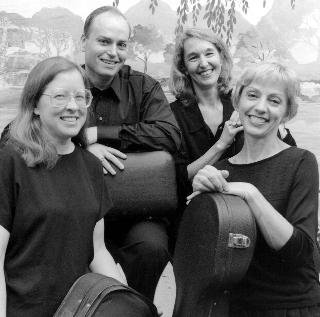 On Saturday night, the Left Bank Concert Society gave an interesting and very good performance at the Clarice Smith Performing Arts Center in College Park. Now in its second season, the LBCS was formed by members of the Theater Chamber Players and champions music by contemporary composers, a cause that is sure to receive sympathy here at Ionarts. The members of the Left Bank Quartet opened the program with the youthful op. 3 string quartet of Alban Berg. They gave a performance full of appealing effects -- croaking staccato notes and odd scraped harmonics -- that put the first movement (Langsam) on the macabre side, at points like a dance for dusty skeletons. The quartet continued with a good sense of rhythmic élan in the second movement (Mäßig Viertel), where the music is much more explosive, with metallic tremolos and a rather memorable ending.
The LBCS mission to perform the most current music possible led violinist Sally McLain toward Axon, a piece by Cuban-born American composer Tania León for violin and interactive computer, from 2002. The original form of the piece called for the live violin part to influence the sonic output of a listening computer. Ms. McLain explained before her performance that "technical difficulties" had scuttled that plan. She chose instead to give us one of the other two arrangements advanced by the composer, with violin accompanied by a tape of prerecorded electronics. The major appeal of the piece appears to have been the possibility of a computer actually interacting with a live musician. Without that element, the work struck me as a collection of interesting motifs -- arpeggiated figures, rasping belchs, runs -- and a soundtrack of world musicish percussion and chanting, all of which didn't add up to much, in spite of Ms. McLain's excellent playing.
Left Bank Ligeti (May 9, 2005) New Sounds over the Potomac: The Left Bank Concert Society is Here! (October 20, 2004) Tōru Takemitsu Concert at the Library of Congress (October 9, 2005) |