CD Reviews | CTD (Briefly Noted) | JFL (Dip Your Ears) | DVD Reviews

5.10.06

Mozart, Nothing New

Some people just cannot get enough Mozart, and not only Mozart but the same Mozart. This was apparently the idea behind a free concert given last night at the Austrian Embassy, under the title Mozart through His Letters and Operas. Donations were requested, and no viennoiserie was on offer afterward. Sorab Modi may not have said much about the letters of Mozart, but he provided commentary between aria and ensemble selections from the five favorite Mozart operas (OK, there was one piece from La Clemenza di Tito), sung by members of Washington National Opera's Domingo-Cafritz Young Artist Program. However, hoping to hear some music off the beaten path (couldn't the Mozart Year be about discovering the composer's other operas?), woven together by passages from the letters about the pieces being performed, I was disappointed.

Magdalena Wór, mezzo-sopranoTrevor Scheunemann, baritone
This is not to say that, for a free concert, there were not moments to be enjoyed. Baritone Trevor Scheunemann had nice turns as the Count and Papageno, with a well-rounded voice and a confident stage presence. I was most impressed by the voice of Polish-American mezzo-soprano Magdalena Wór, who gave a sweet, slightly throaty performance of "Voi che sapete" and a dramatic rendition of Annio's part in "Ah, perdona al primo affetto" (the one piece from Tito mentioned above). Pianist Matthew Ottenlips gave a nice range of color to the various orchestral reductions, especially a fine approximation of an orchestra trying to sound like a guitar in "Deh, vieni alla finestra." He may not have fit in all of Papageno's pipe flourishes, but he played well. Stage director Andrea Dorf did her best to make a recital seem semi-staged, and conductor Benjamin Makino seemed only nominally in control.

Tickets ($25) are still available for the next unusual performance from Washington National Opera, a reduced-price afternoon concert called Welcome to Opera, a week from Saturday (October 14, 4 pm) in the Kennedy Center Opera House. Plácido Domingo will conduct, and I suspect some of these young singers will be performing.

4.10.06

The Beasts Are Coming!

Beasts @ AVAM

But don’t hide the children, they'll love this show too. I got a sneak preview of the latest exhibit, Home and Beast, at the American Visionary Art Museum, in Baltimore. I’ll write more in the coming weeks, but the opening reception is this Friday evening and the exhibit opens to the public Saturday.

Home and Beast will explore the relationship between man and animal, in fantasy and reality. Did you know that 50% of all our water usage goes towards the production of meat? Add that to your next trivia game.

3.10.06

Bach's Music for Gamba and Harpsichord

On Monday night, I was in an approximation of heaven on earth, hearing the first concert in the Baroque series at La Maison Française. The crowd was large enough that it filled every seat, not in the embassy's auditorium, but in the closed-off corner of the main hall. The reason undoubtedly was the announced program, all three of J. S. Bach's sonatas for viola da gamba and harpsichord (BWV 1027-1029), and the name of the gamba player, Jérôme Hantaï, who has been a popular performer at the French embassy. (His brothers, Pierre and Marc, are a respected harpsichordist and Baroque flutist, respectively.) Little did I know that I would be most impressed by Hantaï's partner for the evening, harpsichordist Maude Gratton, whose name I had not really heard before but who has begun a successful career in Europe.

available at Amazon
Jordi Savall / Ton Koopman


available at Amazon
Jaap ter Linden / Richard Egarr


available at Tower Records
Wieland Kuijken / Gustav Leonhardt


available at Amazon
Jonathan Manson / Trevor Pinnock
The gamba sonatas are exquisite pieces, an example of Bach's encyclopedic compositional approach, writing works in the Cöthen period (composed around 1720) to exhaust the performing possibilities even for an instrument that was on its way out of popularity. I am very fond of the recording in my collection, with Jordi Savall and Ton Koopman, but there are several good ones out there (see the link bar to the right), and it was a good experience to hear all three pieces live and in the order Bach numbered them. For the first sonata (G major), Bach revised his own trio sonata (BWV 1039), in a set of four movements that recalls the old sonata da chiesa format. Hantaï and Gratton settled into easygoing tempi, a gentle and lilting Adagio, a chipper Allegro ma non tanto, and a calm and melancholy Andante. That third movement's circular theme is one of the saddest, prettiest tunes Bach ever wrote. Gratton proved herself a steadfast partner, with a crisp sense of articulation and a tendency to drive movements ahead in pace. One sensed that the fluidity of her technique made her chomp at the bit.

While the first sonata is dominated by the viola da gamba, the harpsichord part comes often to the fore in the second sonata (D major). Reserved moods prevailed in the first three movements, caressing the opening Adagio, and allowing the sphinx-like Andante to unfold at its own pace. In the fourth movement the players opened the throttle as the sonata roared to its conclusion. I am not sure about the viola da gamba that Hantaï played, but it makes a gentle sound that was occasionally covered by the harpsichord in the first sonata, which I heard from the back of the room. For the rest of the concert, when I was at the front of the audience, the balance seemed much better.

Maude Gratton, harpsichordistGratton was playing a 1994 instrument made by Mark Adler, who has a workshop in Gaithersburg. It has a suave, noiseless sound that made for very enjoyable listening when the program, played without intermission, was extended at this point with two pieces for harpsichord. (These were not listed in the program, but Ms. Gratton confirmed the titles for me by writing them on my program afterward.) The substantial toccata in E minor from the 6th partita (BWV 830) is more or less in three sections, a central fugue bookended by quasi-improvisatory fantasia sections. This was followed by the B minor Prelude and Fugue on a Theme of Tommaso Albinoni, BWV 923 and 951. The prelude of this pairing is probably not by Bach, but its virtuosic whirls of arpeggiation showed the ultimate facility of Gratton's technique, the result of study with Olivier Baumont and Olivier Latry, among others. The fugue, whose subject combines an ascending minor opening and a descending chromatic tail, was marvelously Byzantine in complexity.

There remained only the third gamba sonata (G minor), in three movements instead of four and of a greater degree of complexity. Its opening Vivace is constructed like a concerto movement, which the players took at an appropriately brisk tempo. The gorgeous and stately second movement ticked like a clock to its inevitable end. This fine concert was capped off, as Hantaï put it, by "some French music," two encores by Marin Marais, a minor-key sarabande and the Fantaisie Luthée from the D minor suite of the composer's second book (1701). The only other matter to be concluded was a choice for each member of the audience: red or white.

Constable's Big Sky

Also on Ionarts:

Charles T. Downey, Constable in London (November 23, 2003)

Mark Barry, A Parade of Clouds (August 10, 2004)

Charles T. Downey, Eric Ravilious (August 4, 2005)

Mark Barry, In Appreciation of Clouds (June 14, 2006)


Available at Amazon:
available at Amazon
John Gage, Sarah Cove, et al., Constable: The Great Landscapes
I spent part of Sunday afternoon taking in the opening day of a phenomenal new exhibit at the National Gallery of Art, the next big thing now that the Rousseau exhibit is nearing its close. Constable's Great Landscapes: The Six-Foot Paintings will be on view through December 31, and it is a beautiful show, compulsory if you already like the work of John Constable and highly recommended if the English painter has just never grown on you. This exhibit is on the middle leg of its journey through three museums, having just appeared at Tate Britain in London and destined next for the Huntington Library in San Marino, California, this winter.

The main draw of this exhibition is the opportunity to see all of the large landscapes that Constable painted for academic consideration, all of which have become his most iconic works. Not only can you stand in front of The Haywain and Stratford Mill (actually released by the National Gallery in London), The White Horse (The Frick Collection), The Leaping Horse (Royal Academy of Arts), Chain Pier, Brighton and The Opening of Waterloo Bridge (Tate Britain), View on the Stour near Dedham (Huntington Library), and Salisbury Cathedral from the Meadows (Private collection), you can also compare each finished painting in almost all cases with a full-size oil sketch (hung side by side) and often other studies, almost all from different museums. This is the first opportunity to see all of these works together in one building since Constable died.
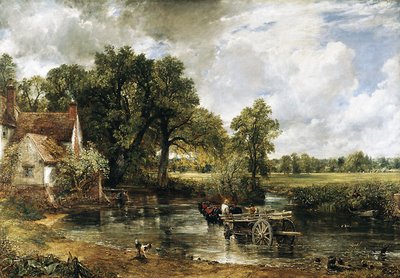
John Constable, The Haywain, 1821The wall text puts each work into the context of Constable's life and the geographical setting of the Stour valley. At one point, a map shows the world of the painter's youth, the course of the Stour River, the location of the Flatford and Dedham mills and locks (both owned by Constable, Sr.), and the other locales from Suffolk that appear again and again in Constable's landscapes. Judging by some photographs of what the area looks like today, not much has changed in this rural setting only an hour from London, probably the result of zealously preservation. Flatford Mill is now a Field Studies Council Centre, where adults and children can take classes on various subjects, and you can even stay the night.

The exhibit also gives insight into how Constable worked, both en plein air and in the studio, guiding your eye to pick out the changes in details from sketch to finished painting. Do not miss the chance to hear the explanation for that troublesome shadow in the middle foreground of The Haywain. If there is one painting you think you know, it is this one, but there in the center of the full-size oil sketch is a figure on a horse standing on the near bank. In the finished painting, Constable began by retaining that figure, then replacing it with a barrel, and finally removing that, too. When you know they used to be there, both of those things pop spectrally out of the painting, defying Constable's ingenious attempts to disguise them as shadows from the tree across the bank on land and water. I will never see the painting the same way again.
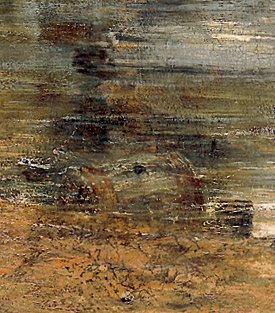
Detail from John Constable, The Hay Wain, 1821The appreciation of Constable's technique and process is not exactly what was proposed by Washington's newspaper critics. Blake Gopnik's dutiful bowing and scraping before the avatars of political correctness is lamentable, in his review in the Post, ascribing Constable's interest in painting idealized landscapes of the countryside to making "ideas of social change or reform [seem] repugnant and dangerous." Even so, that is at least more interesting than Joanna Shaw-Eagle's gross assumption that Constable is "an often boring, stodgy painter" of "academic, bucolic landscapes" in her review in the Times.
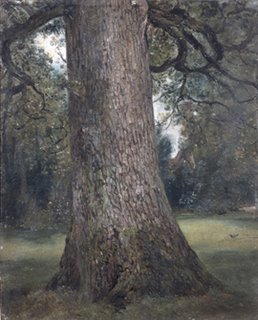
John Constable, Study of the Trunk of an Elm Tree, 1821Constable's influence on later painters, particularly the Barbizon school in France and their descendents, the Impressionists, was due to the showing of some of his canvases throughout the 19th century. When you see the paintings in person, you can appreciate his technique in a much more direct and profound way. His application of white and golden highlights to show the dappling of light, sometimes called the "Constable snow effect," was imitated by many later painters. The glowing hues of his ever-shifting clouds, which I found myself going over inch by inch in many of the large paintings, were based on acute and regular meterological observation of the skies outdoors.

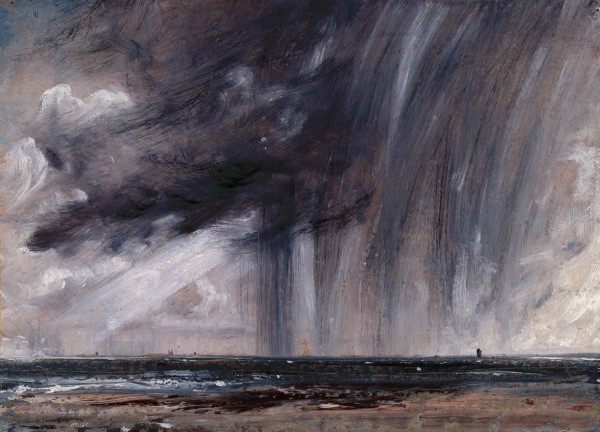
In some cases, modern painters and museum-goers have been more impressed by Constable's sketches, which have been shown occasionally over the years as finished works. When you see this exhibit, you realize that nothing could be farther from the truth, that even some canvases long considered final versions are probably only the last sketch, left uncompleted by the painter's inability to finish the work to meet the standards of the Royal Academy, whose approval he so desperately craved. Unlike those who followed him, he was unwilling to stop at a point in the artistic process where he had only made a basic sketch of what his eye saw in the field. As much as I would like to think of paintings like this gorgeous black stormcloud over the ocean or the cloud studies as finished works, that would be anachronistic. Go see for yourself.

Constable's Great Landscapes: The Six-Foot Paintings will be on view in the National Gallery of Art's East Building through December 31.

Steve Reich at 70

Available at Amazon:
available at Amazon
Steve Reich, Different Trains and other works, Orchestre National de Lyon, David Robertson (released on November 16, 2004)


available at Amazon
Nonesuch Retrospective (released on September 26, 2006)

Today, American composer Steve Reich turns 70 years old. There is no avoiding it: the one-time bad boy of the New York contemporary music scene in the 1960s and 70s is now a member of the AARP. Nonesuch has released a retrospective album of recorded highlights, but these past several days, I have been listening to a 2004 disc of works for orchestra by Reich, recorded by the Orchestre National de Lyon and their music director, American conductor David Robertson (at the helm of the Saint Louis Symphony Orchestra since 2005).

Different Trains dates originally from 1988, when Reich combined a tape he recorded of people talking about trains with music played by a string quartet. In 2000, David Robertson asked him to revise the work, expanding the live musical component to a score for string orchestra, a version that Robertson premiered with the Philadelphia Orchestra in October 2001 (when its performance was perhaps overlooked because of the recent terrorist attacks). The musical motifs -- both rhythmic patterns and melodic content -- are derived largely from the words of the speakers on the tape: Reich's governess, Virginia; a retired Pullman employee; and three Holocaust survivors. In this expanded version, Reich preserved the original tape intact, with its recorded train sounds and musical sounds from a recorded string quartet.

Steve Reich, b. October 3, 1936The live part of the performance takes the instrumental transcriptions of vocal fragments and repeats them with slight variations, the hallmark of the minimalist style, although Reich has indicated his dissatisfaction with that term being applied to his music. Part of the live music in the orchestral version comes from what was originally played on the tape. The work slips imperceptibly from movement to movement, taking us from the hopeful sounds of American train travel leading up to World War II into the more sinister second movement, recounting how trains were used in Germany to transport prisoners to concentration camps during the war. The piece was inspired, according to Reich, by his memories of taking trains when he was a child in the 1940s, traveling between his mother's house in Los Angeles and his father's in New York.

The middle work on the recording is the agitated, lush Triple Quartet (1999), in its reworking for 36 strings. The piece is derived largely from the interval of a minor third, which is often situated actually as an augmented second (it moves hypnotically through four minor chords, all separated by the interval of a minor third or augmented second, beginning with E minor and cycling back to E minor), giving the work the flavor of an Arabian scale. It is one of the more dissonant works in the minimalist style, with Reich allowing the different phases to work their way through several striking clashes.

Reich on Ionarts:

Jens F. Laurson, City Life / New York Counterpoint (August 6, 2005)

Charles T. Downey, Music for Pieces of Wood (November 7, 2005)
By comparison, the last work, The Four Sections (1986), has more orchestral color (the only piece on the disc that uses instruments besides strings) but is more consonant. There is an incremental layering technique, as the jutting wave motifs are built up into sustained chords that swell and then recede. The second movement, with its metallic clatter of piano and vibraphone, may have been in the back of Thomas Adès' mind when he wrote the banquet music in his opera The Tempest. This disc contains 65 minutes of intensely pleasurable listening, for all the same reasons that music in this style is so ideal for film scores. The rhythmic interaction and mathematical proportions can occupy the mind of an attentive listener, but the relative melodic and harmonic stasis can also make the music slip easily into the background.

If you want to celebrate the septuagenarian composer, I know of only one opportunity in the Washington area this week. On Saturday (October 7, 8 pm) the Great Noise Ensemble will give a concert of Reich's music, including Electric Counterpoint, Tehillim, and the marvelous Music for Pieces of Wood at the Unitarian Universalist Church in Silver Spring. Tickets: $20 (students, $10).

naïve MO 782167

UPDATE:
Other tributes:

2.10.06

Reviewing the Critics

Via Anne-Carolyn Bird and Steve Smith at Night after Night, I read some recent entries in another singer blog, Singin'rin by mezzo-soprano Rinat Shaham. Battling illness during her run as Carmen at New York City Opera, she struggled on stage and eventually had to cancel. Leading up to the opening, she penned a series of fascinating posts about her reaction to critics and their reviews: wondering about which reviewer would come from the New York Times, fighting her way through opening night, feeling crushed by Anne Midgette's negative review in the Times, getting back on track by the third performance, feeling exhilirated by a good review from Jay Nordlinger in the New York Sun, and gratefully receiving a kind comment from an audience member. It's a fascinating unfolding of emotions to follow.

May your third eye be shut out and burned with coals!!Especially fascinating from the vantage point of a critic, that is. This summer, I was involved in a couple of shitstorms, consisting of nasty backlash in reaction to negative comments I wrote in reviews. The most outrageous was the worst comment, in terms of its vileness and absurdity, that we have ever received here at Ionarts, suggestive of the sort of psyche disturbed enough to shoot Andy Warhol or something. I know that newspaper critics receive this sort of letter, too, but newspapers will publish such reader comments only if they are not written anonymously, and even then not all that often. Well, after initially deciding not to publish it, I was persuaded that, if we did so, it would appear as ridiculous to others as it did to us. That was apparently not the end of it, since the director of the company reviewed in that article, Wolf Trap Opera's Kim Pensinger Witman, has just referred to it again in a recent post. I know there was at least some e-mailing back and forth about the review among people associated with Wolf Trap.

As I reread that review of Figaro, I still see it as largely positive. I described the production as a "relative low point" in an otherwise very pleasing season: all our other reviews at Wolf Trap this summer were generally enthusiastic. It's a fine company, doing a great job training young singers and giving them major opportunities. The results are not even, and we tried to note both ups and downs. No comment, as I see it, was ever petty, and none was even all that strident. Merely to say anything negative, in the eyes of these commenters (transparently the friends or supporters of performers criticized), is tantamount to dragging the performer's name through the mud. A minor criticism in my review of the Four Islands recital at Wolf Trap set off another such comment.

Some critics just say nothing about performances that they don't like, choosing only those recordings or concerts about which they can write glowing reviews. This tends to be true more as the profile of the critic increases. In some reviews in the past, I have simply omitted any mention of performers whom I might have criticized. There are many reviews, however, where doing so just seems dishonest. I have read far too many whitewash reviews in major newspapers: readers depend on critics not only to praise good performances but to write critically -- and justly -- when there are problems. When you find a critic whose opinion you share most of the time, he or she is a good guide to follow when you are paying lots of money for concert tickets and alloting precious free time in a busy life to go hear a concert. There is nothing that will surely make me as angry as disliking a performance that someone, a critic or otherwise, has told me was a triumph. If I hear something that I don't like in a performance, I am going to write about it, in a way that I hope is respectful.

The Woman without a Shadow

Available at Amazon:
available at Amazon
R. Strauss, Die Frau ohne Schatten, Cheryl Studer, Thomas Moser, Marjana Lipovsek, Bryn Terfel, Eva Marton, Vienna Philharmonic, Georg Solti (Salzburg Festival 1992, released on DVD on September 24, 2002)
Die Frau ohne Schatten, premiered in Vienna in 1919, may be the strangest opera Richard Strauss composed. The libretto, written by the masterful Hugo von Hofmannsthal (who with Strauss made one of the strongest composer-librettist pairings in operatic history), is a fairy tale that has a lot in common with the symbolist world of Maeterlinck's "theater of the unexpressed" in Pelléas et Mélisande: an emperor who captures his wife while hunting, a distant kingdom, much that happens remains unexplained. The opera is strange and almost four hours in length over three acts of strenuous singing, enough that it is one of Strauss's least performed operas: even Santa Fe Opera, where Strauss reigns supreme, has yet to stage it (along with only one other Strauss opera, Guntram, his first). This staging, from the Salzburg Festival in 1992, is the only version available on DVD, which came recently to my mailbox from Netflix.

Hugo von Hofmannsthal and Richard Strauss, c. 1915The singing is quite good, captured in decent sound for a live recording. Cheryl Studer is a vision of vocal transparency as Die Kaiserin, whose lack of a shadow for a period of twelve months means that she will be called back to her father, a spirit figure named Keikobad. The strongest performance, in terms of both acting and singing, comes from Slovenian contralto Marjana Lipovšek as Die Amme, the spirit who is the Empress's nurse. Thomas Moser is splendid as Der Kaiser, one of Strauss's better tenor roles, and Robert Hale is a convincing Barak (a role sometimes described as corresponding most to the composer), although he was near the end of his career. A young baritone named Bryn Terfel stands out as Der Geisterbote, a stripe-faced spirit from the realm of Keikobad. (This was the year that Terfel's career took off, as he also sang Jochanaan in Salome at Salzburg, across from Catherine Malfitano, and then signed a contract with Deutsche Grammophon.)

Over several viewings, I have gone back and forth on Eva Marton in the role of Barak's wife, Die Färberin. Overall, I enjoyed her singing in spite of minor inconsistencies. Her duet with Hale's Barak in Act III, as they have been plunged into darkness, was touching and powerful. It's a difficult role dramatically, as there is so much happening psychologically while not that much is actually happening. Her interactions with the Stimmen der Ungeborenen, the voices of her unborn children who trouble her mind throughout the opera, are always creepy, except for the transcendent conclusion. Solti drives the Vienna Philharmonic through a strong performance, in his trademark way, with a merciless pace and triumphant brass. He brings out the multichromatic details of the score, one of Strauss's best, admirably: the almost Messiaenic bird calls for the Red Falcon in the first scene (the falcon's voice sung well by Andrea Rost), the clicking percussion of the human world, the apocalyptic thunder and tintinnabulation (harp! celesta! jingling metallic percussion!) of the philosophical third act.

CD Recordings:

Jens offers the following recommendations for Die Frau ohne Schatten: "The best version is with Sawallisch, long due for re-release by EMI, in Munich. I didn't
see it, but it was the standard by which all others were measured, at least until Thielemann's MET performance, from what one can read about it. Sinopoli (Teldec) has many a nice touch to his recording, too - but sadly it's heavily cut. Böhm's recording is due for North American (re-)release in October by DG." Both of these are on my Christmas wish list.
available at Amazon
Bavarian State Opera, Wolfgang Sawallisch


available at Amazon
Vienna Phil, Karl Böhm
The productions at Salzburg in the last couple decades, even when they are weird, are beautiful. Rolf Glittenberg's sets are minimal but monolithic, if that makes sense, enough substance to make us aware that we are in the realm of mythology, reinforced by the shadowy lighting (Franz Peter David) and the strange costumes (Marianne Glittenberg). Götz Friedrich's direction largely stays out of the way, with cleanly sculpted scene composition and a minimum of distracting effects. The music is all you need.

Every time I watch or listen to this opera, my opinions and thoughts about it mutate. Strauss and his librettist were working on it for most of the years during World War I, which relates to the characters' struggles, for a barren spirit to become human, to have weight in the world, a shadow, fecundity. Mahler's fingerprints are all over the score, in the orchestration and the metaphysical struggle toward humanity, a Straussian echo of the Symphony of a Thousand, premiered in 1910, just before work began on the opera. Like that symphony, Die Frau ohne Schatten is both disturbing and transcendent.

1.10.06

The Washington Bach Consort Opens its Season With Sacred Mozart

Friday night, a sparsely filled Music Hall at Strathmore saw the Washington Bach Consort’s season open with a Mozart tribute that was a firmament of little stars set around the center of the evening, Mozart’s Requiem, this too-beautiful-to-be-all-sad moon, shining a benign and moving light on our coming to terms with the afterlife.

available at Amazon
Harnoncourt


available at Amazon
Bernstein


available at Amazon
Schreier


available at Amazon
Marriner


available at Amazon
Celibidache
Of course Mozart’s own death mid-Requiem is the attractive story; too ironic, too dramatically sound not to exploit. This leads to the unfinished work’s claim to perpetual center stage among his sacred works. But beyond the deathbed romance á la Pushkin/Shaffer, there are other great and beautiful sacred works of various length that Mozart wrote and deserve more attention. The first half’s offering of these shorter gems was therefore particularly welcome, interesting and enjoyable.

The Epistle Sonata K.329 (with Scott Dettra’s prominent organ contribution) and Regina Coeli K.276 (featuring the chorus and very fine soloists from its midst) are two 1779 works of Mozart’s that are every bit as charming and delightful as you’d expect good Mozart to be.

Young Mozart – perhaps up to 17 – is often charming too, but more in the sense of ‘competent’, not ‘inspirational’. A Mendelssohn-like composing child-genius he was not, despite popular perception. But if not all of Mozart’s youthful work is beset with the same brilliance as his later work, Exultate Jubilate K.165, written just before his 17th birthday, more than hints at the great things that were to come. When sung as marvelously as did Christine Brandes it is a particular treat. The work, written for castrato Venanzio Rauzzini (hence the Italianate Latin in the performance) tested Ms. Brandes’ bottom range (she passed successfully, of course) and presented her plain beautiful, utterly tasteful voice from its best side. With her many appearances in the region one might be tempted to think of her as a ‘local singer’. Were that the case, she’d be the region’s pride.

Ave Verum Corpus K.618 was composed 12 years later. Although just a few minutes long, its impact is momentous. Its hushed and somber beauty is so heartbreakingly tender that for 46 bars your render all your troubles over and give yourself up to that – as Romain Rolland called it – oceanic feeling. Or, if religiously inclined, God.

A good requiem performance is of course to die for. If some deaths are bombastic, violent, secular affairs (say Verdi, Britten, Brahms), others are gentle, happier embraces of the ever-after. Take Duruflé, for example. Mozart’s work – and perhaps part of its genius – can be both: Bernstein-like brooding and brimstone-heavy or airy and light (Harnoncourt!). With the 30-plus sized, usually fleet, Historically Informed Practice–band of the Washington Bach Consort the Requiem was certainly on the gentle side – not no less moving for it. The balance with the just about 30 head strong chorus was ideal and the four soloists standing behind the orchestra were easily able to make themselves be heard. Indeed, in the very pleasing acoustic of the Strathmore hall, the choir sounded rich and full beyond their numbers.

Among the soloists it was unsurprisingly Christine Brandes who stood out. She sounds as though the simply sings - no more… nothing fancy or artificial. If anything, she can sound stern at times. Jessica Grieg’s mezzo held up nicely in comparison and thankfully the MET competition winner didn’t sound like transplanted from La Giaconda into a Requiem. Tenor Dan Snyder was less easy on the ears. A slurred, pressed sound hinted at ‘trying too hard’; the result somewhere at the opposite end of natural. The courage to sing softly, even in big spaces, could be all that is necessary to turn off that unflattering denatured quality. Curtis Streetman had to perform against every bass on every version of the Tuba Mirum any audience member has ever heard. Ideally the opening low notes roar with commanding presence, like a rock in the sea. Mr. Streetman’s voice did not quite give that – but he gave well. The choir meanwhile audibly reveled in what must be one of the most rewarding scores to sing as a member. The audience reveled likewise.