CD Reviews | CTD (Briefly Noted) | JFL (Dip Your Ears) | DVD Reviews

3.4.06

Sweet Elixir: Sticky Maybe, but So Tasty!

Photo by Karin CooperWith Donizetti’s L’Elisir d’Amore and Rossini’s L’Italiana in Algeri the Washington National Opera offers two operas this season that could be characterized as light, ‘happy peasant’ operas. Not necessarily my cup of tea, despite generally delightful (and fairly similar) music, because the suspension of disbelief has to work overtime while trying to appreciate what only too easily degenerates into awkward camp. But isn't it gratifying to see the working and servant class so happily laboring away, bringing in the harvest (as in the opening scene of L’Elisir)? It gives a certain reassuring feeling when congregating under the chandeliers at intermission, discussing the lead's tessitura over a glass of champagne.

When a comedy such as either of these two operas is done well, however, it can genuinely delight. And what a happy surprise this production of the ‘Elixir of Love’ is: an opera to please all but the most obstinately elitist opera lovers. Getting there is admittedly an obstacle course. The music, light but pleasing, is a fun, albeit predictable, romp. The plot is either silly nonsense or absent. The characters unbelievable, irrational, or near imbeciles who can say the dumbest things in song or lack any motivation for their actions. The action haphazard and contorted. Any giant or rainbow-summoning god or fish-woman in Wagner is endowed with more recognizable human emotions. But it works if it is well acted and well directed, and it delights if it is well sung on top. And on Saturday in the Kennedy Center it all came together.
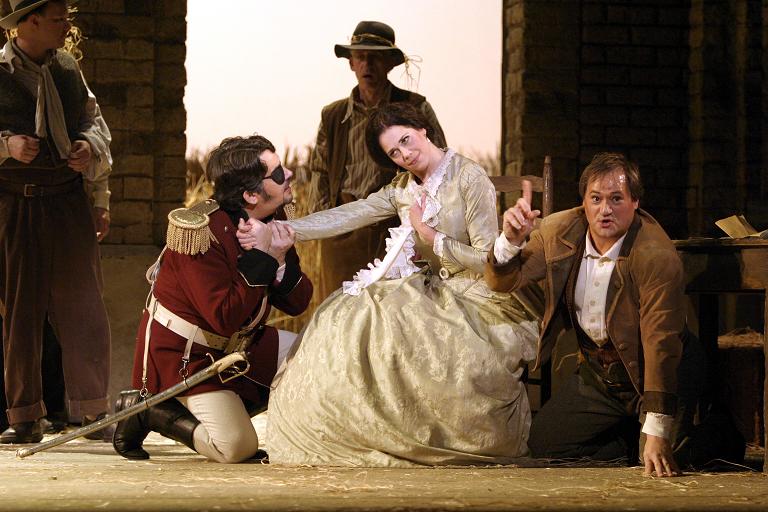
Photo by Karin CooperThanks to an outstanding cast and a staging (credit goes to director Stephen Lawless - even if he did not approve of some last-minute changes that were made to this production, shared with the LA Music Center Opera and the Grand Théâtre de Genève) that not only looked good but gave the chorus and protagonists something to do while frolicking around stage (no one ever looked lost or out of place), Donizetti’s opera made for two very entertaining hours. Paul Groves was utterly convincing as the idiot Nemorino. Without going overboard, he employed his impeccable sense for comedy (physical but not crude) to great effect. His singing was unmannered and never called attention to any specific aspect of it. Save for a bit of a wide vibrato here and there (especially on top), he sang with stunning consistency. No particular arias were highlights; the even, untiring quality of his entire night’s worth of singing was one long highlight. He was blessed with a vocally magnificent Elizabeth Futral, a 1995 Operalia winner, who sang with great charm and amazing agility. With her voice better suited for this repertoire than the recent Bach, she gave life and plenty spark to the fickle character of Adina.

Other Reviews:

Charles T. Downey, DCist Goes to the Opera (DCist, April 3)

Tim Page, 'Elisir': One Love Potion, Stirred Silly (Washington Post, April 3)

T. L. Ponick, Opera scores with 'd'Amore' (Washington Times, April 3)

Tim Smith, 'L'elisir' performance is satisfying, spirited (Baltimore Sun, April 4)
Marc Barrard making his company debut as Sergeant Belcore also displayed a great sense for comedy. Unsubtle enough for the purpose and venue of an opera house but genuinely funny without being too much more a ham than his character already is. He and his colleagues didn’t take their characters too seriously but seemed to enjoy themselves on stage. To add a comic relief character – “Dottore” Dulcamara – to a cast of all comedic characters could well be overkill, but Steven Condy and his trumpet-playing midget sidekick joined the grand silliness smoothly. And if Condy started with a distinctly chalky voice, he later warmed up to a remarkable performance. Christina Martos was a very welcome addition as the feisty Giannetta, getting better and better as the show went on. The bit of melodrama of the last act is gladly overlooked after so much easy-going amusement. It’s an opera for the people, perfect to take the genre a peg down from its sometimes deliberately exclusive pedestal of elitism.

The masses are welcome at repeat performances on April 4th, 6th, 9th (matinee), 12th, 15th, and 17th. On April 11th, a "Generation O" performance by the singers of the WNO Young Artists Program takes place. Sergeant Belcore will be sung by Carlos Archuleta on the 17th, Valeriano Lanchas (the Sagristano from last season's Tosca) will put his abundent talent to use as Dr. Dulcamara on April 15th and 17th.

Fierrabras at the Châtelet

Fierrabras, Zurich Opera, 2006As you may or may not know, Franz Schubert wrote operas, largely unknown today. In fact, the Théâtre du Châtelet gave the French premiere of one of them last month, Fierrabras, brought to Paris in the 1997 production of the Zurich Opera. Marie-Aude Roux wrote a review (Un remarquable "Fierrabras", March 10) for Le Monde (my translation):

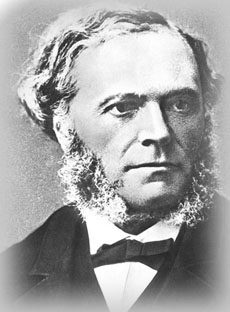
Composed in 1823, the year of Die schöne Müllerin, [the opera] was halted in the middle of rehearsal, with the failure of Weber's Euryanthe, which sounded the temporary eclipse of German opera by Italian opera. Extracts from the work, performed in concert version in 1858, provoked the ire of the famous German critic Eduard Hanslick, who singled out the composer's renunciation "of everything that could be called poetry, good taste, coherence." We would have to wait until 1897, the centenary of Schubert's birth, for the opera -- with numerous cuts and ballet insertions -- to be premiered in Karlsruhe; until 1988 for Fierrabras finally to be restored to its original and complete form, in Vienna, under the direction of Claudio Abbado.

Director Claus Guth points to the relative incoherence of the libretto, so often the case with Schubert. (Josef Kupelwieser's libretto was drawn from the 12th-century chanson de geste relating Charlemagne's crusade against the Moors and the conversion of Fierrabras to the Christian faith.) The staging is playful, with its living room sets, its cuckoo clock, and its oversized children's play furniture, which does not lack elegance. Schubert is there, in flesh and blood, thanks to actor Wolfgang Beuschel, the "little mushroom" as close to life as possible.
Madame Roux praised the cast and the conducting of Franz Welser-Möst, leading the Zurich Opera Orchestra. Jean-Louis Validire also wrote a review (Les rêves de Schubert, March 10) for Le Figaro, which struck the same tone. You can see some pictures on the Zurich Opera's Web page.

Virtuoso Now; Artist-in-Progress

Short on the heels of his reporting on Peter Serkin comes this review from George A. Pieler of Yundi Li at Strathmore.

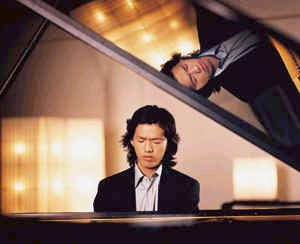
Yundi LiWith the proliferation of piano competitions, it’s easy to become jaded at the prospect of yet another young virtuoso passing through town, making his or her on a hopefully enthusiastic public. But media darling (although we all regret this picture ever having been taken)Yundi Li, the first Chinese national to win the prestigious Chopin Competition (2000, the first impressive crop in 25, 30 years - Alex Kobrin came in third that year, jfl wants to know where Ms. Ingrid Fliter is, these days), is definitely a cut above, as he proved Saturday night at Strathmore.

available at Amazon
F. Liszt, h-moll Sonate, Yundi Li

available at Amazon
Schumann, Scarlatti, Mozart, Liszt: Vienna Recital, Yundi Li
Mr. Yundi’s program promised, or threatened, a barrage of virtuoso display, centering as it did on two of the warhorses of Romantic piano: Schumann’s youthful Carnaval and Liszt’s Sonata in B Minor. There was virtuoso display aplenty, as Yundi Li launched into the Schumann like lightning—a bit fast for what is supposed to be a masked procession of characters, who then become the subjects of the vignettes to follow, but definitely exciting. Although more Florestan than Eusebius (for now), his Schumann did not want poetry, nicely characterizing the contrasts in what is by definition an episodic work, wistful in Charivari and dreamy in Chopin. In presenting the opening Prèambule and closing Marche des Davidsbündler with high drama and speed, Yundi may have sought to unify Schumann’s kaleidoscopic sequence. If so, it worked fairly well, though given Yundi Li’s skill the poetic element – so important to Schumann as both composer and critic – will emerge more strongly in years to come.

The Liszt sonata, arguably the summit of Liszt’s piano music, is a through-composed piece complete with leitmotifs and, properly performed, a tight cohesive dramatic narrative, including a fugue (can’t beat a good Romantic fugue) and mordant fade-out conclusion. In one light it is almost a Ring-of-the-Nibelungen in miniature, and indeed Wagner was a big fan. Most of this was told beautifully in Yundi Li’s performance (he has also recorded it for Deutsche Grammophon – an well developed yet exciting reading –Ed.jr.), with not a dull moment and only a bit of that virtuoso overdrive that can – occasionally – divert attention from the music and towards the musician. Much like the Schumann, here was excellence bound to mature into something better, still.

In a way, though, Yundi Li’s opening Mozart sonata, C-major K. 330, gave the best idea of the kind of artist he will become. Mid-mature Mozart, the sonata is indeed ‘lighthearted’ as the program notes claim, but it is not light music. Yundi gave it a wonderful flow and clarity, never becoming either too precious or too pretentious. The central episode of the Andante had a fine lyricism, and the concluding Allegretto recalled the operatic Mozart in his hands.

Other Reviews:

Stephen Brookes, In This Corner, Yundi Li (Washington Post, April 3)
Throughout the program Yundi Li’s piano had a fine tone, plenty of strength but no sense of forcing, with dynamics and contrasting voices carefully brought out. Sheer joy was apparent everywhere, his playing and the audience that demanded two encores with enthusiastic ovations: a ‘traditional’ Chinese tune, “Sunflowers” (sounding just like (good) old-fashioned salon music) and Chopin’s f-minor Ballade, a generous addition beautifully rendered.

2.4.06

Vadim Repin and Nikolai Lugansky: Greatness Too Small for Meyerhoff

Vadim Repin (The little man next to him is Maxim Vengerov)In a wise, anticipatory move, Amtrak and Marc trains run as if their funding had already been taken away. It will guarantee a smooth transition for when the time comes and it was – despite unmasked incompetence in running a proper public transportation system – good enough to dump me at the steps of the Meyerhoff Hall in Baltimore just a few minutes after Vadim Repin and Nikolai Lugansky were supposed to have started their recital. Simultaneously, if from different ends, the two musicians and I walked into a Meyerhoff Hall so empty, it suggested us having showed up there far too early. With a recital of two of the world’s premiere artists (indeed Repin arguably the finest violinist of his generation and just last week signed on as an exclusive Deutsche Grammophone artist), the concert hall was shamefully empty; less than half full. I am not sure if that sorry state says more about the support for the arts in Baltimore in general, or Baltimore’s lack of a more appropriate venue for a recital, or an abysmal failure on the BSO’s part (which featured the concert) to adequately promote this event. Probably a mix of all of the above.

Nikolai LuganskyFor those who were there (mostly Russians, not surprisingly), Repin and Lugansky had assembled an interesting and perhaps even daring program, opening with Bartók’s Rhapsodie no.1. The first movement (Moderato/Lassú) was square and boxy, angular and precise. The Allegretto moderato / Friss turned on a dime into something much more intimate and sparkling. The work lived off these stark contrasts so well accentuated. Like the following Schubert Fantasia in C-major D934 (a svelte, dancing performance!) the Bartók was lost in the too-large space of the hall. The intimacy and detail that make Repin’s play so special did not quite make it beyond the first block of seats. At a greater disadvantage still was his partner Lugansky who was reduced to plinking about for much of the concert, trying to find a suitable medium between filling the hall with a round sound and not overbearing Repin. It says much about the two artists’ seemingly infinite technical and musical resources that the result was so impressive and felt despite the adverse circumstances.

available at Amazon
A. Pärt, Fratres (Violin & Piano and Cello versions), Tabula Rasa, Benjamin Britten Cantus, Gidon Kremer, Keith Jarrett, Alfred Schnittke / Russell Davies
Arvo Pärt’s Fratres, given in the version for violin and piano, is one of my favorite pieces by the Estonian/German composer. Perhaps because it was also one of the first I’ve encountered by Pärt, on a still definitive recording on ECM. With its deceivingly simple opening – just three tones rotating with the solo violin swirling around them in furious arpeggios – it prepares the ground for the haunting, melancholic chords that the piano softly rings out like heavy, sad bells. It’s a stunning work, brilliantly combining minimal means with highest emotional effect: mystical and esoteric, fragile and beautiful… a work I was actually grateful to hear performed.

César FranckThe César Franck sonata is popular and rightly so, if perhaps not for the reasons I deem it great. It’s a work by a 64 year old man never known for any revolutionary sentiment or affect. And yet here he very quietly delivers a sublime work that just as quietly undercuts all convention, that is far ahead of its time while sounding conservative enough on the surface to placate the romantic-music denizens helplessly stuck in their arrested development.

With unusual rhythm, unusual mood and flaunting its assigned key more often than heeding to it, the first movement – and indeed the entire sonata – takes (secret) leave of standard form. Yet it never does so with the academic obstinance as so much of modern music deliberately did and does. It charms. Instead of robbing the listeners of their expectations at gun point, it smiles, teary-eyed, and – before they ever know it – manages to have stolen their wallet. And most beguiling as she is (clearly a female sonata; even in its stormy passion full of grace) we listeners don’t even mind when we find out that she stole our heart, too. And all because she is solidly modern under a romantic coat.

Repin and Lugansky clearly did something right to have elicited that much emotion in the first place. Even if that could not quite make up for the fact that too much music became a wash in the venue, it had the sparse audience leap to their feat and applaud and cheer loud enough for all those absent-twice over, absolutely forcing the boys to give two encores. But then, they were playing to a home crowd.

Classical Week in Washington (4/2)

Last week | Next week

Classical Week in Washington is a weekly feature that appears on Sundays, at the same time as my Classical Music Agenda for DCist. If there are concerts that you would like to see included on our schedule, send your suggestions by e-mail (ionarts at gmail dot com). Plan your winter concert schedule with our 2006 Concert Preview and Classical Month in Washington (April), or your opera listening with our Opera Preview 2006.

Tuesday, April 4, 12:10 pm
Noontime Cantata: Tue Rechnung! Donnerwort, BWV 168
Washington Bach Consort
Church of the Epiphany (13th and G Streets NW)

Tuesday, April 4, 8 pm
Yo-Yo Ma, cello (WPAS)
Solo cello suites by J. S. Bach
Kennedy Center Concert Hall

Wednesday, April 5, 8 pm
Academy of Ancient Music (Giuliano Carmignola, director)
All-Mozart program
Clarice Smith Performing Arts Center (College Park, Md.)

Thursday, April 6, 8 pm
Turtle Island String Quartet [FREE, and no ticket required]
Library of Congress

Thursday, April 6, 8 pm
Baltimore Symphony Orchestra: Monet and the Impressionists, with conductor Jahja Ling
Music by Debussy, Ravel, and Beethoven (Third Symphony)
Music Center at Strathmore

Friday, April 7, 8 pm
Juilliard String Quartet [FREE]
Music by Schubert, Viñao, and Beethoven
Library of Congress

Friday, April 7, 8 pm
Krystian Zimerman, piano
Shriver Hall (Baltimore, Md.)

Friday, April 7, 8 pm; Saturday, April 8, 8 pm
Reto Reichenbach, piano
Music by Martin, Brahms, Franck
Embassy of Switzerland (2900 Cathedral Avenue NW)

Friday, April 7, 8 pm; Sunday, April 9, 2 pm
Bellini, Norma
Virginia Opera
George Mason University Center for the Arts

Saturday, April 8, 2 pm
Malcolm Bilson, lecture/piano recital
Performing on a replica of the 1814 Nanette Streicher piano
Baltimore Museum of Art

Saturday, April 8, 8 pm
Leon Fleisher, piano
Music by Bach (Capriccio in B-flat major, BWV 992, and Chromatic Fantasy and Fugue), Stravinsky (Serenade for Piano in A Major), and Schubert (Sonata in B-flat, D. 960)
Shriver Hall (Baltimore, Md.)

Saturday, April 8, 8 pm
Lent in Leipzig (music by Keyser, Kuhnau, J. S. Bach)
Cantate Chamber Singers
St. John’s Norwood Parish (Chevy Chase, Md.)

Saturday, April 8, 8 pm
Elmar Oliveira, violin [FREE]
Library of Congress

Saturday, April 8, 8 pm [free masterclass at 1 pm]
Pacifica Quartet
Music by Mendelssohn, Janáček, Tchaikovsky
Kreeger Museum

Saturday, April 8, 8 pm
National Philharmonic, with Cho-Liang Lin, violin
Music by Beethoven and Mussorgsky
Music Center at Strathmore

Sunday, April 9, 3 pm
Fazil Say, piano
Music by Bach (Prelude and Fugue in A minor, BWV 543, and Busoni's arrangement of the D minor chaconne from the second violin partita), Beethoven (Tempest sonata), and Stravinsky (Rite of Spring for piano, four hands)
Shriver Hall (Baltimore, Md.)

Sunday, April 9, 3 pm
Washington Chorus: William Walton, Belshazzar's Feast, and motets and Gloria by Poulenc
Kennedy Center Concert Hall

Sunday, April 9, 6:30 pm
Eusia String Quartet, with James Dick, pianist
Music by Debussy, Fauré, and Gregory Vajda
National Gallery of Art

Sunday, April 9, 7:30 pm
Courtenay Budd, soprano
Jewish Community Center of Greater Washington (Rockville, Md.)

——» Go to the previous schedule, for the week of March 26.

1.4.06

Takács Quartet, Corcoran Gallery

Also on Ionarts:

Takács Quartet at the National Gallery (October 26, 2005)

Takács Marathon, Part II (October 17, 2005)

Takács Addiction (October 4, 2005)

Where's My Takács? (March 10, 2005)

Amazing Audial Alliteration: Borodin, Bartók, Beethoven (October 17, 2004)

Dip Your Ears, No. 8: Béla Bartók, The Six String Quartets, Takács Quartet (August 5, 2004)
Friday night presented one of those Ionarts dilemmas: Jens was going to Baltimore to hear Vadim Repin's recital, but would I hear the Milton Babbitt concert at the Library of Congress, the Baltimore Symphony at Strathmore, or the Folger Consort? No, on this night filled with choices, Ionarts also went to the Corcoran Gallery of Art's auditorium to hear a concert by the Takács Quartet. This is a group that is dear to the ears of Ionarts, although we have been concerned lately because of the recent personnel change, Geraldine Walther, who took over for Roger Tapping on the viola at the end of last summer. Jens and I have both noted that, during the transition period, the group has not always been in their accustomed top form. No surprise there, and we are more than willing to listen as they get their groove back.

The Takács played Mozart's "Dissonance" quartet at Shriver Hall, and it would have been nice to have heard that performance for comparison to the opening of this concert. Ionarts heard part of the Shriver Hall concert, but not the Mozart. K. 465 got its nickname from the strange slow introduction to its first movement, and players often exaggerate the dissonances to get the point across. This struck me as the calmest, smoothest rendition possible, from a group whose particular specialty has been Bartók. A different approach can make even the most jarring dissonant combinations of notes not jarring at all. In the Allegro portion of the movement, the tempo was plagued with minor inconsistencies, seeming to slow at points, only to be hastened along again by other players. The slow movement was achingly beautiful, and the minor mode trio was fraught with agitation. The concluding Allegro molto was thrillingly fast and self-assured in the handling of the Haydnesque stops and starts. This piece was a good start, with a few rocky moments at the opening.

Bartók, String Quartet No. 2, op. 17, third movement, score of Edward Dusinberre, Corcoran Gallery of Art, March 31, 2006Musicians can be finicky about their scores. I know some who prefer to work always with clean scores, to allow them to develop a new interpretation each time. However, most of us keep the same scores from the first time we played the piece, with the pencil marks (never mark in pen!) our teacher scribbled on every page. What do you think the score of Bartók's second string quartet, owned by the first violinist of the Takács Quartet, would look like? (Yes, I wanted to know, too. The page -- torn out of its binding, dogeared, and heavily marked -- was open to the third movement.) I saw Geraldine Walther's score, too, and it is now happily filled with cues referring to her new colleagues.

To my relief, the Bartók op. 17 was superlative, a mosaic of styles and folk references, chimeric, alchemical. The unusual order of movements, slow-fast-slow (not "fast-slow-fast" as Susan Joseph's program notes have it), makes the overall character of the quartet a slow burn. The first movement churned through its dissonant themes, with the last statement dying away on the A string of cellist András Fejér. The second movement (Allegro molto capriccioso) had a Mephistophelian intensity, rollicking with folk rubato. Speaking of dissonance, the third movement (Lento) was full of delicious sounds, tuned smooth like glass and filled with tension. Just when you think you can't take any more, Bartók reduces the movement to its final, somber open intervals.

Other Reviews:

Steve Hicken, Takacs Quartet demonstrates why it's known for Bartok (Tallahassee Democrat, March 31)
What is it with string quartets playing Schubert's "Death and the Maiden" quartet in Washington? Jens heard the Minetti Quartet play it in January, and the Jupiter Quartet played it at the Library of Congress the month before that. Not that I'm complaining about hearing one of the best pieces in the quartet repertoire. It was a driven performance where it worked best, as in the coda of the first movement. The nickname for D. 810 comes from the fact that Schubert used his own song of that name as a basis for variations in the second movement. With proper reverence for what is a profound piece of music, the players paused before beginning the Andante con moto, waiting for total silence in the hall. The first statement of the melancholy tune was exquisitely unified, sotto voce playing. (Der Tod und Das Mädchen, D. 531, from several years earlier sets the poem by Matthias Claudius, in which skeletal death asks for a sick girl's hand.) One of the strengths of the Takács Quartet is dynamic range, from ethereal near-silences to roaring fortissimi. In the slow movement's fifth variation, I was exalted by the rush of one of the group's crescendi, and for a moment I felt myself soaring above the hall somewhere. I came back down in time to hear the sixth variation, in which there is nothing left but the ghost of the melody. The drive of the first movement returned in the last: just when you though that the Presto could not get any faster, the Takács sped away on the flawless unisono moments of the concluding bars. It was a virtuosic display. The heat in the hall on the first few warm days of spring deprived us of an encore.

Upcoming concerts at the Corcoran include the Contemporary Music Forum (April 23), the Weilerstein Trio in an all-Dvořák program (April 28), a Liederabend by Festa della Voce (May 5), and the Daedalus Quartet plays the third Bartók quartet (May 12).

At Home With Mr. & Mrs. Wotan

Leitmotiv: Rheingold
The Washington National Opera’s first installment of their Ring cycle has been well received by critics and understandably so. Das Rheingold is an immensely enjoyable opera – and if Francesca Zambello’s production is not great in itself, it allows for -and sometimes aids- the opera to unfold most of its charm. The ripples of laughter that ran through the Opera house Saturday and Thursday (a rare enough, much welcome, phenomenon) did not come at the expense of the opera, nor were they caused by cheap jokes or slapstick but were a direct result of Wagner’s (understandably underrated) comedic side. Most laughter comes as the audience reads the supertitles which, although modified as mentioned in my (p)review, are straight forward; hardly re-creations á la Peter Sellars. Das Rheingold is, after all, chock full of humor, much of which to be found on the deeply sarcastic and ironic side. Zambello never stands in the way of that, even if her Loge – Robin Leggate (a fondly remembered Captain Vere in the 2004 Billy Budd) – could easily be played more ironically distanced from the Gods, especially in the fourth scene. You never quite see that he is only half God, a society’s outsider. He fits in too well with the Gods, his decision to pass on the move to Walhall comes as an unremarkable surprise.

Photos by Karin CooperIf the Rheingold works as a whole, that is not to say that the production works everywhere equally well. If the “American Ring” idea came across as weak or incoherent it is because there is little connection at all between the first scene, set in an overt American West (gold-digging Alberich), and rest of the opera. Elena Zaremba’s Erda comes as a similarly disjointed reminder of that theme – rather out of place in the last scene. If the ‘American’ character is to emerge fully and more understandably, it won’t be until the next installment of the Ring.

The projections between the scenes (covering very noisy scene changes), too, are an unripe idea with more potential than success. Whenever the images are muted and organic, they work well. But the bright, low quality CGI renderings look like old Windows screen savers; the flight back to Walhall between the second and third scene, once it ‘hits air’, reminds of a cheesy Airline commercial – then descends swirly-swirl into the Grand Canyon. Many intriguing or sensible ideas are touched upon (like in the flight through space during the Vorspiel) but quickly surrendered to other, less cogent images intruding. Color changes appear haphazard and neurotic; the switch between a suggestive sea of colors and shapes and jarring representational and obvious images (iron smelting before scene three: thanks for the reminder that the Niebelungs are not slaving away cleaning tourist’s trash from the bottom of the canyon) does not actually add any congruity.

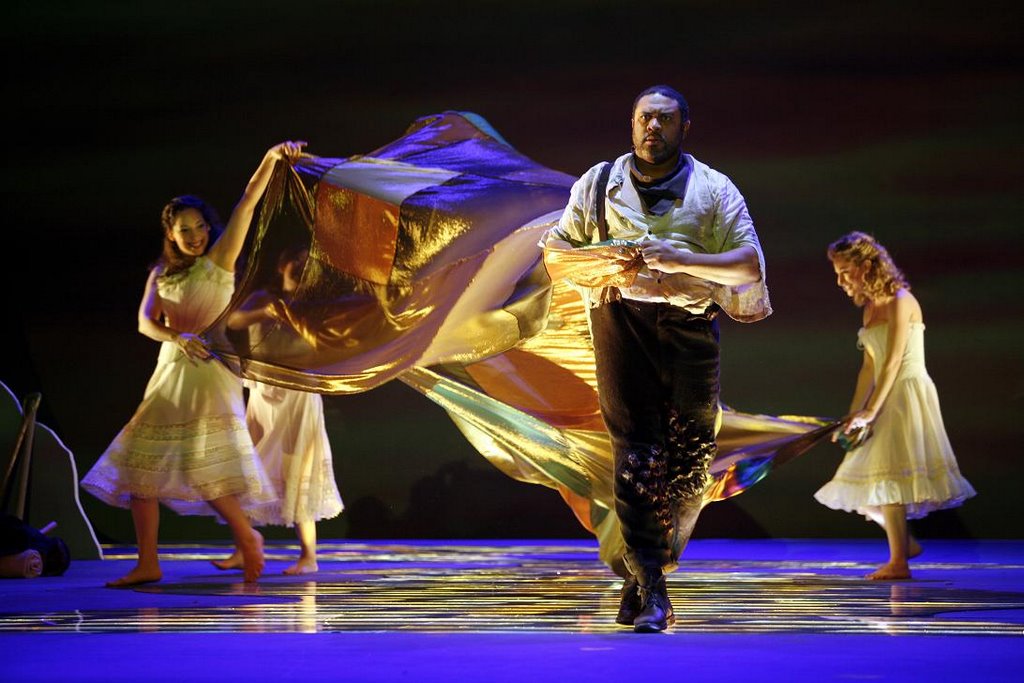
Photos by Karin CooperThe Gold is represented by a quilt (very American, indeed: Innocent history stolen by the intruding slaver Alberich) which isn’t all too bad but looks like a suspiciously economic solution. The firework blast before Alberich’s transformation into a worm (here: a bright yellow copperhead) cracks so deafeningly through the hall that, for a second, the startled audience held its collective breath and then laughed with relief. Catching the toad (a frog in this production) is always a fun moment. Where Donner's architect’s T-bar instead of a hammer added to the second scene, it’s not quite so convincing when he summons thunder with the fragile tool in the fourth scene.

Leitmotiv: Walhall
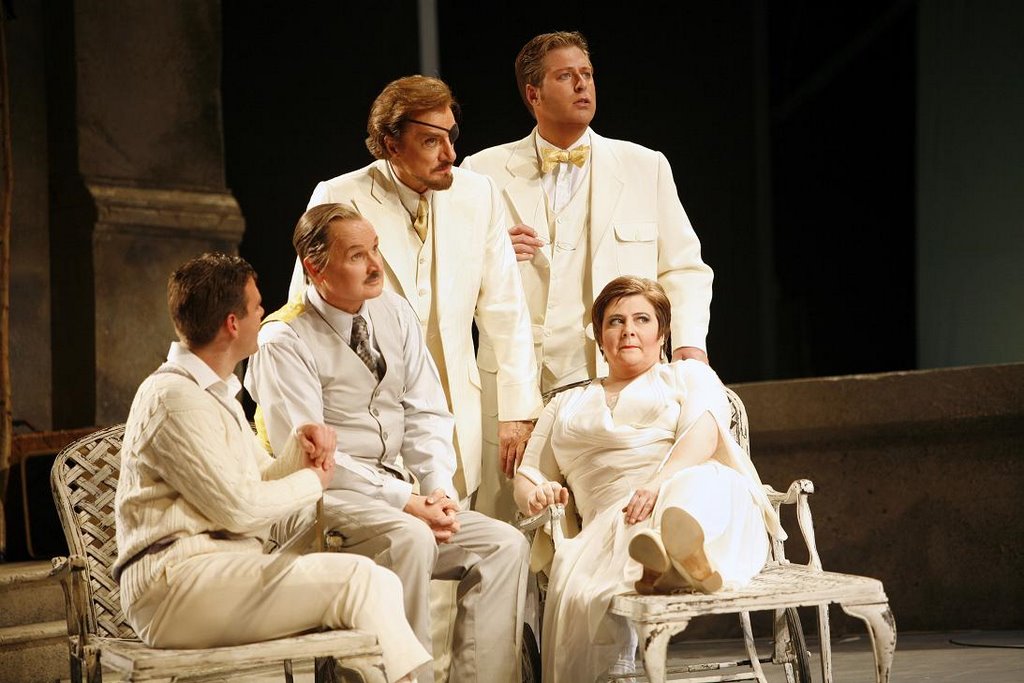
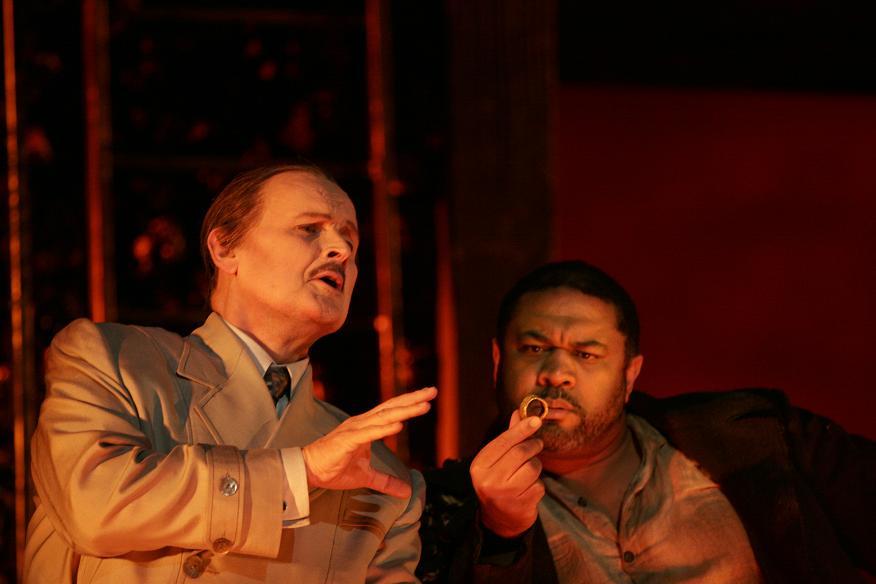
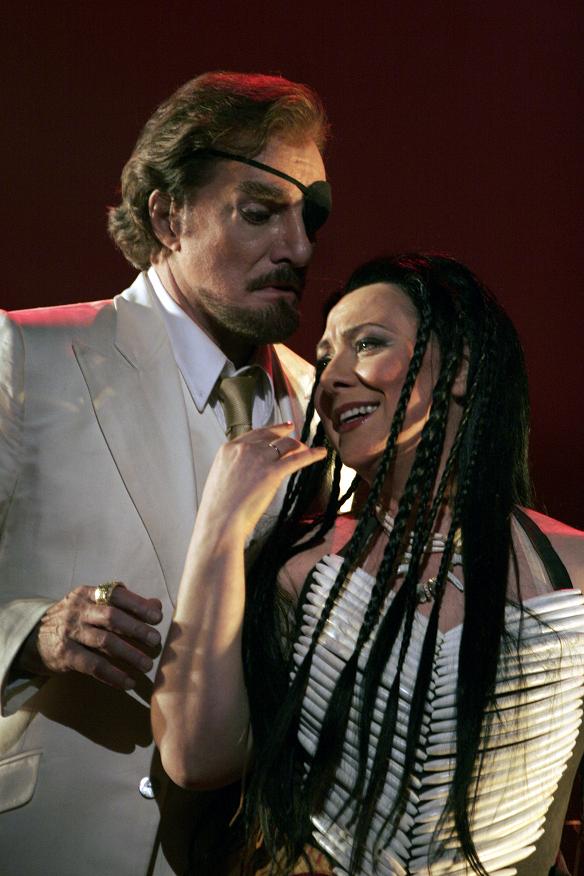
Photos by Karin CooperNone of these elements are fatal to the venture, few miscues (characters not looking at the action they sing about, or other characters not actually doing what is being responded to) mar a first impression and are only more noticeable upon repeated exposure. Most could (but won’t) be ironed out within even one run. The over-all enjoyment of the opera rains very high. That is also thanks due to good acting and fairly good singing. Robert Hale as Wotan was solid (although notably tired at points). Not the big voice that Wotan demands but nicely nuanced. Elizabeth Bishop, a feisty, chubby, cute Fricka was impressive and likable. Unlike portraying Fricka as the God’s Yoko Ono, she had the audience on her character’s side. Jane Ohmes as youth-bringing Freia acted well, which is easily half her character’s game, and sang well under the direct threat of being molested by the Giants. Her brothers, hapless Froh (Corey Evan Rotz) and Donner (Detlef Roth) are young singers, the former an in-house product who I found likeable for the first time; the former an import from Germany. They sang and acted well – with room for improvement, both. Donner’s anger in scene four, to the production’s fault, not Mr. Roth’s, seemed completely unmotivated and purposeless.

Photos by Karin CooperGordon Hawkins’ Alberich acts well (if with less menace than desirable) and sings better still. On Thursday he declined notably in voice and was thinner and drowned out towards the last scene. As in Porgy, I got the feeling that he is great when ‘on’ but not very good at economically using his voice. Gary Rideout’s Mime was a badly pronounced, modestly acted, unevenly sung disappointment. The three Rivermaidens Woglinde, Wellgunde, Flosshilde (JiYoung Lee, Frédérique Vézina, Jennifer Hines) were three attractive moisten, fishy temptresses. Nicely distinct in voice, all were good – with Ms. Vézina sounding the clearest.

Leitmotiv: Giants
Photos by Karin CooperWhich brings me to my favorite part of this ring: Fasolt and Fafner. Regular patrons of the opera will have seen plenty of John Marcus Bindel – now ten years with the WNO. Like his colleague Rotz, I never saw more than a convenient patch for an unfilled role in him (recently Hunding, Mathieu, Bethune, Iago); never found him vocally or dramatically any more than acceptable. And here, as Fasolt, the cutsey Giant, I found him to be stand-out of the production. All the sudden he excelled on every level, singing and acting so equally impressive that he became the character, all Fasolt (perhaps with a touch of Brendan Fraser). It goes in part to the credit of the production if a singer finds his way that completely into a character – and Bindel, who sang the hell out of the music, made the most of it. Not only Freia was sad to see him slain by his fine college Fafner a.k.a. Jeffry Wells (who was notably less secure at either ends of his vocal range).

Photos by Karin CooperThe only big disappointment was Zaremba’s Erda. What happened to that voice – so clear and immensely impressive as Fricka two years ago? What I heard from her was nothing like anything I have ever heard from her before: Wobbly, dense, muddled, pushed. A choice of characterization? I’ve heard resonant Erdas emitting sounds from a hole in the stage – but surely it ought not sound like that when Erda is on stage, free to project into the audience? An awful performance from a singer I greatly admire.

Heinz Fricke and the orchestra, finally, must feel sympathy with Alberich and the Niebelungs. It is difficult to imagine how much hard and frustrating labor went into this performance – but the result was presumably worth it. Subtly of interpretation and particular coloration should not be expected. Merely playing well and not screwing up the over-all impression was the order of the day. Mission accomplished. Even the fortified horn section held tight, no small achievement for this brass-taxing work. Without the fruits of their labor, this heartening, funny, entertaining prelude to the “American Ring” - successful and problem fraught as it is - would not have taken off.
Leitmotiv: Rainbow

ATTEND! - Student Tickets this Month

Go to the Kennedy Center's ATTEND! website to find out details about the $10 ticket program for students. Here is a selection of events we think are interesting among the ones that are offered.

Sequenza
Piano Trio performance with gems in the program: "Haydn's Piano Trio in E major, Hob. XV 28, Martinů's Cinq Pièces Brèves, and the world premiere of contemporary composer Paul Chihara's Ain't No Sunshine. The program finishes with Schubert's Trio in E-flat major"
Sunday, April 2 at 7:30 p.m.
Terrace Theater

Imani Winds
For what it's worth: The hippest Wind Quintet around. Works like Astor Piazzola's Libertango, and John Harbison's Quintet for Winds make going a temptation.
Monday, April 24 at 7:30 p.m.
Terrace Theater

East Coast Chamber Orchestra
Another group I know little about; another program that lures:
Britten's Simple Symphony was plenty fun with the LPO last Monday, it's always a good time for Shostakovich's Quartet No. 8 (arranged for string orchestra; presumably in the Barshai version) but especially in his centenary - and those who will have hated Higdon's "String" will love Tchaikovsky's Serenade.

Friday, April 28 at 7:30 p.m.
Terrace Theater

Helmuth Rilling & NSO
Bach's St. Matthew Passion

Attendance is mandatory! It's a Matthew Passion, it's Easter, it's Helmuth Rilling - the foremost historically INformed (as opposed to "HIP") Bach conductor of our times.
Thursday, April 13 at 7 p.m.
Friday, April 14 at 1:30 p.m.
Concert Hall

Rafael Frühbeck de Burgos, conductor / Julian Rachlin, violin

Great, underrated conductor and a wonderful violinist. LvB 6th, Prokofiev 2nd VC, Stravinsky Firebird Suite.
Thursday, April 20 at 7 p.m.
Friday, April 21 at 8 p.m.
Concert Hall

Mstislav Rostropovich, conductor / Dawn Upshaw, soprano
Overrated conductor, great soprano, program of Bernstein, Britten, Dutilleux, and Dvořák... which could go either way.
Thursday, April 27 at 7 p.m.
Friday, April 28 at 8 p.m.
Concert Hall