CD Reviews | CTD (Briefly Noted) | JFL (Dip Your Ears) | DVD Reviews

7.3.06

Decoding the Goldberg Variations

Available at Amazon:
available at Amazon
J. S. Bach, Goldberg Variations and 14 Canons, Richard Egarr, harpsichord (will be released on March 14, 2006)
This is fascinating, from an article by Lynne Heffley (A 'Variations' that Bach could love, March 6) for the Los Angeles Times (links added):
Promising to give it "the full monty," British harpsichord maestro Richard Egarr, making his first solo tour of the United States, will perform J.S. Bach's masterwork, the "Goldberg Variations," as well as the seldom-heard 14 "Goldberg Canons," on Friday at the Doheny Mansion in Los Angeles. Egarr, an internationally known keyboard virtuoso and conductor and the director of Amsterdam's Academy of the Begijnhof, plays the "Goldberg Variations" using a tuning only recently published by harpsichord scholar Bradley Lehman. Lehman decoded a "squiggle" on the title page of Bach's "The Well-Tempered Clavier" that he believes described the composer's tuning system, Egarr explained in a phone interview. "Other people have been trying to find Bach's tuning," Egarr says. "It's a bit of a Holy Grail in a way." Although not universally accepted, Lehman's discovery is "quite a convincing and most brilliant piece of detective work. It really sounds fantastic in Bach's keyboard music — and that seems to me proof, if anything. It really does work with the music."
The program of the Los Angeles concert, supposedly, is not the Goldberg Variations. As for this version, I reserve musicological judgment until I see something more specific and hear it for myself, but I advise you to read the whole article. Readers, you can hear it yourself on March 11 (Early Music Guild in Seattle), March 19 (Frick Collection, New York). I won't be able to make it to any of those performances, but I'll try to find some reviews.

UPDATE:
Thanks to attentive and helpful Ionarts reader Margarita, who left a comment with a link to an article by Ernie Rideout (300 Years Ago Today, December 2005) in Keyboard. The musicologist who came up with this interpretation, Bradley Lehman, has a Web site. Here is his theory of the Bach tuning, which he formulated in 2004 and published in Early Music last year. More about it when I have had the chance to digest all of this material.

6.3.06

Dead Man Walking

Available at Amazon:
available at Amazon
Jake Heggie, Dead Man Walking (2000), live recording of world premiere, San Francisco Opera, Susan Graham, Frederica von Stade, Patrick Summers (released on January 8, 2002)
In live performance, I have heard only a short excerpt of Jake Heggie's opera, premiered by San Francisco Opera in 2000, Dead Man Walking. That was the beautiful Act II duet between Sister Helen and Sister Rose, presented by the Domingo-Cafritz Young Artists in one of their programs at the Renwick Gallery (American Opera at the Renwick Gallery, October 11, 2004). My interest in seeing the whole thing staged will be sated this weekend, with the production at the Baltimore Opera (March 11 to 19). These performances will feature baritone John Packard, who sang the role in the world premiere production in San Francisco, as well as Patrick Summers, who conducted the opera. You can hear their work on the live recording of that first performance, with two singers who will not be in Baltimore this coming week, Susan Graham as Sister Helen and Frederica von Stade as Joseph de Rocher's mother. Those roles will be sung in Baltimore by Theodora Hanslowe and Diana Soviero, respectively, both well-reputed singers. I expect good things.

available at Amazon
Dead Man Walking (1995), Susan Sarandon, Sean Penn, Tim Robbins (released on January 1, 2000)
available at Amazon
Sister Helen Prejean, CSJ, The Death of Innocents: An Eyewitness Account of Wrongful Executions (2004)


Web site: The Death of Innocents
The opera, like the excellent film of the same title (Dead Man Walking, 1995, directed by Tim Robbins, with Susan Sarandon and Sean Penn), is based on a book by a nun from Louisiana. Sister Helen Prejean, CSJ, will speak on "The Culture of Life and the Penalty of Death" this Thursday (March 9, 7:30 pm), at St. Ignatius Church (740 N. Calvert Street) in Baltimore. (Sister Helen even wrote a blog, although it is now a few months out of date, discontinued after Hurricane Katrina wiped out her neighborhood.) Like most monastic religious, Sister Helen is not an extraordinary person: what impresses is that she has done extraordinary things. Her most important, most public work is her ministry to convicts on death row in Louisiana, where her religious house, the Sisters of St. Joseph of Medaille, is located.

Anyone who has spent any time with nuns, especially, will know that they are often stubborn and audacious in terms of their drive to get things done. If a nun starts asking you to do something to help out, you had better just give in and do what she wants, because eventually she will get you to do it. I think that Susan Sarandon, who grew up Catholic, captured this quality perfectly when she portrayed Sister Helen in the movie (partial credit should go to her husband, Tim Robbins, who wrote the screenplay, too). At her first interview with Matthew Poncelet, as the convict is named in the film, Sarandon's Sister Helen reacts to his sexual advances with an incredulous laugh: "Look at you." It's a great moment, without even addressing the insult to her religious vows, she cuts him down and puts him in his place. The same scene in Terence McNally's excellent libretto does not have the same punch.


Other Articles:

Tim Smith, Writer of 'Dead Man Walking' wanted opera to stress redemption (Baltimore Sun, March 5)
The opera has left most audiences rapturous, and few operas in the last decade or two have had nearly the success of Dead Man Walking, if we measure an opera's success in terms of the number of performances it gets. That being said, critical reaction has not always been as friendly. The musical style is simple, even simplistic, some have charged. Heggie got his start as a pianist and songwriter, and writing a work for orchestra was not something that came naturally. (I am not aware that he turned to an orchestrator for help, as Gustavo Santaolalla did for his score for Brokeback Mountain.) However, when you have a facility for writing melodies for the voice, as Heggie clearly does, that strength may compensate for unimaginative orchestration. (Think Rossini, Bellini, early Verdi.) The immediate appeal of Heggie's style -- basically tonal, sprinkled with affective film music dissonance -- probably explains the opera's popularity with audiences, as does his more or less traditional approach to opera as a series of pieces.

In Act I, there is a compelling scene for male chorus ("Woman on the tier!") as Sister Helen walks through the death row corridor of the prison. Over the course of operatic history, composers have approached the operatic chorus in many different ways, but few have decided to do without it altogether. Heggie's scene is a dramatic and sensible use of the chorus. Heggie also created some effective ensembles, the legacy of Mozart and Verdi, especially the sextet at the end of Act I ("You don't know what it's like to bear a child"), combining the parents of the murdered boy and girl with Sister Helen and Joe's mother, as the family members wait for the decision of the parole board: they vote to go ahead with the execution. I also admire the Act II duet between Sister Rose and Sister Helen ("Sometimes forgiveness is in the smallest gesture"), in which the restless Sister Helen obsesses about her dreams and worries in the middle of the night. (This is the duet I heard at the Renwick Gallery, sung radiantly by Leslie Mutchler and Christina Martos.)

The pieces marked "arias," I have to admit, are less pleasing to my ear, and one major failure of the opera is the music for Sister Helen's hymn ("He will gather us around"), which returns a number of times throughout the opera. It would have been good for Heggie to have created something exquisite for this, but I tired of that music rather quickly. Susan Graham's Sister Helen and Frederica von Stade's Mrs. de Rocher are superbly drawn characters musically. I am less sure about Joseph de Rocher, which is not necessarily John Packard's fault. Music should be able, more or less instantly, to ennoble any villain, no matter how despicable, and I don't know if Heggie really took full advantage of that power. As far as operatic executions go (Cavaradossi in Tosca, Siegmund in Die Walküre, Billy Budd, the nuns in Dialogues of the Carmelites), this is not particularly chilling, I found, because there is so little happening musically. I had the same reaction to the famous announcement that the condemned man is on his way to execution, from which the work takes its name. Opera is opera because singing is more powerful declamation than speech. Having the guard simply shout "Dead man walking!" and having the execution sounds be only the clicks and beeps of the medical machinery betray that fundamental rule. Would it be more dramatic if Violetta shouted the words "Oh gioia!" before she collapsed instead of what Verdi gave her to sing in La Traviata?

There was a recent performance of highlights from Dead Man Walking at Trinity Church in Manhattan, mentioned by Steve Smith at Night after Night. Mirabile dictu, there is a Webcast of that performance, with a top-notch cast, available at the church's Web Site. Even if you cannot see one of the Baltimore performances, take a look. If you're in a hurry, fast-forward past the speeches by Sister Helen and others.

Rembrandt and Caravaggio

Other Reviews:

Linda Sandler, Amsterdam Celebrates Rembrandt Birthday, Aims to Lure Tourists (Bloomberg News, March 5)

Andrew O'Hagan, Same theme, different light (The Telegraph, March 4)

Michiel Haijtink, Rembrandt-Caravaggio, a top-level art contest (Radio Netherlands, March 3)

Gérard Dupuy, Baroques à la colle (Libération, March 2)

Martin Gayford, Rembrandt, Caravaggio Dazzle, Fail to Bond in Amsterdam Show (Bloomberg News, February 24)

Guy Duplat, Le choc des génies (La Libre Belgique, February 24)

In pictures: Rembrandt-Caravaggio (BBC News, February 24)
This year we celebrate the 400th anniversary of Rembrandt's birth, and the Van Gogh Museum in Amsterdam has marked the event with an incredible blockbuster show, pairing the works of Rembrandt with those of another Baroque master, Caravaggio. (This was the idea of the director of another major museum in Amsterdam, the Rijksmuseum, which is also hosting several Rembrandt exhibits this year. The television commercial that the museum made for the 400th anniversary, in which the characters of The Night Watch come to life to sing "Happy Birthday," is quite funny.) Harry Bellet wrote a review (Rembrandt-Caravage, sacré duel, February 28) for Le Monde (my translation):
Based on an idea from Ronald de Leeuw, the director of the Rijksmuseum, the Van Gogh Museum in Amsterdam has organized the first confrontation between two of painting's monstres sacrés, Caravaggio and Rembrandt. They are artists separated by everything, starting with age. They are not contemporaries, or are just barely: when Caravaggio died, in 1610, Rembrandt was four. They lived at opposite ends of the spectrum, the former in Catholic Italy during the Counter-Reformation, and the latter in Calvinist Holland. Caravaggio's clients were princes of the Church; Rembrandt's shop was patronized by the middle-class citizenry of Amsterdam. One wandered about the Mediterranean, courting patrons or escaping from the authorities; the other, who married well, lived in opulence up to the death of his wife, which left him without income and crippled with debts. The Italian led a violent life, punctuated with tavern brawls and culminating in a murder, on May 28, 1606, a month and a half before Rembrandt's birth; the Dutch artist's only known crime was, as a new widower, having impregnated his maid.

Everything about them is in opposition, except painting. This exhibit, laid out by the Frenchman Jean-Michel Wilmotte, shows that by bringing together 38 paintings, 15 by Caravaggio and 20 by Rembrandt. The canvases come from Dublin, London, Madrid, Paris, Berlin, Dresden, Munich, Cleveland, Detroit, New York, San Francisco, Rome, Naples, St. Petersburg, and Melbourne. Anyone who wants to see them after the exhibit closes, on June 18, will have to travel. [...]

The two painters were both masters of the "expressive face," as it was called in the studios, that particular talent of showing, through the agency of facial traits, the movement of emotions. It is fun to compare, as proposed in this exhibit, two examples of female perfidy: the look, both delighted and vaguely horrified, of Dalilah fleeing with the freshly cut hair of Samson, and the look, frankly disgusted but resolved, of Judith cutting off the head of Holofernes. The latter, by Caravaggio, shows Judith with clearly erect nipples: the exhibit comments perceive in that an eroticism much more present in the Italian's work than in the Dutchman's.
You can see many of the images in the exhibit, often in these comparative pairs, at the museum's Web site.

The Golden Age? Emil Chudnovsky vs. Chocolate

Reviewing a book or CD of an acquaintance’s is a losing proposition. Gush and be accused of shameless favoritism and unforgivable bias; be critical and count on not being invited over for dinner any time soon. The truth-content of the review hardly matters in that regard. Should one be a little more critical than usual, protecting the reputation as a hard-nosed, honest-eared critic or can we slip a little service to friendship? The best way to appease both instincts is the strategy representing the exact inverse of ‘damnation with faint praise’, namely “Praise by faint damnation”. So here I go:

The concept of the album strokes my predilections like a cat against the lie of the fur. “The Golden Age” – a collection of virtuoso confections that is to the ear what the Jubilee Praline Edition by Godiva is to the tummy. How is that bad, you might wonder. In that case I would like to know if you have ever eaten a pound and a half of chocolate, and if so: how did you feel afterwards. Exactly.

To be fair, the comparison limps a little; a collection of Saint-Saëns, Massenet, Wieniawski, Paganini, Sarasate and, yes, Kreisler, isn’t quite as dense as a giant ball of chocolate in your innards - and at least it doesn’t leave you nearly as constipated. Mercifully, Mr. Chudnovsky’s tone, style of playing, the sound of his instrument and the sound of the recording itself all work towards higher digestibility. That is to say that there is nothing cloyingly sweet about this CD – this isn’t the Romantic Romance of the Romantic Violin á la candy-man Josh Bell. It’s more a lavishly packaged and good-hearted ego trip about technical abilities, which bans the perpetrator, in my book, to a totally different (and kinder) circle in musician-hell. Of course such a record would be a lamentable joke if the skill wasn’t in ample supply… fortunately it is. There are a few scratchy moments in the highest stratospheres of Paganini’s Le Streghe and the beginning of the Italian fiddler’s 24th Caprice sounds ever so slightly stop-and-go (that quickly dissipates when the pizzicato element enters). The Introduction & Rondo Capriccioso and the Thaïs Meditation are very fine, indeed.

Emil Chudnovsky’s playing has a hard edge, accentuating brilliance, the sound he and his instrument produce is shallow bodied (but big!). There is a virtuosic, short-packed energy to his way with the violin – playing always in the smallest possible gear in the bravado sections but not afraid to shift long when it comes to more lyrical parts… which are impressive still, even if his strengths do not lie there. I could probably come up with a few superlative adjectives for a good many aspects of his playing (nobody would believe it, anyway), instead I’ll mention the one that does not quite come to mind right away: subtlety. On this recording, he displays the subtlety of a race car. Then again that might be appropriate with these works; just like I am not sure if subtlety has ever won a race car the Monza Grand Prix.

Daniel Grimwood is the pianist kind enough to indulge his colleague with his accompaniment. Not surprisingly, Grimwood gets the best chance to display his considerable skill in the only modern work on this disc – although “modern” merely refers to the time of its composition (1999), hardly its lush, neo-romantic style. Philip Lasser’s La Vocalise is the work in question and, fitting in with the theme of the CD and the other works, it is not a spitting and screaming piece of modernist agenda (not that there is anything wrong with that)… it is a simply beautiful, lyrical (and, yes, conservative) work that does the inconceivable: hail from the 1990’s and contain melody. Debussy shimmers through, Langgaard (if you know him), too. It is by far the most lyrical work on the disc – a bit of respite before Kreisler, that old crook, closes the disc with the wistful Viennese Rhapsodic Fantasietta.

Sound is slightly recessed, with the violin set back and the natural resonance of an expansive, if cold, concert space… perhaps a large, marble floored room in an empty house. The recording sacrifices intimacy for detail. Even if there were more warmth in the playing, it would leave the balance still in favor of underscoring the technical achievements. It is not what critics these days like to call a ‘natural sound reproduction’; instead of sounding like a violin, it sounds like a violin being played to you. That’s a matter of preference, mostly – and a matter of how you have set up your stereo system. The distance between listener and the violin leaves the tone room to breathe and dissipate, creates ambience.


"The Golden Age"
Emil Israel Chudnovsky, Daniel Grimwood
JB Record[s]
- available in China, at select Tower Records stores, and directly by contacting the artist.

5.3.06

Oscars 2006

So, here we are on Oscar Night, liveblogging the Academy Awards. I'm nervous for Jon Stewart, because The Daily Show is so great, but this assignment has destroyed many funny people before him. OK, I'm not going to dissect the jokes in detail, but it was good. Perhaps some jokes we've heard before on his show, but some really good stuff. Best joke was about Good Night and Good Luck and Capote: "Both films are about determined journalists, defying obstacles in a relentless pursuit of truth. Needless to say, both are period pieces." Those are some of the funniest bits on The Daily Show, the softballs that journalists toss at politicians these days.

It is an annual tradition, at the legendary Oscar parties hosted by the Hollywood contingent of Ionarts, to have an awards pool. I'll keep track of my points, although Todd always wipes the floor with me. My score at the bottom of this post.

[20:28] Performance by an actor in a supporting role.
Ka-ching! My first correct pick: George Clooney in Syriana. Mrs. Ionarts and I finally saw it just last night. Together. In a movie theater. Without the children. It's a very entertaining movie. Clooney calls it in his speech: this is the sound of a bone being tossed in his direction. It's a contorted plot. Well, it's more like several twisted plots gnarled into a hopeless knot. Clooney's performance is excellent.

[20:39] Achievement in visual effects.
King Kong (Universal). I picked Narnia, but I didn't actually see King Kong. The visual effects in Narnia, the animals and mythological creatures, were just incredible.

[20:44] Best animated feature film of the year.
Another point for me! Wallace & Gromit in the Curse of the Were-Rabbit (DreamWorks Animation SKG), Nick Park and Steve Box. Since a colleague lent me the DVD of this movie, Mini-Critic and I have been watching parts of it together almost every day. He gets creeped out when we finally see the transformation into the were-rabbit, so we don't watch that part. It's a great flick.

[20:55] Best live action short film.
Six Shooter (Sundance Film Channel). No point. No comment.

[21:01] Achievement in costume design.
Memoirs of a Geisha (Sony Pictures Releasing), Colleen Atwood. I chose Pride and Prejudice but for no good reason.

[21:09] Achievement in makeup.
Good makeup joke by the introducers. Yes! Another point for me: Howard Berger and Tami Lane for Chronicles of Narnia: The Lion, the Witch, and the Wardrobe. Yes! Stewart went for the Russell Crowe joke.

[21:15] Performance by an actress in a supporting role.
Well, they picked Rachel Weisz in The Constant Gardener, a movie I didn't see. I was hoping that it would be Catherine Keener in Capote, whose work I have been admiring for a long time.

[21:24] Holy shit. Does Lauren Bacall not see the teleprompter? Abort! Abort!

[21:29] The Daily Show-style fake political commercials for Best Actress nominees are very funny.

[21:31] Best documentary short subject.
A Note of Triumph: The Golden Age of Norman Corwin. Corinne Marrinan and Eric Simonson. Didn't pick it.

[21:33] Best documentary feature.
March of the Penguins (Warner Independent Pictures), Luc Jacquet and Yves Darondeau. Point for me!

[21:45] Achievement in art direction.
Memoirs of a Geisha (Sony Pictures Releasing). Art Direction: John Myhre. Set Decoration: Gretchen Rau. I picked Good Night and Good Luck, but didn't see the winner.

[21:56] Achievement in music written for motion pictures (Original score).
Awesome! Itzhak Perlman playing with Bill Conti's orchestra! Even if he is mostly drowned out. I enjoyed Gustavo Santaolalla's music for Brokeback Mountain. Even though it was awfully plain, I picked it to win, because it's in Brokeback Mountain. It's almost unfair to have to compete against John Williams. Twice. The Munich excerpt sounds the best of the five. Itzhak rules. Santaolalla wins! He thanked his orchestrator. Nice.

[22:13] Achievement in sound mixing.
Again, I picked Narnia, but King Kong wins. I guess I need to see that movie.

[22:16] Lily Tomlin and Meryl Streep are great, giving the very deserved Honorary Oscar for Robert Altman. I think I've seen most of his movies, but watching the clips I am now headed for my Netflix queue. As if the Academy still needed to prove its general irrelevance, they have never given Altman an Oscar for Best Director, although he has been nominated several times. Yes, nice dig at the Academy in his speech, which is charming and funny. "I've never had to direct a film I didn't choose or develop." That is worth honoring by itself. A touching and witty remark about his heart transplant concludes a great speech.

[22:20] It's Hard Out Here for a Pimp. This is disturbing on so many levels. Hoping for a cutaway shot of Itzhak Perlman during this. Alas, it was not to be! I loved the shot mistake of the crew taking down the street sign.

[22:25] Achievement in music written for motion pictures (Original song).
It's not so hard out here for a pimp. All the nominated songs were pretty awful. I chose In the Deep. Stewart can only laugh. "It just got a little easier out here for a pimp." Yes! the Perlman shot I wanted, because of a funny joke about the "3-6 Mafia getting into it with Itzhak Perlman's posse."

[22:28] Achievement in sound editing.
King Kong is cleaning up in the technical categories, which I should have expected. I should have chosen it more often, as I did here.

[22:39] Best foreign language film of the year.
The South African film Tsotsi (Moviworld) wins. Rats! Predictably, I chose
Joyeux Noël from France (Nord-Ouest).

[22:43] Achievement in film editing.
Crash (Lions Gate), Hughes Winborne. This is one of those points that I don't deserve to get, because my choice was completely random. I'll take it!

[22:48] Performance by an actor in a leading role.
Yes! An actor whose work I have also long admired: Philip Seymour Hoffman in Capote (UA/Sony Pictures Classics). My second choice was the infinitely subtle performance of David Strathairn as Edward R. Murrow in Good Night, and Good Luck.

[22:56] Achievement in cinematography.
Dion Beebe for Memoirs of a Geisha. That is the last movie I would have expected to win. I picked Brokeback Mountain, but it was a hard choice to make over Good Night and Good Luck. Both were beautifully shot movies.

[23:00] Performance by an actress in a leading role.
I picked Judi Dench, which was crazy, even I admit. Reese Witherspoon wins for Walk the Line. My points performance is going down the tubes.

[23:10] Adapted screenplay.
This one was a foregone conclusion, I think. It's daunting to try to make something out of an already brilliant story like Annie Proulx's. The screenplay is a great achievement: Brokeback Mountain (Focus Features), screenplay by Larry McMurtry and Diana Ossana. What a great tribute to "the culture of the book, which we mustn't lose."

[23:15] Original screenplay.
Crash wins. I chose Good Night, and Good Luck. Boo.

[23:20] Achievement in directing.
Hooray! I chose correctly with Ang Lee for Brokeback Mountain. He has made some of the most rewarding movies, in a variety of styles and genres. For action films, Crouching Tiger, Hidden Dragon excuses Hulk. As for The Ice Storm and Sense and Sensibility, both of them wonderful for different reasons, I cannot believe that the director did not actually grow up in a 1970s American suburb and also 19th-century England. What an eye! He also gets funniest linguistic mistake for mentioning all the "gay mens and womens" in his speech.

[23:23] Best motion picture of the year.
Whoa, they are really ratcheting up the pace here to get this finished. Crash wins, which is a surprise, even for presenter Jack Nicholson, it appears. I picked Capote. Cutting out the speeches here, in favor of commercials, was a grotesque move.

Good night, indeed! My record: a miserable 10 of 24 awards correctly predicted.

UPDATE:
This was apparently the night for music and culture bloggers to liveblog the Oscars. Other entries seen so far: Patty Mitchell at oboeinsight; Scott Spiegelberg at Musical Perceptions; and this excellent group liveblog hosted by Edward Champion of Return of the Reluctant.

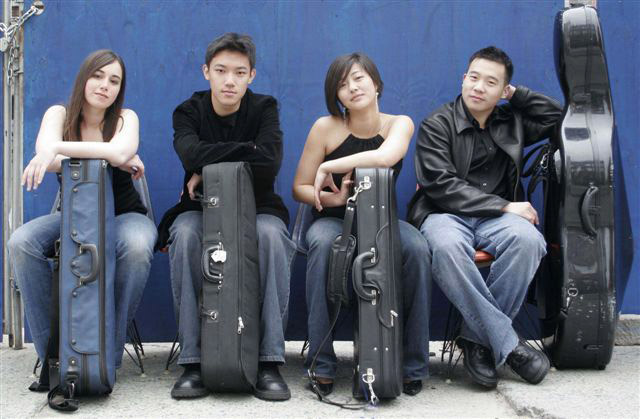
The Parker String Quartet at the Corcoran


One of the best and least obtrusive Mozart tributes of 2006 is the Corcoran Gallery of Art’s cycle of Mozart quintets, each with a different, up-and-coming young quartet, all with Tapping-ex-Takács (one word, no introduction necessary) as the extra viola. Ingenious mixture of youthful enthusiasm and veteran brilliance unleashed unto the best chamber works Mozart ever wrote is just about a guarantee for greatness in music-making.

Roger TappingAnd so it was, last Friday evening with the Parker String Quartet strutting their stuff, playing the C major quintet, no. 3. Neither flawless nor extraordinarily deep, perhaps (the first movement was necessary for the five to find each other), but in toto a most wonderful success for the sum of its good parts and being a performance far, far from routine. Most distinctive about it perhaps was violist Jessica Bodner’s tone in the Andante (and only there). Outstanding in the literal sense, spine-tingling (although I am still not sure if in a good or bad sense), it was a quality of tone seemingly unique, yet familiar. Words fail, describing it: cutting, cold, nasal all miss more than they fit… if the name weren’t already taken, I’d christen it “Blue Steel.” Even if causing an oddly ambivalent reaction, it probably should or could be considered an asset just for having elicited such a visceral one. Just as it appeared out of nowhere, so it disappeared again at the onset of the Menuetto which, with the finale (Allegro) brought out the best playing in the Mozart, concluding an evening that had started with Joan Tower’s Nightfields.

Composed in 1984 for the Muir Quartet, Nightfields is supposed to evoke – not surprisingly – “nocturnal landscapes.” But if that is the case, it’s via a very different mood than we might expect. The sound isn’t hushed, not subdued… and while the cello’s domination in the opening may create a low sound, it evokes darkness only in a rich, chocolatey way. The means of creating nightscapes found in Mahler’s 7th symphony or Ligeti’s first string quartet or Field’s or Chopin’s nocturnes, all more intuitively nocturnal in character, were wholly absent in this bold, forceful, and (I admit: surprisingly) excellent string quartet. Even in lyrical passages it was flooded with clarity – not the least thanks to the flawless and charged playing of Daniel Chong (first violin), Karen Kim (second violin), Kee-Hyun Kim (cello), and the aforementioned Ms. Bodner (viola). Absolute precision and ferocity were present either because of youth or due to maturity ‘beyond their years’ (or a happy combination thereof) – in any case it worked well for Nightfields, which apart from the excited last few staves, sounds like Shostakovich long on lyricism and a little short on rhythmic drive.

NEC's Parker String Quartet
If none of Schumann’s three quartets are very frequent guests on chamber concert programs, it may be because they are ‘ungrateful’ works; offering a less congenial ratio of practice and effort to an actually exciting performance than do other works (like Bartók or Shostakovich ones, which are ‘grateful’ quartets, profiting almost always from the mere fact of being played live). All three of these rare jewels are difficult to bring off really well, not unlike Brahms’s works in that genre. Nor does technical mastery alone make for a rewarding experience (although that’s probably the case with most music). It then goes to the credit of the Parker String Quartet that they programmed Schumann’s A minor quartet, op. 41, no. 3. More impressive, still, that their performance was very good, indeed. The last of its six four movements, the great Allegro molto vivace, was exemplary. A few flat shades from the first violin in the Andante espressivo notwithstanding, the rest was excellent, too, if just shy of electrifying. I haven’t heard these works live very often, but if I’ve heard better, then only from the Zehetmair Quartet.

I’d been told that the Parker String Quartet would be a very exciting quartet to watch – and it wasn’t hype. Young to boot (maybe around 22, 23 years old; the violists' hands suggesting perhaps even a year or two less), they were what the Calder Quartet should wish to be; although the latter seem downright middle-aged compared to this crop and the nearly as young Jupiter and Minetti Quartets. All of them have their strengths and weaknesses (the Minetti the least of the latter, the Jupiter – on a good day – the most of the former, the Parker somewhere between). The Parker String Quartet’s second violin is a particularly good, a sharp (not in the out-of-tune sense), agile instrument of great precision and with energy to waste, followed by the cello with its huge round sound and pleasant timber. It would be unfair and going too far to speak of a ‘weakness’, per se, but at least on Friday night, the first violin was not quite at the same level. Little matter in another outstanding night.

Schoenberg’s First, Beethoven’s Last

Arnold SchoenbergLudwig van Beethoven
The first half of James Levine’s Beethoven/Schoenberg project culminated this weekend with the pairing of Schoenberg’s Chamber Symphony No. 1, op. 9b, and the Ninth Symphony of Beethoven. Most of the buzz surrounding this particular concert, however, concerned the conductor. James Levine, while walking back on stage to acknowledge applause after the conclusion of the opening performance of this program, tripped and fell. Thankfully, no bones were broken, but he did suffer some obvious soreness, which prevented him from completing the remaining performances. Filling in for him was BSO assistant conductor, and Levine protégé, Jens Georg Bachmann. There was some tension on stage. Bachmann, having found himself in a pressure cooker, rose to the task and seemed grateful for the opportunity at concert’s end. I did, however, notice several string players taking their cues from the concertmaster’s bow.

Other Reviews:

Richard Dyer, Historic symphonies elicit emotional performances (Boston Globe, March 3)

Allan Kozinn, With Its Maestro Absent, the Boston Still Takes Beethoven and Runs With It (New York Times, March 8)
Schoenberg’s Chamber Symphony No. 1 (composed in 1906, rescored for full orchestra by the composer nearly 30 years later) is an interesting cross-section of the composer’s career. The composition is lush, late Romantic muscle. The form is commensurate in terms of its symphonic nature but is contained in a single movement. The orchestration is made with the smaller brushes of the post-serial period. Unlike the larger early works, like Pelleas und Melisande, the sound is not completely overwhelming but is tempered with the spirit of the original chamber writing. Strong solo strings and winds had multiple chances to shine in these pared-down moments.

The Beethoven featured a powerhouse veteran quartet: soprano Christine Brewer, mezzo-soprano Jill Grove, and tenor Clifton Forbis were anchored by bass-baritone Albert Dohmen, whose solos were commanding. The Tanglewood Festival Chorus rounded out the massive and demanding undertaking, the sheer volume of which was appropriate for the magnificence of the last movement. The BSO will perform this program at Carnegie Hall on March 6.

The ambitious Beethoven/Schoenberg project has provided the opportunity for Boston concertgoers to hear an abundance of exciting programming in a relatively short time span. Additionally, the project rapidly encapsulated the conflict of programming traditional and modern (or at least modern-sounding) literature. The conflict, of course, exists between seasoned professionals – who, with varying motivations, see the significance of classics as well as modern works and attempt to present such dichotomies with the intent to illuminate – and the wide-ranging tastes of the public. It’s a sticky subject, and it never dies, especially since ticket sales hang in the balance (the BSO concerts that focused on Schoenberg alone suffered from anemic attendance). Conductor’s prejudices, previews, elongated program notes, and assurances from reputable sources that the modern sounds really are “accessible” seem only to be stifling the potential of such programming.

Why? Perhaps because the attempts to fill the seats rely upon the premise that listening to modern works (or any works, for that matter) will sate a need for the listener. When this doesn’t happen, when the composer fails in proving something to the listener, the fault lies invariably with the composer and the artistic director who programmed the work. Never is it mentioned that the listener, the conductor, and the orchestra members are all experiencing the product of a musical mind that is of a higher magnitude than their own. To do so would be even more damaging to ticket sales. It would, however, be honest. And for the specific argument presented in this season’s programming – that Schoenberg and Beethoven are intellectual and artistic equals – this approach could have helped demystify the music in question. After all, one cannot receive a music degree from an accredited institution in this country without studying, or at least understanding, Schoenberg’s techniques, in addition to Beethoven’s.

The project will continue over the summer at the BSO’s Tanglewood programs, and again during the 2006-2007 season – which will include a pairing of the Beethoven and Schoenberg violin concerti with the Grosse Fugue (see Alex Ross’s article about a newly found manuscript), in addition to concert versions of the operas Fidelio and Moses und Aron.

D.C. audiences will have an opportunity to see the BSO [tragically, sans James Levine--ed.] at the Kennedy Center on March 11. The program will include Elliott Carter’s Three Illusions for Orchestra, Strauss’s Till Eulenspiegel, Beethoven’s 7th symphony, and the D.C. premiere of Peter Lieberson’s Neruda Songs, the Boston premiere of which was reviewed on this site.

Classical Week in Washington (3/5)

Classical Week in Washington is a weekly feature that appears on Sundays, at the same time as my Classical Music Agenda for DCist. If there are concerts that you would like to see included on our schedule, send your suggestions by e-mail (ionarts at gmail dot com). Plan your winter concert schedule with our 2006 Concert Preview and Classical Month in Washington (March), or your opera listening with our Opera Preview 2006.

Tuesday, March 7, 12:10 pm
Noontime Cantata: Nimm von uns, Herr, du treuer Gott, BWV 101
Washington Bach Consort
Church of the Epiphany (13th and G Streets NW)

Tuesday, March 7, 12:15 pm
The Garden of Earthly Delights: Music of early centuries on historical harps [FREE]
Constance Whiteside, harp
St. George’s Episcopal Church (915 N. Oakland Street, Arlington, Va.)

Tuesday, March 7, 7:30 pm
Musicians from Marlboro II [FREE]
Beethoven's Piano and Woodwind Quintet, op. 16; Nielsen's Woodwind Quintet, op. 43; Elliott Carter's Eight Etudes and a Fantasy; and songs by Schubert from his op. 129, D. 965
Freer Gallery of Art

Wednesday, March 8, 7 and 9 pm
Turtle Island String Quartet
The Mansion at Strathmore

Wednesday, March 8, 7:30 pm
American Piano: Copland, the Piano and Politics, with various artists [FREE]
American Piano Festival
Clarice Smith Performing Arts Center (College Park, Md.)

Wednesday, March 8, 7:30 pm
Sharon Isbin, guitar, with Susanne Mentzer, mezzo-soprano
Fortas Chamber Music Series
Kennedy Center Terrace Theater

Thursday, March 9, 7:30 pm
American Piano: Charles Ives and the American Pianist [FREE]
Lecture on and performance of Ives's Concord Sonata (Steven Mayer)
American Piano Festival
Clarice Smith Performing Arts Center (College Park, Md.)

Friday, March 10, 8 pm
Ian Bostridge, tenor, Julius Drake, piano, and the Belcea Quartet
Fauré, "La bonne chanson," op. 61; Shostakovich, String Quartet no. 3 in F Major, op. 73; Vaughan Williams, On Wenlock Edge
Library of Congress

Friday, March 10, 8 pm
Russian National Orchestra
Stravinsky’s arrangement of Tchaikovsky’s Excerpts from Sleeping Beauty, Stravinsky’s La baiser de la fée (“The Fairy's Kiss”), and Tchaikovsky’s Suite No. 3 for Orchestra in G Major, Op. 55
George Mason University Center for the Arts (Fairfax, Va.)

Friday, March 10, 8 pm
Peter Sirotin (violin), Claudia Chudacoff (violin), Michael Stepniak (viola), Julius Wirth (viola), Fiona Thompson (cello)
Mozart String Quintets I
Embassy Series
Embassy of Austria

Friday, March 10, 8 pm
St. Lawrence String Quartet
Discovery Series
Barns at Wolf Trap

Friday, March 10, 8 pm; Saturday, March 11, 8 pm; Saturday, March 12, 8 pm
Biava Quartet
Dumbarton Oaks (Friends of Music)

Saturday, March 11, 1:30 pm
Verdi, La Forza del Destino
With Deborah Voigt, Ildikó Komlósi, Salvatore Licitra, Juan Pons, and Samuel Ramey
Metropolitan Opera Radio Broadcast

Saturday, March 11, 4:30 pm
Boston Symphony Orchestra (with James Levine David Robertson)
Lorraine Hunt Lieberson sings Neruda Songs
Kennedy Center Concert Hall (WPAS)

Saturday, March 11, 8 pm
Baltimore Symphony: Strauss's Ein Heldenleben and Prokofiev's second violin concerto
With Sayaka Shoji, violin
Music Center at Strathmore
[Also on March 9 and 10, 8 pm, and March 12, 3 pm, at Meyerhoff Hall in Baltimore]

Saturday, March 11, 8 pm
JCC Symphony Orchestra, with violinist Nicolas Kendall
Music includes Sibelius violin concerto and Finlandia, and excerpts from Smetana's Má Vlast
Jewish Community Center of Greater Washington (Rockville, Md.)

Saturday, March 11, 8:15 pm; Wednesday, March 15, 7:30 pm; Friday, March 17, 8:15 pm; Sunday, March 19, 3 pm
Jake Heggie, Dead Man Walking
Baltimore Opera

Sunday, March 12, 3 pm
Left Bank Quartet, with pianists Larissa Dedova, Bradford Gowen, and Rita Sloan [NOT FREE]
Foote, Piano Trio in B-flat Major (1907-08); Ives: Violin Sonata No. 2 (1907-10); and Amy Beach, Piano Quintet in F-sharp Minor (1908)
American Piano Festival
Clarice Smith Performing Arts Center (College Park, Md.)

Sunday, March 12, 5 pm
Lina Bahn, violin [FREE, with admission to museum]
Phillips Collection

Sunday, March 12, 7:30 pm
New York Festival of Song (VAS)
Marie Lenormand (mezzo-soprano) and Hugh Russell (baritone)
Steven Blier, pianist
Kennedy Center Terrace Theater

Sunday, March 12, 7:30 pm
Nicolas Kendall, violin
Music by Mozart, Ravel, Saint-Saëns, Kreisler, and Sarasate
Jewish Community Center of Greater Washington (Rockville, Md.)

——» Go to the previous schedule, for the week of February 26.