CD Reviews | CTD (Briefly Noted) | JFL (Dip Your Ears) | DVD Reviews
Showing posts with label New York City Ballet. Show all posts

6.6.24

City Ballet marks diamond jubilee with resplendent "Jewels"

Sara Mearns in "Diamonds," from Balanchine's Jewels, New York City Ballet. Photo: Erin Baiano

New York City Ballet celebrated its 75th anniversary by opening the season last fall with its blockbuster staging of George Balanchine's Jewels. A full-length abstract ballet, composed of three rather different acts, it is often described as having no plot. Watching this choreography in the Kennedy Center Opera House Tuesday night, for the first time in a decade, brought home the purely visual stories the work presents, matched ideally with the pulse of the music.

"Emeralds," Balanchine's opening tribute to French Romanticism, remains a graceful but melancholy affair. Set to Gabriel Fauré's incidental music for Pelléas et Mélisande and Shylock, the sense of profound tragedy pervaded the act, made more rueful by the lack of understanding of this unnamed pain from all those who see it. Indiana Woodward and Tyler Angle seemed graceful and settled in to the lead pairing in this part of Jewels, which they performed for the first time last fall. The delicate flute solo movement of the Pelléas music felt especially poignant, and the sadness of the group of men at the tableau's end, gazing up through the murky light to something unseen, felt funereal.

Balanchine's tribute to American dynamism in "Rubies" came across with delightful humor. Megan Fairchild and Anthony Huxley led the light-footed corps through the unorthodox steps and movements, timed with verve to Stravinsky's Capriccio for Piano and Orchestra, energized by the lively piano playing of Stephen Gosling. The red-costumed dancers flirted with all sorts of Americana: they were cowboys, they were flappers, they were the chorus line of the Rockettes. In the most openly sexual moment of the whole ballet, the tall, elegant Mira Nadon was moved about by four male dancers, positioning her like a doll.

After tragedy and mirth came a sense of Russian classicism that stopped time, in the concluding "Diamonds." Sara Mearns, one of the company's most celebrated dancers, brought a reserved nobility to the role that Balanchine created for his muse, Suzanne Farrell. Her partner, Chun Wai Chan, became City Ballet's first Chinese principal dancer two years ago, and he provided all of the athletic power of their scenes, lifting Mearns with effortless strength and leaping with remarkable balance and agility. Andrew Litton paced the movements (all but one) from Tchaikovsky's dance-infused Third Symphony ideally with the Kennedy Center Opera House Orchestra, bringing to an end a grand tribute to Balanchine and the company he helped create.

Jewels runs through June 9. kennedy-center.org

8.6.23

City Ballet, Modern and Contemporary

Joseph Gordon and Unity Phelan performed in Jerome Robbins' Afternoon of a Faun, New York City Ballet. Photo: Paul Kolnik

New York City Ballet returns to the Kennedy Center Opera House this week for its expected early summer visit. For the first of two programs, seen on Tuesday night, the company has revisited four short ballets by its celebrated founding choreographers, George Balanchine and Jerome Robbins. A second program features the work of more recent choreographers leading the way into a new era.

A theme emerged over the course of the evening, perhaps intended but perhaps not: reflections in a mirror. In two striking Balanchine works based on Baroque music, Square Dance and Concerto Barocco, ensemble and soloists are balanced, often dancing in symmetrical patterns. Balanchine attempted a cross between American folk dance and classical ballet in Square Dance, from 1957, even using a square dance caller originally, an innovation he wisely removed later. The music, concerto grosso movements by Vivaldi and dance pieces by Corelli, often features twinned melodic lines, which Balanchine interpreted visually in movement, with fine solo work here from Megan Fairchild and Joseph Gordon. The final movement, a spirited Giga by Corelli, even had something like the feel of square dance music.

This later ballet, although seen first, hearkened back to Concerto Barocco, from 1941, redone for NYCB in 1948. The music, Bach's Double Violin Concerto in D Minor, was even more explicitly about image and reflection in its twinned lines. Two groups of four women mirrored one another, echoed by two lead soloists, the graceful Isabella LaFreniere and Mira Nadon. In the gorgeous slow movement, a male soloist intruded, the long-armed Russell Janzen, upsetting the perfect symmetry of this world of female friendship and balance. Played without scenery and in stark lighting, designed by Mark Stanley, it was likely the first ballet Balanchine had danced in practice clothes rather than costumes, which became a signature of his updated style. The dancers welcomed violinists Oleg Rylatko and Ko Sugiyama to the stage for a well-deserved curtain call.
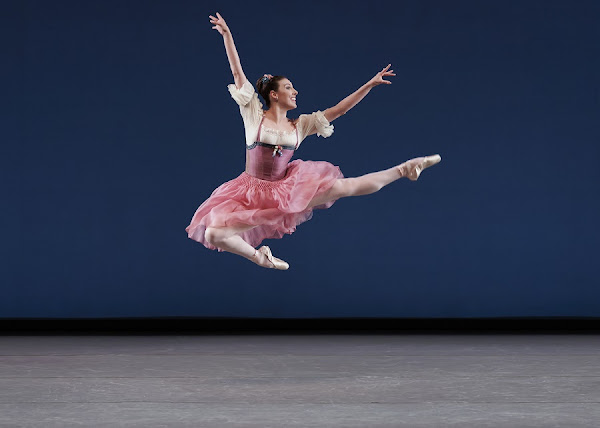
Tiler Peck performed in Balanchine's Donizetti Variations, New York City Ballet. Photo: Paul Kolnik

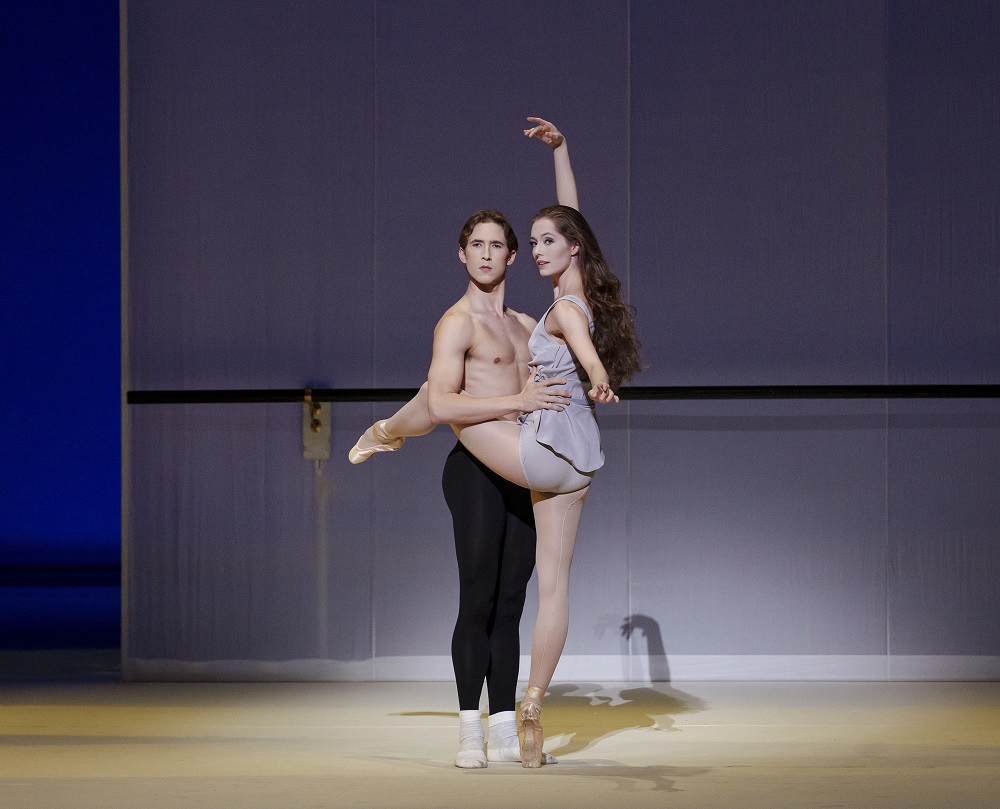
The evening's most striking work was the only choreography by Jerome Robbins on the program, the gorgeous and erotic Afternoon of a Faun, from 1953. Claude Debussy's rapturous score received a marvelous performance from the Kennedy Center Opera House Orchestra, conducted for the evening by Andrews Sills, down to the exotic touches of crotales and harps. Robbins devised a meta-updating of the infamous earlier choreography by Vaslav Nijinsky: the faun and nymphs here become a male and female dancer who meet in a ballet studio, indicated by the barre running around its edge.

The oneiric quality of the scene, suggested by the fact that Joseph Gordon is seen asleep on the floor and returns to sleep at the end, implied that the stunning Unity Phelan was a figment of the man's imagination. He (and she, to a degree) spend most of the time staring at the audience as if seeing their reflections in a mirror, even in their most intimate moments. This vain self-regard - two beautiful people watching themselves in the mirror - was sexually charged and, of course, an acknowledgment that this is what dancers spend some of their rehearsal time doing. The awkward kiss Gordon planted on Phelan's cheek, to which she pressed her hand as if it burned, the shock seeming to propel her out of the room, now brought to mind, at least to me, the charges of sexual abuse by female dancers against former NYCB artistic director Peter Martins. At the same time, the effortless surprise lift of Phelan by Gordon, as Debussy's music swept upwards, was strikingly beautiful.

After these three more serious works, it was good to end the evening with some low comedy in Balanchine's Donizetti Variations, a 1960 romp set to ballet music from Donizetti's French grand opera Dom Sébastien, Roi de Portugal. It's a ballet that is as silly as it is fun, and the pairing of the sassy veteran Tiler Peck with the vivacious Roman Mejia, a rising star, lifted the end of this meaty program with effervescence. The whimsical moment when a corps dancer thinks that a trumpet solo is her cue for an ill-advised leap into the spotlight garnered hearty laughter, and don't leave the theater before you hear the incredible solo turn by the orchestra's glockenspiel player.
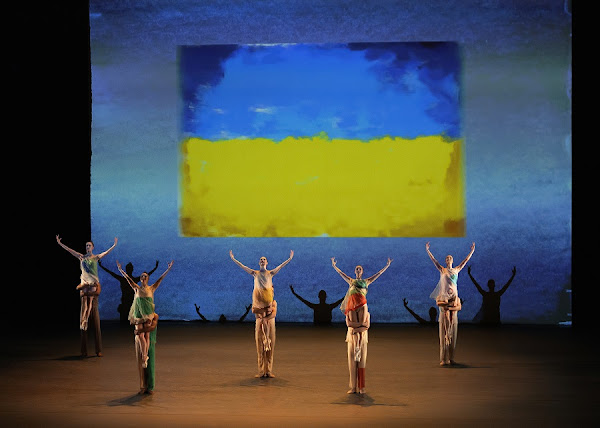
Alexei Ratmansky's updated Pictures at an Exhibition, New York City Ballet. Photo: Erin Baiano

The highlight of the B program, featuring City Ballet's new crop of choreographers, was Alexei Ratmansky's surprising, varied Pictures at an Exhibition, last seen at the Kennedy Center in 2015. The piece remains light-hearted yet powerful, with an ensemble of ten dancers moving through the space of an art museum to the strains of Musorgsky's "Promenade" movements (original piano version played somewhat tentatively by Susan Walters). The dancers form smaller solos and ensembles for the intervening movements, representing artworks, their colorful costumes mimicking the bright circles of Kandinsky paintings projected on the screen at the rear of the stage. Ratmansky, who has publicly and strenuously criticized his native Russia's war in Ukraine, has made a significant addition to the final tableau of this ballet, the movement known as "The Great Gate of Kyiv": a large image of the Ukrainian flag, in the style of a Mark Rothko painting.

Justin Peck's first solo ballet, Solo, featured the lovely Naomi Corti making her debut in the role. String players from the Kennedy Center Opera House Orchestra, under the direction of Tara Simoncic, gave an ardent rendition of Samuel Barber's Adagio for Strings, often seeming only tangentially related to Corti's movements. The two most recent works disappointed by their length and repetition: Standard Deviation, choreographed by Alysa Pires to the pulsating, blues-saturated music of Australian composer Jack Frerer, and the robotic Love Letter (on shuffle), choreographed by Kyle Abraham and set to a (long, ear-piercing) prerecorded track by James Blake. Both pieces have some eye-catching moments, with long stretches in between.

New York City Ballet presents both programs in alternation through June 11. kennedy-center.org

10.6.22

New York City Ballet Returns to the Kennedy Center

New York City Ballet performed Suspended Animation, choreography by Sidra Bell (photo: Erin Baiano)

New York City Ballet has been through a disastrous period in the last four years. In 2018, the company's long-time artistic director, Peter Martins, resigned in disgrace, following accusations of sexual abuse. NYCB scrambled to find a stable way forward, naming Jonathan Stafford as its new artistic adviser, but with Wendy Whelan as associate artistic director and Justin Peck as resident choreographer and artistic adviser. As the company founded by George Balanchine, Lincoln Kirstein, and Jerome Robbins struggled to address its history of sidelining the contributions of women and people of color, the coronavirus shut all of its performances down. NYCB was finally able to present a season over the past year, a selection of which the company brought to Washington for its first appearance at the Kennedy Center since 2019.

Other Articles:

Sarah L. Kaufman, In a terrible week, the much-needed balm of ‘Midsummer Night’s Dream’ (Washington Post, June 10)

Jason Fraley, New York City Ballet’s first Black female choreographer comes to Kennedy Center (WTOP, June 6)

Gia Kourlas, A Farewell and the Promise of a New Future at City Ballet (New York Times, May 31)

---, City Ballet Gets a Modern Dance Fix (New York Times, February 4)

---, At City Ballet, Giving Voice to the Body, With Sneakers (New York Times, January 28)

Marina Harss, At City Ballet, Jamar Roberts and Dancers Find a Common Language (New York Times, January 27)

Roslyn Sulcas, Justin Peck and Collaborators Combine Gravitational Universes (New York Times, January 25)

Madelyn Sutton, Sculptor Eva LeWitt on Designing the set for Justin Peck's Partita (Playbill, May 2)

Jennifer Homans, Ballet Is Back, but All Is Not As It Was (The New Yorker, November 1, 2021)
The first two performances this week were devoted to three new choreographies, all premiered this season, seen on Tuesday evening. The first two were created by African-American choreographers, beginning with Emanon—in Two Movements by Jamar Roberts, resident choreographer of Alvin Ailey American Dance Theater. The work, whose title is "no name" spelled backwards, is set to two pieces by jazz composer Wayne Shorter, “Pegasus” and “Prometheus Unbound.” The choreography was active but in many ways repetitive, aside from a striking solo moment for Jonathan Fahoury. The music from the pit and the dancing on stage did not always seem to line up ideally, although the visuals were beautiful, especially Jermaine Terry’s cool-purple costumes.

With her much more engaging Suspended Animation, Sidra Bell became the first black woman to choreograph a work for New York City Ballet. It opened in a whimsical way with dancers attired in technicolor costumes by the young black fashion designer Christopher John Rogers, something like Dr. Seuss characters strutting on a parody of a 1960s fashion show walkway. The dancing became more visible as the performers lost these extravagant outer layers, like birds molting their feathers. Set to music by Dosia McKay (the string quartet Is Now Not Enough? and Unveiling for strings), Oliver Davis (Solace for strings), and Nicholas Britell (The Middle of the World from his score for the film Moonlight), the piece turned from surreal to serious with an extended solo accompanied only by silence.

NYCB saved the best for last, a dynamic abstract ballet by Justin Peck, inspired by Caroline Shaw's ground-breaking Partita for 8 Voices, heard as accompaniment to the performance in the recording by Roomful of Teeth. Eight dancers, clad in white sneakers and variously colored workout clothes, moved in response to the score's often unconventional sounds. In a noteworthy tie-in, sculptor Eva LeWitt designed the sets for the ballet, hanging backdrops made of brightly colored ropes forming large discs above and behind the dancers. LeWitt is the daughter of minimalist artist Sol LeWitt, whose instructions for anyone executing his work Wall Drawing 305 were quoted extensively in Shaw's piece. Peck, who is one of the more musical choreographers working today, created a compelling work that translated music into motion, somewhat heavy-handed at times but seamless.
Sara Mearns and New York City Ballet in George Balanchine’s A Midsummer Night’s Dream (photo: Paul Kolnik)

The last four days of the run at the Kennedy Center are devoted to a recent classic, George Balanchine's innocent, child-centered story ballet based on William Shakespeare's A Midsummer Night's Dream, seen on Thursday evening. Premiered in 1962, the work weaves together Mendelssohn's overture and incidental music for the play with other selections by the composer, to make a convincing whole, a first act with most of the action plus a compact second act consisting largely of a divertissement. The Pennsylvania Ballet brought its utterly charming version of this Balanchine ballet to the Kennedy Center a few years ago, and this was a welcome chance to see it in the hands of the company that premiered it. (One thing that NYCB should have imitated from Pennsylvania Ballet was the placement of the singers, women from the local choir Choralis, for the vocal selections in the pit: the piping in of those performers from another location was less than satisfying.)

One of NYCB's best dancers, Sara Mearns, was a warm, almost glowing Titania, easily the stronger of the royal pairing with Daniel Ulbricht's Oberon, all vanity and strength in his tantrums and athletic leaps. Taylor Stanley made an antic, caprine Puck, running with manic exaggeration and even soaring suspended on wires in the striking final tableau. Georgina Pazcoguin displayed her own virtuosic strength as Hippolyta, bounding in impressive leaps as she hunted a pack of dancer-animals. The most gorgeous moment of the night came in the Act II pas de deux, danced with time-stopping grace by Tiler Peck and Tyler Angle. The swarms of faeries, especially the local children in their delightful insectoid costumes, stole the show during the scenes where they appeared.

A Midsummer Night's Dream runs through July 12.

4.4.19

New York City Ballet enters the next phase


Gonzalo Garcia and Sterling Hyltin in Jerome Robbins, Opus 19/The Dreamer. Photo: Paul Kolnik

New York City Ballet returned to the Kennedy Center Opera House Tuesday night, as it has done regularly since 1974. Everyone involved with the company seemed a little nervous, starting with a slightly awkward pre-curtain announcement from newly appointed artistic director Jonathan Stafford and associate artistic director Wendy Whelan. They took the reins after longtime ballet master Peter Martins retired from the company in 2018, following allegations he had abused dancers both physically and sexually. Martins denied the charges, and an internal investigation by the company did not corroborate them.

The selection of ballets seemed tailor-made for touring, mostly abstract and without any set pieces. Opus 19/The Dreamer, choreographed by Jerome Robbins, was a highlight because of the graceful, searching movements of Gonzalo Garcia in the title role. In the only white costume, he was seemingly all muscle as he sought among the other dancers dressed in shadowy blue-purple (costumes by Ben Benson). Set to the gorgeous music of Prokofiev, the ethereal Violin Concerto No. 1, the shimmering violin solo (played ably by Kurt Nikkanen) mirrored Garcia's dream-like motions, in fascinating color pairings with harp, piccolo, and other instruments. Principal dancer Sterling Hyltin, taking the lead role often danced in the past by none other than Wendy Whelan, was elusive and pretty.


Other Reviews:

Sarah L. Kaufman, It’s hit or miss for New York City Ballet in first Kennedy Center program under new directors (Washington Post, April 3, 2019)

Alastair Macaulay, The Unstuffy Gala: City Ballet Delivers Youth and Style (New York Times, September 29, 2017)
It made a bracing pairing with George Balanchine's Kammermusik No. 2, with a more abrasive score by Paul Hindemith and somewhat similar costumes in light blue or gray-black, also by Ben Benson. Abi Stafford and the tall, striking Teresa Reichlen excelled as the tandem pairing that shadowed the contrapuntal part of the piano solo from the virtuosic Stephen Gosling, often with hand following hand just as ballerina followed ballerina gesture for gesture. A small group of male dancers, often with interlocked arms, formed complicated shapes echoing the dissonant musical clusters.

For an appetizer, NYCB brought Composer's Holiday, a commission from the young choreographer Gianna Reisen. The three sections showed a pleasing balance and variety, in a poised, short ballet that moved from intriguing vignette to intriguing vignette. It opened with dancers on one side pointing to a woman lifted in the air, for example, and the first scene closed with a woman hurled into the air just as the lights went dark. The choice of Lukas Foss's Three American Pieces for Violin and Piano (played capably by Arturo Delmoni and Susan Walters) was also savvy, music that is just as enigmatic as the movements Reisen chose.

Two dancers took falls in the evening, unusual for this company, and only one that looked painful. That was in the otherwise triumphant final work, Balanchine's Symphony in C. It showcased the NYCB corps of women, all in sparkly white costumes, in the active first movement of Bizet's Symphony in C, an early work in Mozartean style. The second movement, with its plangent oboe theme, inspired in Balanchine, that most musical of choreographers, a scene of heart-breaking tenderness, spotlighting in this case the graceful dancing of Sara Mearns and Jared Angle. Through a sleight of hand, Balanchine does not make clear until late in the work just how many dancers are involved. In the fast changes of the finale's episodes, the numbers on stage grow and grow to a delightful climax.

This program by the New York City Ballet repeats only on April 7, with a different program scheduled for April 4 to 6.

31.3.18

New York City Ballet celebrates Robbins and Bernstein


New York City Ballet in Jerome Robbins's Glass Pieces (photo by Paul Kolnik)

Jerome Robbins and Leonard Bernstein were both born in 1918, the former on October 11 and the latter on August 25. After a program honoring three of its major choreographers earlier in the week, the New York City Ballet offered a tribute to Robbins, its other co-founder, and the composer with whom he often collaborated, seen on Friday night in the Kennedy Center Opera House.

Robbins is most remembered for his hybridization of classical ballet with popular dance, a trend he began in his very first choreography, Fancy Free. Premiered in 1944 by the company that would become American Ballet Theater, it is set to a jazz-heavy score by Bernstein, in a foretaste of what they would create a decade later in West Side Story. The scene is wartime Manhattan, evoked immediately by the "overture," a minute or so of a recording of Big Stuff, a Bernstein original that sounds like a classic blues. NYCB's new music director, Andrew Litton, has changed the recording used at this moment to one made by Billie Holiday, the voice envisioned by both Bernstein and Robbins, although she had obviously not recorded the song at the time of the ballet's creation.

Roman Mejia, Harrison Coll, and Sebastian Villarini-Velez, the Saturday matinee's trio of sailors in a last-minute substitution, burst onto the stage one by one with cartwheels. The opening music, bubbling with enthusiasm, contains the kernel of the melody of "New York, New York, it's a helluva town" (the Bronx is up and the Battery's down, the people ride in a hole in the ground), from the musical adaptation of this ballet, On the Town. This trio was enthusiastic and physical, if not always as unified as they might have been. The style of choreography must have been bracing to see in 1944, still some years before Gene Kelly would popularize the style in countless big-production film musicals. It now feels rather dated, however, especially the interactions of the sailors with the three Passers-by, women who are minding their own business and end up basically getting harassed.


Other Reviews:

Alastair Macaulay, Then, With a Touch of Now, and a Fully Charged Prodigal Son (New York Times, January 21, 2008)

Brian Seibert, A Jerome Robbins Tribute by New York City Ballet Brims With Brio (New York Times, February 9, 2015)
The Robbins legacy came off the strongest in the first work, Glass Pieces, from 1983. Lucinda Childs had already choreographed Glass's music at that point, in Einstein on the Beach and Dance, but Robbins captured something essential about Glass's style in these excerpts from Glassworks and Akhnaten. In the opening scene (see photo above) the corps walks about busily, like the bustling city streets slowed down in the film Koyaanisqatsi, which came out just before this ballet.

Pairings and small groups of dancers in solid colors enter the scene accompanied by new musical motifs, disrupting the workaday mood with lyricism. Eventually the corps is drawn into what they are doing, a sort of metaphor for artistic inspiration. The choreography is most ravishing, however, in the slow movement, set to the "Facades" movement of Glassworks, with a gorgeous pas de deux, spotlit in front of a sort of conga-line corps silhouetted in blue light. The exceptionally strong new principal dancer Russell Janzen elegantly lifted the long-limbed Maria Kowrowski around the stage to the held, hovering notes of the soprano sax solo. The final scene, with its percussion-heavy syncopated elements, did not reveal the men of the corps in the strongest light. Conductor Andrews Sill had some trouble at times keeping musicians on opposite sides of the pit perfectly aligned in this complex, repetitive music.

The eccentric side of Robbins came across in the last piece, The Four Seasons from 1979. It is principally a choreography for the ballet of that name in the third act of Verdi's Les vêpres siciliennes, augmented by some music from the same composer's I Lombardi and Il Trovatore. The staging and costumes, with caped dancers in front of a huge, soaring crest bearing Verdi's name, seemed extremely kitschy by comparison to the week's worth of bare stages. Robbins made many jokes that matched music to movement, like the shivering ballerinas in the Winter scene. Outstanding solo work came from the poised Sarah Mearns, with an elegant, upright vertical line in the Spring section, paired beautifully with Jared Angle. Ashley Laracey was again extraordinary in the lead role of Summer, even in this least striking of the four scenes, and Ashley Bouder and Joaquin de Luz excelled in the wine-dipped concluding dances of Fall, watched over by the athletic caprioles of Daniel Ulbricht.

This program will be repeated today at 1:30 and 7:30 p.m. and tomorrow at 1:30 p.m. in the Kennedy Center Opera House with various casts.

28.3.18

New York City Ballet returns with Balanchine and Peck masterpieces


New York City Ballet in George Balanchine's Symphony in Three Movements (photo by Paul Kolnik)

The New York City Ballet is back in town, bringing an Easter feast of modern choreography to the stage of the Kennedy Center Opera House. The first of their two programs, seen on Tuesday night, brings together works of choreographers representing three eras: George Balanchine, Peter Martins, and Justin Peck.


Chase Finlay in George Balanchine's Divertimento No. 15
(photo by Paul Kolnik)
Two Balanchine jewels bookend the evening, beginning with Divertimento No. 15, from 1956. It is a banquet for the eyes, with costumes by Karinska evoking vaguely military-style dress uniforms for the men and graceful gestures that recall the social and courtly dance of Mozart's gorgeous music. Chase Finlay was a tall, chiseled presence among the three male soloists, gracefully partnering especially with Ashley Laracey in the exquisite "Andante" movement, with its extended cadenza for two violins. The strings of the Kennedy Center Opera House Orchestra struggled, especially the violins in high passages and runs, giving the impression that conductor Daniel Capps had spent the lion's share of rehearsal time on the more complex Stravinsky scores later in the program.

At the end of the evening came Balanchine's striking Symphony in Three Movements, made in 1945 after Stravinsky suggested the title piece to Balanchine as suitable for a ballet. The last company to present it at the Kennedy Center was the Boston Ballet in 2013, and direct from the source, as it were, it was an even more bracing thing to see. The curtain rises to reveal a striking scene, the corps of women in white, belted leotards arranged in a diagonal row, one arm raised. Jagged movements that go with Stravinsky's accented, zig-zagging music were crisply defined, the dancers' hair in long ponytails fanning out at times. The solo pairing of Sterling Hyltin and Adrian Danchig-Waring, featured beautifully in the central slow movement, was a highlight.


Other Reviews:

Sarah L. Kaufman, New York City Ballet: After the fall (Washington Post, March 28, 2018)

Alastair Macaulay, Kaleidoscopes of Patterns Against Backdrop of Mozart’s Chivalry (New York Times, February 16, 2011)

---, City Ballet’s Greatest-Hit Makers Get Help From Some Old Masters (New York Times, January 5, 2008)

---, The Unstuffy Gala: City Ballet Delivers Youth and Style (New York Times, September 29, 2017)

---, One Week’s Journey Through a Whole Century in Ballet (New York Times, May 6, 2012)

---, Taking Flight: A Season of Revival (New York Times, January 28, 2011)
At the heart of the program is a brand-new choreography by Justin Peck, Pulcinella Variations, premiered by the company just last fall. Peck, whose taste in music has sometimes seemed questionable, chose brilliantly here, with the suite from Stravinsky's Pulcinella, Stravinsky's delightful neoclassical reworking of music by Pergolesi, revived after a long absence by the National Symphony Orchestra a few years ago.

Kooky costumes by Japanese fashion designer Tsumori Chisato, half commedia dell'arte by way of Watteau and half manga fantasy, highlighted the inventive movements of the dancers. Red stripes glinted on one costume with each pirouette, and a flesh-colored strip and tutu of only partial circumference made another costume seem to cover only two-thirds of a dancer's body. Breaking from the otherwise bare stage favored in the Balanchine pieces, billowy gray curtains hung above and in the wings, giving the impression of a department store window or fashion show runway.

Sarah Mearns and Jared Angle were a sensual pairing in the "Serenata" movement, but the most beautiful moments of the ballet came from the extended pas de deux of the "Gavotta" with its two variations, featuring the outstanding Tiler Peck and Joseph Gordon. Anthony Huxley proved a dynamo of energy in the "Tarantella," costumed in bright yellow stripes with streamers, reminding Miss Ionarts of an overactive cartoon bee darting among the flowers incorporated into the other costumes.

Two shorter duet pieces filled in the gaps less memorably. Tiler Peck again stood out in Balanchine's Tschaikovsky Pas de Deux, made in 1960 to music drawn from Tchaikovsky’s Swan Lake. Here partnered with Jared Angle, she showed remarkable poise and calm, frozen into extensions like a statuette, often accompanied by ardent violin solos from concertmaster Oleg Rylatko.

In this superior company, Zakouski, made by Peter Martins in 1992, felt a little like a drab cousin, not least for the uncomfortable overtones recently revealed about the Martins era at NYCB. (In January, Martins was forced to resign from his position leading the company, due to allegations of sexual harassment and physical abuse from former dancers; somewhat confusingly, the company announced in February that its two-month investigation did not corroborate any of the allegations.)

Indiana Woodward stepped in on short notice to replace Megan Fairchild and did so with warmth and energy, matched with the somewhat heavy-handed folk dance gestures of the excellent Joaquin de Luz. Violinist Arturo Delmoni and pianist Susan Walters performed the music, all short pieces by Rachmaninoff (including the famous Vocalise), Stravinsky, and Tchaikovsky, admirably from a corner of the pit.

This program will be repeated tonight and Thursday, with a second program, devoted to choreographer Jerome Robbins, performed on Friday, Saturday, and Sunday. Various casts will dance in these performances in the Kennedy Center Opera House.

10.6.17

New York City Ballet, Part 2


Lydia Wellington and Andrew Scordato in The Four Temperaments, New York City Ballet (photo by Paul Kolnik)

The second program of the New York City Ballet's visit to the Kennedy Center Opera House was not as marvelous as the first. The formula was the same as the first program: classic Balanchine paired with new works by the company's best young choreographers.

The Balanchine was a choreography long on my wish list, The Four Temperaments, the best known of the ballet scores composed by Paul Hindemith. The composer is not one most people think of as a dance composer, but his music worked exceptionally well in this collaboration with Balanchine from 1946. The music is in the form of a theme and variations, perhaps the musical structure best suited to ballet dancing because it provides variety in discrete sections. Balanchine created dances, mostly pairings and small groups costumed in domino-like black and white on a bare stage, that went with each of the temperaments in the score.

In the theme, Lydia Wellington and Andrew Scordato set the tone in a stiff and formal way, a vocabulary of movements that seemed mostly geometric but coordinated with and inspired by the music in the most natural way. The second pairing (Lauren King and Devin Alberda) entered with the piano solo, played expressively by Stephen Gosling in the pit, with King's foot kicks accenting flourishes from the keyboard. The third pair of the theme section (Ashley Laracey and Aaron Sanz) entered in a more deliberate set of movements that went with a fine violin solo section, one of the highlights of the choreography, with gorgeous form from Laracey, ending on her being carried off with her legs at a right angle.

Gonzalo Garcia flung himself around in the Melancholic variation, followed by two women who flitted around him in agitation. When joined by four more dancers, the moves became slower and heavier, with repeated gestures weighing down the movement in the style of the music. The Sanguinic variation was marked by enthusiastic high kicks in the entrance of Sara Mearns and Jared Angle. When four women joined Mearns in an active, decisive dance, the black one-piece costumes made them look almost like a synchronized swim team. Solo dancer Ask La Cour was measured and balanced in the Phlegmatic variation, each advance forward matched by a solemn retreat, later shadowed by four women in one of the other highlights of the ballet. Teresa Reichlen, her tall and lithe form all points and edges, led the Choleric section through Balanchine's calculated addition of dancers to involve the whole cast in a climactic final scene.


Other Reviews:

Sarah L. Kaufman, From New York City Ballet: Big music, big dancing (mostly) (Washington Post, June 9)

Alastair Macaulay, Sign of the Times: City Ballet’s Ashly Isaacs Laces Up Her Sneakers (New York Times, May 10)

---, New York City Ballet Opens a Spring Gala, and Some Umbrellas (New York Times, May 5)

---, New York City Ballet’s Very 21st-Century Steps (New York Times, January 27)
The two more recent works on either side of The Four Temperaments could not really measure up to it. Christopher Wheeldon's story-length ballets have not been among my favorites, but in shorter formats he can be intriguing. Sadly his new work American Rhapsody never really seems to connect to its music, Gershwin's Rhapsody in Blue, played with gusto by the NYCB Orchestra and pianist Elaine Chelton. Here was the first set backdrop of the entire run, a starburst on a midnight-blue backdrop encircling the dancers (design by Leslie Sardinias). The costumes, also purple-blue with red and white highlights, recalled the vivacious era of the 1920s when the music was composed. The movements never seemed to have come from the music, indeed had little in common with it, and the central duo dance (Lauren Lovette and Unity Phelan) came not as a result of dramatic growth or with any sense of who the pairing was or why we should care about them.

Justin Peck's The Times Are Racing, premiered this past January, is a mixture of ballet and many other dance forms, including tap, breakdancing, hip-hop, Broadway, and tap. A mass of dancers, dressed in tennis shoes, T-shirts (some marked with the word "DEFY"), jeans, and other street clothes (costumes by Humberto Leon) pulsated to the recorded electronic music of Dan Deacon (the last four tracks from his album America), played through the theater's speakers at ear-piercing volume. The choreography is a tour de force of frenetic action and irrepressible energy, never seeming to slacken its pace for over twenty minutes, and it captures the seething rage, mostly about political realities in the United States, of the music.

The performance also offered another chance to see the choreographer in action as a dancer, because he stepped in to replace Ashly Isaacs in the second pairing of this ballet. Peck's dances with Taylor Stanley were a highlight, but in the closing sections of the ballet Peck's choreography began to repeat itself a lot, as if filling out the time of the final track. It is a brash, bracing work that captures the bristling anger and frustration of the country at this moment, but it felt uneven.

This program repeats this afternoon in the Kennedy Center Opera House.

8.6.17

New York City Ballet: Balanchine, Ratmansky, Peck


Sterling Hyltin and Joaquin De Luz in Odessa, New York City Ballet (photo by Paul Kolnik)

New York City Ballet is back in town for a week-long run at the Kennedy Center Opera House. Its first program, seen on Tuesday night, represents the best the company has to offer, past and present. It is one of the most beautiful and diverting mixed programs seen in recent memory. With no sets, only glowing colors illuminating the side drops and back wall, this selection of choreography put all its attention, and ours, on the movement of bodies.

The evening began with two choreographies by George Balanchine, NYCB's founding ballet master. In Square Dance Balanchine made a brilliant connection between classical and folk dance styles. Selections of Baroque concertos by Vivaldi and Corelli (Concerto Grosso in B minor, Op. 3 no. 10, by the former, and Concerto Grosso, Op. 6, no. 12, by the latter), where American folk music traces some of its rhythmical, repetitive roots, offered striking contrasts of tempo and spirit. The musical performance, complete with actual harpsichord on the continuo part, was conducted sensitively by Andrews Sill.

In particular the alternation of refrain and solo episodes of different characters in ritornello movements worked beautifully for dancing. Six men and six women, costumed in white and gray dresses or T-shirts and shorts, made paired patterns that recalled the inward-facing format of square dancing. (Originally Balanchine had a caller on stage who yelled out the moves to the dancers, a more explicit reference to square dancing, wisely excised in later years.) Balanchine kept the movements mostly classical in style, with a few simplified steps as a nod toward the square dance. Two principal dancers, Megan Fairchild spirited and elegant paired with a slightly rough Chase Finlay, were an ardent duo in the pas de deux accompanied by lovely violin and other solos in the first plangent slow movement. Fairchild's series of slow pirouettes en pointe in the Vivaldi slow movement were exquisite.

Balanchine's Tarantella was the odd man out in this program, a cutesy but charming bagatelle included to feature two younger, non-principal dancers. Erica Pereira and Spartak Hoxha, in Neapolitan peasant costumes (designed by Karinska), burst onto the scene waving to the audience. The choreography is breathless, an almost constant movement of arms and legs, which the dancers pulled off with a smile. Hoxha was so enthusiastic with the tambourine he played at one point that he knocked two of the metal zills loose from it. The music, Louis Moreau Gottschalk's Grand Tarentelle for Piano and Orchestra, op. 67, is a semi-corny Romantic finger-buster, reconstructed and orchestrated by Broadway orchestrator Hershy Kay, Balanchine's favored arranger, which challenged guest pianist Susan Walters at times.


Other Reviews:

Sarah L. Kaufman, New York City Ballet’s knockout punch is delivered at Kennedy Center (Washington Post, June 7)

Alastair Macaulay, For the Couples in This Alexei Ratmansky Ballet, Love Is Not Enough (New York Times, May 5)

Apollinaire Scherr, Ratmansky premiere, Lincoln Center, New York — tremendous (Financial Times, May 5)

Siobhan Burke, No More Gang Rape Scenes in Ballets, Please (New York Times, May 15)

The second half of the program featured new works by NYCB's most talented living choreographers. The company premiered Alexei Ratmansky's Odessa just last month, and it is one of the best new short ballets seen in recent years. Ratmanksy drew his score from the 1990 Soviet film Sunset, a set of tango- and klezmer-infused musical cues by Leonid Desyatnikov. The subject matter came from the same source, Isaac Babel's play about Jewish gangsters in Odessa after the Russian Revolution, in turn based on his collection of short stories The Odessa Tales. The ballet's story does not seem to line up with the play exactly, but the air of jealousy, abuse, and desperation does. Keso Dekker designed the colorful tango costumes, glowing like stained glass under Mark Stanley's lighting.

Ratmanksy follows three couples, who are first to enter the scene. One of them, danced here by Sterling Hyltin and Joaquin de Luz with tender grace, is not happy. Ratmanksy's choreography is generally busy and rife with ideas, and that profusion of ideas here obscures the story line, unclear even after going back on Wednesday night to see this program a second time. That impenetrability does not make the ballet any less powerful, and some of the tableaux are breath-taking in their originality and beauty. The male dancers at one point become like puppeteers, lifting Hyltin and de Luz into the air in their pas de deux (pictured above), which degenerates into a gang attack scene, accompanied to heart-sickening circus music. The score, dotted by charming solos for tuba, accordion, and the space-age sound of the flexatone, provides many delights.

Justin Peck showed a lot of chutzpah in taking on Aaron Copland's music for Rodeo, set originally to an evergreen choreography by Agnes de Mille, even if it was the symphonic version with the "Ranch House Party" movement excised. Rather than a single Cowgirl among a group of boisterous cowboys, Peck's mostly male dancers seem like a bunch of athletes, with costumes recalling gymnasts, racers, or soccer players. They line up at the start line on one side of the stage to open the ballet, running across the bare stage, and when not exercising together, they walk around casually, leaning on each other.

Into this all-male gymnasium setting comes the delightful Tiler Peck (no relation to the choreographer), a gymnast who seems to like physical activity as much as the men. One of them, danced by the choreographer himself, finally notices her, dancing with her to the "Saturday Night Waltz" music. Although touching, this duet somehow did not seem as tender or sincere as the dance for the five men of the blue-costumed "soccer team" in the "Corral Nocturne" that preceded it. Male and female worlds were reconciled in the concluding "Hoe-Down," a whirlwind of athletic activity given its start humorously by Justin Peck, who knelt down at the stage edge and pulled on a cord, like that of a lawnmower, which cued a drum roll.

This program repeats on Saturday evening and Sunday afternoon at the Kennedy Center Opera House. We will review the second program offered by NYCB on Friday evening.

5.3.16

NYCB's Nod to History, 'La Sylphide'


New York City Ballet in Peter Martins’s staging of August Bournonville’s La Sylphide (photo by Paul Kolnik)

Jennifer Homans, in her seminal book Apollo's Angels: A History of Ballet, traces the genesis of the Romantic ballet back to August Bournonville's La Sylphide. Premiered by the Royal Danish Ballet in 1836, it is one of the oldest ballets still being performed today. (It is not to be confused with Michel Fokine's later Les Sylphides, sometimes known as Chopiniana, which has been under review a couple times in recent years.) The original version of La Sylphide, with choreography by Filippo Taglioni and music by Jean-Madeleine Schneitzhoeffer, premiered in Paris four years before Bournonville's ballet, but the Paris version does not survive. Bournonville had wanted to present the Taglioni-Schneitzhoeffer ballet in Copenhagen but, because the cost was prohibitive, he made his own version on the same libretto instead, with music by Herman Severin Løvenskiold. Sadly, it was not one of the Bournonville ballets brought to Washington by the Royal Danish Ballet in 2011. It was, however, the focus of the second program of the New York City Ballet presented at the Kennedy Center on Thursday night.

The story came by way of Charles Nodier's Gothic story Trilby, ou le lutin d'Argail, heavily influenced by Nodier's visit to Scotland and reading of Walter Scott. In the story a young wife is seduced by a demonic spirit and takes her own life when a monk tries to perform an exorcism. The roles are reversed in the ballet, as a Scotsman named James leaves his bride-to-be, Effie, at the altar to chase after the eponymous woodland spirit, which has appeared to him and beguiled him. A spiteful witch, angered because James turned her away from his fireplace, tricks him into using a charm to capture the sylph, which kills her, and also engineers Effie's marriage to James's rival, Gurn. The work is often seen now as "a quaint relic of a misty romanticism," as Homans put it, and this is in some ways how Martins's staging of the ballet, the first that he ever saw in his native Denmark, comes off in performance. Homans traces how the Paris version of the ballet incarnated the political disenchantment of the generation that lived after the French Revolution, including Chateaubriand's obsession with the story.

Due to a cast change, La Sylphide reunited Sterling Hyltin and Andrew Veyette as James and Effie, after their excellent pairing which was the best part of Justin Peck's new choreography The Most Incredible Thing, seen on Tuesday. Veyette, tall and proud in purple tartan, used his remarkable ability to lift from the stage and showily upstaged the humorous Gurn of Daniel Ulbricht in the reel scene, revealing the character's growing obsession in his movements. Ulbricht added needed comic levity with his fay imitation of Hyltin's sylph, who floated in a mesmerizing way throughout the ballet, especially in the scene where she appears to James in the window, seeming almost suspended on wires. Georgina Pazcoguin was a vengeful, bent-backed crone as Madge, the evil witch. The corps, in a light-as-air ballet blanc in the fluorescent wood scene of Act II, were accompanied beautifully by harp and solo violin. In general the Kennedy Center Opera House Orchestra, under conductor Daniel Capps, had a better handle on this score, including the five horns, who were almost faultless.


Other Reviews:

Sarah L. Kaufman, New York City Ballet suits up for courage and soars in ‘La Sylphide’ (Washington Post, March 4)

---, Peter Martins, dipping into his past while bounding into the future (Washington Post, February 26)

Gia Kourlas, ‘La Sylphide’ Is City Ballet’s Bittersweet Valentine (New York Times, February 14)
The evening opened with Bournonville Divertissements, the result of Balanchine's request that Stanley Williams create some excerpts of Bournonville's works for New York City Ballet. The current version includes excerpts from Napoli, Flower Festival in Genzano, and Abdallah, a lovely companion piece to Martins's staging of La Sylphide. Troy Schumacher had impressive energy and buoyancy as the fisherman Gennaro in the Napoli excerpts, and Sara Mearns and Tyler Angle stood out in the duet from Flower Festival, she for her elegantly curved extensions, he for his physical strength. The cost of this evening devoted to ballet history in La Sylphide was reportedly $1.4 million, which compared to Peck's less successful Most Incredible Thing at $1.3 million, sounds like a steal.

This production repeats today and tomorrow, at the Kennedy Center Opera House.

3.3.16

Modern Program from NYCB


New York City Ballet, Company in Justin Peck’s The Most Incredible Thing (photo by Paul Kolnik)

Ballet has a long history of divertissements that have no dramatic coherence. The flimsiest of excuses can justify a series of pretty entrées, going all the way back to the foundation of the genre in French courtly dance. That is essentially what Justin Peck has created in his new choreography, The Most Incredible Thing, given its local premiere by the New York City Ballet on Tuesday evening at the Kennedy Center Opera House. It is an act-length ballet driven more by its quirky, colorful costumes than by dancing or story-telling.

Peck drew the story of The Most Incredible Thing from the Hans Christian Andersen tale of the same name (Det Utroligste). It concerns a contest for the hand of a princess, won by an inventor, whom Peck calls (somewhat ponderously) the Creator. His invention is a miraculous clock that produces twelve automated scenes, one for each of the hours, providing the excuse for the twelve colorful entrées that dominate the ballet. A menacing figure, the Destroyer, challenges the Creator's victory by laying waste to the clock and claiming the princess for himself. Not to worry, because the figures from the clock come back to life and save the day. Peck has softened some of the religious overtones of the clock figures, changing Moses at One o'Clock into a Cuckoo Bird, danced by the energetic Tiler Peck (no relation to the choreographer), with movements recalling the Firebird at times, and changing the Three Kings (Three o'Clock) from the Biblical Magi into sword-wielding warrior-kings.


Other Reviews:

Sarah L. Kaufman, New York City Ballet injects incredible zing into new Peck ballet and other works (Washington Post, March 2)

Joan Acocella, Stepping Up: The precocious rise of Justin Peck (The New Yorker, February 29)

Alastair Macaulay, At New York City Ballet, Works That Tell Stories and Don’t (New York Times, February 22)

---, ‘The Most Incredible Thing’ Brings Hans Christian Andersen’s Fairy Tale to Life (New York Times, February 3)

Brian Seibert, Justin Peck Calmly
Creates a Kingdom at City Ballet
(New York Times, January 29)
Sadly, though, these entrées do not advance the story in any way, and they are effectively performed twice because the dancers all come back to life at the ballet's conclusion. In fact, one remembers neither the story nor the movements of the dancers, but the eclectic, brightly colored costumes (designed by Marcel Dzama, supervised by Marc Happel): the grey hoops of the Five Senses, the pointed hats of the Eight Monks, or the black-white spirals of the Nine Muses. Taylor Stanley was an earnest Creator, overshadowed by the skull-capped Destroyer of Andrew Veyette, who danced a tense pas de deux with the Princess of Sterling Hyltin. The pop-minimalist score by Bryce Dessner, guitarist of the indie rock band The National, is repetitive and, while it does not offend, it goes in one ear and out the other.

In the middle of the evening came Balanchine's classic choreography to Tchaikovsky's second piano concerto, rounding out the Balanchine-Tchaikovsky set from the company's 2013 visit. The cadenzas and solo moments played by soloist Susan Walters corresponded with beautiful solos and duets featuring the tall, lithe Teresa Reichlen. Her partner, Tyler Angle, had a charming scene in the slow movement with five women on either side, like fanned-out shadows, accompanied by a gorgeous duet of solo violin and cello.

The first act featured two short choreographies by Peter Martins, the company's Ballet Master-in-Chief. In The Infernal Machine, the movements of the dancers, Ashley Laracey and Amar Ramasar, on the darkened stage seemed to have little to do with the antic passage through countless sound worlds found in the score of the same name by Christopher Rouse. A snippet quoted from Beethoven's op. 130 string quartet flies by, half unnoticed near the piece's halfway point. Likewise in Ash, Michael Torke's often disjointed score inspired contrapuntal movements for the dancers, often separated only by a beat. It is a shame that we did not have the chance to hear the company's own orchestra, which conductor Andrew Litton now leads. His work here with the Kennedy Center Opera House Orchestra left some details to be desired.

The highlight was an excerpt of Christopher Wheeldon's After the Rain. The evening's best-matched couple, Tiler Peck and Jared Angle, took turns moving one another along, in a slow-moving, longing-drenched choreography that goes a long way to make Arvo Pärt's Spiegel im Spiegel, a piece I find hard to tolerate in concert performance, a more complete work. Violinist Arturo Delmoni and pianist Nancy McDill provided the steady pulse of the music, with the section-ending "ping" notes corresponding to flicks of arms or feet on the stage.

This program repeats Friday evening, with a second program centered on Bournonville's La Sylphide presented in the rest of the run.

10.4.15

New York City Ballet, New and Newer


Pictures at an Exhibition, choreography by Alexei Ratmansky, New York City Ballet

The New York City Ballet is back at the Kennedy Center Opera House, in alternating programs this week featuring the giant of its past, George Balanchine, and its current choreographers. When you are dealing with new works of any kind, some will hit and some will miss, which was exactly the feeling experienced at the end of the selection billed as "21st-Century Choreographers" on Wednesday evening. It was a bit of a marathon, with four works adding up to almost three hours, and some of the works tried one's patience to the extreme.

The program opened with Symphonic Dances, by the company's current ballet master-in-chief, Peter Martins. Actually premiered in 1994, the work is set to Rachmaninoff's superb score of that name, op. 45, the composer's final work and a notable exception to my general aversion to Rachmaninoff's instrumental music. The Martins choreography is visually pleasing, but little about it stood out as remarkable over the course of forty minutes: without a story, the elegant vocabulary wears thin too quickly. In the solo female role, Teresa Reichlen, who hails from Fairfax County, was a wispy and altogether lovely presence, all long legs and lightness. The general appeal of the choreography was not helped by the mediocrity of the orchestral performance, here given by the company's own orchestra under interim music director Andrews Sill. The orchestra has been through a bit of a rocky period in the last few years, which the new tenure of conductor Andrew Litton, a Washington favorite with the National Symphony Orchestra, will hopefully help to stabilize, starting next season.

The undisputed high point of the evening was the delightful new choreography to Musorgsky's Pictures at an Exhibition, created last year by Alexei Ratmansky. The setting of an art museum is suggested by projections (designed by Wendell K. Harrington), based on Wassily Kandinsky's Color Study: Squares with Concentric Circles, dating from 1913, abstract shapes in bright colors that are reflected in movement by the dancers' costumes (designed by Adeline Andre). Although the music runs almost as long as the Rachmaninoff, played capably here in Musorgsky's original piano version by Cameron Grant, Ratmansky's choreography is so varied, brimming with originality, that it never tired. Sterling Hyltin was raised by the strong Tyler Angle in soaring leaps in "The Old Castle" movement, and in a striking reversal, women playfully incarnated the heavy-footed oxen in "Bydlo" and men the antic birds in the "Ballet of the Unhatched Chicks." The "Catacomb" movement, for the entire cast, was bathed in shadows of red light.


Other Reviews:

Sarah Kaufman, New York City Ballet’s life-affirming new works boost the spirit (Washington Post, April 10)

---, New York City Ballet sparkles and blurs in opening program (Washington Post, April 9)

Alastair Macaulay, With Each Star Turn, a Feeling of a Collective Force Begins to Brew (New York Times, January 21)

---, The Art Gallery as Spinning Montage (New York Times, October 3, 2014)

---, Celebrating Old Times With New: A Premiere (New York Times, May 9, 2014)

New York City Ballet on Ionarts:
2014 | 2013
Tiler Peck and Craig Hall made a beautiful pairing in Christopher Wheeldon's somewhat limited, repetitive This Bitter Earth, although it would have been just as visually pretty if it had been performed in silence, so little did it seem to have to do with the music, a recording from the soundtrack for Shutter Island. Both music and choreography felt endless in their over-repetition in Everywhere We Go, Justin Peck's abstract ballet to a suite of music by Sufjan Stevens (orchestrated by Michael P. Atkinson). Both choreographer and composer relied heavily on the copy-paste method, with some whole sections of the choreography simply repeated toward the end, not to mention a number of dancers who slipped and fell, for whatever reason.

The company's second program, seen on Thursday night but not for review, was worthwhile just to have a look at Balanchine's choreography for Agon, which was crucial in my making sense of Schoenberg's twelve-tone score for this work. Maria Kowroski was brilliant, almost superhuman, in the outrageous contortions of the Pas de Deux in the ballet's second part. Balanchine's vivacious choreography to Bizet's Symphony in C, last seen from American Ballet Theater in 2013, was also outstanding, especially the elegant extensions of Sara Mearns in the slow movement's pas de deux.

These programs are repeated through April 12, in the Kennedy Center Opera House.

3.4.14

Glittery 'Jewels' from New York City Ballet


Teresa Reichlen in George Balanchine's Rubies from Jewels,
New York City Ballet (photo by Paul Kolnik)
George Balanchine's opulent Jewels is a favorite of Miss Ionarts, and she has watched it many times in the DVD from the Mariinsky Ballet. From her point of view, it is pretty, colorful, varied, and there are no scary villains. Created in 1967 for the New York City Ballet, it is also Balanchine's survey of the state of dance, with each of its three acts focused on the heritage of three ballet traditions -- French Romanticism in Emeralds, New York modernism in Rubies, and Russian imperialism in Diamonds. The New York City Ballet has brought its refurbished production to the Kennedy Center this week, along with a mixed program of shorter choreographies, and it is well worth seeing.

The music of each act reflects those orientations, beginning with two refined scores of incidental music by Gabriel Fauré, for Maeterlinck's Pelléas et Mélisande (also heard on Sunday night from the Israel Philharmonic) and Shylock, Edmond Haraucourt's reworking of Shakespeare's Merchant of Venice. Neither story appears in any appreciable way in the choreography, but with Balanchine, as with all gifted choreographers, the music was his guide. The horn call of the first movement summons the corps de ballet into a diagonal line; the spinning movement features a ballerina making many turns; arms tick-tocked, clock-like, with gently pulsed repeated notes; each phrase or surge or motif is matched with an evocative movement. Both of these scores are diaphanous wonders -- movements from Shylock are inserted between the third and fourth movements of Pelléas, the last of which ends the act -- and the company's interim music director Andrews Sill led a capable, if not yet perfectly polished performance by the Kennedy Center Opera House Orchestra. Unlike their visit last spring, the company's resident orchestra did not accompany them. One could sense at times a tug of war between conductor and musicians, as in that gorgeous flute solo of the third movement of Pelléas, which needed to go a little faster than the orchestra seemed to want.

27.3.13

New York City Ballet's Tchaikovsky Fest


Maria Kowroski (Odette) in Swan Lake, choreography by George Balanchine, New York City Ballet (photo by Paul Kolnik)
The New York City Ballet is in town this week, performing two different programs in the Kennedy Center Opera House. Last night was the opening of its all-Tchaikovsky sampler, three shorter works choreographed by George Balanchine, grounded on the legendary choreographer's one-act version of Swan Lake, premiered in 1951. These are heritage pieces, perfect to showcase the company on a tour that goes from Washington to the Royal Danish Theater in Copenhagen, and they looked beautiful in their current incarnation.

For this streamlined Swan Lake based on Lev Ivanov's choreography, Balanchine crunches most of Act II and part of Act IV together, leaving out the mirror role of Odile. Once you get past the jarring effect of the curtain opening with the iconic music that starts the second act, the compactness gives the work greater impetus. (Surprisingly, Balanchine left out one of the most famous sections of the score, the fourth movement, Allegro moderato, of the Dance of the Swans, but all the other popular sections are there.) Maria Kowroski was an elegant and tragic figure as the Swan Queen, matched by an athletic and warm Siegfried in Tyler Angle, although the most striking choreography is given to the corps, in their somber black costumes, entering in a snaking line to identical movements carefully timed to the music. The pas de deux, placed at the violin solo in the fifth movement of the Dance of the Swans, was particularly affecting, with Angle lifting up Kowroski, who had gone into a crouch, and propelling her about.


Other Articles:

Sarah Kaufman, New York City Ballet’s all-Tchaikovsky program: A firm concept falls short in execution (Washington Post, March 28, 2013)

Sarah Halzack, New York City Ballet program showcases Balanchine-Tchaikovsky artistic chemistry (Washington Post, March 23, 2013)

Sara Mearns, Barre None: My Magical Moment (Huffington Post, March 22, 2013)

Ryan Wenzel, Romanticism, Balanchine Style: Two Tchaikovsky Triple-Bills at New York City Ballet (rpwenzel.com, February 1, 2013)

Alastair Macaulay, From Lakeside to Ballroom, Taking Tchaikovsky in Many Directions (New York Times, January 19, 2013)

Apollinaire Scherr, Balanchine's one-act "Swan Lake" (foot in mouth, February 15, 2009)

Anna Kisselgoff, Balanchine's One-Act Compression of 'Swan Lake' (New York Times, January 21, 1993)
In the middle slot came the shortest work, Allegro Brillante, set to Tchaikovsky's one-movement Piano Concerto No. 3. In contrast to the ice-cave set for Swan Lake (designed by Alain Vaes), this taut, abstract work played out on a bare stage, with a blue-lit back screen, with vaguely folk-like costumes in pastel colors (costumes designed by Karinska, lighting by Mark Stanley). The extended solos were danced strongly, with the high-jumping Amar Ramasar partnering the lithe, spritely Tiler Peck, light as a feather in the long solo passage accompanied by the piano solo's cadenza (played ably by Elaine Chelton). The company is traveling with its orchestra, a fine ensemble that has been without a music director for a while. The night's guest conductor, David LaMarche, did fine, but one hopes that the ongoing search for a permanent leader bears fruit soon.

The longest work came last, Balanchine's ensemble choreography set to Tchaikovsky's Orchestral Suite No. 3. Balanchine, like all great choreographers, loved music and gives it pride of place: all of these pieces open with the music and nothing else, a closed curtain, swan models gliding past on the lake, an empty stage. Suite is about longing on one level, beginning with the first movement, Élégie, where a man pursues one woman of a group, in long hair and flowing purple dresses. The couple meet and are separated, most poignantly the last time, both bending over backward in a dramatic gesture to a forlorn English horn solo. A similar pattern is repeated in the second movement, Valse mélancolique, and the Scherzo third movement, with the dancers vanishing gradually like the music. All of the groups of women form a large corps de ballet in the grand fourth movement, the Tema con variazioni, in blue and white tutus with red accents, set in a large ballroom with three arches, revealed after the smoky scrim is lifted (scenery and costumes by Nicolas Benois). Variations, of course, are ballet's bread and butter, and it is no surprise that this movement, with its rapidly shifting musical qualities, makes such good ballet. The third variation, all woodwinds, received a choreography for twelve women, in four groups of three, hands held and making lovely patterns. Once again a violin solo, leading into Variation 10, inspired a lovely pas de deux, mesmerizing in its own way, leading into a grand conclusion for the corps.

This program will be repeated this evening and Sunday afternoon, with the B program -- Carousel, Glass Pieces, and Vienna Waltzes -- on March 28 to 30, in the Kennedy Center Opera House.