CD Reviews | CTD (Briefly Noted) | JFL (Dip Your Ears) | DVD Reviews
Showing posts with label Karol Szymanowski. Show all posts

27.9.25

Notes from the 2025 Salzburg Festival ( 2 )
Alexander Malofeev and María Dueñas in Recital

Salzburg Festival • Recitals • Malofeev & Dueñas


Also published in Die Presse: Begeisternd: María Dueñas und Alexander Malofeev im Mozarteum

Unlikely Duo at the Mozarteum

On paper, Alexander Malofeev and María Dueñas have only their age in common. In concert, though, the quiet, pale-blond Russian at the piano and the savvy Spanish violinist made for an unexpectedly effective musical pairing.


Kids at work: Malofeev is 23, Dueñas 22, and when Karol Szymanowski wrote his Violin Sonata in D minor, Op. 9, the Polish composer was just 21. The three met , not for the first time, at the Salzburg Festival soloist recital in the Great Hall of the Mozarteum – and they delighted the audience. Dueñas, with her wild, expressive tone — a touch of viola-like smokiness, high intensity, and more than a hint of risk (or at least the impression of it) — threw herself irresistibly into her part, lips pursed, eyes shut tight. A bit of show? Surely. But who would begrudge her.

The lanky, long-limbed Malofeev, sitting at the Steinway like the Peanuts’ Schroeder, fingered a surprising amount of music from his score. One wanted to listen to him every bit as much as to her, as seemingly simple accompaniments were turned into impressionistic studies or sounded as if he were improvising them on the spot.

That the young man would impress was no surprise, after causing a stir at the Musikverein last February (“Critic’s Notebook: Alexander Malofeev gives his recital debut in Vienna”). He is surely one of the most exciting, promising pianists of his — already well-stocked with good pianists — generation. María Dueñas, on the other hand, had so far made her mark with a meticulously planned and marketed career, stoked by media hype and record contracts, helped by rich parents and dusted with pristine “vanilla cupcake” playing (“Wiener Symphoniker: 16er-Blech und die ‚Fünfte von Brahms‘“). Musical character, however, less so.

That this combination should succeed was by no means a given when the concert was booked — though a nearly identical program intermittently performed in New York’s Weill Recital Hall had raised hopes. In any case, this recital (like most in the “Soloists’ Concerts” series) is not an indigenous Festival event but at best an ornamental garnish, that pretty much anyone can garnish their musical with, assuming they knock at the right agency’s door. That’s neither good nor bad per se; it all depends on the combination. Any Wiener Schnitzel with potato salad benefits from a touch of parsley. But only parsley — musical commodity fare — makes for a dull plate. See Grafenegg.

After the youthfully-exuberant Szymanowski — already cheered frenetically by the (nearly as) youthful crowd on the balcony — things continued promisingly with Debussy’s swan song, his G minor Sonata, written just before the composer’s death. An earthy note came into play, here, not the cliché of ether, but variety and depth. In this work, as in the first two movements of the concluding, massive César Franck A-major Sonata, Dueñas impressed not only with the energy of her playing but also with her kaleidoscope of timbres: smoky, delicate, hefty by turns.

The third movement’s hectic episodes seemed a bit aimless, and in the finale Dueñas’s personal touch — the variety that had benefited the music so far — gave way to a clean, somewhat sharp and loud tone, as if she were intent on bringing the final stretch home without mishap. But this did not diminish the overall impression — and the vociferous audience refused to let the duo go until after a third encore, among them Piazzolla, and an arrangement of Richard Strauss’s “Morgen”, tenderly, almost hesitantly accompanied by Malofeev.


25.4.24

Dip Your Ears: No. 275 (Szymanowski's Music for Violin and Piano)


available at Amazon
K.Szymanowski
Music for Violin & Piano
Bruno Monteiro, João Paulo Santos
Brilliant, 2015

available at Amazon
K.Szymanowski
Music for Violin & Piano
Duo Brüggen-Plank
Genuin, 2017

Szymanowski Due Dilligence


Here are two releases of Szymanowski’s works for violin and piano that feature neither big names nor famous labels. This is very inconvenient, because instead of being able to make up one’s mind ahead of time, it requires close listening. Fortunately, the composer more than merits this exposure and so do these two very different approaches.

Bruno Monteiro is more direct and explosive in his approach; Marie Radauer-Plank has a more lyrical, lighter way with the music, with the notes separated further without being slower. It’s mobile (she) vs. direct (he). She: A slightly emaciated violin sound, dryly recorded, and spritely. He: Round, bold, rather resonant (especially the piano), in slightly wooly sound and his violin with an emphatic, viola-esque sound. The combination on Brilliant features softer, velvety pianism courtesy of João Paulo Santos, while the Duo on Genuin is more intense and tight in the finale of “Harnesie”, despite over-all more relaxed tempo. Henrike Brüggen plays absolutely marvelously in the Nocturne – as adroitly as soothing. Similarly, Radauer-Plank displays a great beauty and purity in her tone where Bruno Monteiro offers a broader, hazier, arguably more sultry sound as an alternative.

If you still can’t decide which might be more suitable to your Szymanowski-preferences, go listen to Alina Ibragimova and Cédric Tiberghien on Hyperion to make up your mind.


23.2.24

Critic’s Notebook: Anderszewski Recital, Musikverein


Also reviewed for Die Presse: Piotr Anderszewski: Chopin-Mazurkas verwandeln sich bei ihm in Muränen

A Masterclass in Relaxation and Rubato: Piotr Anderszewski at the Musikverein


available at Amazon
K.Szymanowski, B.Bartók, L.Janáček,
Mazurkas Op. 50, 14 Bagatelles etc.
Piotr Anderszewski
Warner


Piotr Anderszweski was only the replacement, at his piano recital at Vienna’s Musikverein: Maria João Pires had been scheduled to perform but had to cancel. Not a shabby replacement. Few patrons in the well-filled Golden Hall could have complained beforehand; fewer still afterwards. For one, it’s nice that he isn’t a piano-bench dancer, who tries to tell you with his contortions how you are supposed to feel about the music, rather than making you feel that way through how he plays. He’s got a steady hand at the wheel, and wields a (surprisingly) wild rubato with it, which turned the three Chopin Mazurkas op.59 into relaxed Nocturnes that would, every so often, suddenly, rear their head, and shoot forward like a moray eel aiming for the unsuspecting diver’s naked toe. At those moments, when, after stealing so much time in some places, he had to give it all back at the end of a phrase, the notes became pushed together to the point of cluster chords. Five (out of 20) of Szymanowski’s Mazurkas op.50 varied between relaxed and disembodied, almost indifferent on the one hand (metaphorically, not literally), and lively and besotted with tonal color on the other.

Bartók’s 14 Bagatelles, op.6, are little character pieces that come in all shapes and colors, with cathedral-like grandness one second, prickly little will-o’-the-wisps the next, tickling the ears, turning in the wind this way, then that, and adding a share of lovelorn bitterness. Anderszewski made them come alive, just moving his fingers, entirely unfazed. Where the opening E minor Bach Partita BWV 830 had been so flexible, it had into something intriguing yet almost worryingly romantic, the concluding B major Partita BWV 825, was exalted and sublime, with a steady pulse and forward momentum, very lively (Courante), then exuding celestial peace (Sarabande), a tinkling of bells (Menuet), and dashing, compelling in the concluding Gigue. Bach and Bartók as encores, too, and especially the latter’s Three Hungarian Folk Songs from Csík shone in coy, playful light, sounded almost like Mompou.


17.1.24

Briefly Noted: Anderszewski's Central European Survey (CD of the Month)

available at Amazon
Janáček, On an Overgrown Path (Book 2) / Szymanowski, Mazurkas (selected) / Bartók, Bagatelles (complete), Piotr Anderszewski

(released on January 26, 2024)
Warner Classics 5419789127 | 65'32"
Schedule conflicts prevented me from hearing Piotr Anderszewski's most recent area recitals at Shriver Hall, in 2023 and 2019, much to my regret. The Polish pianist's program last year included some of Karol Szymanowski's Mazurkas, which are at the heart of this new recital disc, combining sets of early 20th-century miniatures by three esteemed composers from central Europe. Anderszewski once summed up his approach to playing the piano by saying, "to be a musician is to make sense through sound." In performance, he continued, he allows himself "a certain incoherence," to be "in a world of feelings where strict logic is not the most important thing."

The sense of vivid storytelling in an uncomprehended language suits this compilation of pieces enlivened by dissonance and folk-inspired rhythm and harmony. The disc opens with the second book of Janáček's On an Overgrown Path, recorded in 2016 at Warsaw Radio. Anderszewski included the three pieces the composer never officially included in the in the second book, from 1911. Janáček eschewed the character titles he gave each movement in Book 1, providing only tempo markings. This choice gives some emotional distance from the subject matter Janáček ascribed to these pieces, a combination of memories of his childhood and the painful experiences surrounding the death of his 20-year-old daughter Olga in 1903.

The other two selections on this disc were captured last year in Berlin. Anderszewski has long championed the music of fellow Pole Karol Szymanowski, and he gives glowing accounts of six of the twenty Mazurkas published in the composer's Op. 50. Szymanowski went even farther than Chopin in his incorporation of folk elements in his Mazurkas, and Anderszewski brings out the blue-note touches, quintal drones, and imitation of folk instruments.

The complete set of Bartók’s Bagatelles, Op. 6, packs intense flavors into each of these fourteen pieces, most no longer than a minute or two. The experimental nature of this early score, completed in 1908, is announced in the very first piece, where Bartók notated the left hand in four sharps and the right in four flats. The mixture of modal colors, drawn from central European folk music, and atonal techniques revealing the influence of Debussy and Schoenberg, is bracing in Anderszewski's rendition. The final pair of Bagatelles reveal the influence of Stefi Geyer, the young violinist Bartók developed an unrequited love for around this time: a funeral elegy ("Elle est morte") and a madcap waltz ("Ma mie qui danse"), both containing a melodic motif associated with her.


Follow me on Threads (@ionarts_dc)
for more classical music and opera news

14.5.22

Briefly Noted: Polish Farewells (CD of the Month)

available at Amazon
Polish Songs, Jakub Józef Orliński, Michał Biel

(released on May 6, 2022)
Erato 0190296269714 | 57'14"
Not surprisingly, countertenor Jakub Józef Orliński has recorded largely Baroque music, often in partnership with the historically informed performance ensemble Il Pomo d'Oro. For this new album, the Polish singer has partnered with Polish pianist Michał Biel, his longtime friend from their student days in Warsaw and at the Juilliard School. The program is the fruit of their collaboration in song recital repertory by more recent Polish composers, all from the last 150 years, recorded in September 2021 at the Nowa Miodowa Concert Hall in Warsaw.

Some of these composers may be familiar, particularly Karol Szymanowski, although his Songs from Kurpie may not be. The words are folk texts collected by Władysław Skierkowski, a musician and priest who died in 1941 in the Soldau concentration camp. His book, The Kurpian Forest in Song, is based on his time during World War I hiding in the swampy forests of Poland's Kurpie region. Szymanowski composed beautiful musical settings for these often cryptic texts, a sort of Polish counterpart to Mahler's Des Knaben Wunderhorn songs. Orliński gives the folk-style cantillation a natural ease of bends and blue notes. In the beautiful bird song (no. 2) his voice reaches effortlessly up to high E.

The other composers are less known outside of Poland and yield fascinating discoveries. Henryk Czyż (1923-2003) may be better known as a conductor, especially for his championing of the music of Penderecki in many recordings. He was also a gifted composer, on display in Pożegnania (Farewells), a set of three gorgeous songs on Pushkin poems translated into Polish by Julian Tuwim. The style is unabashedly Straussian, with lush chromatic turns similar to the delectable music of Joseph Marx. Tadeusz Baird (1928-1981) contributes four songs on Shakespeare sonnets translated into Polish, in a pretty, neoclassical style but perhaps with serial techniques underlying it. As a teenager Baird did a period as a forced laborer for the Nazis, eventually surviving internment in a concentration camp. The last of these songs is somber and gorgeous, and Orliński plies his silken voice to the sighed downward portamenti.

Mieczysław Karłowicz (1876-1909) is represented by the largest number of songs, a dozen rather short piece, drawn mostly from two sets. His style is late Romantic and poignant, akin to Tchaikovsky, whom he admired. Some are especially fine, as the slow, aching melody of "Na spokojnym, ciemnym morzu." Sadly, Karłowicz died young, a victim of an avalanche while skiing in the Tatra Mountains. The only living composer included on this disc, Paweł Łukaszewski (b. 1968), has one song, "Jesień" (Autumn), on a striking text by Maria Pawlikowska-Jasnorzewska, the "Polish Sappho" active in the years between the two world wars. One hears the autumn rain falling in the long piano introduction, slowly dripping with splashing dissonances rebounding, just one example of Biel's sensitive work at the piano. The stark vocal writing features odd, jagged intervals, humming, portamenti, and other austere effects. The program concludes with two songs by Stanisław Moniuszko (1819-1872), often described as the "father of Polish opera."

7.3.16

Ionarts-at-Large: Bruckner-Szymanowski with the Munich Philharmonic

It’s always a pleasure, in principle, to listen to the orchestra of my misspent youth, the Munich Philharmonic. Especially so, when the programming—often on the timid and conservative, occasionally even boring side—is exciting and the conductor one whom I have high expectations of. I last heard Thomas Dausgaard, whose excellent recordings with the Swedish Chamber Orchestras I have long cherished, with the Munich Philharmonic in 2012, which then cajoled me to expound on my concert-program (faux) synesthesia.

The Kurtág-Beethoven-Dvořák program back then was a winner, and so was ultimately the Bruckner-Szymanowski program that enveloped Karol Szymanowski’s Stabat Mater in Bruckner’s Ave Maria (his sacred motet for seven unaccompanied voices and first big composition after finishing his  formal studies in Vienna) and Bruckner’s seldom-performed Second Symphony*: An attractive combination that manages to combine audience-safe familiarity with slightly-off-the-beaten-path beauty.


available at Amazon
K.Szymanowski, Stabat Mater, Harnasie,
E.Gardner /
Chandos


The opening of the Ave Maria is an interesting show of the primacy of the chorus (Philharmonic Chorus Munich) over the orchestra, which just sits and listens to the short, three-to-four minute work. The unclean entry right off the bat aside, and granting a rather timid, not very confidence-inspiring sound in everything piano/pianissimo, and given the lazy coughing of the audience (apparently flu-season, not that it’s an excuse) it was a fine performance of a work that deserves more fine (and still better) performances. Hopefully before a more appreciative crowd, too.

From the Ave Maria, the orchestra went right into the Stabat Mater, attacca, a cute move that I like seeing used because it breaks the routine of habitual clapping (which only makes programs unduly long) and because it sometimes puts the work in more direct contrast or correlation. Mostly contrast, in this case, because in this performance the hushed pianissimo sounds of the Stabat Mater were rarer than the fortissimo-bursts that sounded as though orchestra, chorus and singers (especially baritone Adam Palka) were about to break out into a performance of Boris Godunov. Szymanowski’s Stabat Mater, long in the planning but ultimately inspired by the untimely death of his niece (Berg’s Violin Concerto was similarly inspired a decade later), is a much more sparse, brittle work than the lush romanticism of the earlier The Love Songs of Hafiz, for example, and (aptly, given Szymanowski’s intent) much more Slavic; much less Viennese-romanticism sounding.

Induced by Palka’s singing and those intimations of Boris Godunov, I started wondering: What exactly makes for this unique, specific Slavic timbre in male voices? Is it just the language (Polish in this case, as the Dausgaard eschewed the ‘international’ Latin version of Szymanowski’s work in favor of his, Szymanowski’s, favored original) or the inflection and typical melodies of the music? Both? Or the training of the singers? Palka was in any case part of a vocal trio that struck me as decent if not particularly pleasing. There was Janina Baechle whose round timbre and slightly slurred notes makes for a lascivious, reedy mezzo… effectively projected to make herself heard even before an orchestra that cherished its fortissimo swells. Simona Šaturová jumped in at short notice to save the show; alas I didn’t particularly enjoy the brittle, hard sound or the way her voice and Baechle’s mixed. If I didn’t find this a particularly moving or even

18.12.15

Best Recordings of 2015 (#2)


Time for a review of classical CDs that were outstanding in 2014 . My lists for the previous years: 2014, 2013, 2012, 2011, (2011 – “Almost”), 2010, (2010 – “Almost”), 2009, (2009 – “Almost”), 2008, (2008 - "Almost") 2007, 2006, 2005, 2004.


# 2 - New Release


Karol Szymanowski, Symphonies 1 & 3, Love Songs of Hafiz, Ben Johnson (tenor) / Edward Gardner (conductor) / BBC Symphony Orchestra, Chorus, Chandos SACD

available at Amazon
K.Szymanowski, Symphonies 1 & 3, Love Songs of Hafiz
E.Gardner / B.Johnson / BBC SO & Chorus
(Chandos SACD)

Szymanowski is a composer I always wanted to love and – on CD, at any rate – only ever got to appreciate. This disc has finally changed it. It’s almost as if I had never heard Szymanowksi’s Love Songs of Hafiz, for tenor and orchestra, before: So more obvious does this most ravishing fin de siècle (though actually 1922) vocal symphony jump out of the speakers here: Right up there with Mahler’s Lied von der Erde, Zemlinsky’s Lyric Symphony and not that far from Schoenberg’s Gurrelieder (except more economical). It’s the centerpiece on Chandos’ third disc of their orchestral Szymanowski survey, and alongside the (snappy) First and (choral) Third Symphonies, it’s given a simply enrapturing account by Edward Gardner and the BBC Symphony forces. No other recording has brought Szymanowksi so close to my heart and ears yet!


# 2 – Reissue


Franz Schubert, Symphonies 1-9*, Frans Brüggen (conductor) / Orchestra of the 18th Century, Decca

18.1.15

Best Recordings of 2007 / These Are a Few of My Favorite Things: II - Concerto


For 2007 I wrote something similar to the "Best Recordings" list for WETA's long-defunct blog, naming it: "These Are a Few of My Favorite Things", which ended up being divided into eleven parts:

I - Crossover


This is the second part, restored to ionarts:

29.4.13

Rafał Blechacz in Holding Pattern

available at Amazon
Debussy / Szymanowski, Sonata, R. Blechacz
(DG, 2012)
Rafał Blechacz's first visit to Washington, in 2010, confirmed the Polish pianist's gift for the music of Chopin. The jury and audience at the 2005 Chopin Competition in Warsaw were so impressed with his ability to play Chopin that he swept every prize, an achievement so remarkable that the jury decided not to award a second prize. Blechacz's return to Washington, presented by Washington Performing Arts Society in the Kennedy Center Terrace Theater on Saturday night, left similar impressions of considerable promise that, with each year that passes since the Warsaw win, hangs over the pianist's head, as of yet unfulfilled.

A Bach partita (no. 3, A minor, BWV 827) sounded quite like the Bach partita Blechacz played in 2010: a mechanical, brash, often clipped Fantasia and Courante, with more velvety, rubato-driven sounds in the Allemande and Sarabande, with some soft and suave voicing and little embellishments added on repeats. It was playing with a lot of facility -- ultra-fast on the last three dances -- that somehow ended up being mostly facile, at times even rushed due to what seemed like nervousness. In a Beethoven sonata (D major, op. 10/3) -- instead of Mozart in 2010 -- Blechacz also went for big contrasts, enjoying dramatic tempos and loud extremes, with a virtuosic edge that felt a lot like competition playing but did not exactly add up to compelling listening, again rushing past important formal moments. After a gloomy slow movement, it was the third movement that pleased most, an easy graceful minuet and especially the dancing left-hand crossings of the trio. The fourth movement, a comedy of Haydnesque fits and starts, was good fun, humorous episodes punctuated by chortles and giggles.


Other Articles:

Robert Battey, Pianist Rafal Blechacz at the Kennedy Center (Washington Post, April 29)

Elijah Ho, Rafal Blechacz digs into Chopin — and more (San Francisco Examiner, April 17)
The Chopin selections were less remarkable than what Blechacz played in 2010: a bombastic, four-square "Military" polonaise, followed by its companion polonaise from op. 40 (no. 2, C minor), with a turbulent, booming left hand that dominated. The third scherzo (C-sharp minor, op. 39) -- the same one played by Maurizio Pollini earlier this month -- was blistering and unyielding, the octaves always massive and solid, but the slow section, with its cascading treble figures, went by too quickly, except for its minor iteration, which was slow and tragic, followed by an astounding technical finish in the coda. Chopin was paired with the music of another Polish composer, Karol Szymanowski, the youthful, brash, unfocused sonata (C minor, op. 8) that Blechacz has also championed on his most recent recording for Deutsche Grammophon. He played this demanding, over-the-top score with great technical accomplishment, a work that is itself about excess, torment, impetuosity on some level, especially the first movement, which is the best part. The second movement has its own tempestuous moments, but the third is a sickly-sweet Menuetto, followed by a fourth movement that is introduced by a slow section redolent of Debussy. The influence of Liszt is felt in the closing Fugue, not a particularly memorable one, it has to be said, but played here with plenty of bluster. A Chopin encore brought out some of Blechacz's playing, the melancholy A minor waltz (op. 34/2) and the briefest of preludes (A major, op. 28/7), a strange way to end a largely puzzling recital.

The next not-to-miss event on the WPAS schedule is a concert by the Philadelphia Orchestra on Wednesday (May 1, 8 pm), with new music director Yannick Nézet-Séguin and violinist Hilary Hahn, in the Kennedy Center Concert Hall. The program combines Korngold's sweet violin concerto and Bruckner's seventh symphony.

4.2.12

Ionarts-at-Large: Ax in Szymanowski

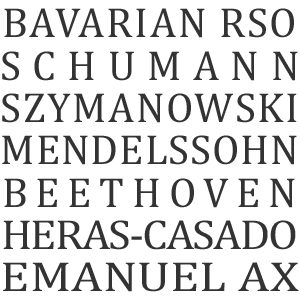
Schumann’s Manfred (“dramatic poem with music in three parts”) exists, even if only the overture is ever performed. Recordings were rare until last year but have been amended by accounts from Andrey Boreyko (Arthaus DVD) and Bruno Weil (Preiser SACD). Perhaps just a few performances of the whole thing would suffice to yearn again for the narrative-romantic conciseness of just the overture. But until then, fine readings like that of the Bavarian Radio Symphony Orchestra under Pablo Heras-Casado (standing in for an injured John Eliot Gardiner) wake a lust for more. It is hard to say whether Gardiner’s Manfred Overture would have sounded less brawny, thundering, dynamically nuanced, cohesive than Heras-Casado’s… Gardiner’s HIP-credentials notwithstanding, the last I heard him conduct the BRSO (Shostakovich, Bartók, Dvořák in 2008), he coaxed as silky romantic a sound out of them as I’ve ever heard. If anything was missing from the young Spanish conductor with hair to put Dudamel’s to shame, it was any element of surprise.

available at AmazonK.Szymanowski, Symphonies No 1 & 4, Concert Overture,
J.K.Broja / Wit / Warsaw PO
Naxos
Much of the same was true for a highly enjoyable yet forgettable “Scottish” Symphony from Mendelssohn that was the anticlimactic conclusion to the premature highlight: Szymanowski’s Fourth Symphony, the de-facto piano concerto “Symphonie concertante” op.60. A continuation of the BRSO’s incandescent Szymanowski-evening with Frank Peter Zimmermann (review here) and both the violin concertos, it was Emanuel Ax’s turn to tackle the soloists’ part of the grand work that has some parallels to Busoni’s Piano Concerto. Its big boned and harsh, brash romantic sound is presented in a corset of classical proportions: the brass-plated first movement, the finely spun exoticism of the second movement (a mini-violin concerto within), and an increasingly long assault of the finale. It is a synthesis of the ecstatic and the dreamy, with many parts for soloists within the orchestra to shine that Ax negotiated with aplomb and the BRSO, less transparent as the work went on, provided with plenty pizzazz.

5.1.12

Twelve Days of Christmas: Slavic Heroes

available at Amazon
Slavic Heroes, M. Kwiecień, Polish Radio Symphony Orchestra,
Ł. Borowicz

(released on January 10, 2012)
HMW 906101 | 55'18"
We have witnessed Mariusz Kwiecień's appeal on stage before. The Polish baritone's new recital of opera arias, recorded back in 2009 with some touch-ups or additions made early last year, gives ample occasion to admire the smoothness and resonance of his voice, while the packaging, with photos of the open-collared singer, may be geared to a portion of the audience with other concerns. Most aria recitals of this sort are hardly worth recommending on musical terms, being aimed mostly at the rabid fans of individual singers. This disc, under the less than imaginative title Slavic Heroes, does offer many excerpts of operas one does not hear often in this part of the world and that are worth knowing. Besides the more obvious choices of Borodin's Prince Igor and Tchaikovsky (Mazeppa and Eugene Onegin, the latter title role being one of Kwiecień's recent successes), there are unexpected selections of Polish, Czech, and Russian operas. Tchaikovsky's Iolanta, Rachmaninoff's Aleko, and Rimsky-Korsakov's Sadko are not exactly unknown quantities, but Smetana's Čertova stěna (The Devil's Wall) and Dvořák's The Cunning Peasant are off the beaten path, not to mention excerpts from three different operas by 19th-century Polish composer Stanisław Moniuszko. While none of the Moniuszko selections sounds like much more than watered-down Donizetti or Verdi, the disc ends with another Polish composer, an excerpt of Karol Szymanowski's Król Roger, the title role of which Kwiecień will sing this summer at Santa Fe Opera. The Polish Radio Symphony Orchestra, under the baton of Łukasz Borowicz, accompanies ably, although the balances sound a little artificial.

11.3.11

Ionarts-at-Large: Zimmermann & BRSO Do Szymanowski Proud

Here’s fantastic programming: Both of Karol Szymanowski’s Violin Concertos in one evening and Albert Roussel’s “Bacchus et Ariane” as dessert. In light of that Maurice Ravel’s Mother Goose as the appetizer (pâté?) may not be a necessary addition to this already rich fare, but in Stéphane Denève’s tender, empathetic, variously hushed and lively rendition (albeit one far away from the percussive world of the original two-piano version) it certainly whetted the appetite for what was to come.

I don’t remember last seeing Szymanowski on a concert program in Germany [actually, I do remember now: it was a little over two years ago, with the same orchestra in the same town], and perhaps he has the occasional outing, but they must be few, and far between. A pity really, because his romantic-impressionist idiom, tempered by folk rhythms à la Bartók, is an alluring and unique mix. Frank Peter Zimmermann apparently thinks so, too, which is why he—as the Bavarian Radio Symphony Orchestra’s Artist in Residence—programmed the two violin concertos for himself to perform… and picked Stéphane Denève, the new man at the helm of the SWR-RSO Stuttgart where he succeeds Roger Norrington after 13 wildly successful years, to conduct the program.


available at Amazon
K.Szymanowski et.al., Violin Ctos.,
F.P.Zimmermann / Swedish RSO, Warsaw PhilO. / Honeck, Wit
Sony


available at Amazon
K.Szymanowski, Violin Ctos etc.,
T.Zehetmair / CoBSO / Rattle
EMI

The two concertos, presented before and after intermission in chronological order, show off the various sides of Szymanowski’s compositional style—and the contrast between them—very nicely. The First, op.35 from 1916, displays the flittering romanticism of a restless Debussy with perhaps a hint of the more conventional style we find in his contemporary Josef Suk. The 16 years younger Second Concerto, op.61, shows more of the rough and angular additions to Szymanowski’s vocabulary.

Zimmermann has long championed these works and in 2009 he added his recording (Sony) to the slowly growing catalog that used to be dominated for years by Thomas Zehetmair’s excellent performances with Simon Rattle on EMI. In performance ‘FPZ’ is—in the best sense of the word—redoubtable… always his seemingly invariably excellent and tasteful self. In concertos that don’t need any glitz added to shine, his clear perfection can carry the day alone. In this case he added searing urgency, navigated the cadenzas—both written by the dedicatee and collaborator of these concertos, Paweł Kochański—with consummate skill and brazing gruff, growling with excitement at one point.

The slow opening of the Second Concerto is rich and heartrending and seems to continue, more or less, the voice of the First. But soon the chugging rhythms challenge the lyricism—a back and forth that goes on to dominate the sinuously tense concerto throughout. It was a treat and well recognized by the BRSO’s grateful audience which—thanks to the slightly more daring programming of that orchestral body—is the most open minded among Munich’s three big symphonic orchestra’s. (The truly explorative ears subscribe to the Munich Chamber Orchestra.)

It would have seemed that adding anything else after such a complex and rewarding meal might have been well intentioned overkill. And perhaps it was, but Albert Roussel’s Second Suite from Bacchus et Ariane was done too magnificently to complain. There was more color in the playing this evening—and particularly in the Roussel—as one might otherwise get in an entire BRSO season as Denève went all out trying to get atmosphere from every section while benefitting from the orchestra’s technical excellence along the way.

The concert was broadcast live on BR Klassik, but I’ve not yet figured out whether it can also be streamed after that fact or at some future date.