CD Reviews | CTD (Briefly Noted) | JFL (Dip Your Ears) | DVD Reviews
Showing posts sorted by relevance for query aaron sheehan. Sort by date Show all posts

1.10.12

Time Stands Still

Style masthead

Charles T. Downey, Folger Consort explores the tunes of 17th-century London
Washington Post, October 1, 2012

available at Amazon
Dowland, The Collected Works, The Consort of Musicke, A. Rooley
The Folger Consort is presenting a musical tour of five European cities for its 35th season of concerts of early music. On Friday night, it began with a delightful survey of music in early 17th-century London, quite appropriately for a historically informed performance ensemble based at the Folger Shakespeare Library.

Most of the credit for this concert’s success is due to the dulcet voice, rarefied diction, and pure intonation of tenor Aaron Sheehan. He excelled most artfully in the exquisite songs of John Dowland and Tobias Hume, accompanied simply by lute and bass viol, and in one case with choral parts sung quietly by the instrumentalists. Sheehan’s is a voice one is content to listen to all by itself, as he showed in an unaccompanied version of “The Northern Lasses Lamentation,” the most innocent of three less-than-lofty Broadside ballads. [Continue reading]
Folger Consort
With Aaron Sheehan, tenor
London: Music from the City of Shakespeare
Folger Shakespeare Library

22.8.12

Classical Month in Washington (September)

Last month | Next month

Classical Month in Washington is a monthly feature. If there are concerts you would like to see included on our schedule, send your suggestions by e-mail (ionarts at gmail dot com). Happy listening!

September 2, 2012 (Sun)
5:30 pm
Annapolis Symphony: Pops in the Park [FREE]
Quiet Waters Park

September 2, 2012 (Sun)
8 pm
NSO Labor Day Concert [FREE]
U.S. Capitol, West Lawn

September 4, 2012 (Tue)
6:45 pm
Opening of John Cage Centennial Festival
Corcoran Gallery of Art

September 5, 2012 (Wed)
12:10 pm
NGA New Music Ensemble [FREE]
John Cage Centennial Festival
National Gallery of Art

September 5, 2012 (Wed)
7:30 pm
Screening of A Tribute to John Cage by Nam June Paik [FREE]
Smithsonian American Art Museum

September 5, 2012 (Wed)
7:30 pm
Alexis Descharmes (cello)
With Irvine Arditti, Steven Schick, and Jenny Lin
John Cage Centennial Festival
La Maison Française
[Review]

September 6, 2012 (Thu)
12 to 4:30 pm
A Cage Film Circus [FREE]
John Cage Centennial Festival
Library of Congress

September 6, 2012 (Thu)
6 pm
Irvine Arditti, violin
John Cage Centennial Festival
Phillips Collection
[Review]

September 7, 2012 (Fri)
5:30 to 11 pm
Percussion Event
John Cage Centennial Festival
Katzen Arts Center, American University

September 8, 2012 (Sat)
2 pm
Stephen Drury, piano
John Cage Centennial Festival
Kreeger Museum
[Review]

September 8, 2012 (Sat)
7:30 pm
Irene Kim, piano
Korean Concert Society
Kennedy Center Terrace Theater

September 8, 2012 (Sat)
7:30 pm
Margaret Leng Tan, piano and voice [FREE]
John Cage Centennial Festival
Freer Gallery of Art
[Review]

September 8, 2012 (Sat)
8 pm
Paul Taylor Dance Company
Clarice Smith Center
[Review]

September 9, 2012 (Sun)
2 pm
Roger Reynolds, composer
John Cage Centennial Festival
National Gallery of Art

September 9, 2012 (Sun)
3 pm
Smithsonian Chamber Players [FREE]
Smithsonian American Art Museum

September 9, 2012 (Sun)
5:15 pm
Jeremy Filsell, organ [FREE]
Washington National Cathedral

September 9, 2012 (Sun)
6:30 pm
NGA New Music Ensemble [FREE]
John Cage Centennial Festival
National Gallery of Art
[Review]

September 9, 2012 (Sun)
7:30 pm
Stylus Phantasticus: Early German Baroque Chamber Music
Corda Nova
St. Mark’s Episcopal Church, Capitol Hill

September 10, 2012 (Mon)
6 pm
J'nai Bridges, mezzo-soprano [FREE]
Kennedy Center Terrace Theater

September 11, 2012 (Tue)
6 pm
Washington National Opera Insights: Don Giovanni [FREE]
Kennedy Center Millennium Stage

September 14, 2012 (Fri)
7:30 pm
Stephanie Blythe, mezzo-soprano
Vocal Arts D.C.
Kennedy Center Terrace Theater
[Review]

September 15, 2012 (Sat)
6 pm
Washington National Opera Insights: Anna Bolena [FREE]
Kennedy Center Millennium Stage

September 15, 2012 (Sat)
7 pm
Donizetti, Anna Bolena
With Sondra Radvanovsky, soprano
Washington National Opera
Kennedy Center Opera House
[Review]

September 15, 2012 (Sat)
8:30 pm
Baltimore Symphony Orchestra
Gala Celebration Concert with Renée Fleming
Meyerhoff Symphony Hall (Baltimore, Md.)
[Review]

September 16, 2012 (Sun)
2 pm
Bellini, La Sonnambula
With Eglise Gutiérrez, Maureen McKay
Washington Concert Opera
[Review]

September 16, 2012 (Sun)
4 pm
Amadeus Orchestra
Music by Mendelssohn, Mahler, Vaughan Williams
St. Luke Catholic Church (McLean, Va.)

September 16, 2012 (Sun)
5:15 pm
Stephen Hamilton, organ [FREE]
Washington National Cathedral

September 18, 2012 (Tue)
7:30 pm
Donizetti, Anna Bolena
With Sondra Radvanovsky, soprano
Washington National Opera
Kennedy Center Opera House

September 20, 2012 (Thu)
7:30 pm
Mozart, Don Giovanni
Washington National Opera
Kennedy Center Opera House
[Review]

September 20, 2012 (Thu)
8 pm
Baltimore Symphony Orchestra
With Gil Shaham, violin
Meyerhoff Symphony Hall (Baltimore, Md.)

September 21, 2012 (Fri)
7:30 pm
Donizetti, Anna Bolena
With Sondra Radvanovsky, soprano
Washington National Opera
Kennedy Center Opera House

September 21, 2012 (Fri)
7:30 pm
Korean Adopted Children's Choir
ASIA, Inc.
Kennedy Center Terrace Theater

September 21, 2012 (Fri)
8 pm
Baltimore Symphony Orchestra
With Gil Shaham, violin
Meyerhoff Symphony Hall (Baltimore, Md.)

September 22, 2012 (Sat)
7 pm
Mozart, Don Giovanni
Washington National Opera
Kennedy Center Opera House

September 22, 2012 (Sat)
8 pm
Baltimore Symphony Orchestra
With Gil Shaham, violin
Music Center at Strathmore
[Review]

September 22, 2012 (Sat)
8 pm
Fairfax Symphony Orchestra
Music by Adams, Zwilich, Bernstein
GMU Center for the Arts
[Review]

September 23, 2012 (Sun)
3 pm
Washington Bach Consort
Music by Bach, Blow, Boyce, Gibbons, Handel
National Presbyterian Church
[Review]

September 23, 2012 (Sun)
4 pm
Nathan Gunn, baritone
Music by Mozart, Rossini, Sondheim
Washington National Opera
Kennedy Center Opera House
[Review]

September 23, 2012 (Sun)
5:15 pm
Corrado Cavalli, organ [FREE]
Washington National Cathedral

September 23, 2012 (Sun)
6:30 pm
NGA Chamber Players [FREE]
With Paul Kosower, cello
Music of J. S. Bach
National Gallery of Art

September 23, 2012 (Sun)
7 pm
Keyboard Conversations with Jeffrey Siegel
GMU Center for the Arts

September 23, 2012 (Sun)
7:30 pm
Joseph Kalichstein, piano
JCCGW

September 24, 2012 (Mon)
7 pm
Donizetti, Anna Bolena
With Sondra Radvanovsky, soprano
Washington National Opera
Kennedy Center Opera House

September 24, 2012 (Mon)
8 pm
Stravinsky,
L'Histoire du Soldat
With U.S. Army Band, UMd Chorus
Clarice Smith Center

September 26, 2012 (Wed)
12:10 pm
Barbara Kolarova, violin [FREE]
Czech Mutual Inspirations Festival
National Gallery of Art

September 26, 2012 (Wed)
7:30 pm
Mozart, Don Giovanni
Washington National Opera
Kennedy Center Opera House

September 27, 2012 (Thu)
7:30 pm
Donizetti, Anna Bolena
With Sondra Radvanovsky, soprano
Washington National Opera
Kennedy Center Opera House

September 28, 2012 (Fri)
8 pm
Baltimore Symphony Orchestra
Music by Adams, Brubeck, Bernstein
Meyerhoff Symphony Hall (Baltimore, Md.)
[Review]

September 28, 2012 (Fri)
8 pm
London: Music from the City of Shakespeare
Folger Consort, with Aaron Sheehan (tenor)
Folger Shakespeare Library
[Review]

September 28, 2012 (Fri)
8 pm
Annapolis Symphony
With Michael Roll, piano
Music by Mackey, Beethoven, Prokofiev
Maryland Hall (Annapolis, Md.)

September 29, 2012 (Sat)
5 and 8 pm
London: Music from the City of Shakespeare
Folger Consort, with Aaron Sheehan (tenor)
Folger Shakespeare Library
[Review]

September 29, 2012 (Sat)
5 pm
Haydn, Creation
WNC Choirs and Orchestra
Washington National Cathedral
[Review]

September 29, 2012 (Sat)
6 pm
Brian Patterson (clarinet) and Audrey Andrist (piano) [FREE]
Kennedy Center Millennium Stage

September 29, 2012 (Sat)
7 pm
Mozart, Don Giovanni
Washington National Opera
Kennedy Center Opera House
[Opera in the Outfield simulcast]

September 29, 2012 (Sat)
8 pm
Baltimore Symphony Orchestra
Music by Adams, Brubeck, Bernstein
Music Center at Strathmore

September 29, 2012 (Sat)
8 pm
Annapolis Symphony
With Michael Roll, piano
Music by Mackey, Beethoven, Prokofiev
Maryland Hall (Annapolis, Md.)

September 30, 2012 (Sun)
2 pm
Donizetti, Anna Bolena
With Sondra Radvanovsky, soprano
Washington National Opera
Kennedy Center Opera House

September 30, 2012 (Sun)
2 pm
London: Music from the City of Shakespeare
Folger Consort, with Aaron Sheehan (tenor)
Folger Shakespeare Library

September 30, 2012 (Sun)
3 pm
Baltimore Symphony Orchestra
Music by Adams, Brubeck, Bernstein
Meyerhoff Symphony Hall (Baltimore, Md.)

September 30, 2012 (Sun)
4 pm
Ars Nova Chamber Orchestra
Music by Schubert, Mozart, Beethoven
Church of the Epiphany

September 30, 2012 (Sun)
5:15 pm
Christopher Betts, organ [FREE]
Washington National Cathedral

September 30, 2012 (Sun)
6:30 pm
CUA Orchestra and Chorus [FREE]
Music of Mozart, Rimsky-Korsakov
National Gallery of Art

September 30, 2012 (Sun)
7 pm
NSO Season Opening Ball
With Anne-Sophie Mutter
Kennedy Center Concert Hall
[Review]

30.9.13

Cornago Mass with Folger Consort


Charles T. Downey, Folger Consort starts season with a polyphonic setting of Catholic Mass
Washington Post, September 30, 2013

available at Amazon
J. Cornago, Missa de la mapa mundi, His Majestie's Clerkes, P. Hillier
A pop song as the basis for a musical setting of the Catholic Mass sounds like a peculiarly modern thing to do, but the practice can be traced back to the 15th century. One of the oldest examples, the “Missa Ayo visto lo mappamundi” by Juan Cornago, was the centerpiece of the first program in the Folger Consort’s new season, its 36th, heard early Saturday evening at the Folger Shakespeare Library.

It is a beautiful polyphonic setting of the Mass, for three male voices, with florid parts woven around the long notes of the Sicilian folk song “Ayo visto lo mappamundi.” Countertenor Martin Near, tenor Aaron Sheehan and baritone Richard Giarusso sang it mostly from a balcony above the stage, in a way that was evenly matched and blended, with just one rough patch in the “Sanctus” movement. [Continue reading]
Folger Consort
With Martin Near (countertenor), Aaron Sheehan (tenor), Richard Giarusso (baritone), and Emily Noel (soprano)
Folger Shakespeare Library

2.4.13

Classical Music Agenda (May 2013)

In May, we are leading with the living composers who are coming to the area and whose music will be performed here. Equally high in our estimation are some definitely dead composers also being performed here next month. Here are the Top 10 choices, but many more concerts will run through the calendar in the sidebar.


Composer John Adams
ALIVE:
The last time that we reviewed Meredith Monk and her performing ensemble in the area was the 2006 performance of Impermanence, at a pathetically third-filled hall at George Mason University. Hopefully, she will have better luck drawing an audience at the Clarice Smith Center in College Park, when she and her Vocal Ensemble perform On Behalf of Nature (May 4, 8 pm). Monk's multimedia approach, which combines voice, movement, video, rhythm, and light, has to be experienced live to be understood. Do not miss. Tickets: $35.

American composer George Crumb is the focus of a concert by Orchestra 2001, with soprano Ann Crumb performing her husband father's music (Night of the Four Moons and Voices from the Heartland), at the Library of Congress. The program also features the world premiere of a piece by Chaya Czernowin, Slow Summer Stay II: Lakes. Tickets: FREE.

May is also John Adams Month in Washington, centered on a residency by the celebrated American composer at the Library of Congress. The Attacca Quartet will play Adams's String Quartet and the world premiere of a new work by Timothy Andres (March 22, 8 pm); Jennifer Koh and Reiko Uchida will play Adams's Road Movies and Esa-Pekka Salonen's Lachen verlernt (March 23, 8 pm); and the International Contemporary Ensemble will play Adams's Son of Chamber Symphony (March 24, 8 pm). Tickets: FREE.

More Adams earlier in the month, too, with pieces performed by two local orchestras. The University of Maryland Symphony will also perform the Son of Chamber Symphony, in an excellent program of Ives, Verdi, and Stravinsky (May 3, 8 pm), at the Clarice Smith Center. Tickets: $25. The Baltimore Symphony Orchestra will play Shaker Loops, on a program that includes Prokofiev's fourth symphony and a tiresome piece by Jennifer Higdon that I do not recommend (May 2, Strathmore; May 4, Meyerhoff Hall). Tickets: $31 to $91.


Tenor Aaron Sheehan
John Adams will remain in Washington the week after the Library of Congress residency, to serve as guest conductor of the National Symphony Orchestra (May 30 to June 1). He will lead a performance of his orchestral tone poem City Noir, plus Respighi's Fountains of Rome and Ravel's G major piano concerto, with Jeremy Denk as soloist. Tickets: $10 to $85.

ALIVE AGAIN:
We wrote admiringly of the Boston Early Music Festival's recording of Charpentier's hunting pastoral Actéon. That production's excellent lead, tenor Aaron Sheehan, heads up a semi-staged performance of the work by Opera Lafayette (May 1 and 2) in the Kennedy Center Terrace Theater. Tickets: $55 to $70.

Color me surprised that Pomerium, the early music ensemble founded by Alexander Blachly is still around, but they celebrated their 40th anniversary this season. (Someone at Archiv and at Old Hall Recordings needs to put me on their CD publicity list.) They will perform a program of English Catholic polyphony from the reign of Mary Tudor at the Phillips Collection (May 5, 4 pm). Tickets: $20.

Pro Musica Hebraica is hosting the Apollo Ensemble, which will perform some of the Jewish Baroque music restored from historical sources in the Ets-Chaim Library in Amsterdam. The program in the Kennedy Center Terrace Theater (May 13, 7:30 pm) will feature Boi b'Shalom by Lidarti, Le-el Nora by Mani, and Kol Haneshama by an anonymous composer, plus music by Salomon Rossi, Marco Uccellini, and Giacobo Basevi Cervetto. Tickets: $38.

ALSO:
We always recommend the visits by the Philadelphia Orchestra, and their upcoming concert, hosted by Washington Performing Arts Society at the Kennedy Center Concert Hall (May 1, 8 pm), is the first under their new music director, Yannick Nézet-Séguin. He will conduct Bruckner's seventh symphony and Korngold's violin concerto, with Hilary Hahn as soloist. Tickets: $35 to $105.

Cellist David Finckel is leaving the Emerson Quartet at the end of this season. Hear him one last time on the Emerson String Quartet series next month (May 11, 6 pm) at the National Museum of Natural History. The concert, already apparently sold out, includes quartets by Haydn and Bartók, plus the gorgeous Schubert C major quintet, with Paul Watkins on the second cello part. Tickets: $67.

31.8.12

Classical Music Agenda (September 2012)

If you, like me, spent the last couple concert-less weeks in withdrawal, be happy that September is just around the corner. Of course, we have already taken a look at the season to come and chosen the Top 25 concerts we most want to hear this season. Truth be told, your editor will likely hear four or five times that many performances between now and next June. For those of you new to how this works, each month I pick the ten most intriguing performances on the calendar. Keeping the number lower makes these agendas more selective, but you can always follow the complete calendar of everything we know about in Washington, in the right-hand column of this page.


Tenor Aaron Sheehan
SINGERS:
We have written about Sondra Radvanovsky at the Metropolitan Opera and here in Washington. The American soprano is back at Washington National Opera this month, this time at the top of the bill, in the title role of Donizetti's Anna Bolena (September 15 to October 6). The Jane Seymour of mezzo-soprano Sonia Ganassi, heard last season in Massenet's Werther, should be a good foil for Radvanovsky's Anne Boleyn. Tickets: $25 to $300.

The weekend of the opening of Anna Bolena will have enough bel canto mad scenes to stun a small cat, since it also features Washington Concert Opera's performance of Bellini's La Sonnambula (September 16, 2 pm). Eglise Gutiérrez, heard in Bellini's I Capuleti e i Montecchi this summer, stars as the sleepwalking Amina, with René Barbera (Elvino), Ben Wager (Rodolfo), and Maureen McKay (Lisa). Tickets: $40 to $110.

One of the singers I am most looking forward to hearing again is tenor Aaron Sheehan, a clear and beautiful voice for early music, in a program called London: Music from the City of Shakespeare with the Folger Consort (September 28 to 30). The program of London-based music by Orlando Gibbons, Thomas Morley, and William Byrd should fill the Folger Shakespeare Library's Elizabethan theater quite nicely. Tickets: $37.

JOHN CAGE CENTENNIAL:
One thing that did not make my season's best was the John Cage Centennial Festival, in honor of what would have been his 100th birthday on September 5. As I have written before, Cage is one of those composers whose influence is hard to overestimate but whose music can be insufferable: I can appreciate the ideas but often abhor the practice. That being said, the Cage celebrations (from September 4 to 10) will bring together a welcome selection of concerts, film screenings, and lectures at several of the city's cultural institutions. Highlights include recitals by Alexis Descharmes and Friends (September 5, La Maison Française), violinist Irvine Arditti (September 6, Phillips Collection), and pianist Stephen Drury (September 8, Kreeger Museum).


Violinist Anne-Sophie Mutter
ALSO:
We generally do not like to recommend gala concerts: with the focus on other matters, the music usually stinks. Christoph Eschenbach has actually made an effort to make his season opening gala concerts not stink, and once again the National Symphony Orchestra's Season Opening Ball Concert (September 30, 7 pm) has music we actually want to hear: Beethoven's overture to The Creatures of Prometheus, star violinist Anne-Sophie Mutter in Mendelssohn's chestnut violin concerto and Sarasate's showoff Carmen Fantasy, and a reprise of Strauss's suite from Der Rosenkavalier, heard at the end of last season. Tickets: $47 to $125.

Speaking of good programming, the all-American season opener from the Fairfax Symphony Orchestra (September 22, 8 pm) gets a nod this month. Soloist Jeffrey Biegel joins for the local premiere of Ellen Taaffe Zwilich's 2011 piano concerto Shadows, co-commissioned by eight orchestras in different countries, matched with short dance pieces by John Adams and Leonard Bernstein, as well as Gershwin's Piano Concerto in F, at the GMU Center for the Arts in Fairfax. Tickets: $25 to $55.

The University of Maryland Chamber Singers join forces with members of the U.S. Army Band and Soldiers' Chorus for an all-Stravinsky program (September 24, 8 pm) at Clarice Smith Center in College Park. This free concert pairs L'Histoire du Soldat and the composer's concise setting of the Latin Mass. Tickets: Free.

It is a bit of a stretch to say that the first concert from the Washington Bach Consort features "music for the political season," a connection that would surely make me run the other direction. It does feature, however, English music for royal occasions by John Blow, William Boyce, Handel, and Orlando Gibbons, as well as two cantatas composed by J. S. Bach for the Ratswechsel, or inauguration of the town council, in Leipzig. Tickets: $23 to $65.

4.1.11

Twelve Days of Christmas: Charpentier's 'Actéon'

available at Amazon
Charpentier, Actéon / Orphée descendant aux enfers / La pierre philosophale, A. Sheehan, T. Wakim, Boston Early Music Festival, P. O'Dette, S. Stubbs

(released on November 16, 2010)
cpo 777 613-2 | 66'19"
While this recent Baroque release did not strike my fancy enough to make the Best of 2010 list, it is certainly worth some brief remarks on its own. CPO's series of operas from the Boston Early Music Festival continues this year: we have already accorded high praise to their releases of Lully's Psyché (2008) and Thésée (2007). This new disc, recorded in 2009 by Radio Bremen, combines three unusual secular works by Marc-Antoine Charpentier, headlined by the concise pastoral work Actéon, whose story and focus on hunting themes mean it was likely intended for the entertainment of a hunting party. The delight in the hunt is palpable in the infectious opening chorus of the hunters, Allons, marchons, courons, hâtons nos pas!, and this has hardly changed in our own time, except for the technology involved. Authorities in Wisconsin reported that during the state's recently concluded nine-day season, an incredible 218,144 deer (!) were shot. Actéon, after his metamorphosis into a stag, would have stood even less a chance these days.

There is much to praise, both in the singing (especially the clean, light sound of tenor Aaron Sheehan in the title role) and the delightful playing, enlivened by the rhythmically effervescent strumming of theorbists Stephen Stubbs and Paul O'Dette in the continuo section, as well as bright, diverting percussion played by Marie-Ange Petit. William Christie recorded Actéon in the 1980s, with Les Arts Florissants, a recording that was re-released just last year (probably no coincidence). You could save yourself a few dollars with that older recording, and it has just as much to recommend it as the new one from Boston (some of Christie's interpretative choices make the Boston performance sound a little bloodless, and the French pronunciation is better). The major difference is that Christie cast a countertenor in the title role, the gifted Dominique Visse, but Sheehan's voice is the more pleasing one. Christie pairs this short work with the intermède for Molière's Le mariage forcé, while the Boston group opts for Charpentier's cantata Orphée descendant aux enfers and his musical scene for Thomas Corneille's play La pierre philosophale. While Les Arts Florissants recorded the latter work (in a still exemplary disc of Charpentier's divertissements, airs, and concerts), this is the first complete recording of the Orphée work (H. 171) to reach my ears.

30.9.08

Psyché in Boston

available at Amazon
Lully, Psyché, C. Sampson, K. Gauvin, Boston Early Music Festival, P. O'Dette, S. Stubbs

(released July 29, 2008)
cpo 777 367-2

Online scores:
Psyché (full score, ed. Nicolas Sceaux)
The fine series of operas from the Boston Early Music Festival, recorded by Radio Bremen, continues with this 3-CD set made during last year's performance of Lully's Psyché. Lully had a life-long fascination with the story of Cupid and Psyche, setting it first as a court ballet with Isaac Benserade in the 1650s and then turning to it again for a 1670 ballet, whose divertissements were reworked as the framework for the full opera recorded here. Les Arts Florissants has recorded some excerpts, but this is the first complete recording. Last year's BEMF release, Lully's Thésée was very good, but this production strikes my ears as even better, largely because of a stronger cast.

The production drew a remarkable confluence of music critics, with reviews published by Jeremy Eichler (Boston Globe), Anne Midgette (New York Times), John Yohalem (Opera Today), Heidi Waleson (Wall Street Journal), and George Loomis (Financial Times). The photographs of the staging make one wish for a DVD instead of a CD. The thorough and excellent booklet includes essays about the opera by Gilbert Blin, Rebecca Harris-Warwick, John S. Powell (the musicologist who provided the performing edition of the music), and other specialists, which give the listener more information than most probably want or need. These essays explain the parallels intended to be drawn between the story and the court in which it was performed. The god L'Amour (Cupid -- Louis XIV) falls in love with the most beautiful mortal woman, Psyché (Athénaïs de Rochechouart, known as Madame de Montespan, the second of Louis's official mistresses, after Louise de la Vallière). He builds her a palace, as Louis built the Château de Clagny, to keep La Montespan near him at Versailles. (Clagny was later demolished, and its bricks used to build an Ursuline convent at the edge of the village of Versailles.)

available at Amazon
Lisa Hilton, Athénaïs: The Life of Louis XIV's Mistress, the Real Queen Of France
Psyché's story was associated with La Montespan in art and music, and the 1678 reworking of the opera was made to celebrate the return of the royal mistress to her former glory at court, after a period in disgrace. The score has a startling range of music, including one of the most extended lament scenes in Baroque opera, the so-called Plainte italienne, a scene sung in Italian and accompanied by extra recorder players on stage. There are also dance scenes for Cyclopes, chain-rattling demons in a celebrated underworld scene, and the Furies given voice by a trio of growling male voices). It is endlessly diverting music, presented in the best possible light by the BEMF Orchestra, led superlatively by theorbists Paul O'Dette and Stephen Stubbs from the continuo section. All of the players are leading players of historical instruments, with especially vigorous and sparkly playing from Kristian Bezuidenhout and Peter Sykes at the harpsichord. A number of bells and other tinkly percussion, as well as glissandi on harpsichord, help give fantastic color to the magical transformation scenes.

The singing is led by two truly excellent sopranos, the luminescent Carolyn Sampson as Psyché and the velvety, fuller Vénus of Karina Gauvin. The chorus is one of the strongest in this sort of recording, made up of the fine singers in the supporting cast, including countertenor José Lemos, tenors Jason McStoots and Aaron Sheehan, and sopranos Amanda Forsythe and Yulia Van Doren. It is not only the sole recording of this important opera, it is hard to imagine it being surpassed by a superior version.

173'42"

10.12.07

American Opera Theater's Messiah

Of the nine Messiah performances in the area last weekend, American Opera Theater’s stab at the Handel oratorio offered historicism and novelty alike. Timothy Nelson, who also conceived the production, conducted the 1742 Dublin version of the work’s premiere played by his Ignoti Dei period-instrument ensemble of a dozen players. The novelty came in the form of AOT staging the oratorio — as far as we know for the first time ever in America. The work opened with the stage littered with hundreds of pages ripped from books, a few chairs, and a ladder, as well as arches projected onto the walls. Meanwhile the orchestra, seated in the back third of the stage of Georgetown University’s Gonda Theatre, offered a lightly played overture.

Tenor Aaron Sheehan’s expressive Comfort ye my people was given with his head in his hands, seemingly distraught over a lady (“Comfort her, that her iniquity is pardoned.”) In the quick runs of Every valley shall be exalted, his vocal agility was limited by an awkward technique. Bass-baritone David Newman, dressed as a homeless man, entered the stage singing Thus Saith the Lord, chasing the tenor with a section of pipe. Soprano Bonnie McNaughton tried to make up with vibrato what she lacked in volume in her aria Who may abide the day of His coming; but if it lacked clarity, the extemporaneous flourishes were dazzling. Contralto Kristen Dubenion-Smith joined the three singers already on stage in And He Shall Purify, which featured much beauty despite every singer choosing to pronounce the ‘i’ differently.


William Blake, Good and Evil Angels [Struggling for
Possession of a Child or Soul], 1795-1805
Eventually the Georgetown Chamber Singers went to work with For unto us a child is born, but the fun really began only with the entrance of the amply winged angel. Soprano Sherezade Panthaki, lit from behind, sang her series of short narrative pieces with a shimmering musical halo from the orchestra. The chorus distinguished itself during Glory to God with fine diction but was overly reliant on amplification. Panthaki’s fast, narrow vibrato allowed her voice be in constant motion with a sinuous legato in Rejoice Greatly, O Daughter of Zion, and virtuosic runs were spiced with interesting ornaments. Panthaki’s superbly resonating voice was distorted by the microphones, intended only for the orchestra and chorus. Adding to the non-musical cacophony were the two overhead projectors that produced strong whirring noises reminiscent of hair dryers.

Other Reviews:

Joe Banno, American Opera Theatre: 'Messiah' (Washington Post, December 10)
The second half featured Newman, our homeless bass-baritone, breaking chairs while convincingly singing of “the Nations’ rage.” Soon thereafter he began ripping the wings off of the angel (text: “and cast away”). The tenor then slowly removed his belt to tie the angel’s arms to the top of the ladder resembling something between Jesus on the cross and a bondage flick. He then ravaged the angel while singing “thou shalt break them with a rod of iron; thou shalt dash them into pieces” and whacked her with a plastic pipe. Feathers were flying as he further thrashed her detached wings.

The Hallelujah Chorus came next – with the four singers predatorily circling the tortured, tied-up, wingless angel. Needless to say, the audience’s instinct to stand and cheerily sing along had been zapped by that point. On the musical front the natural trumpets were more or less on key while the timpanist sounded rather muffled. After a set change, the resurrection theme was reinforced by Panthaki’s rendition of I Know That My Redeemer Liveth. The wingless angel, now presumably human, kissed the homeless bass-baritone at length in silence.

American Opera Theater will reprise this staged Messiah, in a slightly different form, with the Handel Choir of Baltimore's Chandos Singers at the Baltimore Museum of Art (December 22, 8 pm; December 23, 3 pm).

A LETTER TO THE EDITOR:
Timothy Nelson, Artistic Director of American Opera Theater, responds:
I am deeply troubled by Michael Lodico's assertion that our production of Messiah has sado-masochistic overtones. It absolutely has no intended or overtly unintended sexual component. I suppose that since we use a woman as our allegorical "lamb," for Michael the sight of a woman bound is sexual (where I doubt if it were a man in that role this would be the case). That said, a scene of binding and violence is essential for any telling of the Messianic story, and there was nothing presented on stage that sexualizes this in ANY way. If there were any evidence that a sexual overtone had been intended, rather than simply intuited by whatever was going through Michael's own head, I wouldn't even bring this up. But the show is free of everything except the violence described in the text, nothing at all sexual.

7.4.11

Handel's 'Acis and Galatea'

Style masthead

Read my review published today in the Style section of the Washington Post:

Charles T. Downey, Opera Lafayette charms intimately with ‘Acis and Galatea’ at Kennedy Center
Washington Post, April 7, 2011

Handel premiered “Acis and Galatea” at Cannons, the palatial home of the future Duke of Chandos, one of the composer’s most important patrons. Tuesday night, an intimately scaled performance of the work recalled the private circumstances of its premiere nearly 300 years earlier. In the Kennedy Center Terrace Theater, the ensemble of period instruments concluded Opera Lafayette’s season by returning to this charming pastoral work, which it first performed at the Corcoran Gallery of Art in 2000. John Gay’s bubbly, balladic libretto, drawn from a short passage in Ovid’s “Metamorphoses” (by way of Dryden’s English translation), has many pleasing comic touches that adorn its central tragedy.

Bass-baritone Peter Becker stole the show as Polyphemus, the jealous Cyclops who crushes his rival Acis with a large stone, trembling with rage and plenty of bluster in his low notes. Tenor Thomas Michael Allen made a pleasing company debut as Acis, singing with great agility in the fast passages and true intonation. The tone was a little constrained at the top and not as generally pretty as one might have liked.

Rosa Lamoreaux had an elegant turn as the sea-nymph Galatea, but the top of her voice did not have the ideal shimmer for the role. She could not compete with the memory of the versatile Rebecca Duren, who once performed the most difficult arias while suspended upside-down on ropes in the crazy circus-themed production of the work presented a few years ago by the now-defunct American Opera Theater that was in Baltimore. [Continue reading]
Handel, Acis and Galatea
Opera Lafayette
Kennedy Center Terrace Theater

OTHER ARTICLES:
  • Background on Handel and Acis and Galatea: A Stone's Throw (Ionarts, April 6, 2011)
  • Boston Early Music Festival's production of Acis and Galatea: Allan Kozinn, Finding Many Ways to View One Myth (New York Times, April 5, 2011) -- their cast includes the tenor I would have preferred as Acis, Aaron Sheehan

20.8.07

Lully's American Thésée

Available at Amazon:
available at Amazon
Lully, Thésée, Boston Early Music Festival, H. Crook, L. Pudwell, P. O'Dette
(June 26, 2007)
Last January, we reviewed a recital by lutenist Paul O'Dette and soprano Ellen Hargis at the National Gallery of Art. Both are regular participants in the Boston Early Music Festival, where they worked together on this production of Jean-Baptiste Lully's Thésée, in 2001. A co-production with Radio Bremen brought the performers to Germany, where this recording was made last September, somewhat surprisingly the only version of the opera now available. The opera was premiered at St.-Germain-en-Laye in 1675, although its prologue is set in the relatively new château of Versailles (which is one way to signal that the listener should read the opera in terms of the life of Louis XIV). The libretto by Philippe Quinault is one of the stranger works of literature, but the story is based upon Plutarch and Ovid, with a few extra characters thrown in to make it read like 17th-century French drama.

Two mythological characters fresh from disastrous romantic liaisons become entangled with one another. The vengeful sorceress Medea, having just gotten murderously even with the unfaithful Jason, falls in love with her later husband's son, Theseus, who has returned to Athens after killing the Minotaur and abandoning Ariadne. (This family history does not get any healthier, since Theseus's son Hippolytus was killed in an accident after he rejected the advances of his stepmother, Phaedra.) As unlikely as the story is for operatic treatment, Handel's later opera Teseo uses a libretto that is basically Quinault's text translated into Italian. After its premiere at St.-Germain-en-Laye in 1675, Thésée was one of Lully's most successful operas, receiving numerous revivals in Paris late into the 18th century. One can actually consult the entire score, from its first printing, online.


Calyx krater (with Medea in her chariot), c. 400 B.C.
Cleveland Museum of Art
In our time, the opera has largely been forgotten, except for a few performances, led by William Christie as part of the Ambronay Festival. Also, Emmanuelle Haïm and Le Concert d'Astrée will present a staged production at the Théâtre des Champs-Elysées this February and at the Opéra de Lille in March, with Jean-Louis Martinoty directing and Anne Sofie von Otter as Médée. The Boston instrumental forces have a unified and propelled sound (as in the concluding Chaconne), directed gracefully from the theorbo section by Paul O'Dette and Stephen Stubbs. Any orchestra that has two musette players (Jean-Christophe Maillard and François Lazarevitch) is going to have some vibrant colors available. Laura Pudwell snarls and menaces as Médée, with a thick tone and percussive diction, while experienced Baroque tenor Howard Crook continues to impress with his flexible voice as Thésée. The bass of Harry van der Kamp (Ægée), of the same age as Crook, has aged less gracefully. Ellen Hargis's Æglé is good, but perhaps lacks the naïve shimmer proper to the role.

The test of a recording's merit is generally in the supporting voices, which here are hit-and-miss, with some strained and pushed sounds, as well as occasional lapses in French pronunciation. Suzie LeBlanc (Cleone) and Aaron Sheehan (Un plaisir and other minor roles), both of whom we have reviewed live in recent years, have pleasant turns. It seems unlikely that this recording, as good as it is, will not be bettered by one conducted by either William Christie or Emmanuelle Haïm (the latter seems a quite likely eventuality). However, as that has not yet happened, this 3-CD set is most welcome, and it is complete, with all of the charming dance music (and a liner essay on the dance music by respected scholar Rebecca Harris-Warwick).

cpo 777 240-2

7.1.12

Folger Consort's Latest

available at Amazon
A New Song: Celebrating the King James Bible, Cathedra, Folger Consort

(released on December 13, 2011)
The Folger Shakespeare Library marked the 400th anniversary of the publication of the King James Bible with an exhibit last fall, a suiting tribute to perhaps the most influential book in the English language. The Folger Consort also commemorated this landmark event with a concert of music setting King James texts. My review, based on a hearing of the first performance of this program, noted a few shortcomings, the sorts of infelicities that are generally ironed out in subsequent performances as the musicians relax and reach a greater comfort level. Happily for listeners, the group went on to make a recording of this music in the few days following the weekend of concerts, yielding a disc released last month on the Library's private label, Bard Records. The sound, captured in the gorgeous acoustic of the Library of Congress's Coolidge Auditorium, is excellent, and the program has benefited from further thought and performance. Highlights includes two impressively virtuosic pieces played by Adam Pearl on the chest organ, a Fantasia by Orlando Gibbons and a Ground by John Blow, and the particularly fine F major sonata by Purcell. The vocal selections are all good, especially those by Purcell and the concise, perfectly focused Hosanna to the Son of David by Gibbons, with outstanding performances by tenor Aaron Sheehan in solo pieces and sections.

Readers are warmly encouraged to attend the second performance of the Folger Consort's excellent New Year Concert, this evening at Washington National Cathedral (January 7, 8 pm). The four women of Anonymous 4 sing chants of Hildegard von Bingen and a selection of 13th-century motets from the Montpellier Codex. I heard the first performance last night, but my review will not appear until Monday, so consider this your advance notice.

19.3.08

Bach's St. John Passion at National Cathedral

This review is an Ionarts exclusive.

Washington National Cathedral
Sunday afternoon, the Washington National Cathedral Choir and Baroque Orchestra presented Bach’s St. John Passion, conducted by Cathedral Director of Music Michael McCarthy. McCarthy’s unhurried approach to the opening chorus allowed its full intensity to show forth, while enhancing textual clarity in the labyrinth of runs. The deep orchestral crescendo before the choir’s first entrance astutely framed the tripartite repetition of the word “Herr,” recalling the trinity. Sighing two-note slurs on the words “allen Landen” pointed toward the pain found in the earthly setting of the passion narrative.

As narrator, tenor Ole Hass (The Evangelist), carrying the bulk of the work’s recitatives, communicated the often extended text with soaring tone and native diction. Bass James Shaffran (Christ) captured the depth of Jesus’s sparing, yet profound words. Soprano Elizabeth Weigle’s bounding performance of the aria Ich folge dir (“I follow Thee”) featured a highly resonant and capable instrument; however, Weigle, at times behind, did not quite coordinate seamlessly with the Baroque flute and excellent continuo. She showed impressive control on the long notes of the tearful aria after Jesus’s death, Zerfließe, mein Herze (“Melt, my heart”), where Bach showed a new musical reality in the words Dein Jesus ist tot (“Thy Jesus is Dead!”) by composing a distant modulation that she handled well. Nevertheless, Weigle’s immense vocal attributes were limited by her further lack of rapport with orchestra and conductor. Magdelena Kožená’s cantatas with John Eliot Gardiner perhaps set the bar in terms of rapport. Aaron Sheehan (tenor), Roger Isaacs (countertenor), and Bobb Robinson (baritone) were equally strong.

The Washington National Cathedral Choir, comprising about 35 singers, mixes professional tenors and basses with and boy and girl choristers from the Cathedral’s choirs. Singing with belief and comprehension of text, the choir appeared closely attuned to McCarthy’s direction. McCarthy’s unique experience as a vocalist (with the Gabrieli Consort and Monteverdi Choir) allowed him to use simulated vocal technique to help the sopranos place the highest note in the chaotically aggressive Kreuzige, kreuzige! (“Crucify Him!”) section.

The only other conductor I have experienced (live) so connected to his singers is John Eliot Gardiner (yes, more so than Maasaki Suzuki), whom McCarthy has worked with substantially. Notwithstanding hints of fatigue (read: intonation issues), the final chorus, Ruht wohl (“Rest in peace”), created a bittersweet mood one never wanted to end, embodying the weariness at the close of the draining emotional journey through the Passion narrative. A glimpse of the destiny of heaven is foreshadowed in the words Macht mir den Himmel auf und schliesst die Hölle zu (“Openeth the heavens up to me and closeth hell”), when Bach allows light to briefly shine into the music.

CORRECTION:
The original text of this review implied that only girl choristers sang in this performance. According to concerned readers, there were boy trebles performing in the choir, too, whose contributions we did not mean to overlook.

8.10.14

Opera Lafayette Brings Rameau to Life

available at Amazon
Rameau, Les Fêtes de l'Hymen et de l'Amour, C. Santon-Jeffery, C. Sampson, B. Staskiewicz, R. van Mechelen, Le Concert Spirituel, H. Niquet

(released on October 28, 2014)
Glossa GCD921629 | 113'36"
The last time that Opera Lafayette played the Kennedy Center Concert Hall, with Gluck's Armide in 2010, it was a triumph. The company returned to the venue on Monday night, with a house not quite as full but still respectable and very enthusiastic, to give a rare revival of Rameau's Les Fêtes de l'Hymen et de l'Amour, an unusual ballet héroïque from 1747. It is not the first in the modern era, a distinction that falls to Le Concert Spirituel, a performance at Versailles to be released on disc later this month: see my review yesterday for more background on the work. Opera Lafayette gave the piece a not unwelcome modern twist, engaging three different dance companies working in different styles to choreograph the dances that are interspersed with the music.

The musical side had its ups and downs, but this was a mostly satisfying evening. French bass François Lis's Canope stood out for a booming voice, perhaps too booming at times and at others almost out of control toward the top, that gave sonic thrill to the overflowing of the Nile in the second entrée. Soprano Ingrid Perruche, matched with him as the nymph Memphis, used her searing tone and grand presence to give affecting weight to her character's more plaintive moments. In the big roles of Orthésie and Orie, soprano Claire Debono could fill the room with sound but did not seem quite the right type of voice for either role, where one missed a lighter ease at the top. Jeffrey Thompson had an even odder stage presence here, in the haute-contre roles of Osiris and Aruéris, than he did earlier this year in Philidor's Les Femmes vengées, which was exceeded by his affected vocal mannerisms, squeezing out top notes (except for some of the highest ones in the first entrée, which he did not quite get) and exaggerating straight-toned crescendi.

Some voices, like soprano Kelly Ballou (Amour and other small roles) and mezzo-soprano Laetitia Spitzer Grimaldi (Hymen and other small roles), would have fared better in the Terrace Theater but were often swallowed up in the larger acoustic. Regrettably, tenor Aaron Sheehan was under-utilized in smaller roles, where he excelled. With the orchestra placed at the back of the hall's large stage, the sound of the woodwinds was a little muted, perhaps justifying Hervé Niquet's doubling of all of the wind parts on his recording. The placement of conductor Ryan Brown with the musicians also caused a few problems in coordinating with the singers, in spite of a video monitor placed at the edge of the stage for the cast. The chorus sounded strong and was always on the mark, although their location in the chorister seats above the stage took them out of the action in a way that went against the integration of music, dance, song, and visuals -- all flowing into one another without boundaries -- that Rameau and his librettist, Louis de Cahusac, were after.


Other Reviews:

Anne Midgette, Opera Lafayette celebrates 20th anniversary, and Rameau (Washington Post, October 7)

James R. Oestreich, Those Dancing Gods of Love (New York Times, October 12)
The only element that was missing was the stagecraft, the wondrous mechanical stage effects that made Baroque opera into the spectacle it was. Aside from minimal staging, some evocative lighting, and pretty costumes, it was the dancing by three different companies, in choreography created by their respective directors, that bridged the gap. Catherine Turocy's New York Baroque Dance Company provided the period-appropriate courtly dance, with heels and masks, familiar from any number of Opera Lafayette's performances, while Anuradhu Nehru's Kalanidhi Dance gave a subcontinental twist to the Amazons in the first entrée. The most striking was the vocabulary of modern dance movements drawn on by Seán Curran's self-named company as the Nile gods, in shiny aqua unitards, who bolted down the hall's aisle and washed, wavelike, over the stage as the surging waters of the Nile.

This performance will be repeated tomorrow (October 9, 7:30 pm) in the Rose Theater at Lincoln Center in New York.

22.1.07

Handel Meets the Big Top

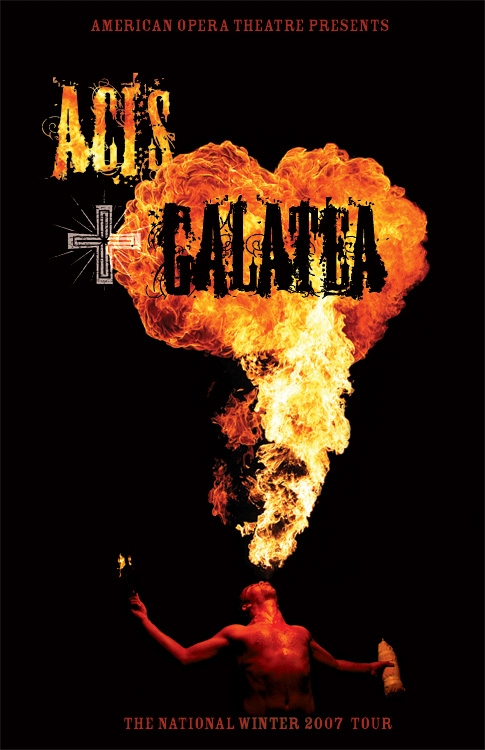
Poster for Acis and Galatea, American Opera TheaterAmerican Opera Theater, the inventive company formerly known as Ignoti Dei Opera, have mounted two interesting productions reviewed here at Ionarts last season. First it was the North American premiere of Cavalli's La Didone, followed by an all-original theater work called Ground that uses 17th-century ostinato bass pieces. Now the newly rechristened company brings us Handel's comic masque Acis and Galatea (1718) in a production that will sound absolutely crazy -- and is at least somewhat crazy -- but that was, once again, of profound interest.

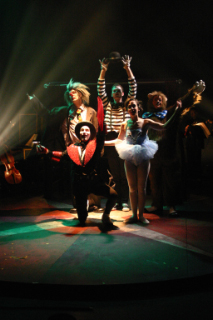
In the original libretto, John Gay, Alexander Pope, and John Hughes (all members of the Scriblerus Club -- not a bad writing team) set the mythological story (used in several other operas) against a background of shepherds and shepherdesses. In this production at Baltimore Theater Project, director Timothy Nelson and lighting and production designer Kel Millionie have recast the music for a group of sideshow misfits -- "a traveling troupe of singing circus folk" as they put it in the program notes. Galatea (soprano Rebecca Duren, who sang a number of roles, including a young boy, in La Didone) becomes a tightrope ballerina, the Trapeze Girl. Her beloved Acis (tenor Aaron Sheehan, who was Enea in La Didone) is a mime in striped shirt and face paint. The cyclops Polyphemus (bass Sumner Thompson) becomes the Sad Clown, with a huge tie, bright red nose, crazy wig, and perpetually sour face.

Other Articles:

Tim Smith, Opera flies high (Baltimore Sun, January 18)

Clayton G. Koonce, American Opera Theater's "Acis and Galatea" (Operatically Inclined, January 20)
In La Didone, the company was lucky to work with soprano Rosa Lamoreaux, who was radiant as Venus. Here, the casting coup was tenor Tony Boutté, a veteran early music singer who has worked with Opera Lafayette and many other groups, who brought experience to the cast as the Ringmaster (transformed from the role of Damon). If we throw in mezzo-soprano Kristen Dubenion-Smith (Hecuba in La Didone) as the Dancing Bear, we get the full five-part chorus that Handel used. The bear was funny in her rotund costume, whiskers, and glasses but sang only in the choral numbers. Saturday night's show was sold out, with the theater having to turn away some interested patrons, and the house was full of kids getting into the circus atmosphere and munching on the free popcorn. At intermission, the cast even helped to sell sodas.

In Ground, the texts that were sung did not match the action on stage, but it was in Italian and no one cared much (including me). Here, the singers declaim in English and the action has even less to do with the libretto. Until the end, that is, when the silliness finally stops and Polyphemus kills Acis with a large rock (well, a pink ball). There is no getting around that tragic ending. I spent the first fifteen minutes or so of the first half thinking that I would leave at intermission. The chorus sings, "Oh, the pleasure of the plains," and Galatea sings, "Ye verdant plains and woody mountains" and "Hush, ye pretty warbling choir." None of this has anything to do with the circus, and at first it all seemed a grotesque distortion of a gorgeous piece of music.

Photo by Greg McLeskey
Cast of Acis and Galatea, American Opera Theater, photo by Greg McLeskey

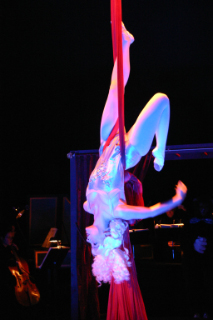
Rebecca Duren as the Trapeze Girl (Galatea), American Opera Theater, photo by Greg McLeskey
Well, at about the point that the Trapeze Girl climbed onto a pair of fabric ropes suspended from the ceiling, it all became irresistibly fun. A while back, I was impressed when Celena Shafer sang a difficult aria in Santa Fe's Lucio Silla while being lifted in the air and dressed in a corseted costume. Some readers may remember Rebecca Duren's gymnastic turns in La Didone: in Acis and Galatea, she sings more than once while suspended in various positions on these ropes, including one passage hanging upside down. Acis and Galatea sing the duet "Happy we! What joys I feel!" while playing on a seesaw and "The flocks shall leave the mountains" while pretending to be on a tightrope, walking toward one another. Acis sings his aria "Love sounds th'alarm" as a lion tamer, with the bear and Galatea pretending to be lions.

There is no point in pretending that this makes any sense. It turns the plot into a muddle and may annoy a viewer who is familiar with the work. However, if you accept that you are not going to be watching Handel's masque, but instead watching something else to the accompaniment of Handel's music, this production is a lot of fun. All of the singing is fine, and in this intimate theater the listener can hear each voice clearly, even in the choral numbers (especially when, at one point, the cast walks up into the seating and serenades individual members of the audience). I have rarely heard an audience laugh out loud this much at the opera.

Remaining performances at Baltimore Theater Project are this Thursday, Friday, and Saturday (January 25 to 27, 8 pm). American Opera Theater will then take the production on tour through the Midwest with performances at the Buskirk Chumley Theater in Bloomington, Ind. (February 7), the Old Centrum Theater in Indianapolis (February 8), the Ruth Page Center for the Arts in Chicago (February 9), and the Marcus Center for the Arts in Milwaukee (February 11).

The next opera production at Baltimore Theater Project will be Benjamin Britten's
Rape of Lucretia, recently discussed at Ionarts, by the Peabody Chamber Opera (February 2 to 4).

18.6.06

Long in the Waiting, Longer Still in the Hearing: Cavalli's Didone Hits Washington

Ignoti Dei Opera's La DidonePier Francesco Cavalli’s La Didone got its North American premiere in Washington over the last three days, nestled away in American University’s pretty and functional Greenberg Theatre. Ionarts promised a little star for your book if you attended; we should offer another one for everyone who sat through the entire opera. If you did, you will have gotten your secco recitativo fill for the year, La Didone’s three-plus hours (after Ignoti Dei Opera’s artistic director Timothy Nelson had mercifully cut some 45 additional minutes) consisting of three-quarters recitative as it does. Baroque audiences were more different than alike us; and they would doubtlessly have experienced and enjoyed the entertainment and novelty that La Didone provides to its patient listeners in a different, perhaps more intense way. Baroque fanatics and musicologists alike must have been spellbound at the production, though: how long has it been since we saw and heard a little orchestra replete with cornettos, lirone, two (!) theorbos, viola da gamba, and the like?

The story is the popular myth of Aeneas (Enea), son of Venus and Anchises, the fall of Troy, his flight, the consequent stopover in Carthage, and the eventual founding of Rome. (Berlioz treats the exact same story in Les Troyens, which, at 5½ hours, feels nearly as long as La Didone.) Aeneas’s story is littered with various women, including Dido (the Didone of the opera’s title), Queen of Carthage, who falls in love (Amor’s intervention helps) with him after he left most of his female family members dead and/or raped in the rubble of Troy. Add insane African kings, assorted gods, children, and old fathers to taste and you are good to go. Librettist Giovan Francesco Busenello does the inevitable (even 300 years before Hollywood), he gives the story a happy end in that Dido does not (successfully) commit suicide.

Other Reviews:

Joe Banno, 'La Didone': A Long, Slow Night at the Opera (Washington Post, June 19)

Charles T. Downey, Going for Baroque in Washington (DCist, June 19)

Tim Smith, U.S. premieres uncover roots of opera's past (Baltimore Sun, June 20)
Stage, costume, and set direction were all in the hands of Ignoti Dei Opera’s founder, Mr. Nelson – who also shared the music direction with harpsichordist Adam Pearl (whom I last heard during the Paris-on-the-Potomac celebrations, and Charles at La Maison Française). For a small company with the consequent financial limitations it is important that good ideas make up for the necessary lack of splendor. With evocative lighting (Kel Millionie) and pointed use of colors (crimson red and white, mostly), the spare sets with screens and backdrops were very effective, often beautifully setting the action. Costumes were simple, modern day dress and worked well enough for this production, too, even if they were devoid of new ideas. Unused to seeing Baroque opera in the U.S. as we are, much less in a modern staging, it didn’t bother that the blatantly symbolic garb (the male, the warrior, in camouflage with boots, the frail father – Anchise – in the latest nursing-home bespoke) smacked of 1980s theater direction.

The orchestra performed beautifully throughout, although one felt for Anna Marsh, the Tambourine-Lady, who got to clap her instrument six, seven times every half-hour, and could have knitted a sweater or two in the time between. On harpsichord and organ, Mr. Pearl led the troupe with seasoned skill that belies his relative youth. The singing, meanwhile, was a different story. To make mention of the proverbial “mixed bag” would be an understatement. There were basically three groups into which they fell: the admirably courageous, the admirably performing, and Rosa Lamoreaux.


available at Amazon
F.Cavalli, La Didone,
T.Hengelbrock et al.
DHM

As Venus, the latter was simply a cut above the rest of the cast. Scott Elliot, in various roles, provided a nice bass and even better, well-judged and appropriately over-the-top acting. Emily Noel, as Creusa (Enea’s wife) and Anna (Didone’s sister), was very fine and arguably the best of the non-Lamoreaux singers. Aaron Sheehan’s tenor for Enea was variable but compared nicely to the other male voices, always good for a pleasant surprise here or there and admirable for his stamina, never mind learning all that text for a role that he won’t revive very often over the course of his future career. Rebecca Duren as Ascanio, Amore, and one of Didone’s girlfriends was the most versatile singer on stage. Her portrayal of Ascanio, the son of Enea, was so eerily on target (including the voice, which she was able to make sound like a treble’s), that I had to check the cast list to makes sure she was not in fact a little boy. Her training in dance and the ability to squeeze a casual cartwheel into her performance only enhanced matters. Bonnie McNaughton, the soprano who was Cassandra and Didone, too, was in the category of those that pleased – and not just for her ravishing appearance. Little wonder that countertenor Brian Cummings went – literally – nuts for her. His performance, sadly, was not his best on Friday; at times he did not even seem to be at home in the role of countertenor. That vocal region, usually the prerogative of frustrated or failed baritones, didn’t suit him as much as when he broke into full voice in the upper tenor regions. One good recitative (on ‘women and lies being but twins’) showed that he can do better. Kristen Dubenion-Smith had fine moments – as Hecuba, Queen of Troy, more so than “Dama,” one of Didone’s playmates. Tenor Jeffrey Rich (Anchise, Cacciatoro, Sicheo) did not have much to do but did that well. Elizabeth Baber (Fortuna, Juno, “Dama”) hid a good voice under the hazy veil of an insufficiently trained instrument.

With a more even cast and an opera that is more interesting to the music lover’s ear than to the scholar’s research (how I would love to hear a Lully work or Vivaldi’s La verità in cimento) Ignoti Dei Opera might even better fill that gaping Baroque opera void in Washington, and one wishes them all the experience, luck, and donations they need to continue to grow into their ambitious plans.


14.6.06

Dido, Queen of Carthage

Rosa Lamoreaux, sopranoI raved about one of those neglected 17th-century opera composers, Antonio Caldara, when Cecilia Bartoli brought her Opera Proibita recital to Washington. Another prolific composer whose operas are now mostly forgotten is Francesco Cavalli ( Pietro Francesco Caletti-Bruni; he took the name of the noble patron who brought him to Venice as a teenage singer). We owe most of the authoritative information we know about him to three musicologists, Lorenzo Bianconi, Jane Glover, and Ellen Rosand.

This weekend, Washingtonians will have the rare opportunity not only to hear a live performance of one of this great composer's complete operas, La Didone (Teatro S. Cassiano, 1641) but also to see it in a full staging with Baroque orchestra. Any fan of opera or early music is hereby charged, in the name of the Ionarts honor code, to make it to one of the three performances this weekend (June 16 and 17, 8 pm; June 18, 2:30 pm), at American University's Harold and Sylvia Greenberg Theatre. The production will feature members of the pride of Baltimore, Ignoti Dei Opera Company, with a cast of fine singers, including D.C. favorite Rosa Lamoreaux in the role of Venus.

Poor Dido's story comes from the first four books of The Aeneid (see also John Dryden's classic English translation). Her tragedy, as with all things in ancient Greece and Rome, was the fault of the gods. Venus sent Cupid to make Dido love Aeneas, who was washed up on the shores of Carthage. As Virgil recounts in The Aeneid, Aeneas leaves Dido once he is well again, and the queen, distraught, kills herself (Book IV). That was the crucial part of Dido's story, told also by Ovid in his perplexing work Epistulae Heroidum, known in English as the Heroides, letters from mythological heroines to their unfaithful lovers. The seventh letter is Dido Aeneae (see also James M. Hunter's English translation). Cavalli's La Didone, set to a libretto by Giovan Francesco Busenello, is the first of many operatic adaptations -- Purcell's Dido and Aeneas (1689), Metastasio's Didone abbandonata (set to music by Porpora, Handel, Jommelli, Piccinni), Berlioz's Les Troyens (1858) -- not to mention Christopher Marlowe's play The Tragedy of Dido Queene of Carthage (1594).

Available at Amazon:
available at Amazon
Francesco Cavalli, La Didone, Yvonne Kenny, Judith Howarth, Thomas Hengelbrock, Balthasar Neumann Ensemble (released on September 10, 1998)
I confess that the only music I have heard before, I think, are the excerpts played by some of the musicians at a press roundtable introducing the production on Monday, at the Istituto Italiana di Cultura. The opera has been performed in a few places since the 1950s but is hardly common. What I heard was the best of what early 17th-century Italy had to offer in the lament of Cassandra (Act I) and the first lament of Dido (Act III), sung by a beautiful Bonnie McNaughton with an affecting, rose-hued soprano voice. The tall and dulcet-voiced tenor Aaron Sheehan gave an equally fine impression of his role, Aeneas, with the lullaby he sings to try to make Dido go to sleep before he slips out the door. Finally, countertenor Brian Cummings sang part of Iarbo's duet with McNaughton, from the end of the opera, when he prevents Dido from committing suicide. This opera, thanks to the unavoidable convention of the lieto fine, rewrites Virgil so that Venus cleans up the mess she created (highly unlikely) and Didone and Iarbo are united in joyous marriage. The orchestra will include strings, cornetti, and in the continuo group, viola da gamba, lirone, harpsichord, organ, theorbo, and guitar, presumably in various combinations.

There is, to my surprise, a complete recording, made from a live performance based on a significantly altered version of the libretto. Given the fact that the title role in this recording is none other than Yvonne Kenny, we could expect blogger Sarah Noble to have a post about it, comparing La Didone and Dido and Aeneas, at Prima La Musica, Poi Le Parole (March 15, 2006). Depending on how much I like the opera this weekend, I may be writing a review about the recording myself in the near future. Please, dear readers, go and hear La Didone so I have someone to argue with.