CD Reviews | CTD (Briefly Noted) | JFL (Dip Your Ears) | DVD Reviews
Showing posts sorted by relevance for query "ionarts in santa fe". Sort by date Show all posts

19.7.06

Preview: Santa Fe Opera, Summer 2006
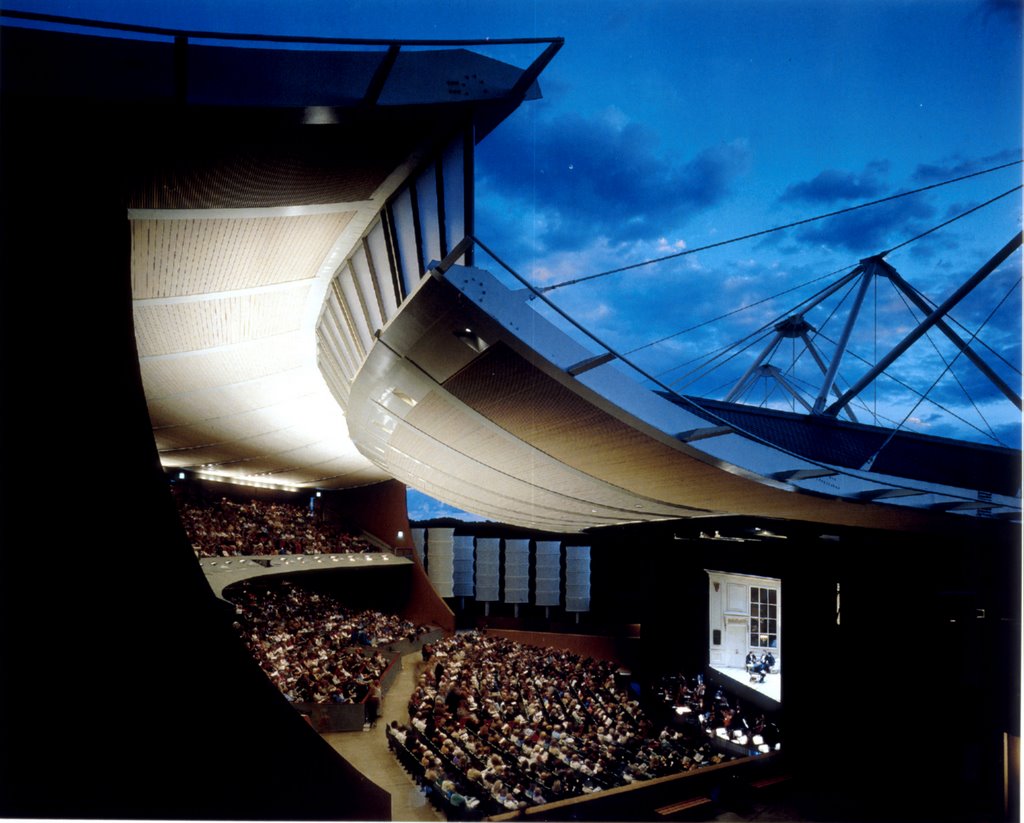
Santa Fe Opera, photo by Robert ReckIn 1957, John Crosby realized what must have seemed like a nutty idea, to build a major American cutting-edge opera company, not in New York but in the New Mexico desert. To this day, Santa Fe Opera remains the premiere summer opera destination in the United States: the oldest is Central City in Colorado, and the best newcomer is probably Opera Theater of St. Louis (founded by Richard Gaddes, one-time Artistic Administrator under John Crosby at Santa Fe, and now back in Santa Fe as General Director). It certainly does not hurt that Santa Fe is such a desirable place to visit, steeped in the multifaceted history of the southwestern United States, amid numerous sites treasured as holy by members of the Pueblo tribes. Even now, in spite of the kitschy shops and the casinos, the place feels close to the gods.

In my posts from Santa Fe last summer, I remarked on the Santa Fe programming formula: two operas from the mainstream repertory (Turandot, Barber of Seville), a new and interesting production of a lesser-known work by a famous composer (Lucio Silla), a 20th-century masterpiece (Peter Grimes), and a premiere (Ainadamar). It doesn't hold true for every season at Santa Fe, I think, but it does appear to match this year's exciting season. As I said before, my only complaint is that I wish they would have a slot for a Baroque opera and invite one of the leading Baroque ensembles (Les Arts Florissants, Les Talens Lyriques, and Le Concert Spirituel leap to mind) to come for the summer. I will almost get my wish in the 2007 season, with Rameau's Platée to be conducted by Harry Bicket.

Last Season at Santa Fe:

Ionarts at Santa Fe Opera (July 23, 2005)

Mozart, Lucio Silla (July 21, 2005)

Rossini, Barber of Seville (July 23, 2005)

Britten, Peter Grimes (July 24, 2005)

Golijov, Ainadamar (August 2, 2005)
First, Santa Fe is mounting a new production of Bizet's Carmen directed by Lars Rudolfsson, who has updated the Spanish setting to the Franco era. The casting is first-rate, with Anne Sofie von Otter in the title role, William Joyner as Don José, and apprentice Jennifer Black in my favorite role, Micaëla. At the time I will be hearing the opera, in August, Laurent Naouri -- who is another singer I am looking forward to hearing -- will replace David Pittsinger as Escamillo. As for the other chestnut, definitely high on my list of most anticipated Santa Fe experiences, it is the new production of Mozart's The Magic Flute directed by Tim Albery, mostly because Natalie Dessay will sing her first Pamina at Santa Fe. Heather Buck, who sang in Washington last as Stella in A Streetcar Named Desire, is the Queen of the Night.

You may recall that I enjoyed a regional production of Massenet's Cendrillon. It is one of the operas that Massenet composed after meeting American coloratura soprano Sibyl Sanderson, although unlike Esclarmonde and Thaïs the coloratura role in this opera (La Fée) was not created specifically for her. The fairy godmother has some of the most exciting music, a deliciously appropriate use for the coloratura voice -- think Tinkerbell. Sadly, we will not hear Santa Fe alumna Celena Shafer, who is taking a break from performing these days, as La Fée (she was a sensation in Lucio Silla last season at Santa Fe and in Esclarmonde here in Washington), but a promising young Cuban-American soprano named Eglise Gutierrez. Joyce DiDonato as Cinderella and a production by Laurent Pelly with dancers from Aspen Santa Fe Ballet are the headlines.

The news gets better, because Strauss is back at Santa Fe. Strauss's operas were a favorite of John Crosby's, and this summer we will hear the early 20th-century shocker Salome in a new production directed by Bruce Donnell. (I wish I could have combined my trip to Santa Fe's Salome with a trip to Tanglewood for James Levine's return to the podium with Elektra.) Janice Watson takes up her third Strauss role at Santa Fe as Salome, with Greer Grimsley as Jokanaan and Ragnar Ulfung as Herod.

Finally, Santa Fe has introduced an incredible number of new operas to the American public. That tradition continues this summer with the American premiere of The Tempest (2004, Covent Garden) by Thomas Adès. (That particular Shakespeare play was already adapted in a libretto by Andrew Porter for another premiere at Santa Fe, John Eaton's The Tempest, in 1985.) Some of the singers from the London premiere will be in the Santa Fe version (Cyndia Sieden in the breath-taking coloratura role of Ariel, Toby Spence as Ferdinand, and others), with William Ferguson instead of Ian Bostridge as Caliban. Alex Ross called the opera "a masterpiece of airy beauty and eerie power" in The New Yorker, and Andrew Clements said that there are "moments in all three acts which are by any standards sheerly, heartstoppingly beautiful" in The Guardian. In short, yes, I am looking forward to hearing it.

UPDATE
Ionarts in Santa Fe:
The Tempest | Cendrillon | Carmen | The Magic Flute | Salome

Newspapers:
Hugh Canning (London Sunday Times, August 13)
Scott Cantrell (Dallas Morning News, August 12)
William Littler (Toronto Star, August 11)
James R. Oestreich (New York Times, August 5)
5.8.06

Ionarts in Santa Fe: Salome

And so ends another year for Ionarts at Santa Fe Opera, with Richard Strauss's Salome (1905), a work that along with Debussy's Pelléas et Mélisande (1902) set the tone for opera in the 20th century. Both adapted famous works of literature from the late 19th century, made famous by their controversial style and content. Opera as a genre would never be the same. Strauss was one of SFO Founder John Crosby's favorite composers, and over the course of its 50-year history, Santa Fe Opera has mounted 13 of his 15 operas (only Guntram and Die Frau ohne Schatten are on the To Do List), five of them for the first time ever in the United States.

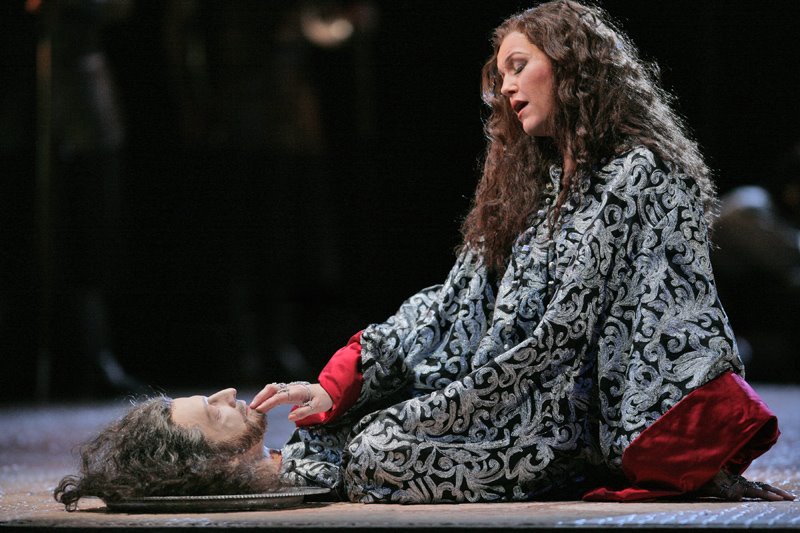
Janice Watson with Jokanaan's head, Salome, Santa Fe Opera, photo by Ken Howard © 2006
Janice Watson with Jokanaan's head, Salome, Santa Fe Opera,
photo by Ken Howard © 2006
Strauss had fallen out of regular performance at Santa Fe in recent years, but Stravinsky has fared much worse: since the 1970s, there has been only The Rake's Progress and that only twice, in 1981 and 1996. I was surprised to learn that Salome is the most performed Strauss opera at Santa Fe, with ten performances: I would have guessed Der Rosenkavalier, which is in second place with five. This year's production of Salome fell short of my expectations, sad to say. I was frankly puzzled by the audience's reaction, which was an unusual amount of laughter, at some of the least appropriate moments. Perhaps it is a sign of how social taboos have changed in the 100 years since Strauss first shocked the world with his operatic adaptation of Oscar Wilde's scandalous play. It is now apparently funny that Salome's motivation for causing John the Baptist to be executed was thwarted sexual desire. On the other hand, laughter is often a way to express discomfort.

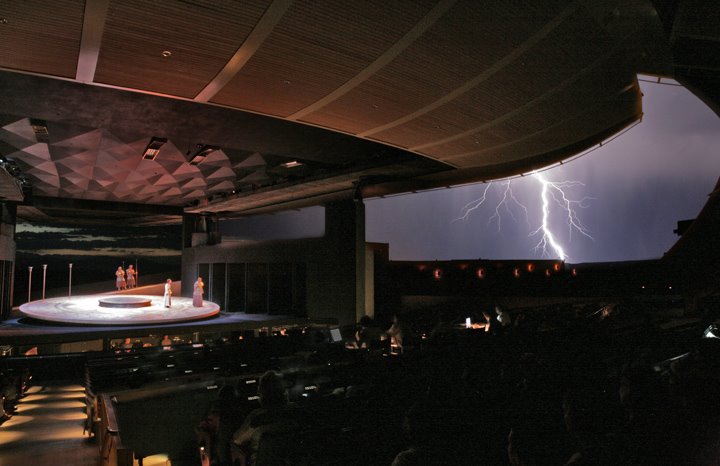
Salome, Santa Fe Opera, with natural lighting, photo by Ken Howard © 2006
Bruce Donnell directed a bare-bones staging, with almost non-existent sets and traditional, even stereotypical costumes designed by Neil Patel. The action took place on a steeply raked circle around the cistern where Jokanaan (John the Baptist) is held prisoner, the hole covered by what looked like a large salt shaker lid. There are torches to one side, the back of the theater is open to the vista of the Jeméz Mountains, and Herod and Herodias sit on something like director's chairs, brought in as they enter. Little changes for the nearly two hours without intermission. As in the superb photo shown at right, graciously offered to Ionarts by photographer Ken Howard, flashes of lightning in the distance added some much needed visual diversion.

Although there is little to suggest the decadence of this court and the incestuous depravity of this family, the score and libretto communicate it still quite forcefully. Perhaps the shocking indecency of the story would be more acidic, less likely to provoke laughter, if it were updated to, say, the setting of Desperate Housewives. A brazen teenage Britney Spears takes advantage of her lecherous and wealthy stepfather's lust for her to have a holy man put to death, only to kiss his decapitated head. On second thought, that is a terrible idea. The story is grotesque enough just as it is.

Janice Watson as Salome and Greer Grimsley as Jokanaan, Salome, Santa Fe Opera, with natural lighting, photo by Ken Howard © 2006
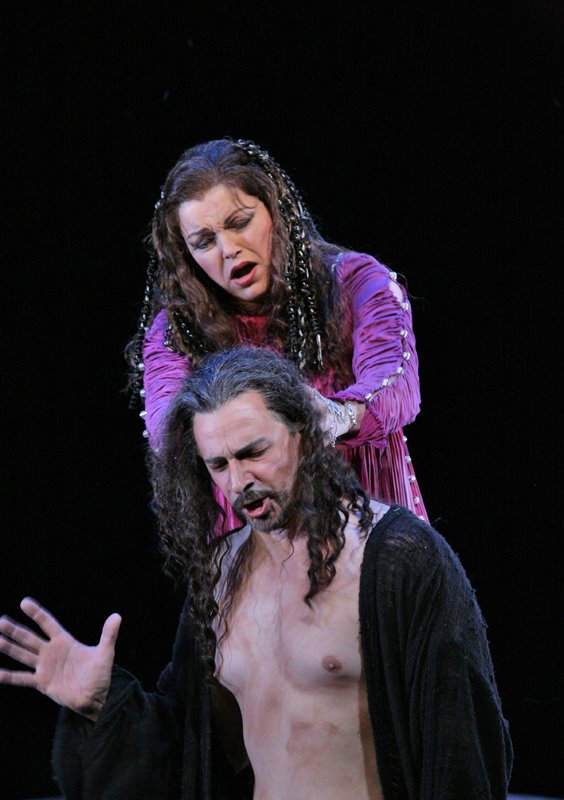
The best singing of the evening came from Greer Grimsley, who was well received last summer in the Seattle Ring. He was commanding, apocalyptic, and august of voice as Jokanaan, resonant enough to be heard quite well even from inside the cistern. I know that Salome sings a lot about Jokanaan's white body, but I don't think it requires him to be costumed bare-chested, as Grimsley was here. In fact, to be true to the story in the Gospels, Jokanaan would probably look pretty much like hell warmed over, after living on grasshoppers in the wilderness and then rotting in Herod's prison. By comparison, English soprano Janice Watson was slightly underpowered in the title role, although she sang with incision and stridency on some of the highest notes. It is sometimes a necessary trade-off in casting Salome to sacrifice some of the vocal power needed to rise above the orchestra, out of concern for the physical demands of the role. Sadly, Watson was mostly awkward in the extended Dance of the Seven Veils, stripping down to seminudity as she knelt down in front of Herod, to be quickly covered in a robe by two servants.

Tenor Ragnar Ulfung has been a regular at Santa Fe Opera for 40 years, and casting him as Herod this year was a touching tribute to a man who first sang the role in Santa Fe in 1967. (You are mostly likely to have seen Ulfung as Monostatos in Ingmar Bergman's unforgettable film version of The Magic Flute.) That's a lot of water under the bridge, and it is hardly a surprise that his performance was often more like Sprechstimme than a Straussian role, imprecise and strained. English mezzo-soprano Anne-Marie Owens, reprising the role of Herodias from the 1998 Santa Fe production, was a potent, shrewish wife. The supporting cast was good, with particularly fine performances from tenor Dimitri Pittas as Narraboth and Andrea Silvestrelli (also Sarastro in this summer's Magic Flute) as the Cappadocian. Conductor John Fiore led the orchestra in a full-throated performance, surely not the full 105-instrument orchestration that Strauss originally penned. All the powerful sounds were there, including those thrilling trumpet statements of Jokanaan's dominating theme and the solo cello's cricket chirping as Salome listens to the silent execution and waits for the Baptist's head.

I am thrilled that Strauss appears to be back in Santa Fe, with the company's fourth mounting of Daphne on the calendar for next summer. I hope to hear a lot more Strauss over the next 50 years at Santa Fe Opera.

6.8.09

Ionarts in Santa Fe: 'La Traviata'


Natalie Dessay (Violetta, center) and cast in La Traviata, Santa Fe Opera, 2009 (photo by Ken Howard)
It is press week at Santa Fe Opera, and that means that Ionarts is back in the house that John Crosby built. I sat just behind librettist Terry Teachout and composer Paul Moravec for the third performance of their new opera The Letter on Monday night, but since I have the luxury of hearing another performance of the work later tomorrow night, I am holding my review for further thought. The hottest ticket at Santa Fe this year has been Natalie Dessay's debut in the role of Violetta, in a staging of Verdi's La Traviata by Laurent Pelly and his team (see the online score). The company's general director, Charles MacKay, told me this morning (an interview is forthcoming) that the demand for La Traviata was so great that they could have filled the house for three or four more performances. Dessay enjoys her visits to Santa Fe enough that she and her family have purchased a home here, and she has chosen the company for role debuts before, Pamina in 2006 and her first American Amina in the 2004 La Sonnambula.

Not surprisingly, Dessay's voice has not been the same since undergoing surgery to repair vocal nodes. The tone has more complexity while the stunning stratospheric possibilities have contracted slightly (there were a few clicks of empty air in some of the high notes on Tuesday night), meaning that Dessay has moved away from the coloratura roles of her earlier career into other music, like her relatively successful foray into Bach this year on disc. Whatever anyone may have thought about Dessay's voice, it was never going to be an ideal Violetta, without more real power at the top and some general meat on the bones in the middle and low ranges, too.


Laurent Naouri (Germont) and Natalie Dessay (Violetta) in La Traviata, Santa Fe Opera, 2009 (photo by Ken Howard)
With help from conductor Frédéric Chaslin's radical dynamic control of the orchestra, Dessay compensated for these problems by creating a flirtatious, frivolous Violetta who succumbs to more internal melancholy than external suffering. She told the New York Times interviewer that "the thing that I have trouble with is this need for redemption she has. I have to find a way to make it believable. I have to find a way to work on the guilt." Perhaps as a result, her Violetta was compressed (one of the softest outbursts of "Amami, Alfredo!" ever to reach my ears, for example), idiosyncratic in terms of tempo fluctuations, and shining most on the runs and fioriture that sometimes suffer with a more dramatic soprano, but unable to rise above the amassed chorus at the end of the second act.

Perhaps to go with this characterization, director Laurent Pelly and his team created a minimalistic, even drab staging. Chantal Thomas's set consisted of countless, haphazardly arranged metallic gray rectangular slabs (packing boxes? sarcophagi?), connected by staircases of various sizes as in an Escher drawing. Overall it was ascetically sparse, serving as both party scene and, covered with drop clothes, the shuttered apartment for the final act, while a swath of green grass brought in from one side evoked the country home of the second act. Even the costumes, by Pelly and associate designer Jean-Jacques Delmotte, were mostly starved of color, after the flapper hot pink in which Dessay opened the opera, with a memorable ululation recalling an Offenbach can-can girl (or, because of the bright orange hair, Cyndi Lauper just wanting to have fun). It was a far cry from the Pelly team's previous outings at Santa Fe, a technocolor Platée in 2007 and a luxurious, fairy-tale Cendrillon in 2006.


Natalie Dessay (Violetta) at the conclusion of La Traviata, Santa Fe Opera, 2009 (photo by Ken Howard)
In his Santa Fe debut Albanian-born tenor Saimir Pirgu brought a voice more light and airy than heroic to the role of Alfredo, a schoolboy poet more than a Romantic heavyweight. He was more than a few times behind the beat of Chaslin, who tended toward quick tempi, and the high notes were small and sometimes off pitch. The most robust voice of the principals was the Germont of Laurent Naouri, whose gruff baritone had enough kick when he needed it but was not always at a roar like others in the role. (Germont's beard and shining top hat may have been modeled on Giovanni Boldini's famous portrait of the elder Verdi.) Current and former apprentices filled out most of the supporting cast, with the fetching Emily Fons standing out as Flora and the versatile Tom Corbeil (more on him later in the week) as the Marquis d'Obigny. Wagne Tigges was a particularly stentorian Baron Douphol, an arrogant foil to Alfredo.

Other Articles:

George Loomis, Santa Fe Opera, New Mexico (Financial Times, August 10)

Scott Cantrell, 'La traviata' refreshed but disjointed at Santa Fe Opera (Dallas Morning News, August 7)

Lawrence A. Johnson, Hyperactive Dessay upstages Violetta in soprano’s “Traviata” debut (South Florida Classical Review, August 7)

Allan Kozinn, Heroines Sing Amid a Landscape of Boxes and an Egg of a Temple (New York Times, August 6)

Anne Midgette, In Santa Fe, Concepts Without Connections (Washington Post, July 27)

Kyle MacMillan, "La Traviata" triumphs in Santa Fe (Denver Post, July 12)

Photo Journal: Dessay and Pirgu Star in Santa Fe Traviata (Playbill Arts, July 9)

John Stege, L'Amour to La Morte (Santa Fe Reporter, July 8)

Mike Silverman, Dessay takes on Verdi's Violetta for 1st time (Associated Press, July 6)

Craig Smith, 'La Traviata' opens SFO season with power, passion (Santa Fe New Mexican, July 4)
The divertissement in the second part of Act II was handled by the chorus, with only two actual dancers in a comic pantomime (returning in the third act to grope their way suggestively across the stage as the carnival music is heard outside Violetta's window), the women standing on the boxes in fashion gowns like mannequins and the men singing as the matadors. It was a curious misstep to have the chorus sway in time in the Act II finale, where there is not really any mention of dance in the libretto. Even worse, the chorus milled around the stage distracting from the exquisite music that introduces the third act, the men covering the boxes with cloth and the women ritually stripping Violetta of her jewelry and fine clothes. Pelly opted to make the somber, funereal nature of this music clear by staging Violetta's burial procession across the stage in the prelude to Act I, when it is first heard, with Alfredo observing at a distance. Only then did those strange metallic boxes most seem like the variously sized mausolea of a Parisian cemetery like Père-Lachaise.

In so many ways it was a quiet, even gentle La Traviata, which might disappoint someone who loves a more conventional version of this opera. The whole experience, staging and music, had a veiled, ambiguous quality I associate less with La Traviata than with something like Debussy's Pelléas et Mélisande (speaking of which, I am putting in my request for Dessay to bring her recently acquired Mélisande to Santa Fe, which last mounted it in the 1970s). Even the shattering ending of the opera was deadened emotionally by having all of the other characters back quietly off stage as Violetta began her final speech, her brain starved of oxygen and making her believe that she is well again. As she sang out her final high note, Violetta collapsed on the stage, alone in death.

This production of La Traviata will be repeated five more times at Santa Fe Opera, through August 29. At the final three performances (August 22 to 29) Anthony Michaels-Moore replaces Laurent Naouri as Germont and Nicholas Pallesen fills in as Baron Douphol.

7.8.09

Ionarts in Santa Fe: 'Alceste'


Christine Brewer (Alceste, front) and cast in Alceste, Santa Fe Opera, 2009 (photo by Ken Howard)
At the start of my meeting with Charles MacKay, General Director of Santa Fe Opera (interview forthcoming), I joked that it would be fine with me if the company replaced its annual tradition of a Mozart opera with an opera by Christoph Willibald Gluck (1714-1787) instead. We have had precious few opportunities to review Gluck's operas over the years, on stage or otherwise, but his operas are not only very important in the history of the genre's development -- his reform-minded ideas about opera were a major influence on Wagner, for example -- but also universally beautiful. Prior to this year's production of Alceste, heard on Wednesday night, Santa Fe Opera has mounted only one of Gluck's operas (Orfeo ed Euridice, 1990). During our interview, MacKay told me that soprano Christine Brewer has been talking to him about the possibility of singing in a production of Alceste for some ten years at Opera Theater of St. Louis. MacKay, who cast Brewer in her first solo role when he was general director of OTSL, was only too happy to be able to help make it happen in Santa Fe.

Gluck and his librettist, Ranieri de Calzabigi (1714-1795) -- a composer-librettist partnership on par with Mozart-Da Ponte or Strauss-Von Hoffmannsthal -- aimed to undo the anti-dramatic conventions of opera seria, set in place largely by Metastasio. Their reform has its roots in the academic origins of opera, the attempted recreation of ancient Greek tragedy. For that reason Gluck's operas lend themselves well to a sort of ritual staging, shown so effectively in Robert Wilson's gestural production of Orphée et Eurydice. Director Francisco Negrin went in a similar direction, setting his Santa Fe Alceste in a Thessaly of barren stone walls, haunted by masked, demon-like immortals (sets and costumes by Louis Désiré). In front of a temple dominated by the obsessive image of a large, all-seeing eye, the chorus commented on the action, making stylized emotional gestures right out of the Peter Sellars playbook (Mr. Roboto movements by Spanish choreographer Ana Yepes). The choreography was a mixture of classical ballet and the jerky blockiness and male-female inversions reminiscent of Mark Morris.


Tom Corbeil (Oracle, left), Matthew Morris (Apollo, top), and Christine Brewer (Alceste, right) in Alceste, Santa Fe Opera, 2009 (photo by Ken Howard)
The mythological story that underlies Calzabigi's original Italian libretto was drawn from the play Alcestis by Euripides. It concerns one of the many miracles accomplished by Hercules (on the way to his eighth official labor), in which he helped to rescue Alcestis, the virtuous wife of Admetus, from the underworld, where she had gone by choice, sacrificing her life for husband's. The libretto's happy ending, by which Alcestis and Admetus are made immortal as a model of perfect marital love, is undone by Negrin's staging. The powers of the underworld, portrayed by Yepes and six other dancers, plus the versatile Tom Corbeil, so inhuman in their white face makeup with blackened eyes, looked like members of the band KISS had been colonized by the Borg ("Resistance is futile -- prepare to rock and roll all night and party everyday"). They were omnipresent, moving menacingly during most of Alceste's arias and even claiming the mortals at the conclusion, by wrapping them in a black banner bearing the words "La mort." This is an unfortunate example of a director utterly missing the point: perfect fidelity is ennobled by the gods, not destroyed.

Christine Brewer, Alceste excerpts:
available at Amazon
Vol. 1


available at Amazon
Vol. 2

Alceste was the second of Gluck's reform operas (see this piano-vocal score), premiered in Vienna in 1767 and then adapted in a 1776 French version for Paris, where Gluck followed his former student, Marie-Antoinette, when she married King Louis XVI. This version, with a revised French libretto by Leblanc du Roullet and some major changes to the music, is generally thought to be better and is usually chosen for performance, although it is sometimes translated back into Italian. Santa Fe, quite wisely, chose the French version and kept it in French. In the modern era, Alceste's gorgeous arias have attracted many great sopranos who have used their star power to insist on stagings of the entire opera: Kirsten Flagstad, Maria Callas, Eileen Farrell, Jessye Norman, Catherine Naglestad, and most recently Deborah Voigt, who will probably star in her own staged production soon. Christine Brewer sang the role with vitality, warmth, and shattering power, a resplendent earth mother of opulent potency. It might not be the optimal type of voice for Gluck, but all of the details were there, with more than enough expansive élan on the high notes of Divinités du Styx and a luscious, long-breathed legato in the slower pieces.


Tom Corbeil (The Infernal God) and Paul Groves (Admète) in Alceste, Santa Fe Opera, 2009 (photo by Ken Howard)
Paul Groves was a heroic, dynamic Admète, in keeping with the optimal recording of the work, where he costars with Anne Sofie von Otter under the baton of John Eliot Gardiner. In addition to his strong, even singing, Groves even joined in with the dancers in Act II and was pinned to the wall by them in Act III. Among the supporting cast, apprentice singer Matthew Morris distinguished himself with a resonant baritone as Apollo, but bass Tom Corbeil stood out head and shoulders above the others, singing well in the roles of the Oracle and the Infernal God: until he sang, however, one easily mistook him for one of the dancers, so convincingly did he move like them, after some intense study with the choreographer. The French version eliminates the roles of Alceste's children (they became mute parts in Santa Fe) but adds parts for the high priest (a stately Nicholas Pallesen) and Hercules (a particularly strong Wayne Tigges).

Other Articles:

George Loomis, Santa Fe Opera, New Mexico (Financial Times, August 10)

Sarah Bryan Miller, Singer Christine Brewer is back from injury — and "rollin' " (St. Louis Post-Dispatch, August 9)

Scott Cantrell, Santa Fe Opera's 'Alceste' makes a simple story tiresome (Dallas Morning News, August 8)

Photo Journal: Christine Brewer is Alceste in Santa Fe (Playbill Arts, August 7)

Allan Kozinn, Heroines Sing Amid a Landscape of Boxes and an Egg of a Temple (New York Times, August 6)

John Stege, It's the Music (Santa Fe Reporter, August 5)

Lawrence A. Johnson, Fine cast, glitzy production provide mixed rewards in Santa Fe’s “Alceste” (Chicago Classical Review, August 3)

Craig Smith, Lustrous music saves 'Alceste' (Santa Fe New Mexican, August 2)
Romain Rolland noted in his essay on Gluck's Alceste that, after the failure of the Paris production, Gluck spoke with his friend, the printer Corancez, about his disappointment. Alceste, he said, is a work "stamped with the truth of nature," not the kind of work "to give momentary pleasure or to please because it is new. Time does not exist for it, [and it] has nothing whatever to do with fashion." Rolland also took note of the weakness of the third act (it repeats some of the earlier material and has a weak resolution), which was also borne out by the Santa Fe production. It is essential with Gluck's operas to keep the ballet music, and this staging found an ideal solution to that problem, if perhaps making the dancers too important. The orchestra played beautifully, although the slightly mushy beat of conductor Kenneth Montgomery, stronger in Mozart last year, made the coordination between pit and stage tricky. The musicians played on modern rather than historical instruments, although sounds of harpsichord and (was it?) transverse flute were heard. One could imagine stronger renditions of the work, but for me this was one of the highlights of the Santa Fe Opera season.

Santa Fe Opera's production of Alceste will be repeated only three more times, on August 10, 14, and 19.

30.7.06

Ionarts in Santa Fe: The Tempest

Also on Ionarts:

Ionarts in Santa Fe: The Tempest Revisited (August 3, 2006)

More on "The Tempest" (July 30, 2006)

The Tempest (July 29, 2006)

Preview: Santa Fe Opera, Summer 2006 (July 19, 2006)


Other Reviews:

Craig Smith, Ades brings telling sea change to 'Tempest' (Santa Fe New Mexican, July 31) [The cranky comments on this article are not to be believed.--Ed.]

J. A. Van Sant, Strong Tempest at Santa Fe (Opera Today, July 31)

Scott Cantrell, New take on 'The Tempest' (Dallas Morning News, August 4)

James R. Oestreich, Santa Fe Opera Offers Love on a Stormy Island (New York Times, August 5)
Joshua Kosman, Thomas Adès' American premiere of 'Tempest' opera is a magical marvel of sound (San Francisco Chronicle, August 5)
The plays of Shakespeare may seem like the perfect sort of dramatic work for operatic adaptation, with memorable characters, moments of grand expression, and marvelous scope of setting. There are basically two models for past success: Verdi's late masterpieces, which are distant from their sources because the libretti are in Italian; and Britten's A Midsummer Night's Dream, the best example of a Shakespeare opera in English, which uses the original text almost verbatim. The main drawback in The Tempest, the 2004 opera by British composer Thomas Adès, is that it is in English, but the retelling of the story in simpler language reads and sounds sadly like Shakespeare's homespun cousin. After a few days before the first performance of the opera, now in its American premiere at Santa Fe Opera, spent reading and studying Shakespeare's play again, the lightly rhymed, short-lined libretto by Meredith Oakes was a disappointment.

Shakespeare's play is a confusing aesthetic experience. It is a complicated story that does not necessarily leave you with any clear message. By removing its subtleties, the libretto also bleaches out most of the interest. You will not recognize Shakespeare's characters in the operatic version. Prospero is no longer the omnipotent thaumaturge: in Shakespeare, he directs Ariel to bring Ferdinand and his daughter, Miranda, together and is happy to see love blossom between them, having already announced his plan to see his child married to the son of his mortal enemy. In the opera, Prospero is helpless to stop the two young people from falling in love, and it seems to be against his plans.

Ariel is not explicitly a male spirit, but the possessive pronoun applied by Shakespeare is "his" instead of "her," while Adès and Oakes cast Ariel as one of the most striking coloratura roles ever conceived for the stage. The host of other spirits in the masque scenes of Shakespeare's plays almost disappear in the opera, to be replaced by a chorus identified as "The Court," a host of well-heeled people who land on the island with Antonio, Sebastian, and Gonzalo. The opera enhances the roles of Prospero's enemies, while diminishing the characters at the center of the play. Nothing happens in Shakespeare's play without being part of Prospero's ultimate plan, while in the opera the action seems to overwhelm Prospero, leaving Ariel and Caliban the apparent victors, in possession of the island.

The Tempest, Santa Fe Opera, set and costumes designed by Paul Brown, photo by Ken Howard © 2006
The Tempest, Santa Fe Opera, set and costumes designed by Paul Brown,
photo by Ken Howard © 2006
Nevertheless, while I think that there are better ways to adapt The Tempest as an opera, Adès has composed something that deserves to be remembered, recorded, and performed widely. The score is paced very well, never dragging and always creating interest for the listener. Each act is more or less one continuous scene, although there are a few sections we might call arias and ensemble pieces that are set off by changes in style. At the symposium I attended on the morning of the premiere, the moderator asked Adès if he was most attracted by or sympathized with any one particular musical style or –ism; he paused for a well-timed moment, leaning toward the microphone, and said very dryly and to much laughter, "No." The Tempest veers between thorny dissonance (in the opening storm scene) and lush consonance (Ariel's agonizingly beautiful aria "Five fathoms down"), between contrapuntal complexity (the Act III sextet) and diaphanous orchestration (the clanging, sonorous masque scene). One could suggest similarities with the work of other composers, but this young composer (b. 1971) has found a unique voice, making such comparisons beside the point.

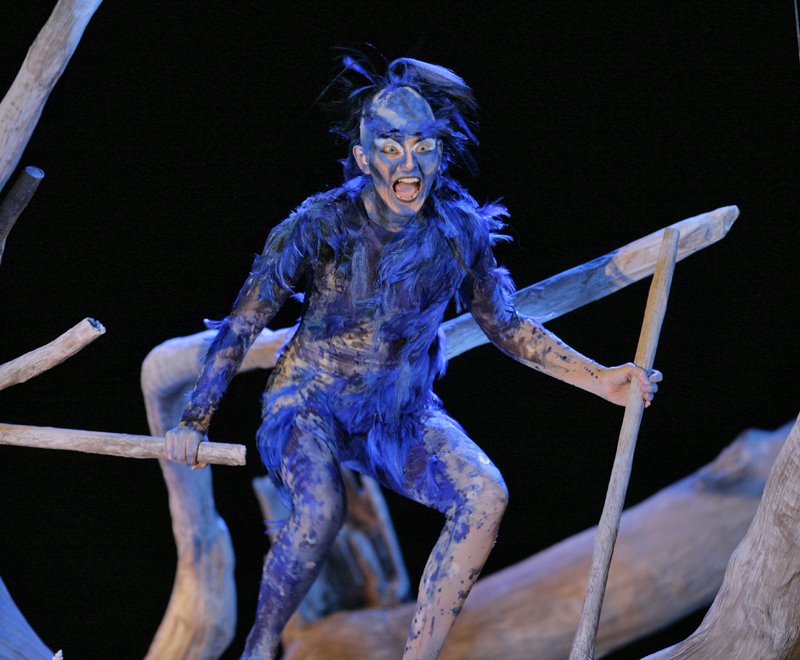
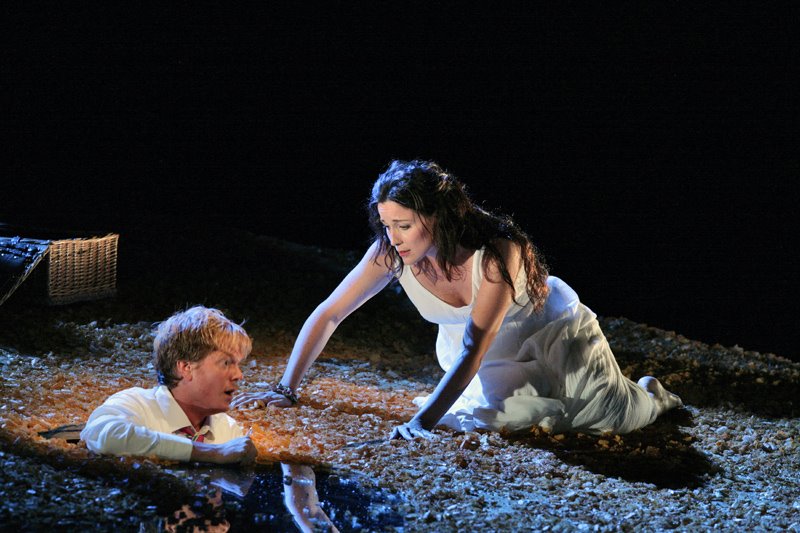
Director Jonathan Kent and set/costume designer Paul Brown wanted to flood the orchestra pit, a plan that was, wisely, not approved. They did incorporate a small pool of water at the front of the stage. In the dissonant eponymous storm that begins the opera, the chorus members of the Court rise up from an opening and pass through the pool, walking like zombies out of the water and across the yellow sand of the island. The basic set does not change through the opera's three acts, a raked island covered with yellow material that shines brightly under the lights. Several trap doors allow characters to sink into the island, as if in quicksand, or rise out of it, as Ariel does on a ladder. A large, leafless tree grows from the upstage corner, where Ariel and Prospero often hover over the proceedings. The costumes play with the juxtaposition of the desert island fantasy world with modern reality. The members of the Court look more or less like the British royal family and retinue. Ariel, spirit of the air, is a blue-plumed bird, and Caliban's "costume" consists mostly of a few splashes of mud.

Toby Spence as Ferdinand and Patricia Risley as Miranda, The Tempest, Santa Fe Opera, set and costumes designed by Paul Brown, photo by Ken Howard © 2006
Certainly, the triumph of this opera is the role of Ariel, an insanely strenuous use of the coloratura, truly birdlike, and not only in limited sections but with terrifying consistency. Toby Spence confided that many of the singers who created the opera were not sure that what Adès intended was even possible. The remarkable soprano Cyndia Sieden, reprising the role in Santa Fe after a triumphant premiere in London, arrived at a most satisfying approach, which involves a lightness that captures Ariel's inhuman quality. Quite rightly, she received the loudest ovation at the curtain call, and I found myself longing for her next entrance and shaking my head in admiration when she finished yet another incredible performance. Here she was directed to emphasize the avian nature of the role, made clear by her bright, lovely costume.

Cyndia Sieden as Ariel, The Tempest, Santa Fe Opera, costume designed by Paul Brown, photo by Ken Howard © 2006
No one in the cast was anything less than good. Special mention must be made of William Ferguson, who had the unfortunate task of stepping into Ian Bostridge's shoes in the role of Caliban. He excelled as the pathetic, earthly monster that Adès and Oakes made of Caliban, evoking an otherworldly delight in the final scene of the opera, as Ariel echoed from the wings his plaintive calls over the empty island. Toby Spence and Patricia Risley were a handsome couple as Ferdinand and Miranda, both physically and vocally, the unity of the pair represented in the closeness of their ranges. Bass Wilbur Pauley (Stefano) and countertenor David Hansen (Trinculo) made a charming Mutt and Jeff, distanced as they were in range, as the pair of clowns. The valiant Rod Gilfry seemed to struggle the most as Prospero, both with the numerous high-range demands of the role as well as the strain of being on stage and singing for so much of the opera. Santa Fe Opera music director Alan Gilbert conducted the fine orchestral ensemble, which after a slightly rocky start in the tempest scene (with percussion and other parts not quite lining up rhythmically), played very well. The strength of Thomas Adès, in my opinion, is his magical use of the orchestra to evoke countless colors and timbres, with a special favoring of glassy string chords, tinkly percussion, and the rumbling bluster of low instruments like the contrabassoon and low brass, which now and then poke their massive, mossy heads out of the orchestra.

The Santa Fe Opera has scheduled only three more performances of The Tempest, on August 2, 11, and 17. I will hear the first of those, but if I were in New Mexico through the end of August, I would be happy to hear all of them.

12.8.10

Ionarts in Santa Fe: 'The Magic Flute'


Ekaterina Siurina (Pamina) and Charles Castronovo (Tamino) in The Magic Flute, Santa Fe Opera, 2010 (photo by Ken Howard)
The overture of the Santa Fe Opera’s anachronistic production of Mozart’s The Magic Flute began with the picturesque backdrop of the setting sun behind the Jemez Mountains and equally colorful birds mounted on sticks poised for flight on a minimalist stage. Once past some sour brass chords in the Adagio, comic elements burst forth in the fugal Allegro with syncopated accents on the turn motif later found in the Queen of the Night’s famous Der Hölle Rache aria, and an upward flute line capturing the first solo of the work.

The somewhat dry acoustic of the Crosby Theater (named after SFO founder John Crosby), due to its fascinating semi-open air design and lack of walls, allows for every detail to be heard, especially in some of the sweet spots for the singers near the front of the stage. Indeed, during the last week of July the Concert Hall Research Group of world’s top acousticians held their quadrennial Summer Institute in Santa Fe and were given a backstage tour of the Crosby Theater by the architect of the current facility. One physicist in attendance regarded the facility as “truly amazing.”


available at Amazon
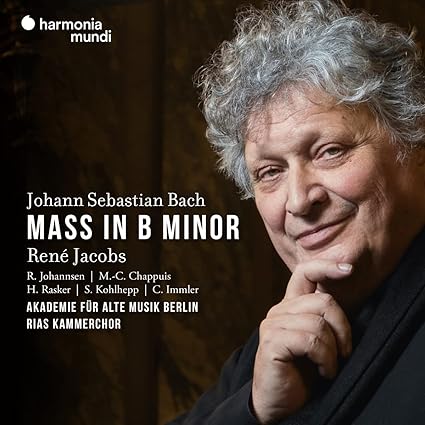
Mozart, Die Zauberflöte, Akademie für Alte Musik, R. Jacobs

(release on September 14, 2010)
High points of the production (last seen at Santa Fe in 2006) included the three ladies’ humorous killing of a serpent giant enough to comfortably allow Tamino (Charles Castronovo) to sing from inside the snake’s mouth; the strong yet agile baritone of Joshua Hopkins' Papageno coupled with a strong musical and acting rapport with his Pamina, Ekaterina Siurina; and the depths of Andrea Silvestrelli's bass instrument as Sarastro. Pamina’s Ach, ich fühl's aria probed sadness in a profound, wistful pianissimo. Castronovo’s elegant tenor voice, with a reedy yet creamy resonance and large, unforced passagio, did not make up for a lack of dramatic conviction to signify his enlightened transformation, which by the opera’s end was mostly signified by his lack of clothing and shoes. Indeed, his attire eventually devolved from a medieval jumper and riding boots to a "wifebeater" sleeveless shirt and bare feet.

Other Reviews:

Heidi Waleson, Santa Fe's Busy 'Tales,' Bloody 'Butterfly,' Tinny 'Flute' (Wall Street Journal, August 14)

Sarah Bryan Miller, Santa Fe Opera: Benign "Magic Flute," flawed "Life is a Dream" (St. Louis Post-Dispatch, August 9)

Scott Cantrell, 'The Magic Flute' at Santa Fe is welcome, if not the best we've seen (Dallas Morning News, August 6)

Kyle MacMillan, Santa Fe Opera storms into season (Denver Post, July 18)

James M. Keller, 'Magic Flute' enlightens and enchants (Santa Fe New Mexican, July 4)
In this production, the Queen of the Night assumed a character role closer in temperament to that of the Fairy Queen in Iolanthe than a supernatural being one must fear. Apprentice Lindsay Ohse, standing in for an indisposed Erin Morley in this difficult role, was not perfect but should be applauded for a fine attempt. Conductor Lawrence Renes, seen at Santa Fe in Tan Dun's Tea, was not entirely effective due to his limited connection to the orchestra, which progressively diminished further in correlation to his flailing, unnoticed gestures. Lastly, the hokey rhymes of the dialogue, translated into English, in combination with Sarastro’s stiff acting and halting English, similar to vintage Arnold Schwarzenegger films, left one disappointed. Albeit, there were a large number of children in attendance for whom the English dialogue would have been a helpful component.

Charles's 2006 review of this production by stage director Tim Albery details the anachronism of costumes that distract from the larger themes of the opera: Sarastro and the priests in 18th-century costumes, Monostatos and his henchmen as Nazi soldiers, the Queen of the Night and the three ladies as Elizabethan noblewomen, Papageno as the Ugly American Tourist, Tamino as a Renaissance prince, and Pamina as a 50s Annette Funicello. Charles did not mention the costumes of the three spirits: boys bizarrely dressed in orange robes as Hare Krishna ascetics with latex cap and all: perhaps the connection to the opera is that the Indian God Krishna plays the flute. The most outstanding music, particularly the works of J. S. Bach, can sound wonderful even when butchered. The Magic Flute contains such exceptional music that even if it were set on an ant farm or in South Park, the delightful experience of the music would suffice.

Performances of The Magic Flute continue at Santa Fe Opera through August 27.

30.7.16

Ionarts in Santa Fe: Santa Fe Songs

This review is an Ionarts exclusive.

available at Amazon
New American Art Song, D. Okulitch, R. I. Gordon, J. Heggie, L. Liebermann, G. Roven
(GPR Records, 2013)
It is time for press week at the Santa Fe Opera, although I arrived a little earlier than normal this year. In between the five operas, there are some recitals presented by Performance Santa Fe, which celebrates its 80th anniversary this year. The first concert of the season is part of a four-part Festival of Song, two of which are falling on days when the opera house is dark this week. On Thursday afternoon, soprano Keri Alkema and bass-baritone Daniel Okulitch teamed up with composer Glen Roven to perform a program mostly of Roven's songs, at the Santa Fe Scottish Rite Center.

Roven has worked mostly as a Broadway composer, conductor, and arranger, and his art songs, unknown to me up to this point, have something in common with those of Ricky Ian Gordon and Jake Heggie. Roven credited Chinese soprano Hui He with the inspiration for his song cycle Six Ancient Chinese Poems, a set of six songs set to Chinese poetry translated by Jane Hirshfield, sung here by Keri Alkema, who made her Santa Fe Opera debut this summer as Donna Elvira in Don Giovanni (more about that later). The more dramatic soprano writing suited Alkema's powerful voice beautifully, particularly thrilling at the end of the second song and at the exclamation "O wind, do not stop" in the final song, while songs that required a softer approach at the top were not as easily negotiated.

Roven's harmonic and melodic palette in these songs did not have Chinese elements, other than perhaps a tinge of something like Debussy's Pagodes, but in a second cycle, The Santa Fe Songs, Roven ranged into many other styles and sounds. It seemed tailored to the voice of Daniel Okulitch, who sings the title role of Don Giovanni across from Alkema's Donna Elvira this season, a rich, refined sound across the whole ambitus and with excellent diction. The second song, "Listening to Jazz Now," was a highlight, with a pitch-perfect jazz style, as was the harmonic tension that mirrored the poetry of the third song. In all of his songs, Roven played his own accompaniments with poise. Here Roven set all texts by poets from Santa Fe, encountered on a previous visit, and three of the poets were in attendance.


Other Articles:

Jennifer Levin, Poetry and music intersection: Glen Roven's "The Santa Fe Songs" (Santa Fe New Mexican, July 22)
Two songs by Jake Heggie, sung by Alkema and accompanied by Joe Illick, reinforced the impression of Heggie's songs as musical equivalents of Hallmark cards, complete with a soupy cello solo played well by Joe Johnson, the principal cellist of the Santa Fe Opera orchestra. Stylistically similar was Evan Mack's A Little More Perfect, set to excerpts from the U.S. Supreme Court's opinion in Obergefell v. Hodges, which was utterly nondescript musically while meaningful in its words. Roven's weakest work was in a poorly judged, overblown setting of Goodnight Moon, the dulcet children's book by Margaret Wise Brown, heard here in the first performance of a new duet version made for these two singers. An encore of You're Just in Love, from Irving Berlin's Call Me Madam, was an eye-roller.

The next concert in the Performance Santa Fe Festival of Song series will feature soprano Angela Meade (July 31, 4 pm), in a program including Strauss songs and some opera arias.

30.7.08

Ionarts in Santa Fe: Adriana Mater

For more background information on this opera, see my preview article on Adriana Mater.

Monica Groop (Adriana) and Pia Freund (Refka) in Adriana Mater, directed by Peter Sellars, Santa Fe Opera, 2008 (photo © Ken Howard)
Monica Groop (Adriana, below) and Pia Freund (Refka, above) in Adriana Mater, directed by Peter Sellars, Santa Fe Opera, 2008 (photo © Ken Howard)
On Saturday night, the Santa Fe Opera extended its distinguished history of presenting new operas to American audiences, with the American premiere of Kaija Saariaho's second opera, Adriana Mater. Earlier that morning, at a symposium on the opera, the composer, librettist Amin Maalouf, and director Peter Sellars spoke about the opera and its third production (after the world premiere in Paris and a production at the Finnish National Opera this spring). The Santa Fe theater required some adjustments, to George Tsypin's luminous sets, to the casting, and especially to the orchestration, which had to be reduced in numbers of strings and other instruments. Even so, the opera lost little of its emotional punch, unfolding in a steady, purling flow, tidal, glacial, pulsatingly quiescent. There will be more to say about the work itself after a second hearing tonight [see my Final Thoughts on the 2008 Season].

The libretto by Amin Maalouf is set in a village before and after a devastating war. No nationality or location is specified, and the enemy force that threatens is identified only as les autres, the others. The character names and other minor details make the Serbian-Bosnian conflict the likely background (something confirmed by Maalouf), but the idea is that the story could easily be imagined in any number of wartorn areas. (Maalouf, raised in French Catholic schools in his native Lebanon, has lived in France since the 1970s and writes in French: so the themes of homelessness and civil strife have a background in Lebanon, too.) George Tsypin's sets, made of sculpted resin, glow with light like burning embers or reflect it like dull metal or stone, recalling the domes of mosques or Eastern Orthodox churches. In the second act, most of the village walls have been reduced to rubble, the only real reference to the warfare that has occurred in the time elapsed between the rape of the central character, Adriana, and the birth of her son, Yonas.

Monica Groop (Adriana) and Pia Freund (Refka) in Adriana Mater, sets by George Tsypin, Santa Fe Opera, 2008 (photo © Ken Howard)
War and violence are told only through the interactions of four characters: a soldier, Tsargo, rapes a woman, Adriana, who confides in her sister, Refka, and gives birth to the soldier's son, Yonas. The son discovers that his father is not a war hero, as his mother told him when he was growing up, but a rapist and murderer. When the rapist returns to the village at the end of his life, the son confronts him and threatens to kill him. (The question of paternal identity is also at the center of the recent film set in Sarajevo, Grbavica: The Land of My Dreams.) A faceless chorus comments from the pit, amplified at Santa Fe, as are all the principal singers, mostly repeating words or phrases sung by the characters, as well as singing on neutral syllables and occasionally introducing their own words. At the symposium, Saariaho said definitively about the chorus, "They are not persons. They color the orchestra, continuing some of the lines." As Peter Sellars sees them, she added, "they are like spirits in the village."


Monica Groop (Adriana), Matthew Best (Tsargo), Pia Freund (Refka), and Joseph Kaiser (Yonas) in Adriana Mater, Santa Fe Opera, 2008 (photo © Ken Howard)
As Adriana, mezzo-soprano Monica Groop was eloquent, still, and richly voiced, although many of the lowest parts of the role trailed off into shouted speech. As Adriana's sister, Refka, soprano Pia Freund, struggling with a cold, was less beautiful in sound, but just as dramatically convincing. Both women, who are Finnish, sounded less than idiomatic in French, although the sense of alienation from language is not necessarily inappropriate, and both were occasionally covered in louder orchestral passages, despite the amplification. Matthew Best's Tsargo had a growly menace, both pathetic and threatening, although in the first scene he did not appear as a young man (as Peter Sellars put it at the symposium and the libretto indicates). The young Canadian tenor, Joseph Kaiser, was also suffering from a cold but recovered on opening night to give a dramatic and heroic rendition of the high-lying part of Yonas, Adriana's son. Their embrace of reconciliation at the end of the opera, beginning with just putting their heads on the other's shoulder, was a striking, emblematic moment.


Monica Groop (Adriana) and Joseph Kaiser (Yonas) in Adriana Mater, Santa Fe Opera, 2008 (photo © Ken Howard)
It was difficult not to regret that Esa-Pekka Salonen, who conducted the opera's premiere, had been replaced by Ernest Martinez Izquierdo at the podium, first in Finland and now at Santa Fe. In his entertaining comments at the symposium, Peter Sellars made a point of stating that Izquierdo loves the score of Adriana and conducts with that love, adding wryly that love is not a word associated with what most conductors do (unless it has "self-" in front of it). Izquierdo certainly knows the score well and shaped it with delicacy and scope, keeping the extremely complicated structures aligned, allowing masses of sound to blossom and evaporate. The pace of the opera is slow and deliberate, mixing dream and reality in an almost indistinguishable way. More than once at the symposium, Peter Sellars used the image of a Byzantine altarpiece to describe how the libretto and music worked, with the characters removed from time and space, against a golden background.

Other Reviews:

Craig Smith, ‘Adriana’ has plenty of depth, heft (Santa Fe New Mexican, July 28)

Anthony Tommasini, Compassion, Not Revenge, After a Rape in a War Zone (New York Times, August 1)

Scott Cantrell, Santa Fe Opera premieres arresting war story, 'Adriana Mater' (Dallas Morning News, August 1)

Anne Midgette, Promising 'Adriana' Could Use a Drama Lesson (Washington Post, August 4)

George Loomis, Adriana Mater, Santa Fe Opera (Financial Times, August 4)
Saariaho's compositional inclinations have included electronics and spectralism, the unfolding of dissonances around the central organizing principle of the overtone series. Some themes stood out over several hearings, especially a downward microtonal glissando, perhaps a sighing motif, that is repeated throughout the score. Downward half-steps, set sharply on the beat, also pervade the music, ultimately associated with the repeated singing of "J'aurais dû" (I should have), as the four characters all express regrets in the final scene. The rocking semitone pulses through the score until the final tableau, as mother and son embrace, and then resolves. Saariaho's sound is distinctive, although she turns to more or less standard atonal clusters, amassed in huge waves, to set the rape scene. Much more memorable are the softer washes of sound, especially as larger orchestral tutti passages vanish, to reveal the ping of a triangle, the rumble of contrabassoon or low brass, or the stray raindrops of celesta or the extensive battery of percussion.

For all of Saariaho's association with IRCAM and the French spectralists, it is the orchestral music of Sibelius that seems the most important influence. At more than a few points, as magisterial brass spiked their heads through the texture, similar moments in Sibelius's symphonies came to mind. The comparison puts me in mind of what Saariaho said about Adriana during the symposium, that it was the dream sequences she most relished, as they allowed her to turn her ear from the horrors of the story's oppressive reality. Noting that she has a complex dream life herself, Saariaho said that no matter how long she has lived in Paris, her dreams are always set in Finland.

Kaija Saariaho's Adriana Mater will be repeated at Santa Fe Opera on July 30 (tonight) and August 8 and 12.

28.7.08

Ionarts at Santa Fe: Billy Budd

For more background information on this opera, see my preview article on Billy Budd.

William Burden (Vere) in Billy Budd, directed by Paul Curran, Santa Fe Opera, 2008 (photo © Ken Howard)
Better late than never. Santa Fe Opera has finally staged two of Benjamin Britten's masterpieces, with Peter Grimes in 2005 and now Billy Budd this summer. This opera is, with Grimes, Britten's grand operatic masterwork, and it works very well with a blockbuster staging like that of Francesca Zambello for Washington National Opera. Paul Curran, as he did for the Santa Fe Grimes, has situated his production in a way that seems both expansive for the more intimate Santa Fe stage and yet closing in to more introspective space.

The set that remained for both acts showed a composite view of the deck of the HMS Indomitable (sets designed by Robert Innes Hopkins), with the helm wheel far upstage, on a raised deck with the Union Jack fluttering in the desert wind blowing through the open stage. A yellow mast in the center raised up the foretop riggings, and other ropes and sails were seen closer to the audience, as well as two cannons on either side. Walls slid from both sides, meeting in the center, to mark off Captain Vere's quarters, and the raked stage lifted up to reveal the men's quarters beneath the deck (not unlike Zambello's production, but less spectacularly).

Keith Jameson (Novice) and Peter Rose (Claggart) in Billy Budd, Santa Fe Opera, 2008 (photo © Ken Howard)
The headliner of the cast, who were all generally good, was Teddy Tahu Rhodes in the title role (his first American appearance in the title role, having debuted it earlier this spring with Opera Australia). Rhodes certainly looked the part, a handsome, lanky, even gangly Billy, scuttling up and down the rigging and, of course, singing some of the time without his shirt. Vocally, however, it does not strike me as his part, although his slightly woolly sound was pleasant enough. Some of the high notes were just not there, at least on last Friday night, as in Billy's scene with the chorus ("Starry Vere, I'm for you"). He did not seem all that comfortable with the musical demands of the role, either, not quite certain of the beat at several points. Tenor William Burden, a former Santa Fe apprentice and audience favorite, was a refined, aristocratic Vere, an impression helped not least by the staging, which showed him sipping a glass of port as the three men were impressed into service in the first act. His voice is not something I found easy to love, with some vocal tics like scooping and other affectations that caused a few intonation problems.

Peter Rose (Claggart), Teddy Tahu Rhodes (Billy), and John Duykers (Red Whiskers) in Billy Budd, Santa Fe Opera, 2008 (photo © Ken Howard)
By far the most impressive sound came from the snarling, sadistic Claggart of British bass Peter Rose, so spiteful of the machinery in which he is a cog that he spits in Captain Vere's port glass. He was a huge, hulking figure with a powerful voice to match, descending to a menacing growl in the bottom range (only exaggerated final consonants displeased). Britten battled somewhat with his librettists, especially E. M. Forster, over the homosexual motivations of the characters in the opera, much more transparent in Melville's book than they ended up in the opera. Curran opted to bring those desires out of the closet, as it were, by importing great significance to the red neckerchief that Billy wears. Claggart imperiously orders Billy to remove it, deeming it too colorful for a ship at war. Not only does he pocket the token, like Cherubino with the Countess's ribbon in Le Nozze di Figaro, but it appears again in Claggart's hand when he sings his monologue "O beauty, o handsomeness, o goodness!".

Most unusually, it appears yet another time, in the hand of Captain Vere at the end of the opera, as he struggles with how to respond to Billy's unintentional murder of the scheming Claggart. Its presence there indicates that Vere likely understood the self-loathing origins of Claggart's hatred of Billy, as he clearly believed that Claggart's accusations were groundless. Vere cannot bring himself to make that knowledge public, with the shame of "the sin that cannot be named" providing another reason why the captain does nothing to save Billy from his fate. Steve Smith, who was seated next to me on Friday night, and I both saw this as a tragic expression of a sort of "Don't ask, don't tell" policy in His Majesty's Navy.

Lucas Meachem (Donald) and Teddy Tahu Rhodes (Billy) in Billy Budd, Santa Fe Opera, 2008 (photo © Ken Howard)
Lucas Meachem (Donald), Teddy Tahu Rhodes (Billy), and Cast in Billy Budd, Santa Fe Opera, 2008 (photo © Ken Howard)
Among the supporting cast, so large in Billy Budd, Keith Jameson (former Santa Fe apprentice and Bob Boles in Peter Grimes) had an especially fine turn as the Novice. Some of his high notes were (not inappropriately) a little squeaky, but the voice had intense appeal as the young man's flogging and subsequent shame were plaintively accompanied by those bluesy alto saxophone solos (Eric Lau). Jameson had exactly the right dramatic presence for the novice, genuinely terrorized rather than whining or snively. The passages with the Novice, more than any other scenes, seem to support Humphrey Carpenter's comparison of the sufferings of the ship's all-male environment to those of a British boys school. Did Britten suffuse the Novice's music with his own memories of being unjustly punished at school?

Other Reviews:

Craig Smith, Going Dutch with 'Billy Budd' (Santa Fe New Mexican, July 10)

D. S. Crafts, SFO Cast Carries Britten's 'Billy Budd' (Albuquerque Journal, July 15)

John Stege, Hey There, Sailor (Santa Fe Reporter, July 16)

Hervé Le Mansec, Décapant ! (ResMusica, July 18)

Steve Smith, Anchors Aweigh (Night after Night, July 26)

Georgia Rowe, Innocence Meets Fate (San Francisco Classical Voice, July 29)

Scott Cantrell, 'Billy Budd' would benefit from a recast (Dallas Morning News, August 2)

Anthony Tommasini, Billy Budd the Jock, Beautiful and Agile (New York Times, August 2)

Anne Midgette, Promising 'Adriana' Could Use a Drama Lesson (Washington Post, August 4)

George Loomis, Le nozze di Figaro, Santa Fe Opera (Financial Times, August 14)
Timothy Nolen (Mr. Flint) and Richard Stilwell (Mr. Redburn) had too much fun in their witty interactions ("Don't like the French!"), and the ensemble gave a puissant, virile sound to the remarkable choral numbers, with vast waves of sound in the shanty scene ("Blow her to Hilo") and battle scene ("This is our moment!"). Santa Fe Chief Conductor Edo de Waart led a convincing reading of the score from the podium, although Richard Hickox, whom we reviewed at Washington National Opera, had a more profound knowledge of and ease with the score. De Waart was most challenged in those large choral scenes, where there were several disturbing misalignments between the singers, who tended to rush ahead of the beat, and the orchestra.

Among many beautiful solos from the pit, the piccolo's warbling commentary in Billy's dawn song, just before the execution, was particularly fine. As for the so-called Interview Chords, the series of sustained triads that are heard in the orchestra as Vere meets with Billy to explain his fate, de Waart gave them a stillness more serene than ominous, although the forte entrance of the brass chord was powerful. Curran's only misstep in the staging was the music theater antics of the crew during the shanty scene (see photo above -- "We're off to Samoa!"), but all in all, this was an excellent production for the debut of Billy Budd at Santa Fe Opera.

Britten's Billy Budd will be repeated on July 31, August 6, 14, and 21 at Santa Fe Opera.

8.8.09

Ionarts at Santa Fe: 'Elisir d'Amore'


Dimitri Pittas (Nemorino) and Chorus in Elisir d'Amore, Santa Fe Opera, 2009 (photo by Ken Howard)
In my summer opera roundup, Santa Fe Opera's production of Donizetti's Elisir d'Amore was previewed as fluff and labeled, to the outrage of some and the delight of others, "one of the dumbest operas ever created." To Santa Fe Opera's credit, the company has mounted this fizzy, sentimental, and yes, insipid work only once before, back in 1968. For a new production, Santa Fe gave the nod to director Stephen Lawless, who created a rather traditional staging for Washington National Opera, premiered in 1997 and revived, without the director's approval, in 2006. The only thing, other than truly stellar singing, that can make this opera interesting is to update the time setting, which Lawless did, to Italy in 1945. Sergeant Belcore and his regiment become American GIs, who show up in an unnamed Italian town -- not the Basque village indicated in the libretto by Felice Romani -- in their sputtering Jeep. In a nice touch, the villagers first waved Italian flags, not sure which side is coming, only to replace them with American flags when they saw who it was.

The Nemorino of American tenor Dimitri Pittas ultimately makes this production work, as the hapless grease monkey with a dopey smile and a heart of gold. He has sung the role at Welsh National Opera and at the Met, and the voice is placed well, making the high notes shine in Una furtiva lagrima, sung under dim lights with the instrumental introduction accompanying Nemorino sadly covering over the beloved red sports car he has been restoring. With the characters in 1945, it was harder to make Adina seem truly of a different class than Nemorino, which is ostensibly why she disdains him, especially when she was costumed essentially like all the other women in the village. At one point, she sneers at him over her espresso demi-tasse, a sure sign that she is a latte-drinking elitist -- although not in Italy, where everyone drinks espresso. Jennifer Black, a lovely Micaëla in Santa Fe's 2006 Carmen and one of their Mimis in the 2007 La Bohème, was not quite the perfect voice for the part, a little too dark in tone to get the right sparkle and brightness for the flashy Adina.


Thomas Hammons (Dr. Dulcamara) in Elisir d'Amore, Santa Fe Opera, 2009 (photo by Ken Howard)
The center rear of the stage throughout this staging is dominated by a bill board, carrying ads for olive oil, Dr. Dulcamara's miraculous elixir, the wedding announcement of Belcore and Adina, and so on. At first, it made me think that the director had hit on the ingenious idea of somehow equating the charlatan Dulcamara with the excesses of modern advertising, but it was not to be, as Dulcamara appeared instead as a two-bit mobster, hawking dubious wares out of his suitcase. John Del Carlo, who was to make his Santa Fe Opera debut in the role of Dulcamara, asked to be released from his contract in June because of a bad sinus infection. He was replaced by Thomas Hammons, a former Santa Fe apprentice who has had experience with the role but who convinced with his acting more than his singing. The many patter sections were often off-kilter with the orchestra, making the highly skilled conductor, Corrado Rovaris, scramble far too often to realign the orchestra. Lawless hit on a cute solution to the "servitore" who is supposed to accompany Dulcamara, playing the trumpet, by having the doctor put a scratchy record on a phonograph instead.

Other Articles:

George Loomis, Santa Fe Opera, New Mexico (Financial Times, August 10)

Scott Cantrell, Santa Fe Opera's 'Elixir of Love' is a frothy good time (Dallas Morning News, August 9)

T. D. Mobley-Martinez, Opera 'Elixir' proves fine comic tonic (Colorado Springs Gazette, July 30)

John Stege, Bel Canto, Pronto (Santa Fe Reporter, July 15)

Craig Smith, 'Elixir' a merry brew of love and laughter (Santa Fe New Mexican, July 5)
Baritone Patrick Carfizzi, another former Santa Fe apprentice, hammed it up as the cigar-smoking, sunglass-wearing Sergeant Belcore, with that unmistakable American swagger, more Catch-22 than The Greatest Generation. Vocally, he was equally on the money, with exemplary definition to the voice in melismatic passages and enough blustery rodomontade in the tone for the entire regiment. Lawless's staging went over the top in many ways, with a fairly simple set (two opposing barn-like doors on either side of that spectacular billboard -- sets and costumes by Ashley Martin-Davis) but almost too many unrelated jokes, like the wedding menu (everything chicken, including the gelato for dessert) and the priest arriving at the wedding on a green Vespa and unidentifiable in a leather jacket. In any case, it was an oh-so-charming evening of fluff and fun.

If you can stand it, this production of Elisir d'Amore will be repeated at Santa Fe Opera four more times through August 28.