CD Reviews | CTD (Briefly Noted) | JFL (Dip Your Ears) | DVD Reviews
Showing posts sorted by relevance for query mark barry. Sort by date Show all posts

29.11.03

Paintings by Mark Barry

Mark Barry, Pool Side, 2002, image thanks to Steven Scott GallerySome time ago, in a post on August 11, I mentioned the paintings of Mark Barry. I liked what I saw of Mark's paintings from his Web site, and he has been interested by my postings on Matisse, Gauguin, and Constable, among others. Mark's paintings have been on display at the Steven Scott Gallery outside Baltimore since October 1, but the show comes down this evening. Fortunately, I was able to see the show this past Wednesday, with the gracious guidance of Steven Scott who showed me the paintings of Mark Barry and the other artists he represents. (Mr. Scott's gallery was on Charles Street in downtown Baltimore until last year, when he moved it to its present location in Owings Mills, just off the Baltimore beltway.)

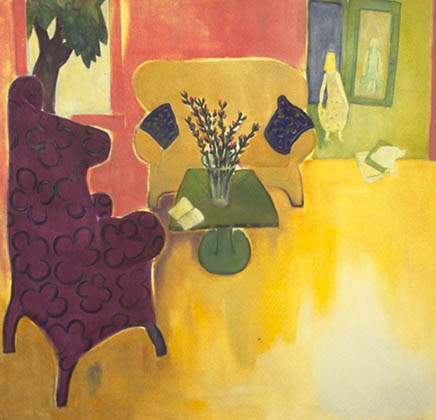
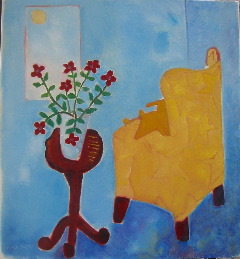
I liked the pictures I was able to see over the Internet, and that was reinforced when I saw them in person. Mark's style is colorful and direct, with perspective that is often distorted or just simplified and figures who are rendered in a somewhat primitive or naive manner. (This "faux-naive style," Mr. Scott made a point of saying, is intentional and certainly not the result of a lack of academic training.) What strikes me about Mark's work is its happy warmth, revealed in his focus on domestic scenes like parties and activities like reading, bathing, and cooking. There is little darkness in the works I saw, but plenty of grace and vivacious color and pleasing curves. Prominent themes include jazz musicians and the sound of jazz (Night Life, 1998; and the ceramic vases), flowers (The Caller, 2003; March Morning, 2003), fabric patterns on furniture and curtains (The New Dress, 2003; Her Favorite Spot, 1998; The Makeover, 2003), and still life, especially of crabs and other Maryland cuisine (The Crab House, 2002). One of the paintings I liked best in the show was Pool Side (2002), which is shown at right, and I came back to it the most. Rather than providing a portrait of one particular day by a pool, the composition reduces the subject to its essentials: a stand of flowers in a garden, a woman reclining on a lounger, and the water of the pool. The pool, a simple and fairly small rectangle, stands like a mirror in the background, and the flowers hover about the woman's feet and over the water. I admired another painting in the show, Special Spot (2003; see image here), for many of the same reasons. The specific scene, a particular room in Barry's house, is lost in a wash of blue that mingles with the sunny sky seen through the window. Only a vase of red flowers on a slanting side table and the back of a yellow chair create the sense of what makes the dog think this spot is special. You can see several more of Mark's paintings here at his Web site, which he is updating at the time of this writing. There will hopefully be more images of old and new work, as there were in the old version of his site.

You will be able to see some of Mark Barry's paintings in Steven Scott's next show, from December 2 to February 28, called "Regarding Nature." This will feature recent works by many of the artists who show at the gallery, including Robert Andriulli, Mark Barry, Gary Bukovnik, Anne Marie Fleming, Patricia Tobacco Forrester, Carla Golembe, Amy Lamb, Annie Leibovitz, Michael H. Lewis, Katja Oxman, Mark Poss, Tracie Taylor, Frank Trefny, and Karen Vornov. The beautiful flower photographs of Amy Lamb, the cloud study landscapes of Robert Andriulli, the precise still lifes of Frank Trefny, and the urban landscapes of Sam Robinson (especially one of a parking lot in Ocean City) were other works I saw on my visit that are worth a trip to Owings Mills.

27.6.04

Living in a Painting, for an Evening

Mark Barry, The Birthday, 2001
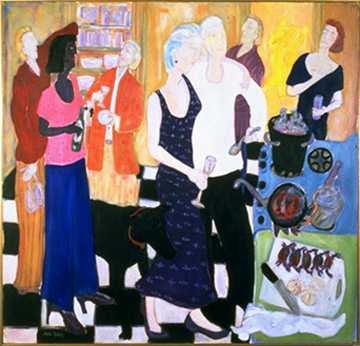
I came as close as I ever may to living inside a painting (much more satisfyingly than in that silly J. Seward Johnson show I wrote about here, here, and here), when I was a guest last Sunday evening in the home of Ionarts contributor and Baltimore artist Mark Barry. Some of my favorite paintings Mark has done (see my review of Mark's show last fall, from November 29) are scenes of family and friends in his house. When I finally entered the places I knew only from his paintings—like the dining room with its long table (image shown here), the living room, the kitchen, the yard patrolled by kind-hearted dogs and chickens, or the interior turtle pond—it was positively Proustian.

However, while the narrator of Proust's A la recherche du temps perdu felt disappointment when he actually saw the church of Balbec and found it less glorious than he had imagined it (here's a passage from Swann's Way), it was quite magical to be in the moving version of one of Mark's paintings. As you can imagine in such a home (Mark's wife, Sandra, is also an artist) every corner, every wall, is filled with something interesting and beautiful to see. I especially enjoyed seeing their collection of outsider or visionary art, which is one of Mark and Sandra's special interests. We enjoyed the delicious dinner and charming company in the picturesque back yard, and for someone used to the song of the city of Washington, there was not a single military helicopter or police siren to break the song of the birds. It was truly blissful.

Fortunately for me, one of Mark's watercolors, related to this painting, will now be hanging in my own house to keep a piece of that serenity close at hand. Mark, thank you and keep up the good work.

14.5.04

A Friend Returns

It happens every spring in my yard. From a very fragile-looking shaft the most beautiful blossoms appear. I'm told it's a wild rhododendron. Whatever the species, it makes me very happy. Life is good.

Mark Barry, Rhododendron, 2004

Mark Barry (www.markbarryportfolio.com) is an artist working in Baltimore.

7.5.04

Painting in the Dark (and Everything Else)

Mark Barry, Lites Out, watercolor, 2004
Mark Barry © Lites Out, watercolor, 2004
This past Sunday around 11 pm, due to a fierce storm, we lost our power and didn't get it back until Tuesday afternoon.

There is a lot to be grateful for when the electricity goes out, the best reason being that it's quiet. The phones were out, the computers out, the TV out also. Oops, we have to talk to each other: what was her name again? And reading in bed by flashlight, that brought back some memories. My daughter really enjoyed herself, a little Frontier Life lite.

The downside in our case was no hot water. Actually since our source of water is a well, we had no water at all, but I truly missed a hot shower; and those around me missed me not showering too.

Habits are not easily broken either. Whenever I went into a darkened room or closet, my first instinct was still to hit the light switch. Try to chase the chickens out of the flower bed with a spray from the garden hose: no dice.

This all comes around to painting, of course. How did so much art get made in the past with so little light? Even on a clear day, there may be five or six hours of good light to work by. In my case the days were overcast, and it was a struggle to see what I was putting down. I'm now going back and tweaking the glaze I painted on some pottery and tightening up some watercolors. Very little painting got done, but several canvases were stretched.

I'm sure that candles and oil lamps were a primary source of after-hours light for pre-electric artists, but still it's a very different way seeing the world. It's definitely a much simpler lifestyle.

Mark Barry (www.markbarryportfolio.com) is an artist working in Baltimore.

25.5.05

Lost in Italy, Part 1

Ionarts contributor Mark Barry has sent his first missive from his fantastic trip to Venice. He promises many pictures but has had trouble with reliable computer connections.

It’s a long flight to Venice when the seats are inches apart and the couple in front are large fidgety water buffalos, on their way to catch one of the many cruise ships leaving from the port. But, once you get here, fortunately, that’s all a memory. It’s so nice to get away and experience a different culture.

Palazzo Ducale, VeniceLet’s see, Venice in three days: walk, walk, and more walk; it’s great. I love watching all the people, the fashions, and the hand gestures that are so prominent in Italian art. Everything! is important and requires a major discussion. If there is one complaint, it's that Venice is expensive. The euro this trip is about .72 to the dollar. If possible, get a hotel package with museum passes included. We luckily did and had a gondola ride too, normally 100 euros—no, really!—and that was a story worthy of hand gestures. To get a true feeling for the city a gondola ride is essensial. We met our gondoliere in front of the Disney store.

Calder sculpture, Venice, May 2005
Sculpture by Alexander Calder, at the Grand Canal entrance to the Peggy Guggenheim Collection, Venice, with Sandra Magsamen in the background
Coffee, warm milk, pastries; so nice. In addition to the grand master Paolo Veronese’s amazing work at The Doge’s Palace there is a small exhibit of his paintings at the Correr Museum in Piazza San Marco, of mythological compositions and portraits. Lucian Freud is the next exhibit here, starting June 11th. So many museums, so little time.

What I did see, and it is one of the most popular places in Venice, is the Peggy Guggenheim Collection. I would have loved to go to a dinner party here. What a collection of art to be surrounded by and to call this home! I could get used to this. The lady had a good eye and championed so many of the greatest artists of the century: Klee, Miró, Kandinsky, and of course Jackson Pollock (his own room of five paintings [formerly the "guest bedroom," hee hee!—CTD]). I missed the Dalí exhibit in Philly, but here I saw his Birth of Liquid Desires. Picasso, Magritte, Albers, and a very cool hammered silver headboard by Calder, fit for a queen.

I noticed several young people, obviously American, working in the galleries; it pays to be nosey. The Guggenheim offers a three-month paid internship (650 euros a month). The young woman I spoke with was from the University of Michigan. Why didn’t I know about this!

Mark Barry (www.markbarryportfolio.com) is an artist who used to live in Baltimore and has now fled to Italy.

UPDATE:
Mark has put some pictures of Venice online. How much are plane tickets to Europe right now?

4.4.04

Birthday Thoughts

Mark Barry, The Wish, oil/board, 2004
We're always the last to learn everything. Happy birthday, Mark! Here's to simplicity!

"It takes a long time to become young."
— Pablo Picasso

How did this happen? A guy looks and feels (acts) 18 but one day turns 49? But what does that have to do with painting? Everything and nothing. One view is that I'm still making art after all these years, and secondly there's something to be said about maturity (in my painting).

Saying more with less and actually having a more informed opinion is a nice benifit of time. One of my favorite quotes is by a writer in a letter to a colleague and it goes something like "forgive me for writing such a long letter: I haven't the time to write a shorter one." My one birthday wish is to make that time.

Mark Barry (www.markbarryportfolio.com) is an artist working in Baltimore.

30.12.03

Memories of '03 — by Mark Barry

Ionarts is happy to welcome a new guest contributor, artist Mark Barry, who will be writing about art from an artist's point of view. Mark weighs in today with a quick review of favorite exhibits in 2003.

One last remembrance for 2003: first of all, I still can't get used to the idea of 2000, let alone 2003. As an artist I have felt for some time that the new century would have significance in our lives, more than just an array of numbers or y2k. It would be a time to take stock, sum up, stretch limits. Then came 9/11, Afghanistan, Iraq, turmoil in Africa, the World Bank, fires, floods. There is precious little time to take stock of any one particular event. It was several years before Picasso painted Guernica, and it will be several more before we can adequately commemorate what transpired on September 11th.

Picasso loomed large again this year along with Matisse, at their fabulous painting-fest (Matisse Picasso) at MoMA Queens, one incredible work after another: matching each other, one large juicy painting for painting to the very end. Another painter of large canvases who never shied away from pushing the limits, in this case to the heavens, was Velázquez, at the Met. After paying my 5 cents to get in (artist's benefit), I found that it was a members-only preview, so I had to slip in through the gift shop and view the show in reverse. Just as well: what a bold painter he was; how can you not be a believer?

There was Romare Bearden and Édouard Vuillard at the National Gallery, both building on wonderful complex patterns of color, which reminded me of the Bonnard exhibit at the Phillips earlier this year. Those baths of Mr. Bonnard, to see a room full of them was a highlight of my year. George Inness reminded me again of the simple beauty of landscape painting in a really nice, small exhibit, at the National Academy of Design. A few blocks down, at the Guggenheim, the Rosenquist retrospective was over the top and all over the building, an amazing amount of work and still going. The press was rolling for the John Currin retrospective at the Whitney. He's a good painter, with lots of imagination and humor; no one can live up to so much hype, nor should they. One of my favorite places, the American Visionary Art Museum, ends the year with an opening, a new exhibit called Golden Blessings of Old Age. There is art after 50!

I haven't even mentioned all the gallery shows of this year, mine included, or the fate of the Barnes Foundation (see it while you can), but there is a lot to celebrate; amazing art is being made all around the country. There will be a fitting response to 9/11 at some point; it's happening in small ways right now. Here's to great art to be made and seen in 2004.

22.2.04

I Found Milton Avery — by Mark Barry

Milton AveryAlthough he was never lost to me, I have learned a lot of biographical information about Milton Avery (image at right) that I didn't know before from the exhibit Discovering Milton Avery: Two Devoted Collectors, Louis Kaufman and Duncan Phillips at the Phillips Collection in Washington, D.C. (through May 16). For one, how much he struggled as an artist with both his art and his finances, and how important the support of his wife Sally and daughter March were to him. For all the attention his work gets these days, it wasn't so throughout his career. This exhibit focuses on his two primary collectors: first came friend and patron Louis Kaufman and then Duncan Phillips, who gave Avery his first museum exhibit. (For more information, see the piece on Kaufman and Avery broadcast by NPR on Thursday.)

What I enjoyed most was the chance to see a progression of work, starting with Winter Riders (c. 1925, the first Avery painting purchased by Duncan Phillips), which has an impressionist feel to it, possibly Degas, to the three still lifes of 1928, of which Still Life With Pop Bottle has a Picassoesque, early cubist sensibility, while Still Life with Iron, Plant, and Bananas is all Matisse. My favorite of this period is the beautiful portrait Sally Avery with Still Life. It reminded me of Honoré Daumier’s linear quality, but the more I looked there was the strength of a John Singer Sargent portrait, a grand picture of a simple woman.

From the late 20s through the mid 30s Avery was finding his personal voice. By his 1938 self-portrait Milton Avery in a Grey Shirt with "The Chariot Race" he had arrived. Here is a confident man: the image of the chariot in the background makes him look a bit devilish, and the paint is his own unmistakable style. Contrast this portrait with The Convalescent (self-portrait in a red sweater from 1949), painted after his first heart attack. It's a chillingly honest picture of a man confronting his mortality, with turquoise eyes peering out of a ghostly white mask. However, I can tell this is not a man ready to quit: his brilliant red shirt and wiry golden hair say, I'm still here.

This bold new style is evident in the simplified shapes of Girl Writing and broad planes of color in Chinese Checkers (c. 1941). The same boldness serves Avery well in his landscapes. Nature is dominant in Shells and Fishermen: an undulating blue sea and sky approach as one, while a somewhat ominous ledge threatens to gobble up the two unsuspecting fishermen; even the shells in the foreground are their equal. In Bird and Breaking Wave, a small bird is perched on a rock, surounded by a dark purple sea. Billowing waves are about to come crashing down, but the bird somehow feels safe on its fleshy perch; there is redemption. Man and nature are one in California Landscape, as the warm golden shore embraces a pale green sea and sky, very Japanese.

One room is dedicated to notebook entries, dry-point etchings such as Reclining Nude or Rothko with Pipe, monoprints, and woodblock prints. Avery was quite prolific, constantly drawing portraits, still lifes, and landscapes, always searching: it sure inspired me to get to work.

The last gallery is saved for large canvases that were painted in the late 50s and early 60s. Grey Rocks, Black Sea (1957) and Rolling Surf (1958) are as abstract as he gets, the essence of his quest for the pure shape and weight of color, and again in Pink Meadow (1963) with that wonderful blue blob, a precurser to Richard Diebenkorn and David Hockney. These large canvases are a tightrope walk: to pare the image down to the essential is a huge challenge. For example, the black brushstrokes in Rock and Wave (1959) don't hold: they're too haphazard, and every stroke has to count. There is success in this room, but I can't help but think of his protégé Mark Rothko. When it comes to the size, shape, and weight of color in a minimalist format, he is more successful. It's also a bit unfair, since the period around 1950 is Rothko's prime and toward the end of Avery's career. But, then again, without the influence of Milton Avery where would Rothko have been?

Mark Barry (www.markbarryportfolio.com) is an artist working in Baltimore.

3.10.06

Constable's Big Sky

Also on Ionarts:

Charles T. Downey, Constable in London (November 23, 2003)

Mark Barry, A Parade of Clouds (August 10, 2004)

Charles T. Downey, Eric Ravilious (August 4, 2005)

Mark Barry, In Appreciation of Clouds (June 14, 2006)


Available at Amazon:
available at Amazon
John Gage, Sarah Cove, et al., Constable: The Great Landscapes
I spent part of Sunday afternoon taking in the opening day of a phenomenal new exhibit at the National Gallery of Art, the next big thing now that the Rousseau exhibit is nearing its close. Constable's Great Landscapes: The Six-Foot Paintings will be on view through December 31, and it is a beautiful show, compulsory if you already like the work of John Constable and highly recommended if the English painter has just never grown on you. This exhibit is on the middle leg of its journey through three museums, having just appeared at Tate Britain in London and destined next for the Huntington Library in San Marino, California, this winter.

The main draw of this exhibition is the opportunity to see all of the large landscapes that Constable painted for academic consideration, all of which have become his most iconic works. Not only can you stand in front of The Haywain and Stratford Mill (actually released by the National Gallery in London), The White Horse (The Frick Collection), The Leaping Horse (Royal Academy of Arts), Chain Pier, Brighton and The Opening of Waterloo Bridge (Tate Britain), View on the Stour near Dedham (Huntington Library), and Salisbury Cathedral from the Meadows (Private collection), you can also compare each finished painting in almost all cases with a full-size oil sketch (hung side by side) and often other studies, almost all from different museums. This is the first opportunity to see all of these works together in one building since Constable died.

John Constable, The Haywain, 1821The wall text puts each work into the context of Constable's life and the geographical setting of the Stour valley. At one point, a map shows the world of the painter's youth, the course of the Stour River, the location of the Flatford and Dedham mills and locks (both owned by Constable, Sr.), and the other locales from Suffolk that appear again and again in Constable's landscapes. Judging by some photographs of what the area looks like today, not much has changed in this rural setting only an hour from London, probably the result of zealously preservation. Flatford Mill is now a Field Studies Council Centre, where adults and children can take classes on various subjects, and you can even stay the night.

The exhibit also gives insight into how Constable worked, both en plein air and in the studio, guiding your eye to pick out the changes in details from sketch to finished painting. Do not miss the chance to hear the explanation for that troublesome shadow in the middle foreground of The Haywain. If there is one painting you think you know, it is this one, but there in the center of the full-size oil sketch is a figure on a horse standing on the near bank. In the finished painting, Constable began by retaining that figure, then replacing it with a barrel, and finally removing that, too. When you know they used to be there, both of those things pop spectrally out of the painting, defying Constable's ingenious attempts to disguise them as shadows from the tree across the bank on land and water. I will never see the painting the same way again.

Detail from John Constable, The Hay Wain, 1821The appreciation of Constable's technique and process is not exactly what was proposed by Washington's newspaper critics. Blake Gopnik's dutiful bowing and scraping before the avatars of political correctness is lamentable, in his review in the Post, ascribing Constable's interest in painting idealized landscapes of the countryside to making "ideas of social change or reform [seem] repugnant and dangerous." Even so, that is at least more interesting than Joanna Shaw-Eagle's gross assumption that Constable is "an often boring, stodgy painter" of "academic, bucolic landscapes" in her review in the Times.

John Constable, Study of the Trunk of an Elm Tree, 1821Constable's influence on later painters, particularly the Barbizon school in France and their descendents, the Impressionists, was due to the showing of some of his canvases throughout the 19th century. When you see the paintings in person, you can appreciate his technique in a much more direct and profound way. His application of white and golden highlights to show the dappling of light, sometimes called the "Constable snow effect," was imitated by many later painters. The glowing hues of his ever-shifting clouds, which I found myself going over inch by inch in many of the large paintings, were based on acute and regular meterological observation of the skies outdoors.

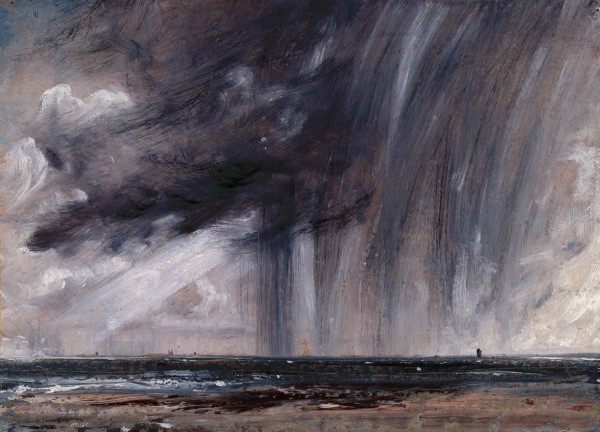
In some cases, modern painters and museum-goers have been more impressed by Constable's sketches, which have been shown occasionally over the years as finished works. When you see this exhibit, you realize that nothing could be farther from the truth, that even some canvases long considered final versions are probably only the last sketch, left uncompleted by the painter's inability to finish the work to meet the standards of the Royal Academy, whose approval he so desperately craved. Unlike those who followed him, he was unwilling to stop at a point in the artistic process where he had only made a basic sketch of what his eye saw in the field. As much as I would like to think of paintings like this gorgeous black stormcloud over the ocean or the cloud studies as finished works, that would be anachronistic. Go see for yourself.

Constable's Great Landscapes: The Six-Foot Paintings will be on view in the National Gallery of Art's East Building through December 31.

25.5.05

Lost in Italy, Part 2

Ionarts contributor Mark Barry sends his second missive from his fantastic trip to Italy. Here is Part 1. He has been posting some great pictures from the road.

Galleria degli Uffizi, Florence, May 2005Thursday was our fourth day in Italy. We drove south from Venice to Florence. We stopped for the night in the seaside town of Cesenatico. This must be a very busy summer spot, but at this time it was a sleepy village along the coast. I’m writing this from a balcony overlooking the Adriatic.

From the coast we wound our way over the Alps, an incredible journey. The Giro d'Italia bike race is going on now, and I expected to run into them around any corner; we did not, but there were many riders along the way, mostly men, some in their 60s. As a flat-trail rider I was humbled by their effort.

We entered Florence at mid-afternoon. Did you know that when you drive through the historic area without a hotel pass, cameras generate electronic tickets? And if you drive in an ambulance-only area—well, we’ll find out soon enough. Florence is a loud, busy place; but if you want great art, all the masterpieces you’ve only seen in reproductions, you MUST come here. Michelangelo, Bronzino, Botticelli: if you're an art pilgrim and not moved to tears when you finally see the Botticellis at the Uffizi, I don’t want to know you. As luck would have it all museums are free this week!

Boboli Gardens, Florence, May 2005I was here about five years ago on a day trip. At that time I walked to the Uffizi and entered with only a short wait and the galleries were nearly empty. This trip there are no passes for general admission until June 16th (see image above). The only possiblility is with a guided tour. On one hand, it’s wonderful that so many people are looking at art, but on the other hand it means looking for a scalper.

Not to worry, there’s much more to see, like the Pitti Palace, built by banker Luca Pitti starting in 1457. It was taken over in 1550 by the Medici and became their primary residence. Not a bad crib: it has room after room of masterpieces by Titian, Tintoretto, Giorgione, and this nice little Madonna and Child by Raphael, which you may have seen reproduced a few times. In addition to the art collections, the palace has the extensive Boboli Gardens, which could take a good day to cover.

There is a show up now about Maria de Medici, called A Florentine Princess on the Throne of France. Maria married Henry IV in 1600, becoming the second Medici queen of France. Michaelangelo attended the wedding and apparently helped to plan the occation. An artist and a party planner, too!

Mark Barry (www.markbarryportfolio.com) is an artist who used to live in Baltimore and has now fled to Italy.

26.5.05

Lost In Italy, Part 3

Ionarts contributor Mark Barry sends his third missive from his fantastic trip to Italy. Here are Part 1 and Part 2. He has been posting some great pictures from the road.

The Galleria dell'Accademia (The Academy Of Fine Arts), founded in 1563, is the first school established in Europe specificially to teach drawing, painting, and sculpture. The big draw here is Michaelangelo's David. It is worth the wait. The long line to get in moves by half every 20 minutes. Once in, there he stands, all 17' of nude male perfection. Michelangelo was 29 when he sculpted this out of a single stone. Most of the tourists leave after seeing David, but real treasures are on the second floor. There are several galleries of paintings, religious icons, and altar pieces by Florentine artists such as Lippi, Bronzino, Pontormo, Botticelli, and yes, Michaelangelo; he owned this town.

The beauty of Venice and Florence for me is the walking, at least 5 miles a day with very steep terrain and lot of steps. Get lost, and you will, but enjoy, because every corner has a surprise. Pinch yourself.

Collegiata, San Gimignano, May 2005From Florence to Siena and a night in San Gimignano. The Baroness was in need of wild boar tagliatelli and Vernaccia. We spent two nights in the area. This was a main stop on the pilgrim route from Northern Europe to Rome. The small duomo of the Collegiata has a series of frescoes based on the life of Christ. My favorite is the racy vision of hell by Taddeo di Bartolo. Hell seems much more exciting than the other option.

Padua: Cappella degli Scrovegni. Enrico Scrovegni built this chapel in 1303 to spare his dead father from eternal damnation, nice boy. [Dante still places him in Inferno, Canto XVII—CTD.] In turn we get the frescoes of Giotto, the father of western art; what James Brown did for soul. You’ll need reservations and arrive an hour early to watch a movie and get background info. It's helpful. This is also time to decontaminate, to prevent damage to the chapel. It took a few years for me to get here, so what's another hour.

The glass doors to the waiting room slide open, and the attendant guides you into the chapel; you have 15 minutes. It's breathtaking. The blue ceiling, although worn by time and the elements, is still majestic. It must have been stunning in its day. With only 15 minutes your eyes move quickly, then a slow pass, then a broad sweep. This is why the movie is helpful, to navigate particular panels. Giotto's version of hell is, of course, my favorite. I never thought the devils' tails could do so much probing!

This was a great trip, very inspiring. Where's my cappuccino?

Mark Barry (www.markbarryportfolio.com) is an artist who may actually come back from Italy to his home in Baltimore.

20.11.04

The Tortoise and The Cat

I'm often asked where the idea for a painting comes from, and I always respond with "none of your...."; not really, well, maybe once, but I was tired.

Mark Barry, Turtle Play, 2004In reality, with what I think are my best outcomes, I haven't a clue. There may have been an initial plan, but once the process begins it's all about painting. How the image sits on the canvas, how my eye flows from one point to another, color and form, all the technical things time has taught: the good stuff. When the energy is right and I know enough to stay out of the way, some great things can happen. At best I learn something, about the world or myself.

We have several turtles happily living in a bowl. They lounge on a stone island during the day, toasting in the sun. Along will come the cat, poking around with great interest. She likes to jump up on the table, perch over the bowl of sunning turtles, looking to pounce. She never does. I always listen for a crunching sound, but what we always get is a slurping sound instead. The turtle bowl is Emily the cat's watering hole. The turtles don't mind, and it's probably got some protein in there.

It's actually a beautiful example. To have complete dominance of the situation but to choose to live in harmony. Now that's a good subject for a painting.

Mark Barry (www.markbarryportfolio.com) is an artist working in Baltimore.

9.8.04

A Parade Of Clouds

This past week I ventured to Cape Hatteras on the outer banks of North Carolina for a family vacation. We arrived on Monday and settled into our hotel with a beautiful oceanfront view. We did a little exploring around the town, stocking up on snacks and beer and finding the edible restaurants: yes, I love eating a good restaurant.

If you're lucky enough to have 4-wheel-drive, this is one of the only areas in the country, that I know of, where you can drive on the beach. It's a lot of fun, especially if you like to surf fish. Many take this pasttime very seriously and have their trucks decked out for the task.

Mark Barry, Cloud Parade 9, 2004By early evening we were back at the hotel sitting on the dunes, drinking and noshing, watching the waves. As the sun was setting a fantastic parade of clouds drifted by. My digital attempt to capture the moment pales, but, you get the picture (sorry). Constable's cloud studies were all I could think of (see Ionarts post on November 23, 2003). You've got to be decisive when painting clouds, as the scene changed quite rapidly. The large cumulus formations with rain showers beneath were my favorites.

As with anything so wonderful it comes at a cost. In this case the reason we had this grand display was because this was only the first act. The main performance would come the next day, Tuesday, in the form of a category 3 hurricane called Alex. Winds topped out at 110 mph. The gusting rain blew in over the top of our hotel room door and sand permeated the trim around the windows. We hunkered down in the rear bathroom. I did yoga.

By noon the eye of the storm was over us, and an erie, yet beautiful calm appeared. I went out on the beach and took some pictures (one, two, three, and four). A steady wind blew sand that stung my back, ouch! After a few minutes of this it was back inside for act two.

The storm came around this time from the west, the lower-lying bay side. The wind now literally poured water through the rear bathroom windows with each gust. We moved our hunkering back to the front room. After an hour or so the roads and hotel parking lot were flooded. The windows were coated with sand, we could only imagine what was happening to the cars parked in the lot. I took a nap.

Eventually Alex drifted away, and we munchkins slowly emerged. I was looking for Glinda the good witch of Munchkin Land to sing "Come out, come out, wherever you are." We had all survived. There was a lot of flood and wind damage. Many cars in the hotel lot had their rear windows blown out and were coated inside and out with sand. My car only had a sand blasted rear window and side mirror which was pretty amazing to see. Luckily there were no injuries and within an hour the roads were plowed of sand. The first to arrive on the scene were TV crews with huge satellite dishes hungry for images and quotes. Most importantly the beer truck arrived, closely followed by the ice truck. Now that's a relief operation. By the way very little painting got done.

Mark Barry (www.markbarryportfolio.com) is an artist living in Baltimore.

24.4.04

Thinking Blue

Mark Barry, The Swimmers, 2004, oil on canvas, 34 x 30 inIt's spring and I should be thinking mostly of flowers, green, and this year's crop of cicadas, but I can't seem to get blue out of my head. Blue skies and the ocean blue.

On my recent Belize trip (see my post on March 22), I watched two men, who turned out to be a father and son, bobbing in the ocean and talking, about one hundred yards off shore. It was a breezy late afternoon, and the sun was setting, making the water an ever deeper blue. All that was visible of the two were their heads. The sun shimmered across the water, illuminating their faces. I quickly made a watercolor of the scene, actually two, and later gave one to the father. This led to a discussion of our mutual appreciation of how precious these moments with our sons and daughters are. Without a doubt that's true, but for me it was the scene that stayed with me most. The two figures isolated, bobbing among all that shimmering blue, the mystery below the surface. It's a very powerful image that will appear in my work for some time in one form or another.

For now, the figures have appeared in several more drawings and watercolors (Swimmers and Swimmers 2) and two paintings (including The Swimmers, shown here). I've been meditating on an image for a woodcut and this may well be it.

Of the thousands of images that pass through our senses daily, I'm amazed at what resonates and morphs into so many possibilities.

Mark Barry (www.markbarryportfolio.com) is an artist working in Baltimore.

26.3.04

New York in a Day

Mark Barry, Access NY, watercolor, 2004The line to get into the Whitney Biennial stretched out the door and around the block on my visit this past Wednesday. Luckily, I was there around 10:30 and got in after only a short wait. If you buy a $75 membership, you'll be whisked to the front of the line. Once inside, it's a happening. There's painting, sound, installation, and more lines to view videos. I've got to admit up front something I'm not proud of, and that is my lack of patience for video, be it this exhibit or in a gallery. I give it a few minutes, and if it doesn't click, I'm gone. What attracts me most is painting.

This biennial is a big vibrant funhouse on four floors. I started on the second floor and made my way up to the fourth, at a fairly quick pace, weaving and bopping around the crowd, and then retraced my steps on the way back down. Many of the artists I was already familiar with from the Chelsea galleries. As a whole I really enjoyed this biennial. As always, it's heavy on New York. That's expected, but there's a lot of good art being made outside of New York, too. There, I said it.

Some other interesting reviews of the Whitney Biennial:

• Peter Schjeldahl in The New Yorker (March 22 issue)
• Tyler Green's Five Favorites at Modern Art Notes (March 24)
• Nathalie's Thoughts on the Whitney at Cup of Chicha (March 21)
Jerry Saltz (March 15) and Ed Halter (March 16) at the Village Voice
Blake Gopnik in the Washington Post (March 14)


What remained in my mind a day later are the same works already mentioned by other writers. Elizabeth Peyton's small painting gems, for one. Probably because of their small, quiet stature, they stand out in this boisterous show. In the same room are several David Hockney portraits, interiors, and landscapes in watercolor. (Hockney is also showing new drawings up the street at Richard Gray Gallery: Self Portrait In The Bathroom is great.) I spent most of my time in this room.

Some other work I liked were the painting/drawings on big canvases by Julie Mehretu, Lecia Dole-Recio's large abstract mixed media works on paper (a conservation challenge in the making), the imaginary landscapes of Robin O'Neil (I thought of Pieter Brueghel the Younger), and Erick Swenson's spooky albino deer installation. It's a feast for the senses: check out the Whitney artist list for images.

Also uptown, in addition to Hockney at Richard Gray, Helen Frankenthaler is showing some very nice large woodcuts at Salander-O'Reilly Galleries. Two pieces also exhibit the original woodblocks.

On 57th Street, Alexandre Gallery is showing four small (14 by 16 inches) landscapes by Lois Dodd, which were probably the most memorable paintings of the day. Snow, Wood, Flatbrookville, 1976 is one. Mary Ryan Gallery has new paintings by Michael Mazur, and Michael Rosenfeld has the largest Fairfield Porter painting I've ever seen in his office. Barbara Mathes Gallery has a beautiful exhibit of costumes and textiles from 10th- to 13th-century China. OK, I'm inspired: back to painting.

Mark Barry (www.markbarryportfolio.com) is an artist working in Baltimore.

29.1.04

Snow Art — by Mark Barry

I’d much rather be thinking of paintings with a warm climate theme—think Paul Gauguin; however, you have to deal with what is before your eyes. A beautiful white carpet of snow has been covering the mid-Atlantic region and I have been inspired. Maligned by commuters, romanticized by lovers and musicians, thrilling sledders and snow angel enthuthiasts, snow leaves an indelible impression.

Looking out my studio window, maybe too much this past week, I love how the stark winter trees cast long shadows of purple and blue across the white snow pack. Nature is rarely this graphic: an opportunity for some very straightforward imagery. Think Alfred Sisley (Snow at Louveciennes, 1875, Musée d'Orsay, shown at left; or Road under Snow, Louveciennes, c. 1876, Private Collection), Claude Monet (The Cart; Snow-Covered Road at Honfleur, with Saint-Simeon Farm, c. 1867, Musée d'Orsay), or Pieter Bruegel the Elder (detail from The Hunters in the Snow (January), 1565, Kunsthistorisches Museum, Vienna), a favorite of mine: these are not paintings made gazing out the window of a warm studio, they are easel stuck in a snowbank, frozen palette paintings, the original arctic explorers.

Several years back The Phillips Collection had a fabulous exhibit of snow paintings (Impressionists in Winter: Effets de Neige, 1998; and at the Yerba Buena Center for the Arts in San Francisco in 1999). It was a gem of a show that is still talked about to this day, a refreshing look at snow through artists' eyes, and there were many. (See also the selection of snow paintings from the BBC online exhibit Painting the Weather.)

So let it snow, let it snow. Enjoy, it’s a gift.

Mark Barry (www.markbarryportfolio.com) is an artist working in Baltimore.

9.1.04

Road Trip — by Mark Barry

Mark Barry, Blind Woman's BluffAfter a nice long holiday, I am excited about getting back to painting. It's time to get back to a real schedule of art making that includes carpooling and house stuff. Picasso most certainly did not do house stuff or carpool, although he may have walked the children home if he knew the teacher was young and attractive. Matisse, no way.

I've always had a regimen to guide me. Early morning, with breaks throughout the day to attend to the things of life, and conclude in the early evening. So many ideas and possibilities for paintings have drifted from my consciousness due to responsibilities other than art making. That's not a complaint, just considering it part of the process. One of my solutions is to block time for the studio and stick to it. Another is to keep a notebook with me. I'm always finding spare parts for paintings in my travels: a gesture, a color combination, sometimes enough for a whole painting. A camera has been an important addition too, especially a digital. Take as many pictures as the memory card will allow, delete the nonessential, Photoshop and file the keepers. Digital jpegs have been a great way to send images of my paintings to collectors and galleries.

The most important rule for me is to be conscious of any opportunity, even in the car. There may never be a great carpool painting; I might be wrong, but there are many possibilities along the way. Great and not so great moments in human behavior now take place in the car: gourmet dining, neverending drama through the windshield, and the occasional immaculate conception, the drama of an accident; I believe Caravaggio could have been inspired by a multi-car pileup.

About a week ago Artnet had a post with a picture of a Fragonard painting, Blind Man's Bluff. I'm always on the lookout for imagery that will spark my painting process. The scene, a woman blindfolded but peeking slightly, in a lush, flowing environment, stepping closer to the edge of a stair, loaded with metaphor as with all of Fragonard's work. The image stayed in my mind for the following week, and I knew it held potential for me. Indeed, while driving the afternoon shift to chauffeur my daughter from school, I noticed a group of kids running across a large green lawnscape, and the last child had on a blindfold. The scene lacked the wanton lust of the Fragonard, but I know an epiphany when it kicks me, usually. I started my own version (Blind Woman's Bluff, shown here) today, and the possibilities are endless, blindfolded, tiptoeing carefully in an uncertain world, quite relevant to my current world view. OK, back to work.

30.1.05

The Aztec Empire at the Guggenheim

Related Resources:

Holland Cotter, A Lost Culture, Drenched in Blood and Beauty (New York Times, October 15, 2004)

Peter Schjeldahl, Memento Mori (The New Yorker, November 1, 2004)

Frederick M. Winship, Guggenheim museum revisits Aztec empire (Washington Times, from UPI, November 19, 2004)

Michele Leight, The Aztec Empire: Solomon R. Guggenheim Museum (The City Review, with lots of great images)

Carolyn Weaver, Aztec Art Exhibit Showcases Fascinating Civilization (Voice of America News, December 17, 2004)

Jennifer Viegas, Aztecs Cooked, Skinned, Ate Humans (Discovery News, January 25, 2005; thanks to Cronaca for this link)

Courtly Art of the Ancient Maya (exhibit at the National Gallery of Art)

Mark Barry's visit to Teotihuacan
On my recent trip to New York (where I saw the excellent play 9 Parts of Desire), I spent my last morning in the Solomon R. Guggenheim Museum looking at the absolutely mind-blowing exhibit on The Aztec Empire (until February 13). The Guggenheim's Web site is pretty terrible, as far as images go, but there are some other images in the articles listed to the right. This exhibit is noteworthy because it is apparently the largest single collection of Aztec artifacts, most of them loaned from the Museo Nacional de Antropología, ever shown outside of Mexico. This cachet appears to have justified an outlandish admission price ($18, plus $5 for the audio tour), almost as high as the regular admission to the new MoMA, although it had no impact on the crowds happily forking over their money on the day that I visited.

This show gives an extended look into the obsessions of the Aztecs, with death and how it sustained life. Many of the sculptures depict their seemingly endless pantheon of gods, and the animals associated with them, beginning with the ground floor presentation of Quetzlcoatl (the feathered serpent, shown in a large serpent head sculpture) and the death goddess Coatlicue, with her skirt of serpents. The incredible number of objects encourages you to plumb the many associations these deities had for Aztec artists, such as the symbolism of the snake, shedding its skin and rejuvenating itself. One of the most striking pieces in the show is an anthropomorphic brazier (shown at left), in which a youthful human face is seen within an aged face, which is itself within a dead face, with hollow eyes like a snake skin. Looking at this piece gave me a new perspective on the Aztec practice of flaying sacrifice victims and priests wearing their skins until they rotted away, a ceremony depicted in the Xipe Totec sculpture also in the show.

For someone who has not yet visited any of the great Mesoamerican sites, the exhibit also provides some excellent pieces from the Templo Mayor at Tenochtitlán and other temple sites, such as the Atlantean figures, sculptures that supported an Aztec temple at its four cardinal points. The Aztecs, like other Mesoamerican cultures, assimilated most of the legends of cultures that preceded them. They continued to revere the sacred city at Teotihuacan and appropriated artwork from much older cultures like the Olmec, worshipping the ancient goggle-eyed weather god, whom they called Tlaloc, at the Templo Mayor. There are some beautiful Olmec pieces in this exhibit, too, including several masks and a standing figure depicting the Jaguar-child motif found in that culture. According to the exhibit commentary, the Aztecs excavated the major Olmec sites, in a quest for their past.


Photograph by Michele Leight (www.thecityreview.com)
The exhibit has a lot of small pieces in the cases along Frank Lloyd Wright's spiral, but there are also some stunning large statues in the adjoining spaces. A statue of Mictlantecuhtli, ruler of the underworld, shoes his exposed liver splayed open like a flower, and an Eagle Warrior from the Templo Mayor towers over the visitor in a darkened room, representing "a standing man wearing a helmet in the form of an eagle, from whose beak the warrior's face emerges." Although there were Aztec warriors who wore this costume, recent research indicates that this statue may depict the Sun God, on whom the warriors' costume was based.

With a lot to think about, I spent my last few minutes in Manhattan wandering through Central Park. The bases of Christo and Jeanne-Claude's upcoming installation The Gates had been installed, with little orange plastic supports visible on all the paths winding through the park. Mark Barry tells me that he will be in New York for the opening (it will be in place from February 12 to 28) and will give us some pictures. We look forward to it.

UPDATE:
Thanks to Marja-Leena Rathje for her kind reference to and comment on this post.

23.7.13

Ionarts Turns 10


Image by jfl

Ionarts was launched on this day in 2003, in an era when one had to explain what a blog was when you said you were writing one. The Age of the Blog (2005-2008, R.I.P.) has come and gone since. Most of the blogs we enjoyed reading every day are now defunct or intermittent, and these days we usually describe Ionarts as an online magazine.

In the last ten years, we have published 5,950 articles, at the rate of at least one per day and often more than that. On those articles we have published over 4,624 comments -- and that is only since 2005, when we switched comment systems -- some insipid, others brilliant, some congratulatory, some cursing me and my family (yes, literally placing a hex -- oh, boy, do we get letters). Most of our articles are read by all or most of our hardy regulars, but some blow up and become Internet sensations. Why this happens has nothing to do with quality or interest and everything to do with the all-powerful connections made by search engines. I know editors at reputable publications who make more and more content decisions on the basis of this kind of data, which I think is just stupid -- business-smart, perhaps (by a stretch), but stupid.

What are the most-read articles in the ten-year history of Ionarts? I did some data mining to find out, and it turns out that a few articles have been read in vast numbers, mostly because of an image or topic that makes it big in the algorithms of search engines. If we were to tailor what we write about only to what is most popular -- the list on the left below has the ten most often accessed articles, with the lowest at around 8,000 individual hits -- we would have a rather different site. To give a better idea of what this site is about, Jens and I have both chosen ten articles we have particularly enjoyed -- one from each year in the existence of Ionarts -- as a way to look back.

Most Read Articles on Ionarts:

10. Vuillard Painting Will Return to France (Charles T. Downey, January 12, 2004)

9. Toulouse-Lautrec and Montmartre (Charles T. Downey, April 25, 2005)

8. Save the Butterflies! (Mark Barry, February 14, 2007)

7. Washington Ballet 'Nutcracker' (Charles T. Downey, December 16, 2008)

6. Ionarts at Large: Bavarian State Orchestra in Gubaidulina and Strauss (Jens F. Laurson, November 3, 2010)

5. Painting on the Walls in Nice (Charles T. Downey, September 16, 2004)

4. Yuja Wang @ Terrace Theater (Michael Lodico, January 28, 2008)

3. Ionarts in Siena: Duccio's Maestà (Charles T. Downey, July 21, 2007)

2. Le Corbusier's Chapel at Fifty (Charles T. Downey, May 11, 2005)

1. Visionary Art: Séraphine de Senlis (Charles T. Downey, June 17, 2009)
Ten Posts by Charles T. Downey:

28.2.13
'Hedda Gabler' in Modern Oslo

28.1.12
Cage 100, Part 2: 'Freeman Etudes'

25.3.11
La Brewer, Diva of Divas

24.10.10
'Magic Flute' Revived, Restored, Re-Imagined

2.9.09
The Mess of 'Mass': Du bing, du bang, du bong

30.7.08
Ionarts in Santa Fe: 'Adriana Mater'

30.6.07
Ionarts in Florence: 'La Valchiria'

15.8.06
'Don Quixote' and Music

9.4.05
Massenet's 'Esclarmonde' with Washington Concert Opera

9.12.04
Thomas Hampson at the library of Congress

15.12.03
'La Juive' and, Once Again, Proust
Ten Posts by jfl:

20.1.13
Schubert, Schumann, Ives: Not Beautiful, Courageous!

26.10.12
Concert Program Synesthesia

8.12.11
Original and Happy Freaks: Alexandre Tharaud's Scarlatti

27.3.10
A Trophy Wife for the Munich Philharmonic: Maazel Signs His Contract

5.2.09
Grażyna Bacewicz – 100th Anniversary

24.10.08
Ionarts at Large: Widmann World Premiere with Mariss Jansons and the BRSO

30.3.07
Do You Notice the Symmetry?

7.3.06
Maestra Talks a Little: Ionarts Interview with Marin Alsop

6.8.05
New York Soundtrack

5.7.04
Dip Your Ears, No. 1

24.12.03
Happy Birthday, Menahem!

At the same time, we also recognize all of the guest contributors who have each placed a brick in the structure you see around you, all without any remuneration: Mark Barry, Michael Lodico, Robert R. Reilly, Todd Babcock, Noah Mlotek, Sophia Vastek, Janet Peachey, Richard Rice, George Pieler, Rachel Conrad, Karren Alenier, Anne Marie McMahon, Richard Fitzgerald, and likely others I am missing. Thanks also to the whole gang here at Ionarts Central -- Mrs. Ionarts, Miss Ionarts, and Master Ionarts -- all of whom have put up with and even shared my obsessions over the last ten years.

And, finally, thanks to all of you for reading!

22.12.07

Ionarts: MMM

Mile Marker 3000This blog got its modest start in July 2003, and we have now published posts in five calendar years, more or less without interruption. According to the Blogger software, this is our 3,000th post, which seems like an incredible number, but computers do not lie. As a way to mark the colossal waste expenditure of time and effort that this milestone represents, here is a look back at a few selections, some fun and others serious, from the embarrassingly large pile. Feel free to add quotes from and links to your most or least liked Ionarts posts in the comments. Thanks for reading!

Charles T. Downey, Bayreuth, Anyone? (August 12, 2003):

Last-minute round-trip plane ticket to Bavaria: $900.
Hotel room in Bayreuth for two nights: $200.
Admission to see Wagner's home, the Haus Wahnfried: $6.
Rental tuxedo: $90.
Ticket to Der fliegende Holländer for this Saturday night: $1,600.
The chance to see the place where Richard Wagner made his fantasies real: Priceless.
CTD, Lille, Capital of European Culture (December 7, 2003)
As Rep. David Hobson (R-Ohio) put it, "We have more nuclear weapons now than we know what to do with." When even Republican representatives are saying that, it's clearly time to carve up some of that DoD budget to transform a few cities in North America into fabulous cultural madhouses.
Todd Babcock, Bud, the Brando I Knew (July 4, 2004):
In Hollywood, urban legends flourish about as strong and fast as bad publicity. In fact, sometimes they become so strong or widely believed that they actually become bad publicity. Such is the case where Richard Gere even has to address anything involving a gerbil. But the "legend" aspect often can take the form of fortifying a movie star or icon's reputation into the realm of myth. Such is the case with Dustin Hoffman and Lawrence Olivier. When Hoffman arrived on the set of Marathon Man exhausted from sleep deprivation in order to play a scene honestly, Olivier leveled him with his eyes and decried, "Why don’t you try acting."
CTD, Susan Sontag, the Iron Lady of New York (December 30, 2004):
She said and wrote these things in spite of the grave personal danger it brought to her own person, which is what I think we can call, without any irony, heroism. She prized erudition and she abhorred ignorance. Of course, she should be buried in Paris.
Aspen eyeMark Barry, Don't Forget to Close the Gates (February 13, 2005):
It could not have been a more beautiful day on Saturday for the unveiling of the long-awaited project of Christo and Jeanne-Claude, known as The Gates. Thousands showed up throughout the day to take it all in. There were joggers, strollers (many of the kind with babies in them), police on horseback, helicopters circling above, and so much fur I fear the forests will be very quiet this spring.
Jens F. Laurson, Do You Love Wagner? (June 27, 2005):
More whistling follows, and then the music is broken up until the overture continues polka-style, then joined by what seems like the drunken, expelled, and disgraced chapter of the Swingle Singers. It (reluctantly) gets one of my thumbs up -- a motion you will undoubtedly agree with, if not the choice of digit.
JFL, New York Soundtrack (August 6, 2005)
To be on the safe side altogether, I walked back from 85th to Gramercy – stopped at the Lincoln Center Tower classical department and cried. It’s a temple! They have CDs that are not even supposed to be available in the U.S. And a separate room for opera – tons and tons of opera and every available Parsifal recording under the sun.
CTD, Stale Ayre (December 6, 2005):
Somewhere there must be ugly actresses to play ugly characters and fat actors to play fat characters, aren't there? By extension, if you want to have someone sing crude, nasal, unpleasant sounds, please don't ask Dawn Upshaw to do it. Get someone who has an ugly voice. They are out there.
JFL, Political Piano: Zimerman at Shriver Hall (April 8, 2006):
Despite some supportive hollers, the air of inappropriateness hung heavy over Shriver Hall at that unexpected political outburst. I am sure that the assorted inmates at Gitmo – terrorists, soldiers, innocents, and Mudjaheddin alike – (the kind who support regimes that outlaw Beethoven, blow up statues of Buddha, condemn converts to Christianity to death, generally unenthusiastic about womens' rights) appreciated his gift of the Beethoven sonata tremendously. At least as much as the present Polish Ambassador must have appreciated Zimerman’s venture into his business.
JFL, Conducting without a Pulse: Rostropovich Survives, Dvořák Doesn't (April 28, 2006):
Churchillian-sounding faux-political speeches interpolated with totalitarian crowds cheering are played from the speakers while the orchestra runs empty loops for a while. All that is not necessarily saying that Slava! isn’t fun to listen to… it is. Much in the way that your funny, slightly trashy, crude cousin from down-south is. You just wouldn’t want him telling those jokes in good company.
JFL, May I Introduce: Festa della Voce, Insult to Music (May 6, 2006)
Had he treated a physical work of art as he did Schubert’s songs (like taking a knife to a Rubens, acid to a van Gogh, or a hammer to the statue of David), he would have been arrested – and rightly so.
EyesCTD, Gaddafi: Failure or Triumph? (September 17, 2006):
I put the word opera in scarequotes above because the director of ENO has admitted in print that the very word "opera" might put off the young, hip audiences the company is trying to attract. It sounds like that was the correct instinct, since the piece barely qualifies for the honor. The work was uniformly vilified in the British press, quotes from which have been circulating in English-language news services in Europe, North America, and Australia.
CTD, Genesis by Glass and Lanting (February 23, 2007):
The score is everything one expects of Philip Glass, static, pulsating, and hypnotically pleasing to the ear. It occurred to me last night that Glass is the modern counterpart of Antonio Vivaldi: his music appeals widely, is mostly programmatic and rhythmically activated, trades on formulas in easy-to-understand forms, and is characterized by a high degree of self-borrowing.
Mark Barry, Kinetic in Baltimore (May 6, 2007):
This year's race, in which everyone was a winner, included seasoned veterans piloting quite sophisticated and elaborate creations, along with well-intentioned water-soluble entries.
Michael Lodico, American Opera Theater's Messiah (December 10, 2007):
The Hallelujah Chorus came next – with the four singers predatorily circling the tortured, tied-up, wingless angel. Needless to say, the audience’s instinct to stand and cheerily sing along had been zapped by that point.