CD Reviews | CTD (Briefly Noted) | JFL (Dip Your Ears) | DVD Reviews

23.8.10

Rattle's 'Fidelio'

available at Amazon
Beethoven, Fidelio, A. Denoke, J. Villars, A. Held, T. Quasthoff, Berlin Philharmonic, S. Rattle

(re-released on November 11, 2008)
EMI 2 17630 2 | 110'10"

Online score:
Beethoven, Fidelio

available at Amazon
Paul Robinson, Ludwig van Beethoven: Fidelio
EMI recently re-released this 2003 concert performance of Beethoven's only opera, made during Berlin performances of the opera with the same cast that performed it at the Salzburg Easter Festival that year. Whether it really stands a chance among a hundred or so available recordings, even at a bargain-bottom price for a 2-CD set, likely depends on the type of collector. If price is the only concern, this recording is more than acceptable among a large field: good sound, an unusual reading by Simon Rattle, full of personal nuances right from the opening bars, with great playing and singing from Berlin Philharmonic and the Arnold Schoenberg Chor (but a bare-bones booklet, with no libretto, of course). For scholarly interest, it was apparently the first recording made from Helga Lühning's new critical edition for Bärenreiter -- the confusion of versions of the opera that have to be sorted out is far too vast to go into here. The supporting cast is particularly fine, including Alan Held's disturbed Don Pizarro, László Polgár's Rocco, Juliane Banse's Marzelline, and especially Thomas Quasthoff's Don Fernando, but one wishes better results for the two leads.

Angela Denoke has had her detractors, in this role and others, although her coverage at Ionarts has been generally positive. Still, for power, pitch accuracy, and overall beauty of tone (in spite of a lovely "Komm, Hoffnung") there are far better Leonoras out there, like Christine Brewer (in either German or English), Christa Ludwig (stupendous), Birgit Nilsson (impeccable), Gwyneth Jones (intense), Elisabeth Söderström (at Glyndebourne with Bernard Haitink at the helm), Hildegard Behrens, Deborah Voigt, and the upcoming re-release of Jessye Norman from Decca. Regrettably, there are better Florestans than Jon Villars, too: a young Jonas Kaufmann in a Zurich DVD conducted by Nikolaus Harnoncourt, Ben Heppner before the cracks in the Met DVD with Karita Mattila. A truly excellent recording will cost more, and Rattle's version cannot complete against, for example, Mackerras's historical instruments recording with the Scottish Chamber Orchestra, not to mention classics by names like Klemperer (above all, by most accounts) and, roughly in this order, Furtwängler, and Kleiber (with room further down the list for Böhm, Karajan, and Solti).

22.8.10

In Brief: Back to School Edition

Here is your regular Sunday selection of links to good things in Blogville and Beyond.
  • Could anyone ever top Nora the piano-playing cat? Well, for your video pleasure (embedded at right), a cat's improvisation on the theremin. [LOLCats]

  • Earlier this month the Quatuor Tournières traveled from Caen in France to the Jesuit missions of Bolivia. [Le Point]

  • Grieving for the death of a spouse's parent, further complicated when a writer grieves for the loved one's unfinished book, which she promised to finish. [Maud Newton]

  • Was Victor Hugo's famous hunchback based on an actual person? Adrian Glew, an archivist at Tate Britain in Londres, found a reference in the journal of minor sculptor Henry Sibson to a hunchback working on the renovations of Notre Dame Cathedral in 1820. Sibson refers to a stone mason named Trajan who worked with the ornery hunchback: in a draft of Les Misérables, Hugo named his hero Trajean, changing it later to Jean Valjean. [Le Figaro]

  • Bull takes revenge by leaping arena wall and goring spectators at bullfight. [Boing Boing]

  • A sculpture by Salvador Dalí, Lady with Drawers, was the object of a brazen art burglary in Bruges. On Wednesday afternoon, an exhibit visitor was able to remove the sculpture from its base, put it into a sack, and walk out of the gallery, all under the watchful eyes of security cameras. The piece was insured, but there was no specific alarm protecting it. The two employees on guard were also responsible for selling tickets, and police believe that an accomplice blocked their view during the theft. [Libération]

  • There is apparently a Creation Museum in Lexington, Ky. Ugh. A sociology professor reports on the reactions of different kinds of students taken for a visit there. [Christian Science Monitor]

  • The Venus de Milo, newly restored and cleaned to a milky sheen, has returned to its place of honor in the Louvre. [Le Monde]

  • Summer vacation may be over, but console yourself with this video of giant bubbles floating over a beach full of kids. [Boing Boing]

21.8.10

Christoph Schlingensief is Dead


"I told you I was sick!"


Earlier today, Christoph Schlingensief lost his battle with (non-smoke related) lung cancer, the illness that he had instrumentalized in his last few works to the point of exhibitionism.


Links (will be added to, as articles appear): Deutsche Welle

20.8.10

Out of Frame: 'Mao's Last Dancer'

available at Amazon
Li Cunxin, Mao's Last Dancer
Li Cunxin was a Chinese ballerino who came to the United States in the 1980s, as an exchange student at the academy of the Houston Ballet. He took on some starring roles with the company and chose to remain in America, creating a minor international incident when he was detained at the Chinese consulate in Houston. Although he lost the right to return home to China and see his family, because of the anger of the Chinese government, he went on to become a star at the Australian Ballet and still lives in Australia, working as a stockbroker. During this last phase of his life he wrote a very popular memoir of his life (see him speak in this video interview). It was only a matter of time before this inspirational story was made into a movie, with a screenplay adapted from the book by Jan Sardi (Shine).


Not surprisingly for something directed by Bruce Beresford (Driving Miss Daisy, Black Robe, Breaker Morant), the movie treads a little too close to saccharine at times, soft-pedaling the desperate circumstances of Li's childhood (in Qingdoa, a remote village in northern China) and the hardships of Madame Mao's ballet school in Beijing, where he was taken by the government when he was 10. This is a fair warning to the tearjerker-averse viewer, from someone who loathes feeling his heartstrings pulled by a lachrymose movie, but with the admission that the origins of the story in a real life make the happy outcomes feel more sincere than manipulative. That combination of inspirational story, emotional appeal, and beautifully choreographed ballet scenes means that it is likely that Mao's Last Dancer will join the pantheon of classic ballet movies like The Red Shoes (1948), The Turning Point, and White Nights (perhaps memorable only because of Mikhail Baryshnikov).

The performances are strong where they need to be, beginning with the dancing of Chi Cao (a Birmingham Royal Ballet star in his film debut) as the adult Li Cunxin, although his acting was less than natural, especially some awkwardness trying to approximate various levels of discomfort in English (bettered by briefer appearances by Chengwu Guo and Wen Bin Huang as the teenage and child Li). Bruce Greenwood had an imperious turn as Houston's star choreographer Ben Stevenson, whose interest in Li is at least partially out of a desire to make his troupe the first to tour China. Kyle MacLachlan comes into the film late as the immigration lawyer Charles Foster, who played a part in Li's defection, prompted by his marriage to an American dancer, Elizabeth Mackey (played by Amanda Schull), a marriage that fell apart and is the only part of the story that seems cheated by the screenplay. Li's second wife, Mary McKendry, and also his costar on the stage is played beautifully by Camilla Vergotis (again more for the dancing than the acting), who was at one time a star with the Australian Ballet.


The Chinese scenes viewed in flashback are the strongest, with a particularly affecting part for Su Zhang as Teacher Chan, who struggles to keep the flame of classical ballet alive when Madame Mao's interest is to make a new type of ballet that glorifies the Communist Revolution in China. As expected, he ends up a victim of the cultural purges, but not after he leaves Li a precious gift, a videotape of Baryshnikov, which the students watch in one of the most moving scenes. Without a doubt the most powerful acting performance came from Joan Chen as Li's mother, who has to deal with the heartbreak -- and yet simultaneous joy -- at seeing the sixth of her seven sons taken off to Beijing, followed by being accused by government officials when he stays in America. It was not until somewhere near the end of the film that I even realized it was Joan Chen -- yes, of Twin Peaks and The Last Emperor and (should I even admit knowing this?) The Blood of Heroes. What was clear even in that last, memorably awful future-fi cult film is clear again here, that Joan Chen could act her way even out of the most purple of screenplays.

In Washington, Mao's Last Dancer opens today at area theaters.


19.8.10

Leoncavallo and the Medici

available at Amazon
Leoncavallo, I Medici, P. Domingo, C. Álvarez, D. Dessì, Maggio Musicale Fiorentino, A. Veronesi

(released on June 8, 2010)
Deutsche Grammophon 4777456
124'50"

Online score:
Leoncavallo, I Medici
Wagner's influence on composers outside of Germany continued to grow in the years after his death, heard most famously perhaps in the late operas of Verdi. Inspired by the Ring cycle, Ruggero Leoncavallo even began a trilogy of operas on epic themes drawn from Italian history, with similar aims of championing Italian national heritage. If Wagner turned to German pre-Christian legend, it made sense that Leoncavallo would see the Renaissance as a cause for pride among Italians. The cycle was to be called Crepusculum, a name itself drawn from the Italian translation of Wagner's Götterdämmerung, and it would include operas based on the lives of Savonarola and Cesare Borgia (more information available from the Fondazione Leoncavallo). He completed only the first part, I Medici, relating the infamous Pazzi conspiracy of the late 15th century, an attempted coup d'état in Florence, orchestrated by the Pazzi family and others, even involving the Archbishop of Pisa, Francesco Salviati, and Pope Sixtus IV, both enemies of the Medici. At Sunday Mass in the Cathedral of Florence (identified in the libretto by its former namesake, Santa Reparata) on April 26, 1478, assassins stabbed the two ruling sons of the Medici, killing the younger brother, Giuliano, but allowing Lorenzo to escape and be locked safely in the sacristy by poet Angelo Poliziano.

Again imitating Wagner, Leoncavallo wrote his own libretto, a decision that is a creative mistake in more cases than not. He personalizes the historical events, abbreviating many years into four acts, by focusing the story on Giuliano, a role Leoncavallo entrusted to Francesco Tamagno, who also created Verdi's Otello. Sung here by the legendary Plácido Domingo, with heroic resolve in the face of declining vocal power, it adds some needed star power to a work that is, not without reason, almost completely unknown. (I Medici was reportedly first recorded in 1993, with Marcello Viotti conducting, an LP recording not yet transferred to CD.) Giuliano is loved by Fioretta de' Gori (sung with beauty and forthright strength by Renata Lamanda), who bears him an illegitimate child, a boy later adopted by Lorenzo and destined to become Pope Clement VII. Giuliano, however, loves Fioretta's friend, Simonetta Cattanei, who is dying, quite operatically, of consumption: the performance by Daniela Dessì is overly brawny, even harsh, although the fault may be partially due to microphone placement or balance manipulation, since the various singers are heard with puzzling differences of presence.

The best vocal work comes from the male side, especially the robust Carlos Álvarez as Lorenzo de' Medici and throaty Eric Owens as Giambattista da Montesecco, one of the conspirators, which is not to say that the rest of the cast is not good. The work itself is not exactly a hidden diamond waiting to be unearthed, but it is certainly worth knowing. In the liner essay, Michele Girardi observes that Leoncavallo kept meticulous notes of examples in operas by his competitors that were based on other composers' work, going on to write that "intertextuality almost seems a fixation, if not a mission, with him" (trans. Kenneth Chalmers). Leoncavallo not only wove many Wagnerian references into I Medici but had clearly been studying the works of Verdi. He even out-Rigoletto-s Rigoletto with the third act, set along the Arno by the Ponte Vecchio: two parallel scenes unfold simultaneously, one inside the house of Fioretta, where the drama of Giuliano's love life unravels, and the other in the street, where the conspirators lay their final plans. This is hardly an essential purchase but certainly an interesting curiosity, especially for fans of verismo opera.

18.8.10

Ionarts in Santa Fe: 'Life Is a Dream'


Roger Honeywell (Segismundo) in Life Is a Dream, Santa Fe Opera, 2010 (photo by Ken Howard)
The Santa Fe Opera’s satisfying world premiere of Lewis Spratlan’s Life Is a Dream offered a fresh adaptation of Calderón’s 17th-century play La Vida es Sueño in conjunction with Santa Fe’s 400th anniversary year. The New Haven Opera Theater commissioned the work in 1975 but folded before presenting it. Spratlan, a retired professor from Amherst College, received a Pulitzer Prize for a self-funded concert performance of Act II in the year 2000. His semi-serial musical language exudes an academic wit.

As heard on August 12, the work began with a high, slowly moving violin cluster that gradually builds in orchestration, while on the stage thirteen large lighted mechanical watch arms lowered abstractly to frame the sunset over the Jemez mountains. Rosaura (Ellie Dehn) claimed the first enchanting vocal note, which glistened within the orchestral texture with both consonance and dissonance and was followed by odd, yet beautiful intervals. She and the jester Clarin (Keith Jameson) fitfully stumbled across the prison tower of Prince Segismundo (Roger Honeywell) when following “the sun looking for a new horizon”; obligingly, the sunset backdrop actually reappeared with dramatic color after passing thunderstorms. At intermission, a worker in the Opera Shop noted that in Santa Fe, rain is always appreciated, even during an opera. Not by coincidence, the roof of the Crosby Theater can collect and store 60,000 gallons of rainwater.

During Segismundo’s anguishing aria concerning his fate of imprisonment, decreed at birth by his father, King Basilio (John Cheek), the orchestra burst into complicated, ever-changing colors and textures. Bouncy winds and brass supported the King’s idea to release his son from the tower, allowing him to become a true Prince pending the conduct of his free will. As Segismundo, Honeywell’s tenor voice, even if not large, was agile and focused, while Cheek's King Basilio ably scaled falsetto heights on one note and dropped to the lowest in his bass range on the next. Often an entrenched orchestral line loosely helped along the solo part. Nonetheless, conductor Leonard Slatkin deftly held the singers’ hands at all times -- sans baton -- while magnificently balancing a myriad of orchestral demands. This run should aid in putting last spring’s unfortunate episode at the Met further into the rear-view mirror (it may be featured in Slatkin's upcoming book Conducting Business).


Other Articles:

George Loomis, Life is a Dream/Albert Herring, Santa Fe Opera (Financial Times, August 10)

Heidi Waleson, Boys Will Be Boys (Wall Street Journal, August 10)

Sarah Bryan Miller, Santa Fe Opera: Benign "Magic Flute," flawed "Life is a Dream" (St. Louis Post-Dispatch, August 9)

Scott Cantrell, 'Life is a Dream' comes to life in Santa Fe production (Dallas Morning News, August 7)

Kyle MacMillan, As "Life is a Dream" comes true, reality is a dramatic reverie (Denver Post, August 1)

Anthony Tommasini, Overdue Debut for Composer and Exiled Prince (New York Times, July 25)

Brian Holt, What Dreams May Come (Out West Arts, July 25)

James M. Keller, Spratlan's 'Dream' comes true in impressive premiere (Santa Fe New Mexican, July 25)

Lewis Spratlan, 'Life Is a Dream' remained a dream for three decades (Los Angeles Times, July 25)

David Belcher, What Dreams May Come (Opera News, July 2010)
As the watch arms raised to act as a lighted ceiling for the King’s court, Segismundo’s tower lowered, allowing its top to become the King’s bare metal, futuristic throne. An atonal Viennese waltz indicated that the soon-to-be-married cousins, the likely Hapsburg Astolfo (Craig Vern) and Estrella (Carin Gilfry), were an unnatural succession to the throne. Vern’s expressive baritone and the chorus of the King’s subservient attendants overshadowed Gilfry’s subdued tone, though not her cool Mikado Plant-like crown.

The King admonished his son for throwing a servant off the balcony and raping Estrella’s attendant Rosaura by singing: “It grieves me that your first act of freedom should be an act of grave homicide… Be humble, for perhaps you are dreaming even while awake.” Segismundo is forced to return to the tower but is soon freed by the people who wish for a “natural” king. Rosaura gently offers her support and affection, motivating a big Romantic chord that went beyond all previous parameters of expression. Segismundo laments, “But what if I awake from this and find it [Rosaura’s love] gone?” It would have been welcome if this vivid indiscretion had been shared with some of the vocal parts, which often sounded too much like speech, a complaint also voiced about Nicholas Maw's Sophie's Choice, for example. James Maraniss’s succinct libretto kept the plot moving.

When Segismundo and his supporters found the King and his aid Clotaldo (James Maddelena), through a forest of watch hands, instead of beheading the King, Segismundo, of his own free will, pardoned his father at the last minute and then to an angular flute line crowned himself. The opera ends quietly as the lights go down slowly with Segismundo leaning forward toward the enthralled audience as King.

The final performance of Life Is a Dream is on Thursday (August 19) at Santa Fe Opera.

17.8.10

More Big Fat Summer

As promised my postings are few, because summer has many distractions. But I've been seeing things and some of it keeps flashing in my mind, like the fabulous Miles Davis documentary at the Montreal Museum of Fine Art, We Want Miles.

Davis was a complex and, towards the end, volatile character, but as this exhibit reminds us so well through photos, film, and mini-sound rooms, twenty in all, throughout each of his many incarnations Miles Davis was brilliant. He collaborated with the greats, Monk, Blakey, Dizzy, Ron Carter, and Herbie Hancock and the amazing Bill Evans. A studio album released in 1959 would make him a star: Kind of Blue would go on to become the largest-selling jazz album ever and influence a generation of artists, not a bad spot in history.

But of course there would be many more transformations of Miles to come, coupled with the influence of drugs, racism, and fame. Who can forget the Davis soundtrack for Louis Malle's film Ascenseur pour l’échafaud (1957)(Elevator to the Gallows in the U.S.) and Jeanne Moreau's scene walking the streets of a gray Paris at night, Miles's score playing in the background. He even made Paris cool.

Also in Montreal through November 14th is a small Jenny Holzer exhibit at the DHC/ART Foundation, including a few of her Redacted paintings and LED light sculptures from her recent Whitney show. This was my first visit to the foundation: nice space.

Of course NYC closes up tight in August and it's hotter than --, so who in their right mind would visit but me and 60,000 tourists all converging on the Met at the same time. I paid my dime and elbowed my way through the Picasso show: very nice, except for the cameras from hell! As you may know from past posts, I'm very open to camera use in galleries and museums, but the mob at the Met were bonkers. I could barely examine a painting without a camera being thrust right in front of me, flash and all. It's Taser time at the Met! (update: A Met press release claims the Picasso exhibit drew 700,000 visitors in 17 weeks)

I finally made a visit to the almost newly renovated Museum of Art and Design to see Bespoke: The Handbuilt Bicycle (closed on August 15). I'm a bike nut and hope to someday either weld my own steel bike or buy one of the beauties from this exhibit. With all the rage of lighter than air carbon fiber road rockets, I know fiber is good for you, but steel is real and many pro designers and enthusiasts are rejuvenating the bike industry with handbuilt one-of-a-kind or limited-edition old-school steel bikes.

Of course the steel is lighter and the mechanics are far superior to the bikes I had as a kid. Sascha White's Vanilla Bicycles of Portland, Oregon, makes a tricycle that even I would happily pedal around on. His Randonneur road bike might be a better fit, with its beautiful simple lines.


For the ladies, Peter Weigle's 50s-inspired Randonneur or one of my favorites, a 70s-inspired Richard Sachs roadster or one of Italian master Dario Peroretti's free-form paint jobs. Jeff Jones builds off-road bikes without fancy suspension. He builds a titanium SpaceFrame with a truss fork, combined with extra-large wheels to absorb the shock and awe. There is video of Jones riding the trails near his shop with an attached camera, very cool. I would like one of each please!

16.8.10

'Midsummer Night's Dream' at Wolf Trap


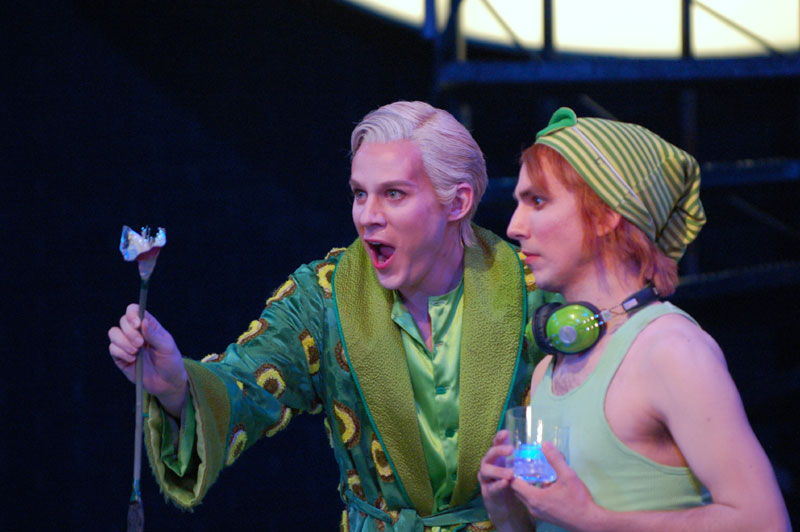
Ryan Belongie (Oberon) and Alexander Strain (Puck) in
A Midsummer Night's Dream (photo by Kim Pensinger Witman
for the Wolf Trap Opera Company) -- More photos
Benjamin Britten's operatic adaptation of Shakespeare's A Midsummer Night's Dream is one of my favorite 20th-century operas, which until now I have not managed to see in a live production. Having had to miss a production a couple years ago from Maryland Opera Studio (and David Kneuss's staging for Tanglewood before that), I was not going to make the same mistake with Wolf Trap Opera's new production, which opened on Friday night. Britten's music seems to make sense of this odd play, in a very modern way, stemming especially from the alluring, yet menacing figure of Oberon. For Britten, in whose works the loss of innocence is a major theme, there is something threatening and not quite right in the Fairy King's obsession with the "changeling child" protected by his queen, Tytania. It comes through in the magical, shimmering, otherworldly orchestration, which is at its most brilliant in the fairy sections of the opera.

Although it seems a little surprising to me, some people are still put off by Britten's harmonic and melodic style: at the end of the first act, which is heavy on Oberon's menace, a large portion of the audience got in their cars and drove away. This is a shame, because by the third act the opera becomes a rollicking farce with the performance of the "rude mechanicals," costumed in this production (directed by Patrick Diamond, costumes designed by Camille Assaf) as a highway construction crew in reflective vests and overalls. The concept included a mullet for Nicholas Masters's Bottom, played as the paragon of inept vanity, which required only a large pair of ears for him to be transformed into an ass. Among the group of six, the full low range of Kenneth Kellogg as Quince stood out, as did the cross-dressed hilarity of David Portillo's Flute, complete with voice cracks as he tested out his feminine range (Peter Pears, who created the role, would have been proud). Nathaniel Peake should win some sort of versatility award, having switched gears from the sadistic Soliman in Zaide to the hapless Snout, whose blithely tone-deaf performance as the Wall in the Act 3 play brought down the house.


available at Amazon
Britten, A Midsummer Night's Dream, F. Lott, I. Cotrubas,
J. Bowman, Glyndebourne Opera,
B. Haitink
The vocal discovery of the evening was countertenor Ryan Belongie, a smooth voice that did not edge into shrillness and was sized perfectly for the intimate size of the Barns. His mesmerizing stage presence had just enough threat to justify the title "King of Shadows" bestowed on him by Puck, a white-haired roué who stands out from the rest of the fairies, all topped with Tytania's bright orange hair. Ashlyn Rust's bright-edged soprano was suited to the pyrotechnical parts of Tytania, but an active vibrato made more sustained lines a little buzzy. The Arlington Children's Chorus had a summery, delicate sound as the fairy chorus (ably prepared by Kevin Carr), like all the fairies in bright green pajamas -- somewhat reminiscent of Robert Carsen's production for the Aix-en-Provence Festival -- except the quartet of named fairies, costumed as servants with feather-dusters. The quartet of lovers was well matched and convincingly directed, the nerdy Lysander of Paul Appleby and equally nerdy Helena of Rena Harms, in particular. Actor Alexander Strain was a high-energy presence in the spoken role of Puck.

Other Reviews:

Joan Reinthaler, Wolf Trap's "Midsummer Night's Dream" is a light, fun frolic (Washington Post, August 16)

Terry Ponick, Spend your 'Midsummer Night' at Wolf Trap's Barns (Washington Times, August 17)
Patrick Diamond's production was not quite as modernized and rife with malevolent imagery as David McVicar's staging for the Théâtre de la Monnaie but less traditional fairy land than Peter Hall's classic Glyndebourne production (available on DVD). A platform raised a tilted stage at an awkwardly raked angle (singers should get combat pay for having to walk on these), and designer Erhard Rom used the same spiral staircase at the back of the stage, in the alien prison in Zaide and here leading to Oberon's chamber above. Conductor Steven Osgood, in his Wolf Trap debut, led a vivid reading of the score, with only some of the string glissandi sounding less than tidy and unified. In spite of the separation of some of the instruments placed outside the small pit, the ensemble sounded convincingly on the same page most of the evening. It was a delightful end to a season of a few too many disappointments.

This production of Britten's A Midsummer Night's Dream will be repeated once more, on Tuesday night (August 17, 8 pm), in the Barns at Wolf Trap.