Welcome to #ClassicalDiscoveries. There is a little introduction to who we are and what we would like to achive at the first (or rather "double-zeroëth" episode). It still bears mentioning every time that your comments, criticism, and suggestions are most welcome, of whatever nature they may be. Now here’s Episode 002, where we’re talking about Alfred Schnittke's film music in general but more specifically about his music to the Mikhail Schweitzer filmed version of Pushkin's Little Tragedies on the occasion of Capriccio having released the 6th volume of their Schnittke Film Music series with that extended soundtrack. (With Vladimir Jurowski). I love Schnittke, and we get to play one of my favorite little bits of volume 4 of the series. (Which, admittedly, I panned, when reviewing it for Fanfare Magazine. Let us know if you find Schnittke half way as intriguing as we do:
The City Without Jews, a 1924 Austrian Expressionist film by Hans Karl Breslauer based on the novel of the same title by Hugo Bettauer, was first shown 100 years ago. For many years it was deemed lost, but after an intact copy was unexpectedly found some years ago, the Austrian Film Institute has stitched the film back together and made digital copies of it. While it’s good to have this rare film available and while it feels good (for Austrians, particularly, one reckons) to know that there were “good people” out there, who stood up against antisemitism, the quality of the film and the print – and its copies – is variable and dodgy.
The Salzburg Festival screened the film as part of their “Time with Schoenberg” series – although there was little (none, in fact) Schoenberg involved in this project. The new soundtrack was composed by Olga Neuwirth and a little prelude came courtesy of Hanns Eisler. Very apropos for Salzburg, that work was the Fourteen Ways to Describe the Rain. Well, as far as Salzburg is concerned, there are the impotent fat drops, that lazily plop from above, announcing an impending storm. There are middle-sized ones, that offer half trepidation, half hope, with a thunderstorm already or still being stuck behind one of the surrounding mountains. And then there are mean little needles of drops, that shoots down your neck from behind – themselves a prelude to the specific drizzle the locals call “ Schnürlregen”, a straight, light put consistent pour that has a dispiriting, it-will-never-end quality about it.
A Dearth of Ideas
Led by Nacho de Paz, the PHACE Ensemble performed the Eissler excellently (especially violist Petra Ackermann gave her best to make music out of Eisler’s quickly tiresome note salad) and the film music properly, along to their click-track. But the music was not particularly rewarding. Neuwirth's apparent dearth of ideas for the music to this film was baffling. At least half of it was smeared with a monotonously ominous, reverberant droning sound – quite regardless to what the film shows: Love scene: Droning. Singing in the synagogue: Droning. The only notable deviations are the interlacing of Austrian clichés (jodling, zither-music, and voice fragments of Hans Moser, a famous Austrian actor who had one of his first starring rôles in this film and whose apt physical comedy is already on display) into the soundtrack – and one telephone, that actually rings.
The film’s banal depiction of the reasons for the economic and financial crisis in Austria is close to being an antisemitic trope itself; the actual antisemitism that the film ridicules is so over-the-top, it’s a bit too easy to be against it. And the “good Jew” of the film, Johannes Riemann might be a sympathetic proto-Mr. Bean, but nine years later, he became Nazi Party member No. 2641955. Well, we can’t all be on the right side of history, I suppose.
More and more orchestras have added live music accompanying film screenings to the lighter side of their repertory in the last fifteen years. The National Symphony Orchestra gives a much-needed estival twist to this trend by hosting such performances during their summer residency at Wolf Trap. On Wednesday night, another capacity crowd filled the Filene Center and its lawn for the latest in the series, a screening of Harry Potter and the Deathly Hallows, Part 1, in spite of the humidity and occasional spritz of rain.
Such performances do not generally merit comment at Washington Classical Review, but the Ionarts children have always enjoyed attending them - other parents looking for an easy way to introduce young people to the sounds of a live orchestra may find likewise. Miss Ionarts, now in her college years, delighted in seeing a number of children attending in Harry Potter costumes. Released in 2010, this installment of the Harry Potter film series was a bit too frightening for Miss Ionarts back then, and there were still a couple jump scares that had their intended effect even now.
Alexandre Desplat composed the score, making use of themes first created for the series by John Williams. With Desplat's more pedestrian music, it is not exactly a score-driven cinematic experience like the Lord of the Rings or Star Wars films. Guest conductor Constantine Kitsopoulos, aided by the metronomic click track projected on the podium, lined things up just fine with the orchestra, but there were few genuine musical frissons to be experienced. Principal cellist David Hardy stood out for his eloquent solos in the closing act of the movie, for sad scenes I will not spoil, but most of the audience's cheers were sparked by memorable lines or actions from the characters on screen, rather than by the orchestra seated beneath it on stage.
Emil de Cou returns to conduct the NSO in Elmer Bernstein's classic score - complete with ondes Martenot (!) - for the screening of Ghostbusters 8 p.m. this Friday. wolftrap.org
For a film industry devastated by the coronavirus, the nominees in the major categories of the Academy Awards felt of lower quality as a group. Not really a surprise as most Americans have not seen a movie in an actual cinema for over a year, and the rules on qualifying for the awards were relaxed to allow entries from streaming platforms. At the top of the pile for this critic was The Father, which should win Best Picture, Best Adapted Screenplay (by Christopher Hampton and daring French author Florian Zeller, from Zeller's play), Film Editing, and Actor in a Leading Role (for Anthony Hopkins).
Also noteworthy were Nomadland, which should win Frances McDormand the award for Actress in a Leading Role; Mank, for Cinematography; Ma Rainey's Black Bottom, for Costume Design, Makeup and Hairstyling, and Production Design; Minari for Original Screenplay and Actress in a Supporting Role for the hilarious Yuh-Jung Youn; Sound of Metal for Sound; and the charming, disturbing Another Round for Best Director and International Feature Film.
On the other hand, the short films nominated for awards in their three categories were of a remarkable quality this year, or perhaps it is just that they are at their normal level and shine by comparison. The movies up for Animated Short Film took on subjects tragic (If Anything Happens I Love You and Genius Loci), whimsical (Burrow), and weird (Opera). The most charming, watchable nominee in this category was Yes-People, the entry from Iceland written and directed by Gísli Darri Halldórsson. A microcosm of existential desperation and human coping set in an apartment building, the film develops several stories in a deceptively compact eight minutes.
Among the nominees for Documentary Short Subject the entries were intensely personal, including A Love Song for Latasha (commemorating the shooting of Latasha Harlins in a Los Angeles convenience store in 1991), Hunger Ward (filmed inside the famine crisis in Yemen), and Do Not Split (shot from behind the lines of the Hong Kong democracy protests). Near the top was Colette, a searing look back at a very uncomfortable topic in France, the resistance to the Nazi occupation, involving the meeting between a young historian seeking to document the era and an elderly woman who fought in the resistance. Their visit to the concentration camp where the older woman's brother was killed is overwhelming to watch. The winner for me was A Concerto is a Conversation, a love song between jazz pianist and composer Kris Bowers and his grandfather, whose sacrifices and triumphs over racism laid the foundation for the younger man's success.
In the Live Action Short column, The Letter Room was strong, starring Oscar Isaac (Inside Llewyn Davis), and Two Distant Strangers put an odd, almost witty spin on the issue of police murders of black men in the United States. The strongest nominee is The Present, directed by Palestinian filmmaker Farah Nabulsi. It tells the story of the humiliating day-long journey made by a husband with his young daughter to buy a new refrigerator as an anniversary gift for his wife. This seemingly mundane outing is complicated because the man lives in the West Bank and must pass Israeli Checkpoint 300, near Bethlehem, to reach the store. One early morning scene was actually filmed guerrilla-style at the checkpoint, with the actor among actual Palestinians waiting to cross.
The Academy Awards will be broadcast tonight at 8 p.m.
Among the summer offerings of the National Symphony Orchestra at Wolf Trap was a screening of the classic film E.T. the Extra-Terrestrial on Friday night. It was a beautiful evening for it, with a cool breeze that could have been a little stronger to make up for the heat of the receding day at the Filene Center. It was heartening in a way to see that the crowd for this supposedly popular offering, in both the house and on the lawn, was smaller than the straight-classical program the NSO had played here last weekend.
The NSO's longtime associate conductor, Emil de Cou, continued his leadership of most NSO events at Wolf Trap for the screening. The Steven Spielberg film, released in 1982, was much funnier than I had remembered, and my son and I both enjoyed watching it again. John Williams, who has provided so much of the soundtrack of American cinematic lives for the last fifty years, may not be remembered principally for this film. In fact, there is not much to the score except some memorable moments created with papery piccolo solos, tingling celesta and harp, and quirky, almost mechanical loops.
That is with the noteworthy exception of the two flying bicycle scenes, the two places in the film where the NSO could really open up and soar. The effect with live orchestra was an exponential increase of the gooseflesh effect of Williams's full-orchestra treatment of one of his distinctive melodies. If some people who do not normally attend orchestra concerts experienced that feeling, this aspect of the NSO's "popular outreach" effort will have been worth it.
Daisy Ridley and Mark Hamill in Star Wars: The Last Jedi, directed by Rian Johnson
There is so much Disney profiteering on the Star Wars franchise, viewers going into the latest feature may be confused about what they are seeing. Your cheat sheet: this movie, The Last Jedi, is not a continuation of last year's Rogue One, the first in a series of spin-off films; this is Episode VIII of the main story line, taking up where The Force Awakens left off two years ago. Judging by the tepid attendance at a popular cineplex in the Virginia suburbs (perhaps the film did not need to open in quite that many theaters), most people do not need to be told to wait for this long, rather dull movie on Netflix. After all, even Mark Hamill didn't like it.
Rian Johnson has directed his own script, and where The Force Awakens mostly felt like it recycled the story line of Episode IV (the original Star Wars), The Last Jedi is a mix of reused motifs from The Empire Strikes Back and Return of the Jedi. A young hopeful touched by The Force (this time, Daisy Ridley as the feisty young Rey) seeks out an elusive Jedi master on a distant planet (this time, Mark Hamill reprising his role as Luke Skywalker). After undergoing training and confronting the Dark Side in a spirit quest in a cave, she ignores the wise old master's advice and goes to confront her nemesis, Kylo Ren (a regrettably dull Adam Driver, who looks like he has been on steroids), hiding his anger and disfigurement behind a mask.
There she faces Ren's all-powerful overlord, Supreme Leader Snoke (played by the omnipresent digital actor Andy Serkis), who has far greater power than she could have imagined. Indeed, everything that has transpired has done so according to his design. There is even an Ewok gambit in some cuddly residents of a distant planet that get in on the action, digital sheaths given to the puffins at the location, guaranteed to be under your Christmas tree soon. If this all sounds familiar, you know you are a Star Wars nerd. Other parallels abound, but in the interest of avoiding even worse spoilers, you will have to discover them yourself.
None of the hollow characters from The Force Awakens get much more interesting, as most of the powerful moments, such as they are, come from the old characters. Also like The Force Awakens the CGI effects and battle sequences are stunning, which is probably part of the problem. It is now all too easy to wow an audience with gorgeous planetscapes and massive explosions, and far more difficult, or so it seems, to craft a story and dialogue that will entertain.
One does question why the directing of this juggernaut fell to Rian Johnson, a director with a few television credits and thrillers (Looper, Brick) to his name. If you do like this installment of the franchise, you will be glad to know he is reportedly going to be writing a whole new Star Wars trilogy and directing at least one of them. This may be what we are to expect for a long time to come.
This movie is playing everywhere, around the clock.
Mark Rylance in Dunkirk, directed by Christopher Nolan
Director Christopher Nolan's previous movies have ranged from the intriguing (Memento, The Prestige) to the over-budgeted and overblown (Inception, yet more installments of the Batman franchise). He has reportedly long wanted to make a film about the evacuation of British armed forces from the French beaches at Dunkirk in 1940, and his box office successes gave him the opportunity. The taut, simplified, but effective Dunkirk, which opened over the weekend, is the result.
Fitting the story into the film's 106-minute span required streamlining. The other participants in the vast battle and evacuation (French, Belgians, Canadians) are largely ignored, and we experience the events mostly through a chaotic tangle of unexpected characters, sometimes hard to keep straight. A hapless British soldier, Tommy, played both naive and level-headed by newcomer Fionn Whitehead, manages to get to the beach and tries like many of the characters just to save his skin and get away. A trio of Spitfire pilots takes off for Dunkirk, where they try to protect British craft in the waters from the air (thrillingly shot in low-tech splendor), with the exploits of Farrier (played expressively by Tom Hardy, in spite of having his face almost always covered by an oxygen mask in the cockpit) proving the most important. Nolan's terse screenplay is full of silences.
Representing the famous little ships of Dunkirk, the private watercraft requisitioned by the Royal Navy and mostly piloted by their officers, is Mr. Dawson. This older character, who pilots the English Channel in dress shirt and tie, is given life and depth by the incomparable Mark Rylance (Bridge of Spies, Wolf Hall), as he takes the helm of his own boat with his teenage son (another newcomer, Tom Glynn-Carney) and young friend (Barry Keoghan). The three narrative threads overlap, with characteristic Nolan-esque time shifts, unified especially around another fine performance, that of Kenneth Branagh as a naval commander overseeing the evacuation.
These little stories, though told in a compelling way, do not add up to an appreciation of the entire battle, leaving me feeling a little cheated at the end. The cinematography (Hoyte Van Hoytema) is unfailingly beautiful, shot in large format film for IMAX and capturing grand vistas better than intimate scenes. (Watching this movie on a large screen is essential.) The sound, especially the occasional screaming of fighter planes, is hard to take. Hans Zimmer's score struck me mostly as pedestrian, often little more than a pulsating unison in one instrument or another. The only moment of musical grandeur is stolen from Elgar's "Nimrod" movement from Enigma Variations, predictably perhaps but to powerful effect.
Jean-Luc Godards's first full-length feature, À bout de souffle, was released as Breathless in the U.S. in 1961. Hitting the theaters a year after François Truffaut's Les 400 Coups and Alain Resnais's Hiroshima, Mon Amour, it helped launch the French film movement known as La Nouvelle Vague. François Truffaut and Claude Chabrol created the screen treatment, loosely basing the story on a newspaper article that Truffaut read about a man named Michel Portail and his American girlfriend Beverly Lynette. In 1952 Portail had stolen a car in order to be able to visit his ailing mother in Le Havre, killing a motorcycle policeman who tried to stop him. When the film did not work out for Truffaut and Chabrol, they gave it to Godard.
Godard changed the story significantly, reportedly writing the script scene by scene and then feeding the lines to the actors only shortly before each scene was shot, often prompting them as they shot. Seeking the gritty look of a documentary, Godard asked cinematographer Raoul Coutard to shoot the entire film on a hand-held camera, with next to no lighting. Working on a shoestring budget that made a camera dolly far too expensive, Godard pushed Coutard around in a wheelchair in the tracking shots.
The noisiness of the camera and the sound of Godard's prompting meant that most of the of the dialogue had to be dubbed in post-production, something that non-French speakers often miss because they are reading the subtitles. The interview scene at Orly Airport, featuring Jean Parvulesco (a journalist who had written articles on the Nouvelle Vague early on, played by Jean-Pierre Melville), shows exactly the sort of camera used in the film. Supposedly in response to a demand to shorten the film, Godard cut out many small sections of scenes, leading to an effect known as the jump cut.
The crew filmed entirely on location, instead of in studios as was the practice at the time, mostly on the streets of Paris in August and September 1959. People walking by the characters in crowd scenes are often seen looking back at them, curious about what's going on. Footage of presidential motorcades going down the Boulevard des Champs-Élysées is from the actual visit of President Eisenhower to Paris, where he met with General De Gaulle and spoke to the NATO council that September, a happy coincidence.
Godard shot most of the scenes in chronological order, except for the opening sequence, where Michel steals a car in Marseille and drives along R.N. 7 to Paris, which was shot last. The interior scenes were shot in rooms at the Hôtel de Suède, on the Quai St-Michel in the 5th. One can only assume that he arranged with business owners to have messages about the impending arrest of Michel Poiccard flashing on the news tickers as he shot along the Boulevard Saint-Germain. The magical moment, when Michel is standing by the car and the lights come on in the dusk of the Boulevard des Champs-Élysées, must have been carefully timed.
The Orly interview scene is only one of several meta-references in the film. Jean Seberg, an American actress who had lived in France part of her life, got her start in Otto Preminger's Saint Joan a few years before Breathless, when she was not yet 18. It was a flop, but Preminger still cast her in Bonjour, Tristesse, and Godard gave her an even bigger lift with the role of Patricia Franchini in Breathless. When Patricia ducks into a theater, trying to lose a detective tailing her, the movie playing is Otto Preminger's Whirlpool , released in 1950, a film noir about a woman, married to a famous psychoanalyst, who is arrested for shoplifting.
Patricia ditches the detective, and then Michel and Patricia go to another theater to see Westbound together, a Western with Randolph Scott and Virginia Mayo. At one point a young girl tries to get Michel to buy a copy of Cahiers du cinéma, the publication that both Truffaut and Godard started out writing reviews for. La Nouvelle Vague, as one critic put it, is cinema made by cinephiles. Godard even gives himself a significant cameo, as the nosy, pipe-smoking man who recognizes Michel's picture in France Soir and snitches on him to the cops nearby.
Another unseen but iconic aspect to the movie is the jazzy soundtrack by jazz pianist Martial Solal. He was a French citizen born in Algeria, the son of an opera singer and a piano teacher, and it was his only collaboration with Godard. He must be the one we hear furiously practicing tedious Hanon exercises on the piano at one point, something he must have heard a lot at home. Solal got his start playing the piano for American GIs in Morocco during WWII, and he wrote several film scores, this one being the most famous. You can get a feel for his style of improvisation from the clip embedded below, a take on Bronisław Kaper's song On Green Dolphin Street, made famous in a version by Miles Davis.
Disney's profiteering from the Star Wars franchise continues apace. The company moved the story's timeline forward last year, with a visually beautiful yet dramatically stultifying Episode VII, directed by J.J. Abrams. The next phase is a spin-off film series, filling in other parts of the saga, beginning with this year's Rogue One: A Star Wars Story. If the first installment is any indication, these films will mostly look like Star Wars films but will not slavishly retain all the traditional elements, such as the receding block of text in the opening sequence. This particular film is sort of an Episode IIIb, which provides the background events leading up to the start of Episode IV, where the love of Star Wars began. (Spoilers to follow.)
Our hero is Jyn Erso, played by English actress Felicity Jones (The Theory of Everything). She is the daughter of a scientist, Galen Erso (Mads Mikkelsen), whom the Empire has forced to build a moon-sized battle station capable of destroying an entire planet. Elements in the Rebellion save her from being sent to an imperial prison, because they hope she can lead them to one of their former allies, Saw Gerrera (Forest Whitaker), who has become too militant and no longer trusts them. She agrees, on the condition that she will be set free, and sets off with a pilot named Cassian Andor, played by Mexican actor Diego Luna (Frida, Y Tu Mamá También), and a reprogrammed imperial droid named K-2SO, honest to a fault and voiced by Alan Tudyk.
Along the way they pick up a blind Jedi warrior monk, Chirrut Îmwe, played by Hong Kong action star Donnie Yen, complete with impressive staff technique (Kung Fu meets The Force); his friend Baze Malbus (Chinese actor Wen Jiang), a man who trusts more in large weapons; and a defecting imperial pilot, Bodhi Rook, played by Riz Ahmed (Jason Bourne), a British actor of Pakistani descent. This Star Wars world is much less Euro-centric than its predecessors.
Thanks to an unremarkable script crafted by committee (Chris Weitz and Tony Gilroy's screenplay, based on a story credited to John Knoll and Gary Whitta), none of the characters has any real depth. As in The Force Awakens, the droid seems more human and gets bigger laughs, while some of the human characters, thanks to creepy digital technology, are played by living actors covered in dead actors' virtual skins. In both Peter Cushing's sneering Grand Moff Tarkin and the late Carrie Fisher's young Princess Leia, the performances fall somewhere in that "uncanny valley" that can turn a viewer's stomach.
Rogue One is visually just as beautiful and realistic as The Force Awakens, which makes it watchable but then instantly forgettable. English director Gareth Edwards, whose only major credit prior to this film was the 2014 remake of Godzilla, focuses on battle scenes, which thrilled Master Ionarts, without lingering much on any individual human element. Michael Giacchino furnishes a score that is symphonic in scope but is memorable only when it is quoting the famous themes of John Williams. (Williams, for his part, recently told an interviewer that he has never actually watched any of the finished Star Wars films and does not find any of the scores he wrote for the franchise particularly good.)
The good news is that there are more Star Wars movies to watch. Any fan of the franchise will enjoy guessing how the movie will tie up the loose ends to graft itself onto the start of Episode IV. The bad news is that the glory days of Star Wars are gone, likely never to return. What we have instead is another fiefdom of the Disney empire.
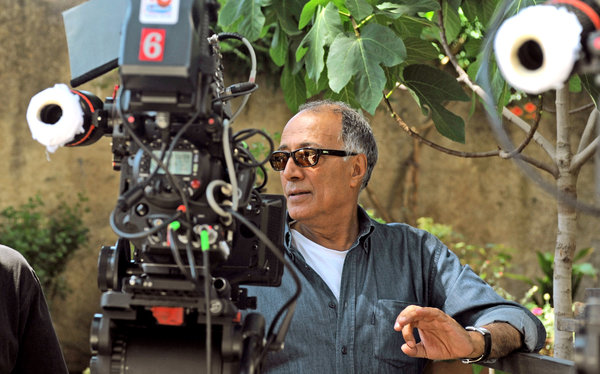
We are admirers of the Iranian New Wave here at Ionarts, and the biggest fish in that lake was Abbas Kiarostami. After making his last two films outside Iran, he died yesterday in Paris, after a long battle with cancer. Jacques Mandelbaum has a moving tribute (Abbas Kiarostami, emporté par le vent, July 5) today in Le Monde (my translation)
It is a major loss, of an immense artist -- photographer, poet, and painter -- who has left an indelible mark on the history of world cinema. According to the press agency ISNA, the director, whose health had worsened, had left Tehran last week to undergo a treatment in France, after having had an operation in mid-March in the Iranian capital.
So life comes to an end, even for the director of And Life Goes On. In that magnificent film from 1992, a filmmaker in Tehran, the director's double, is returning with his son to the locations of a previous film, where a deadly earthquake has just occurred, to search for survivors among the children who took part in the film. That search for life in a landscape of death, that humanistic aspiration under the straitjacket of oppression, was in truth the admirable constant of Abbas Kiarostami's work. A work undertaken with courage under the yoke of Islamic censorship, to the point of the director's exhaustion, having left to make films under other skies when the regime hardened its authority.
A master of the slow burn, Kiarostami made movies driven by characters and dialogue, or by the lack thereof, and he will be missed. We will be revisiting his masterpieces this month (see video embedded below).
Bernard Herrmann was the score composer for many great film directors, beginning with Orson Welles and continuing with Alfred Hitchcock, François Truffaut, Brian De Palma and Martin Scorsese.
Joseph Horowitz, whose PostClassical Ensemble is co-hosting a festival honoring the composer, wants us to remember that Herrmann was more than just a film composer, even though the majority of the festival’s events are film screenings. PostClassical Ensemble’s last festival performance fell on Sunday afternoon at the National Gallery of Art.
There should be no shame in being known as a film composer, especially when one’s credits include Hitchcock’s “Vertigo,” which critic Alex Ross once described as “a symphony for film and orchestra”... [Continue reading]
We have an annual cinema screening at school, for which a colleague and I do a panel to introduce the film, in the style of Robert Osborne's The Essentials show on Turner Classic Movies. This year we screened Federico Fellini's E la nave va, released in 1984, which was one of the last features completed by Fellini, who died in 1993. Fellini wrote the screenplay with Tonino Guerra, who wrote L'Avventura and La Notte with Michelangelo Antonioni in 1960 and 1961. Guerra, who died in 2012, also wrote other films with Fellini, including Amarcord.
Following the death of legendary soprano Edmea Tetua in the summer of 1914, her friends and devotees take a luxury ship together to the island of Erimo, where she was born, to scatter her ashes. The cast of characters is led by a hapless journalist, played by English character actor Freddie Jones, who serves as narrator, often looking directly at the viewer and speaking to us. Tetua's vain operatic colleagues are joined by an Austrian grand duke who was a fan, and in mid-voyage the captain picks up a group of Serbian refugees fleeing the conflict with the Austro-Hungarian Empire, about to ignite World War I. An Austro-Hungarian warship later demands that the refugees be turned over, with disastrous consequences. Celebrated soprano Ildebranda Cuffari, foremost rival of the dead diva, is played with cold reserve by Barbara Jefford, who was just seen in Philomena from 2013. The sister of the Grand Duke, the blind Principessa Lherimia, is played by Pina Bausch, the ground-breaking modern dancer and choreographer, who died in 2009.
E la nave va is also a meta-history of film, beginning in the silent era and ending in the 1980s on the edge of digital cinema. When the Gloria N. leaves Naples, the film is completely silent. We hear only the whir of the camera, until sounds gradually creep in, noises like the ship's horn. Characters' lines are still displayed on cards, like a silent film, until gradually voices enter the soundtrack, too. References to early film legends, like Charlie Chaplin, are worked naturally into the story. By the end of the film, the camera drifts away from its illusions -- the whole film was shot at the Cinecitta studio outside Rome, with effects that are often charmingly false -- to show another camera on a scaffold, the hydraulic-powered ship set (all designs by the legendary Dante Ferretti), the lighting, the cloth representing the sea, even coming to rest on the lens of another camera. It is a self-aware cinematic moment reminiscent of the end of Blazing Saddles. The details of the set are meticulous, down to the paintings on the walls, based on masterpieces but copied by Fellini's friend, painter Rinaldo Geleng and his son Giuliano. It is the opposite of the world of digital effects filming, with everything handmade and shot on a stage.
Fellini said he was inspired by a painting by Hieronymus Bosch called The Ship of Fools (shown at right). The "ship" is a tiny craft, on which a nun strums a lute while a Franciscan friar and several other men sing along. They lean in to take bites of a hunk of bread suspended on a string. A man reaches up toward a plucked chicken suspended from the mast; another vomits into the water. There is no way that this crazy craft with its lunatic crew can survive. The panel is the top section of the left wing of a larger altarpiece Bosch made around 1490, cut apart from the lower section, which is in the collection of the Yale University Art Gallery. The right wing of this altarpiece, Death and the Miser, is now in the collection of the National Gallery of Art here in Washington, D.C. The Ship of Fools, then, appears to be a depiction of the sin of prodigality, which Dante saw as the twin vice of avarice, or gluttony.
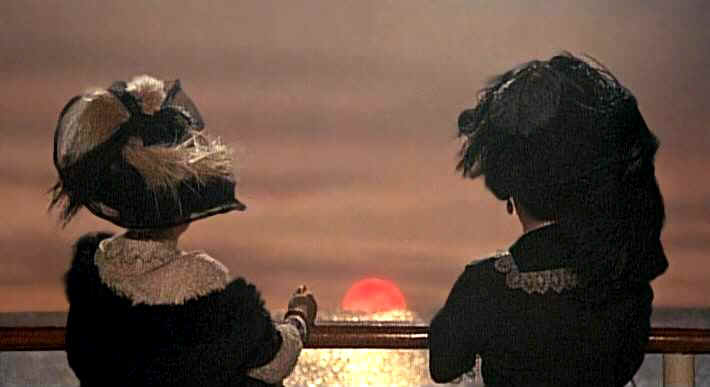
For Fellini the Ship of Fools was a metaphor for the creation of art, specifically about making a film. During the filming, Fellini put it this way: "I've decided to renounce the idea that I'm omnipotent when I'm directing. The more I'm convinced that I'm piloting the ship, the more the ship goes wherever it wants to. After the first few weeks, I'm not directing the movie anymore; the movie is directing me. It's nothing new. It happened to Geppetto, too. He was still there, working on his precious puppet, and then Pinocchio starts kicking him." Film is blissfully artificial, although it gives the impression of documentary reality. When the hearse arrives with the ashes of La Tetua, two men start to carry them toward the ship. The cameraman then arrives to film the scene, so they dutifully walk backwards to the hearse and start again, this time for the camera. At one point the ship dining room's maitre-d' asks the journalist to move to another location while he gives his narration to the camera, because he is blocking the path of the waiters in the dining room. As two ladies look at the setting sun, they remark that it looks painted -- which, of course, it is.
Music is at the heart of the film, with many sections of famous pieces, juxtaposed and arranged in different ways by Gianfranco Plenizio. The first music we hear, not long after sound enters the picture, is the Agnus Dei from Rossini's Petite messe solennelle, played in a piano arrangement by Plenizio. At more than one point, the maestro character suddenly begins conducting, and the whole cast becomes an opera chorus, taking up choral scenes from Verdi's La forza del destino and other works. There are waltzes by Johann Strauss for the Grand Duke of Herzog; a Schubert Moment Musical is played on tuned glasses in the kitchen scene; Debussy's Clair de Lune, from the Suite Bergamasque, plays a major part, and there is also his prelude Des pas sur la neige; Tchaikovsky's Nutcracker is heard for the sped-up kitchen scene and the slowed-down dining room scene, which has the look and feel of a ballet. Several parts of Rossini's William Tell are included, and in the ash-scattering scene we hear a recording of La Tetua singing O Patria mia from Aida.
The movies of Mel Brooks have long been a guilty pleasure of mine, none more than Blazing Saddles. One must be careful, however, when quoting or even referring to the film, because politically correct sensitivities have eroded some people’s sense of humor. In Blazing Saddles, Brooks has his characters say the things that are better left unsaid, making fun of racists, homophobes, sexists, and other small-minded people by blasting open the dam that holds back vile talk and sentiments. No trigger warnings here: you are going to hear what people really think.
Brooks is still going strong at almost 90, as he showed when he appeared at the Kennedy Center Concert Hall on Saturday night, in a Q&A session after a screening of Blazing Saddles. Truth be told, there were relatively few questions in this part of the event, mostly just Brooks sharing memories of how the film came to be made, in a rather delightful, slightly manic monologue.
Even people who know Blazing Saddles well may be surprised to learn that Brooks had wanted Richard Pryor to play the role of Sheriff Bart. The insurance company balked, because of Pryor’s problems with addiction, but the film is still partly Pryor’s work, through the writing he contributed to the screenplay. “All of the uses of the N-word,” Brooks said at one point, “were approved by Richard.” This sounds like retroactive butt-covering on Brooks’s part, but Richard Pryor, who died in 2005, could not be reached for comment. More surprising is that Brooks approached John Wayne for the film, possibly to take the role of the Waco Kid, which Gene Wilder eventually played. Brooks said that Wayne read the script and liked it, but declined because he had “too many white Christian fans.”
For such an outrageous film, was there anything that Brooks thought was too much? He claimed he had cut only part of one scene, the scene where Madeline Kahn’s Lili von Shtupp beds Sheriff Bart. In the darkness, she says, “Is it twue what they say about you people, how you are built?” After a pause, she exclaims, “It is twue! It is twue!” Brooks said that he cut the next part of the scene, where Kahn was making noises that sounded like she was performing fellatio. Bart then said, “I hate to disappoint you, Ma'am, but you’re sucking on my arm.” A friend quipped that if Brooks were making the film now, the blowjob scene would stay and all the racist and homophobic jokes would be cut. Different times.
Brooks said it was hard to get clean takes throughout the shoot because people lost it so much on set. When the actor David Huddleston said the line, “We don’t want the Irish" (in the scene embedded above), they had to do twenty takes because everyone was laughing so much. Eventually he bought everyone on the crew white handkerchiefs and told them to stifle their laughs so they would stop burning through so much footage. Incredibly, Harvey Korman never lost it during the shoot of Blazing Saddles, according to Brooks. The only time he after spoiled a take by breaking character was in History of the World, Part I, when he told Brooks’s king, “Your Majesty, you look like the piss boy.” Brooks said that he improvised the king’s now-famous response (“And you look like a bucket of shit!”), and Korman lost it.
Alexandre Tharaud, who last visited Washington in January, is an Ionarts favorite. The French pianist gave documentary filmmaker Raphaëlle Aellig Régnier (Les Villageois) permission to follow him in his travels and private life (up to a point) for a period of two years. The result, Le temps dérobé (from 2013, and released on DVD in 2014), is an intimate look at the performing life of the pianist, as we see his rituals in the green room before concerts, rehearsals with cellist Jean-Guihen Queyras and orchestras (including Les Violons du Roy, with Bernard Labadie), his work with composer Gérard Pesson on a new piano concerto. Washingtonians had the chance to see the film, which has not been widely distributed, thanks to the always rewarding film series at the French Embassy, where it was screened on Wednesday night.
The film is known in English, for better or worse, as Behind the Veil. Its actual title, which could be translated as Stolen Time or Time Eclipsed, refers to what Tharaud says at one point in the movie, about why playing concerts is so important to him. There is in every concert, maybe only for a short time but both for him and the listeners, a moment where time is suspended. That is apparently what keeps him going on the crazy, lonely schedule of an international performer. The movie is divided into sections shot in various cities around the world, as his time is taken up with practicing, yoga, a visit to a massage therapist or chiropractor, listening intensely to his own recording takes, an interview by remote radio connection. A scene where Tharaud worries neurotically over the sound of a piano he will be playing, ministered to by a pair of piano technicians, is reminiscent of similarly sound-obsessed performers in Pianomania.
No narration intervenes, and the music heard is never identified with subtitles. Listeners who know the piano repertoire will easily pick out most of what he plays: here are fragments of Debussy's Danseuses de Delphes, there is just the tantalizing opening of Couperin's Le Tic-Toc-Choc. It is not really a film for serious listeners, though, as no excerpt is longer than a minute. One hears both sections of the air from Bach's Goldberg Variations, which is pretty much the most extensive excerpt in the film. If you want to listen to how Alexandre Tharaud plays, you are going to be disappointed. If you want to see glimpses of him backstage and offstage and hear him speak about his life, in ways that border only occasionally on self-indulgence, the film hits the mark.
The next screening in the French Embassy's film series will beL'ombre des femmes, released last year by Philippe Garrel, this time at the Avalon Theater in Chevy Chase (January 20, 8 pm).
"(sob) You mean I could have held out for a larger percentage of international residuals?"
Star Wars, in case you missed it, has become a Disney franchise. The company that specializes in putting trademarks on beloved folk stories, to further its attempts to extract cash from your wallet, paid a massive sum for the rights to your favorite childhood characters and stories. Most fans think only of the "restart" given to the film series, with this month's excessively hyped release of Episode VII: The Force Awakens, but the effects of the buyout of Lucasfilm go much deeper.
Readers with children, like us at Ionarts Central, know that the mill turning the grist of Star Wars into pop pablum has been grinding away on the Disney Channel, where shows and specials can now make jokes and plot lines using the Star Wars characters and costumes. The iconic score by John Williams can be woven into Christmas music tags between idiotic kids shows, and there is even an animated series for kids, Star Wars Rebels, already in its second season, and a Star Wars Land in the works for Disneyland. The latest news about Disney's mounting financial woes can only mean that the Star Wars profiteering will accelerate. Lucas, who referred to Disney's purchase of the rights as "selling his kids to the white slavers," may not have gone too far.
What Disney trades on is the commercialization of nostalgia, betting that parents will shell out large sums to share prescribed sentimental moments with their children. For the most part, they are right, and that is where Episode VII comes in. All most fans wanted from the new film, directed by J. J. Abrams, was something to wash the bad taste of George Lucas's prequel films out of their mouths. Abrams co-wrote the script with Lawrence Kasdan and Michael Arndt, apparently with the goal of slavishly reproducing a long list of the average fan's favorite moments from the first classic trilogy of movies. Sure, it is fun to wallow in memories as cameo after cameo features every possible one-time character or beloved concept from the old movies, but at some point the story has to stop trying to cash in on fan cravings and generate its own interest, which it just did not. Not only was the script full of hard-to-swallow plot holes, the new characters are flimsy and forgettable. (Spoilers ahead.)
The new movie takes place thirty years after the end of Episode VI. General Leia, princess no more, and Han Solo have a son, Kylo Ren, who takes his obsession with his grandfather Anakin's legacy too far and turns to the Dark Side. Adam Driver, so memorably pissed off and weird in the delightful Girls, here is anodyne and devoid of menace in the role. Equally vanilla performances come from Daisy Ridley (an almost completely blank slate) as the feisty Rey, a scavenger who turns out to have a gift with the Force, and John Boyega (equally unknown) as Finn, an imperial stormtrooper with a heart of gold.
The talents of Oscar Isaac (so excellent in Two Faces of January and Inside Lleywn Davis) are wasted on the role of Poe Dameron, who is apparently a really good fighter pilot or something. Sadly, the most vivid character work is done by the new droid, BB-8, who is important because -- you can probably guess this -- he contains super-important plans (revealing the location of Luke Skywalker). All of this is a double-shame because so much about the movie is superb. The art direction and effects are the most gorgeously realized of any Star Wars film, and John Williams has again produced a top-notch score, weaving in his old themes in heart-moving ways.
This movie is playing everywhere, around the clock.
Here are some gift ideas from the CDs, DVDs, and books I enjoyed this year, in no particular order. Jens has already offered his thoughts on the best recordings of the year. When you buy through the links provided on these pages, Ionarts receives a cut at no extra cost to you -- so you are actually giving two gifts at once.
RECORDINGS
Sibelius, Music for the Theater, 6 vols., Turku Philharmonic, L. Segerstam (Naxos)
Leif Segerstam is recording all of Sibelius's music for the theater with his new band, the Turku Philharmonic Orchestra. Currently it numbers six discs, and it is all quite wonderful. Some of these pieces are better known than others, but many are tiny fragments one never hears. Sibelius's best-known incidental music is likely that for Maeterlinck's Pelléas et Mélisande, a gloomy musical setting for that murky Symbolist play. The set came to my attention because of the most recent volume, devoted to the longer score for Scaramouche. This delightful set of movements is for chamber orchestra, mostly woodwinds and strings, joined by four horns and piano, but Sibelius creates a wonderful tapestry of sound with these limited forces. [READ REVIEW]
--Vol. 1 | Vol. 2 | Vol. 3 | Vol. 4 | Vol. 5 | Vol. 6--
Haydn, Symphonies, Vol. 2, Il Giardino Armonico, G. Antonini (Alpha)
Any good recording of Joseph Haydn's symphonies is welcome at Ionarts, where the Austrian composer's music is a matter of faith. Last year the Alpha label and the Joseph Haydn Stiftung Basel inaugurated the Haydn 2032 project, for which Giovanni Antonini will record all of Haydn's 107 symphonies, divided between his period-instrument ensemble Il Giardino Armonico and the Kammerorchester Basel, in time for the 300th anniversary of the composer's birth, in 2032. Antonini worked with the former group on the first two releases in the series, and it puts its crisp and lightly balanced sound to excellent effect in these relatively early symphonies. In an unusual but value-enhancing way Antonini has included, on each disc of three symphonies each so far, a less-known work by one of Haydn's contemporaries. [READ REVIEW]
President Obama has yet to refer to the massacre of Armenians in Turkey during World War I as a genocide, something he made a campaign promise to do. Among those who have been willing to cross the Turkish government on this issue are Pope Francis, Evgeny Kissin, and Turkish novelist Orhan Pamuk. Given that Turkish laws curtailing freedom of expression are hardly enlightened, it is not insignificant that Fatih Akin, the director of this new film about the Armenian genocide, is German and not Turkish. While Akin's previous major films (Head-On, The Edge of Heaven) are about the Turkish immigrant experience in Germany and lighter in tone, this screenplay is set directly against the background of that tragic episode in Turkish history.
Nazaret Manoogian is a blacksmith in the small town of Mardin, not far from the border with Syria, where he and his family are members of the minority Armenian Christian community. He and his brother, like all young Armenian men in the town, are first separated from their families and sent off to work on chain gangs in the desert. While they are building roads, they see the next phase of this "extermination under the guise of deportation," as groups of women and children are force-marched past them further into the desert. (A similar religiously motivated extermination is being carried out in Syria and Iraq right now.)
In that sense, The Cut is not an attempt to show the Armenian genocide as a historical event, showing instead how such a devastating thing could unfold slowly, piece by awful piece -- so that even those targeted by the state's efforts would not understand what is happening to them until it is too late. Nazaret, played with steadfast calm by French actor Tahar Rahim, sees his brother and all his fellow conscriptees lined up to have their throats cut, but himself escapes with a wound to his throat that leaves him mute. He manages to track down his sister-in-law, abandoned like so many in a desperate desert camp, and never loses hope that he might find his twin daughters.
So the film is about more than the events of the Armenian Genocide, following Nazaret as he follows the trail of his daughters throughout the Middle East, Cuba, and the United States. Armenians, long spread out from their homeland, as we understand it today, were under the thumbs of Persian, Byzantine, and Ottoman emperors, as well as the Soviet Union, and in the 20th-century diaspora were spread even farther and wider. It is a worldwide scope that threatens to collapse the film under its own weight at times, even after Akin's screenplay was sharpened by co-writer Mardik Martin, whose last major credit was a little film called Raging Bull in 1980. (Martin's family, of Armenian descent, fled Iraq to come to the United States.) The screenplay is based on careful historical research, although the characters are fictional, and the relationships that play on Nazaret are complex. His life is spared by a Turk, Mehmet (Bartu Küçükçaglayan), and a Muslim in Syria, played by Makram Khoury, takes pity on him in the desert and nurses him back to health. Not only does Nazaret lose his voice, he loses his faith in God; but no one could blame him for that.
Whatever else may or may not be changing in Iran, the situation for filmmakers there remains restrictive. Iranian director Jafar Panahi, placed under house arrest after a run-in with his government's censorship machine, managed to make two extremely low-budget films, This Is Not a Film and the less effective Closed Curtain that were smuggled out of the Islamic Republic. Panahi, who is now apparently enjoying some greater liberty, has made a new feature that takes up many of the same themes as This Is Not a Film, blurring the lines between documentary reality and cinematic artifice. Its conceit, so flimsy as to be absurd, is that Panahi is driving a taxi around Tehran with an anti-theft camera on the dashboard, speaking to a series of passengers who happen to get into his car. The result is ninety minutes of delightful whimsy and meta-satire.
In a regime where "sordid realism" is strictly forbidden by the censorship laws, Panahi has extended discussions with a petty criminal (on the subject of capital punishment, no less), a DVD bootlegger (who promises that he can get Panahi any film or television series he wants, even dailies of films still in progress), and a legal consultant (defending women arrested trying to watch sporting events in stadiums, from which women are banned in Iran, with open references to Panahi's masterpiece Offside, the film that appears to have landed the director in all this trouble). This legal consultant, with whom Panahi openly discusses his own harrowing experience with the government interrogators, lays a rose on the dashboard in front of the camera, blowing a kiss of tribute to us, the viewers of "the world of cinema," who will never waver in their support of justice in Iran. While still claiming to be true to the conditions of the judgment against him -- twenty years without making any movies -- Panahi effectively thumbs his nose at any attempt to impose censorship on free expression in the digital age.
In one of the stranger passages in the film, two old women get into the director's taxi, carrying a gold fish in a large glass bowl. The goldfish may refer to Panahi's earlier film The White Balloon, which is about a little girl who wants to buy a goldfish, but the women are taking this gold fish to the Spring of Ali. As they explain, somewhat exasperated, they have kept this fish from the spring alive for a year. Now they must return the fish to the spring or they will die. (The spring, in the southern part of the city, is a pre-Islamic site, but these sorts of popular devotions do not die easily, surely a point of contention in the Islamic Republic.) The passenger with the greatest impact is Panahi's precocious niece, whom he picks up at her school. Like the DVD seller, who is pressed into service to record a wounded pedestrian's last will and testament with Panahi's cell phone, the niece seems more directly a filmmaker than her famous uncle, using her digital camera to create a short film for a class project. Parroting her teacher, she dutifully recites the absurd government regulations on cinema to Panahi, all of which are broken in the course of the film, just to be able to show the most basic things. Without being a critique of the government, Jafar Panahi's Taxi reveals the absurdities of living in a society under such rules.
This film opens today, at Landmark's E Street Cinema.
François Ozon's new feature Une nouvelle amie is perfectly timed. The story, about a young woman who discovers that her best friend's husband wants to become a woman, resonates in the post-Caitlyn Jenner era. At the same time, it is bracing to see the transgender issue from outside the American context, where a politically correct sanctimony, so perfectly satirized this week on the television show South Park, makes discussion impossible. In fact, transitioning from male to female may indeed be ridiculous, it may alienate one's friends and family, and it may even destroy one's life. Nonetheless, it is the only possible option for some people.
Ozon drew the idea, quite loosely, from a lurid short story written by Ruth Rendell in the 1980s, where the transgender issue is presented from a sort of horror-story perspective. Some of that uneasy quality is transferred to the female character, Claire, played with prim androgyny by Anaïs Demoustier (Belle épine) as someone who is uncomfortably close to her childhood girlfriend Laura (Isild Le Besco). When Laura dies, Claire cannot seem to go on, but her husband, Gilles (Raphaël Personnaz, from The Princess of Montpensier), tries to get her to heal by helping out Laura's husband, David, and infant daughter. The four friends are BCBG (bon chic, bon genre) to the max, living in American-style McMansions in the wealthy far exurbs of Paris, and it is a shock when Claire finds David dressed in Laura's frock and a blond wig.
This is where the movie became so weird and absurd, so infatuated with its own kitsch, that I almost stopped watching. Actor Romain Duris, whom you may recall as one of the students in Cédric Klapisch's L'auberge espagnole or in the title role in Laurent Tirard's Molière, is not bad in drag. Claire helps David sort out his feelings about becoming a woman, on shopping excursions and most memorably at a drag show one weekend (featuring the 1970s pop song Une femme avec toi, sung by Nicole Croisille, which apparently became a French gay anthem). What kept me watching was Ozon's directorial tics, swerving between his tendencies as a filmmaker, alternately towards screwball comedy (Potiche) and psychological thriller (Dans la maison). While not a good film exactly, it is at the least an unusual one, albeit with some explicit sexual themes that may make some viewers uncomfortable.
Jean-Pierre Dardenne and Luc Dardenne, the Belgian brothers who form a writer-director team, had good critical attention once again at last year's Cannes Film Festival. Their 2014 film Two Days, One Night played earlier this year at Landmark's Bethesda Row and again, on Tuesday night, on the French Cinémathèque series at the Embassy of France. Like most of their films, including their most recent Le gamin au vélo, this film focuses its lens on the less than glamorous working neighborhoods of Wallonie.
Leadership at Solwal, a company that makes solar panels, has laid off one of its workers, Sandra, played with gritty beauty by Marion Cotillard. The Dardennes' script slowly reveals the details: Sandra was on medical leave because she suffers from depression, and while she was gone her boss discovered he could run his shop with one less salary to pay. The workers voted to accept a thousand-euro bonus in return for agreeing to Sandra losing her job, but Sandra's friend in the group has convinced the owner to allow the group to vote again, to give Sandra a chance to speak to them. Sandra has the weekend to convince her co-workers to give up their bonus so she can have her job back.
It may not seem like enough to sustain a viewer's interest over an hour and a half, but Cotillard and the Dardennes' script make this unlikely story compelling. Cotillard is as plain as possible, with no makeup, discount store clothes, and her hair unstyled. Sandra struggles to make it through her day, sleeping late and popping Xanax after Xanax. The lingering symptoms of depression make it difficult for her even to fight for the chance to hold on to her job. Her gentle husband, Manu, played by Fabrizio Rongione in a way reminiscent of Daniel Auteuil, does his best to keep her on task, because his salary at a fast food restaurant only goes so far and their two children are worried that their mother will be "sick again." The stories of the coworkers make you realize that this whole community is hurting, and that theme is personal for the Dardennes: they grew up in Seraing, where some of the locations in the film were shot.









#/media/File:Triptych-Bosch-reconstruction.jpg)