CD Reviews | CTD (Briefly Noted) | JFL (Dip Your Ears) | DVD Reviews

25.1.08

Ionarts at Large: Good Martha, Bad Opera

available at Amazon
Flotow, Martha, Heger / Bavarian State Orchestra / Rothenberger, Fassbaender, Prey, Gedda et al.
In a German opera guide from the 1960’s, Friedrich von Flotow’s operas are described as “amiably complaisant” – and that’s the guide talking about the two best operas. The more popular one, Martha, or the Market of Richmond, has (barely) clung unto being in the repertoire of a few Germanic opera houses and the occasional revival elsewhere. But the times where this was a repertoire staple (either in German or the oft-performed Italian version) even at the MET, are over. Having finally heard the opera live at the Volksoper in Vienna, I’m tempted to say: “Thankfully”.

I often see this feeble, harmless operetta about love and its tribulations in the English Countryside described as a lost masterpiece, a “rich, tuneful, melodious” work – and great surprise expressed that it should languish now, neglected and forgotten. I wish not to infringe on anyone’s joy, of course. As M.D.Calvocoressi has written: “[T]rying to make people see that their taste and faith is at fault [means] you are proposing, not to add to their stock of artistic pleasure, but to detract from it. The task is as graceless as that of taking a bone from a dog.”

So if you are into music that exudes the profundity of off-day-Rossini and the light charm of early Wagner (think Rienzi), and would not mind randomly added Magic Flute and Fledermaus moments, all executed with the sophistication of a country-fair band or beer hall songs, then Martha is for you! Flotow’s earnest attempt to fuse comic German opera with French opéra comique fails… or maybe it actually succeeds – I suppose it depends on what you think of the genres.

You can pay a smaller price for Martha's charms by listening to it highlights, for they are all contained in two moments: the tenor aria “M’appari tutt’ amor” (probably more famous in this Italian version than the German original “Ach, so fromm, ach so trau”) is available from nearly a hundred tenors on recital discs (or on YouTube, for that matter). The oft recurring hit aria “Die letzte Rose”, meanwhile, is the Irish song of Sir John Stevenson’s to Thomas Moore’s poem “The Last Rose of Summer”, clumsily cut and paste into the rest with key-changes so awkward, you can hear the gears grind. This touch of an Irish song being the key piece of local English flavor is a nice added bit of cultural insensitivity despite (or because) of British occupation of Ireland at the time.

The story is told quickly enough: Lady Harriet Durham is bored at court and needs diversion. This is provided by dressing up as ‘regular folk’ and attending the market where maids offer their services to prospective employers. When she and her confident Nancy are accidentally chosen by Plumkett for service at his estate, they decide to play along. Plumkett’s step brother, “whose heritage is shrouded by mystery”, falls in love with Harriet (masquerading as “Martha, the maid”) who turns him down. The two ladies escape with the help of their hapless cousin Tristan (who fancies Lady Harriet himself).

While Plumkett extols the virtues of porter, a group of hunting ladies rides by, among which Plumkett and Lyonel recognize ‘their maids’. Harriet denies everything – including her true feelings (especially since Lyonel is beneath her in social rank) – and accuses him of madness. About to be arrested, Lyonel gives his ring to Plumkett to give to the Queen when in need or danger – for this is supposed to save him. Turns out Lyonel is of noble heritage, after all, and now Harriet is interested in him again. Now he turns her down. She has the market-scene re-created and offers herself to Lyonel as the maid that he thought her to be when they first met. Naturally Lyonel now realizes that her love is genuine and Plumkett marries Nancy, to round things off.

It’s like someone traipsed through the librettos of Roberto Devereux, and Midsummer Night’s Dream and took random plot elements to cast a new opera out of it. The story and clunky verse (Wilhelm Friedrich a.k.a. Friedrich Wilhelm Riese) does have the advantage of making the music seem sophisticated.

Not that you would have known from the performance at the Volksoper, because most of the cast sang a German that was incomprehensible. Pavel Černoch’s Lyonel (tenor) was valiant effort and a few beautiful moments, but little more – and he sounded like he had a hot potato in his mouth. Ulrike Pichler-Steffen’s Nancy (mezzo) was sadly underpowered, pleasant but week, pretty and nimble. The mostly crass and crudely, usually imbalanced, and sometimes professionally playing orchestra (direction: Elisabeth Attl) was no help in that regard. Mathias Hausmann’s Lord Tristan dropped off at the lower end of his register, but he affably acted out the Lord Tristan shtick as an effeminate, pompous buffoon.

If, after all of this, the performance was still plenty worth having heard it was because of Lars Woldt’s full, round, and reliable bass as Plumkett – and foremost because of Jennifer O’Loughlin’s Lady Harriet Durham. The native Pennsylvanian who has filled in for Diana Damrau’s Susanna at the Salzburg Festival in 2007 (and covered the role for Anna Netrebko in 2006) stood out and apart with a clear voice that, though modestly sized, carries very well. The notes were secure even at the very top and nimbly produced. Not yet the last word in flexibility, there were moments that struck me as a bit steely – but never unpleasantly so. A voice just waiting to be cast to great effect in oratorios, for example.

Her performance was like a touch of silver on the otherwise modest production that annoyed with cheap props (plastic foam on plastic cups in the beer scene – a full moon that was nothing but a white plastic covered lamp through which you could see the neon bulb). The staging itself was well done, and in it’s rustic way just what the opera needed (or deserved). The lighting was unimaginative. Whoever thought of sticking little kids into dog costumes for the hunting scene should be forced to so appear on stage him- or herself.

Dawn Upshaw Is Back, in Style


"I listened often to Lorraine Hunt Lieberson's recording of Bach's cantata Ich habe genug (I Have Enough), especially the aria Schlummert ein (Fall Asleep). It happens to be a glorious piece, but it's also an extraordinary performance -- one that is blessed, and that blesses us."

-- Dawn Upshaw, on music that inspired her as she battled breast cancer (Minneapolis Star Tribune, January 11)
Dawn Upshaw gave a sold-out recital on Wednesday night in the Kennedy Center Terrace Theater, as part of the Fortas Chamber Music series. The celebrated American soprano, who was diagnosed with breast cancer late in 2006, has recovered from aggressive treatment and returned to performing. The recipient of a MacArthur Foundation genius grant this past fall, Upshaw is beloved by listeners for her radiant voice and intensely dramatic style of singing. Addressing the audience after her first piece, Upshaw explained that her recital program had no overarching theme: the songs were selected, about one year ago, because they were "what I would like to sing after chemotherapy." The capacity crowd in the Terrace Theater, who could not refrain from applauding after each and every song (ignoring the clear divisions implied in the program), was clearly delighted that she was able to sing them.

Much of the program was suffused with simplicity (Foster's parlor song Beautiful Child of Song and Ives's Two Little Flowers), whimsical humor (Debussy's La Flûte de Pan and Ravel's Le Cygne), and hammy playfulness (three of Bolcom's Cabaret Songs). As many of the songs came from Upshaw's burgeoning recital discography, the effect was a "Best of Dawn Upshaw" evening, with the added benefit of the sympathetic and vital presence of the singer herself. Indeed, many of the more serious songs on the program followed the theme of ecstatic awakening, putting me in my mind of how precious music is and, as a result, how fortunate we are to have Upshaw's voice in our ears. Upshaw chose to read the translation of Charles van Lerberghe's poem L'aube blanche, set by Fauré in his Chanson d'Eve:
And my soul, like a rose,
Trembling, languid all day long,
Awakens to the beauty in every thing,
And my heart to each thing's love.
Although she sings music from many periods, it is her championship of contemporary music, like the new song cycle by Dutilleux we heard her sing in 2006, that has been her greatest contribution. The undoubted high point of the recital came at the end of the first half, with two songs from Olivier Messiaen's exquisite Poèmes pour Mi, selections recorded on Upshaw's 2004 Voices of Light CD. A haunting, lovely performance of Le Collier (about the "necklace" of a lover's arms entwined around one's neck, poems by Messiaen himself) combined an opalescent melody from Upshaw in the refracted sunlight of harmony from the piano, played with impressive sensitivity by senior accompanist Gilbert Kalish.

Dawn Upshaw:
available at Amazon
Voices of Light


available at Amazon
Goethe Lieder


available at Amazon
Songs to Morpheus


available at Amazon
Ainadamar
In a moment that can only be described as religious, Upshaw then offered up the Prière Exaucée, in which the soul cries out for grace in a howl of supplication. The hair on my arms literally stood on end as Upshaw sang, as she surely thought as she emerged from her fight with cancer, "Ring out, my heart! / Joy has returned." The contemplation of the dreadful possibility of death seems to have been behind the intense emotion in Upshaw's performance, in a second-half German set, of Mignon's Kennst du das Land, too. Pianist Gilbert Kalish was a consummate accompanist, flustered only once when a page-turning incident forced him to restart Ravel's Le Cygne. His solo contributions, the Alcotts movement from Ives's Concord Sonata and the op. 119/1 intermezzo by Brahms, were notable more for their tender introspection than forceful pianism.

Other Reviews:

Anne Midgette, Upshaw's Freshly Picked Bouquet Of Favorites (Washington Post, January 25)
What has happened to Upshaw's voice after chemotherapy? It is hard to say with certainty because, although it was not announced, she may be recovering from a cold caught in the Great White North, where she recently inaugurated her tenure as artistic partner with the St. Paul Chamber Orchestra. The lower range seemed enriched and the high occasionally strained, with some intonation issues creeping in here and there and some raspiness in a few crucial spots. Her breath support may also have been affected, but if anything the joy and intensity of her singing have only increased, as has her disarming and informal way with audiences. Her two encores, Schubert's Im Frühling and Ives's Memories, reinforced another major theme of this supposedly themeless recital: the ecstatic reverie that song can inspire, not only in the listener but in the singer. Let us all give thanks for our own prière exaucée: Dawn Upshaw est revenue.

The next concert in the Kennedy Center Fortas Chamber Music series features violinist Barnabàs Kelemen and pianist Shai Wosner (February 4, 7:30 pm) in the Terrace Theater. They will play violin sonatas by Mozart, Bartók, Debussy, and Brahms.

24.1.08

Monsters of Grace

available at Amazon
Philip Glass, Monsters of Grace, Philip Glass Ensemble
(released October 9, 2007)
Orange Mountain Music 0041
The digital opera Monsters of Grace was premiered in 1998, a collaboration between Philip Glass and Robert Wilson, twenty years after their ground-breaking work Einstein on the Beach. Co-commissioned by the UCLA Center for Performing Arts and a dozen other institutions (including Wolf Trap, one of the many places it was performed in 1998 to 1999), the work was widely considered a failure because the visual aspect, a full-length computer animation feature, was far more complicated to produce than the creative team expected. Robert Wilson ended up washing his hands of most of the visual decisions, leaving the filmmakers, Jeff Kleiser and Diana Walczak, to make of his designs what they would (video clips from the MOG animation are available at the Synthespians Flash-heavy Web site). Now, almost ten years later, Glass has released a recording of his musical score for the project, on his private label, Orange Mountain Music.

The title of the project comes from Wilson's own malaprop (a distortion of Hamlet's line "Angels and Ministers of grace, defend us!"), and it provides the kernel-idea behind the work. The "libretto" is a set of lyrics ostensibly by the 13th-century Turkish philosopher Jelaluddin Rumi, in an English "translation" by Coleman Barks. Barks has helped engineer the recent wave of interest in Rumi's poetry through his rather creative editions, although he does not speak Persian and creates his "translations" by simply reworking older English translations. Unfortunately for the real Rumi, the founder of the Mevlevi Order (now commonly known as the Whirling Dervishes), his work has now been inextricably associated with Deepak Chopra, Madonna, Oliver Stone, and others who have popularized his work. For a related phenomenon, see the must-read article on Kahlil Gibran (Prophet Motive, January 7) by Joan Acocella in The New Yorker.

Philip Glass, b. January 31, 1937Glass's meditative, pulsating music is better suited to Sufi mysticism (or, rather an American New Age approximation of it) than what Christopher Theofanidis composed for his Rumi-based choral work The Here and Now from a few years ago. Without being able to comment on the visual component of this "cyberopera," Glass's score is one of the most appealing he has produced in the last decade. The basic instrumental palate of woodwinds, various sizes played by the three-member core of the Philip Glass Ensemble, is augmented by synthesized sounds from the keyboards of Michael Riesman and Glass himself, which help tilt the colors evocatively toward the East.

Glass's usual vocal collaborators are here, too, in all of their clear-voiced abstraction, closely miked as they must be to capture their fragile sound. The treble voices, soprano Marie Mascari and mezzo-soprano Alexandra Montano, sound as much like astral twins as they ever have, although baritone Gregory Purnhagen, who has quite a few solo moments, has a voice that pleases more as part of the quartet. This score also reminds of my recent assessment of Glass as the modern counterpart of Antonio Vivaldi: Glass's music appeals widely, is mostly programmatic and rhythmically activated, trades on formulas in easy-to-understand forms, and is characterized by a high degree of self-borrowing. If you do not like Glass's music, this is not for you, but if you are interested in the development of opera as a modern genre, you should give a listen.

Rap 23

This delightful and beautiful adaptation of Psalm 22 (23) came to my attention by serendipity this morning. It is by DJ Renegade ( Joel Dias-Porter), one-time poet-in-residence at Ballou High School here in the District.

The creator's my homey, so I'm never short.
He lets me know when to chill in the park
and when to cool out by the river.
He schools me with knowledge of self
and keeps me doing the right thing, to protect his rep.
And yo, even when I step through the shadows
of the buildings in the projects,
I don't sweat it, cuz he's got my back.
He flexes whenever suckers try to jump bad
and keeps me hooked up.
I'll definitely be living large until I'm outta here.
And then I'll be chilling at his crib, forever.
Peace.
The idiom fits perfectly into the language of many of the psalms, anguish and defiance in the face of oppression. A complete adaptation of the Psalms should be DJ Renegade's next project.

23.1.08

Mark Padmore's Dowland Songs

available at Amazon
Dowland, Lute Songs / Britten, Nocturnal after John Dowland, Mark Padmore, Elizabeth Kenny, Craig Ogden
(released January 8, 2008)
Hyperion CDA67648
This new release from Hyperion is the perfect antidote for the serious listener turned off by Sting's crossover expedition into the Dowland lute songs. What was charitably described here as "not an ideal version of Dowland's music" some decried as mass audience pablum, and with some reason. That type of listener may want to consider this CD as a follow-up gift for that classical-shy someone who enjoyed Sting's Labyrinth, an enticement along the path to the dark side. Considering my recent praise of Mark Padmore's new Handel, it is no surprise that his performance of this baker's dozen of delectable lute songs should get a recommendation. Not least because it presents not only the lachrymose Dowland but the randy, witty Dowland ("Her eye commands, her heart saith No. / No, no, no, and only no! / One No another still doth follow").

Here are all the things that, for better or worse, were missing from Sting's version: exquisite diction, studied and pure pronunciation, warm and burnished vocal tone, endless breath support. The incredibly long note at the end of Sorrow, stay! will take your breath away, although Padmore sounds like he had some left over. Elizabeth Kenny, a distinguished lutenist who is heard frequently with Les Arts Florissants and the Orchestra of the Age of Enlightenment, is a sensitive partner, allowing Padmore to anchor the ends of phrases, add rhythmic touches to important words, and treat repeated phrases with an eye toward variation. She also contributes three solo pieces, including one of the fantasias from Dowland's collection of études.

The warm sound, captured in London's All Saints Church (East Finchley), renders the fragility of the genre, music that is meant to be heard from as close as possible, without introducing too much distracting detail. As a companion piece, guitarist Chris Ogden also performs Benjamin Britten's Nocturnal after John Dowland, op. 70, composed for Julian Bream to play at the 1964 Aldeburgh Festival. It is a marvel to hear the opening measures of this work directly after the Dowland song that inspired it, Come, heavy Sleep. The bitonal -- really pretonal -- harmonic mixture of the song is distorted and exploded by Britten in the first movement and throughout the series of contrasting affects, leading to a hazy restatement of Dowland's gorgeous original at the end.

Two Recent Prokofiev Recordings

available at Amazon
Yefim Bronfman, Perspectives
(released December 11, 2007)
Sony Classical 88697-21081-2
Yefim Bronfman is being featured this season in the Carnegie Hall Perspectives series, for which musicians are asked to put together their own concert series that explore their individual musical personalities. The opportunity has brought Bronfman into a press limelight, including a meaty feature by Anne Midgette (A Star Who Plays Second Fiddle to Music, December 15) in the New York Times last month, as well as a lot of coverage of his rush-hour charity concert in Grand Central Station. To mark the occasion, Sony has released this retrospective, bringing together some of the recordings the pianist made for the label in the 1990s. Bronfman bridles at being labeled a specialist in Russian music, but this 2-CD set, devoted to Bronfman's mastery of Russian composers, offers all of the reasons why that reputation remains. Affordably priced, it makes a good introduction to the Russian literature through Bronfman's capable hands.

The first three of the five Prokofiev concerti come from Bronfman's complete set recorded with Zubin Mehta and the Israel Philharmonic. (Nos. 2 and 3 are scheduled for Bronfman at Carnegie Hall, on February 5 with the Royal Concertgebouw and March 1 with the Vienna Philharmonic.) As with so much of Prokofiev, there are piles and piles of notes: Bronfman gets them all (or a very high percentage) and finds the right tone of irony or fantasy in each movement. The sonatas -- my two favorites, no. 2 and no. 7 -- are explosively weighted but ultimately less convincing, especially no. 7, recorded in 1987. It is a work that Bronfman would undoubtedly record even more solidly and musically today. More recent solo recordings give a better impression of Bronfman's pianism, selections from his Tchaikovsky Seasons and Balakirev's Oriental fantasy Islamey. I was already sorry to miss Bronfman's Shriver Hall recital last month, where he played Islamey (the same program as the December 17 recital at Carnegie Hall).


Esa-Pekka Salonen, Piano Concerto, 2nd movement
BBC Proms, BBC Symphony Orchestra, Yefim Bronfman,
conducted by the composer (July 30, 2007)


Available at Amazon:
available at Amazon
Lise de la Salle, Mozart/Prokofiev
(released April 24, 2007)
Naïve V 5080
All this Prokofiev brought to mind another recent release, a solo double album by French prodigy Lise de la Salle. It is one disc of exquisite Mozart, with each note set carefully in place by her delicate, shaded touch, and another of raucous Prokofiev. This recording made the recommended list for 2007 that Jens offered at the WETA blog, and it makes me regret even more the circumstances that did not allow me to attend her 2007 recital at the Strathmore Mansion, where she played this very program (Mark Estren reviewed for the Post), not to mention her 2004 debut recital at the Terrace Theater.

Her Prokofiev selections include the outrageously virtuosic, especially the four-minute wild ride of the op. 11 toccata, but also the single-movement third sonata. Unlike Bronfman, de la Salle does not push the tempo as fast as she probably could (at 4:32, well behind 16-year-old Claire Huangci at the stunning but unnecessary 3:45, Martha Argerich at the near-perfect 4:12, and even Prokofiev's own piano roll at 4:22), although she plays at a vicious clip when it suits what she is trying to do in shaping the piece. Much of the most interesting playing comes in the selections from the Romeo and Juliet suite, in which de la Salle often stretches and distorts the musical fabric in the quest for some new color or texture.

Some listeners may not like it because it is not what they expect if they have previously formed ideas about Prokofiev, but others like to be surprised sometimes. To these ears, it bodes well for de la Salle's forthcoming concerto recording, which will include the first Prokofiev concerto. The 30-minute DVD (Lise de la Salle, Majeure, directed by Jean-Philippe Perrot) included in this release has some excerpts from the concerto recording sessions in Lisbon, as well as lovely footage of the pianist speaking (sometimes with her mother) and playing at La Roque d'Anthéron and at George Sand's home at Nohant.


Prokofiev, Toccata in D minor, op. 11
Lise de la Salle, piano

As for the Mozart, her reading of the little A minor rondo (K. 511) brilliantly captures the sly, seductive qualities of the piece, in a way that makes Richard Egarr's otherwise capable performance on his recent recording seem almost prosaic. Two variation sets, the last movement of the (complete) D major sonata, K. 284, and the famous C major variations on Ah, vous dirai-je, Maman, K. 265, occasionally startle in their sparkly flash. Then she plays the penultimate variation as a sad French song, which of course the theme is, in a funny way, bringing out the similarities to Michel Legrand. All the more remarkable in that Lise de la Salle will be 20 years old this year.

22.1.08

Washington Bach Consort

In recent years, the Washington Bach Consort has taken to styling itself "The Nation's Premier Baroque Chorus and Orchestra," using the phrase on their Flash Web site and in the program for their Sunday afternoon concert at the Harman Center. Since that assessment is not credited to a newspaper critic or other independent source, we must assume that the words were chosen by someone within the organization. If so, it is an act of hyperbolic hubris, a Cassiopeian boast, that cries out for comment, and the lot appears to fall to me to pose the question. Is the Washington Bach Consort actually the nation's premier Baroque chorus and orchestra?

Sunday's concert was generally good, on par with most of the group's performances, but there were enough sounds that were frankly mediocre to cause a reasonable person to say nay. This performance of five concerti for violin and harpsichord was rife with the problems of intonation and accuracy that Pinchas Zukerman famously criticized as proving that period performance must be an aberration. As lead soloist, concertmaster Tim Haig played with consummate musicianship, but at the fleet tempi of many fast movements (sometimes arrived at after considerable disagreement in the opening bars, as in BWV 1043 and 1052), the other string players struggled to keep up or underplayed.

The slow movements of BWV 1041 and 1043 had a pleasing lilt but may have been just a notch too fast. The contributions of two other violin soloists, especially in the triple-violin concerto BWV 1064R, were valiant but marred more often than not by squeaky, imprecise playing. The ultra-capable harpischord soloists were Scott Dettra and the group's director, J. Reilly Lewis, who both played extremely well on BWV 1062, Bach's reworking of the concerto for two violins as a double-harpsichord tour de force. It was a mixed concert in many ways, and the polite applause offered by the group's supporters (who did not fill the Harman Center's mid-sized hall) was tellingly brief.


Cassiopeia mosaic from Palmyra,
Syrian National Museum
Over its 30 years of playing the music of J. S. Bach in the Washington area, the Bach Consort has made three concert visits to Germany (1981, 1985, and 2000) and released three recordings on minor labels (a complete Bach motets set from Pro Organo now hard to find, a very good pairing of the C. P. E. and J. S. Bach Magnificats from Newport Classic in 1999, and a worthy disc billed as volume 1 of a complete set of J. S. Bach's Mass settings from Loft Recordings in 2004). A new recording of soprano cantatas with Elizabeth Futral, presumably made in the wake of their 2006 concert collaboration, is expected. In their concert history, they have given good, sometimes excellent performances of all (or nearly all) of Bach's choral masterpieces, sometimes under distinguished guest conductors, and almost always here in Washington.

The best contribution the Bach Consort makes to Washington's musical life is their monthly cantata series, during the course of which the group has recently completed performing each and every Bach cantata at least once. As reviewed here a few times, these noontime concerts, offered free of charge to the public, are a treasured moment of peace in the busy lives of many people. Still, does this worthy history justify the group's self-appellation as the leading exponent of the HIP (Baroque) movement in the United States? Does the Washington Bach Consort really merit comparison to the best European Baroque music ensembles -- say, Les Arts Florissants or Les Musiciens du Louvre (France), Concerto Italiano or Venice Baroque Orchestra (Italy), the Akademie für Alte Musik Berlin (Germany), or the Academy of Ancient Music (U.K.)?

Other Reviews:

Cecelia Porter, Bach Is Instrumental To Consort's Success (Washington Post, January 24)
On balance, while there is much to admire, it seems they are not there quite yet. By comparison with the situation in Europe, the HIP movement in the United States is generally moribund, but groups like Apollo's Fire (Cleveland) and the Boston Camerata at least travel more regularly and are known more widely outside Washington. In fact, Le Monde named the Boston Camerata as "America's foremost early music ensemble" at one point, but that group's specialty would be medieval music (although they have made recordings of Renaissance and Baroque music, too).

The next concert by the Washington Bach Consort is a noontime cantata (March 4, 12 noon) at the Church of the Epiphany, featuring Aus der Tiefen rufe ich, Herr, zu dir (BWV 131) and organist Diane Heath playing the Prelude and Fugue in C Major, BWV 531.

21.1.08

Emerson Quartet's Brahms and Bartók

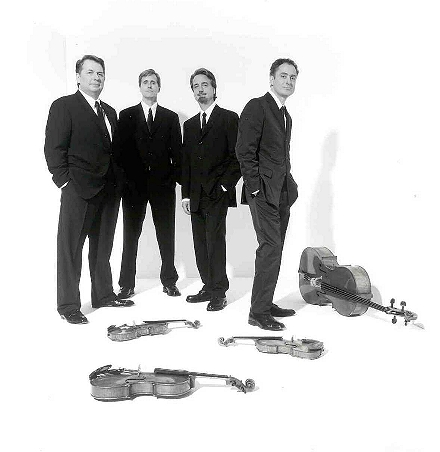
The Emerson String QuartetA concert by the Emerson Quartet would likely be well attended under any circumstances. Little wonder, then, that the group's Saturday concert on the Smithsonian Resident Associates series was almost completely full, with a program consisting of two string quartets by Johannes Brahms and one by Béla Bartók. The Baird Auditorium, on the lower level of the Smithsonian National Museum of Natural History, is a quirky little venue. A circular hall with a tiled ceiling that is part YMCA and part railroad station, it has a pleasing and resonant acoustic. Ionarts has been tireless in reviewing the Emerson Quartet series, which we have covered exclusively up to this point in the season: the first concert in September featured a new work by Kaija Saariaho, and the second concert last month included a new quartet by Bright Sheng. The third concert focused on more familiar territory, completing an integral performance of the Brahms string quartets, recently recorded by the group, and returning to their truly extraordinary (and Grammy award-winning) complete Bartók set.

As the quartet's recordings indicate, at least to these ears, the Bartók third quartet was the apex of the program. A terse tour de force without movement breaks, it is perfectly suited to the Emerson's intense, muscular style. Through all of the work's buzzing insect calls, folk cantillations, spiky dissonant chords, and eerie glissandi, the four players were united in scalpel-like precision. While the Bartók quartets may be a hard sell to first-time listeners in recording (as Jens has pointed out before), the appeal of a live performance, especially as icily robust as this one, is visceral (meaning that it has the effect of a punch in the guts). This is probably true even if it did, by one report, give the impression of hearing your parents fight and not being able to say anything. If anything, the Emerson's interpretation of this quartet is stronger, more refined than their recording, made almost 20 years ago.

Emerson Quartet:
available at Amazon
Brahms


available at Amazon
Bartók
The two remaining Brahms op. 51 quartets (the op. 67 quartet having been performed at the December concert) bookended the Bartók. For part of the first movement of no. 2, the four players struggled to settle into agreement of intonation. By the time violist Lawrence Dutton had his turn at the main melody in the recapitulation, the group had resolved those issues. On first violin for the first half, Philip Setzer lent his great strength, a sweet and focused tone especially in soft passages, to the second movement. The rondo theme of the fourth movement, handled by all four players in faultless unity through all of its stops and starts, appeared in a range of multiply colored guises.

Other Reviews:

Anne Midgette, The Allusionist (Washington Post, January 22)
In both of the Brahms quartets, what stood out in this concert were the third movements: the Emerson Quartet has a characteristic grasp of the Brahms dance. For all of Brahms's seriousness (not to mention his personal tendency toward stoutness), one may not be inclined to think of Brahms as a dancer, but his waltzes and dance movements tend to be some of my favorites. The Quasi minuetto of no. 2, as on the recording, was a warm and muted affair, giving the impression of a dance imagined inside someone's mind, although the trio was brash and not quite aligned. The lilting third movement of no. 1 is not labeled as a dance, but its graceful main section serves as interlude to contrasting sections, including a lovely, understated waltz that caps it off. Switching to first violin, Eugene Drucker was laser-precise in no. 1, insistently pushing the intense Romanze second movement to the fast edge of Poco Adagio. His ability to produce a clearer but still searing E string tone at full volume also served the fourth movement well.

There is only one Emerson Quartet concert remaining in the Smithsonian Resident Associates series, featuring both Brahms string sextets (May 10). Violist Lawrence Dutton will also give a solo recital, with violinist Elizabeth Lim-Dutton and pianist Marija Ilic (February 2). All concerts begin at 6 pm, in the auditorium of the National Museum of Natural History.