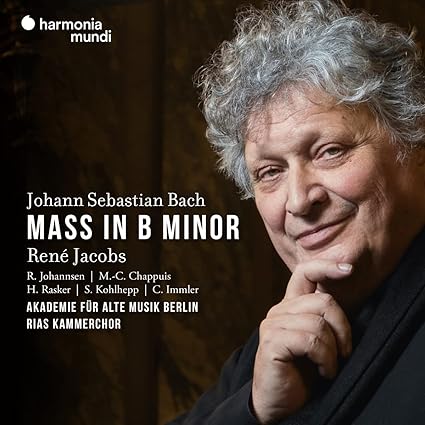
Ionarts had the good fortune to hear lutenist Paul O'Dette in concert earlier this year at the National Gallery of Art. A new recording of Lully's Thésée, under his direction at the Boston Early Music Festival, has also been under review recently. As the Director of Early Music at Eastman, he is one of the leading figures of the American early music scene, which by comparison to the flowering of historically informed performance (HIP) ensembles in Europe could be described as moribund. O'Dette brings a veteran's experience, therefore, to this new recording of the complete works for lute by J. S. Bach (many of them are arrangements of his own pieces for solo violin and cello). Its first installment is welcome, particularly since there is not a favorite complete recording on my shelf featuring Baroque lute (the various discs made by Hopkinson Smith are all good), although there are several adaptations by excellent guitarists.
Bach's pronounced tendency toward encyclopedic completism probably led to his composition of a significant body of works intended, apparently, for the lute. As O'Dette's excellent liner notes summarize, scholars have pointed out that Bach had an affinity for the lute, although his manner of composition for it indicates that he conceived the music in a non-idiomatic way. It is likely that he composed while seated at the Lautenwerk he designed, a keyboard instrument with gut strings that imitated the sound of the lute. In any case, he notated these pieces not in lute tablature but as if they were to be played at a keyboard. This requires some creative adaptation, such as transposing BWV 1011 (adapted in G minor from the C minor cello suite) up a step to A minor (a solution suggested by Hopkinson Smith). It is all recorded in clear and warm sound on the 13-course lute built by New York-based luthier Andrew Rutherford, after an 18th-century instrument by Sebastian Schelle.
Seasons come and seasons go. It's not the best way to judge the true value of the art world, but it is telling to see what the galleries are showing. The gorilla in the gallery this season is the economy and whether or not it will crash the feverish art market and level things out, maybe bring some rational thinking to what is valid and what is market-driven. But this is art: what's rational? what's valid? We all just happen to have really valid and, of course, rational opinions, don't we?
So far I see no substantial changes: a high percentage of what I recently saw in Chelsea was very weak to very lame, and I’m very fussy about what door I choose to walk through. But with that said, I’m always open to surprise and enlightenment, especially surprise.
A very nice surprise was the garage door open at David Zwirner. They were unloading crates for the Chris Ofili exhibit; so, never one to pass an open door, I walked in and was taken in by a display of some very potent Raymond Pettibon drawings, dealing with that war thing, as with many of the books coming out lately: great, love it, right on, but too little too late; OK, I’m frustrated.
There are lots of shows about death -- go figure -- but Cheim & Read has the best skulls in The Skeleton in Art. Ensor, Dalí, Jenny Holzer, and a very cool Alice Neel.
There is a beautiful Sol LeWitt cube at Paula Cooper and an amazing, Keith Tyson installation, Large Field Array, at Pace Wildenstein. There are over 220 individual sculptures in this show: allot some time to take it all in.
Another large show that requires a moment to take it all in is the 23 paintings by Willem de Kooning at Gagosian on West 21st, just the fix I needed from the master. Unfortunately, I wasn't allowed to take a picture so you'll have to see it for yourselves.
I like Gordon Moore’s paintings at Betty Cuningham. The choice of materials is quite interesting, too: latex, pumice, ink, blood, a future conservator's challenge but beautiful work.
Thomas Lendvai has what at first seems to be a very spare, simplistic, installation at Winkleman Gallery. But once you enter his realm, it become obvious that Lendvai is a master craftsman, and his piece, Between Pain and Boredom, has much a deeper effect on you. It on one hand totally alters your perception of the space, but I soon felt I was in my old family attic, full of mystery, cobwebs and all.
Selling art is surely one of the hardest tasks: Having enough passion for the subject to do it in the first place would preclude having the heart to treat it as a mere commodity. Treating it as anything but a mere commodity, however, would mean eventual bankruptcy. It should therefore be no surprise that the more successful merchants of culture are those that are well endowed on the business side of things, but with scant or modest inclination to artistic and ‘high-culture’ flights of fancy.
We, the consumers, although we might not like to think of ourselves as such, especially those among us that (naïvely) deem culture and the fine arts as something that ought to be above commercialism, benefit when commerce and high art connect and overlap – even if just by coincidence. As such we are blessed to have WPAS in our midst – an organization that manages to bring some of the finest exponents of classical (and non-classical, for that matter, but Ionarts tends to let that fall by the wayside) music in the world to town… even if that comes about despite, rather than because, of the tastes and ambitions of its leadership. A vibrant, commercial-as-it-wants-to-be WPAS serves the region infinitely better than a bankrupt, that is: non-existent, one.
Popularity, even in classical music, is the touchstone of success. Those who by virtue of education, experience, ability, or merely self-delusion and pretension, think themselves as the arbiters or vanguard of ‘good taste’ (you may replace this convoluted description with “music critics”) therefore have an interest in communicating as best we can why we think certain artists worthy of the public’s attention and – ultimately – worthy of popularity. There is no need to steer people away from what they like: Il Divo and Andrea Bocelli are loved for a reason (as are, unfathomably perhaps, Paris Hilton and Brittany Spears) and energies need not be wasted on patronizing consumers who well know best what they like, when they hear it. I have quoted from M.D.Calvocoressi’s "Musical Criticism” before: “[I]f you are trying to make people see that their taste and faith is at fault [for liking something ‘unworthy’], the position is that you are holding out no direct, positive inducement: ostensibly, you are proposing, not to add to their stock of artistic pleasure, but to detract from it. The task is as graceless as that of taking a bone from a dog.”
Much rather it is to gently suggest, introduce, or ease their ears toward something we know will be rewarding to them, if, perhaps, not on first listening. It is a selfish task, surely. The more popular that is, which ‘we’ already hold in high regard, the more likely we are to be rewarded with it through scheduled performances of this town’s arts organizations. If the enthused audiences become amenable to new experiences and even the occasional surprise, we will find that program calendars, too, will become less predictable and more diverse. WPAS will be the threshold for measuring the regions’ willingness into exposing themselves to new music and new names, rather than just warhorses… while those warhorses we all like will always remain staples for our every-years’ consumption.
Maybe 2007/2008 is not that year. A quick look at which concerts and artists sell tickets, regardless of program, allows one to predict WPAS’ season with some accuracy – and I’ll be glad to take a stab at it.
No season can go by without the “big three moneymaker” classical artists. Expect Yo-Yo Ma in a recital – perhaps as soon as November. Bank on Joshua Bell appearing with WPAS. Again. Be assured that Lang Lang will perform. These artists could play “Three Blind Mice” and fill the Kennedy Center – and they will. (Fill the Kennedy Center Concert Hall, that is, not play “Three Blind Mice”.) And since the NSO had great success with the ever popular James Galway, maybe he, too, will perform again in Washington. Shamelessly, we might even be served another helping of Dmitri Hvorostovsky. I learned to love him in New York last week, but if he were to come to town (or North Bethesda) with his Russian Warsongs - again! - I might fall out of love, just as quickly. (Now if he sang Verdi and assorted Russian Opera-arias, we’d be talking. Don’t count on that. Expect Russian War Songs. I saw the line for tickets when he performed them last.)
Then there are performers that have local appeal and, too, are money in the bank. They can be of lesser artistic appeal to the high-bred snob or, alternatively, are superb artists with a slightly lesser name-recognition. Yefim Bronfman seems to show up a lot – so I would not be surprised if he showed up again, at Strathmore in October. Coupled with Orpheus I could imagine very fine results, actually. Especially if they played challenging music next to the inevitable barnstormer. Schnittke next to a Beethoven concerto… or Schoenberg coupled with Brahms D-minor comes to mind. I hope we will be spared Garrick Ohlson but Itzhak Perlmanmight be nice to hear. If not for the artistic value, anymore, so at least as a life-time achievement tribute to his supreme art. Put down Itzhak for me, for WPAS. Gil Shaham – often bringing his sister – is aregular andpopular guest. Perhaps not exciting but always welcome: We’ll find him on the schedule, surely.
But if there is a sense of complaining, it must be said that commerce most happily colludes with art if rarely gifted artists exude ticket appeal: If Murray Perahia recovers from his ailment (or has, already), I would love it if he graced us with is presence where he canceled last year. And since Alfred Brendel at the Kennedy Center was a great success, I’d be equally looking forward to hearing him. At Strathmore. Leif Ove Andsness, too. Maybe even Yundi Li (at GMU with the Gewandhaus Orchester Leipzig under Riccardo Chailly on March 3rd, by the way). Piotr Anderszewskiimpressed at the National Gallery – let him do the same at Strathmore. Perhaps in one of his fine Mozart Piano Concertos? (My favorite being the C-minor, K.491 – so I am keeping my fingers crossed.)
Orchestras are expensive to move around, so their popularity is particularly important in order to calculate proceeds (and underwriters’ contributions) against expenses. Their performance was excellent, if not exactly thrilling, so let’s have the Cleveland Orchestra with Franz Welser-Möst back. If the NSO won’t bring James Conlon back (and apparently not make him our new conductor), let WPAS shame them by having him here. He could lead the Philadelphia Orchestra (who also need a new conductor) in a concert with, for example, Charles’ favorite Helene Grimaud. Yuri Termirkanov may have left Baltimore for good, but would it not be fun to hear him with his favorite band, the St. Petersburg Philharmonic? Good business sense – and an absolute delight for anyone who heard her in Baltimore last season – would be if he brought Julia Fischer with him… and together perform the Beethoven concerto again. (Don’t forget that Julia Fischer also plays with the NSO in the third week of March. Her Khachaturian concerto should not be missed!) Since Kurt Masur has proven popular, he might come with his Orchestre National de France. We were robbed of his Bruckner last season – maybe he will make up for that. Otherwise, Beethoven is always reliable with Masur.
I don’t know how tickets are selling for Chailly’s concert at the Center for the Arts – but surely a program of Italian hits would fill the Kennedy Center, if he brought the Filarmonical della Scala. Most of all, despite just having been here… nay: because he was just in town: We’d love to hear Mariss Jansons and the Concertgebouw again. And best of all I should like to hear them in Richard Strauss and Gustav Mahler. It would be a program good enough to whack any facetiousness out of me, when it comes to commenting about cultural programming.
Fun speculations as these are, we’ll see how well the WPAS predictability-meter functions when they announce their season.
Jesus saw a man called Matthew sitting at the tax office, and he said to him: Follow me. Jesus saw Matthew, not merely in the usual sense, but more significantly with his merciful understanding of men. He saw the tax collector and, because he saw him through the eyes of mercy and chose him, he said to him: Follow me. This following meant imitating the pattern of his life - not just walking after him. St. John tells us: Whoever says he abides in Christ ought to walk in the same way in which he walked.
And he rose and followed him. There is no reason for surprise that the tax collector abandoned earthly wealth as soon as the Lord commanded him. Nor should one be amazed that neglecting his wealth, he joined a band of men whose leader had, on Matthew’s assessment, no riches at all. Our Lord summoned Matthew by speaking to him in words. By an invisible, interior impulse flooding his mind with the light of grace, he instructed him to walk in his footsteps. In this way Matthew could understand that Christ, who was summoning him away from earthly possessions, had incorruptible treasures of heaven in his gift.
-- Venerable Bede (673-735), Homily on St. Matthew
September 21 is the feast day of St. Matthew, tax collector turned apostle and evangelist. He is the patron of the Cathedral of Washington.
Image: Orcagna [Andrea di Cione], Saint Matthew Altarpiece (completed by Jacopo di Cione), c. 1367 (Galleria degli Uffizi, Florence), with thanks to the incomparably wonderful Web Gallery of Art
When Mel Gibson released The Passion of the Christ, there was a lot of outcry about the violence of the film: why would anyone take such delight in the suffering of Jesus? As I and others commented at the time, the suffering body of Jesus has been the focus of ecstatic reverence in art for centuries. The devotional poem Salve mundi salutare (Hail, salvation of the world) was a collection of stanzas focused on the parts of the savior's body hanging on the cross. In more recent editions, the parts are reduced to seven -- feet, knees, hands, side, chest, heart, and face -- but in medieval sources the poems by Bernard of Clairvaux, Arnulf van Leuven, and others were supplemented by additional parts known only in a few manuscripts.
If the poem is a literary reflection on the Vir dolorum (Man of Sorrows), Dietrich Buxtehude created a musical counterpart when he selected parts of the poem to make a libretto for a cycle of seven brief cantatas, which he called Membra Jesu nostri patientis sanctissima (The most holy body parts of our suffering Jesus, 1680). It is a strange quirk of history that the Lutheran church, for which this music was composed, has in the last century (especially in the United States) abandoned the use of crucifixion images in many churches.
Buxtehude's musical style is based on fairly simple idioms, a late Renaissance and early Baroque combination of homophonic and contrapuntal textures. The setting is most effective at marshalling a careful control of dissonance for words evoking pain. The work is not exactly unknown, actually something of a choral favorite, and there is no shortage of recordings (of which the four best are shown at right). This new recording by the Montreal-based Les Voix Baroques, under the direction of countertenor Matthew White, cannot be considered more worthy than any of those. (The good news is that it costs less than almost all of them: only the Jacobs recording is truly discounted, at $6.97 at the time of writing.) The instrumental accompaniment is subtle, with two violins, as many as four violas da gamba, and a continuo group featuring both theorbo and organ.
It is a lovely if not essential recording, about which American baritone Thomas Meglioranza wrote in January that he was involved "on shortish notice" in the sessions near Montreal (see the photo of the church of Saint-Augustin, where the recording was made). This may account for the occasional sense that the group of five singers is not quite at unity. In many passages, the ensemble and intonation are spot on, although some of the voices become a little brittle in solo sections. The Latin vowels are highly individualized at times, although to say that there is a standard pronunciation of Latin is to ignore the universality of the language. Considering how widely recorded this piece is, what could possibly explain that we have yet to review a live performance of Membra Jesu nostri in the history of Ionarts? (In fact, the last Buxtehude reviewed was in 2004.) One of the choral groups of Washington will hopefully heed my call, instead of doing yet another Bach passion (as wonderful as they are) this spring. In fact, Buxtehude died on May 9, 1707, making this his 300-year anniversary: where is all the Buxtehude?
Ma chambre a la forme d'une cage, Le soleil passe son bras par la fenêtre. Mais moi qui veux fumer pour faire des mirages J'allume au feu du jour ma cigarette. Je ne veux pas travailler -- je veux fumer.
My bedroom is shaped like a cage, The sun puts its arm through the window. But I, wanting to smoke to make mirages, I light my cigarette from the day's fire. I do not want to work -- I want to smoke.
-- Guillaume Apollinaire, "Hôtel" (from Le guetteur mélancolique), trans. Charles T. Downey
Francis Poulenc set this poem memorably to music in Banalités, in which it is no. 2.
An Ionarts favorite singer, mezzo-soprano Bernarda Fink, has drawn attention for several of her recordings (Canciones Argentinas, the Jacobs Clemenza di Tito, the Minkowski Hippolyte et Aricie). It was normal then for Ionarts to be looking forward to La Fink's new release on Harmonia Mundi of Hector Berlioz's arch-Romantic, exotiste song cycle Nuits d'été, op. 7. Musicologist Julian Rushton once asked the question (in an essay that is the fifth chapter of Berlioz Studies) of whether this set of six songs should be considered a cycle or merely a collection. It is hard to speak of a definitive version of the work, since the original 1841 conception for piano and voice (either tenor or mezzo-soprano) was altered significantly in the orchestrated version in 1856, in terms of keys and intended voice part. The poems by Théophile Gautier (1811-1872) do not form a coherent narrative and lend themselves more to performance by a group of voices than a single one, which is how they are usually performed now. Even so, memorable recordings have come from superlative voices, always those who combine a French-sensitive approach to the gorgeous poetry and the luscious melodic line.
In front of the sensitive playing of the Deutsches Symphonie-Orchester Berlin, led by Kent Nagano, Fink slinks her way through the languid melodies, although in strict terms, this is a slightly faster performance than many others. The second song, Le spectre de la rose, comes in at 6:27, sounding almost edgy by comparison to the utterly relaxed Régine Crespin, for example, at 7:08 (watch via YouTube). By contrast, the lament of Sur les lagunes is slowed down to near-stasis at 6:30, even more luxuriant than Crespin. One thing that helps the dusky sound of this performance is the transpositions: for example, in Villanelle, Fink sings in the key of F, a third below the key Berlioz stipulated in both versions of the cycle, A major.
As for the rest of this disc, the opening set of the Cinq mélodies populaires grecques lose much of their freshness in these orchestral versions. My ears still prefer Elly Ameling's readings of this set (Erato ECD 75324, apparently no longer available). The other selection, Ravel's Shéhérazade, seems to belong more naturally with the Berlioz. Tristan Klingsor's poems, while not as exquisite as the Gautier, are in the same exotiste vein. Fink's velvety voice strikes the same simultaneously shy and brazen pose as the Ingres Grande Odalisque on the CD cover. It is a worthy addition for lovers of the mélodie.
The late Régine Crespin's recording of Nuits d'été with the Orchestre de la Suisse Romande is one of the best available. Its recent remastering has encouraged a reassessment of that reputation, which stands after close listening. The incomparable clarity of tone (the opening bars of Absence, for example, are a knockout) and the loving diction of Gautier's superb poetry make this the version to own, and at $11.98 in this re-release, it is hard to beat in price. The other issue in choosing a recording of Nuits d'été is that the work only takes about a half-hour: what else to program with it? The Crespin disc is also superior in that department, with the same Ravel Shéhérazade on the Fink recording, plus a knockout selection of Debussy (Chansons de Bilitis) and especially Poulenc (neither with orchestra). Take a look at the YouTube video below to see Crispin's Poulenc: she should be required listening (and viewing) for any singer studying French diction. That song is track 17. As for other worthy Nuits d'été recordings for Berlioz nuts, Victoria de Los Angeles is also beloved but hard to find, while the two alternatives linked at right above are fine, inexpensive options, too.
Decca 000710802
Régine Crespin, Les gars qui vont à la fête (F. Poulenc), recorded on 11 January 1964
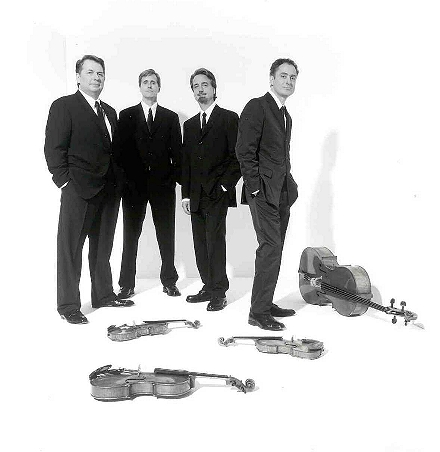
The Emerson String Quartet presented a concert of their trademark high quality at the National Museum of Natural History Saturday night (reviewed exclusively by Ionarts), as part of the Smithsonian Resident Associates series. Back to a more standard programming format than last season’s Shostakovich half-cycle, the quartet offered works of Haydn, Finnish composer Kaija Saariaho (b. 1952), and Beethoven. Saariaho’s Terra Memoria, dedicated to “those departed,” was premiered by the Emerson Quartet just last June at Carnegie Hall.
The one-movement work contains persuasive writing for string quartet. One heard the quartet performing mostly as one musical unit in this work, which is a testament to both the quartet’s vast experience as an ensemble and Saariaho’s precise compositional approach. Making one long phrase – perhaps a life-cycle – Terra Memoria held the interest of the audience by keeping a very delicate textural balance; its own musical eco-system, if you will. Often the four instruments would play in a kind of heterophony, when each player would begin on different notes and move in similar rhythmic and intervallic direction. One wonders if the National Museum of Natural History specifically requested the programming of this work, or if it was a striking coincidence. Place Nymphea (1987), Saariaho’s first work for string quartet, and her two operas -- L’Amour de loin (2000) and Adriana Mater (2006) -- on your listening lists.
Haydn’s String Quartet in C Major (op. 20, no. 2) came off blandly due to a lack of strong downbeat and the quartet’s regretful approach of emphasizing characterless long lines over interesting musical figures. Considering the intonation issues in the slower bits, perhaps only the more complex material was fully rehearsed. Beethoven’s first Rasumovsky string quartet (op. 59, no. 1) was full of character, optimism, and cunning. With seemingly perfect tempi, lots of punctuation, and even gradation of dynamics, the Beethoven was nothing but pleasing.
The next concert in the Emerson Quartet series at the National Museum of Natural History (December 9, 6 pm) features Beethoven's fourth quartet (op. 18, no. 4), a new quartet by Bright Sheng, and the third Brahms quartet. The latter features on their latest recording, of the Brahms quartets and the op. 34 piano quintet.