CD Reviews | CTD (Briefly Noted) | JFL (Dip Your Ears) | DVD Reviews

22.5.15

Briefly Noted: Veracini's Sonate Accademiche

available at Amazon
F. M. Veracini, Complete Sonate Accademiche, Trio Settecento

(released on May 12, 2015)
Cedille CDR 90000 155 | 186'48"
The versatile American violinist Rachel Barton Pine leads an early music ensemble, Trio Settecento, heard at Dumbarton Oaks in 2011. The latest in the group's series of recordings of mostly 18th-century music for the Cedille label is a complete three-CD set of the Sonate Accademiche by Francesco Maria Veracini (1690-1768). The twelve sonatas in this set, published as opus 2 in 1744, are a mixture of the sonata da camera and sonata da chiesa varieties, including both dance movements and more serious contrapuntal movements Veracini designated as Capriccios. Veracini's love of counterpoint, noted by Charles Burney among others, makes him an interesting composer to compare to his near-contemporary, J.S. Bach.

Fabio Biondi and Rinaldo Alessandrini have already recorded these works (sample on YouTube -- the inclusion of theorbo on that recording is something missed here), as have the Locatelli Trio. Where Biondi favored a smooth and rhythmically stable style, Barton Pine and her colleagues play just a notch faster in most cases, and with an ear toward a slightly volatile, unpredictable way of playing with the tempo. In a particularly inspired move, she adds Scottish folk fiddle ornamentation to the Scozzese movement of no. 9 and gives a folksy color to other movements based on tunes Veracini likely took from John Gay's The Beggar's Opera, which he most certainly heard during his travels in Great Britain. Those Capriccio movements are probably the reason behind the identification of op. 2 as sonate accademiche, culminating in the studiously contrapuntal and excessively chromatic twelfth sonata (Passagallo, Capriccio Cromatico with two subjects, Adagio, and Ciaccona). The collection ends with a two-voice canon setting the text of a Latin epigram ("Ut relevet miserum fatum") for violin and cello set close together -- a rather Bach-like musical gesture.

21.5.15

À mon chevet: 'At Last'

À mon chevet is a series of posts featuring a quote from whatever book is on my nightstand at the moment.

book cover
Patrick drifted towards Nicholas and Annette, curious to see the outcome of his matchmaking. "Stand by the graveside or the furnace,' he heard Nicholas instructing Annette, 'and repeat these words, "Goodbye, old thing. One of us was bound to die first and I'm delighted it was you!" That's my spiritual practice, and you're welcome to adopt it and put it into your hilarious "spiritual tool box".'

'Your friend is absolutely priceless,' said Annette, seeing Patrick approaching. 'What he doesn't realize is that we live in a loving universe. And it loves you too, Nick,' she assured Nicholas, resting her hand on his recoiling shoulder.

'I've quoted Bibesco before,' snapped Nicholas, 'and I'll quote him again: "To a man of the world, the universe is a suburb".'

'Oh, he's got an answer to everything, hasn't he?' said Annette. 'I expect he'll joke his way into heaven. St. Peter loves a witty man.'

'Does he?' said Nicholas, surprisingly appeased. 'That's the best thing I've heard yet about that bungling social secretary. As if the Supreme Being would consent to spend eternity surrounded by a lot of nuns and paupers and par-boiled missionaries, having his lovely concerts ruined by the rattle of spiritual tool boxes and the screams of the faithful, boasting about their crucifixions! What a relief that an enlightened command has finally reached the concierge at the Pearly Gates: "For Heaven's sake, send Me a conversationalist!" '

-- Edward St. Aubyn, At Last, pp. 15-17
The trend of autobiographical novels -- Elena Ferrante, Karl Ove Knausgaard -- includes the inimitable Patrick Melrose series by Edward St. Aubyn, now available in a complete set including the final book, At Last. It is typical of the series in that it takes place on one single, rather horrid day in the narrator's life, the funeral of his mother. Amid the encounters of the parts of his mother's sad life, many memories of other days flood into the story, in the minds and voices of several characters. Readers who treasure bitchy repartee will be relieved to know that the incorrigible character of Nicholas Pratt has a final turn in the spotlight. Here, he spars with Annette, the irrepressibly happy New Age apostle of the charlatans who trick Patrick's mother into giving them her family house in southern France.

20.5.15

Ernest Chausson's 'Le Roi Arthus'


Ernest Chausson (1855-1899) wrote only one opera, Le Roi Arthus, which received a rare performance as one of the centerpieces of the Opéra de Paris's season. The promise of the company's publicity photo, showing the ruins of the medieval Abbey of Glastonbury, where King Arthur is supposedly buried, shrouded in fog, was not borne out in the staging by Graham Vick. Marie-Aude Roux called it a "Scottish shower," running both cold and hot, in her review (Le Roi Arthus n’entrera pas dans la légende, May 19) for Le Monde (my translation):

[Vick] preferred to distance his approach and do without the Arthurian legend as much as he could. An unusual way of serving up a little-known work (even if Montpellier, in 1997, and Strasbourg, in 2014, presented staged versions of it), in any case never staged in Paris, where only a concert version was performed on Radiodiffusion française in 1949, then on Radio France in 1981. The duty of presenting the work for its baptism at the Opéra Bastille with, as godparent, a visual world that resonates with the music, should have prevailed.

Instead of which, we had to suffer through the sets of a model kit universe, with its snippets of buildings, its 1970s furniture, the pragmatic ugliness of odd costumes taken directly from a Ken Loach film on the homeless. King Arthur's half-built mobile home is dismantled bit by bit as his Arthurian ideal -- the spiritual harmony of the Knights of the Round Table -- crumbles and is destroyed, undermined by internal jealousies and the adulterous love of Queen Guinevere and Lancelot. The only relics: a circle of ropes held up by swords, a pathetic (low) round table, the silhouette of a castle tower at the top of a green hill (a subtle Wagnerian allusion?). Nothing in any case that takes into account the musical magic of Chausson, the great symphonist, whose abundant, refined, sensual orchestration clothes a harmonic language of fluid and elegant complexity, reinforced by the almost syllabic prosody of the accompanied recitative.
An excerpt of this beautiful score is embedded above. Chausson never got to hear the first performance, in 1903 in Brussels, because he died in a freak fall from a bicycle before it happened. Philippe Jordan conducts, drawing out the French flavors of this Wagner-influenced score, and Roberto Alagna, Thomas Hampson, and Sophie Koch star. Performance continue through June 14, with a broadcast on France Musique on June 6, so we will hopefully get the chance to hear it in rebroadcast.

19.5.15

How to Say Farewell to Aurélie Dupont


We wrote about Paris étoile Aurélie Dupont in 2012, the last time that the Ballet de l'Opéra de Paris came to the Kennedy Center. Shame on you if you missed it, because the French ballerina, 42, is set to retire from dancing this week, at least at the Garnier, going out on a performance of Kenneth MacMillan's L'Histoire de Manon, which will be filmed by Cédric Klapish and shown later in movie theaters. Ariane Bavelier has an appreciation (Aurélie Dupont, comment lui dire adieu?, May 18) for Le Figaro (my translation):

Aurélie justifies her choice by saying that dancing for her is about telling stories with gestures measured note for note. For her farewell, she wanted to dance with Hervé Moreau. Since she has had Manuel Legris for a partner, from when she was just a soloist in her debut, the search for a perfect match has always obsessed here. With Legris, as with Hervé Moreau, a look was enough, movements spontaneously were in dialogue. "I wanted to leave with Hervé: the work with him is always delicate, musical, stunning. But he is hurt, and I did not feel able to dance with someone from the company. So I asked Roberto Bolle, the star of La Scala. He is very demanding and he is 40 years old: it's a beautiful artistic balance," she says. At one time, Aurélie had dreamed of having Manuel Legris, today director of the Vienna State Ballet, as M. GM and Jérémie Bélingard, her husband, as Lescaut. But he will be in the hall to reassure their two sons, who are 4 and 7, for whom the ballet seems rather long, especially when things go bad for their mother.
Although she will not dance with the company anymore, she has plans to dance in other places, and Benjamin Millepied has given her a new role in Paris, naming her Maître de Ballet.

18.5.15

'Israel in Egypt' at National Presbyterian


available at Amazon
Handel, Israel in Egypt, Trinity Wall Street, J. Wachner
(Musica Omnia, 2012)
Charles T. Downey, Washington Chorus performance was like an ocean liner going up C&O Canal (Washington Post, May 18)
Handel performed his oratorios with relatively small orchestras and choirs. Later audiences heard these works with massive forces playing and singing, an anachronism that the historically informed performance movement stripped away by researching the practices in Handel’s lifetime. Although both approaches can work musically, it makes little sense to mix a small orchestra of period instruments with a nearly 200-voice choir, as the Washington Chorus did in its performance of Handel’s “Israel in Egypt” on Sunday at the National Presbyterian Church... [Continue reading]
Washington Chorus
Handel, Israel in Egypt
National Presbyterian Church

17.5.15

Perchance to Stream: Graduation Edition

Here is your regular Sunday selection of links to online audio and online video from the week gone by. After clicking to an audio or video stream, you may need to press the "Play" button to start the broadcast. Some of these streams become unavailable after a few days.

  • Watch the production of Szymanowski's Król Roger from London's Royal Opera House. [ARTE]

  • Cecilia Bartoli and Andreas Scholl star in a production of Handel's Giulio Cesar in Egitto, with Giovanni Antonini and Il Giardino Armonico, from the Salzburg Pentecost Festival. [ARTE]

  • The Orchestre National de France and Choeur de Radio France perform Verdi's Oberto Conte di San Bonifacio under Carlo Rizzi at the Théâtre des Champs-Elysées. [France Musique]

  • Listen to a performance of Darius Milhaud's opera La mère coupable, starring Markus Butter, Mireille Delunsch, and Angelika Kirchschlager, with the ORF Radio-Symphonieorchester Wien and conductor Leo Hussain at the Theater an der Wien earlier this month. [ORF]

  • Marc Minkowski conducts Les Musiciens du Louvre--Grenoble in a performance of Rameau's Les Boréades, recorded last year at the Aix-en-Provence Festival. [RTBF]

  • From the Opéra Royal de Wallonie in Liège, listen to a performance of Bizet's Les pêcheurs de perles, recorded on April 25, with Paolo Arrivabeni conducting a cast starring Anne-Catherine Gillet (Leïla), Marc Laho (Nadir), and Lionel Lhote (Zurga). [RTBF]

  • Daniel Barenboim leads a performance of Beethoven's Fidelio at La Scala, starring Anja Kampe and Klaus Florian Vogt, recorded in Milan last year. [Radio Clásica]

  • Sandrine Piau and Marie-Nicole Lemieux perform duos by Handel, with Ricardo Minasi and Il Pomo d’Oro. [France Musique]

  • Listen to a performance of Solaris, the new opera by Dai Fujikura (b. 1977) on a libretto by Saburo Teshigawara, based on the novel by Stanislas Lem, recorded in March at the Théâtre des Champs-Elysées in Paris), with the Ensemble Intercontemporain and others. [France Musique]

16.5.15

Filharmonia Szczecińska


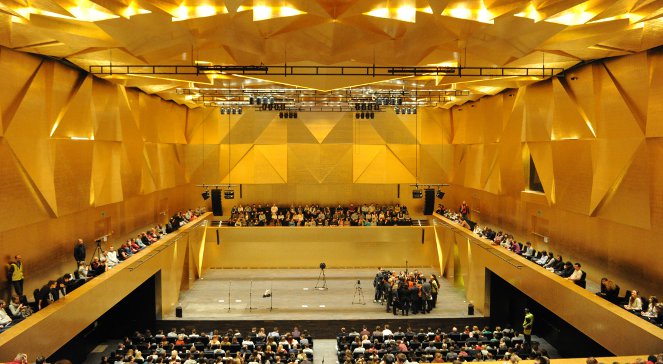
The European Union's architectural award, given by the Mies van der Rohe Foundation, went earlier this week to the Filharmonia Szczecińska, the symphonic hall in the Polish city of Szczecin (shown above), created by the Italo-Spanish firm Barozzi Veiga. Covered in glass that is all white and translucent, it has the look of an ice cathedral or, as it struck me the first time, Superman's Fortress of Solitude. Jean-Jacques Larrochelle has a report on the hall (Le prix Mies van der Rohe attribué à la Filharmonia Szczecinska, May 9) for Le Monde (my translation):

The building, completed in 2014 after three years of construction, offers 13,000 square meters of functional space. It includes a 1,000-seat concert hall, a hall for chamber music that seats 200, a multipurpose space used for exhibits and conferences, and a large entry hall. Its cost: 30 million euros.

Built at the intersection of the historical site of the Konzerthaus, an old neighborhood bombed during the Second World War, then renconstructed, the Filharmonia Szczecinska is made up of vertical façades capped with pointed gables. Built up against the headquarters of the Wojewodzka police, made of brick and stone, it generously faces out on green spaces. The architects Barozzi and Veiga wanted to give it "a luminous element." The glass façade, illuminated from the inside by a stiff grill, offers a broad range of color scenarios that play with the architecture, especially at night. During the day, as shown in photographs, the contrast is just as striking between the stark whiteness of the new building and the lackluster environment that surrounds it.
Larrochelle also points that, although singular, the building does not stand out from its surrounding in other ways: its height is in keeping with its surroundings, for example. The architects even speak about its austerity, at least on the outside, because the interior is more colorful and varied.

15.5.15

Kavakos on the Podium and Beside It


available at Amazon
Sibelius, Pelléas et Mélisande (original version), Lahti Symphony Orchestra, O. Vänskä
(BIS, 1999)
Charles T. Downey, Kavakos ends two-week NSO residency by taking up the baton (Washington Post, May 15)
Leonidas Kavakos came to the end of a two-week residency with the National Symphony Orchestra by showing a third facet of his musical personality. After shining as a soloist in Sibelius’s violin concerto last week, he gave what was reportedly an excellent solo recital earlier this week with Christoph Eschenbach at the piano. As heard last night in the Kennedy Center Concert Hall, Kavakos concluded by taking the podium for his conducting debut with the orchestra.

Most conductors begin their musical lives playing an instrument, switching later to conducting... [Continue reading]
National Symphony Orchestra
With Leonidas Kavakos, violinist and conductor
Kennedy Center Concert Hall

PREVIOUSLY:
Robert Battey, Kavakos and Eschenbach combine to put on an inspired recital (Washington Post, May 13)

Charles T. Downey, Second Opinion: Eschenbach's Mahler 5 (Ionarts, May 9)

---, A cohesive-sounding conductorless New Century Chamber Orchestra at Strathmore (Washington Post, February 1, 2013)

---, Café Zimmermann (Ionarts, November 5, 2007)