CD Reviews | CTD (Briefly Noted) | JFL (Dip Your Ears) | DVD Reviews

11.12.12

KC Chamber Players in Terrace Theater

Darius Milhaud
This review is an Ionarts exclusive.

On Sunday evening in the Kennedy Center’s Terrace Theater, the Kennedy Center Chamber Players, all principals of the National Symphony Orchestra, presented a polished program of music tied loosely together by the theme of contrast between sacred and profane.

The program began with Darius Milhaud’s four-movement Suite for Violin, Clarinet, and Piano, op. 157b (1936), for which pianist Lambert Orkis was joined by violinist Marissa Regni and clarinetist Loren Kitt. The piece’s prevailing lighthearted and danceable mood is tinged with tongue-in-cheek detachment and polytonal complexity, while a dreamy second movement reveals a heart of childlike simplicity. In a smooth and precise reading, Regni played with especially tender, almost vibrato-free purity in the second movement. Here as throughout the evening, Orkis was the most expressive performer of the group.

Next, Orkis joined cellist David Hardy for César Franck’s Sonata in A Major (1886), written for violin and piano and later arranged, with the composer’s blessing, for cello and piano. The piece gains expressive depth with the use of cello instead of violin, although in Sunday’s performance the cello was swallowed up by the piano in places where a violin would have soared above it. This was not helped by the placement of the cellist right next to the piano, making it hard to distinguish the two instruments. In this world-weary sonata, Franck’s nomadic chromaticism and cyclic rehashing of motifs create a sense of endless searching without finding. Orkis and Hardy brought an appropriately grand seriousness to the piece, while also injecting fire into its exhilarating fast passages. At times, though, this entailed a loss of some precision in the piano part. Hardy delivered the cello’s final gruff outburst with dramatic flair.

Orkis and Hardy returned for J. S. Bach’s Sonata in G minor, BWV 1030b. Bach reworked this piece in different keys and for different instruments; it is more commonly performed on flute or oboe than on cello. Bach’s unsettled chromaticism here recalled Franck’s, and Orkis and Hardy again grappled ably with this intricate music. However, they also succumbed to some of the dangers of playing Bach on modern instruments; it was generally too bright and insistent. Hardy’s higher register began to fray toward the end, sounding squeaky and not quite in tune. The players closed with Béla Bartók’s Contrasts for Violin, Clarinet, and Piano (1938). This fiery piece was commissioned by jazz clarinetist Benny Goodman, and in it, Eastern European dances mingle with jazz riffs appropriate to Goodman’s style. The players reveled in its eccentricities, from the opening mock-serious military recruiting dance to the jarringly mistuned (scordatura) violin scratchings of the final movement.

10.12.12

Chantry's Palestrina Christmas

This review is an Ionarts exclusive.

available at Amazon
Palestrina, Missa Benedicta es,
Tallis Scholars
(1996)
Ah, it is December again, and the sounds of Christmas are all around us: the rhymed Latin poetry, the theological explications of the mystery of the Virgin Birth, the Propers of the Dies natalis Christi, the complex six-voice polyphony. At least these were the sounds of the season at the Palestrina Christmas concert presented by Chantry on Saturday night, at the church of St. Mary Mother of God in Chinatown. It was my kind of Christmas concert and an easy recommendation for my December concert picks.

The centerpiece of the program was the Missa Benedicta es, a relatively early Mass setting by Palestrina, completed at some point before 1562 (see this essay on the subject by Peter Philips), when the composer was in his 30s and working as choirmaster at either the basilica of St. John Lateran or Santa Maria Maggiore. Palestrina based this Mass, using the Renaissance imitation technique, on the six-voice motet Benedicta es, caelorum regina by Josquin Des Prez, who had been a member of the papal choir in Rome in the 1490s. Josquin's motet is based in turn on the sequence melody setting that text, proper to feasts of the Virgin Mary. It is a sublime example of the medieval and Renaissance concept of creativity, building on the achievements of older generations, by which Gregorian chant was elaborated into early polyphony and later polyphony elaborated from early polyphony. It is also a historically minded gesture by Palestrina, since the plainchant incorporated into Josquin's motet -- heard in the distinctive long notes of the opening measures, transferred distinctively into the opening of Palestrina's Mass movements -- was one of the sequences removed from the Catholic liturgy by the Council of Trent around this time. The ghostly presence of deleted music is a pleasing touch.

Chantry's performance of the Josquin motet and the Palestrina Mass, reconfigured by transposition for a group of twelve singers, a mixture of men and women, was full-throated in style. In that respect it is more or less similar in conception to the more gorgeous recording by the Tallis Scholars, made with about the same number of voices (in that recording, Peter Phillips moved the key of Josquin's motet up a major third from its original notation). Transposition moves the alto parts into a range more comfortable for women, but it also makes the tenor and soprano parts very high. Music director David Taylor's choices of tempo, often fast, and dynamic shaping, making for some thrilling crescendos, just occasionally put too much stress on the high voices, which stuck out of the texture uncomfortably. Aside from one slip in the bass in the Gloria ("tu solus dominus") and some unpleasantly exposed tenor lines, it was a pleasing performance, beautifully in tune, with clean ensemble and nicely sculpted dynamic shapes (if perhaps just a bit too much of the loud side of the spectrum).

As with so many polyphonic settings of the Ordinary, the Sanctus movement is the most beautiful, with its reduction of textures (matching a similar gesture by Josquin in the secunda pars of the motet) -- unfortunately a movement that is often not sung, even when such Masses are performed in the modern liturgy. The Mass was broken up by some seasonally appropriate motets, including the stellar six-voice motet O magnum mysterium, with its mysterious opening measures (all major chords and interesting modal shifts) and angelic explosion of joy ("collaudantes dominum"). The two double-choir motets O admirabile commercium and Hodie Christus natus est were less effective, perhaps because the two choirs were physically divided, creating more problems of intonation and blend. The latter motet, however, with its infectious interpolation of shouts of "Noe" (Noel), is irresistible, one of those rare moments where even the papal choir could get away with singing words that were decidedly not liturgically proper.

This concert will repeat this weekend (December 15, 8 pm), at St. Bernadette's in Silver Spring.

London Town: The LSO, Vengerov, and the Queen


As my colleague-friend-mentor Bob Reilly and I approached the air-raid shelter masquerading as a cultural center under the name “Barbican Hall”, a motorcade skipped by… tiny, by Washington DC / Presidential standards. Thirty feet further, amid a handful of enthusiast bystanders, it spilled its contents—chiefly a little white haired woman—into the Barbican, blocking the entry for a couple minutes.

On the inside waited the London Symphony Orchestra with a concert framing the presentation of the 2012 Queen’s Medal for Music. And what would be the point of a Queen’s Medal for Music without Her Majesty The Queen. In contrast to her quiet, placid ways (which reminds me of nothing so much as of Harpo Marx, minus the props), she was received with much Fanfare. Literally, too: An Entry Fanfare by Dudley Bright, the National Anthem, and then the Master of the Queen's Music’s Fanfare: Her Majesty’s Welcome: Royal Gebrauchsmusik by Peter Maxwell Davies — conducted, especially, by Timothy Redman. Maxwell Davies’ piece for professional orchestra and student players is an exceedingly inoffensive, pleasant brassy curtain raiser with tasty sour tinges in the harmony and irregular rhythms that propel it with foot-tapping drive… not that there was much foot-tapping on part of the audience, royal or not.

Maxim Vengerov, whose career has been rather quiet since his prolonged Tango-sabbatical, performed the Tchaikovsky Violin Concerto. With his solid, leathery tone, he cut through the delicate, fleet, and light-footed orchestral opening that Robin Ticciati (substituting for Colin Davis, who is in ill health) coaxed from the orchestra. Vengerov did so unassailably, as if in isolation from his surroundings, and without any detours by way of nuance; rhythmically (if not intonation-wise) secure and steadily as though he had swallowed a metronome. For the most part Ticciati just followed, but he also added magnified timpani accents which, together with the straightforward, mercifully unperfumed interpretation, allowed for new, unusual hearing-angles on the concerto. Like or not-like these peculiar effects; hearing a war horse slightly anew and newly askew has to be be a welcome thing.


available at Amazon
P.Tchaikovsky, Violin Concerto,
V.Repin / V.Gergiev / Kirov Orchestra
Philips


available at Amazon
Elgar, Blacher, Kodály, Enigma-, Paganini-, Peacock-Variations,
G.Solti / WPh
Decca


Despite uncharacteristic near-stumbles from Vengerov—in the first cadenza especially—there was also the suspended tenderness in the second movement to enjoy, and for those who like the infallible applause-generating effectiveness of the hurried fast-and-loud approach, also the finale. For those who thought the Tchaikovsky an odd run-through, meanwhile, a stately Adagio from Bach’s C major Sonata ought to have been assuaging stuff.

After intermission came the ceremonial bit: After a film on the short history of the Queen’s Medal for Music (past winners include Emma Kirkby, Judith Weir, Bryn Terfel, Charles Mackerras, Colin Davis), the 2012 medal was bestowed upon the National Youth Orchestra of Great Britain (last reviewed here in 2009)… the first time an institution was at the receiving end. A few pimply representative representatives clambered up the stage, shook the silent Queen’s hand, forgot to curtsey, and toddled off after an awkward moment of silent disorientation, all under the auspices of master of ceremonies Peter Maxwell Davies.

Robin Ticciati—who looks a little like young Jake LaMotta shadowboxing—and the LSO (amended with a few of those NYO kids) then put a most English end to the concert, with a run-through of Elgar’s Enigma Variations. After a bit of routine tedium and a cliché-sodden Nimrod variation—it’s supposed to be two friends talking about Beethoven; it often ends up two pallbearers on a rainy day in a pub—there were moments lovely enough to redeem the entire concert. Most notably the Basil G. Nevinson cello bit of the 12th variation (a much more naturally emotive section than Nimrod) and the following Romanza, with exemplary pianissimo passages and a shining string sound at last. Botched entries in the “E.D.U.” finale did little to undo this late fine impression of a reasonably good concert that has already begun to fade from memory.

9.12.12

In Brief: Advent II Edition

Here is your regular Sunday selection of links to online audio, online video, and other good things in Blogville and Beyond. (After clicking to an audio or video stream, press the "Play" button to start the broadcast.)

  • Listen to a performance of Wagner's Lohengrin from La Scala, with Jonas Kaufmann, Anja Harteros, Evelyn Herlitzius, Tomas Tomasson, René Pape, and Zeljko Lucic, with Daniel Barenboim at the podium. [France Musique]

  • A November concert by the Quatuor Mosaïques, playing music by Haydn, Mozart, Beethoven, and Joseph Johann Baptist Woelfl. [Österreichischer Rundfunk]

  • Watch Emmanuel Krivine and Nelson Freire with the Orchestre Philharmonique de Luxembourg, in music of Mendelssohn, Schumann (the piano concerto), and Richard Strauss (Ein Heldenleben). [Cité de la Musique Live]

  • Georges Prêtre leads the Vienna Symphony in Beethoven's fourth symphony and Strauss's suite from Der Rosenkavalier and Ravel's La Valse. [Österreichischer Rundfunk]

  • Violinist Sergei Krilov joins Mikhail Pletnev and the Russian National Orchestra for music of Prokofiev (violin concerto no. 1), Rachmaninoff (Isle of the Dead), and Scriabin (Poème de l’extase), at the Salle Pleyel. [France Musique]

  • From the Musica Sacra Festival in September, a performance of Monteverdi's 1610 Vespers with Les Cornets noirs, the Cappella Nova Graz, the Domkantorei St. Pölten, and soloists. [Österreichischer Rundfunk]

  • From the Opéra Comique, you can listen to the final round of the Concours Long-Thibaud-Crespin. [France Musique]

  • For your Christmas listening, a Christmas oratorio composed by Roman composer Giovanni Lorenzo Lulier (1662-1700), performed by the Coro Gioventù Incantata, Vienna Vocal Consort, and soloists. [Österreichischer Rundfunk]

  • Listen to Philippe Cassard playing the complete works of Debussy for the piano, at the Salle Gavreau. [Part 1 | Part 2 | Part 3 | Part 4]

  • From the Wigmore Hall in London, Jean-Christophe Spinosi leads the Matheus Ensemble and countertenor Iestyn Davies in music of Handel. [Österreichischer Rundfunk]

  • The Takács Quartet plays Schubert, Britten, and Dvořák at the Auditorium du Louvre (some overlaps with their recent concert at the Library of Congress). [France Musique]

  • Mezzo-soprano Hermine Haselböck joins violist Thomas Riebl, pianist Anthony Spiri, Klavier, and the Altenberg Trio for music of Brahms and Schubert. [Österreichischer Rundfunk]

  • Pianist Andrei Korobeinikov plays Schumann, Rachmaninoff, and Scriabin at the Théâtre des Champs-Elysées. [France Musique]

  • From the Bridgewater Hall in Manchester, Gianandrea Noseda leads the BBC Philharmonic in two Prokofiev piano concertos, with Jean-Efflam Bavouzet as soloist, and Alfredo Casella's third symphony. [Österreichischer Rundfunk]

  • Have a listen to the young Armida Quartet, playing a concert of Mozart, Bartók, and Beethoven in Switzerland. [France Musique]

  • Ingo Metzmacher leads the ORF Radio-Symphonieorchester Wien and mezzo-soprano Petra Lang in music by Schreker, Mahler, Berg, and Pfitzner. [Österreichischer Rundfunk]

  • A classic recording of Donizetti's La Favorita, from the Metropolitan Opera in 1978, with Shirley Verrett, Luciano Pavarotti, and Sherrill Milnes. [Österreichischer Rundfunk]

Notes from Istanbul: Tricontinental Dvořák with Borusan Quartet


The Borusan Quartet consists of four former first chairs of the Borusan Philharmonic: Esen Kivrak and Olgu Kizilay (violins), Efdal Altun (viola), and Çağ Erçağ (cello). Some time into their chamber music exploits they gave up performing in the orchestra and focused on the quartet entirely. A wise decision: All too often chamber-music-as-a-side-project produces horribly mediocre results. And the Borusan’s Dvořák program at the Süreyya Opera House in Kadıköy wasn’t mediocre at all.

True, the first violinist didn’t display a particularly rich or beautiful tone, nor rock-solid intonation. Attacks where a little wimpy and the fourth movement of the “American” Quartet op.96 (by the European Antonín Dvořák, performed on the Asian side of Istanbul) was sapped of energy. The ensemble sound had its thin moments, too, but then the playing was clean and together except for a brief moment of the first movement in the Piano Quintet (op.81) through which Itamar Golan coolly steered the players. But even without the assurance of a local critic that this wasn’t their best night by far, the Yays would have outnumbered the Nays in the perfectly acceptable acoustic of the little charming—yes: carpeted—opera house.


available at Amazon
A.Dvořák, PQ5t op.81, SQ4t op.96,
Jerusalem Quartet
Harmonia Mundi

Accents and ornamentations in the Dvořák quartet were played quite differently than one is used to hearing—an individual difference perhaps, but it’s hard to resist the temptation of attributing it to the cultural difference in the perception of rhythms. In any case, it gave a lovely and subtle sense of the original to the reasonably often performed piece. Most of all, the quartet can boast a truly exceptional cellist. Çağ Erçağ’s secure intonation, his delivery in the Lento of the quartet, his absolutely gorgeous tone make mark him as truly world class, not just “Bon pour L’Orient” (as goes the bigoted French phrase for ‘good enough for Turkey and beyond’): A cello-talent no less than his extraordinary countryman Efe Baltacigil. Efdal Altun raspy and muted chocolately viola tone fit in nicely to the butter soft piano sound that Itamar Golan elicited from the Steinway, each note with a little halo around its head, and round like sea-washed pebbles—except for a brief turn to the acerbic in the quicker tutti passages of the quintet.

Very happily there was little to no coughing between movements—a pleasant contrast to the perennially bronchitic Munich or Washington concert societies. Instead there was applause: The Allegro and Scherzo movements of the Quintet, for example, were applauded; the Andante not… That’s exactly how you would expect an audience to react if it followed only the musical cues and not those that mid-20th century concert etiquette stiffly stipulates… refreshing in its own right.

8.12.12

Yuja Wang's Polished Performance with the NSO

available at Amazon
Fantasia, Y. Wang
(2012)

available at Amazon
Rachmaninoff, Rhapsody on a Theme of Paganini / Piano Concert No. 2, Y. Wang, Mahler Chamber Orchestra, C. Abbado
(2011)
The National Symphony Orchestra is performing its last major program of the year, not counting the annual Messiah, heard on Thursday night at the Kennedy Center. Hans Graf, returning to the NSO for the first time since 2008, led a program unified around the theme of Polish music. The Austrian conductor, currently music director of the Houston Symphony, was cool and confident at the podium, helping the musicians to shape the score according to some clear ideas. The results were mixed in many ways, with the smaller scores of Lutosławski and Chopin, more intimate and collaborative, faring better than the frankly overblown "Polish" symphony, no. 3, of Tchaikovsky.

The big draw, of course, was Yuja Wang playing the solo part of Chopin's first piano concerto. A prodigious technician at the keyboard, she has also impressed me as a fiercely intelligent musician, and this performance was no different. Chopin is not one of the composers I associate with her all that much, but his combination of virtuosity and wistful expression suited her just fine. Wang brought a fragile, understated tone to the more delicate passages, but that perhaps over-affected wanness was tempered by an unpredictable rhythmic quality that made the first movement leap off the page. Her runs glistened smoothly, and the trills sparkled -- it was a technical tour de force, as usual -- and because she was often able to make her right hand's sound so transparent (like those sighing bel canto excesses in the slow movement), even at maximum velocity, many interesting details in the left hand emerged. Graf kept the orchestra underneath her often very soft sound, and the orchestra, with some of the principal musicians sitting out (Wang had lovely duets with the bassoon in the second movement), gave a tragic quality to the introduction and interludes. The Vivace finale is not exactly a great piece of music, but Wang's astonishing virtuosity was enough to make you forget that. After such a blockbuster but admirably subtle performance, it was disappointing that Wang chose not to treat us to one of her signature trashy encores, especially since she played four of them at her 2010 recital and since her most recent recording is a smorgasbord of such pieces.


Other Reviews:

Robert Battey, Graf and the NSO get the most out of two little-known works (Washington Post, December 7)
Neither of the other pieces on the program had been heard from the NSO in over forty years. Witold Lutosławski's Musique funèbre (last played in 1971), dedicated to and written in imitation of Béla Bartók -- the palindromic forms, the irregular meter, the insect-laden night music of the middle section, the barbaro finale over repeated notes -- was a suitably gloomy, tragic introduction to the Chopin. Building up into a keening mass of strings from just a few cellos and violas, the piece uses a 12-tone procedure but is not as harsh and dissonant as most Second Viennese School music that used the technique. Graf led a lesser-known Tchaikovsky symphony, no. 1, in his 2005 appearance with the Baltimore Symphony Orchestra, and he concluded this concert with the composer's third symphony, nicknamed the "Polish," last played by the NSO in 1968. The work has some alluring moments but as with so much of Tchaikovsky's orchestral music, he needed someone to tell him when to stop. This is likely why his ballet scores are so excellent, because the choreography dictated the length of the music, forcing Tchaikovsky into a much-needed self-critical concision. Graf had less control of the piece, which did not help, making too many of the attacks and shifts of tempo a little imprecise across the orchestra. High points came in the graceful second movement and its quirky trio, with echoes of the charming pieces he would soon be writing for the ballet, and the tender, lyrical slow movement, but that over-thought first movement and a dog of a finale -- ponderous fugal section and all -- just run on too long.

This program repeats this evening (December 8, 8 pm), in the Kennedy Center Concert Hall.

7.12.12

Ballet West's 'Nutcracker'

Utah's Ballet West was invited to the Kennedy Center Opera House this year in the revolving series of December performances of The Nutcracker, and it was an easy choice for our December picks. After a musically disappointing return visit to the Washington Ballet's version of this holiday favorite this weekend, Miss Ionarts and I had high hopes for the Ballet West production, especially since Alastair Macaulay had written so glowingly of it in the New York Times a couple years ago. It turned out to be the version of The Nutcracker we have enjoyed the most.

With original choreography by Willam F. Christensen (created initially when he was at San Francisco Ballet), this version is billed as the oldest complete Nutcracker production in the United States. It is refreshingly traditional, hewing close to the details of Tchaikovsky's magical score: when the trumpets sound during the Christmas party scene, Fritz and the boys are running around blowing noisily on their toy trumpets (also, the overture is not given any choreography, a nice touch). The pretty storybook sets (designed by Ariel Baliff) are colorful, with a video effect of blowing snow added to the opening scenes, and a Dr. Seuss-bright Land of the Sweets in the second act, half Arabian harem and half Oh, the Places You'll Go!. The company trained a large cast of local children for these performances, and they all charmed, especially the tumbling polichinelles in the Mère Gigogne entrée of the divertissement. The costumes (David Heuvel) were handsome and just slightly old-fashioned.


Other Reviews:

Sarah Kaufman, Ballet West’s ‘Nutcracker’: One to truly enjoy (Washington Post, December 6)

Heather Brady, Salt Lake City to Washington: America's oldest 'Nutcracker' pivots east (WTOP, December 5)

Kathy Adams, Ballet West heads for Kennedy Center with enlivened Nutcracker (Salt Lake Tribune, December 1)

Ellen Fagg Weist, Spin, Sugarplum, spin: It’s ‘Nutcracker’ season (Salt Lake Tribune, November 26)
Ballet West's current artistic director, Adam Sklute, reportedly restored some of Christensen's ideas to the choreography, which had been lost in the intervening years, embracing this version's retro vision, which packs a nostalgia-filled punch. The Nutcracker is about a little girl dreaming of growing up. For a father of a young daughter, who is taller with each year's new Nutcracker I take her to, it can be daunting and emotionally overpowering. Christensen takes the little girl's dreams quite seriously -- the terrors and the dreams of love, with a grown-up Prince (Owen Gaj). As Clara sleeps fitfully on a couch in the dream scene, her mind seems to replay the thrills and disappointments of the Christmas party, as the teasing children, her creepy godfather, and the delightful but slightly scary dancing bear that is one of the automated dolls all reappear in her mind. No dream is more important than the dream of dancing: the other automated doll that Drosselmeyer brings to the Christmas party is a dancing ballerina. When she arrives in the Land of Sweets, Clara is clad in a ballet costume like the Sugar Plum Fairy's.

Terence Kern led the Kennedy Center Opera House Orchestra in a buoyant rendition of the score, slightly rough in patches but likely to improve by the end of the run. Something happened with the sound system at the start of the choral section of the snow scene, but the Lower School Singers from National Cathedral Schools sounded lovely when the sound was stabilized. All of the dancers were elegant and in good form, especially the Snow Queen of Haley Henderson Smith and her strong-armed Cavalier, Easton Smith -- a beautiful pairing. The lead pair, Christiana Bennett and Christopher Ruud, were a graceful Sugar Plum Fairy and Cavalier, with outstanding character dances from the Arabian Dancers (led by Jacqueline Straughan and Ronnie Underwood) and the quintet of acrobatic Russian Dancers (led by Christopher Sellars).

This performance will be repeated, with different casts, through December 9, in the Kennedy Center Opera House.

6.12.12

Simón Bolívar Symphony

The last time we reviewed the Simón Bolívar Symphony Orchestra of Venezuela, they still styled themselves as a youth orchestra, the top-level ensemble of the country's famed music education system, El Sistema. As such, they are a high-energy ensemble, a vast number of musicians, mostly young and avid, who piled onto the stage of the Kennedy Center Concert Hall on Tuesday night, at the invitation of Washington Performing Arts Society. As with the solo recital by Yo-Yo Ma the previous evening, although the music making was not the most memorable, it is heartening to see classical music's broad appeal to a large audience, although in this case it comes mixed with uncomfortable nationalistic overtones.

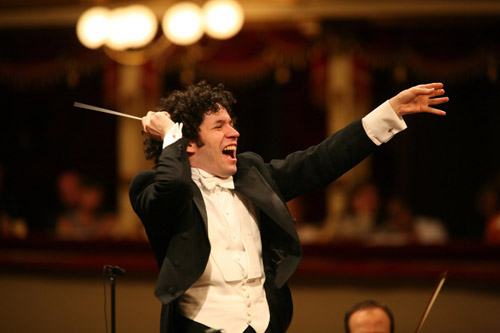
El Sistema's most famous product, Gustavo Dudamel, was back at the podium, and he led an assured, broad reading of Richard Strauss' tone poem Eine Alpensinfonie. This was the sort of music a group this large was meant to play, vast in scope and character -- four harps (doubling the two parts, one assumes), twelve horns, organ, wind machine, thunder sheets, and all. It is little surprise that the massive crescendos, the offstage brass fanfares, and the booming storm scene -- communicating the terror of being caught in a thunderstorm while exposed on a mountain randonnée -- were thrilling. Dudamel's challenge with this group is to contain it, to refine their sound, and work remains in those areas. The smaller chamber-sized moments were not always together or in tune, although the odd passages of the score -- the shimmering cascade of the waterfall, the cowbells and bleating herds -- were fun.


Other Reviews:

Anne Midgette, Simon Bolivar Symphony Orchestra: All grown up on the Kennedy Center stage (Washington Post, December 6)

Tim Smith, The refreshing power of Gustavo Dudamel, Simon Bolivar Symphony (Baltimore Sun, December 6)

Andrew Patner, Gustavo Dudamel and the Simon Bolivar orchestra bring vigor and finesse to Symphony Center (Chicago Sun-Times, December 3)

Lawrence A. Johnson, Dudamel and Bolivar Orchestra spark an audience frenzy in Chicago (The Classical Review, December 3)
The first half seemed flimsy by comparison, folk-influenced pieces by Latin American composers. Strauss towered over these works in melodic invention, harmonic color, and especially orchestration, and their rudimentary nature sounded vastly overplayed by a Strauss-sized orchestra. Carlos Chávez's Sinfonía India did not receive much nuance, a slender suite of dance tunes that benefited from the group's considerable verve of tone. Julián Orbón's Tres Versiones Sinfónicas seemed to come together less easily, some raggedness appearing in the sections without percussion to calibrate the ensemble. The second movement, inspired in some way by medieval music, does not sound all that medieval and, worse, drags on and on without really getting anywhere. The third movement, by contrast, is a percussion-centered lark, short enough to serve as a brilliant orchestral encore.

Hear the performance of the Simon Bolivar Symphony Orchestra, live at Carnegie Hall, via Internet radio (December 10, 8 pm).