CD Reviews | CTD (Briefly Noted) | JFL (Dip Your Ears) | DVD Reviews

5.9.10

Ionarts-at-Large: From the 2010 ARD Competition, Day 14 - Horn, Final


The ARD International Music Competition is winding down, with the third of four finals over with. The jury had promoted four French horns into the final, among them, somewhat inexplicably, the German Luise Bruch. She probably least expected the final of all people, which would explain why the concerto—she chose Reinhold Glière’s over Richard Strauss’—so caught her by surprise. It was an unfortunate performance, and by the looks of her, no one was more keenly aware of it than the artist herself. Let silence rule the day on this one.

Next to play his concerto with the Bavarian Radio Symphony Orchestra, again under Christoph Poppen, was Paolo Mendes. Not only is Strauss' second EI major concerto (AV132) so much more to the point than the Glière, Mendes also played it very passably, his charismatically clear tone and scarcely a hint of hesitancy hinting at the fact that he already has a solo horn position at a major orchestra, the DSO Berlin.


Dániel Ember tried to make the Glière more palatable, and to the extent that he succeeded (it still isn’t a sophisticated concerto and it takes unnatural love of the French horn to find any merit in the trite finale) it was the result of his confidence, the resulting precision, the roundness of the slow movement, and the stormy first few moments of the Allegro vivace. The finale now became a boys’ competition of solo-horn players from different major German orchestras, Ember being with the Hamburg State Opera orchestra (the same where Christian Kunert, bassoon ARD Prize winner in 2008 performs).


The third in that triptych was Přemsyl Vojta, who is a solo horn at the Konzerthaus Orchestra in Berlin. The BRSO, still awfully loud in the Glière (not that it’s a sophisticated concerto), notably moderated its tone in the second half, and also performed the Strauss concerto generally with greater nuance. That meant that Vojta got very reasonable orchestral support for his concerto performance which was another solid notch above the competition. His dark, varnished tone and total confidence ensured him the audience prize and the first prize, both of which were not in the least surprising. The event ended on a very conciliatory note for Ember and Mendes, too; they got to share a second place.

Tonight the last final—that of the (promising) flutes—will take place.


All pictures courtesy ARD Intl. Musik Competition, © Dorothee Falke

available at AmazonR.Strauss, Horn Concertos,
Previn / WPh
Ronald Janezic (et al.)
DG
available at AmazonR.Glière, Horn (& Cello) Concerto,
Soustrot / Royal Flemish Phil
Eliz Erkalp (et al.)
Talent

In Brief: Rest from Your Labors Edition

Here is your regular Sunday selection of links to good things in Blogville and Beyond.
  • The observance of the precise anniversary has managed to escape official notice around here both this year and last year, but in July Ionarts completed its seventh year in existence. At the rate of at least one post per day, and sometimes more, that adds up to 4443 posts at the time of this writing. In that time, a couple million visitors have racked up several million page views, from all the inhabited continents of the planet. Hello, Japan, Peru, Croatia, Indonesia, Sweden, Hong Kong, India, Belarus, Thailand, New Zealand, and Iran! All of you, we thank you and please keep reading! [Ionarts Birthday]

  • Eric Bietry-Rivierre reports on an astonishing archeological discovery made recently in Neuville-sur-Sarthe, a small village about four kilometers from Le Mans: recently uncovered ruins of a striking Gallo-Roman religious complex. Over an area of four hectares, the dig has turned up alignments of well holes, temple foundations, sepulchers, and several hundred small objects. There is no known name for the settlement, and it is not even clear what gods were worshiped there, but it is apparently one of the largest such sacred sites in western France and was active between the first century B.C. and the third century A.D.
    [Le Figaro]

  • Composer Jonathan Harvey thinks that the classical music world needs to give up on its stuffy listening etiquette: "Young people don't like concert halls... and wouldn't normally go to one except for amplified music," he says in a radio interview to be broadcast today. "There is a big divide between amplified and non-amplified music. The future must bring things that are considered blasphemous, like amplifying classical music in an atmosphere where people can come and go, and even perhaps… and certainly leave in the middle of a movement if they feel like it." [The Observer]

  • Critic Fiona Maddocks cries foul. "The London Philharmonic Orchestra's Vladimir Jurowski addressed this question after conducting Beethoven at a free-spirited beer-and-crisps concert at London's Roundhouse. While he could tolerate chatting and tweeting at this non-classical venue, he conceded that at the Royal Festival Hall any unnecessary noise is a distraction. Who, of a classical tendency, hasn't sat next to someone whose noisy breathing – yes, that's how much we mind – has prompted murderous feelings?" [The Observer]

  • Architect Rem Koolhaas says that governments are too hasty to put historic buildings and other sites on protected status lists, without reflecting on "how we are trying to stop the advance of time, how what is preserved can remain alive while still evolving. We must stop embalming cities, monuments, and whole parts of the world, and not only because it is financially impossible." At the same time he notes with despair that countries all over the world are causing all traces of post-WWII architecture to disappear. [Le Monde]

  • Michel Houellebecq's new novel La Carte et le Territoire is set to be available in bookstores in France on Wednesday, one of the big events of the rentrée littéraire. Slate.fr has isolated several passages of the book that were lifted, more or less verbatim, from an encyclopedia -- Wikipedia, to be precise. Flammarion, Houellebecq's publisher, maintains that this is just another example of the author's habit of incorporating or imitating non-fictional types of writing in his novels. [Le Point]

  • The Château de Versailles regularly hosts expositions of contemporary art in its historic rooms. After Jeff Koons two years ago, there is currently an exhibit of sculptures by Takashi Murakami, with imagery inspired by Japanese manga cartoons. Petitions and threats of legal action to stop the exhibit have been circulating on the political right: Jean-Jacques Aillagon, now director of the château, says that these protests are coming from extreme-right, ultra-conservative factions in French society, people who want to make Versailles into "a reliquary of nostalgia for the France of the Ancien Régime." One young man, who has hosted one of the petitions, says that he has done so under a pseudonym because "not liking contemporary art could be seen badly by prospective employers." [France 2]

4.9.10

Ionarts-at-Large: From the 2010 ARD Competition, Day 13 - Flute, Semi final


Who thought it would be the flutes to come to the rescue of the 2010 ARD competition. That—flutists may forgive me—potentially most tedious of instruments, in the hands of young musicians entering a competition is scarcely a promising scenario, especially not after other instruments with a much greater probability to please have already placed the bar so low. And six Mozart concertos in a row can so very easily be turned into an instrument of torture… nearly as dulling as a triple-Dvořák bill.

Alas, the six flutists—five flautettes and one flutude, the reverse gender distribution from the horn competition—didn’t torture, or dull the senses, they delighted all, albeit in varying degrees. Not just in the Mozart, but also the commissioned work they had to perform, “Quatre mélodies arméniennes” by Bruno Mantovani (not related with Mantovani, the arranger of syrupy string cascades fame). “Quatre melodies” ended up being played in five different ways by six different flutists, and it was interesting every time—a sure sign of quality on the part of the composer, as well as the performers.


Lívia Duleba (Hungary) went first, sensitive to the music behind the notes, bringing out at least two of the Armenian melodies obviously enough to grasp even at first listen. Her Mozart (K313) had poise, keenness, sense, was very well delineated, neatly articulated… not quite enough to keep a colleague from dozing off, but to these ears it was a whole different affair from the Cello-Haydn or Horn-Mozart or even the Piano-Duo Mozart we had endured thus far. I was enchanted, already, but this was just the beginning.

Next up was Timea Acsai, also from Hungary, and her Mantovani, while similar in authentic (?) sensitivity to the melodies, had a clearer sound, very round and woody, smoothly integrating the ¼ tones, and featured one of the most effective, air-less forte possibles. Add to that some very nicely shaped non-vibrato to molto vibrato crescendos. Her Mozart (also the concerto in G), including a very short but very compelling cadenza, had many of the same qualities as did Duleba’s, but came across as more naturally, more maturely played, peaking in a Rondeau that was absolutely compelling, despite its understatement. In its subtle way, this was the best playing in the competition I had heard so far, and if it was going to be bested by at least one following candidate, that isn’t taking away from the fact that I would be happy to hear a performance like it on any stage, at any time. I couldn’t help being reminded of how Emanuel Pahud had recently bored me to tears with the same (in itself somewhat unsatisfying, it should be said) concerto, and how much more gripping Mlle. Acsai’s performance was.

But before I was even finished being delighted, willowy Ivanna Ternay (Ukraine) was up, and she upped the ante again, and considerably. In Mantovani’s piece she went all-out, exposing herself without ever failing, virtually spitting the soufflé notes out of the flute, never over-blowing, or overtaxing the instrument, no matter at which pitch or dynamic range. It would seem that it might help tremendously to be familiar with the kind of traditional melodies that Mantovani refers to, their character, the soundworld, the morning overtones of shepherds’ tunes in the mountains (this is speculation on my part, by the way, not based on information from the composer). Perhaps it is no coincidence that Mlles. Duleba, Acsai, and (in her more extrovert way) Ternay seemed to come closest to that sensibility. But even if that was the most proper way to perform “Quatre mélodies arméniennes”, it was by no means the only way to play it well, as the next three candidates showed.

But first to Mlle. Ternay’s Mozart—the first to play the concerto in D, K314 (originally written for the oboe, and much more amenable to repeat listening than K313): What articulation, what nuance! Individuality was asserted, and Ivanna Ternay displayed a determined will to enchant, not just hope to do passably well. Flutists, these three performers suggested, might be closer in character to singers than are horn players or cellists. There was generally, and especially with this performer, a desire for direct communication with the audience that was evident to all present. What followed the Allegro aperto was the most eloquent, interesting slow movement of this entire competition so far (which, in all honesty, it isn’t saying a whole lot). There was no monotony creeping in only because the tempo was slower, and the cadenzas—her own? Johannes Donjon's—were musical, witty, intelligent, and impressive. The closing Allegro was chair-dance inducing, capping a performance I have no qualms calling great—something that was affirmed by the audience’s shouts of “Brava” and Mlle. Ternay being called back on stage for an unprecedented third time at this stage of the competition.

The Austrian Daniela Koch went first after the short break, and was the first to play “Quatre mélodies arméniennes” completely different, perhaps completely ‘wrong’ [though Duke Ellington reminds us: “If it sounds good, it is good”], and completely charming with her western ear for the harmonics and melodies. She turned it into a work of birdsong, an extension of Prokofiev’s Peter and the Wolf. Her very attractive Mozart would have elicited raves from me, just two hours earlier, but going fourth and having been spoiled so far, I caught myself taking the very high level of her performance for granted.

Sooyun Kim (USA/South Korea) went almost as far as her Ukrainian colleague in pushing the souffle-marked notes, and gave Mantovani’s piece a darker hue, a sense of imbued mist, pagodas and small temples on dark, green mountains, rather than wistful melodies waving by goat carcasses on yellow stones and browned grasses amid wide open stretches of sloping mountain sides. Most impressive was the new sense she gave to the staccato sextuplets of brutally fast semiquavers… they allowed the irregularly occurring outliers to form a melody by turning the repeated notes into constant background, rather than a mere line from which the performer deviates every so often. In Mozart, I found my colleague’s (not entirely flattering) comment of a “mechanical bird” appropriate, and her cadenzas silly, but again, on its own rather than post-Ternay, this would have been fully satisfying.

Last to go was Loïc Schneider from France, who probably went furthest in Mantovani’s piece, equally exaggerated (in a good sense) as Ternay, and the first to get a real beat going in the staccato/tenuto passages somewhere around the first third of the work that had hitherto seemed the most dispensable of “Quatre mélodies arméniennes”. His fortissimo was as good as Acsai’s, but his ‘bird runs’ didn’t raise the bar any further than Kim and Koch had. His Mozart was a touch put-on, but then that always beats timidity… and there was none of that in his performance. He didn’t overdo the ‘beauty’ part of the concerto, partly due to a lot of extraneous air in his tone, and some of his notable efforts in the slow movement seemed to produce more heat than light, but he still showed how easily and obviously a titillating performance stands apart from mere goodness. Pushing the Allegro to the brink in order to squeeze out as much excitement from Mozart as was possible hearing the concerto for the fourth time in a row, he was not even bothered by the hammering that started somewhere in the building, creating a rather irregular off-beat to Mozart’s concerto.

available at Amazon
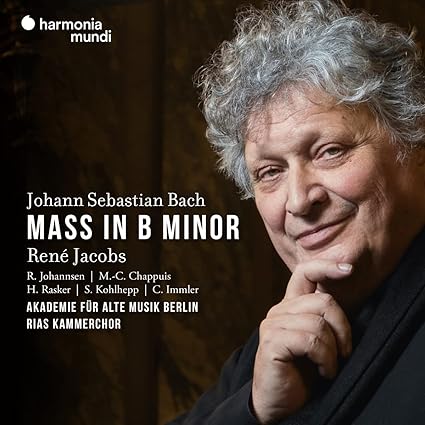
W.A. Mozart, Magic Flute,
Jacobs / AAMB
Harmonia Mundi
I wouldn’t hold it against the accompanying Munich Chamber Orchestra (MKO), again on Mozart duty, if they took a year-long sabbatical from the composer after this ARD competition. Heck, I want to take a sabbatical from Mozart, too—except that I also really want to hear René Jacobs’ new Magic Flute, no matter what other damage has been done. That said, the MKO once again went well beyond the call of duty, still giving their best even for the sixth performer. At least they were being more highly rewarded by their musical collaborators that day, which must have been gratifying.

From this qualitatively most pleasing semi final, four flutists advanced, Ivanna Ternay and Loïc Schneider most obviously, as well as Daniela Koch and Sooyun Kim—the four, perhaps by coincidence, to have chosen K314. I will miss Timea Acsai’s understated presence more than I might have missed Mlle. Kim in the final, but at least this was a decision where the jury was spoiled for choice, and any of these will be worth hearing again in the final, no matter how you feel about the flute as an instrument.

D'Anglebert on the Clavicytherium

available at Amazon
D'Anglebert, Pièces de clavecin

(re-released on December 10, 2009)
EMC CD-7759 | 110'25"

Online scores:
d'Anglebert, Pièces de clavecin
Christophe Rousset recorded all of the keyboard music of Jean-Henry d'Anglebert (1629-1691), combining pieces that were published and those drawn from manuscripts. Before and since that 2000 disc -- can we get a re-release, Decca? -- d'Anglebert has been an occasional interest among other harpsichordists, too. Recently, Canadian harpsichordist Hank Knox recorded selections -- about half of the pieces in the only published volume of d'Anglebert's music, the Pièces de clavecin, from 1689 -- a disc actually made in 2003 but which arrived on my desk only recently. The twist that makes the release slightly unusual is that Knox, the director of the early music program at McGill University in Montréal, plays these pieces on a clavicytherium (built by Yves Beaupré and modeled on an 18th-century example by Albertus Delin, a Tournai-based builder who specialized in this type of instrument). The instrument signified by that exotic term -- a combination of roots from words for keyboard and cithara -- is nothing more than an upright harpsichord, with the strings and action extending vertically upward rather than horizontally like other harpsichords, perhaps to save space in a small room.

The sound is essentially no different: to paraphrase Beecham, it is still like two skeletons copulating on a tin roof -- just while standing up. The only change, as far as I can tell without having played one of these instruments, is that the sound would be much louder in the player's ears rather than radiating outward toward one's listeners (a special action to make the plucking of the strings possible in a horizontal direction adds more noise). D'Anglebert was one of the favored keyboard composers of the 17th century, somewhere in the shadow of the Chambonnières (father and son -- the latter was possibly d'Anglebert's teacher, honored by a Tombeau among d'Anglebert's works) and the Couperins. He spent most of his career playing in court settings, at the private entertainments of Louis XIV and his guests, as well as for the king's brother, the Duc d'Orléans. The music of the publication featured here would all serve quite nicely for that purpose: three "suites" of dances (D minor, G minor, G major -- with more or less the expected order of movements, although he does not label them as suites), complemented by arrangements or adaptations of popular ballets and operas by Lully (emphasized in Knox's selection), music that had only recently been premiered and was much in vogue. The clavicytherium is tuned to A415, in an unusual temperament: as described in David Chung's much more detailed review for the Journal of Seventeenth-Century Music, the temperament of six pure thirds is based on one created by the organist Lambert Chaumont, resulting in one hair-raising wolf fifth. (Chung also notes that the oldest surviving stringed keyboard instrument is actually a clavicytherium.) Knox's playing, assured and enlivened by a knowledgeable execution of ornaments, helps make this disc worth a spin, if not a necessary purchase.

3.9.10

Ionarts-at-Large: From the 2010 ARD Competition, Day 12 - Cello, Final


I can’t deny a certain talent for putting my foot in my mouth. Darting up the stairs of the Herkulessaal, where the Cello finale of the ARD International Music Competition’s was taking place, I run into Jean-Guihen Queyras, one of my very favorite cellists, who is attending with his entire, ridiculously charming family, replete with three adorable youngsters. “I’m nervous, of course”, he confesses which I find odd, and then thoroughly misinterpret, because I reply, semi-jesting: “I think you needn’t worry—there’s no one in this year’s crop that will ever challenge you.” He looks at me quizzically for a second, then clarifies, completely unflappably: “Oh, you may not know, two of my students are in the final today.”

Ooops.


Those two students are Gen Yokosawa, born in 1986, and Tristan Cornut (1985), with the third cellist who made it into the final being the German Julian Steckel, about 28 years old. All three had chosen to perform the Dvořák Cello Concerto, which brings me to the first point of (slight) criticism: Why offer such ‘greatest hit’ concertos for the final (Shostakovich No.1 and Schumann would have been alternatives), which in this case not only makes it likely that one gets a lopsided finale (almost half the participants chose the Dvořák, in case of finale), but ensures that the audience gets to hear warhorses, and that the performers get reinforced in studying warhorses. There is no reason to go crazy-obscure with the options they could choose from, but wouldn’t such a competition be a wonderful opportunity to introduce audience and performers alike to works that linger just outside the regular canon, and are still masterpieces? The ones that come to mind immediately would be Britten, Walton (still largely an Anglo phenomenon, both) and Myaskovsky. (The same goes for always choosing Haydn, Mozart, and Beethoven, in the other categories.) With those works less likely to already be part of the repertoire of an aspiring competition-participating musician, the playing field would be leveled further, and a public service to music-diversity, away from concerto mono culture, would be performed to boot. Perhaps the catty remark of a colleague hits the nail: “But then the jury would have to learn these works, too…”

Anyway, Dvořák it was, and gorgeous though that work is, it does not lend itself to being heard three times in a row. With every round, it seems another five minutes longer, which is considerable, since it starts five minutes early (the cellist just sitting about, twiddling his thumbs) and ends five minutes too late (the final climax seemingly reached, still bumbling around until it finds the exit sign). It would be a tough session, even if the concerto was played phenomenally well. Which it decidedly wasn’t. But this time—unlike in the semi final—the blame does not just lie with the young (and not so young) performers. Which brings me to my second point of (not so slight) criticism, the otherwise so venerable Bavarian Radio Symphony Orchestra and, more specifically, its conductor Christoph Poppen. He brought two modes to this Dvořák, ‘loud’, and ‘very loud’. Then he proceeded to play the work identically, three times, with seeming disregard to the soloists’ different tone and approaches, uninterested in fixing obvious mistakes from one performance to the next, unwilling to keep the orchestra together in the slow movement, and completely foresquare, to boot. Veteran ARD and BRSO audience members, and everyone else who shared their thoughts with me afterwards, were unisono aghast. For shame, because Poppen, who successfully oversaw the ARD Competition for several years, should know better.


Liberal portamenti gave Tristan Cornut’s first movement an old fashioned character, and his anguished vibrato yielded some returns. But his tone—Queyras-student or not—was very tense. There were no liberties in the phrasing, the third movement sounded ever tighter and eventually whiny, instead of delivering Parsifal-like awe and calm. His performance, as everyone’s that night, was better than his semi-final Haydn, and especially his slow movement offered genuinely pleasant moments, but if that had been a performance in a bona-fide concert (though hopefully he’d have had a more sympathetic conductor, in that case), it would still have been a great disappointment.

In case anyone wonders if that’s a fair measure to apply to such a final: Yes, it is. These are not students (though some still are) trying to get into the business, these are professional musicians presumably trying to gain merits to jumpstart an international solo career. They definitely ought to be able to turn in a top-notch concerto performance, as good or perhaps even better than what one can hear in many a non-metropolitan concert hall. (Having heard the semi final of the flutes just before writing this up only corroborates that position; there I heard five out of six performances that could have been plopped on any concert stage to have left with nary a soul disappointed.)

Ionarts-at-Large: From the 2010 ARD Competition, Day 11 - French Horn, Semi final


It’s strange that intonation should be less an issue with up-and-coming French horn players, than with cellists, but that’s what the ARD Music Competition’s horn semi final produced. Six musicians, each playing a Mozart concerto and each playing the commissioned composition, performed over a almost four hours, always in groups of three tackling “Bamberger Hörnchen” by Jörn Arnecke, then their concerto.

The commissioned work’s name is a coy play on the city in which Arnecke composed it and the many meanings of “Hörnchen”, which is not just the diminutive of French horn (just “Horn”, in German), but also means squirrel, or a croissant-like pastry. Unfortunately the work was neither cute nor yummy, bound to be played one more time (by the winner of the contemporary performance prize at the prize winner concert’s), and then never again. To see all six candidates struggle with it in various degrees was understandable… there was little music to squeeze out of the notes between all the required technical shtick. Constant pitch and microtone shifts make it sound like an organized tuning effort. Especially after the Salonen work “knock, breathe, shine” and Borboudakis’ “loops’n grains” (Edition Peters), this was a notable drop-off in listening-enjoyment.

The first horn player to go was Dániel Ember (Hungary), who had trouble—as did everyone— to get the sung notes (“cantato”) out while simultaneously playing harmonics. The runs with alternating rhythmic patterns, among the most pleasing elements of “Bamberger Hörnchen”, were done very well, shifting the pulse Le Sacre style. Ember’s Mozart (the two concertos with ripieno horns were available to chose from; Ember went for the earlier K417), sadly, was crushingly boring from the first bars onward. Dopey’s interpretation, if you will, without the (un)intentional humor. There was nothing the excellent, but eventually exhausted, Munich Chamber Orchestra (MKO) could do, accompanying such a listless performance. Give me spunk, surprise, excitement… give me anything, just not this limpid student-timidity. Ember was accurate in the Rondo throughout, but dutiful, plain, earnest. The hunting call dotted notes in the Rondo were awfully tame, not at all a crushing hunting party storming indoors, mud still on their boots.

Lin Jiang (Australia) was next. He had gorgeous, soft-hued moments of precision in the pitch-changes of “Hörnchen”, and terrifically articulated consonants in the spoken elements, which made it sound as though someone was walking behind him on stage. He even eked a few musical moments from the score by successfully connecting phrases. But his runs were very clumsy, and the breathing in legato phrases distracted. A few stumbles here and there, fewer dynamic variations, but no fewer troubles with the “cantato” part than his Hungarian colleague. In Mozart—also K417—his sound was muffled, the playing not much less unexciting, and a few infelicitous tones are almost a welcome diversion. But it was still this damnable ‘playing safe’ that is the course of competitions.

Přemsyl Vojta (Czech Republic) performed the “Hörnchen”-runs very nicely, smoothly shifting the pulse without a halting moment. The part where the player has to percussively speak the consonants “ktktpt…” into the instrument was different from Jian, less neat but with a more pronounced accelerando—as he was more observant of the dynamic markings in general. But even he couldn’t get that pasty-squirrel into gear. In Mozart’s K496, he slumbered in homely circles through the first movement, a docile smile on his face, emitting a sense of farm-boy transfiguration. The physical and temperamental difference from horn players to, say, cellists, is strikingly obvious, and very possibly telling. In the first movement cadenza—his own—Vojta managed to surprise with a slight touch of genius, referencing the ‘cantato’ parts of the commissioned composition. (Once would have sufficed, though… three times was pushing it.) The Rondo was dashing, but still short of excitement.

2.9.10

Ionarts-at-Large: From the 2010 ARD Competition, Day 10 - Piano Duo, Final


Four teams made the finale of the Piano Duos, including two that I heard in the second round where they performed the ARD commissioned work, “loops’n grains”, by Minas Borboudakis. Those two duos were the Josiane Marfurt – Fabienne Romer Duo (playing together in their first year) and the Gröbner – Trisko Duo.

If the Marfurt-Romer Duo’s appearance in the finale was a little plain, in that dear, well-behaved, mannered, "Mozart for proper young society ladies"-way, their second round performance of Liszt’s Don Giovanni Fantasy was nothing like that. You may like the work or not—a lot of note spinning, admittedly—but it is rambunctious, over the top, strangely loveable… and especially for me, just back from a mesmerizing Don Giovanni experience in Salzburg. Hearing the Liszt-explorations on familiar tunes was like getting postcards from a far-away friend; a wonderful mélange of Don Giovanni’s greatest hits replete with ten minute flamboyant finale… riotously funny actually, in the best—entertaining—sense. The whole piece was performed with the bravura bravado it elicits, demands, deserves; Marfurt-Romer’s tone sympathetic, their touch soft, their legato fluid, their fingers nimble. The incredibly full bodied beginning was played with tons of oomph and still completely clear, unmuddled. I liked their performance of “loops’n grains”, too: Their prepared notes–high and low–sounded a good deal nicer than the other duos elicited and they made much more sense of those parts… now the prepared strings low sounded like a dead bell, not an ugly piano, which was the case with Gröbner – Trisko and the Russian duo Olga Kozlpva – Nikolay Kozhin. Incidentally, their second round Mozart sonata (K521) was similar to the Mozart in the finale: “Maybe trying to get a little more from the notes [than Gröbner – Trisko]… but getting stuck at impeccable loveliness, harmless” is what I wrote down… which is pretty much what ended up not getting them any prize (or even honorable mention) in the finale. Their rendition of Mozart’s Concerto for Two Pianos K365, supported by the Bavarian Radio Symphony Orchestra under Christoph Poppen, was faultless and harmless in equal measure, as described above. Mozart that was very “nice”, but unfortunately with those damning quotes around it.


Gröbner – Trisko didn’t get a placement prize either, but they garnered the prize for the best performance of the commissioned work and if a prize had been given for best dressed Duo, they would have swept that category, too, appearing, as they did, in matching gowns of ruby red and tree frog green/mustard yellow, as lush as their blonde manes. Shallow focus? Hardly. For one, why should one ignore the importance of the visual when the artists themselves affirm it so boldly? And while choice of dress is obviously not as important as playing the right notes [] or a rhythmically taut, groovy Allegro in the E-flat Major Concert [], it is inevitably part and parcel of any artist’s package—solo or ensemble—and it would be folly to ignore how it influences our perception when it does, one way or the other.

In the second round I was more impressed by their Rachmaninoff Suite No.2 op.17, which was performed with the ample romantic gestus that this wild and luxuriant work—in many ways similar to his famous piano concertos—needs to take off. Only the middle movement lacked the flash and teetered at the brink of boring. Their Mozart sonata (K497, for four hands, rather than two pianos) had a particularly lovely, swift middle movement, and their “loops’n grains” was given a fully bodied workout. Hearing the work for the first time, I was still busy listening to the music, rather than the performance, and didn’t catch those elements that propelled their interpretation above that of their Swiss colleagues (except that their prepared strings sounded—purposly?—much more ungainly). The piece itself has a Morse code-like beat that permeates everything, sends the players to alternate ends of the keyboard in a first part that peters out slowly while still sounding the same… and gets punctuated by a shrill single high note. Then it continues, deliberately, with a modulation into a second, halting part before gathering speed and drive again; all that unalterable mechanical way. Clusters that are played with the flat hand and a few more extremes on the piano are thought out… which makes for reasonably attractive, if not thoroughly enchanting hearing. If there was one particular sense I came away from hearing it three times, it was that of having been faced with an emasculated Winnsboro Cotton Mill Blues.


The American Piano Duo Susan & Sarah Wang, twins from New Jersey and 2007 graduates from the Manhattan School of Music, got bonus points for choosing a concerto different than the Mozart work. (A pity none of the duos that had chosen the wonderful Poulenc concerto or the Martinů work made it to the finale; mediocre Mozart being rather more a punishment than you might think.) The Double-Wang Duo chose Mendelssohn, an underrated concerto that can be propelled to excellence with a gutsy enough performance. Unfortunately the Wangs’ performance was everything but gutsy, it was more a case of the nerves, with unnecessary missteps permeating the first movement, and a nimble, but tinkly sound. The most gorgeous moment came with the middle movement when the summer-outfit of the BRSO (but with their marvelous first flutist Henrik Wiese on duty!) wallowed in the lush Adagio non troppo introduction. Not having heard the duo on previous occasions, there is no way of knowing how that performance played into the decision of the jury to give them a third prize, except that based on the performance in the finale alone, I might have seen the Austrians slightly ahead of the American twins in their partner-look of (supremely tasteful) shoulder-free burgundy dresses.


The final duo of the day was the Remnant Piano Duo—an odd name; suggesting something like the two players from their graduation class left without a soloist career. Hyun Joo June and Hee Jin June—sisters from Seoul, trained in St. Petersburg—are actually a very successful and longevous team, having started playing as the Remnant Duo in 1997 and clearing out top prizes at competitions ever since. Their performance of Mozart’s E-flat Major concerto was subtly better, and at the same time in a different league. Their experience, not to say routine, came through fully, in a gusty, brawny Allegro, where there was finally a sense of dance and a little lilt and some tension-release in the ritardandos. The Andante, fluent, neat, glib, went by quickly enough and the Rondeaux–Allegro, although on the see-saw side, was playful. That convinced the jury to give them the top—a very appropriate second—prize and the listeners were convinced, too, bestowing them the audience prize. (Which goes to show that Mozart with a pulse can outweigh a pair of unflattering, white and garish red maternity dresses.)

All pictures courtesy ARD International Music Competition, © Dorothee Falke

available at AmazonW.A. Mozart, Concertos for 2 & 3 Pianos,
Lupu, Perrahia / ECO
Sony
available at AmazonF. Mendelssohn-B., Concertos for 2 Pianos,
Frith, Tinney / RTE Sinfonietta / Ó Duinn
Naxos

1.9.10

Notes from the 2010 Salzburg Festival ( 15th and last for 2010 )
Simon Rattle in Mahler’s 11th Symphony


Berlin Philharmonic • Simon Rattle • Schoenberg, Berg, Webern, Wagner


You can tell that the Salzburg Festival is wrapping up when the local camera teams, trying to catch a glimpse of B- and C-celebrities, are thinning out, when outside seating at the Triangel restaurant across from the Festspielhaus becomes easily attainable, when the days get notably shorter than they were at the height of July and the temperature drops. The spot of the Festival’s last orchestral concert traditionally belongs to the Berlin Philharmonic, and after the out-of-this-world Firebird from the Concertgebouw Orchestra and Mariss Jansons, the Berliners under Sir Simon Rattle had to do something very special to see that their appearance would not be an anti-climax.


The Pieces Are Coming Together


Fortunately, they did have something special on offer, namely the programming. After Wagner’s Parsifal Vorspiel and Richard Strauss’ Four Last Songs with Karita Mattila, Sir Simon programmed a veritable Second Viennese School workshop: Schoenberg’s Five Orchestral Pieces op.16 (1909), Anton Webern’s Six Pieces for Orchestra op.6b (1909, rev. 1928), and Alban Berg’s Three Orchestral Pieces op.6 (1914, rev. 1929). In a very succinct introduction, Rattle asked to abstain from applause between the works, so that they might be appreciated as a triptych, “…or more—maybe even as an imaginary 11th Symphony of Gustav Mahler.”

What a daring, good program. Not so much a crowd pleaser as it is a taste-builder. This wasn’t going to elicit the ecstatic applause the Concertgebouw got post-Stravinsky, and indeed many in the audience fled pretty much immediately after the March from Berg’s 3 Pieces ended, but every disturbed set of ears was matched by a grateful, spellbound set that got lost in Schoenberg, Webern, Berg. Spellbound by the yearning love that Webern’s opening “Langsam” exudes, the cautious restlessness and search of “Bewegt”, the sweet longing of “Mäßig”, the looming, cloudy slowness of “Sehr Mäßig”, the road to serenity in “Sehr langsam”, or the mourning in the final “Langsam”. By the impossibly compelling climaxes of the “Präludium. Langsam” in Berg (finally putting an end to all distracted coughing), the audible heartbeat in “Reigen. Anfangs etwas zögernd – Leicht beschwingt”… by the rousing, gripping “Marsch. Mäßiges Marschtempo“, with Wozzeck bleeding through the score. One of Berg’s great skills is that he can cumulate climaxes, one after the other, without losing any tension in the stops, only re-gripping to further tighten the screws. The trombones, finally, burst out (Lady Macbeth of Mtsensk District-style) with a sexuality that belies any ideas of dry, theoretic dodecaphonic music.


Wagner from the Fridge


The Berliners, though distracted by a hearing-aid with its high-pitched feedback that reared its ugly head throughout, traded some of their perfection for grit and brawn, made Rattle proud and many in the audience very happy, indeed. That their Second Viennese School ended up more moving and romantic than the first part of the program was partly due to their excellence in the latter, partly due to blasé Wagner and cold Strauss. With little mysticism, nor even the absolute precision they are uniquely capable of under Rattle, Parsifal was more stuffer than spiritual experience. And The Four Last Songs, insensitive to Karita Mattila’s need to sing through the wall of sound around her, didn’t stir, didn’t move, and would have been unintelligible even if Rattle had taken his band back whenever he realized that Mattila was in trouble. Mattila was warmly received from the audience anyway, and half sang, half yelled a Straussian “Habet Dank” back at them, but the best thing about her that night was a tastefully purple, body-hugging dress that, in sharp departure from a dress recently worn during Strauss in Munich, didn’t make her look like a GDR shot putter.

Outside the Festspielhaus an old but sharp lady approached me, shaking her head about that ‘modern, newfangled music’, and how she could not be expected to like it, or applaud after it. Since I wasn’t going to pretend to agree, I tried to make the Second Viennese School slightly more palatable to her in the gentlest terms possible, suggesting that if she—by her own admission—could find it impressive or even rousing, just not beautiful, she was already three quarters of the way down the road to appreciating it. ‘Beauty’, in the conventional sense, isn’t the point of these works, but then that isn’t the point of something like Le Sacre (which she likes), either. And I couldn’t help point out that, and I went about this tactfully, the music she just heard and found so awfully ‘new’ was older even than she. There we are: A century later, Schoenberg, Webern, and Berg are still poster boys for “New” music.


• • ♥ • •

Later that night the Berlin-bound Jürgen Flimm, the Intendant of the Festival for the last four years, threw a little parting party at the Triangel that marked the end of his reign. Markus Hinterhaeuser, the mind behind the concert series and the new music programs at the Festival, is responsible for the tantalizing next season, which includes Claus Guth's complete DaPonte/Mozart cycle (Minkowski, Nezét-Séguin, Ticciati), a Frau ohne Schatten with Christian Thielemann conducting and Christof Loy directing, and Esa-Pekka Salonen in Janáček’s The Makropulos Case. After that, it will be up the experienced (ex-) Zurich Intendant Alexander Pereira to take the reins, a choice that especially the modern music enthusiasts among the Salzburg Festival audience fear might be a leap backwards but should be rich in populisms.