CD Reviews | CTD (Briefly Noted) | JFL (Dip Your Ears) | DVD Reviews

6.8.07

Ionarts in Santa Fe: Daphne


Erin Wall as Daphne, Santa Fe Opera, photo by Ken Howard © 2007
Richard Strauss’s late opera Daphne (last reviewed by Ionarts in concert performance and recording with Renée Fleming two years ago) begins simply with a gentle theme stated by the oboe and winds that binds together this single-act work. The new production by director Mark Lamos at Santa Fe Opera features staging that is simple yet effective: a laurel tree centered on stage, a few rocks, and shepherds featuring actual sheep. Cupid, having been mocked by Apollo for his skills as an archer, fired two arrows, one blunt and lead-tipped that struck Daphne (Erin Wall, the artist formerly known as Canadienne), causing her rejection of all things romantic. Finding love in nature, Daphne’s voice (her body camouflaged within the laurel tree) joins the chorus of shepherds in their farewell to the day – also a literal experience for the audience, due to the dusk enveloping the magical New Mexican landscape, visible from the open-air theater.

Other Articles:

Into the Woods (Out West Arts, August 9)

Scott Cantrell, Santa Fe production of Strauss' 'Daphne' a garden of delights (Dallas Morning News, August 4)

Scott Cantrell, 'Daphne' soprano Erin Wall hopes for more Strauss operas (Dallas Morning News, August 4)

Alicia Solomon, 'Daphne' showcases strong singers (Los Alamos Monitor, July 19)

John Stege, Up Against the Wall (Santa Fe Reporter, July 18)

Craig Smith, Musical high points but some directorial lows in 'Daphne' (Santa Fe New Mexican, July 15)
Apollo, the recipient of Cupid’s other arrow -- sharp and gold-tipped -- interrupts the preparations for the evening’s Dionysian feast, disguised as a mortal herdsman. Daphne, after rejecting shepherd Leukippos (Garrett Sorenson) and his flute playing, is urged to learn to love by her concerned mother, Gaea (Meredith Arwady). Filled with insatiable lust triggered by the golden arrow, Apollo succeeds in seducing Daphne with a kiss. However, Strauss underpins this kiss with tonal ambiguity by having the orchestra wander out of key, conveying Daphne’s mistrust of passion. Apollo later interrupts the Dionysian feast, a care-free tradition of wine and mating of young couples, by revealing himself as a god and, with an arrow, striking down Leukippos, who had returned cross-dressed in disguise still as Daphne’s suitor. Daphne proclaims, “I have been twice deceived,” and the opening theme is heard over dissonant muted trumpets at Leukippos’s last words: “Companion [Daphne], I have dared to love you, and was struck down by a God.”

Daphne’s calls for help to her friends and brothers in nature are met with Apollo’s opportunistic reply that he is of nature as the god of light. Though true, the aggressive, god-like motif given to Apollo by Strauss contrasts greatly to that of the gentle opening theme portraying nature, although they both comprise eight notes and are similar in rhythmical construction of two notes, triplet, and tail. Apollo then asks forgiveness from Dionysius for killing Leukippos and ruining his feast, and Zeus, for intruding on his creation, Earth.

Meredith Arwady, Matthew Best, and male chorus, Daphne, Santa Fe Opera, photo by Ken Howard © 2007
Apollo’s request to transform Daphne into an immortal laurel tree is met by chromatic instability that is gradually resolved by the growth of branches literally from the stage while Daphne is again camouflaged as one with the tree while singing “wind, play among my leaves.” The opera ends with Daphne lovingly singing the opening theme on an ‘ah’ vowel leading it in canon with the oboe – thus depicting her new role as a god of nature – in a texture of lightly shimmering violin clusters and harp notes. One never wanted this period of tonal solidity to end.

A regional connection to the profound worship of nature found in Daphne may be found in the Taos Pueblo’s 64-year legal battle against the government for 48,000 acres of mountain land taken in 1906 to become part of the National Forest system. The Native American tribe finally won the suit in 1970 on religious grounds due to the importance of Blue Lake, a site of sacred importance to religious rites that off-limits to non-members.


Erin Wall surrounded by Bacchic dancers, Daphne, Santa Fe Opera, photo by Ken Howard © 2007
Soprano Erin Wall became one with her character and showed no signs of fatigue in Daphne’s challenging role while always projecting well beyond the orchestra. Tenor Garrett Sorenson (Leukippos) sang with passion and fire, whereas tenor Scott MacAllister was a convincing Apollo, although seeming to struggle to project over the orchestra consistently. Contralto Meredith Arwady (full disclosure: we went to school together) best focused musical energy to herself by forcing the orchestra to follow her phrasing and breathe with her deep, slow breaths. The unique depth of Arwady’s voice was extended with great evenness through her upper range, which gave a sense of musical and dramatic maturity. Bass Matthew Best’s strong voice provided character to the role of Daphne’s father, Peneios, while veteran Santa Fe conductor Kenneth Montgomery led the orchestra and capable chorus with care and trusting authority.

Tickets appear to be available for the final two performances of Daphne on August 8 and 17.

5.8.07

Ionarts in Siena: Antonio Meneses

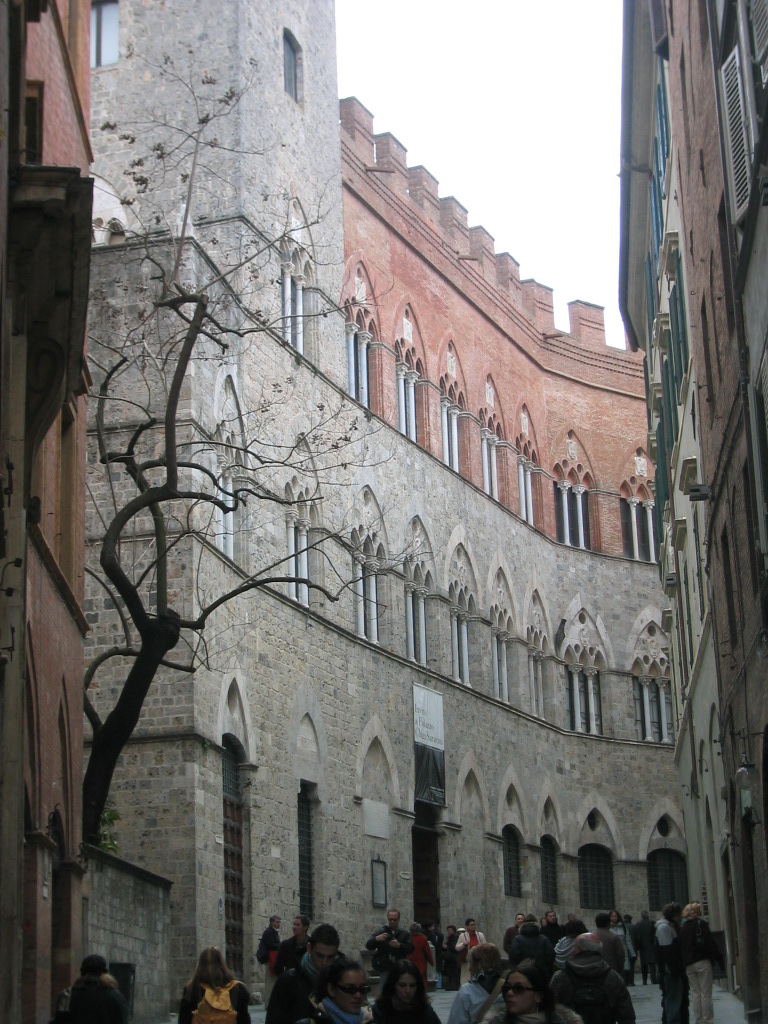
It would not have been in character for me to do anything but hear music on my last night in Siena. After a short bus trip into the Sienese countryside, we arrived at the unspeakably beautiful monastery of Monte Oliveto Maggiore, near Asciano. Perched like a fortress on a long ridge, this Benedictine abbey is visible through a cloak of pine trees only because of its slender campanile and tall crenellated walls. As we arrived, the abbot and a few monks were in the courtyard in front of the church to greet us, as a reminder that hospitality to guests is an important part of the Rule of St. Benedict ("Let all guests who arrive be received as Christ, because He will say: "I was a stranger and you took Me in" -- Chapter 53). The abbey bells tolled a few minutes later, summoning more monks from the cloister. Although we had arrived after the conclusion of Compline, only a few stayed up late to listen to the music.

Antonio Meneses:
available at Amazon
Schubert/Schumann (2007)


available at Amazon
Bach Suites (2005)


available at Amazon
Cellissimo (2002)


available at Amazon
Brahms Double Concerto (1993)
Cellist Antonio Meneses and pianist Gérard Wyss gave this recital in the open-air court of a building next to the monastery. With the performers on a platform in front of the back wall, the acoustics were not perfect, but the wind and sounds of ringing bells did not interfere too much with one of the most exquisite concerts during my time in Italy. Perhaps the performers were affected as I was by the location, but the introspective first movement of the opening work, the Brahms op. 38 cello concerto, has never sounded so calm and peaceful. In this performance, the work was a series of small, monastic epiphanies, moments of quiet transformation, with none of the driven qualities of the recently reviewed recording by Hélène Grimaud and Truls Mørk. A leggiero second movement and rather severe, contrapuntal third movement -- accompanied poetically by the tolling of the abbey bells -- were equally well served by Wyss's favoring of a dry, lightly pedaled sound, which allowed Meneses' gentle tone to shine.

Ionarts in Italy:

*Giuliano Carmignola (July 21)

Istituto Superiore di Studi Musicali "Rinaldo Franci" (July 17)

*Accademia Nazionale di Santa Cecilia (July 14)

*Concerto Italiano, Monteverdi's Orfeo (July 11)

*Cappella della Pietà de' Turchini (July 10)

*Fabio Vacchi, La Madre del Mostro (July 8)

Istituto Superiore di Studi Musicali "Rinaldo Franci" (July 5)

Staatskapelle Berlin, Mahler Seventh Symphony (July 4)

Staatskapelle Berlin, Mahler Fifth Symphony (July 3)

La Fura dels Baus, Die Walküre (June 29)

La Fura dels Baus, Das Rheingold (June 27)
The somewhat youthful first sonata was bookended by the much more Brahmsian second sonata (op. 99), composed some 20 years later. Except for a single dropped passage in the first movement, Wyss again proved himself a hyper-subtle player, technically secure but always shading each line with finesse, making him a good match musically for Meneses. The tempi were well chosen to showcase the prowess of the duo, with shimmering fast movements, especially the superlative scherzo, balanced by a luscious second movement. Sandwiched between the Brahms selections was what could almost pass for a third Brahms sonata, Richard Strauss's youthful assay of the genre, the F major sonata, op. 6. While it may be technically a work of juvenilia (Strauss composed it at age 19), the piece received a sympathetic performance here, with a formal, Brahmsian first movement and earnest, somberly tragic slow movement. Only in the third movement do we catch a glimpse of the mature Strauss, the dramatic composer who loved a story. In this performance, the rondo's main theme seemed to be conceived as a young hero in a series of picaresque adventures, a good-hearted jokester who laughs off the love serenades and dreamy moments.

Two charming encores sent the crowd into the night with very different flavors in their ears, beginning with Gaspar Cassadó's Requiebros, recorded by the two performers on their disc of encore pieces for the cello, Cellissimo. Its technical flair seemed to call for something lighter -- as Meneses, who teaches at the Accademia Musicale Chigiana in Siena, put it in very good Italian, "qualche cosa leggiera dopo questo programma pesante." The final piece was a short, melancholy work by Francisco Mignone, like Meneses born in Brazil, a shady and sultry miniature that closed a magnficent evening of music in an extraordinary place.

The Accademia Musicale Chigiana has again proven that its summer concert series is among the best in Europe. The main competition also reviewed here, the Maggio Musicale Fiorentino, is larger and perhaps more star-studded, but it was the Chigiana concerts in and around Siena that provided some of the most delectable musical moments of my summer (the Chigiana concert reviews have been marked with a star in the table). This is in no small part due to the guidance of Guido Burchi, whose excellent and informative program notes were featured at many of these concerts and who made my attendance possible. Prof. Burchi, who teaches in Siena, is reportedly at work on a biography of Count Guido Chigi Saracini, who founded the famous Sienese institution that bears his name and gave his own palace as its home. The Count left an archive of some 40,000 letters. That will surely be a fascinating book.

The Accademia Musicale Chigiana's 76th Estate Musicale Chigiana continues through the month of August, with the highlight surely being the Chopin-Schumann recital by Maurizio Pollini in Siena's Teatro dei Rozzi (August 12, 9:15 pm). We wish we could be there.

4.8.07

Dip Your Ears, No. 82 (Chamber Busoni)

available at Amazon
F. Busoni, Wks. for Cello & Piano,
Duo Pepicelli
Naxos

Busoni - Ferrucio Benvenuto Busoni (1866-1924) - might be best known for his Bach transcriptions that offer pianists genial versions of a rather romantic Bach to play. One might be excused to think that his name is, hyphenated, "Bach-Busoni". There are probably more recordings of his Bach transcriptions in the catalogs than "just-Busoni". But this highly Germanic Italian composer who straddled the musical times between romanticism and atonality - not with unease but with little lasting success, much like Max Reger (1873-1916) - has much to offer. Forty years ago, his transcriptions were not mentioned in his 55-word lexicon entry, but his pianism is (after all, Busoni was hailed as the "most perfect" pianist of his time - often compared to Franz Liszt) - as are his four most important operas: "Turandot", "Arlecchino", "Die Brautwahl", and "Dr. Faust".

available at Amazon
Doktor Faust - Leitner


available at Amazon
Doktor Faust - Nagano
The splendid "Dr. Faust" is not easily had - Warner has pulled its fine Nagano (Dietrich Henschel, Dietrich Fischer-Dieskau) recording (with prologue) and Deutsche Grammophon also has yet to re-issue its star-studded (Franz Grundheber, Hans Sotin, Dietrich Fischer-Dieskau et al.) Karl Leitner recording (without prologue). A shame, because along with Pfitzner's "Palestrina" and Schreker's "Die Gezeichneten", it is among the finest 'German' non-Strauss operas of the 20th century. But Naxos is tackling Busoni's creative and re-creative œuvre disc by disc. One of the recent gems in this series is his complete works for Cello and Piano. Kleine Suite ("Little Suite"), op.23, Serenata, op.34, and Kultaselle (Ten Variations on a Finnish Folksong), are included - as are his Liszt transcription of the Valse oubliée and the substantial Piano and Cello version of Bach's Chromatic Fantasy and Fugue.

This neatly encompasses his two main musical influences in Bach and Liszt (although Busoni well explored the limits of tonality before settling on his intriguing 'neo-classicism' style) which shine through even in the echt-Busoni Suite which, though not a transcription, is illuminated by Bach, from the inside. Terribly charming in its melancholic, structured, and undeniably romantic way, it is rightly at the heart of this recording by the brothers Angelo (piano) and Francesco (cello) of the epomymous Duo Pepicelli. As should be expected, the piano carries its own throughout all of Busoni's cello works and the artists perform to the highest standards... even if there remains the desire to hear some of the works played by two fiery soloists together.

The Serenata is Busoni-Busoni - a work he transcribed himself from the last movement of his clarinet suite op.10. It's far from mature Busoni, but in the transcribed form it already hints at some of the delicious complexities with which Busoni achieved to contemporary baffle ears, even if today most would find these earlier ventures rather tame. Thankfully, tameness does not go to the discredit of a work if it manages to be quite so pleasing. To fill out the disc a little beyond the 50-some available minutes of Busoni for that genre, Naxos added Busoni's contemporary and compatriot Ottorino Respighi to the mix - with his early (and later transcribed for cello and orchestra) Adagio con variazioni. Just like all of the Busoni works on this disc, I should be delighted to find it sticking its head out of any Piano/Cello recital - perhaps as a little respite between one stern Beethoven sonata and another. Until that takes place, Naxos' recording will serve as a most pleasing stopgap.

3.8.07

Ionarts in Santa Fe: Così fan tutte


Norman Reinhardt (Ferrando), Katherine Goeldner (Dorabella), Dale Travis (Don Alfonso), Mark Stone (Guglielmo), Susanne Mentzer (Despina), and Susanna Phillips (Fiordiligi), Così fan tutte, Santa Fe Opera, photo by Ken Howard © 2007
Santa Fe Opera has revived a smart production of Mozart's Così fan tutte, directed by James Robinson. As the Crosby Theater has no curtain, the five wide chalkboards with “La scuola degli amanti” written across them created a good amount of interest before the performance and through the Overture. To the right of these boards hung a medical diagram of the human heart, where the conniving Don Alfonso (Dale Travis) and his nurse prepared to give marching orders to the ten men lining up on stage, ready for the “School for Lovers” boot camp. Once these chalkboards were pushed aside, sisters Fiordiligi (Susanna Phillips) and Dorabella (Katherine Goeldner), dressed in pure white, were visible, cigarettes in hand, flipping through glossy magazines in a grand salon that later opens into a garden. The sisters scurry to hide the ashes at the entrance of their beaus Ferrando (Norman Reinhardt) and Guglielmo (Mark Stone), the pair who pretend to go off to battle and return in disguise to seduce their friends’ partners, disguised as lecherous Albanians, in order to test their faithfulness, and, of course, win a bet against Don Alfonso. With the help of servant Despina (Susanne Mentzer) and the chorus, bribed visibly in cash by Don Alfonso, the sisters indeed “tried to have their cake and eat it, too.”

Other Reviews:

Scott Cantrell, Santa Fe Opera again center stage (Dallas Morning News, August 2)

Kirsten Laskey, A lesson about love (Los Alamos Monitor, July 5)
In addition to much fine solo singing, cast members – no matter the arrangement – sang duet, trio, and especially quintets with exceptional balance, where moments of rising 5-6 harmonic motion began to reveal the full magic of Mozart. British baritone Mark Stone, making his Santa Fe debut as Guglielmo, had an impressive technique that allowed his voice to widen during dynamic increase. As a result, Stone was best able to exploit the theater’s fine acoustic. American soprano Susanna Phillips’s (Fiordiligi) recitatives – nicely accompanied by fortepiano – were performed most fluently. In Act II, when lamenting, “I burn with passion, but no longer for a virtuous love…betrayal, let them be hidden forever,” Phillips used Mozart’s sparse accompaniment as an opportunity for musical flexibility; she personalized the section well with free, sweet high notes. This more than made up for nice musical attempts at expressivity in Act I, which occasionally resulted in sharpness. American mezzo-soprano Katherine Goeldner portrayed Dorabella memorably, when expressing to a disguised Guglielmo that “I cannot give what I do not own [my heart].” American mezzo-soprano Susanne Mentzer’s vast on-stage and teaching experience was evident in her entertaining turn as Despina, while American tenor Norman Reinhardt (Ferrando) lacked sufficient legato and support in his upper range.

Though highly entertaining, the success of this production was limited by the rash conducting of London-born William Lacey, who never achieved rapport with the orchestra or cast. By attempting to create excitement through briskness, from overture on, all were left behind, especially in the botched accelerando at the end of Act I. At times, an entire beat separated singer(s) from orchestra.

This production repeats on August 6, 13, 20, and 24.

Summer in the City

It’s Summertime, and livin’ is the best option. It’s easy to get around Chelsea right now to see the few galleries that are open, and the weather has been quite nice. Keith Mayerson has two paintings in a group show at Zach Feuer: Anne Frank’s Wall and Composition For Those In The Towers, both beautifully painted and right to the core. There is another provocative show at Jack Shainman, The Color Line, curated by Odili Donald Odita. It’s a 23-artist exploration of the meaning of black and white, color and race, including Nick Cave’s ceremonial costume.

I liked George Kuchar’s painting in the Good Morning, Midnight exhibit at Casey Kaplan. The gallery web site is pretty cool, too: you can make a personal Etch-a-Sketch on the home page. Enjoy it before the image disappears, this may be your only gallery solo. There are also a few nice paintings at Stephen Haller, especially Robert Jantz’s.

Kiki Smith, lithograph @ MoMA, this print is amazing!For an extended stay in air conditioning, there’s nothing like heading over to MoMA, to finally check out the Richard Serra retro. Much has already been written about it, and it’s all you would expect: it’s powerful, intimidating (a bit -- no, a lot), claustrophobic, and quite beautiful. They don’t allow photos, which doesn't make sense. Dan Perjovschi’s wall drawing project, What Happened to Us?, in the main hall is lots of fun to decipher and very popular with the summer crowds. My favorite space as always is the print gallery, now showing Repicturing the Past/Picturing the Present, with work by Max Beckmann, Picasso, Louise Bourgeois, a beautiful Red Riding Hood litho by Kiki Smith, shown at left, and a room full of Kara Walker, worth a visit on its own.

I fought the massive hordes of tourists at the Met to see the Neo Rauch mini-retro. I’m a fan, as I’ve noted before. Though this is a good show I was somewhat disappointed by some of the imagery and the paint on a few of the canvases isn’t holding the pigment. They’re relatively new works, and the paint is already going flat. It’s distracting.

By Wednesday, the summer heat returned, but being the professional blogger that I am (is it really a profession? [Did you not get the check I sent you? -- CTD]) I headed to the Lower East Side to see A New American Portrait, at Jen Bekman. The air was on (phew!), and the show was hot. Bekman has gotten a reputation for herself, finding and creating opportunities for photographers through her on-line juried project, Hey, Hot Shot: Alec Soth's photo is great, as are these two from Todd Hido.


My next and last stop was at 31GRAND, which has a cool, brand new comfortable space since moving over from Brooklyn. This 27-artist exhibit is full of good work. Some of my favorites are Barnaby Whitfield's luscious, pastel drawing, The Prestige, Ryan McLennon's Gather, and Maureen Cavanaugh's Family -- hold on to that baby: in a flash, it's off to college. The area around the gallery is undergoing huge changes with restaurants and high-rise condos. Not the Bowery I remember. More images on my Flickr site.

2.8.07

Thomas Stewart's Dutchman

Available at Amazon:
available at Amazon
Wagner, Der fliegende Holländer, Thomas Stewart, Gwyneth Jones, Bayreuther Festspiele, Karl Böhm
(re-released June 12, 2007)
When the distinguished American bass-baritone Thomas Stewart died last year, it was one of several signs that a golden age of opera singing had disappeared. Birgit Nilsson, Renata Tebaldi, Victoria de Los Angeles, and others all died in recent years, followed this year by Beverly Sills. Deutsche Grammophon has re-released a classic live recording of Wagner's Der fliegende Holländer from the Bayreuth Festspielhaus, spliced together from several performances in the summer of 1971, with Thomas Stewart in the title role. Having been only two years old at the time, I missed that one and was happy indeed to have the chance to appreciate Stewart's voice in its heyday. The Dutchman's opening monologue as preserved here is electrifying, dark, and full of desperate terror, in spite of the sometimes less than ideal sound quality, complete with inelegant joining of spliced sections and prompter's whispers.

Stewart is also excellent in the duet with the splendid Gwyneth Jones -- who is still going strong in the new Alice in Wonderland in Munich, as reported by Alex Ross -- as a fragile and troubled Senta in Act II. Her entrance in Act II, as she stares dreamily at the picture of the Dutchman, seems lost, almost coming from her mind. There is nothing held back when Jones launches into the opening of the Dutchman's ballad, but that gorgeous piano legato is put to very good use throughout the recording. Karl Ridderbusch is a virile Daland, while Harald Ek's Steuermann is a little shouty. Sieglinde Wagner is a throaty nurse, and Hermin Esser's Erik has a rather heroic sound, with occasionally covered tone leading to some flatness. The Bayreuth Chorus gives a hearty rendition (yo-ho-ho, matey – or, rather, Johohoe) of the sailors' chorus that concludes the first act so memorably, while the woman's chorus in the second act has trouble staying together at times. The opposing choruses that end the second act are appropriately infernal.

The orchestra can be heard quite clearly, with only a few minor infelicities in the overture and opening scene as blemishes on an otherwise fine performance from the Bayreuth Orchestra. Karl Böhm's conducting is as forceful and authoritative as ever, with driven choruses in Act III, for example. The booklet is on the skimpy side, in keeping with this economically minded two-CD mini-set. With a scene-by-scene synopsis instead of a libretto and no liner notes, this would not be a good choice for one's only Dutchman, but it is a worthwhile addition as a historical supplement.

Deutsche Grammophon 00289 477 5673

Washingtonians can look forward to a production of Der fliegende Holländer from Washington National Opera this season (March 15 to April 10, 2008), with Alan Held set to make his debut in the title role. Jennifer Wilson, whom I recently heard as Brünnhilde in the La Fura dels Baus Die Walküre in Florence, will sing the role of Senta.

1.8.07

Ionarts in Santa Fe: La Bohème

One of the drawbacks of my trip to Siena this year is that I cannot also make my annual pilgrimage to Santa Fe Opera (see 2006 and 2005). Ever willing to sacrifice for Ionarts, Michael Lodico will be reporting from New Mexico this year. -- CTD


Dimitri Pittas (Rodolfo) and Serena Farnocchia (Mimi), La Bohème, Santa Fe Opera, photo by Ken Howard © 2007
The Santa Fe Opera’s compelling new production of Puccini’s La Bohème did not disappoint. Monday evening’s performance included a scheduled cast change for Rodolfo (Gwyn Hughes Jones to Dimitri Pittas), Mimi (Jennifer Black to Serena Farnocchia), and Marcello (Corey McKern to James Westman). Based on Henry Murger's book set in the Quartier Latin of Paris near the end of a long winter in the 1840s, the opera begins with an abrupt three-note descending motif that immediately grabs the attention of the ear. Moments later, this desperate three-note motif is heard upside down, ascending with Romantic expectation. Director Paul Curran’s new production portrays the somewhat bipolar artistic temperament -- which tragically slams back and forth between love and loss -- very effectively by keeping the set intimate in a way that allows the characters never to be overshadowed. Curran’s aim for the set appeared to be realism, which was convincing except for the taxidermic deer head hung on the wall, which could have been a nod to New Mexican culture. After Act I, the attic apartment set impressively folded like a book into a street scene in less than a minute; later, the apartment effortlessly unfolded, with characters inside, for Act IV.

The amount of musical care found in this production was indeed world-class. Conductor Corrado Rovaris focused attention on the singers instead of himself by allowing them to lead the phrasing. The orchestra’s lush strings always reached for the high notes of phrases, while the winds were often delightfully witty and always precise. Tender orchestral moments from Puccini’s score reminded one of the sweet affect Mahler creates in the Adagietto from Symphony No. 5, a work written less than a decade after La Bohème.

Other Reviews:

Been There, Done That (Out West Arts, August 8)

Ho Tanto Freddo: La Boheme In The Blue Light of a New Mexico Night (Opera Chic, July 22)

Kyle MacMillan, Opera warhorses get fresh stagings (Denver Post, July 6)

John Stege, Get Così with La Bohème (Santa Fe Reporter, July 4)

Roger Snodgrass, Boheme is lovely and bittersweet (Santa Fe Monitor, July 4)
Greek tenor Dimitri Pittas (Rodolfo), who portrayed Narraboth in last season’s Salome, sang with inspiring resonance and was always at ease. When in Act I Rodolfo sang of the “moon shining,” so shimmered his voice. In Act I, Italian soprano Serena Farnocchia (Mimi) had an unsure start due to sometimes awkward intonation, though this was resolved, and in the final three acts her focused voice was very convincing. James Westman (Marcello) was often overpowered in duetto moments, soprano Nicole Cabell’s diction as Musetta was not at the level of the rest of the cast, and the chorus tended to lag a bit behind the beat. A special treat near the end of the final act was Russian bass Alexander Vinogradov, whose Colline had rich tone and exceptional phrasing that was never static. It was at this point that he left to pawn his overcoat to purchase food. The feeling of loss felt at Rodolfo’s realization of Mimi’s death was dreadfully heavy.

This production of La Bohème repeats on August 4, 7, 11, 14, 18, 21, and 25.

Classical Month in Washington (October)

Last month | Next month

Classical Month in Washington is a monthly feature. If there are concerts you would like to see included on our schedule, send your suggestions by e-mail (ionarts at gmail dot com). Happy listening!

October 1, 2007 (Mon)
7:30 pm
Traffic Quintet
La Maison Française
Review -- Charles T. Downey (Ionarts, October 3)

October 2, 2007 (Tue)
12:10 pm
Noontime Cantata Series: BWV 106 (Gottes Zeit ist die allerbeste Zeit) [FREE]
Washington Bach Consort
Church of the Epiphany (1317 G Street NW)

October 2, 2007 (Tue)
7:30 pm
Jean-Frédéric Neuburger, piano
Embassy Series/Young Concert Artists
La Maison Française (4101 Reservoir Road NW)
Review -- Michael Lodico (Ionarts, October 4)

October 4, 2007 (Thu)
7 pm
National Symphony Orchestra (Beethoven 9th and world premiere)
Kennedy Center Concert Hall
Review -- Michael Lodico (Ionarts, October 5)

October 4, 2007 (Thu)
8 pm
Baltimore Symphony Orchestra
Music by Adams and Beethoven (7th symphony)
Meyerhoff Symphony Hall (Baltimore, Md.)
Review -- Charles T. Downey (Ionarts, October 6)

October 4, 2007 (Thu)
8 pm
Opera Lafayette (with Jean-Paul Fouchécourt and Heidi Grant Murphy)
Rebel and Francoeur, Zélindor, roi des Sylphes
Music Center at Strathmore
Review -- Charles T. Downey (Ionarts, October 7)

October 5, 2007 (Fri)
1:30 pm
National Symphony Orchestra (Beethoven 9th and world premiere)
Kennedy Center Concert Hall

October 5, 2007 (Fri)
7:30 pm
Wolfgang David (violin) and David Gompper (piano)
Music by Schoenberg, Korngold, Bach
Embassy of Austria

October 5, 2007 (Fri)
7:30 pm
Welcome to Opera Concert (Washington National Opera)
Conducted by Plácido Domingo
Kennedy Center Opera House

October 5, 2007 (Fri)
8 pm
Baltimore Symphony Orchestra
Music by Adams and Beethoven (7th symphony)
Meyerhoff Symphony Hall (Baltimore, Md.)

October 5, 2007 (Fri)
8 pm
Groves of Antiquity (French, Italian cantatas)
Folger Consort (with Rosa Lamoreaux et al.)
Folger Shakespeare Theater
Review -- Charles T. Downey (Ionarts, October 8)

October 5, 2007 (Fri)
8 pm
Left Bank Concert Society
Music by Eisler, Sirota, Sierra
Clarice Smith Performing Arts Center

October 5, 2007 (Fri)
8 pm
Peabody Concert Orchestra [FREE]
Includes Corigliano, Promenade Overture
Peabody Institute, Friedberg Hall (Baltimore, Md.)

October 5, 2007 (Fri)
8 pm
Paul Leavitt, piano [FREE]
Music by Chopin, Bach, Beethoven
Lutheran Church of the Reformation (212 East Capitol Street NE)

October 6, 2007 (Sat)
11 am
Baltimore Symphony Orchestra (Casual concert)
Music by Adams and Beethoven (7th symphony)
Meyerhoff Symphony Hall (Baltimore, Md.)

October 6, 2007 (Sat)
1:30 pm
Donizetti, La fille du régiment (Ionarts review)
Washington National Opera (2006)
WETA (90.9 FM)

October 6, 2007 (Sat)
2 pm
2007 Gala Concert
Hines-Lee Opera Ensemble
Kennedy Center Terrace Theater

October 6, 2007 (Sat)
3 pm
Parker String Quartet [FREE, tickets required]
Baltimore Museum of Art

October 6, 2007 (Sat)
5 pm
Groves of Antiquity (French, Italian cantatas)
Folger Consort (with Rosa Lamoreaux et al.)
Folger Shakespeare Theater

October 6, 2007 (Sat)
8 pm
Axelrod Quartet (music by Haydn, Britten, Beethoven)
Renwick Gallery, Grand Salon

October 6, 2007 (Sat)
8 pm
National Symphony Orchestra (Beethoven 9th and world premiere)
Kennedy Center Concert Hall

October 6, 2007 (Sat)
8 pm
Groves of Antiquity (French, Italian cantatas)
Folger Consort (with Rosa Lamoreaux et al.)
Folger Shakespeare Theater

October 6, 2007 (Sat)
8 pm
Peabody Camerata [FREE]
Music by Harrison, Rochberg, Stravinsky
Peabody Institute, Griswold Hall (Baltimore, Md.)

October 6, 2007 (Sat)
8:15 pm
Verdi, La Forza del Destino
Directed by Paolo Micciché
Baltimore Opera
Review -- Charles T. Downey (Ionarts, October 8)

October 7, 2007 (Sun)
2 pm
Groves of Antiquity (French, Italian cantatas)
Folger Consort (with Rosa Lamoreaux et al.)
Folger Shakespeare Theater

October 7, 2007 (Sun)
4 pm
Jennifer Caine (violin) and Oksana Ezhokina (piano) [FREE]
Phillips Collection

October 7, 2007 (Sun)
6:30 pm
National Gallery Orchestra [FREE]
National Gallery of Art

October 7, 2007 (Sun)
7:30 pm
Vivaldi, L'Estro Armonico
Rebel Ensemble
Clarice Smith Performing Arts Center
Review -- Charles T. Downey (Ionarts, October 9)

October 7, 2007 (Sun)
4 pm
10th Anniversary Celebration Concert: Encounter with Stradivari 2007
Tokyo String Quartet, with Sayaka Shoji, Arabella Steinbacher, et al.
Châteauville Foundation (Castleton Farms, Va.)
Review -- Michael Lodico (Ionarts, October 10)

October 7, 2007 (Sun)
7:30 pm
Axelrod Quartet (music by Haydn, Britten, Beethoven)
Renwick Gallery, Grand Salon

October 7, 2007 (Sun)
7:30 pm
Robert McDuffie (violin) and Christopher Taylor (piano)
Includes Paul Moravec, The Time Gallery (2001)
Fortas Chamber Music Series
Kennedy Center Terrace Theater
Review -- Joe Banno (Washington Post, October 10)

October 9, 2007 (Tue)
12:10 pm
Marilyn Moore (soprano) and Bob Sykes (piano) [FREE]
Church of the Epiphany (1317 G Street NW)

October 9, 2007 (Tue)
8 pm
Peabody Trio (and Friends) [FREE]
Music by Zhou Long, Meltzer, Dean
Peabody Institute, Friedberg Hall (Baltimore, Md.)

October 10, 2007 (Wed)
7 pm
Discussion with Marilyn Horne [FREE, ticket required]
Clarice Smith Performing Arts Center

October 10, 2007 (Wed)
7:30 pm
Composers in Conversation: Tan Dun
Baltimore Theater Project

October 10, 2007 (Wed)
7:30 pm
Andrei Licaret, piano
Embassy Series
Romanian Ambassador's Residence (2500 30th Street NW)
Review -- Stephen Brookes (Washington Post, October 13)

October 10, 2007 (Wed)
7:30 pm
Verdi, La Forza del Destino
Directed by Paolo Micciché
Baltimore Opera

October 10, 2007 (Wed)
7:30 pm
Classical Conversation with Miles Hoffman
The Mansion at Strathmore

October 10, 2007 (Wed)
8 pm
La Scala Philharmonic (with Riccardo Chailly)
WPAS
Music Center at Strathmore
Review -- Charles T. Downey (Washington Post, October 12)

October 11, 2007 (Thu)
7 pm
National Symphony Orchestra
With Midori, violin (Bartók second concerto)
Kennedy Center Concert Hall
Review -- Michael Lodico (Ionarts, October 12)

October 11, 2007 (Thu)
7:30 pm
Christian Gerhaher (baritone) and Gerold Huber (piano)
Vocal Arts Society
Embassy of Austria
Review -- Charles T. Downey (Washington Post, October 13)

October 11, 2007 (Thu)
8 pm
Baltimore Symphony Orchestra (with Tan Dun, conductor)
Music by Shostakovich, Borodin, and Tan Dun
Music Center at Strathmore
Review -- Charles T. Downey (Ionarts, October 15)

October 11, 2007 (Thu)
8 pm
André Emelianoff (cello), Margaret Kampmeier (piano), and Mary Nessinger (mezzo-soprano)
Music by Brahms
An die Musik LIVE (Baltimore, Md.)

October 12, 2007 (Fri)
7 pm
Master Class with Marilyn Horne [FREE, ticket required]
Clarice Smith Performing Arts Center

October 12, 2007 (Fri)
7:30 pm
Katarina Michaelli (soprano) and Monika Mockovčákova (piano)
Embassy Series
Embassy of Slovakia

October 12, 2007 (Fri)
8 pm
Takács Quartet
The Barns at Wolf Trap
Review -- Charles T. Downey (Ionarts, October 14)

October 12, 2007 (Fri)
8 pm
Ariel Quartet, with violist Roger Tapping
Corcoran Gallery of Art

October 12, 2007 (Fri)
8 pm
Offenbach, Tales of Hoffmann
Virginia Opera
George Mason University Center for the Arts
Review -- Mark J. Estren (Washington Post, October 15)

October 12, 2007 (Fri)
8:15 pm
Verdi, La Forza del Destino
Directed by Paolo Micciché
Baltimore Opera

October 12, 2007 (Fri)
8 pm
Baltimore Symphony Orchestra (with Tan Dun, conductor)
Music by Shostakovich, Borodin, and Tan Dun
Meyerhoff Symphony Hall (Baltimore, Md.)

October 12, 2007 (Fri)
8 pm
National Symphony Orchestra
With Midori, violin (Bartók second concerto)
Kennedy Center Concert Hall

October 13, 2007 (Sat)
1:30 pm
Janáček, Jenůfa (Ionarts review)
Washington National Opera (2007)
WETA (90.9 FM)

October 13, 2007 (Sat)
2 pm
Xiaojing Chang, piano [FREE]
An die Musik LIVE (Baltimore, Md.)

October 13, 2007 (Sat)
4 pm
Ravi Shankar and Anoushka Shankar
WPAS
Kennedy Center Concert Hall
Review -- Stephen Brookes (Washington Post, October 15)

October 13, 2007 (Sat)
7:30 pm
Suspicious Cheese Lords
St. Matthew's Cathedral (1725 Rhode Island Avenue NW)

October 13, 2007 (Sat)
8 pm
Cypress String Quartet (music by Barber, Griffes)
Dumbarton Concerts
Dumbarton Church (3133 Dumbarton Street NW)
Review -- Joan Reinthaler (Washington Post, October 15)

October 13, 2007 (Sat)
8 pm
Baltimore Symphony Orchestra (with Tan Dun, conductor)
Music by Shostakovich, Borodin, and Tan Dun
Meyerhoff Symphony Hall (Baltimore, Md.)

October 13, 2007 (Sat)
8 pm
National Symphony Orchestra
With Midori, violin (Bartók second concerto)
Kennedy Center Concert Hall

October 14, 2007 (Sun)
2 pm
Offenbach, Tales of Hoffmann
Virginia Opera
George Mason University Center for the Arts

October 14, 2007 (Sun)
3 pm
The City (film screening with live music by Aaron Copland)
Post-Classical Ensemble
Clarice Smith Performing Arts Center
Review -- Michael Lodico (Ionarts, October 17)

October 14, 2007 (Sun)
3 pm
Verdi, La Forza del Destino
Directed by Paolo Micciché
Baltimore Opera

October 14, 2007 (Sun)
3 pm
Yakov Kasman, piano [FREE]
National Academies of Science (2100 C Street NW)

October 14, 2007 (Sun)
3 pm
Baltimore Symphony Orchestra (with Tan Dun, conductor)
Music by Shostakovich, Borodin, and Tan Dun
Meyerhoff Symphony Hall (Baltimore, Md.)

October 14, 2007 (Sun)
4 pm
Richard Goode, piano
FAES
Congregation Beth-El (Bethesda, Md.)
Review -- Charles T. Downey (Ionarts, October 16)

October 14, 2007 (Sun)
4 pm
Joseph Petric (accordion) and Norman Forget (oboe) [FREE]
Phillips Collection

October 14, 2007 (Sun)
5 pm
Capital City Symphony
Atlas Performing Arts Center

October 14, 2007 (Sun)
5:30 pm
Trio Jean Paul
Shriver Hall (Baltimore, Md.)

October 14, 2007 (Sun)
6:30 pm
Voices of London [FREE]
Music by 18th- and early 19th-century English composers
National Gallery of Art

October 14, 2007 (Sun)
7:30 pm
Stefan Jackiw, violin
Jewish Community Center of Greater Washington

October 14, 2007 (Sun)
8 pm
Rebel Ensemble
Friends of Music
Dumbarton Oaks

October 15, 2007 (Mon)
8 pm
Cleveland Orchestra (Adams, Guide to Strange Places)
WPAS
Kennedy Center Concert Hall
Review -- Charles T. Downey (Ionarts, October 17)

October 15, 2007 (Mon)
8 pm
Rebel Ensemble
Friends of Music
Dumbarton Oaks

October 16, 2007 (Tue)
12:10 pm
Eclatante: Sharon Pabon (flute) and Melissa Dvorak (harp) [FREE]
Church of the Epiphany (1317 G Street NW)

October 17, 2007 (Wed)
7:30 pm
Ravi Shankar and Anoushka Shankar
Meyerhoff Symphony Hall (Baltimore, Md.)

October 17, 2007 (Wed)
7:30 pm
Composers in Conversation: HK Gruber
Baltimore Theater Project

October 18, 2007 (Thu)
7 pm
National Symphony Orchestra
With Emanuel Ax, piano (Brahms second concerto)
Kennedy Center Concert Hall
Review -- Michael Lodico (Washington Post, October 20)

October 18, 2007 (Thu)
8 pm
Orpheus Chamber Orchestra (with Yefim Bronfman, piano)
Music by Brahms and Schoenberg
Music Center at Strathmore
Review -- Michael Lodico (Washington Post, October 20)

October 19, 2007 (Fri)
7:30 pm
Peter Conte (organist at Wannamaker's Philadelphia)
National City Christian Church (5 Thomas Circle NW)

October 19, 2007 (Fri)
8 pm
François Loup (bass-baritone) and Santiago Rodriguez (piano)
Schubert, Die Winterreise
Clarice Smith Performing Arts Center
Review -- Charles T. Downey (Washington Post, October 21)

October 19, 2007 (Fri)
8 pm
National Symphony Orchestra
With Emanuel Ax, piano (Brahms second concerto)
Kennedy Center Concert Hall

October 19, 2007 (Fri)
8 pm
Baltimore Symphony Orchestra (with HK Gruber, conductor)
Music by Saint-Saëns, Gruber, Beethoven
Music Center at Strathmore

October 20, 2007 (Sat)
1:30 pm
Wagner, Die Walküre (Ionarts review)
Washington National Opera (2007)
WETA (90.9 FM)

October 20, 2007 (Sat)
2 pmElizabeth Borowsky, piano [FREE]
An die Musik LIVE (Baltimore, Md.)

October 20, 2007 (Sat)
7:30 pm
Thomas Tirino, piano
Embassy Series
Cuban Interests Section

October 20, 2007 (Sat)
8 pm
National Symphony Orchestra
With Emanuel Ax, piano (Brahms second concerto)
Kennedy Center Concert Hall

October 20, 2007 (Sat)
8 pm
Baltimore Symphony Orchestra (with HK Gruber, conductor)
Music by Saint-Saëns, Gruber, Beethoven
Meyerhoff Symphony Hall (Baltimore, Md.)

October 20, 2007 (Sat)
8 pm
National Philharmonic (Holst, The Planets)
With Brian Ganz, piano (Brahms second concerto)
Music Center at Strathmore

October 20, 2007 (Sat)
8 pm
Sharon Isbin, guitar
Baltimore Classical Guitar Society
Peabody Institute, Friedberg Hall (Baltimore, Md.)

October 21, 2007 (Sun)
3 pm
François Loup (bass-baritone) and Santiago Rodriguez (piano)
Schubert, Die Winterreise
Clarice Smith Performing Arts Center

October 21, 2007 (Sun)
3 pm
William Jenken (clarinet), Peter Minkler (viola), and Sylvie Beaudoin (piano)
Includes Messaien, Abyss of the Birds (for clarinet)
An die Musik LIVE (Baltimore, Md.)

October 21, 2007 (Sun)
3 pm
Eclipse Chamber Orchestra
Music by Adamo, Harris, Mozart
George Washington Masonic Memorial (Alexandria, Va.)

October 21, 2007 (Sun)
3 pm
National Philharmonic (Holst, The Planets)
With Brian Ganz, piano (Brahms second concerto)
Music Center at Strathmore

October 21, 2007 (Sun)
4 pm
Verdehr Trio (violin, clarinet, piano) [FREE]
Phillips Collection

October 21, 2007 (Sun)
4 pm
Drew Mays, piano
Smithsonian Resident Associates
National Museum of the American Indian

October 21, 2007 (Sun)
6:30 pm
Amanda Pitt (soprano) and David Owen Norris (piano) [FREE]
National Gallery of Art

October 22, 2007 (Mon)
7:30 pm
Winners of Horowitz Piano Competition
Embassy Series
Embassy of Ukraine

October 22, 2007 (Mon)
8 pm
Czech Philharmonic Chamber Orchestra [FREE]
With Jana Brozková (oboe) and Barbora Kolárov (violin)
Library of Congress
Review -- Charles T. Downey (Ionarts, October 24)

October 22, 2007 (Mon)
8 pm
Opera Potpourri: Fin de siècle [FREE]
Scenes from 19th-century opera
Peabody Chamber Opera
Peabody Institute, Friedberg Hall

October 23, 2007 (Tue)
12:10 pm
Eric Plutz, organ [FREE]
Church of the Epiphany (1317 G Street NW)

October 23, 2007 (Tue)
8 pm
St. Petersburg Philharmonic (Yuri Temirkanov, director)
WPAS
Kennedy Center Concert Hall
Review -- Michael Lodico (Washington Post, October 25)

October 25, 2007 (Thu)
7 pm
NSO Pops: Music of John Williams
Kennedy Center Concert Hall
Review -- Grace Jean (Washington Post, October 29)

October 25, 2007 (Thu)
7 pm
Mozart, Don Giovanni
Washington National Opera
Kennedy Center Concert Hall
Review -- Charles T. Downey (Ionarts, October 31)

October 25, 2007 (Thu)
8 pm
Baltimore Symphony Orchestra
With Garrick Ohlsson, piano (Barber concerto)
Meyerhoff Symphony Hall (Baltimore, Md.)
Review -- Michael Lodico (Ionarts, October 28)

October 25, 2007 (Thu)
8 pm
Pamina Devi: A Cambodian Magic Flute
Khmer Arts Ensemble (Sophiline Cheam Shapiro)
Clarice Smith Performing Arts Center
Review -- Sarah Kaufman (Washington Post, October 27)

October 26, 2007 (Fri)
7:30 pm
Handel, Alcina
Opera Vivente (Baltimore, Md.)
Review -- Michael Lodico (Ionarts, October 30)

October 26, 2007 (Fri)
8 pm
University of Maryland Symphony Orchestra (Yevgeny Yevtushenko, narrator)
Shostakovich, Symphony No. 13 ("Babi Yar") and Sibelius 7th
Clarice Smith Performing Arts Center
Review -- Charles T. Downey (Ionarts, October 28)

October 26, 2007 (Fri)
8 pm
Martha Graham Dance Company
George Mason University Center for the Arts
Review -- Sarah Kaufman (Washington Post, October 29)

October 26, 2007 (Fri)
8 pm
Baltimore Symphony Orchestra
With Garrick Ohlsson, piano (Barber concerto)
Meyerhoff Symphony Hall (Baltimore, Md.)

October 26, 2007 (Fri)
8 pm
Pamina Devi: A Cambodian Magic Flute
Khmer Arts Ensemble (Sophiline Cheam Shapiro)
Clarice Smith Performing Arts Center

October 26, 2007 (Fri)
8 pm
NSO Pops: Music of John Williams
Kennedy Center Concert Hall

October 27, 2007 (Sat)
2 pm
Annapolis Chamber Players
An die Musik LIVE (Baltimore, Md.)

October 27, 2007 (Sat)
5 pm
21st Century Consort
Reynolds Center for American Art and Portraiture
Review -- Daniel Ginsberg (Washington Post, October 29)

October 27, 2007 (Sat)
8 pm
Baltimore Symphony Orchestra
With Garrick Ohlsson, piano (Barber concerto)
Music Center at Strathmore

October 27, 2007 (Sat)
8 pm
NSO Pops: Music of John Williams
Kennedy Center Concert Hall

October 27, 2007 (Sat)
8 pm
Chantry: Madrigals of Morley and Marenzio
St. Mary Mother of God (737 Fifth Street NW)

October 28, 2007 (Sun)
1 and 3 pm
National Symphony Orchestra Family Concert
More Spooky Sounds and Scary Tales
Kennedy Center Concert Hall
Review -- Grace Jean (Washington Post, October 31)

October 28, 2007 (Sun)
3 pm
Handel, Alcina
Opera Vivente (Baltimore, Md.)

October 28, 2007 (Sun)
3 pm
Baltimore Symphony Orchestra
With Garrick Ohlsson, piano (Barber concerto)
Meyerhoff Symphony Hall (Baltimore, Md.)

October 28, 2007 (Sun)
4 pm
Murray Perahia, piano
WPAS
Music Center at Strathmore
Review -- Charles T. Downey (Ionarts, October 30)

October 28, 2007 (Sun)
4 pm
Charles Crowder Memorial Concert [FREE]
Eric Himy, Alan Mandel, Steven Silverman, Haskell Small, piano
Phillips Collection

October 28, 2007 (Sun)
4:30 pm
Contemporary Music Forum
Corcoran Gallery of Art
Review -- Andrew Lindemann Malone (Washington Post, October 31)

October 28, 2007 (Sun)
6 pm
Chantry: Madrigals of Morley and Marenzio
St. Bernadette (Silver Spring, Md.)

October 28, 2007 (Sun)
6:30 pm
Jon Manasse (clarinet) and Jon Nakamatsu (piano) [FREE]
National Gallery of Art

October 28, 2007 (Sun)
7:30 pm
Choral Arts Society: Evening of Russian Music
With guest conductor Antony Walker and soprano Alessandra Marc
Scenes from Boris Godunov, Eugene Onegin, and more
Kennedy Center Concert Hall
Review -- Joe Banno (Washington Post, October 30)

October 29, 2007 (Mon)
7 pm
Mozart, Don Giovanni
Washington National Opera
Kennedy Center Concert Hall

October 29, 2007 (Mon)
7:30 pm
Klavier Trio Amsterdam
La Maison Française

October 29, 2007 (Mon)
7:30 pm
Guarneri String Quartet, Open Rehearsal [FREE]
Clarice Smith Performing Arts Center

October 30, 2007 (Tue)
12:10 pm
Sonya Suhnhee Kim, piano [FREE]
Church of the Epiphany (1317 G Street NW)

October 30, 2007 (Tue)
7:30 pm
Elaine Alvarez, soprano (Thomas Bagwell, piano)
Vocal Arts Society
Kennedy Center Terrace Theater
Review -- Tim Page (Washington Post, November 1)

October 30, 2007 (Tue)
8 pm
Alarm Will Sound (Founder’s Day Concert) [FREE]
Music by Nancarrow, Ligeti, Birtwistle
Library of Congress
Review -- Michael Lodico (Ionarts, November 2)

October 31, 2007 (Wed)
8 pm
Peabody Symphony Orchestra
With conductor Marin Alsop and Benjamin Pasternack, piano
Music by Adams, Bernstein, Shostakovich
Peabody Institute, Friedberg Hall (Baltimore, Md.)
Review -- Tim Smith (Critical Mass, November 5)