CD Reviews | CTD (Briefly Noted) | JFL (Dip Your Ears) | DVD Reviews

25.12.06

Merry Christmas 2006

Softly a light is stealing,
Sweetly a maiden sings,
Ever wakeful, ever wistful.
Watching faithfully, thankfully, tenderly
Her King of kings:

"My soul doth magnify the Lord:
And my spirit hath rejoiced in God my Savior."

Mary her song to Jesus
Softly, serenely sings:
"I will love you, I will serve you,
May my lullaby glorify, magnify
My King of kings."

-- Andrew Carter, Mary's Magnificat
Happiest Christmas wishes to all of you! If you hear the bells on Christmas Day, as in the poem by Henry Wadsworth Longfellow, reflect on how each of us can make their "old familiar carol" a reality: "peace on earth, good will to men."

24.12.06

In Brief: Christmas Eve Edition

LinksHere is your regular Sunday dosage of interesting items, from Blogville and beyond:

  • American composer Daniel Pinkham passed away on the morning of December 18, in Natick, Massachusetts. Prolific and seemingly unstoppable, Pinkham premiered his most recent opera, The Cask of Amontillado, around the time of his 80th birthday, in 2003. Carson Cooman wrote an obituary. [Sequenza 21]
  • Alex Ross marks the death of Russian composer Galina Ustvolskaya, on December 22. [The Rest Is Noise]
  • Who sits down to hear a contemporary music concert? Virgil Thomson catalogues the audience of 1950, with comparative notes by Greg Sandow a half-century later. [Sandow]
  • Lisa Hirsch recaps the critical savagery that greeted the opening of Tan Dun's Last Emperor at the Met. [Iron Tongue of Midnight]
  • At first I thought that Ned Vizzini's guestblogging stint for Jessa Crispin was some sort of joke, a literary experiment masquerading as blogging. The posts became odder and odder but appear to be real. I kept reading. [Blog of a Bookslut]
  • George Loomis, I want your job when you retire. Yes, the roving critic is in St. Petersburg, checking out the new hall that Valery Gergiev built for the Mariinsky Theater. [IHT]
  • In our search for the perfect Christmas Concert, we dreamed of Les Arts Florissants performing Bach's Christmas Oratorio. William Christie's young soloists are singers to watch: Nicholas Watts, Tim Mead, Marcel Beekman, Marie Arnet, Markus Werba. [The Independent]
  • Thomas Eakins' The Gross Clinic was on the block. It is one of the great American paintings, so the National Gallery of Art quite reasonably made a bid. Wealthy Philadelphians prefer to keep the work in Philadelphia. Well, if Sam Walton's money was in the mix, we can be glad he got stiffed. [WP]
  • The forward-thinking chamber ensemble eighth blackbird has a blog: we thank them for linking to Ionarts. [thirteen ways]

23.12.06

Candide Goes to Paris

Candide, directed by Robert Carsen, 2006, Théâtre du Châtelet, photo by Marie-Noëlle Robert
It is helpful to get some perspective on classic American works. For example, Leonard Bernstein's Broadway opera Candide (1956), based on the story by Voltaire, was just produced for the first time ever in Paris, at the Théâtre du Châtelet. The staging was directed by Robert Carsen, who admits a curious fact in the program notes, that he had never seen the work in his life before directing it. Renaud Machart wrote a review (Le sinistre "Candide" de Robert Carsen, December 14) for Le Monde (my translation):
This did not stop him from unlacing and relacing the work in his way, as if he had been thinking about the problem for 15 years. That is how Carsen confronted the rather troubled history, through numerous reworkings, of a score that remains problematic -- it has been revised, rerecorded, reorchestrated, etc. Intended for the Broadway stage without being a musical, Candide has often been heard in international opera houses without being an opera either. After having endured (unlike one part of the audience) the three hours and some of a sinister spectacle that was intended to be funny and interesting, one thinks that Carsen should have gone to see what others had done with Candide.

This work, whose words were written by several people -- Richard Wilbur, Stephen Sondheim, John Latouche, Lillian Hellman, Dorothy Parker -- is part of the political context of its time, among other things, an acerbic criticism of McCarthyism. But was it necessary to use the food processor on a message that anyone could understand? The dialogue has been rewritten, Westphalia becomes "West Failure." The parade of anti-American clichés is a constant embarrassment visually and for the work's pacing. Believing the second act to be weak, as he put it, Carsen overburdens and stretches it out, removes all the tension and makes it flat. The scene that caricatures the five presidents of the entente cordiale, including Jacques Chirac with a bottle in his hand, has nothing funny or sarcastic about it; it is, as so often with Carsen, the stupidest way to read the passage.
Christian Merlin saw things quite differently in his review (Candide de Bernstein : Tourbillon festif, December 14) for Le Figaro (my translation):
Sacré Robert Carsen! This clever devil is just as capable of sounding the depths of the human soul by transposing Richard Strauss's Die Frau ohne Schatten to the time of Freud as transporting you in a festive whirlwind worthy of Broadway. As soundly as the Châtelet, in its new popular political stance, had failed to give life to Le Chanteur de Mexico, it has succeeded brilliantly with Candide. It must be said that the vehicles could not be more different: Francis Lopez and Leonard Bernstein are like a Citroën 2 CV and a Rolls Royce. Premiered in 1956, Bernstein's operetta has waited 50 years to get its Parisian debut. We knew the music was ingenious, and now we know that the piece works on the stage. At least if you have the proper means: with his set designer Michael Levine and the tireless machinistes of the Châtelet, Carsen takes us into Hollywood cinema. The stage becomes a 1950s television screen where we find ourselves in the time of McCarthyism and the Kennedys, with each scene being a pretext for a backdrop change. It's bright, funny, breath-taking, without forgetting that the satire of the American Dream also applies to today's world. Only the second half drags a little, in spite of skillful updating.
Other Reviews:

Bertrand Dermoncourt, Candide (Théâtre du Chatelet) (L'Express, December 15)

Caroline Alexander, La joyeuse férocité de Voltaire et Bernstein (Webthea, December 19)
The complete opposite of Machart, Merlin praises almost all aspects of the performance, criticizing only the "miserable amplification, uneven and poorly managed, necessary to the Broadway performers but bad for the operatic voices and for the orchestral sound." On its Web site, the Châtelet has helpfully provided some background information on this work unknown to Parisian audiences, including some Thoughts on Candide by Lambert Wilson, who portrays Dr. Pangloss. The theater also feels that it has to explain what an American musical is, in some excerpts of an essay by Alain Perroux, What Is a Musical? (my translation):
It is, more precisely, associated with one area: Broadway. It is viscerally American, even if it is rooted partially in Europe and if, over time, other countries have started to produce them. [...] Often musicals are a series of diverting scenes with a rather thin plot that serves only to make the songs and dances stand out. [...] The musical owes a large part of its qualities to its economic situation: musicals are always created in private theaters by independent producers. They finance the performances only by tickets sold. To have a chance at lasting (and being remembered by history), a musical thus has to meet with public success and has an obligation to please. Faced with that demand, composers and librettists are rewarded for their aptitude in making an individual work while keeping in mind the commercial imperative.
I love France. Of course, because in France they spend money on good cultural programming on both television and radio, Candide will be played twice on the public airwaves: on Arte TV (January 20, 10:30 pm) and on France Musique radio (February 7, 8 pm).

22.12.06

Han-Na Chang at the Terrace Theater

available at Amazon
Prokofiev, Cello Concerto, Chang/Pappano/LSO

available at Amazon
Shostakovich, Cello Concerto No.1, Sonata, Chang/Pappano/LSO
Han-Na Chang may enjoy an illustrious career – but her star-power does not quite extend so far as to sell out the Kennedy Center’s Terrace Theater on a Saturday evening. Those who did find their way to her recital at the side of Sergio Tiempo (the 34-year-old Argentine is, like Ms. Chang, an EMI artist) must have been pleased to hear her surprisingly large sound, full of body, dashed with energetic abrasiveness and a healthy amount of self-satisfaction, starting with Schumann’s Adagio and Allegro, op.70. That that work was originally composed for horn, not cello (although Schumann suggested the cello as a possibility), would not have crossed the mind of any listener unfamiliar with the work.

Shostakovich’s Cello Sonata, which Ms. Chang recently recorded along with the concerto and to much acclaim, came next and was oddly situated between the lyrical and its mercilessly driving forces that hint to the Shostakovich of later years to come. That position is of course the very nature of the beast… but it is the performer’s duty to weld it all together. To get all the romantic material out in all its beauty and make the subtly troubled, repetitive phrases not stick out as alien. A lack of aggression was hardly the problem (certainly not on the cello’s part) – a more mechanically steady pulse might have bridged the cleavage between those elements in the Allegro non troppo. The clean separation of the two moods within and Scherzo assured that all the performers’ qualities emerged unadulterated. The bright-eyed, bushy-tailed final Allegro, where Mr. Tiempo proved his immense skill and musicality more than any other part of the recital, was a joy with all its extravagance, quirky humor, coarse irregularities… fiery beyond the call of duty. Quibbles or not as there may have been room for, the Shostakovich achieved two things: It made you lust for what she’d do with Prokofiev and made such an impression that it nearly eradicated the memory of the Schumann from just minutes before.

Other Reviews:

Daniel Ginsberg, Han-Na Chang: Her Technique Is Now Just One Facet to Marvel At (Washington Post, December 11)
A softer grain might have been expected in the Chopin Sonata in G-minor, op.65. But here, too, “stormy” took precedence over flowing beauty: a dragging metallic grain snuck into her tone. Not displeasing, necessarily, but like a reminder that the music had to be made; that it didn’t just flow forth from the cello. The cello sonata itself can come across as less than coherent – and might please those ears that find too many Chopin Nocturnes, Ballades, or Preludes agitatingly sweet more than full-out admirers of his piano œuvre. It might be a stretch – but the sonata reminds me, despite the more hectic mood (accentuated by Ms. Chang), of the Brahms D-minor piano concerto: A quilt of beautiful music and filler. More successful in instances than as a whole. The Scherzo – Allegro con brio for example seems to fly by, amusing along the way, but leaving no trace.

The Largo’s short, soft kiss, with a breathy (unsteady), longing, last note, is quite different: The strengths of brevity well coupled with warm expressiveness. The Finale, achingly individualistic, left one excited, perhaps, but confused as to why. A jump of 17 years back from the 1846 sonata shows a very different, 19-year-old Chopin in the Introduction and Polonaise Brillante, op.3. ‘Quaint’ might be the right word. Even if in a flashy way. But then Ms. Chang tackles all that is before her with such keen vigor and in such a strident way that little quaintness is allowed to survive. Quenching every bit from this gaily entertaining Chopin, beauty of tone took yet again a back-seat to impressiveness, size of tone, and unmasked energy. If that is a calculated trade-off and the audience’s reaction a good measure, it paid off nicely, indeed. And then, as if she had sensed the above-described lust, she gave a movement from the Prokofiev sonata as an encore. Sublime.

Christesmass with Henry VIII

Henry VIII as a young man
King Henry VIII as a young man
Since its founding in 1977, the Folger Consort has been bringing interesting programs of early music to Washington, usually in the beautiful Elizabethan theater of the Folger Shakespeare Library. The group's December concert is usually the best holiday music in the city, and this year's program was no exception. Greensleeves, a selection of Olde Tyme Englishe Musicke™, was intelligently programmed and beautifully performed. It is no surprise that a capacity audience had bought up every seat for the Wednesday performance (December 20). It may be difficult to come by a ticket at this point (tonight, December 22, at 8 pm, or tomorrow, December 23, at 2 and 5 pm), but if you can find one, you will not regret it.

Most of the program was anchored around the reign of King Henry VIII (1509-1547), a monarch who loved music, who composed and sang as well as being a patron. Of the three selections credited to Henry in this concert, the lovely carol Green Groweth the Holly stood out from the others. The best instrumental selections were arranged for three recorders, like the anonymous Ave rex angelorum and the arrangement of Christ Church Bells, with its opening repeated note motif meant to evoke tintinnabulation. Fa la sol, arranged for two recorders and violin, was also charming, the work of William Cornysh, one of Henry VIII's best chapel musicians. The singing -- by tenors Philip Cave and Robert Petillo, bass Bob McDonald, and countertenor Drew Minter -- was certainly good, in some cases exceptional, but not without a few slips here and there. The instrumental portions -- without the other half of the core group, lutenist Christopher Kendall (who has recently begun a new position at the University of Michigan) -- were fine on a range of instruments. In particular, guest artist Tom Zajac's contribution on the bagpipe, in dance selections from the Mulliner Book, was a hit.

Other Reviews:

Cecelia Porter, Folger Consort (Washington Post, December 19)
One of the best things about a Folger Consort program is the chance to discover something completely new, which is especially appreciated in the context of a Christmas concert, when much of the music presented year after year is so disappointingly the same. Ah, My Deare Son, by the other major composer patronized by Henry VIII, Robert Fayrfax, is a fascinating dialogue between Mary and Jesus ("Kiss thy mother, Jesu, with a laughing cheer"), imagined at the moment of Christ's birth and at the moment of the Crucifixion (although not all of it was performed). The anonymous Alone, alone, alone is another dialogue between mother and son, beautifully performed. Walter Lambe's Stella caeli, addressed to Mary, the star of heaven who can stop the plague, is the musical counterpart of the painted altarpieces invoked for their power against the plague. In a similar way, Richard Pygott's Quid petis, o fili is the musical counterpart to painted depictions of the Holy Family, with its child-like babbling of Jesus to his mommy and daddy. Cornysh's Ave Maria, which was announced from the stage as replacing a piece by Walter Lambe, was another happy find, its text not that of the standard prayer but one of the countless variations on it. A drink of Folger Wassail, sadly non-alcoholic, at intermission went nicely with the arrangement of The Somerset Wassail that concluded the concert.

The next concert by the Folger Consort, The Elizabethan Muse: Shakespeare, Byrd, and Dowland, will take place on January 5 and 6 at Washington National Cathedral. It should be a musically superlative way to celebrate the New Year.

21.12.06

Classical Month in Washington (February)

Last month | Next month

Classical Month in Washington is a monthly feature that appears on the first of the month. If there are concerts you would like to see included on our schedule, send your suggestions by e-mail (ionarts at gmail dot com). Happy listening!

February 1, 2007 (Thu)
2 pm
Baltimore Symphony Orchestra
Music by Diamond, Britten, Tchaikovsky
Meyerhoff Symphony Hall (Baltimore, Md.)
Review -- Tim Smith (Baltimore Sun, February 3)

February 1, 2007 (Thu)
7 pm
National Symphony Orchestra
With violinist Chee-Yun
Kennedy Center Concert Hall
Review -- Jens F. Laurson (Ionarts, February 2)

February 1, 2007 (Thu)
7:30 pm
Frédéric Yonnet, harmonica
Mansion at Strathmore

February 2, 2007 (Fri)
1:30 pm
National Symphony Orchestra
With violinist Chee-Yun
Kennedy Center Concert Hall

February 2, 2007 (Fri)
7:30 pm
Verdi, Falstaff
Kirov Opera
Kennedy Center Opera House
Review -- Jens F. Laurson (Ionarts, February 4)

February 2, 2007 (Fri)
7:30 pm
Britten, The Rape of Lucretia
Peabody Chamber Opera
Baltimore Theater Project
Review -- Charles T. Downey (Ionarts, February 4)

February 2, 2007 (Fri)
8 pm
Minetti Quarttet
Embassy Series
Embassy of Austria
Review -- Jens F. Laurson (Ionarts, February 6)

February 2, 2007 (Fri)
8 pm
King's Singers
Music Center at Strathmore

February 2, 2007 (Fri)
8 pm
St. Lawrence String Quartet
With soprano Heidi Grant Murphy
Clarice Smith Performing Arts Center (College Park, Md.)

February 2, 2007 (Fri)
8 pm
Chamber Music Series: Osman Kivrak and Friends
Katzen Arts Center, American University

February 3, 2007 (Sat)
11 am
Baltimore Symphony Orchestra (Casual Concert)
Music by Britten, Tchaikovsky
Meyerhoff Symphony Hall (Baltimore, Md.)

February 3, 2007 (Sat)
3 pm
Lully, Armide
Opera Lafayette
Clarice Smith Performing Arts Center (College Park, Md.)
Review -- Jens F. Laurson (Ionarts, February 7)

February 3, 2007 (Sat)
5 pm
21st Century Consort: Error of the Moon
Reynolds Center for American Art and Portraiture

February 3, 2007 (Sat)
7:30 pm
Verdi, Falstaff
Kirov Opera
Kennedy Center Opera House

February 3, 2007 (Sat)
8 pm
Minetti Quarttet
Embassy Series
Embassy of Austria

February 3, 2007 (Sat)
8 pm
National Symphony Orchestra
With violinist Chee-Yun
Kennedy Center Concert Hall

February 4, 2007 (Sun)
2 pm
Baltimore Symphony Orchestra
Family Concert: Bring on the Brass
Meyerhoff Symphony Hall (Baltimore, Md.)

February 4, 2007 (Sun)
2 pm
Art Song Discovery Series
Vocal Arts Society
Glenview Mansion (Rockville, Md.)

February 4, 2007 (Sun)
3 pm
St. Olaf Choir
With violist Charles Gray
Music Center at Strathmore

February 4, 2007 (Sun)
3 pm
Britten, The Rape of Lucretia
Peabody Chamber Opera
Baltimore Theater Project

February 4, 2007 (Sun)
3 pm
Shostakovich, Lady Macbeth of Mtsensk (concert performance)
Kirov Opera, with Valery Gergiev
Kennedy Center Concert Hall
Review -- Jens F. Laurson (Ionarts, February 8)

February 4, 2007 (Sun)
4 pm
Orpheus Singers: “With its Sweet Air” [FREE]
Phillips Collection

February 4, 2007 (Sun)
4 pm
Viviane Hagner (violin) and Tatiana Goncharova (piano)
Foundation for the Advancement of Education in the Sciences
Congregation Beth-El (8215 Old Georgetown Road, Bethesda, Md.)

February 4, 2007 (Sun)
6:30 pm
Roger Chase (viola) and Michiko Otaki (piano) [FREE]
National Gallery of Art

February 5, 2007 (Mon)
7:30 pm
Shostakovich String Quartets
Emerson Quartet
Kennedy Center Terrace Theater
Review -- Jens F. Laurson (Ionarts, February 6)

February 6, 2007 (Tue)
12:10 pm
Washington Bach Consort: Noontime Cantata Series [FREE]
Fantasia and Fugue in C Minor, BWV 537 (Eric Plutz, organ)
Komm, du süße Todesstunde (BWV 161)
Church of the Epiphany (13th and G Streets NW)

February 6, 2007 (Tue)
7 pm
Appreciating Chamber Music through Performance: Beethoven's Archduke Trio
Members of Garth Newel Piano Quartet
Corcoran Gallery of Art

February 6, 2007 (Tue)
7:30 pm
Shostakovich String Quartets
Emerson Quartet
Kennedy Center Terrace Theater
Review -- Jens F. Laurson (Ionarts, February 10)

February 7, 2007 (Wed)
7 pm
Jose Franch-Ballester, clarinet
Embassy Series and Young Concert Artists
Residence of the Spanish Ambassador (2300 Foxhall Road NW)

February 7, 2007 (Wed)
7:30 pm
Shostakovich String Quartets (and one piano quartet)
Emerson Quartet with pianist Joseph Kalichstein
Kennedy Center Terrace Theater
Review -- Jens F. Laurson (Ionarts, February 10)

February 7, 2007 (Wed)
7:30 pm
Arianna Zukerman (soprano) with Eugenia Zukerman (flute) [FREE]
National Museum of Women in the Arts
Review -- Ronni Reich (Washington Post, February 9)

February 7, 2007 (Wed)
7:30 pm
Washington Concert Opera
Kreeger Museum

February 8, 2007 (Thu)
7 pm
National Symphony Orchestra
With Iván Fischer, conductor (all-Mendelssohn program)
Kennedy Center Concert Hall
Review -- Jens F. Laurson (Ionarts, February 9)

February 8, 2007 (Thu)
7:30 pm
Susan Bickley (mezzo-soprano) and Stephan Loges (baritone)
With pianist Roger Vignoles (Shakespeare in Washington)
Vocal Arts Society
Kennedy Center Terrace Theater
Review -- Daniel Ginsberg (Washington Post, February 10)

February 8, 2007 (Thu)
8 pm
Baltimore Symphony Orchestra
Mardi Gras with Preservation Hall Jazz Band
Music Center at Strathmore

February 9, 2007 (Fri)
7 pm
National Symphony Orchestra
With Iván Fischer, conductor (all-Mendelssohn program)
Kennedy Center Concert Hall

February 9, 2007 (Fri)
7:30 pm
Einar Røttingen, piano
Embassy Series
Residence of the Norwegian Ambassador (3401 Massachusetts Avenue NW)

February 9, 2007 (Fri)
7:30 pm
Mozart, Così fan tutte
Washington National Opera, Domingo-Cafritz Young Artists
Generation O Special Event
Washington National Opera Studio (6925 Willow Street NW)
Review -- Michael Lodico (Ionarts, February 11)

February 9, 2007 (Fri)
8 pm
Alexander String Quartet
Music by Mozart, Peterson, and Beethoven
Corcoran Gallery of Art

February 9, 2007 (Fri)
8 pm (lecture at 7 pm)
A New Songbook (music by Ades, Del Tredici, Golijov, and others)
Phyllis Bryn-Julson (soprano), Leah Inger, Bonnie Lander, Andrea Moore (sopranos), Ryan Scott Ebright (baritone)
Evolution Contemporary Music Series
An die Musik LIVE (Baltimore, Md.)

February 9, 2007 (Fri)
8 pm
Baltimore Symphony Orchestra
With Preservation Hall Jazz Band: Mardi Gras
Meyerhoff Symphony Hall (Baltimore, Md.)

February 9, 2007 (Fri)
8 pm
Handel, Agrippina
Virginia Opera
George Mason University Center for the Arts (Fairfax, Va.)
Review -- Charles T. Downey (Ionarts, February 11)

February 9, 2007 (Fri)
8 pm
Paris Piano Trio
With violist Bruno Pasquier
The Barns at Wolf Trap

February 9, 2007 (Fri)
8 pm
Music of Daniel Bernard Roumain [FREE]
Library of Congress
Review -- Grace Jean (Washington Post, February 12)

February 10, 2007 (Sat)
8 pm
Woodley Ensemble (music by Richefort and modern French composers)
St. Mark's Episcopal Church (Capitol Hill)
Review -- Sarah Hoover (Washington Post, February 12)

February 10, 2007 (Sat)
7:30 pm
Happy Birthday, Mozart
University of Maryland School of Music
Clarice Smith Performing Arts Center (College Park, Md.)

February 10, 2007 (Sat)
7:30 pm
Left Bank Concert Society: Divas, Tempestuous and Divine
With Linda Mabbs (soprano) and Dolores Ziegler (mezzo-soprano)
Kennedy Center Terrace Theater
Review -- Cecelia Porter (Washington Post, February 12)

February 10, 2007 (Sat)
7:30 pm
From Shakespeare to the Sephardim
Barbara Hollinshead, mezzo-soprano and Howard Bass, lutenist
Presented by Bach Sinfonia
Woodside United Methodist Church (Silver Spring, Md.)

February 10, 2007 (Sat)
8 pm
Orlando Consort: Food, Wine, and Song
Music by Compere and Robert Morton
Dumbarton Concerts
Dumbarton Church

February 10, 2007 (Sat)
8 pm
National Symphony Orchestra
With Iván Fischer, conductor (all-Mendelssohn program)
Kennedy Center Concert Hall

February 10, 2007 (Sat)
8 pm
Baltimore Symphony Orchestra
With Preservation Hall Jazz Band: Mardi Gras
Meyerhoff Symphony Hall (Baltimore, Md.)

February 10, 2007 (Sat)
8 pm
National Philharmonic
With pianist Carter Brey
Music by Adams, Elgar, Stravinsky
Music Center at Strathmore

February 10, 2007 (Sat)
8 pm
Axelrod Quartet
Renwick Gallery

February 11, 2007 (Sun)
2 pm
Handel, Agrippina
Virginia Opera
George Mason University Center for the Arts (Fairfax, Va.)

February 11, 2007 (Sun)
2 pm
Mozart, Così fan tutte
Washington National Opera, Domingo-Cafritz Young Artists
Washington National Opera Studio (6925 Willow Street NW)

February 11, 2007 (Sun)
2 and 4 pm
National Symphony Orchestra Children's Concert
With Iván Fischer, conductor
Kennedy Center Concert Hall
Review -- Tim Page (Washington Post, February 12)

February 11, 2007 (Sun)
3 pm
Love You Madly! (music by Duke Ellington and others)
Washington Musica Viva
Atlas Performing Arts Center

February 11, 2007 (Sun)
3 pm
Baltimore Symphony Orchestra
With Preservation Hall Jazz Band: Mardi Gras
Meyerhoff Symphony Hall (Baltimore, Md.)

February 11, 2007 (Sun)
3 pm
Happy Birthday, Mozart
University of Maryland School of Music
Clarice Smith Performing Arts Center (College Park, Md.)

February 11, 2007 (Sun)
3 pm
Washington Metropolitan Philharmonic
With Elisabeth Adkins (Beethoven, Violin Concerto)
Bishop Ireton High School (201 Cambridge Road, Alexandria, Va.)
Review -- Mark J. Estren (Washington Post, February 13)

February 11, 2007 (Sun)
3 pm
Shape Note Singing
Led by John W. del Re
Mansion at Strathmore

February 11, 2007 (Sun)
4 pm
Accordia (dir. Philip Cave), “Orpheus and his Lute” [FREE]
Phillips Collection

February 11, 2007 (Sun)
4 pm
Terrence Wilson, piano [FREE]
National Academy of Sciences (2100 C Street NW)
Review -- Grace Jean (Washington Post, February 13)

February 11, 2007 (Sun)
4:30 pm
Contemporary Music Forum, with Robert Baker (tenor)
Corcoran Gallery of Art

February 11, 2007 (Sun)
5 pm
Chamber Concert
Members of Capital City Symphony
Bethesda Presbyterian Church (Bethesda, Md.)

February 11, 2007 (Sun)
6:30 pm
Till Fellner (piano) [FREE]
Music by J. S. Bach, Beethoven, Kurtág, and Schubert
National Gallery of Art
Review -- Charles T. Downey (Ionarts, February 13)

February 11, 2007 (Sun)
7 pm
Richard Goode, piano
WPAS
Music Center at Strathmore
Review -- Jens F. Laurson (Ionarts, February 17)

February 11, 2007 (Sun)
7:30 pm
Axelrod Quartet
Renwick Gallery

February 13, 2007 (Tue)
7:30 pm
Atlantic String Quartet
Music Center at Strathmore
Review -- Michael Lodico (Ionarts February 15)

February 15, 2007 (Thu)
7 pm
National Symphony Orchestra
With Renaud and Gautier Capuçon
Kennedy Center Concert Hall
Review -- Jens F. Laurson (Ionarts, February 16)

February 15, 2007 (Thu)
7:30 pm
Wagner in Switzerland: Genius in Residence
Lecture by Prof. Donald Crosby
Wagner Society of Washington, D.C.
George Washington University, Funger Hall (2201 G Street NW)

February 15, 2007 (Thu)
8 pm
Baltimore Symphony Orchestra
With Orli Shaham, piano (Messiaen, Oiseaux exotiques)
Music by Wagner, Debussy, Berlioz
Meyerhoff Symphony Hall (Baltimore, Md.)
Review -- Ronni Reich (Washington Post, February 17)

February 15, 2007 (Thu)
8 pm
Benjamin Bagby's Beowulf [FREE]
Library of Congress
Review -- Robert Battey (Washington Post, February 17)

February 16, 2007 (Fri)
12 noon
Friday Morning Music Club Orchestra
Sumner School
Review -- Cecelia Porter (Washington Post, February 19)

February 16, 2007 (Fri)
7 pm
National Symphony Orchestra
With Renaud and Gautier Capuçon
Kennedy Center Concert Hall

February 16, 2007 (Fri)
8 pm
Cuarteto Casals
Friends of Music Series
Dumbarton Oaks
Review -- Charles T. Downey (Ionarts, February 19)

February 16, 2007 (Fri)
8 pm
Baltimore Symphony Orchestra
With Orli Shaham, piano (Messiaen, Oiseaux exotiques)
Music by Wagner, Debussy, Berlioz
Meyerhoff Symphony Hall (Baltimore, Md.)

February 16, 2007 (Fri)
8 pm
Robert Mann and Geoff Nutall (violins), Nicholas Mann (viola), and Bonnie Hampton (cello) [FREE]
Music by Mann, Mozart, and Bartók (6th quartet)
Library of Congress
Review -- Joan Reinthaler (Washington Post, February 19)

February 17, 2007 (Sat)
4 pm
Jean-Yves Thibaudet, piano
Music by Chopin, Liszt, Messiaen
WPAS
Kennedy Center Concert Hall
Review -- Jens F. Laurson (Ionarts, February 19)

February 17, 2007 (Sat)
8 pm
Washington Bach Consort
Solo soprano cantatas, with Elizabeth Futral
Rachel M. Schlesinger Concert Hall and Arts Center

February 17, 2007 (Sat)
8 pm
National Symphony Orchestra
With Renaud and Gautier Capuçon
Kennedy Center Concert Hall

February 17, 2007 (Sat)
8 pm
Cuarteto Casals
Friends of Music Series
Dumbarton Oaks

February 17, 2007 (Sat)
8 pm
University of Maryland Symphony and Choirs
Stravinsky's Symphony of Psalms; works by Brahms
Clarice Smith Performing Arts Center (College Park, Md.)

February 18, 2007 (Sun)
3 pm
United States Air Force Band
With pianist Abbey Simon and Conductor Emeritus Col (Ret) Arnald D. Gabriel
DAR Constitution Hall

February 18, 2007 (Sun)
4 pm
Silver-Garburg Duo (piano, four hands) [FREE]
Phillips Collection

February 18, 2007 (Sun)
4 pm
Marina Piccinini (flute) and Emanuele Segre (guitar)
Foundation for the Advancement of Education in the Sciences
Congregation Beth-El (8215 Old Georgetown Road, Bethesda, Md.)

February 18, 2007 (Sun)
5 pm
Washington Metropolitan Philharmonic
With Elisabeth Adkins (Beethoven, Violin Concerto)
Church of the Epiphany (1317 G Street NW)

February 18, 2007 (Sun)
6:30 pm
Mark Kaplan (violin) and Yael Weiss (piano) [FREE]
Music by Carter, Feigin, and Sessions
Sixty-second American Music Festival
National Gallery of Art
Review -- Charles T. Downey (Ionarts, February 20)

February 18, 2007 (Sun)
7 pm
Cuarteto Casals
Friends of Music Series
Dumbarton Oaks

February 20, 2007 (Tue)
7:30 pm
Amedeo Modigliani Quartet
WPAS
Kennedy Center Terrace Theater
Review -- Robert Battey (Washington Post, February 22)

February 21, 2007 (Wed)
7:30 pm
Prokofiev, Cinderella
Bolshoi Ballet
Kennedy Center Opera House
Review -- Jens F. Laurson (Ionarts, February 22)

February 21, 2007 (Wed)
8 pm
Venice Baroque Orchestra (Andrea Marcon, director) [FREE]
With violinist Giuliano Carmignola
Music by Vivaldi (plus one piece by Tartini)
Library of Congress

February 21, 2007 (Wed)
8 pm
Dale Underwood, saxophone [FREE]
Clarice Smith Performing Arts Center (College Park, Md.)

February 22, 2007 (Thu)
7 pm
National Symphony Orchestra
With violinist Janine Jansen
Kennedy Center Concert Hall
Review -- Jens F. Laurson (Ionarts, February 23)

February 22, 2007 (Thu)
7:30 pm
Prokofiev, Cinderella
Bolshoi Ballet
Kennedy Center Opera House

February 22, 2007 (Thu)
8 pm
University of Maryland Dance Department
Waylon Anderson choreography set to Stravinsky's Rite of Spring
Clarice Smith Performing Arts Center (College Park, Md.)

February 22, 2007 (Thu)
8 pm
Baltimore Symphony Orchestra (with Marin Alsop)
Music by Philip Glass, with film by Frans Lanting
Music Center at Strathmore
Review -- Charles T. Downey (Ionarts, February 23)

February 23, 2007 (Fri)
1:30 pm
National Symphony Orchestra
With violinist Janine Jansen
Kennedy Center Concert Hall

February 23, 2007 (Fri)
7 pm
Rebecca Webber (soprano) and Douglas A. Beck (piano) [FREE]
Arlington Arts Center (Arlington, Va.)

February 23, 2007 (Fri)
7:30 pm
Prokofiev, Cinderella
Bolshoi Ballet
Kennedy Center Opera House

February 23, 2007 (Fri)
8 pm
Marc Hantaï (flute), Alessandro Moccia (violin), Alix Verzier (cello), and Jérôme Hantaï (fortepiano) [FREE]
Music by J. C. Bach, Haydn, Mozart
Library of Congress
Review -- Michael Lodico (Ionarts, February 26)

February 23, 2007 (Fri)
8 pm
Baltimore Symphony Orchestra (with Marin Alsop)
Music by Philip Glass, with film by Frans Lanting
Meyerhoff Symphony Hall (Baltimore, Md.)

February 23, 2007 (Fri)
8 pm
University of Maryland Dance Department
Waylon Anderson choreography set to Stravinsky's Rite of Spring
Clarice Smith Performing Arts Center (College Park, Md.)

February 23, 2007 (Fri)
8 pm
Andreas Haefliger, piano
Swiss Ambassador's Residence
Review -- Jens F. Laurson (Ionarts, February 27)

February 23, 2007 (Fri)
8 pm
Vivaldi, Four Seasons
Tafelmusik, with Chinese pipa, Indian serenghi, blah, blah, blah
Clarice Smith Performing Arts Center (College Park, Md.)
Review -- Robert Battey (Washington Post, February 26)

February 24, 2007 (Sat)
1 pm
Metropolitan Opera Council
Middle Atlantic Region auditions
Kennedy Center Terrace Theater

February 24, 2007 (Sat)
1:30 and 7:30 pm
Minkus, Don Quixote
Bolshoi Ballet
Kennedy Center Opera House

February 24, 2007 (Sat)
6 pm
Emerson String Quartet
Quartets by Haydn, Ives, Mendelssohn
National Museum of Natural History

February 24, 2007 (Sat)
7:30 pm
Music from Japan [FREE]
Junko Tahara, biwa (lute); Kohei Nishikawa, flutes; Akikuni Takahashi, percussion
Freer Gallery of Art

February 24, 2007 (Sat)
8 pm
Baltimore Symphony Orchestra (with Marin Alsop)
Music by Philip Glass, with film by Frans Lanting
Meyerhoff Symphony Hall (Baltimore, Md.)

February 24, 2007 (Sat)
8 pm
National Symphony Orchestra
With violinist Janine Jansen
Kennedy Center Concert Hall

February 24, 2007 (Sat)
8 pm
Berlin Piano Quartet
Music by Fauré, Schumann, Mendelssohn
Dumbarton Concerts
Dumbarton Church
Review -- Michael Lodico (Ionarts, February 27)

February 24, 2007 (Sat)
8 pm
James Stern, violin [FREE]
Solo repertory for violin
Clarice Smith Performing Arts Center (College Park, Md.)

February 24, 2007 (Sat)
8 pm
Sound the Trumpets: Music for a Royal Occasion
Katzen Arts Center, American University

February 25, 2007 (Sun)
1:30 and 7:30 pm
Minkus, Don Quixote
Bolshoi Ballet
Kennedy Center Opera House

February 25, 2007 (Sun)
3 pm
Baltimore Symphony Orchestra (with Marin Alsop)
Music by Philip Glass, with film by Frans Lanting
Meyerhoff Symphony Hall (Baltimore, Md.)

February 25, 2007 (Sun)
3 pm
Sound the Trumpets: Music for a Royal Occasion
Katzen Arts Center, American University

February 25, 2007 (Sun)
3 pm
United States Air Force Band
With the Empire Brass
DAR Constitution Hall

February 25, 2007 (Sun)
4 pm
Stephen Beus (piano) [FREE]
Phillips Collection

February 25, 2007 (Sun)
6:30 pm
Alan Feinberg (piano) [FREE]
Music by Beiderbecke, Cage, Feldman, Ives, and Nancarrow
Sixty-second American Music Festival
National Gallery of Art (East Building Auditorium)
Review -- Andrew Lindemann Malone (Washington Post, February 27)

February 25, 2007 (Sun)
8 pm
Franklin Cox, cello [FREE]
New music
Clarice Smith Performing Arts Center (College Park, Md.)

February 26, 2007 (Mon)
12:10 pm
Salem Academy Glee Club [FREE]
National Museum of Women in the Arts

February 26, 2007 (Mon)
7:30 pm
Choral Arts Society of Washington (French chansons) [FREE]
La Maison Française

February 26, 2007 (Mon)
8 pm
Elisabeth Adkins (violin) and Edward Newman (piano) [FREE]
Music by Debussy, Strauss, and Rozsa
Clarice Smith Performing Arts Center (College Park, Md.)

February 27, 2007 (Tue)
7:30 pm
Joyce DiDonato (mezzo-soprano) and Julius Drake (piano)
Vocal Arts Society
Kennedy Center Terrace Theater
Review -- Stephen Brookes (Washington Post, March 1)

February 27, 2007 (Tue)
7:30 pm
Washington Musica Viva
Music by Smetana, Martinů, Nelhybel, and Brahms
Embassy of the Czech Republic

February 28, 2007 (Wed)
7:30 pm
Balanchine, Midsummer Night's Dream
New York City Ballet
Kennedy Center Opera House

February 28, 2007 (Wed)
8 pm
Artis-Quartett Wien [FREE]
Music by Mendelssohn, Beethoven, French
Library of Congress

February 28, 2007 (Wed)
8 pm
Chris Gekker, trumpet [FREE]
Classical and jazz program
Clarice Smith Performing Arts Center (College Park, Md.)
Fond Memories of '06

China Painting 1995-96I think it’s the time of year to do something totally new, like an end-of-year list of my favorite 10 shows: bear with me, this has never been done before. In no particular order...

1. Dada was an exhibit that truly surprised me by its depth, the number of artists that were actually involved in the movement, the volume of work displayed, and how relevant the work is to our current times.

2. Brice Marden’s recent retrospective at MoMA was one of my favorite exhibits this season. It’s rare to have an opportunity to view a large body of an artist’s work, especially spanning a career.

3. Combination of The Armory Show and the Pulse Fair. I haven’t made the trip to Miami to see the Art Basel tournament of art buying/viewing, but the New York version is a similar beast. Everyone is gearing up for them in February. I’ve met some wilted gallerists who have just returned from Miami. Love them or not, they have become a vital part of the art trade, and several dealers have confided that they could not survive without them.

4. Manet: The Execution of Maximilian at MoMa. All three versions of this amazing painting.

5. Day for Night, the Whitney Biennial, is another exhibition that brings a mixture of surprise and yawning. Even with the advent of the Wheeler Dealer art fairs, museum-sponsored surveys such as the Whitney’s are still a huge cachet boost for artists. This particular biennial had more yawns than it should have. My suggestion is to have a smaller, more focused exhibit. Don’t neglect the rest of the country: there is a lot of great art being made outside of New York. No, really.

Sean Scully6. Sean Scully. This show didn't disappoint: luscious paint.

7. Edvard Munch: The Modern Life of the Soul. Although I wasn’t totally impressed, on whole this was a special exhibit and a rare chance to see a large body of his work.

8. Tara Donovan's beautiful installation of plastic cups at Pace Wildenstein.

9. Alex Katz: The Sixties. Another Pace show and some of Katz's finest paintings.

10. Cézanne to Picasso, Ambrose Vollard, Patron to the Avant-Garde, a great story recounting the career launching influences Vollard had on so many artists.

Also worth mentioning, some of the best surprises have come in the print and drawing galleries at MoMA, the best part of the newly renovated museum. This has been a great year viewing art. Here's to 2007: peace.

Honorable mentions, from Charles:

Prayers and Portraits: Unfolding the Netherlandish Diptych (National Gallery of Art)

In the Beginning: Bibles before the Year 1000 (Arthur Sackler Gallery)

Constable's Great Landscapes (National Gallery of Art)

Le Douanier Rousseau: Jungles à Paris (Grand Palais)

Hiroshi Sugimoto (Hirshhorn Museum)

Pierre Bonnard Retrospective (Musée d'Art Moderne de la Ville de Paris)

Ingres Retrospective (Louvre)

20.12.06

Ensō Quartet @ LOC

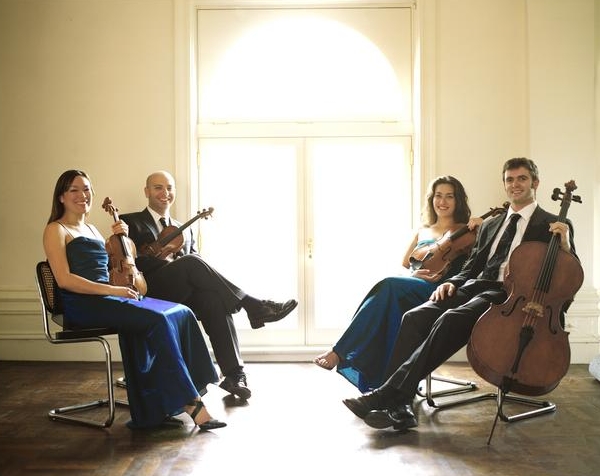
Ensō String Quartet -- Maureen Nelson and John Marcus, violins; Melissa Reardon, viola; Richard Belcher, cello -- photo by David Mehr
Ensō String Quartet (Maureen Nelson and John Marcus, violins; Melissa Reardon, viola; Richard Belcher, cello), photo by David Mehr
On Monday night, for its last free concert in the calendar year, the Library of Congress celebrated Gertrude Clarke Whittall's donation of several precious Stradivari instruments to their collection, on the day of the great Cremonese luthier's death in 1737. For whatever reason, perhaps the mini-Ice Age that made the trees of northern Italy yield wood that was extremely dense, the sound of a Strad is still prized. The last time that a young string quartet, the Jupiter Quartet, was at the Library of Congress to play a concert on the Strads, Jens observed that just because an instrument was built by Stradivari does not mean that it will be a match for a player. When the young players of the Ensō Quartet spoke about the instruments they were using, first violinist Maureen Nelson compared the "Betts" Strad to a thoroughbred. It could be "a little wild," and she had to decide when to give it its head or rein it in.

Nelson had originally chosen to play the darker "Ward" violin but switched instruments with second violinist John Marcus, in the interest of the ensemble's sound. That says something about the Ensō Quartet's approach, and what stood out about their playing was that their sense of the entire composition trumped any individual player's virtuosity. Not only did we hear far more of the inner lines, especially second violin and viola, in this performance than in many others -- we wanted to hear those lines. The group's finest playing of the evening came on the modern work, Alberto Ginastera's second string quartet, op. 26, commissioned by the Library of Congress (through the Elizabeth Sprague Coolidge Foundation) and premiered in 1958 by the Juilliard Quartet. It should be no surprise that the Ensō Quartet played the Ginastera well, as the group won second prize at the triennial Banff Competition, and a special honor for best performance of a new work, albeit without two members in their present makeup. (This was in 2004, as it turns out, the same year that the Jupiter Quartet won first prize.)

Ensō Quartet:
available at Amazon
Pleyel Quartets


Ginastera Quartets:
available at Amazon
Lyric Quartet

This was my first encounter with the Ginastera quartets, and based on the Ensō Quartet's visceral rendition of no. 2, they should make a recording of all three of them. The first movement is marked Allegro rustico, but if it has anything to do with rustic folk, they are murderous peasants: a barbaro 6/8 with accents all over the place, on and off the beat, duple crossing triple, moments of manic shrieking. The second movement featured a lovely viola solo from Melissa Reardon, on the Library's "Cassavetti" Strad, and the third was a magical incantation, spider music so soft at points that it almost evaporated between the stage and my ears. After a folk improvisation, devil's violin scordatura sounds and all, in the fourth movement, the fifth movement pulsated back to the spirit of the quartet's opening. In a case in the auditorium's entry hall, Ginastera's holograph score of the second quartet fooled me: the composer's handwriting was so precise and clear that I thought it was a printed score. His letters to Harold Spivacke (then Chief of the Library's Music Division and dedicatee of the second quartet) are also neatly typed and signed by hand. If he was a perfectionist, he should have felt proud of the second quartet.

Other Reviews:

Andrew Lindemann Malone, Enso String Quartet (Washington Post, December 20)
-- "After a somewhat tentative first movement, the Enso pushed the tempo in the Mozart quartet's slow movement too much, making its repeated phrases sound perfunctory." [Well, we heard the same concert! -- Ed.]
The group's obvious relish of the Ginastera could not have contrasted more with the lackluster performance of one of Mozart's Haydn quartets, K. 421, that preceded it. It was so cautious and well behaved, although with beautiful sound and excellent balance, that it seemed like the dutiful work students do for a piece forced on them by a beloved teacher. The first movement felt overly frenetic, the second movement perfunctory. Happily, the concluding work, Dvořák's E-flat major quartet, op. 51, was far from a disappointment. Last performed at the Library of Congress by the Panocha Quartet two years ago, it relies heavily on Czech folk sources and is nicknamed the "Slavonic." The performance was finely tooled, especially the second movement, in which a melancholy Czech Dumka battles for supremacy with a chipper Viennese waltz, and the lyrical, fast fourth movement. After some coaxing, the Ensō Quartet offered Bagel on the Malecon, a brief multimetric tango by Ljova [Lev Zhurbin, b. 1978]. You can hear it on the entry page to the quartet's Web site. Thank you, once again, to Mrs. Whittall.

The next concert in the free series at the Library of Congress (January 24, 8 pm) features Yuri Bashmet and the Moscow Soloists with pipa player Wu Man, in a program of modern music by Tan Dun, Takemitsu, and Hayashi.