CD Reviews | CTD (Briefly Noted) | JFL (Dip Your Ears) | DVD Reviews

20.2.04

Mr. Picassohead

I don't know how I missed this, but I finally got around to reading an article (Mr. Picassohead Brings out the Child/Artist Within, February 4) by Jim Regan in the Christian Science Monitor about Mr. Picassohead, an interactive Web site that

follows the conventions of Mr. Potato Head in constructing home-made portraits, but uses Cubist elements in the choices of construction material. And while it's possible that a few surfers might gain some useful academic insight about the Cubist movement during their visits, the purpose of the site is simply recreation. Play. Which is to say, art in its purest form.
At the site, you can not only create your own Picassoesque portrait but also page through 137,011 submitted examples (and counting) (here is one that's good for Ionarts). It's actually remarkable how diverse the various works are, considering that they all are composed of the same basic elements. I was also surprised to see how very few of them actually look like the work of Picasso, even through they are patchworks of shapes taken from his paintings. There is something to be learned there. When I teach Cubism this spring, I will probably use the site to get the students thinking about how to approach Picasso's work. Perhaps I will ask them to use it to make a portrait of me: the universal desire of teenagers to ridicule their teacher may drive them to complete the assignment.

19.2.04

Love On North Latch's Lane — by Mark Barry

For other opinions on the Barnes Foundation, see the post on August 8 about the first Ionarts visit there, More Renoirs Than You Can Shake a Stick At. Also, don't miss Peter Schjeldahl's article (Untouchable: The Barnes Foundation and Its Fate, February 16/23 issue) in The New Yorker.

I got a very romantic Valentine's gift this year, tickets to the Barnes Foundation for this past Sunday. The tickets were purchased online: we got a confirmation number along with our ten-dollar parking fee. Not easy to get, since the Barnes is regularly sold out months in advance.

In the car with my Valentine of 23 plus years (who could pass for 23, mind you), halfway there, I realized that I had forgotten my confirmation number at home: "aahhhh, they’ll never let me in," I thought, as the fear of the notorious Barnes idiosyncrasies sets in. We pressed on.

Our check-in time was 12 PM. As we pulled up at 11:30, the guard came out of her guard hut, clipboard in hand and said, "name please." After what seemed 2 minutes, we were allowed to proceed to the parking area. The lot was almost full so we were given a spot along the driveway. Did I mention it was bitter cold? We wasted no time getting to the door. I did brave the cold long enough to notice the ornate designs around the doorway: if I'm not mistaken, they included some of Henry Mercer's tile work. He, like Albert Barnes, was another independent Pennsylvania spirit. A visit to his home/creation and Moravian Pottery and Tile Works is a must. The guard standing at the gallery entrance took our tickets. When I mentioned our 12 o'clock time, he said, "Check your bags and coats downstairs: you can go in anytime." This is too easy, I thought: what about the notorious Barnes quirkiness?

Henri Matisse, Study for La Danse, 1930–1931If you've never visited the Barnes before, the initial feeling of entering the main gallery is one of amazement. All my friends were there: Cezanne, Seurat, Picasso, a beautiful William Glackens (Chester Bathing Hour, with brilliant purple/violet water), and the main man, Matisse. The glorious, rhythmic mural, La Danse (panel 1, panel 2, and panel 3; the study shown here, from 1930 to 1931, comes from Chris Craig; the photograph below shows Matisse sketching out the mural) floats above in the archways (the mural is even more fantastic seen from the 2nd floor balcony). I could be satisfied spending the day in this room alone.Matisse at work on La Danse

We continued on through room after room full of surprises: Van Gogh's Nude Woman Reclining (my first Van Gogh nude) and House and Figure, Rubens's The Incarnation as Fulfillment (small, yet very complex, and in need of a good cleaning), and several Henri Rousseau paintings. In the simplified style of Rousseau the collection has several very nice paintings by Horace Pippin and Modigliani portraits, a favorite of my wife's, including his beautiful Nu couché de dos. There is so much visual stimulation that it is difficult to take it all in: this is what heaven must look like. A treat for me was finding El Greco scattered around the galleries. I think of his work as priceless, unattainable by a private collector, and that thought returns often while viewing this collection: Dr. Barnes must have been a formidable art buyer and astute businessman.

Which brings me around to the current situation the Foundation is in financially and its proposed move to Philadelphia. Barnes must also have been a very savvy businessman with great passion and love for art, especially his own collection. During my visit, many possibilities to generate money to sustain the vision and spirit of Dr. Barnes came to my mind: it's time to think "outside the will" in order to survive! He would have.

I've heard mention of a need for a $50 million endowment, so sell something, like one of the too many Renoirs (sorry, it's true). The collection has many works that could bring in well beyond what the endowment needs, without sacrificing the continuity of the whole. What about traveling exhibits and packaging or branding of the collection? For example, there is no book in the gift shop showing the entire collection, which I would have bought, only Great French Paintings of the Barnes Collection. As bad a rap as gift shops have, the majority of visitors love to shop and sales bring in a lot of money (a few licensing deals = endowment). This store has great potential as does its online counterpart: expand, and it's a gold mine. Go all out, with T-shirts, ties, shower curtains. There are many loyal supporters of the foundation (yours truly was ready to buy) who would proudly wear Barnes memorabilia, which would mean free advertising.

I don't know the enough about the details of the inner working of the foundations board to comment (Tyler Green at Modern Arts Notes has more insight on that: see his latest report). However, the findings from the initial court hearings don't paint a competent picture. To go forward, a solid financial base and clear vision are needed: a new board? maybe a full investigation and accounting? Definitely. Competent overseers don't misplace artwork and pianos, and good board members are trustworthy and ensure that the endowment fully supports the mission.

I love this place. Dr. Barnes was amazing, and I would like to see his collection remain on North Latch's Lane. Big courageous steps must first be taken for the Doctor.

Mark Barry (www.markbarryportfolio.com) is an artist working in Baltimore.

18.2.04

The Center of the Universe, According to Dalí

Salvador Dalí, Mystique de la gare de Perpignan, 1965, Museum Ludwig, CologneFamous surrealist painter Salvador Dalí was born on May 11, 2004 1904 (thanks to the alert reader who caught this!). To celebrate his 100th birthday, the Fundació Gala-Salvador Dalí is sponsoring the Year of Dalí 2004, with a schedule of celebrations and events. (This is in competition with the Year of George Sand: see post on February 6.) The only real Dalí-related news I have been reading in the English-language media, however, has been the exciting rediscovery of the short animated film that he began for Disney in 1945 but did not finish, Destino (the film, completed under producer Roy Disney, has been nominated for an Academy Award this year, for what that's worth). You can see it in many places as a preview to the animated movie The Triplets of Belleville. I expect more on Dalí to follow later in the year.

One story I read about in France but never got around to mentioning here was reported in Le Nouvel Observateur (February 2, Perpignan célèbre les cent ans de Dali [Perpignan celebrates Dalí's 100th birthday]). According to the article, Perpignan is "the only town in France that is commemorating the centenary of the artist's birth, by dedicating six exhibitions to him and by installing an illuminated column, on a base 4 meters [13 feet] high and projecting a laser beam into the sky, in front of the train station." Why Perpignan and why the train station?

Dalí caused the Perpignan train station to be entered into the history of art by naming it the "center of the universe" after having experienced there on September 19, 1963, in his own words, "a sort of cosmic ecstasy [stronger than all those I had had before. I experienced a precise vision of the construction of the universe.—full quotation added by CTD]" In 1965, he made it the subject of a canvas named Mystique de la gare de Perpignan (Mystery of the Perpignan train station).
This painting (shown above) is now in the Museum Ludwig in Cologne. The praying figures to the left and right are taken from Millet's painting The Angelus (1857–1859, now in the Musée d'Orsay), a theme that was also painted by Dalí in his Archeological Reminiscence of Millet's Angelus (1933–1935), now in the collection of the Salvador Dalí Museum in St. Petersburg, Florida, and Millet's Architectonia Angelus from 1933. (You can read analyses of this and other Dalí paintings here.)

17.2.04

Tarantino at Cannes

Quentin TarantinoA short article (Quentin Tarantino président du jury en 2004, February 15) in Le Nouvel Observateur reported Friday's announcement that American director Quentin Tarantino (image at right from Romain Desbiens's site, Quentin Tarantino, Cinéphile et Cinéaste) will preside over the jury of the 57th Festival International du Film at Cannes, from May 12 to 23. (He succeeds Patrice Chéraud, the French director probably most famous for his 1994 remake of La Reine Margot.) Tarantino is not unknown at Cannes, of course, since his film Reservoir Dogs competed there in 1992 and Pulp Fiction won the Palme d'Or in 1994. QT was reported as responding to the honor of the presidency as follows (what I think he said originally in English is on the festival's Web site):

For a filmmaker and film lover there's no greater honor than to be on the jury of the Cannes Film Festival. To be President is both a magnificent honor and a magnificent responsibility. And also the crowning achievement of a lifetime spent in cinematic obsession: a magnificent obsession.
The presence of Americans on the Cannes jury is certainly not unusual in recent years (Meg Ryan and Steven Soderbergh in 2003, Sharon Stone in 2002, Jonathan Demme in 2000, and Holly Hunter and Jeff Goldblum in 1999, for example), and Americans have already served as jury presidents, as David Lynch did in 2002 and Martin Scorsese in 1998. That being said, I'm still very happy for QT, and I think that his selection shows the growing esteem for his movies in France. I'm sure that he will represent the United States well, if perhaps somewhat quirkily, on the Croisette this year.

16.2.04

Rebuilding History

Palais des Tuileries, 1871, Charles Deering McCormick Library, Northwestern UniversityThe lost palace of Paris, the Palais des Tuileries, was built in the 16th century for Catherine de Médicis. It was located on the site of former tile kilns, hence its name, at the west end of the Louvre. The whole complex of buildings was the main residence of the French royal family until, in the 17th century, Louis XIV relocated the court to the new Château de Versailles. During the upheaval of the French revolution, Louis XVI was forced to move back into the Tuileries Palace, supposedly to make him understand the miserable poverty of most Parisians. In 1792, when things got much uglier for the monarchy, the king and queen were imprisoned and ultimately executed, and the revolutionary government took possession of the Tuileries. They renamed it the Palais National, and it became the meeting place for the National Convention; important documents like the Declaration of the Rights of Man and of the Citizen were issued there. The building later became the imperial residence of Napoleon I and Napoleon III in the 19th century. (Go to the bottom of this list, from The Siege and Commune of Paris, 1870–1871, at Northwestern University, to see several photographs of the inside and outside of the Tuileries in the 19th century [including the image shown at left]; several more images are here.) What became of this famous palace? Why is the western end of the Louvre grounds only an open garden (Jardins des Tuileries) with a clear view to the Arc de Triomphe?

The Franco-Prussian War ended with the signing of a humiliating surrender by the French government of Adolphe Thiers. A radical, revolutionary rebellion eventually known as the Commune controlled Paris by seizing arms and cannons left in the streets by the National Guard. Paris, having barely survived the siege and bombing by the Prussians, was now under attack from its own government. On May 16, 1871, the Communards led a crowd (including the painter Gustave Courbet) in the destruction of the Vendôme Column (another picture here). In the following week, more such destruction ensued as fires were set throughout Paris by the pétroleuses, revolutionary women arsonists who threw kerosene bombs into buildings, especially those that were seen as symbols of the ancien régime, including the Tuileries Palace and the Palais-Royal. The old Hôtel de Ville (Town Hall), the seat of the Communard government, was bombed by French guns and destroyed. The Communards were eventually all captured and shot against a wall in what is now Père-Lachaise Cemetery (the Mur des Fédérés). After the fire, the shell of the Tuileries stood in ruins until they were finally demolished. Parts of the ruins were purchased by a Corsican family and used to build the Château of La Punta on the gulf of Ajaccio. (For more information, see Henri Lissagaray, History of the Paris Commune of 1871, published in 1876.)

The Vendôme Column was restored almost immediately, in 1873 to 1874. The Hôtel de Ville was also rebuilt according to the exact same plan in 1882, paid for by a special national tax. Now, as I learned in an article (Tuilerie: la reconstruction en marche, February 14) by Anne Muratori-Philip in Le Figaro, people may be getting serious about rebuilding the Palais des Tuileries:

Should the Tuileries Palace be reconstructed? This question was asked on December 18, 2002, during a special meeting of the Academy of the Second Empire in the great auditorium of the Louvre, and the idea has made some progress. Fourteen months later, a new meeting in the rooms of the Institut de France, led by the Princess Napoleon, has launched a projet which is not all a dream. "Today, the Tuileries Palace has been forgotten," lamented Alain Boumier, President of the Academy of the Second Empire while convening the meeting.
[...]
As for finances, the provisional budget is allegedly on the order of 300 million euros [$384.5 million], or one-fourth of the cost of the work on the Grand Louvre or the equivalent of the annual budget of La Villette. The financial burden will fall on sponsorship, in accordance with the law of August 1, 2003, and on national and international donations.
The plan would be to use the reconstructed Tuileries Palace as a space into which the Louvre could expand. A Web site is supposedly being set up for the rebuilding project, but at the time of this writing, it was not functioning.

15.2.04

Anonymous 4, La Bele Marie

As I announced here a few days ago (see post on February 9), Anonymous 4 is in residency at Catholic University this semester to take part in a team-taught seminar ("Sacred and Secular Music in Medieval Culture"). I gave my lecture in the course this past Wednesday, on the Divine Office in the Middle Ages, and lectures by other scholars and master classes with Anonymous 4 will continue for the rest of the semester. Some of Anonymous 4's presentations in April will be open to the public, and I will publish some more information about that when I know what is going to happen.

cover
La bele marie: Chant and Polyphony in Honor of Mary

Buy it from Amazon.
Last night, on Valentine's Day, Anonymous 4 gave a concert of music from their recent CD, La bele marie: Chant and Polyphony in Honor of Mary (you can read more about the CD and listen to a few tracks here), in the Crypt Church of the Basilica of the National Shrine of the Immaculate Conception. The program featured 16 of the 17 selections from the recording (the group did not perform the prosa "Ave maria gracia plena," and some of the verses in the program were not sung), and the warm, resonant acoustic of the Crypt Church provided a perfect sonic space for the four voices. (The members of the Choir of the National Shrine, myself included, far prefer singing in the Crypt Church to the cavernous space of the Upper Church.) The preference of Anonymous 4 is always to sing a shorter program, without intermission or applause between pieces, and so, when the four woman walked down the center aisle to stand in front of the altar, we were treated to about 90 minutes of exquisite music.

Most of the pieces on this program are conductus (this Latin word is a noun of the fourth declension, so the plural form in the nominative case is the same as the singular). That does not mean that the concert was repetitive, since the conductus genre in the Middle Ages was remarkably varied: they were composed in from one to four parts and in a number of styles. Conductus texts are in Latin and represent some of the best examples of new poetry of the time. The first conductus ("O maria o felix") was monophonic, featuring all four singers on the same part, in a simple style. What is most interesting about this piece is its text, in which the Virgin Mary is extolled as "spiritus sancti cratera" (chalice of the Holy Spirit), "stella non occidua" (star never setting), and "ficus sed non fatua" (fig tree not barren). Some of the interesting Biblical images applied to Mary, which I had never encountered before, include "Ioseph spica" (Joseph's ears of corn), referring to the dream about the ears of corn that Joseph interpreted for Pharaoh in Egypt (Genesis 41), for which Joseph is elevated from the status of servant to governor of Egypt. Another is "humus de qua vipera per quam sicca ione perit hedera" (earth whence came the worm by which the dry gourd of Jonah perished), which is the vine or ivy that God caused to grow over Jonah's head and then also killed with a worm. She is also the "funda davitica" (David's sling) that slew Goliath (1 Kings 17), as well as the "david sitim satians puteus" (well for slaking David's thirst) from which David longs to drink (2 Kings 23).

The second conductus ("Pia mater gratie") on the program was polyphonic and again featured all four singers. Where the first piece was strophic and simple, the second had a short text and featured long and complicated melismatic passages, which sounded more like a medieval motet than a typical conductus. The third piece ("De la mere au sauveor") was the first of four monophonic French chansons, each of which was performed as a solo by one of the women. This one was sung by Jacqueline Horner, the only member of Anonymous 4 who was not original to the group (she replaced Ruth Cunningham in 1998). A more typical example of the conductus genre ("O maria virginei") was next, featuring three singers. Among the many images in this piece's text for Mary is that of "vellis gedeonis" (Gideon's fleece), an allusion to Judges 6 that also appears in other pieces on the program. After that, a two-part conductus ("Verbum bonum et suave"), which was also strophic, featured the beautiful medieval cadence of a major 2nd resolving to a unison.

Susan Hellauer sang the second French chanson on the program ("Mainte chançon ai fait") which begins with the wonderful words of a composer of secular chansons trying to turn over a new leaf:
Mainte chançon ai fait de grant ordure
Més, se Dieu plaist, jamés n'en avrai cure.
En moi a petit eu
Bien et sens et mesure
Or me tieng a deceu
Quant si lonc tens me dure.
Bien ai mon cuer esmeu
Car por chanter l'ai meu
De la roine pure
Par qui somes esleu
En grant joie et receu
Et fors de grant ardure.
I have composed many songs of great filth
but if it please God, I shall never again care about them.
In me there has been
neither rhyme nor reason.
Now I think I was deceived
that it lasted so long.
My heart is certainly stirred,
for I have begun to sing
about the pure queen
by whom we are chosen
and received in great joy
and kept from burning.
Ms. Hellauer is the musicological leader of the group, and her dark and low voice is perfectly suited to the performance of this exceptionally beautiful song, which retells the story of the Annunciation (Luke 1) in a way that a 13th-century court lady may have experienced it. Mary's response to the angel's announcement that she will bear God's son includes the phrase "Mout sembleroit grant ennuis/Se sanz home engendroie" (It would really seem like a drag/If I could get pregnant without a man).

Anonymous 4: Marsha Genensky, Susan Hellauer, Jacqueline Horner, Johanna Maria RoseAll four singers joined in the singing of the next conductus ("Beata viscera"), attributed to the Notre-Dame composer Perotinus, according to the recording's program notes. This monophonic piece shows that music does not require anything more than one part to be extremely appealing and emotionally moving. This is a strophic song with a marvelous refrain that begins on a high note (after the ending of each verse on the low final): the wonderment of the refrain's text ("O mira novitas et novum gaudium/matris integritas post puerperium" [O new wonder and new joy, the mother's chastity after giving birth]) is reflected by the brief, strange opening melisma on O, which could be represented with the solfège syllables sol-fa-mi-re-ti. It may not seem like much out of context, but the effect within this song is truly wondrous. Sadly, at the end of this piece, in spite of the warning to turn off pagers and other electronic devices (which the seminar's organizer, Grayson Wagstaff, said was an offense that merited being ejected), a cell phone went off in the audience. From her place on the left part of the altar, Ms. Hellauer glared in the direction of the offender and shook her head.

When the sound stopped, three of the singers proceeded to sing the next conductus ("Mundum renovavit"), which is a good example of the strange harmonic structures that can be found in medieval music, especially in the second half of each stanza. The third French chanson ("Je te pri de cuer") was sung by Johanna Maria Rose, and it revealed symptoms of what is hopefully only a cold or other temporary illness and not more long-lasting vocal problems, which might be one of the reasons why the group is ending its touring activities. The intonation problems and weakness in sustaining high notes that were heard in Ms. Rose's performance of this song were less evident when she sang with the other women, but still there. Ms. Hellauer and Marsha Genensky combined for the two-part conductus "Salve sancta parens" that came next. Some conductus may have had a role in the medieval liturgy, and the text of this piece is in the same character as any number of Marian chants from the same period. The three-part conductus that followed it ("Serena virginum") and the final conductus on the program ("Ave nobilis venerabilis"), in four parts, both conclude with the versicle "Benedicamus domino/Deo gracias," that was sung at the end of the medieval service of Matins. Pieces like this may have been composed as a sort of trope on that versicle to be sung in the Divine Office. In both cases, the response "Deo gracias" was sung in simple monophony.

The final French chanson ("De la trés douce Marie") was sung by Marsha Genensky. This song is an example of the ballade, one of the formes fixes, song patterns favored by the troubadours and trouvères and carried on by polyphonic song composers in the late Middle Ages and Renaissance. This form can be represented by the letters aabC: each of the first two lines is sung to the same section of music (a), and the third and fourth lines to a different section of music (b), followed by the three lines of the refrain ("Cil doit bien," C). All three of the remaining conductus featured all four members of Anonymous 4. During "Ave virgo virginum" someone's watch alarm behind me went off with a steady beep for 10 seconds and with a double-time beep for another 10 seconds. This happened twice, and I think the owner of the watch couldn't hear it or in any case did not stop it. In spite of that distraction, I admired some more unusual Biblical images for the Virgin Mary in this piece, such as "moysi fiscella" (basket of Moses) and "mosaice rubus visionis" (bush of Moses' vision). Here, the imagery of Gideon's fleece is explained further: "celi rorans pluvia vellus gedeonis" (distilling heaven's rains, fleece of Gideon). The different rhythmic styles available to composers of the period were displayed in the penultimate conductus ("Mater patris et filia"), in which those first four words are sung in an unmetered, melismatic style, while the rest of the piece is in a stricter modal rhythm that is fast-moving and hocket-like.

This was a remarkable concert, and Anonymous 4, in spite of one singer's struggles, were in top form. The intonation and purity of tone were impeccable, as was the selection of pieces. The audience did not want the evening to end and insisted on an encore with their applause. Anonymous 4 obliged us with a short polyphonic setting of the words that end the Latin Mass ("Ite missa est: Deo gratias" [Go, the Mass is ended: thanks be to God]). Submissive to the commands of four who had so enchanted us, we applauded them as they processed out and then did as we were told.

14.2.04

Díaz Trio at the Library of Congress

The string trio combination of violin, viola, and cello is not all that common, and the Díaz Trio is unusual among performing chamber music ensembles in that they have chosen to focus on the rather narrow range of music composed for it. After a hiatus since the end of December, the series of free concerts from the Library of Congress resumed Friday night with a program presented by the Díaz Trio. The concert began with a piece that did not inspire me and appeared not to have inspired the players either, Ludwig van Beethoven's String Trio in G Major, op. 9, no. 1. Composed in 1797 to 1798, this is the work of a young Beethoven who, after moving on to the string quartet genre after the three trios of op. 9, never wrote another string trio. There are moments of great beauty, and the performers gave an impressive performance, but something about their rendition left me cold. Perhaps it was the overzealous con brio on the part of cellist Andrés Díaz: maybe there are a lot of sforzandi in the score, but from where I sat I heard more percussive bowstrikes than pure tone more often than I would have liked.

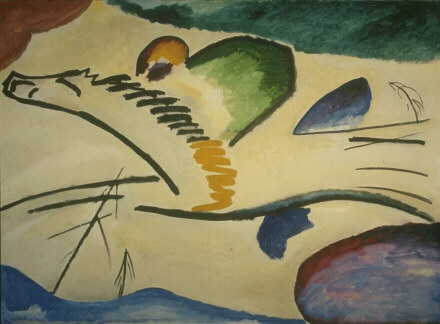
My slight disappointment with the Beethoven was quickly overcome by the next piece on the program, the world premiere of a new piece by Puerto Rican composer Roberto Sierra. Kandinsky is a suite of eleven movements for various combinations of violin, viola, cello, and piano, commissioned by the McKim Fund. For this work, the Díaz Trio was joined by a guest artist, Chilean pianist Luz Manríquez, who like the group's violinist, Andrés Cárdenes, teaches music at Carnegie Mellon University in Pittsburgh. This piece was inspired by three paintings by abstract painter Vasily Kandinsky. On the left below, Lyrisches [Lyrical] painted in 1911, and on the right, Launisches [Capricious], from 1930, are both now in the Museum Boijmans Van Beuningen (Rotterdam, The Netherlands). In the center, Schwarze Striche I [Black Strokes I] dates from 1913 and is now owned by the Guggenheim Museum in New York.

Kandinsky, Lyrisches, 1911, Museum Boijmans Van Beuningen</a>, RotterdamVasily Kandinsky, Schwarze Striche I, 1913, Solomon R. Guggenheim Museum, New YorkKandinsky, Launisches, 1930, Museum Boijmans Van Beuningen</a>, Rotterdam

Sierra has drawn inspiration from painting before, in a piece for flute, clarinet, violin, cello, and piano called Turner. In his program notes on Kandinsky, the composer writes, "The bold strokes, colors, and capricious nature of the paintings are translated in the rhythms, melodies, and harmonies of my work." I have read good things about Sierra's music, which has been rather popular with audiences. What I loved about this piece is that it embraced many idioms, such as a dissonant and Webernesque pointillism in the first movement ("Lyrisches," for violin and piano, inspired by the first painting above); strange instrumental effects familiar from the music of Bartók in the second movement ("Improvisation 19," for violin, piano, and cello; see Kandinsky's Improvisation 19 from 1911); ultrafast runs, harmonics, and other harsher sounds in the daring viola solo of the third movement ("Bild mit schwarzem Bogen" [Picture with a black arch]; see Kandinsky's painting Mit dem schwarzen Bogen), played excellently by violist Roberto Díaz, who seemed to me the surest and best of this excellent group's members. Happily, Sierra believes that even modern music can be fun and even pleasant listening, as he showed in the sixth movement ("Schwarze Striche I," for violin and piano, inspired by the painting in the center above), which had both a cool sound, inspired by jazz and Latin music, and a delicate, pretty grace that could have come from Debussy. I think the most successful composers of the early part of this century, like Sierra, will be willing to use the many styles available to us now, not ignoring more "modern" or harsh sounds but not limited to them either.

The most successful movements in the piece were the two featuring all four performers, the fifth movement ("Kleine Freuden" [Small pleasures]; see Kandinsky's delightfully vivid Kleine Freuden from 1913) and the final movement ("Buntes Ensemble" [Colorful ensemble]; see Kandinsky's Buntes Ensemble from 1938). The former is marked "ritmico" and the latter "Con sabor latino." It is that Latin rhythmic element, which pervades these movements, that made them so pleasant to listen to, music that sounded like it was part Heitor Villa-Lobos and part Sergei Prokofiev. This was especially true of the final movement, which was in 7/8, not the frantic Precipioso of the last movement of Prokofiev's seventh piano sonata, but the late-night experiment of a cool-headed dance band. The constant piano ostinato, a beboppy chromatic line in the bass (sol-sol-si-la-la-li-ti-ti-te-la-la-le-sol, in the pattern of dotted quarter-quarter-quarter), is gradually undermined and knocked off its stride by the addition of extra beats. The effect is not unsettling but freeing. It was truly a fun listening experience.

The Kandinsky paintings that correspond to the other movements are Improvisation 26 (Oars) (1912) (fourth movement), Weisser Strich (White Stroke, 1920) (seventh movement), Kleine Welten III (Small worlds III, 1922) (eighth movement), and Composition VIII (1923) (ninth movement).

After intermission, the concert concluded with a piece that is naturally the bread and butter of this group, Mozart's Divertimento for String Trio in E-flat Major, K. 563, the only piece for this combination of instruments that can be reliably attributed to that composer. It is a challenging and rewarding work that belies its title, since it is not typical of the light, diverting music written under the name of divertimento: it is a sort of extended four-movement sonata, just with two menuetti and two slow movements to make a total of six movements. Composed in 1788, this work shows Mozart at the height of his powers, just after completing his last symphony. It was dedicated to Mozart's friend from the Masons, Michael von Puchberg, in gratitude for the large amounts of money he had loaned to the composer, whose financial situation was deteriorating rapidly. In this piece that Mozart himself premiered and performed more than once, playing the viola part, the composer displays all of his skills in creating a joyous German dance (4th movement), writing joking but graceful melodies (for himself on the viola in the fifth movement), in breaking apart and developing melodic motifs (sixth movement), and in conceiving contrapuntal complexity (first and fourth movements).

Finally, I was reminded of why we need more concert series like this in the United States. At the end of the concert, a young woman, who I think was a music student, gave the three performers bouquets of flowers and was obviously moved by what she had heard. Even more touching, a young man perhaps in the eighth or ninth grade went up to the stage at the intermission and collected a stray piece of bowhair that had been left on the floor there by one of the players. Perhaps a dream was born or encouraged in a young person last night, and that is an important thing. If you don't live in Washington and you would like to be able to hear these concerts, you should join me in writing to the Library of Congress or to a radio network like NPR to ask that someone make all of these concerts, which are recorded, available in recorded form either over the radio or by Internet.

13.2.04

Elitism and the Arts

After all the complaining I have been doing lately about the subject of money and creating a cultural life, this article (Lottery cash 'subsidises arts for rich', February 13) by David Hencke in The Guardian gave me some new fat on which to chew. I don't know much about the background of the story, but it concerns how profits from the British lottery system are spent:

The upper and middle classes are enjoying a night out at the opera, theatre and ballet in new modern facilities, courtesy of the national lottery, at the expense of the working class, a report by MPs finds today. It attacks Arts Council England for wasting lottery and taxpayers' money to bail out venues such as the Royal Opera House and Sadler's Wells in London, and for not putting enough cash into working-class areas or attracting more diverse groups to theatres.

The report from the Commons public accounts committee criticises the Arts Council for being slow to provide figures which proved that the 15 biggest projects were mainly benefiting the better-off. It found that in only one city in England—Stoke-on-Trent—do audiences accurately reflect those who buy lottery tickets. In London, 70% of lottery cash distributed to the arts went to high-profile arts projects.
Of course, it is difficult not to agree that a lottery is a stealth tax on the poor, but I had never really considered trying to make sure that profits from a lottery somehow matched the interests of the people who buy most of the tickets. I would like those profits to go to symphonies, museums, Artotheks, and so on: should they really be supporting NASCAR races and the next reality TV show instead?