CD Reviews | CTD (Briefly Noted) | JFL (Dip Your Ears) | DVD Reviews
Showing posts with label Yuri Temirkanov. Show all posts

18.3.16

More Russians Play More Russians


available at Amazon
Rachmaninov, Piano Concerto No. 3, D. Matsuev, Mariinsky Orchestra, V. Gergiev
(Mariinsky, 2010)
Charles T. Downey, Denis Matsuev in a fierce performance with Baltimore Symphony (Washington Post, March 18)
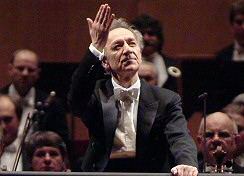
A trifecta of Russian piano virtuosos hit the Washington area this week. Daniil Trifonov played a wild Prokofiev concerto with the Orchestre Symphonique de Montréal on Monday night. On the same Thursday night that Nikolai Lugansky performed as soloist with the National Symphony Orchestra, Denis Matsuev appeared with the Baltimore Symphony Orchestra in the Music Center at Strathmore. That program also featured the BSO’s former music director, Russian conductor Yuri Temirkanov, and two Russian orchestral warhorses.

The last time Matsuev was soloist with the BSO, in 2004, he played Rachmaninov’s Second Piano Concerto; this time he branched out by playing the composer’s Third Piano Concerto... [Continue reading]
Baltimore Symphony Orchestra
With Yuri Temirkanov (conductor) and Denis Matsuev (piano)
Music Center at Strathmore

SEE ALSO:
Tim Smith, Temirkanov produces electric results in BSO return (Baltimore Sun, March 18)

---, Yuri Temirkanov on his BSO return and, yes, still disliking the idea of female conductors (Baltimore Sun, March 18)

15.4.11

St. Petersburg Philharmonic

available at Amazon
Shostakovich, Cello Concerto No. 1 / Symphony No. 1, M. Rostropovich, Philadelphia Orchestra, E. Ormandy
Cellist Alisa Weilerstein completed her undergraduate degree at Columbia in Russian History, and her Russian specialization has continued this month. She is playing Shostakovich's first cello concerto on tour right now with the St. Petersburg Philharmonic, the orchestra that premiered the work in 1959, when its dedicatee, Mstislav Rostropovich, played it in Leningrad. The group came to Strathmore on Tuesday night, with conductor Yuri Temirkanov, whose tenure with the Baltimore Symphony Orchestra we enjoyed for many years, leading his longtime "other band" in Rimsky-Korsakov's dynamic Russian Easter Overture and a heavy-handed Brahms fourth symphony.

Other Articles:

Joe Banno, Temirkanov’s appearance at Strathmore reminds Washington of what it’s missing (Washington Post, April 14)

Tim Smith, Temirkanov leads St. Petersburg Philharmonic in high-powered concert at Strathmore (Baltimore Sun, April 13)

---, Temirkanov: Sounding upbeat (Baltimore Sun, April 9)

Matthew Guerrieri, St. Petersburg Philharmonic brings precision to Symphony Hall (Boston Globe, April 11)

Keith Powers, Alisa in wonderland (Boston Herald, April 9)

Andy Thomason, St. Petersburg Philharmonic Orchestra stuns with epic evening (Daily Tar Heel, April 6)

Susan Isaacs Nisbett, St. Petersburg Philharmonic shines at Hill Auditorium with Rachmaninoff, Rimsky-Korsakov (AnnArbor.com, April 3)

Lawrence A. Johnson, St. Petersburg Philharmonic shows brawny strength and refinement (The Classical Review, April 1)

Alan G. Artner, St. Petersburg Orchestra easily scales the peaks (Chicago Tribune, April 1)

Sue Gilmore, Cellist Alisa Weilerstein teams with the St. Petersburg Philharmonic in S.F. (Contra Costa Times, March 24)

Mark Swed, St. Petersburg Philharmonic begins U.S. tour with Alisa Weilerstein (Los Angeles Times, March 23)

Tom Jacobs, Alisa Weilerstein with the St. Petersburg Philharmonic (Santa Barbara Independent, March 21)

Donna Perlmutter, Cello virtuoso Alisa Weilerstein is always at the head of her class (Los Angeles Times, March 20)
The best playing was on the Rimsky-Korsakov, something in the overture slot of the classic orchestral program (overture, concerto, symphony) that was not actually a waste of ten minutes. Temirkanov, with his trademarked hands-off conducting style, allowed the Easter liturgical themes to unfold and breathe naturally. The violin section was not always together with itself (splendid violin solos by concertmaster Lev Klychkov, though), but overall the orchestra played with remarkable ensemble unity, especially in the many shifts of meter and syncopation. While the overture popped and sparkled under this rather amped-up kind of playing, in the Brahms one missed some greater exploration of the soft side of the dynamic spectrum, beyond some melting, sweet horn playing in the second movement. The third and fourth movements of the Brahms, especially, had tinges of the "Russian triumphal" sound that not only seemed a little out of place but kept the ensemble from quite locking into place. The piece is itself on the weighty side, both formally and texturally. One thinks of Edouard Hanslick's private review, sent to Brahms after hearing this symphony performed in a two-piano version: "All through I felt I was being beaten by two terribly clever men." Thank goodness that Tchaikovsky was not programmed, or our hearing would have been damaged.

Weilerstein is a remarkably charismatic player, approaching the music with smoldering energy and intellectual commitment: that is at least what is communicated by her enigmatic staring into space and often-flopped hair, but it comes across even when one keeps one's eyes closed and focuses only on the sound. Her tone has a resonant buzz but does not really have a large, searing intensity in the style of someone like, say, Rostropovich, for whom Shostakovich composed his first cello concerto. At times one missed a certain vicious quality in Weilerstein's sound, although sometimes her attempts to reach a gutsy sound compromised the accuracy, but this performance had considerable appeal. In particular, Shostakovich's mastery of orchestration by this point in his career is evident in many odd colors, like the strange opening in the low winds, a sort of hurdy-gurdy wheezing, and at the end of the second movement the graveyard-pale mixture of cello harmonics (impressively clean playing from Weilerstein) and celesta and hushed strings. The horn solos, prominently featured throughout the concerto, were burnished and clear. Weilerstein played the extended Cadenza movement in a tense and somber way, pushing the fast passages to the edge of wild chaos. The orchestra showed more of its delicate side in an encore of the Nimrod movement of Elgar's Enigma Variations.

The next visiting orchestra to be presented by WPAS will be the Philadelphia Orchestra (May 20, 8 pm) in the Kennedy Center Concert Hall, featuring Gil Shaham in Walton's violin concerto, with Charles Dutoit at the helm also in pieces by Mendelssohn and Tchaikovsky. Given the very disturbing news that the Philadelphia Orchestra may soon file for bankruptcy, a plan that has been loudly protested by the players, you will want to support the musicians when they come to Washington.

25.10.07

Julia Fischer and the St. Petersburg Philharmonic

Julia Fischer, violinistWashington Performing Arts Society’s presentation of the St. Petersburg Philharmonic and Julia Fischer, Gramophone’s new Artist of the Year, was indeed memorable. At the Kennedy Center on Tuesday night, Yuri Temirkanov provided Fischer support in the Beethoven Violin Concerto by neither allowing textures to become overly heavy nor fast. With sparklingly clear tone and a fast, narrow vibrato, Fischer acted as an extension of the exceptionally earthy string sound supplied by the St. Petersburg Philharmonic. However, in the first movement (Allegro non troppo), Fischer’s intonation was near the limit of being too high. Each of the concerto’s three movements contained satisfying motifs that were repeated three times, either expanding upward or, in the case of the third movement, containing two repetitions with a tail. Fischer’s phrasing possessed lots of fantasy by using both dynamics and time to exploit this material – the orchestra followed her every step of the way. Indeed, the orchestra and conductor appeared to be listening equally as much as playing. Fischer’s chords in the final cadenza locked remarkably well.

Other Reviews:

Tim Smith, The Temirkanov Touch (Baltimore Sun, October 25)

Robert Battey, St. Petersburg Philharmonic, A Program of High Notes (Washington Post, October 25)

Jens F. Laurson, Setting the Perfect Tone: Julia Fischer with the Baltimore Symphony Orchestra (Ionarts, May 26, 2006)
Prokofiev’s Symphony No. 5 (1945) provided Temirkanov a platform for more creative conducting, as what had been observed prior to it were mainly large horizontal gestures. Thus, the wry Russian humor and pointed clarinet solos of the second movement (Allegro marcato) stood out, while the third movement’s stern, cold Adagio character warmed up – perhaps by passing around a bottle of vodka – near the end of the movement and became sentimental. The final movement’s positive theme (Allegro giacoso) flipped around in an amusing way while the entire symphony ended with the entire ensemble in a bright, upward run. The ensemble virtuously never sounded loud, just powerfully full and wide.

The audience was treated to a well-orchestrated encore by Elgar. One wishes success to the St. Petersburg Philharmonic, especially since, according to a Russian friend, not so long ago its musicians were rarely paid.

The next concert sponsored by WPAS is a recital by Murray Perahia (October 28, at Strathmore), which inaugurates the new Piano Masters series.

Julia Fischer on Disc:
available at Amazon
Bach, Sonatas / Partitas
available at Amazon
Glazunov, Khachaturian, Prokofiev, Violin Concertos
available at Amazon
Mozart, Violin Concertos 1,2&5
available at Amazon
Mozart, Violin Concertos 3&4
available at Amazon
Tchaikovsky, Violin Concerto

30.9.06

Shostakovich and Temirkanov Open the BSO Season

available at Amazon
D. Shostakovich, Symphonies Nos.5 & 6, St.PetersburgNewPhil / Temirkanov
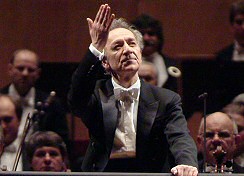
Yuri TemirkanovAfter difficult contract negotiations that were just recently resolved, it was very good to welcome the Baltimore Symphony Orchestra back in time for their season opener at Strathmore last Thursday. Indeed, it was an entire evening of welcome returns: Yuri Temirkanov, now no longer the Music Director of the Baltimore Symphony, came back for this concert - and for the Mahler Kindertotenlieder that now occupied the first half of an originally all-Shostakovich program the audience welcomed Nancy Maultsby (last heard in Temirkanov’s farewell concert of Mahler’s Second) back. It was a rousing affair.

Visibly more at ease now that he does not have to be in Baltimore, the diminutive, wiry Maestro led an amiable if not very idiomatic performance of the Mahler. Nancy Maultsby (whose return seemed like her wish to show her talent in a better light better than in last season’s Mahler where illness hampered her) impressed with sonorous low notes and dedication to these songs. I wish I had liked it better, still, but the singing was too dense, too mealy to be really enjoyable. The poems by Friedrich Rückert need not be understood for the Kindertotenlieder to be enjoyed (otherwise even most native speakers would get little out of them) but with the text open, they should at least be possible to follow for the audience members. Moreso, the way of pronouncing and vocally shaping a text influences the sound and I suppose Ms. Maultsby’s tone might not have seemed to come from somewhere between above he gum and behind her upper cheekbones had she sung Barber or Duparc. Still, with those low sounds and her wide range she proceeded to get well beyond these reservations and, together with the determined orchestral contribution behind her, wooed on Mahler’s behalf for more frequent performances of the “Children Death Songs”.

If the second half of the 2005/2006 season was Mozart-mania, the first half of the 2006/2007 season will be Shostakovich-salacity. “DSCH-5” was Temirkanov’s contribution to the celebrations – and a celebration it was!
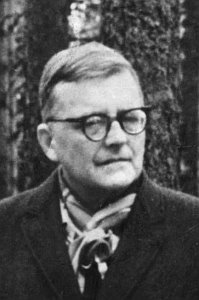
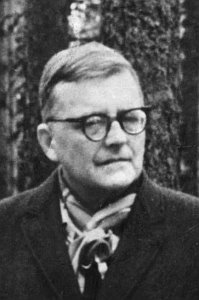
Dmitri ShostakovichShostakovich’s music is one of the prime examples of how extra-musical elements determine our appreciation of music itself. There are of course hundreds of those elements that influence our enjoyment of music: from the way we slept the night before to our particular mood that moment or whether we had that espresso or glass of wine before listening… But unlike these ephemeral events that make us like one thing today but not tomorrow (vice versa rarely happens because an associated negative impression keeps us from returning to that particular work or version thereof), the “Shostakovich Factor” is one that has influenced critical and public perception at large and has lasted for many decades.

The idea: Shostakovich is the wily anti-totalitarian writer who was cowed into writing superficially propagandistic and conformist music that secretly sticks it to the Soviet dictators. Propagated by such figures as Solomon Volkov in his “authentic biography” of Shostakovich, “Testament”, and immediately taken up by the (Russian-émigré) champions of Dmitri Dmitrievich’s cause in the west once they realized how marketable this image was, this idea of Shostakovich has been the single most important factor for the popularity of his music in the West – and I include his music itself among those factors. Assume the opposite situation: That this moral white-washing of his music didn't exist and we thought his works mere propaganda-bombast cranked out to the greater glory of Stalin & Co., all by a good Soviet citizen, informer, and apparatchik. We would condemn it to the furthest reaches of the repertory the way we hail a 'secret freedom-fighter' in every of his third movements. In all this DSCH’s music would only be the ball in a moral-political game; not always good enough to assert itself against defamation, nor so bad as not being loveable with the correct ideology attached.

Other Reviews:

Tim Smith Compelling pairing opens BSO season (Baltimore Sun, September 30)
Instead of trying to figure out whether Volkov et al. have it right or Ms. Laurel Fay (one of the foremost critics of the probably fraudulent work of Volkov’s e.g. in her book “Shostakovich: A Life” – no secret which direction I lean toward), it is better to try to face Shostakovich’s music as absolute and then either be enthralled or reject it as hollow and modestly inspired kitsch and spectacle. Here I lean toward the former. I need no biographies to decipher the emotion and meaning of his string quartets and I’d rather not have prescribed how I am to feel about his symphonies, either. Rather than being told that his subtitle for the Fifth Symphony – “ A Soviet artist’s response to just criticism” – is of course secretly sarcastic (something I don’t actually believe), I shall content myself with the onslaught of music, the church-like calm of intermittent sections, and the come-hell-or-high-water finale. Anyone who is into “big” will love the Fifth (or, for that matter, most of his symphonies – whether overly propagandistic (No.12, No.3) or subversive (the Fourth, to my ears).

Temirkanov, calm and understated on the outside (not quite in the regal, stern manner of Mravinsky but a far cry from the animated style that was Bernstein’s or the hopping and bopping that is Slatkin’s), conjured a rousing, but not over-the-top Fifth Symphony. The lower strings sounded particularly great in the opening of the second movement, the brass as good as ever under him, and the rhythms were almost delicately accentuated amid the noise-assault. The orchestra visibly played their hearts out for him and the result sounded accordingly great.

The program will be performed again at the Joseph Meyerhoff Symphony Hall tonight, Saturday, at 8PM and tomorrow, Sunday, at 3PM.

12.6.06

Roboto Mahler, Serial Number 002

Sean Scully, Wall of LightThree symphonies in the course of one long weekend constituted a sort of heaven for Mahlerians in the region: the 8th with the NSO, the 5th with Michael Stern and the University of Maryland School of Music Orchestra (part of the National Orchestral Institute’s summer program at the Clarice Smith Center), and of course Yuri Temirkanov’s farewell concert of the Mahler 2nd, coming full circle with the work that started his seven-year tenure with the Baltimore Symphony Orchestra. It should have been the crowning of a week (I didn’t go hear the 5th which fell unto the Saturday the BSO played at Strathmore), and I had the highest hopes for Temirkanov’s performance, expecting pure fire, passion, and that raw, exciting take of Mahler that Russian conductors can produce. That was not, as it turned out, what we got Saturday night.

To say that the BSO and Temirkanov executed their second anything less than expertly would be a lie. The quality of the playing (getting the notes right, not missing entries, ensemble-work) was far more than just adequate; indeed: just short of exemplary. The crux lied somewhere else: no matter how much of an outburst and a forte-fortissimo they produced, the performance felt lifeless, dutiful to near comical effect, at best impressive but never even close to moving, much less thrilling. It brought that curiously uninvolved, unexcited feeling of watching porn after having had sex or visiting a Michelin-starred restaurant after just having eaten. For nearly its entire duration I felt as if separated from the orchestra by a giant glass wall, except I could hear them.

The entry of the first movement over plasticky violins – all at excruciatingly slow-sounding speed – brought cellos and basses with it that were crass rather than ominous. You could hear all the notes, little of the music. In contrast: the winds rising from behind were divine; very present yet with distance they were a delight. But heavy brass took over, humpy… and even the brutal effects, that dark fall into a short march, did not register with maximum effect. The lightness of the strings afterwards, that difference of plane on which they enter, was underplayed. Early climaxes puffed into thin air. Here, as for the remainder, there was a great detachment that made listening less involving than hearing a Mahler symphony on the radio.

After less than the Mahler-suggested five minutes break (though late-comers had the chance to enter, furthermore taking away atmosphere), the tired-looking Yuri Temirkanov ably moved his players through the Andante at a speed that was either fast with a slow pulse or slow with a fast pulse; confusing to the ears, either way. (The performance on Thursday seems to have gone better, according to Tim Smith; perhaps the Maestro was tired this Saturday?) In the third movement (In ruhig fliessender Bewegung) the brass showed its glorious side that they have attained over the last years, although at times the effect bordered on a blare-fest. The percussion (drums, in particular) offered one of the best crescendos I have heard; the fine-tuned Strathmore acoustic doing its part. The off-stage effects, especially in the last movement, were nicely done (save for one off trumpet).

Other Reviews:

Tim Smith, A soul-stirring farewell program (Baltimore Sun, June 10)

Tim Page, Ending on a High Note (Washington Post, June 12)

Charles T. Downey, More Mahler at Strathmore (DCist, June 12)

James R. Oestreich, Mahler Symphony Brackets A Turmoil-Spotted Tenure (New York Times, June 13)
Only soloists and choirs did not match the technical level of excellence. Mezzo-soprano Nancy Maultsby had no low notes in the primordial Urlicht (where is Anna Larsson when you need her?); like her soprano colleague Janice Chandler-Eterné, she had no German to speak of but more vibrato than desirable. The choirs (Baltimore Choral Arts Society, Morgan State University Choir) entered with the same curious punctuated détaché as the orchestra in the first movement – but were muddled, on top of it. The chorister-by-chorister rising to their feet for the “Resurrection” part was overdone in its faux-dramatic way, exuding zero magic nonetheless. A haywire hearing aid and plenty of patrons leaving in the middle of the last movement furthermore undermined any sense of occasion that might or should have been. The half-rousing end (the bells lost amid the noise) was too little, too late to salvage the disappointingly neutral impression, that feeling of standing vis-à-vis de rien. The performance as a whole reminded of the anecdote where a Cortot student plays for the master and, upon finishing, sees Cortot sadly shake his head. “But I made no mistakes at all,” declaims the student, with curious surprise. To which Cortot is said to have responded “Son, it was one long mistake.”

One hopes for Temirkanov to be recharged and on fire when he opens next season with the Shostakovich 5th; this season finale for the BSO meanwhile will be conducted by the next Music Director, Marin Alsop, and will feature Joshua Bell in the Corigliano Violin Concerto, The Red Violin, from the film of the same name.

2.6.06

Jonathan Carney and the BSO in Khachaturian and Tchaikovsky

This account from Strathmore was kindly contributed by Ionarts guest reviewer John Henry Crosby.

Jonathan CarneyJonathan Carney arouses different emotions among those who listen to him and watch him – and if he raises others’ ire, I am a fan of his playing and leadership. This is not less true even after his somewhat troubled performance of Aram Khachaturian’s Violin Concerto with the Baltimore Symphony at Strathmore Thursday night.

While technique must always be at the service of artistry, it ought still be remarked that Mr. Carney, while offering great technical command, did not pull the concerto off quite flawlessly. Minor — very minor — lapses of intonation as well as occasional lack of clarity (in the most demanding passage work) and projection kept it some distance from perfection. At least the problem of projection was not entirely Mr. Carney’s fault. Maestro Yuri Temirkanov might well have done a better job to adjust his seemingly overbearing orchestra to his soloist’s size of tone; different violinists project to varying degrees and Mr. Carney was at times drowned out.

Despite my great admiration of Carney, I can’t say that I was “convinced” by Mr. Carney. He did not reach me. And the reason for this was not a missing intention to communicate but certain overly sculpted, overly calculated, overly technical aspects of his performance. I kept thinking how admirably he made use of his bow here, how velvety his tone there, how remarkable his technique in general. But in all of this, the world of the Khachaturian concerto did not come alive for me. The middle of the second movement – that seemingly endless passage in which the muted solo violin has a yearning, searching, plaintive song against the soft, lilting orchestral accompaniment – although played with great feeling, was lacking that icy desolation that slowly grows into unbearable intensity (Henryk Szeryng comes to mind).

The second half of Thursday’s concert featured the Manfred Symphony, the great and too rarely performed symphony/tone poem by Pyotr Ilyich Tchaikovsky. Perhaps the most important accomplishment of a concert performance is to make better known a piece of such magnificence and caliber. Technically, Manfred is extremely demanding, and the musicians of the BSO met the challenge by playing tremendously. The difficult second movement was executed with tremendous élan, and throughout the entire performance there were transcendent moments, especially in the lyrical string passages: truly vintage Tchaikovsky. At the same time, it was not one of those inspired, once-in-a-lifetime concerts. That sense of inner necessity, in which the audience and the orchestra become one, just never came into Strathmore Hall.

This same program will be repeated on Friday and Saturday, June 2nd and 3rd, at 8pm and on Sunday, June 4th, at 3pm at Meyerhoff Symphony Hall in Baltimore.

26.5.06

Setting the Perfect Tone: Julia Fischer with the Baltimore Symphony Orchestra

Yuri TemirkanovIs the region saving up its best musical events for last? In a season that was less exciting across the board than 2004/2005, we just heard the finest opera performance in The Turn of the Screw – and the Baltimore Symphony Orchestra’s current string of concerts with German violinist Julia Fischer delivered easily this season’s best violin concerto performance. It all seems to bode well for the remaining highlights, Kurt Masur’s all-Beethoven concert with the NSO next Thursday and the two Mahler performances of the BSO and NSO the week thereafter.

First things first: Yuri Temirkanov was back after a prolonged (well over half a year), protracted stay in St. Petersburg that apparently included post-Soviet tales of embezzlement, the Russian Mafia, and firing the St. Petersburg Philharmonic’s corrupt administration. (Read Tim Smith’s article in the Baltimore Sun.) He jumped onto the rostrum and, as if possessed, with fresh and raw energy, dove into Carl Maria von Weber’s ebullient Overture to Euryanthe. One got the idea that the BSO might have missed their outgoing music director. The music is itself the utmost of charming Romanticism – light but never smacking of the facile quality that befalls even greater composers (Mendelssohn comes to mind) every once in a while. Expanding from chamber-like moments to the broad and expansive sounds of the, now expanded, explosive opening, this is the kind of music that would charm anyone’s socks off. The BSO didn’t treat it like a throw-away prelude, either but played with zest and great engagement.

Julia FischerJulia Fischer is not one of the teeny-superstars of the violin like, say, Nicola Benedetti or Hilary Hahn, a few years back. For one, Ms. Fischer, born in 1983, is not a teenager. But more importantly, she is building her career judiciously, step by step with great care, some well-applied self-restraint, and what seems an immaculate intellectual grasp. If her bio and recordings (on the audiophile label Pentatone) had not proven it by now, this concert did: she is not a violinist, she is a musician.

Equipped with a prodigious technique (itself being nothing special in these days of violin-athletes), she strikes a marvelous balance between the impressive intellectualism of her senior German violinist colleagues Christian Tetzlaff, Thomas Zehetmaier, and Frank Peter Zimmerman and lyrical élan (well displayed by Hilary Hahn). Her teacher, Ana Chumachenko, may have had a hand in this; the same teacher has also brought us Arabella Steinbacher, another rising violinist from Munich whose career and style are not too dissimilar. (I’ve probably not heard enough of either in concert to truly compare – but from what I have heard, I come away with the impression that Ms. Fischer tends towards the pristine while Ms. Steinbacher is more likely to ‘get dirty’ playing a particular work.)

available at Amazon
J. S. Bach, Sonatas & Partitas

available at Amazon
Glazunov, Khachaturian, Prokofiev, Violin Concertos

available at Amazon
W. A. Mozart, Violin Concertos
What Julia Fischer chose to play with the BSO was no less a work than the Beethoven concerto: not a razzle-dazzle piece, the flash of which is to blind the audience and stun them into happy submission, but a work that demands foremost a thinking player’s approach, lest it fail to take off. Technical perfection and bravura playing can still produce a dud (as Anne Sofie Mutter has been happy to prove with two recordings) – conception and a sense of the complete work at every instant are more important. With her ability to place emotional peaks into refined playing, with her nicely developing tone – never shy, not too big – Ms. Fischer gave this concerto both: the nobility and excitement it needs without veering either into aloof coldness on one side or showy gypsy fiddling on the other. And while the “Beethoven Concerto against Violin” can take any number of approaches, it is especially allergic to the latter.

Cutting a dashing figure in a very red dress as she did, it was not enough to detract from the sternly delicate, searing Largo, where she made the otherwise middle-of-the run, broad rendition of the work sound very special; nuances well placed called attention to the music, not her. Grace and purity abounded. Under Temirkanov’s caring hands – here was something he visibly cherished doing – the BSO performed this and the cadenza-linked last movement splendidly, even with delicacy when called upon to do so. The ripping finale topped it all off in great style. This was an example of 45 minutes of music-making as it should be – and the audience sensed it: the longest standing ovation and sustained applause (did anyone at all sneak out into intermission?) I have witnessed at Meyerhoff Hall forced an encore out of her: Paganini’s Caprice No. 2 in B Minor; delicately sawed out of the musical material if perhaps not ideally prepared. Secretly, I had hoped for some of her Bach.

Other Reviews:

Joe Banno, A Violinist of Promise and Polish (Washington Post, May 27)

Tim Smith, Temirkanov's return was worth the wait (Baltimore Sun, May 27)

Charles T. Downey, Julia Fischer Gets In On It (DCist, May 27)


Shostakovich’s 1st Symphony does not have a nickname, but if my vote counted, I’d suggest “My Little Bombastic.” Outblaring and outgunning the two successive symphonies, it is a short, blazing trail of fire and brimstone. A student work of the 18-year-old Dmitry, the success of this symphony is not measured by the level of its sophistication (none of his symphonies are, really) or even coherence but by sheer visceral impact. Stravinsky, Mahler, and Prokofiev have their fingerprints on this work, but despite those and the early date of composition, it unmistakably spells out “Shostakovich” at every corner and with surprising clarity. The way that the unrelated themes bully each other around – the limping waltz with flute being rammed off stage by the timpani and brass-driven full orchestral forces only to suddenly make way for calm; then circus music – is Mahler in idea, Prokofiev in sound, Shostakovich in execution.

Anyone looking for particular sense in the way these divergent themes play off or against each other would do better to give up and enjoy the onslaught before the music is over. The symphony does not ask to be understood, it asks to be felt. Especially the haunting Lento, where there is respite found in (hollow?) beauty, a beauty not far from the second movement of the Ravel piano concerto, actually. And with Temirkanov once more leading something dear to his heart, the BSO following most every step of the way, it did make itself felt. A fine nightcap after one of the best Beethoven performances I have heard. So good, indeed, that I shall try to go again today. The third performance, as part of the “Casual Concert” series and without the Shostakovich, will be given on Saturday at 11AM.