CD Reviews | CTD (Briefly Noted) | JFL (Dip Your Ears) | DVD Reviews
Showing posts with label Gustav Mahler. Show all posts

11.12.24

#ClassicalDiscoveries: The Podcast. Episode 004 - Beethoven vs. Mahler


Welcome to #ClassicalDiscoveries. Here is a little introduction to who we are and what we would like to achive at the first (or rather "double-zeroëth" episode). It still bears mentioning every time, that your comments, criticism, and suggestions are most welcome, of whatever nature they may be. Now here’s Episode 004, where we are talking, about the "Retuschen" that Gustav Mahler made to Beethoven's symphonies:


available at Amazon
L.v.Beethoven via Mahler
Symphonies et al.
German State Philharmonic Rheinland-Pfalz, Michael Francis
Capriccio, 2024

31.3.24

Critic’s Notebook: Daniel Harding brings a touch of Sweden to the Konzerthaus


Also reviewed for Die Presse: Hugo Alfvén muss man entdeckt haben: Hinreißende Schweden-Romantik im Konzerthaus

available at Amazon
Hugo Alfvén,
Complete Symphonies, Suites & Rhapsodies
var. Orch., Niklas Willén
Naxos


available at Amazon
G. Mahler,
Orchestral Songs
C.Gerhaher, K.Nagano, OSMontreal
Sony


Swedish bonbon and Gerhaherisms

The Swedish Radio Symphony Orchestra’s gig at the Vienna Konzerthaus was notable for its inclusion of Hugo Alfvén on the program, and Christian Gerhaher (who loves working with Harding) singing Mahler’s Rückert songs. Less attractive on paper perhaps was Also sprach Zarathustra lurking on the back of the program, which, of course, features one of the most memorable openings in all of classical music… followed by thirty minutes of tedium. But “Strauss” sells tickets, is fun, and already in the repertoire of the orchestra, whereas something really cool, romantic, and Swedish – say, the Viola Concerto of Allan Petterson or a Symphony by him or by Erland von Koch, Wilhelm Stenhammar, or Kurt Atterberg – would admittedly have been box office poison. Sånt är livet.

Incidentally, it was a pretty good Zarathustra, that Harding and his Swedes (he’s been their MD since 2007) delivered. Listening closely, you could hear how Strauss, in 1896, opens almost all the doors to his future works: In the octet of first desks (very nicely played!) we have premonitions of the Capriccio Sextet. Further down the road, there are glimmers of the Alpine Symphony, in those somewhat meandering, intertwining musical strands. And for the “Tanzlied”, a waltz on near-infinite loop, Harding mercifully took the reins tight, as a result of which the precision suffered, but at considerable benefit to the work.

The opening Alfvén (who should, but unfathomably does not, have a chapter in Surprised by Beauty) was En skärgårdssägen, op.20. Naturally the first-ever performance in the Konzerthaus, much like a visiting Viennese orchestra would probably be the first, if they played a Robert Fuchs Serenade on a visit to Stockholm. As the ear clamors for familiar references in this 1904 sea-themed tone poem about the group of islets outside of Stockholm, it finds them in Debussy during the impressionistic heaves, in Zemlinsky when the flame begins to lick in the strings, or even in Wagner, when the brass and timpani get going.

In between Hugo and Richard, it was Gerhaher to impress with his usual, unparalleled ‘intoned parlando’ in the Mahler. The fact that you have to listen closely, sometimes, when he drops the color from his voice (one of several trademark Gerhaherisms), is easily put up with; in fact, it probably enhances the experience – though Harding and his lustily playing orchestra didn’t exactly help out, either. The cries of nocturnal pain in “Um Mitternacht” were harrowing, and “Liebst du um Schönheit” was, interestingly, stripped of any overt cynicism. Mahler didn’t know it, when he composed it, but he custom tailored “Ich bin der Welt abhanden gekommen” to Gerhaher’s style. Hearing him suffer, while simultaneously exposing the vanity in the lines “Nor am I all that much concerned / If she should think me dead”, by not so much intoning rather than de-toning them, was as touching as anything.


7.7.23

Mahler, who was born today: Two Record Reviews from the Archives


Mahler. Sometimes it's just a bit too much. But a post today is appropriate though, because today, 163 years ago, Mahler was born. Mahler recycled his ideas (and sometimes those of others) - and so will I, adapting a post (part of which ended up here) that was published on WETA's website on this day, 13 years ago, in order to rescure two short record reviews that would otherwise have been lost to the æther:

available at Amazon
Mahler,
Symphony No.1
Honeck / Pittsburgh SO
Exton SACD


Because we don’t have enough Mahler to satisfy our every taste and desires, Manfred Honeck has also started a cycle “if it is possible, in the next five, six years” with the Pittsburgh Symphony Orchestra. If the audiophile Exton label doesn’t get its distribution act together, it may not matter, since we can’t get a hold of the recordings… but if we do (and I’ve snagged a copy of the First, released in April; the Fourth will be out next, and the Third was recorded in June), we might find it’s much more than another layer of Mahler-overkill.Über-idiomatic and rambunctious, joyously self-celebratory, laugh-out-loud daring, hyper-romantic but without the (differently-appealing) heavy hand of Bernstein, it is one of the most notable Firsts to have appeared in a very long time. Perhaps that can be partly blamed on the old zither teacher of Honeck.

When Honeck was a kid, he was—very reluctantly, because it was deemed cruelly uncool even then—made to learn the zither. He had an old teacher; not technically gifted but of a generation that had the Austrian folk music and rhythms in their blood and able to pass it on. Recording Mahler now, Honeck said that now he knows why he has reason to be thankful for those lessons: because he took to Mahler’s Ländler-rhythms like fish to water. “That’s something you can’t learn”, he suggests, “but rather absorb and hope to be able to pass on. In any case, that’s what I’ve tried with these recordings and so far I am very happy with the result.” The fact that he plays the unique rhythms and snaps up wherever they appear, contributes a good deal to the zest and color of this recording.


.

available at Amazon
Mahler,
Symphony No.9
Norrington / Stuttgart WRSO
Hänssler

Yet another Mahler cycle [Ed.: Correction: just a recording; no cycle planned as of yet] from Roger Norrington who finds himself delighting in a happily controversial golden fall of his career. With the ideology and methods of the original instrument and historical performance practice movement, he’s been inching his repertory ever further up, suggesting that the modern tradition of performing romantic music is in fact much more modern than the music itself and that in just a few decades the newfound habits—especially that of permanent orchestral vibrato—have clogged out memory of how the composers themselves still had (and expected) their music (to be) played. When he forces this theory down an unwilling or unable orchestra’s collective throat—regardless of the merits of his theories—the results have been frankly awful. I shudder to remember the Bruckner Fourth he made the NSO perform a few years back. But he has his own modern orchestra lab now—the excellent SWR Stuttgart Radio Symphony Orchestra, and they have wisely learned to go along with Norrington’s shtick. Not just hesitatingly, by the sound of it, but with considerable enthusiasm and even more dexterity. The results are performances of staple repertoire played in ways you haven’t likely heard before (Norrington goes further, with more teeth, than Herreweghe) which has in turn put the Stuttgarters squarely on the map of record collectors and concert-goers—both as object of derision, but more and more so of admiration.

Norrington calls the vibrato-free playing of his strings the ‘pure tone’ and suggests that the last time we’ve heard an orchestra play with such a pure tone was the pre-World War II Vienna Philharmonic, still led by concertmaster Arnold Rosé (Mahler’s friend and brother in law), and conducted in such a ‘pure’ Mahler 9th by Bruno Walter’s famous EMI recording (which I happen to think is woefully overrated). So Norrington gives the great diffuser and comfort-smudger that permanent vibrato admittedly is, the boot, and has his modern instrument violinists, violists, cellists, and double basses hit the notes and play them clean without—literally—the wiggle room that vibrato provides, intonation-wise. Since his orchestra knows how to do that now, the sound isn’t off; instead it’s more direct, seeming a little more strident at first, a little sharper, but certainly also more detailed and clearer. Or, I suppose, ‘purer’.

I’ve only now heard the Ninth Symphony of Mahler with Norrington (aFirst, Second, Fourth, and Fifth are also available), and while I wouldn’t say that loving this performance means being sold on his theory to the exclusion of the various other current ways of performing Mahler, I, well… I love it. There is a zany bite and yet a plain simplicity to the music that is very refreshing, gripping, and exciting. Although Norrington certainly doesn’t stretch the heavenly closing Adagio to its limits at 19’24’’ (that’s two minutes faster than Boulez), he draws out the ethereal quality just right. He also manages to keep the tension in those last minutes when the energy of the symphony drops to what can end up a hesitant whimper rather than carefully stringed repose evaporating into a confident, gentle goodbye.


30.12.22

A Survey of Mahler Symphony Cycles: A Work in Progress


An Index of ionarts Discographies


Mahler, an Addiction

Bruckner is a love, Mahler an addiction

When I helped put together three complete Mahler cycles to be aired during Classical WETA’s Mahler Month in 2009, I accompanied it with a series of articles on Mahler's Symphonies (and favorite recordings). These are the core of the Mahler Survey that’s now on ionarts, 26 essays in all. What was conspicuously missing at the time was a discussion of complete Mahler cycles, the point being that no one cycle could do all symphonies equal justice and, perhaps more to the point, that such a survey would be an enormous amount of extra work. So it has proven to be… and after a decade, I’ve finally cobbled together enough information to attempt this Mahler Symphony Cycle Survey.

A Question of Completeness

There are symphonic cycles that are either complete or not complete in a straightforward manner. If you’ve recorded fewer than 15 Shostakovich- or six Martinů-symphonies, your cycle is not complete. If you have recorded more than that you know something more than we do. But take Bruckner: Nine symphonies or eleven, including the “F-minor” and “0”? Or Schubert: Which, if any, completions of the numerous fragments to include? Mahler tops it all. We have Symphonies One through Nine, of course. But wouldn’t a proper cycle also include Das Lied von der Erde, which Mahler counted among his symphonies? Then there is the Tenth Symphony to consider and include: at the very least just the completed Adagio (and/or Pergatorio), or better yet one of its many performing versions. Now what’s a complete cycle. One that features Nine Symphonies? Those, and the Lied? Nine Symphonies and the Adagio? Nine and both, Adagio and Lied? Ten symphonies but not the Lied? Everything? Maybe boni like Das Klagende Lied, the Blumine-movement or Todtenfeier [sic], the early version of what would become the Second Symphony’s first movement? The Britten-arrangement of “What the Wild Flowers tell me”?

Since this survey has the ambition to be completist, I have included anything and everything that might constitute a cycle, including a few incomplete ones. But to visualize the state of completeness, I have added a sort of traffic light to the various states:


I distinguish between:

1-9 (Less than the basic Nine, incomplete)
1-9 (Basic Nine)
1-9+1 (Nine and either Lied or Adagio or compl. 10th)
1-9+L+A (Nine, Lied and Adagio)
1-10+L (All ten plus the Lied)
>1-10+L (Everything and then some boni, übercomplete)

Arrangement

Because it’s more practical and because the Twitter-survey suggested as much, I will sort these sets by conductor, not by date-finished, as is my practice in the other recent, advanced surveys. The practical aspect comes in, where there are inclusions of semi-cycles, that were never really issued as complete cycles but constitute something alike enough… and with conductors with multiple (almost-)sets to their name but overlap among them. It’s simply neat to know how many times Haitink and Bernstein went around the full (or not) Monty.

Unfinished and Taking Forever

Why publish this work in progress when I've only made it to Bernstein, so far? Well, partly to motivate myself to work on this. Also because I tweeted out the following: "Should I publish the #Mahler Symphony Cycle Survey I've been working on (on and mostly off) forever unfinished* or hold off until it is complete?" and the response, however limited, was on the "go ahead" side. What pushed it over the edge was this smartalec remark: "Mahler review dragging on endlessly. Who says irony is dead, who says this?" Well, there you have it. Mahler, dragging on and with irony.

Help!

Finally a call for help: Such a survey would not be possible—and certainly not complete—without the kind help of many fellow Mahler-lovers who chip in with their knowledge, cover pictures… who spot lacunae, spelling mistakes, broken links and factual errors. Thank you all for all much-appreciated contributions past and future! Finally a few abbreviations: LvdE = Lied von der Erde. LefG = Lieder eines Fahrenden Gesellen. DKL = Das klagende Lied.

22.10.22

Briefly Noted: Igor Levit drinks the philtre

available at Amazon
Wagner, Act I Prelude from Tristan und Isolde (Henze, Liszt, Mahler), Igor Levit

(released on September 9, 2022)
Sony Classical 886449503582 | 1h41
The Russian-German pianist Igor Levit is on a Tristan und Isolde kick. His new two-disc set, titled Tristan, pairs Hans Werner Henze's ground-breaking Tristan, from 1974, with the Wagner work that inspired it, especially the notorious Act I prelude, transcribed by Zoltán Kocsis. The Henze is an elusive, unclassifiable work, combining piano solo, electronic tapes, and orchestra. This thoughtful rendition, recorded in November 2019, features the Leipzig Gewandhaus under Franz Welser-Möst. An authoritative booklet essay by Anselm Cybinski lays out the work's many other musical quotations and allusions (Brahms, Mahler, and Chopin among them) as well as the multiple layers of meaning encoded in it.

Levit surrounds this enigmatic modern piece with romantic works he sees as related. From Liszt he takes the A-flat major nocturne known as Liebesträum No. 3, derived from a song set to poetry by Ferdinand Freiligrath. The poem, quoted and translated in the booklet, is the antidote to the love-death of Wagner's opera, a plea for lovers to remain alive, and therefore love, as long as they may. The disc concludes with "Harmonies du Soir," the eleventh piece from the same composer's Études d'exécution transcendante, an evocation of the night in which Wagner's lovers try to hide their passion.

This "program of Tristanesque works," as Cybinski puts it, includes Ronald Stevenson's piano arrangement of the first movement (Adagio) of Mahler's Tenth Symphony. One could see this selection as representing the point of view of King Marke on the Tristan story, as Mahler wrote it in the period after he learned of the affair between his wife, Alma, and Walter Gropius. Stretched out to over 27 minutes, this version grows organically from its opening (given to the violas in the orchestral score), that has considerable resonance with the main motif of Wagner's Act I prelude.

Levit returned to Washington this week, for the first appearance since his striking local recital debut in 2017, presented again by Washington Performing Arts. Thursday's excellent concert, in addition to exquisite Schumann and a new piece commissioned from jazz pianist Fred Hersch, added one last Tristan nugget to this program. On the second half, Levit played the Kocsis transcription of the Act I prelude from this recording, following it with a Faustian interpretation of Liszt's vast B minor sonata.

The juxtaposition made me realize, for the first time, that the final measure of Wagner's prelude is identical to the first measure of the Liszt sonata: two short staccato strikes on G in 6/8 meter. Wagner ends up on G without really giving the listener much reason to think of that as the keynote of the prelude, and Liszt immediately obscures the note with the descending scalar pattern that opens the sonata. To draw attention to this conjunction, Levit elided the two pieces, not only eschewing any pause between them, but making Wagner's last two notes simultaneously Liszt's first two.

31.10.19

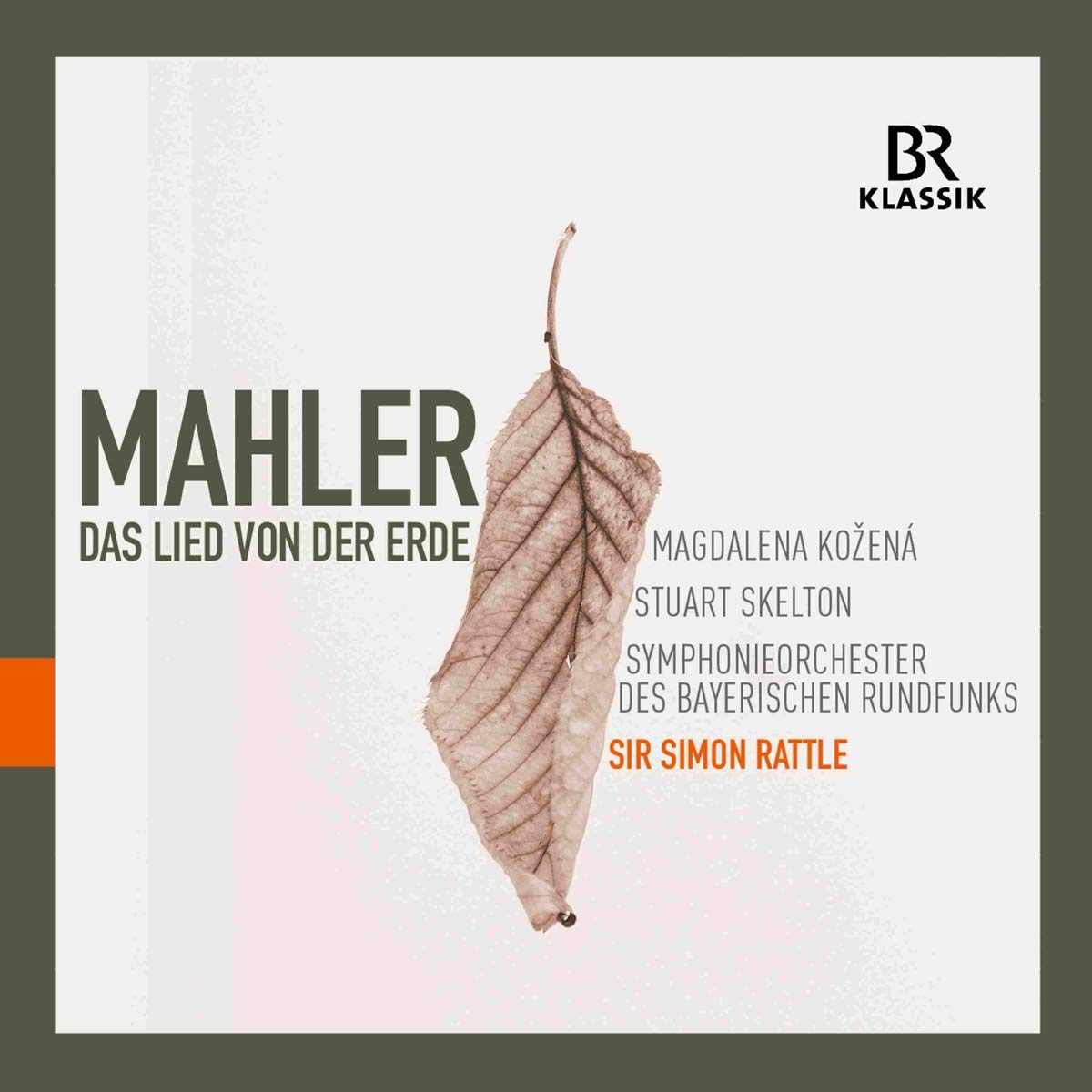
Dip Your Ears, No. 257 (Rattle's Bavarian Lied von der Erde)

available at Amazon
Gustav Mahler, Das Lied von der Erde
Simon Rattle/Bavarian Radio Symphony Orchestra/
Magdalena Kožená (mezzo), Stuart Skelton (tenor)
(BR Klassik)

There’s a reason to eye musical nepotism critically. Mediocrity rears its head when relatives – usually spouses – ride on the coattails of their more talented counterparts. Just think Garanča/Chichon, Netrebko/Eyvazov, or Zukerman/Forsyth. Even at the more exalted and mutual levels of talent, a critical stance is merited: Much is great, but hardly all. Even the best of them – Britten /Pears, Fischer-Dieskau/Varady, Vishnevskaya/Rostropovich – had their off-moments. And with conductors generally aging better than singers, the same caution is warranted when Simon Rattle and Magdalena Kožená are sold to us as a package.

Happily, this BR Klassik release of the couple’s Das Lied von der Erde stands up to scrutiny – and then some! The river-like clarity of the BR Symphony Orchestra is not of a cold, but elegant, perfection. Every instrument can be heard and every one of them is a joy to listen to. Any number of examples might underscore this, but just try the woodwinds in the opening of “Von der Jugend” for size. Rattle leads with zaftig grace and leaves no ostentatious fingerprints on the score. Kožená is not the first mezzo to sing these songs beautifully, but she really throws herself into it, in all her autumnal glory, dramatic, generous and clear, with warmth and intensity, never swooping and with splendid handling of the text. No hints of an aging voice here, as I’ve encountered on some live occasions.

But of course every Lied von der Erde stands or falls with the contribution of the ‘high’ voice’s part, the tenor. It’s the downfall of many otherwise splendid accounts when those admittedly difficult and much less grateful parts are croaked or wailed or underpowered. Meet Australian heldentenor Stuart Skelton, who actually approximates Kožená in the sonorous warmth of his portrayal, even if he does not match her handling of the text. Without following the libretto it’s occasionally a bit of a guessing game what he is singing about, but in fairness, most native speakers aren’t much better. It’s a minor caveat, given the quality of the whole package here, which amounts to nothing less than one of the finest and best-sounding modern recordings of Mahler’s de-fact Ninth Symphony.

Or is it? Over at ClassicsToday, you’ll find a very, very different, almost diametrically opposed #CDFromHell review of this release, which doesn’t agree with any of the above. Obviously, it sent me scurrying back to this recording, wondering if I had been deceived by headphone-listening or drunkenness. Not from what I can tell. The singers are prominently recorded, yes, which was more notable via speakers, but nothing worrisome. That said, we certainly agree on the reference versions… which you can read more about in the Lied-chapter of the ionarts-Mahler Survey.

9/9


14.8.19

Dip Your Ears, No. 249 (Cologne Mahler Cycle, Take Two)

available at Amazon
Gustav Mahler, Symphony No.5,
Gürzenich Orchestra Cologne / F.X.Roth
(Harmonia Mundi)

Ten years ago, the Cologne’s Gürzenich Orchestra released a recording of Mahler’s Fifth Symphony with their then-Music Director Markus Stenz. It turned out to be an excellent new recording (of a whole cycle) by the orchestra that premiered that Symphony in 1904. Now the same orchestra has recorded it again with their new music director François-Xavier Roth, also beginning a new Mahler cycle. Again the result is excellent. Interestingly enough it is Roth, who often flirts with period performance, who delivers the more slightly more conventional, slower reading. Most notably in the Adagietto where Stenz takes under nine minutes; Roth two minutes longer. But the transparency is top-notch; there is a pleasant and elegant lightness to the playing: The scoring never feels thick (nor anemic). Of course there are a good number other fine recordings of this symphony available, too. But if you have any inclination or rationalization to try this new cycle-in-the-making, there’s no reason not to start here.

8/9


8.6.19

Briefly Noted: Blomstedt's Mahler 9

available at Amazon
G. Mahler, Symphony No. 9, Bamberger Symphoniker, H. Blomstedt

(released on June 21, 2019)
Accentus Music ACC-30477 | 83'28"
Herbert Blomstedt, who will turn 92 next month, remains not only active but supremely accomplished on the podium. He now serves as Honorary Conductor for a number of ensembles, including the Bamberg Symphony, with whom he led this glowing live performance of Mahler's Ninth Symphony in June 2018. (The sound engineering leaves something to be desired, with some awkward joining between sections.) The last symphony Mahler published before his untimely death, it is often seen as the composer's reluctant eyeing of death. In a dark coincidence, for example, it will be the last work Michael Tilson Thomas (at 74, a young whippersnapper) conducts next weekend, before he takes a leave of absence to undergo heart surgery.

The Ländler seems rather genteel in Blomstedt's hands, a little pokey in tempo, perhaps a different way of understanding the "ungainly" and "course" markings that Mahler indicated. The third movement is appropriately brash, but again more polished than rough around the edges. The fourth movement misses the glimpse of the infinite it can afford, as Blomstedt could have drawn out its effusive lines even longer, but the chamber music moments of grouped solos put the Bamberg musicians in beautiful spotlights. Most effective is Blomstedt's first movement, an expansive, elegant rendering of the layers of appoggiaturas leaning on one another in row after row. The reluctant impartial quotations of the "Lebewohl" motif from Beethoven's piano sonata "Les Adieux" pile up beautifully.

Marin Alsop takes another crack at this elegiac work tonight at Strathmore and Sunday afternoon at the Meyerhoff, even as the identity of the Baltimore Symphony Orchestra as a full-year major orchestra continues to unravel.

13.5.19

On ClassicsToday: Vienna Philharmonic' Mahler's 8th at the Konzerthaus


Vienna Aroused: Mahler’s Eighth Still Does the Trick

May 12, 2019 by Jens F. Laurson
Vienna, May 11, 2019; Vienna Konzerthaus—Even in times of inflationary Mahler performances, a Mahler Eighth is something special. It was notable from the moment you set foot into the Vienna Konzerthaus on this past Saturday afternoon. The mood was different. A little tense, a little hushed in anti...  Continue Reading


See also:

106 Years Mahler Eighth: The Best Recordings (Forbes)
Gustav Mahler – Symphony No.8 (Part 1)
Gustav Mahler – Symphony No.8 (Part 2)
Alles Vergängliche: Ozawa's Mahler Eighth


30.3.19

On ClassicsToday: Mahler Third with the Gustav Mahler Youth Orchestra & Jonathan Nott


The Gustav Mahler Youth Orchestra’s Mahler Cure

Musikverein, Vienna; Saturday, March 16, 2019—There is either a glut of Mahler on the concert circuit or you can’t ever get enough Mahler. There is no middle ground. Mahler is appealing stuff on many levels, not the least that you can easily impress with the music at rather less rehearsal expense than you could with, say, Haydn. Also: the musicians are already there, so they might as well be used—lest you get a letter from a subsidy-conscious politician about efficiency concerns (as happened to the Vienna Symphony not long ago). Granted, not all of this applies to the Gustav Mahler Youth Orchestra’s performance of Mahler’s Third at the Musikverein, one of three Mahler symphonies in six performances over the course of just nine days at that venerable house alone... Continued on ClassicsToday


22.1.19

Twitter comments: "#pompous, ill judged & tone deaf"

I do love a good argument!


12.6.18

Forbes Classical CD Of The Week: Mahler Most Charming, Made In East Germany


...Something similar happens on this disc, except the nine Mahler-songs included – four from Des Knaben Wunderhorn and the Rückert-Lieder – do steal the show. Also recorded two years before the symphony (1982), but in the same glorious, rich analogue sound, it features the lyric Lied-baritone Siegfried Lorenz. His timbre, his naturalness, his dead-on intonation, and his lyrical quality make his voice knee-bucklingly beautiful. I’d go so far as suggesting he is a proto-Gerhaher. And if the “Songs of a Wayfarer” selection, originally on the LP, wasn’t good enough, the CD adds the bonus of one of the most touching Rückert-Lieder cycles I know on record. Try and not just melt right into Lorenz singing “Es ist mir auch gar nichts daran gelegen…” in Ich bin der Welt abhanden gekommen...

-> Classical CD Of The Week: Mahler Most Charming, Made In East Germany


2.1.18

Gustav Mahler – Symphony No.4 (Part 3)


While Mahler’s Forth Symphony is very different from the previous three, it also constitutes the group of Wunderhorn Symphonies with them, of which the last three had all included vocal elements. From here on, Mahler set out on a slightly different path and soon had a new source of delight and suffering entering his life in the form of Alma Mahler, née Schindler.


available at Amazon
Symphony No.4, Boulez / Banse / Cleveland (DG)


available at Amazon
Symphony No.4, Sinopoli / Banse / Dresden StK. (PROFIL Hänssler)

I have just extolled the virtues of recent Mahler Fourth recordings by David Zinman, Iván Fischer, and Michael Tilson Thomas, but if they fail to elicit more enthusiastic praise from me, it is because they share with the earlier Haitink recordings and Pierre Boulez’ (DG) a missing, hard-to-define, distinctive quality that goes beyond exquisiteness. Unlike with the Third Symphony, I am less content with sheer excellence alone in the Fourth, since the recording catalog offers so many more choices. Swift Boulez almost gets there, though, because the Cleveland Orchestra provides him with pronounced and individualist chatter of instruments that comes, like Bernstein, a little closer to the aforementioned ideal of a “Concerto for Orchestra”. What does stand out with Boulez is his first movement, which he zips through at a pace that leaves you bopping along without your mind ever tempted to wander. Taking only a minute less than Bruno Walter (who more than makes up for lost time in the last two movements), he sounds twice as fast. His soprano Juliane Banse is equally wonderful in the totally different, very broad Sinopoli recording from Dresden (PROFIL Hänssler) where the Italian (one of the few conductors to master Bruckner and Mahler equally well at a relatively young age) adds three minutes to Boulez’ 8’44” in “Das himmlische Leben”… with wildly fluctuating tempi. Banse doesn’t sing her quick parts any slower in Dresden than she does in Cleveland, only her slow parts are retarded to a point where it must have become challenging for the singer to maintain the line. It is exaggeration occasionally—well, regularly—seen in Sinopoli’s Mahler, but one can’t blame him for wanting to explore the beautifully spacious acoustic and striking sound of the orchestra both of which come across nicely on the recording.

available at Amazon
Symphony No.4, Kletzki / Loose / Philharmonia (EMI)

The gEMIni re-issue of Paul Kletzki’s Fourth—coupled with his acclaimed Lied—does the EMI remastering-engineers proud: the 1957 sound is far better than one might expect and the performance among the light ones that please. Paul Kletzky’s wife, Emmy Loose, sings faultlessly and wonderfully innocently, if without particular distinction beyond that. Washingtonians with a long memory and therefore skeptical of such musical Mahler-Fourth / Wife nepotism can be assured that Loose earns her inclusion in that performance on account of skill, not wedding band. [Ed.] It holds up in 2017 just as much as in 2009 and it is high time that Warner, which has taken over EMI's catalogue and tends to it very appreciably, gives this a nice re-issue as it seems currently out of print.

available at Amazon
Symphony No.4, Haitink / Schäfer / RCO (RCO Live)

SACDLogo_Klein2
One Mahler recording issued in 2008 truly stood out among the lot: the Concertgebouw’s performance of the Fourth Symphony with Bernard Haitink conducting and Christine Schäfer taking the soprano part. If a Fourth Symphony can easily be undone by an inappropriate soprano (Gielen/Whittlesey, Abbado/Fleming), it can’t generally be ‘made’ by a great singer. Well, maybe Schäfer could actually, because her soprano is simply perfect for “Das himmlische Leben”. Clarity and beauty of tone are a given with her, but the innocence, the angelic ring that she believably exudes is exactly what the symphony (and Mahler) asks for. In theory a treble might be better, still, but put into practice it simply doesn’t work.

Fortunately Schäfer doesn’t have to rescue anything here, she’s simply the crowning glory of what is a superb performance. Haitink is generally short on cutting and acerbic tones in Mahler and long on beauty. So here. This Fourth Symphony (his fourth commercial recording of it!) benefits from beauty and suffers not from the absence of tortuous and biting sounds, as for example the Sixth would. Generous, rich, and yet transparent, there is plenty of that beauty to go around here. Among his three live recordings (two with the RCO and one with the Berlin Philharmonic), this is the one with the quickest pulse. The RCO plays with near-perfection (this is a true live recording, not patched from several performances), its usual gorgeousness, and grandeur of sound—all caught perfectly by the recording engineers. This sumptuous performance has now replaced Inbal, my previous top choice.


available at Amazon
Symphony No.4, Gielen / Whittlesey / South West German RSO (Hänssler)

Michael Gielen’s Mahler is more and more becoming a favorite of mine. Here is a conductor with a modernist perspective of Mahler (like Abbado and Chailly) who (unlike Abbado and Chailly) can really rip through these symphonies instead of making them sound ‘lovely’. There is little of that ‘well behaved’ sound in his recordings with the South-Western Radio Symphony Orchestra Baden-Baden. Perhaps because his players are not as seasoned a Mahler orchestra as are Chicago, Vienna, and even Berlin? His Fourth suffers from the same problem Abbado’s does, though: Three good movements and then big a let-down from the soprano. Christine Whittlesey’s problem is not self-conscious artificiality but that she sounds like the evil witch from one of Brother’s Grimm fairy tales. You’d think that once she finishes with “Die eng’lischen Stimmen / Ermuntern die Sinnen, / Daß alles für Freuden erwacht” she’ll rush back home to roast Hänsel. Others react more kindly to her voice, but it manages to rub me the wrong way, alright. (Gielen’s inclusion of the sublime Schreker “Prelude to a Drama” probably makes for the best filler on any disc with the Fourth Symphony, though.) [Ed.] Gielen's cycle has just been re-boxed by SWR Classic: This arguable dud apart (and they all have at least one dud), it is probably one of the two all-around best Mahler cycles out there. While this second re-issue also doesn't include the fillers that I find so attractive in the single discs, it does include absolutely all the Mahler that Gielen recorded with the South-Western Radio Symphony Orchestra Baden-Baden & Freiburg and covers 17 CDs and a DVD of the Ninth Symphony.

available at Amazon
Symphony No.4, Chailly / Bonney / RCO (Decca)


available at Amazon
Symphony No.4, Szell / Raskin / Cleveland (Decca)

Another wonderful and appropriate filler are the Seven Early Songs by Berg. The above mentioned Abbado offers them (and here, unlike with Mahler, Fleming really shines)—as does the Ricardo Chailly recording with the Concertgebouw and Barbara Bonney. Like Gielen, the recording can be difficult to get outside the complete box (Arkiv currently lists it, actually), which is a shame as neither collections—Gielen’s or Chailly’s—include any of the ‘fillers’. Chailly’s Fourth is unwavering in its forward-momentum… steady and secure like a sewing machine. Understated, but surreptitiously powerful. The playing (aided by excellent sound) is three-dimensional. There isn’t a more delicate, more loving third movement on record. This is a monument to well thought-out craftsmanship of the highest order. ([Ed.] Chailly has re-recorded the Fourth in Leipzig - issued on DVD/Blu-ray on Accentus, this time with the fine (scarcely divine but appropriately young) Christina Landshamer as the soprano.)

Many consider the George Szell recording (Sony) with Judith Raskin one of the finest recordings; inexplicably it has gone out of print... though thankfully it can now be had as an ArkivMusic licensed CDR re-print (if you can't find the original cheaper on Amazon). It should be heard; it remains one of the finest in the catalog even after so many years of strong competition. The same cannot be said of every recording that has old age on its side. When, after timid discovery, I started listening to Mahler in earnest, it was usually a Bruno Walter recording that I went with. My first impressions of the First, Second, and Fourth were with Walter. Such early impressions are usually indelible, but in this case they have all been dislodged and surpassed. His Fourth (Sony) with the New York Philharmonic from May of 1945, for example, is nice and brisk, and the less than perfect playing, occasionally sour, can be said to add lots of character. (More character, still, comes from the so-so 1945 recording quality!) But it is full of strange touches, too. Take the first movement, where Walter doesn’t hurry up the introductory sleigh-bell phrase and consequently has no room or time for a ritardando. (Boulez almost does the opposite: begins fast and refuses to slow down.) By not making much of a distinction between “Deliberate” and “Very leisurely”, it sounds like his sleigh grinds into the snow and never quite gets going again. For reasons of interpretation and authority, Walter is always worth coming back to. But if I had only two or three Mahler Fourths on my shelf, I’d not put up with the technical limitations this effort demands excusing.


The font used in the title is "Eckmann Regular"

Mahler 4 Choices

1. Bernard Haitink / Christine Schäfer, RCO, RCO Live

2. Eliahu Inbal / Helen Donath, Frankfurt RSO, Denon / Brilliant

3. Paul Kletzki / Emmy Loose, Philharmonia Orchestra, EMI

4. Esa Pekka Salonen / Barbara Hendricks, LA Phil, Sony via Arkiv

5. George Szell / Judith Raskin, Cleveland, Sony via Arkiv

6. Riccardo Chailly / Barbara Bonney, RCO, Decca

Mahler 4 SACD Choice

Bernard Haitink / Christine Schäfer, RCO, RCO Live


This continues Gustav Mahler — Symphony No.4 (Part 1)
and: "GUSTAV MAHLER — SYMPHONY NO.4 (PART 2)"
FIND A LIST OF THE Mahler Survey HERE: HTTP://IONARTS.BLOGSPOT.COM/2009/12/MAHLER-SURVEY.HTML


Gustav Mahler. Postcard by Hans Boehler.
Courtesy of the Carnegie Hall Archives