CD Reviews | CTD (Briefly Noted) | JFL (Dip Your Ears) | DVD Reviews
Showing posts with label Virginia Opera. Show all posts

14.4.14

Another Year, Another 'Carmen'


Charles T. Downey, Virginia Opera stages ‘Carmen’
Washington Post, April 14, 2014

An opera company is unlikely to have a triumph, in the critical sense, by staging “Carmen,” but Georges Bizet’s story of passion and murder will fill a house. It worked for Virginia Opera, which staged the opera on Friday night at George Mason University Center for the Arts. With some talented singers and a handsome production, updated by director Tazewell Thompson to Franco-era Spain, it was bound to be a crowd-pleaser.

Mezzo-soprano Ginger Costa-Jackson... [Continue reading]
Bizet, Carmen
Virginia Opera
GMU Center for the Arts

VIRGINIA OPERA, 2013-14 SEASON
Falstaff | Magic Flute | Ariadne auf Naxos

Sadly, Virginia Opera will celebrate its 40th anniversary season by giving over half of its productions to music theater and operetta. It is a long way from the company's daring 2011-12 season.

9.12.13

Virginia Magic Flute Living Up to Mozart


Many thanks to Robert R. Reilly for this review from just around the corner.

One feels a slight bit of trepidation when a regional opera company takes on one of the masterpieces of the repertory—in this case, Mozart’s The Magic Flute. Can it live up? However, one need not have worried with the Virginia Opera’s production, which reached George Mason University’s Center for the Arts in Fairfax on the evening of December 6th, 2013, after an earlier run beginning on November 8th elsewhere in the state. It did live up.

See also Charles Downey's ionarts-review here.


Vocally, things went very well indeed, with several outstanding performances. The only controversial note of the evening was the production itself, and that only partially. Stage director Michael Shell chose to set the opera as a dream. During the overture, the lights come up on a bed center stage. We also see a red tricycle, a baby bottle by the bed stand, and other appurtenances of a young family.

Husband and wife enter in pajamas; they are icily silent toward each other. They are obviously going through

8.12.13

Virginia Opera's 'Magic Flute'

The libretto of Mozart's Die Zauberflöte is not about realism. Ways to make sense of it include playing up the Masonic elements that are part of the backdrop of the opera's creation, relocating the story in a completely different era, exaggerating the fairy tale aspects, using marionettes to enhance the surreal nature of the events, making the story even more confusing, or dispensing with reality altogether. The production that Michael Shell directed for Virginia Opera, seen on Friday night at George Mason University's Center for the Arts, is essentially a traditional staging, albeit in an English adaptation by Kit Hesketh-Harvey. Shell recontextualizes the story by setting it as a dream, shared by a husband and wife who have fallen asleep after a fight. The unbelievable -- the Egyptian temple, the unlikely love story, the diametrically opposed forces of good and evil, the magic instruments -- is made oneiric. The husband, who somehow becomes Tamino in his dream, is not falling in love with the portrait of his wife, who becomes Pamina -- he is rediscovering what made him fall in love with her in the first place. In this context, the libretto's moral lessons, compact dicta against lying and hurting others, seem like valuable marital advice.

The conceit works in large part because of the convincing acting and fine singing of both singers: tenor Matthew Plenk as an ardent Tamino, and particularly the robust, not weepy Pamina of Nadine Sierra. The two foils of male and female in the libretto were also served beautifully, in the daring but refined, not overblown coloratura of Heather Buck as the Queen of the Night (pictured, see interview) and the smooth, not dragging Sarastro of bass Kenneth Kellogg. In Shell's retooling of the story, the foibles of both of these characters, the conniving queen and the misogynistic Sarastro, can be seen as the shortcomings behind the argument of the dreaming husband and wife. Baritone David Pershall, a former emerging artist with Virginia Opera, was a charming, if not extraordinary Papageno, matched by the goofy Papagena of Amanda Opuszynski, a current emerging artist. The three ladies, quizzically recast as a sort of Andrews Sisters backup trio, were also sung by current and former emerging artists, effective but not optimal.

3.12.12

'Die Fledermaus'

Style masthead

Charles T. Downey, Virginia Opera's "Die Fledermaus" at George Mason University
Washington Post, December 3, 2012

available at Amazon
J. Strauss, Die Fledermaus, E. Schwarzkopf, N. Gedda, Philharmonia Orchestra, H. von Karajan
The Virginia Opera’s 2011-12 season was marked by daring programming and innovative staging, a gutsy move for a company that has just undergone a crisis in leadership. But it was a short-lived experiment. After an unsuccessful attempt to get a new company off the ground, ousted artistic director Peter Mark was welcomed back into the Virginia Opera fold last month, with the company even agreeing to mount the productions Mark had planned for the coming year. The move seals the Virginia Opera’s return to a more conservative strategy, a shift borne out by its latest production, Johann Strauss II’s “Die Fledermaus,” seen Friday night at George Mason University’s Center for the Arts.

This evergreen operetta has its appeal, played for all of its champagne-cork-popping effect in an effervescent, even manic staging by Dorothy Danner, revived from 2006. The cast, more satisfactory than striking, went with the antics physically but did not always deliver vocally, including the overextended Rosalinde of soprano Emily Pulley and baritone Philip Cutlip’s Eisenstein, cracking at the top of the role by the end. Continue reading]
J. Strauss, Die Fledermaus
Virginia Opera
GMU Center for the Arts

SEE ALSO:
Mike Paarlberg, Holy Cornballs, Batman! Virginia Opera’s Die Fledermaus (Washington City Paper, December 1)

Jens F. Laurson, Holy Leaden Joke, Batman! (Ionarts, April 14, 2004)

16.10.12

'Pearl Fishers'

Style masthead

Charles T. Downey, Virginia Opera’s ‘The Pearl Fishers’ may signal a turn to the conventional
Washington Post, October 16, 2012

available at Amazon
Bizet, Les Pêcheurs de Perles, B. Hendricks, J. Aler, Orchestre du Capitole de Toulouse, M. Plasson
Last season the Virginia Opera positioned itself as the local opera company most willing to challenge its audiences. It had accomplished this in the wake of a leadership schism in 2011, when founding music director Peter Mark was ousted by the company’s board. The company’s new season opened with a blandly traditional staging of Bizet’s flawed “The Pearl Fishers,” heard on Sunday afternoon at the George Mason University Center for the Arts. It may be the first sign of a turn back to the conventional, a season of mostly old favorites that will conclude with a musical.

What this production had going for it was an excellent soprano at the top of the cast. Heather Buck, who gave a sexy, icy sheen to the role of La Princesse in last winter’s outstanding production of Philip Glass’s “Orphee,” had an alluring presence and glimmering voice as Leila, the priestess who comes between two friends on the shores of ancient Ceylon. With pure, high notes even at pianissimo, beautifully controlled breath support and unobtrusive vibrato, Buck gracefully dispatched the trills and coloratura of the showpiece “O Dieu Brahma,” at the end of Act I. [Continue reading]
Bizet, The Pearl Fishers
Virginia Opera
GMU Center for the Arts

SEE ALSO:
Terry Ponick, Virginia Opera's bright, affecting 'Pearl Fishers' at GMU (Washington Times, October 15)

Charles T. Downey, Bizet's 'Pearl,' Dusted Off (Washington Post, September 22, 2008)

---, Opera Preview: Les Pêcheurs de Perles (Ionarts, September 18, 2008)

11.2.12

Virginia Opera Does It Again


La Princesse leads Cégeste to the underworld -- Jonathan Blalock (Cégeste) and Heather Buck (La Princesse) in Orphée, Virginia Opera, 2012 (photo by David A. Beloff)
Virginia Opera has moved into the lead position as the local opera company most willing to take risks and challenge its audience. After winning new productions of Aida and Hansel and Gretel in the fall, it threw all caution to the wind by staging an opera by Philip Glass, and not a well-known one at that, Orphée, premiered in 1993. It was a sparse audience indeed that showed up for last night's performance at George Mason University's Center for the Arts in Fairfax, and it thinned out even more amid some grumbling at intermission. Based on the 1949 film of the same name by Jean Cocteau (French libretto adapted by Glass and Robert Brustein), Orphée did not impress me (or others) that much on a recent recording on Glass's Orange Mountain Music label. It again became apparent to me how much Glass's repetitive music relies on a visual element -- true of both his operas and his film scores -- to bring it to life. In this staging, created for Glimmerglass Opera and taken to Portland Opera for the production from which the OMM live recording was made, the work became many times more hypnotic and alluring.

available at Amazon
Glass, Orphée, P. Cutlip, L. Saffer,
Portland Opera, A. Manson

(released on July 20, 2010)
OMM 0068 | 101'49"
Cocteau updated the Orpheus legend to the modern era, with a celebrity poet and his wife becoming entangled with a mysterious princess, later revealed to be death herself, and the spirits of those she has taken, wandering in an unexplained other world. It begins when a young poet, Cégeste, is struck by a motorcyclist at their home. Orphée becomes obsessed with his patron, La Princesse, and listens to mysterious messages received from the world beyond through a transistor radio -- quite appropriately for Glass's music these cryptic communications, in a sort of Symbolist nonsense style, are repeated over and over. The princess's chauffeur, Heurtebise, takes a shine to Orphée's wife, Eurydice, helping to guide her husband to find her in the underworld after she, too, is struck by a motorcyclist. A panel of judges sends Orphée and Eurydice back home, but the banal reality of living with someone you are not allowed to look at becomes intolerable and Orphée seeks out death to spend eternity with the Princess. She instead sacrifices herself to make Orpheus immortal.

Much of this cast's magic is due to the regal presence, vocally and dramatically, of soprano Heather Buck as La Princesse. We last reviewed her as a venomous Queen of the Night in an odd Magic Flute at Santa Fe Opera, and the same icy strengths were assets here as the bewitching figure of death, both loving and terrifying. After the opening scene, in which Glass subordinated his trademark style to an evocation of bubbly jazz, the composer's stripped-down, static music returned to the score, making an elegant characterization of the tense dread of much of the story and especially of the alluring role of La Princesse. Buck was matched vocally by the robust baritone of Matthew Worth and strong, radiant soprano of Sara Jakubiak as Eurydice, and less so by the somewhat pale tenor of Jeffrey Lentz as the silver-haired chauffeur Heurtebise. The supporting cast was distinguished by able performances from the lead judge of Christopher Temporelli, the Poet of Matthew Burns, and the commissioner of Oliver Medina.


Other Articles:

Anne Midgette, Virginia Opera presents Philip Glass’s ‘Orphee’ at George Mason University (Washington Post, February 13)

---, For Virginia opera lovers, it’s a whole new scene (Washington Post, February 4)

Alex Baker, Orphee at Virginia Opera (Wellsung, February 11)

Emily Cary, Matthew Worth sings Philip Glass' 'Orphee' (Washington Examiner, February 7)

Paul Sayegh, Va. Opera's 'Orphée' powerful, haunting (The Virginian-Pilot, January 31)
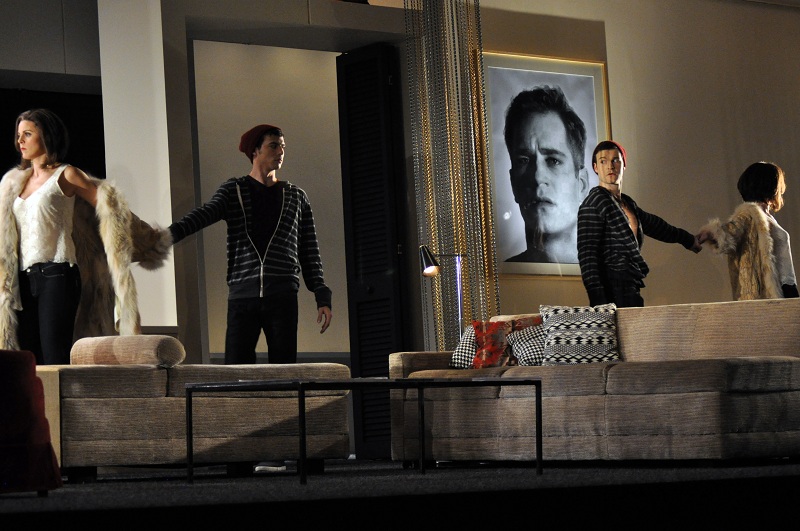
The single set (designed by Andrew Lieberman) place the action in a bare, modern apartment, dominated by a large reproduction of a head shot of Worth, underscoring the narcissistic self-regard of the title character. Mirrors provide the method of travel between the world of the living and that of the dead, an idea echoed in the first transmission from the transistor radio ("Mirrors would do well to reflect more, I repeat, mirrors would do well to reflect more"). Rather than actual mirrors, which appear only in the hands of the mysterious glazer in this production, director Sam Helfrich instead uses a small army of supernumeraries to create mirror images of most of the characters, who move about the stage in disorienting ways. Conductor Steven Jarvi had his hands full keeping the generally good but sometimes not quite aligned pit, filled by members of the Virginia Symphony Orchestra, on the same page. His beat was admirably clear and he was generous in cuing the singers on the stage, but it did not always line up as well as it could. Although not perfect, this production is still recommended as a compelling evening of contemporary theater.

This production will be repeated tomorrow afternoon (February 12, 2 pm) at GMU, followed by two performances next weekend in Richmond (February 17 and 19). Virginia Opera has also announced its lineup for next season: Bizet's Pearl Fishers, Strauss's Die Fledermaus, Andre Previn's A Streetcar Named Desire, and Mozart's Marriage of Figaro.

5.12.11

Have a Pop-Tart, Dearie

Style masthead

available at Amazon
E. Humperdinck, Hansel and Gretel, C. Schäfer, A. Coote,
P. Langridge, Metropolitan Opera,
V. Jurowski
Charles T. Downey, Virginia Opera’s modern-day take on ‘Hansel and Gretel’
Washington Post, December 5, 2011
The Virginia Opera, in the first full season since its board unceremoniously ousted founding director Peter Mark, is not playing it safe. After a gutsy “Aida” in October, the company’s new production of Engelbert Humperdinck’s “Hansel and Gretel” is anything but the usual cloying sort of December fantasyland staging for this opera. The audience at the George Mason University Center for the Arts was a little sparse, thinning out even more at intermission, perhaps missing the gingerbread house and candy canes.

Strong performances came from the young cast, especially the ardent Gretel of soprano Julia Ebner, the robust Dew Fairy of soprano Elizabeth Baldwin; and the acid-edged mezzo-soprano of Margaret Gawrysiak, as both the mother and the witch. The convincingly boyish Hansel of mezzo-soprano Karin Mushegain was pleasing (in the sweet prayer duet, for example), if slightly underpowered, while baritone Eric Greene’s father was energetic but a little unfocused and wild at the top. [Continue reading]
SEE ALSO:
Roy Proctor, Opera review: 'Hansel and Gretel' (Richmond Times-Dispatch, November 27)

David Nicholson, Virginia Opera opens an updated version of 'Hansel and Gretel' (Daily Press, November 10)

Laura Watkins, ‘Hansel and Gretel’ for the modern age (Virginian-Pilot, November 10)

18.10.11

Virginia Opera Ascendant


See my review of the Virginia Opera's production of Aida:

Concert Review: Virginia Opera Performs “Aida” (The Washingtonian, October 17):

available at Amazon
Verdi, Aida, P. Domingo, A. Millo, D. Zajick, S. Milnes, Metropolitan Opera, J. Levine
[DVD]
Aida has some of the most recognizable strains of music composed by Giuseppe Verdi, and yet it remains one of the least staged of his most popular operas (not heard from the Washington National Opera, for example, in almost a decade). Aida is a grand opera, packed with big choral scenes, ballet, and other spectacle -- an Egyptian story made for the Khedivial Opera House in Cairo, with costumes and scenic ideas contributed by an Egyptologist. It is the sort of work that small, regional companies -- like the Virginia Opera, which brought its new production of the work to the GMU Center for the Arts on Friday night -- generally do well to avoid. The Virginia Opera, in fact, has just survived a schism in leadership, with board members, staff, and donors swarming from the hive to follow ousted music director Peter Mark -- but nonetheless, it chose Aida to open its new season. It was a gutsy choice, and one that paid off; the slightly camp yet savvy production is a success, minimalist in set design but meaningfully directed in all its scenic details, and with a solid cast. Combined with a season of three other equally palatable operas, it is a good indication that the Virginia Opera is headed for a bright future.

On the heels of a fine performance as Tosca with the Virginia Opera in 2009, and as Adriana Lecouvreur with the Washington Concert Opera last year, soprano Mary Elizabeth Williams took on the title role. She sounded overall to be in good form, with a few scratches and strains that possibly indicated minor vocal fatigue. Williams’s voice rang out over the big choral numbers, but it was the softer moments where she shone brightest, kneeling to sing the Act I “Numi, pietà,” for example, in a serene pianissimo. In “Patria mia,” set against a plaintive oboe solo, and in the final scene with Radamès, she was equal parts musically expressive and dramatically affecting. Mezzo-soprano Jeniece Golbourne was every bit a match for Williams as Amneris, the Egyptian princess who holds Aida, the Ethiopian princess, as her slave. Golbourne has a photon-strength voice, with a viscous thickness in the chest and occasionally a little shrillness at its apex, giving her Act I duet with Williams the sound of a jealous, competitive edge. [Continue reading]
SEE ALSO:
Anne Midgette, Virginia Opera produces a wonderful ‘Aida’ (Washington Post, October 17)

Ati Metwaly, Egyptian bass-baritone in Virginia Opera's production of Aida (Ahram Online, October 2)

Teresa Annas, Dressing up 'Aida' at the Harrison Opera House (Virginian-Pilot, September 30)

David Nicholson, Virginia Opera season opens with 'Aida' (Daily Press, September 28)

16.2.09

Doomed Tosca at Virginia Opera


Mary Elizabeth Williams as Tosca, Virginia Opera, 2009 (photo by Anne M. Peterson)
The troubles of Virginia Opera's production of Puccini's Tosca may not have had any connection to the supposed curse of Friday the 13th. Even so, on Friday night at the George Mason University Center for the Arts, many singers struggled with vocal problems and even the candelabra lights on the back set wall in Act II flickered on an off. If the theater had been lit by large chandeliers dangling over the house like the Sword of Damocles, I probably would have left at the first intermission. While the Washington National Opera's last production of Tosca was noteworthy for its male cast outshining its Tosca, the only real reason to stay after the first act was the robust dramatic soprano of Mary Elizabeth Williams.

Making her company debut in this demanding role, Williams stood out for the strength and refinement of her voice, true intonation, and breath-taking dynamic range from ear-splitting to sweet pianissimo. The top gave out a bit at the high point of the torture scene in Act II, where she seemed to cut short some of the high notes, but her rendition of Vissi d'arte (see photo) was affecting and dramatic. It was a splendidly sung and movingly acted performance, right down to a full leap from the parapet of the Castel Sant'Angelo. Williams was scheduled to reprise the role with Augusta Opera in March, but that company has just announced that the rest of its season is canceled. Happily, she has also been engaged to sing the role with Arizona Opera in March and April.

Other Articles:

Anne Midgette, Woe, Hoarse: A Rough Ride For 'Tosca' at George Mason (Washington Post, February 16)

Tim Smith, Promising soprano lifts Virginia Opera's 'Tosca' (Clef Notes, February 16)

Walt Amacker, Smooth, soaring lyrics and melodies mark ‘Tosca’ (Richmond Times-Dispatch, February 15)

T. L. Ponick, Puccini's best in grand performance (Washington Times, February 13)

David Nicholson, Soprano makes or breaks show (Newport News Daily Press, January 30)
Unhappily, the rest of the cast fell victim to the cause of paraskavedekatriaphobia. As Cavaradossi, tenor Michael Hayes struggled through the first act, eventually singing most of the high passages an octave lower and withdrawing at the first intermission. He continued to act the role while his cover sang from the pit -- Kevin Perry, the evening's Spoletta, whom we can only thank for making the show go on. Baritone Stephen Kechulius had the right menacing sneer for Scarpia, although without some of the stentorian power at the top of the role's ambitus; regular throat-clearings hinted that he, too, was not feeling well. Among the supporting cast the best performances came from the avuncular Sacristan of Jason Budd and the boyish Shepherd song of Kimberly Smith Markham.

As is often the case with regional opera companies, the production was pleasing in a nondescript way. Director Marc Astafan's staging cobbled together sets originally designed by Michael Yeargan, with costumes borrowed from Opera Theater of St. Louis. Act I showed a Masaccio-like downward-sloping perspective with reproductions of decoration from the church of Sant'Andrea delle Valle, although better care could have been taken with the Catholic details (a minister who was clearly not a pope was vested like a pope; a bishop processes with only one crozier, not two). It was a nice effect to have the silhouette of Michelangelo's dome for St. Peter's in the background of Act III, although in reality it is nowhere near that close (see this panoramic view). The orchestra gave a pleasing sound but not unexpectedly maxed out short of the full sound Puccini wanted, for the memorable entrance of Scarpia in Act I, for example. The company was using a chamber orchestra arrangement (with far fewer numbers of winds and brass), and some of the bell and organ sounds, played by synthesizer, were just terrible. With the number of small opera companies going bankrupt, we should just be glad that Virginia Opera somehow survives on its limited budget.

The final stop for Virginia Opera's production of Tosca is Richmond's Landmark Theater, next weekend (February 20 and 22).

1.4.07

Pagliaccio Rusticano

Gustavo López Manzitti and Cristina Nassif, I Pagliacci, Virginia Opera, 2007, photo by Anne Peterson

Gustavo López Manzitti and Cristina Nassif, I Pagliacci, Virginia Opera, 2007, photo by Anne Peterson
Virginia Opera's production of Leoncavallo's I Pagliacci, double-billed as always with Mascagni's lesser work of verismo shock, Cavalleria Rusticana, came for a last weekend at the George Mason University Center for the Arts in Fairfax. These operas are not among the most refined operatic delights, but they are designed to please musically and inspire not very subtle emotions. They are good options for local opera companies because a "Cav/Pag" will fill the house, but one takes a chance when casting singers on a smaller company's budget. This production was hit and miss in that department but over all a pleasant enough experience.

Other Reviews:

B. J. Atkinson, One of These Things Is Not Like the Other (Portfolio Weekly, March 20)
-- "It’s time to put the show [Cav] on the shelf…stick it up there with Norma and A Masked Ball." [Is Norma really on the shelf?--Ed.]

T. L. Ponick, Tales of carnage among the knaves (Washington Times, March 23)

Daniel Neman, Murder, lust, envy make for splendid opera (Richmond Times-Dispatch, March 24)

Mark J. Estren, Still Great, but 'Cav/Pag' Need Time Apart (Washington Post, April 2)
Baritone Andrew Oakden had the most consistent success over the two operas, as the jealous husband in Cav and especially as the deformed, lecherous Tonio in Pag. (Oakden will make his New York City Opera in the same pairing this fall.) The soprano roles were divided, with Jane Dutton as a dark-toned Santuzza and Cristina Nassif, a Washington-area soprano whom I interviewed for DCist last year, as Nedda. Nassif's voice is on the reedy side, with a vigorous vibrato, and her physical appeal and dramatic instinct served her well. The most beautifully sung and dramatic scene of the evening was Nassif's love scene in I Pagliacci with Silvio, sung by the equally handsome and full-voiced baritone Michael Todd Simpson.

Gustavo López Manzitti sang both demanding tenor roles of the evening, something that a much better singer, Salvatore Licitra, recently did at the Met. Manzitti sounded strained but had all the notes for both roles, although his high range was veiled, all inwardly focused (see what I mean in these video excerpts) and his acting style was strangely stilted. Lorna Haywood's staging set both operas in the same Sicilian village -- sugary sets by Ron Keller with the look of a Kinkade cityscape -- in the 1940s. (Yes, that was Mamma Lucia and Santuzza with Turiddu's baby in the crowds of I Pagliacci.) The crowd scenes were a bit, well, overcrowded, making for choreography that consisted mostly of standing around and gesturing, but the chorus sounded effective, if not remotely Italian. While this production is not exactly excellent, the ticket prices are well below what you would pay at larger companies, for a mostly enjoyable evening.

11.2.07

Oh, That Silly Agrippina

Title page of Agrippina, by G. F. HandelOn Friday night, Virginia Opera brought its production of Handel's Agrippina to an undersold George Mason University Center for the Arts in Fairfax for two performances. Directed by Lilian Groag (who also mounted it for Glimmerglass Opera, much more sumptuously), this staging went far beyond a typical interpretation of Handel's youthful masterpiece, identified on its title page only as a drama per musica. As was quite common in this period of Venetian opera, the libretto mixes comic and tragic elements, but does that justify turning Agrippina into a silly farce? Here is how Handel's biographer Winton Dean put it:

The ability to suggest the profound, the commonplace and the ridiculous aspects of human behaviour, not only in the same opera but in the same scene and situation, places Handel beside Monteverdi and Mozart as a master of dramatic irony on many levels. The spirit of playful comedy is not absent from Handel's most serious operas. [...] This comprehensiveness of mood and dramatic approach gives his operas a depth seldom attained in the history of the art. But their quality can emerge only from productions based on a complete understanding of the convention.
In other words, directors would do better to trust Handel's innate dramatic sensibility, which usually surpasses their own, rather than giving into apprehension that their audience is not capable of appreciating Baroque opera on its own terms. Judging by the reviews, David McVicar has done no better in this regard in his production of Agrippina now at English National Opera (see the reviews linked in the inset below).

After making a name as an opera composer in Hamburg, the young Händel set off for Italy. He caught a big break while in Venice during the 1709-1710 season, in the opportunity to compose the music for a new opera at the Teatro S. Giovanni Grisostomo. Cardinal Vincenzo Grimani, who owned the theater, provided the libretto himself for Agrippina (HWV 6, for which Indiana University has made an online score available in its remarkable Variations prototype). The wild success of the opera with Venetian audiences made it "the climax of Handel's career up to the age of 25," as Winton Dean saw it.

Here is an opera whose setting would lend itself to the cold-hearted, modern interpretation we recently saw applied by the Kirov Opera, in a misguided way, to Verdi's Falstaff. In this opera, at least, we really do have a bunch of blood-thirsty wealthy elites -- the Roman imperial family -- who are certainly capable of the worst. Empress Agrippina hears that her husband, Claudio, has died and immediately sets in motion a plan to have her son, Nero (Nerone), named Emperor. When Claudio turns up alive, she has to try to have him killed, while plotting to unseat Ottone, whom Claudio named his successor, through a scheme involving Poppea, the mistress of all three men.


Other Reviews:

Mark J. Estren, Virginia Opera's 'Agrippina' Shines With Modern Twists And Political Turns (Washington Post, February 12)

T. L. Ponick, Modern-day 'Agrippina' with a bit of zing (Washington Times, February 3)

April Phillips, Virginia Opera gets down and dirty with farcical "Agrippina" (Virginia Pilot, January 25)

McVicar Production,
English National Opera:

Anna Picard (The Independent)
Anthony Holden (The Observer)
Edward Seckerson (The Independent)
Warwick Thompson (Bloomberg News)
Why belittle the violence of the story by turning the characters into caricatures? Fine, Nerone sleeps in his mother's bed and snorts cocaine off his hand during an aria. Agrippina and Poppea do not need to click spoons in their teacups to the rhythm of another ritornello, and the manic laughter could be halved. Most unnecessary of all was the chorus of smoking supernumeraries, who confused the story from the moment that the overture was "staged" -- never a good sign. By the time we reach the end of the opera, the forced happy ending is undercut by ironic subtitles, with factoids about the historical consequences of the story (most of the actual people portrayed in the opera ended up suicides or victims of murder). What a laugh riot! Silly Romans!

The cast was of mixed quality, at about the level one would expect from a regional company charging lower ticket prices (maximum price, $90). The strongest singing came from the women, especially soprano Jane Redding, who glittered vocally as Poppea, especially in Vaghe perle, eletti fiori in Act I. Sujung Kim was strong as Agrippina, although some of the more demanding passagework of the role was not really there. Countertenor David Walker was not in optimal voice as Ottone, with a nervous flutter that soured the pitch occasionally. Still, his impressive experience in Baroque specialized performance was evident in the fine ornamentation he incorporated, and his rendition of the stunning Act II aria Voi che udite il mio lamento was particularly fine.

Tenor Jeffrey Halili was mostly underpowered and overacted in the role of Nerone, which Handel created for a soprano castrato (a fact suspiciously absent from the program notes). Bass-baritone Derrick Parker brought a well-projected, throaty sound to Emperor Claudio, but without much stylistic sensitivity (strange, given his experience singing Baroque opera). The only member of the supporting cast who requires mention is Matthew Burns, who had a consistently pleasing sound as Pallante.

Agrippina has its final two performances in Richmond this Friday and Sunday. Virginia Opera's final production of the season, a double-bill of Cavalleria Rusticana (with Cristina Nassif as Nedda) and I Pagliacci, opens on March 9 in Norfolk. It will come to George Mason on March 30 and April 1.