CD Reviews | CTD (Briefly Noted) | JFL (Dip Your Ears) | DVD Reviews
Showing posts with label Jacques Offenbach. Show all posts

10.1.26

#ClassicalDiscoveries: The Podcast. Episode 020 - Johann Strauss II and his Contemporaries


Welcome to #ClassicalDiscoveries. Here is a little introduction to who we are and what we would like to achive at the first (or, in a nod to Bruckner, "double-zeroëth" episode). Your comments, criticism, and suggestions remain most welcome, of whatever nature they may be. Comments on YouTube directly are even more appreciated, as they will help the visibility and reach of the podcast - and because they make us feel like what we are doing is not completely in vain.

Now here’s Episode 020, cunningly released around the New Year to ride the Johann-Strauss-train of popularity to its full extent, as we talk about said composers, the whole business of Waltz-writing in Vienna, his rivals and successors and his Danish counterpart, Hans Christian Lumbye!


If you wanted to dance with somebody, in 19th century Vienna, Johann Strauss was your best bet to provide the soundtrack. But he wasn't alone in churning out the waltzes and polkas and operettas - continental "light music" - that the city consumed at such a rapid rate. In this episode Jens and Joe explore some of these composers, the history of the genre, and even visit Copenhagen by way of twirling musical entertainment.

2.8.15

Production Photos from the Bregenz Festival's Turandot


It might merit confessing that I’m not all that hot about Puccini and that I suffer from a general deficiency in appreciating Italian opera. That said, I consider Turandot the best compromise as far as quality and popularity is concerned. Granted, I think that if it weren’t for Nessun dorma and one or two other greatest-hits moments and the ensuing grand popularity, nothing near the throngs of people would go sit through Turandot, as they might realize it’s actually a fairly modern opera, worthy of its 1925 composition date, and audibly aware of, say Alban Berg’s work.

But there it is, Turandot, associated more with Paul Potts than Alban Berg, and drawing millions. Even in the rain… for rain it did that night...

Full review on Forbes.com. Click on excerpted images below to find a higher resolution version of the full picture.

All images courtesy Bregenzer Festspiele, © Karl Forster


10.6.14

NGA Vocal Ensemble


available at Amazon
Debussy, Music for the Prix de Rome (Le Gladiateur, La damoiselle élue, L'enfant prodigue), Flemish Radio Choir, Brussels Phil., H. Niquet
(Glossa, 2009)
Charles T. Downey, National Gallery of Art Vocal Ensemble provides some pleasant surprises in concert
Washington Post, June 10, 2014
Composers and painters have influenced one another in many eras, and in France at the end of the 19th century, the ties were strong. In a concert Sunday evening, the National Gallery of Art Vocal Ensemble explored the atmosphere of that period, offering music that complemented the museum’s exhibit of works by Edgar Degas and Mary Cassatt.

The selection featured many unexpected choices, and the performance was generally good, despite a few... [Continue reading]
NGA Vocal Ensemble
Music in honor of Degas/Cassatt
National Gallery of Art

31.7.13

Ionarts at Santa Fe: 'La Grande Duchesse de Gérolstein'


Kevin Burdette (General Boum, center) and cast in La Grande Duchesse de Gérolstein, Santa Fe Opera, 2013 (photo by Ken Howard)

Charles T. Downey, Fizz is off the champagne in Santa Fe Opera’s “Duchess of Gerolstein” (The Classical Review, July 31)
Listening to three hours of an Offenbach operetta will likely cause a hangover, not unlike the one caused by all the champagne that is guzzled by the operetta’s characters. This was the lesson learned at the Santa Fe Opera’s new production of Offenbach’s La Grande Duchesse de Gérolstein, heard Tuesday night.
[Continue reading]

Offenbach, La Grande Duchesse de Gérolstein
Libretto by Henri Meilhac and Ludovic Halévy
With Susan Graham, Emmanuel Villaume
Santa Fe Opera

available at Amazon
Offenbach, La Grande Duchesse de Gérolstein, F. Lott, S. Piau, Les Musiciens du Louvre-Grenoble, M. Minkowski (production directed by Laurent Pelly)
[CD]
available at Amazon
[DVD]
SEE ALSO:
Mike Silverman, Actress makes royal return home at the Santa Fe Opera (Associated Press, July 27)

Scott Cantrell, A hyperactive Santa Fe ‘Grand Duchess of Gerolstein’ (Dallas Morning News, July 31)

16.8.11

Tales of Hoffmann at Wolf Trap

Wolf Trap Opera Company's new chamber production of Offenbach's The Tales of Hoffmann offered much comedy, yet missed its dramatic potential due to minimal staging, lighting, and orchestral forces. The stories of love lost from demoralized poet Hoffmann (tenor Nathaniel Peake), reinforced by the Muse/Nicklausse and chorus of hipster students, with antagonist (bass-baritone Craig Irvin), begins with boisterous drinking songs in a bare, cramped Luther's Tavern (sets by Michael Olich).

First, the disappointments. Given that over three-quarters of the stage was taken up by moveable wooden blocks making a wall in the staging by Dan Rigazzi, Hoffmann and the chorus barely had room to move during the fun, rhyming Legend of Kleinzach. Perpetually under low lighting, the dozen chorus members would at times spend more than a dozen minutes blocked in the same place, looking bored, particularly during awkward lengthy pauses between scenes (conductor Israel Gursky) that slowed the work's momentum. Faces of main characters were often obscured in a shadow (lighting by Robert H. Grimes), which did not much matter for Hoffmann, who had more or less the same detached expression throughout the entire opera. Clumsy French dialogue was reminiscent of a local high school French class. Hoffmann's Muse, resonantly sung by mezzo Catherine Martin, was supposed to be in disguise as Hoffmann's friend Nicklausse; however, it must be difficult to walk like a man wearing stilettos.


Other Reviews:

Tim Smith, Wolf Trap Opera offers vigorous, absorbing production of 'Tales of Hoffmann' (Baltimore Sun, August 9)

Karren LaLonde Alenier, Hoffmann's Sirens (The Dressing, August 9)

Anne Midgette, Intimate, long ‘Hoffmann’ has problems at Wolf Trap Opera (Washington Post, August 8)

Terry Ponick, Wolf Trap Opera's lengthy, vigorous 'Tales of Hoffmann' (Washington Times, August 8)
Craig Irvin's strong acting, demonic eyes, and brassy bass-baritone voice strengthened his roles (Lindorf, Coppelius, Dr. Miracle, and Dapertutto) as adversaries to Hoffmann and were most memorable. The mechanical doll Olympia (soprano Jamie-Rose Guarrine, pictured), who is seen as fully human through special glasses by an infatuated Hoffmann, sang her virtuosically sweet song with comfortable ease and precision, until her robotics had a comic meltdown. Antonia (Marcy Stonikas), who was forbidden to sing by her father (Kenneth Kellogg) since it was thought to cause her illness, did sing secretly for Hoffmann, leading to her death. Stonikas was quick to overpower the resonant wooden walls of the Barns when singing the sweet text, "the turtledove has flown far away from you." The seductively malicious courtesan Giulietta (soprano Eve Gigliotti) conveyed the best balance of vocal nuance, emotive acting, and command of French language. After his woeful stories of suffering and a nicely sung lamenting piece for unaccompanied men's chorus, Hoffmann realized that poetry is his love and kissed his undisguised Muse under a spotlight, switched on for the first time.

Photo by Carol Pratt

14.8.10

Ionarts in Santa Fe: 'Tales of Hoffmann'


Paul Groves (Hoffmann) and Kate Lindsey (Nicklausse) in Tales of Hoffmann, Santa Fe Opera, 2010 (photo by Ken Howard)
The Santa Fe Opera’s grand production of Offenbach’s Tales of Hoffmann is true to the opera's original setting, yet cleverly innovative in terms of staging and lighting. Combined with the marvelous music making of the singers and orchestra, led by Stephen Lord of the Opera Theater of St. Louis (and heard at the August 11 performance), this memorable, humorous production is worth seeing.

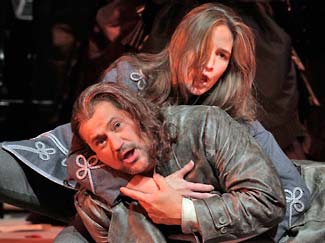
Christopher Alden's production begins with poet Hoffmann’s muse of poetry Nicklausse (mezzo-soprano Kate Lindsey) tucked away lying on an upright piano in a wood-paneled bar with long wooden tables and chairs, while Hoffmann (tenor Paul Groves) is face down at a table, drunk, with pages of his poetry at hand. A Romantic landscape painting reminiscent of Caspar David Friedrich fills the entire back wall (sets by Allen Moyer), and the offstage chorus supplies several "pizzicati" to the orchestral texture. The singing Muse playfully moseys onto Hoffmann’s table, sprawling on her back in front of him and eventually embracing him, with the consequence of getting him writing again. Lindsey was effective in blending in to a scene and executing tuneful, tricky arias with laser-like precision. At the opera’s end, her final words to Hoffmann are: "Let your genius be reborn from the ashes of your heart… the Muse will soothe your sorrows."


available at Amazon
Offenbach, Des Contes d'Hoffmann, N. Dessay, Opéra de Lyon, K. Nagano

(new edition by Michael Kaye)
[Review]
Hoffmann’s sorrows lie in his being “conquered” by the voices of three women, who the Muse explains to him are three in one -- all the prima, Stella. Hoffmann puts the Muse in a headlock for a second time at this revelation. The story unfolds with Hoffmann re-enacting in three acts the tales of Olympia, Antonia, and Giulietta to an outstanding large chorus of soldiers who are later joined with dates. The drunk, rowdy soldiers egg Hoffmann on with medleys of drinking songs while the innkeeper Luther (Harold Wilson) fills their steins.

Soprano Erin Wall, last heard as Daphne in 2007, as Olympia, Antonia, Giulietta, and Stella hooks Hoffmann again and again with her “rapturous” singing, consistently exuding a cool confidence. The vocal demands of the roles were immense and included having to intentionally flub and miss notes as the automaton Olympia, who was only visible as a real woman through special glasses. The sword fight was in slow motion on top of a table with lighting that put its shadow on the wall. Other particularly effective blocking included having most of the singers onstage through the entire performance, with the principals placed on top of a table to add importance or separation.


Other Reviews:

Heidi Waleson, Santa Fe's Busy 'Tales,' Bloody 'Butterfly,' Tinny 'Flute' (Wall Street Journal, August 14)

Sarah Bryan Miller, A long and often-dreary "Tales of Hoffmann" (St. Louis Post-Dispatch, August 8)

Scott Cantrell, Santa Fe production of Offenbach's unfinished 'Tales of Hoffmann' is cluttered, confusing (Dallas Morning News, August 5)

Brian Holt, All the World's a Stage (Out West Arts, July 31)

James M. Keller, Paul Groves shines in dizzying take on 'Tales' (Santa Fe New Mexican, July 18)
Bass-baritone Wayne Tigges stepped in for Gidon Saks (on vocal rest) for the entire run as Hoffmann’s nemeses Lindorf, Coppéllius, Dr. Miracle, and Cpt. Dapertutto with dramatic and musical impact, albeit with a tendency to over-achieve sharp on peak fermatas. Tigges transformed from the character Coppélius -- similar to Professor Harold Hill from The Music Man -- to the evil Dr. Miracle, framed under sickly green light (lighting by Pat Collins) while smacking similarly colored surgical gloves onto his hands before an ailing Antonia. Hoffmann’s dramatic performance was undeniably strong; however, the role does not garner similar vocal opportunities when compared to that of the other principals, so there were fewer opportunities to shine vocally, and Groves did not sound at his best.

Lord elicited seamless sweep from the orchestra, exploiting many opportunities for flexible tempo choices. It was worth waiting for the famed Barcarolle in the final act, though Lord should have made the decision to abandon the excruciating keyboard organ sound for a real fake organ (electronic organ) or nothing at all leading into the opera’s close. At the end, all were standing and singing brilliantly about how “one becomes great through love and greater still through tears” except for a dejected Hoffman, in a consoling embrace from the Muse. The orchestra then cut out partway into the last chord, giving the singers the gripping last word.

This production of The Tales of Hoffmann continues at Santa Fe Opera through August 28.

28.7.09

Rediscovering Offenbach's 'La Haine'

In 2006 musicologist Jean-Christophe Keck discovered the lost score of Offenbach's La Haine, incidental music written in 1874 to go with a performance of the massive play of that name by Victorien Sardou, on the subject of the divisions between Guelphs and Ghibellines in medieval Siena. The work finally saw the light of day last week, at the Festival de Radio France Montpellier, and Marie-Aude Roux was there to report on the performance ("La Haine" toujours vivace d'Offenbach, July 23) for Le Monde (my translation):

Rape, violence, love, insults, and hatred accompany the love story of the beautiful and unbending Ghibelline Cordelia Saraceni (Fanny Ardant) and the Guelph Orso Sovagnano (Gérard Depardieu, whose arrogance gives way and explodes. Lost behind the scrim that separated them from the actors, the Orchestre national de Montpellier and the excellent Choeur de la Radio lettone, supported by the conducting of the young Dutch conductor Enrico Delamboye, gave their best for the pleasure of a grateful and convinced audience.
Armelle Héliot was also there (Un Offenbach sombre pour Ardant et Depardieu, July 21), for Le Figaro. The reviewers so far were all really moved and impressed but have not really said why. Do we dare hope for a webcast? A few bits of the rehearsal and interviews with the big stars in the clip below.

UPDATE:
A commenter has noted that this concert will indeed be broadcast on France Musique, this Thursday (July 30) at 9 am (French time). One can listen to it streamed live on the Internet -- that would be at 3 am EDT for you American readers. Some of these programs are made available as webcasts, for a period of seven days, although I have yet to make their interface work properly. It worked just fine on the last attempt -- Offenbach's La Haine!--Ed.

3.7.08

Ionarts-at-Large: Minkowski & Pernoo With an Offenbach Surprise


Marc Minkowski is not a conductor known for conventionalism, whether it be his interpretations or the repertoire itself. Guest-conducting the Bavarian State Orchestra (the opera’s orchestra) in its Fifth Akademiekonzert of the 2007/2008 season, he underlined that perception by opening with Stanislaw Moniuszko’s Halka Overture, a lovely little, bubbly curtain raiser that whets the appetite for more music of Poland’s largely forgotten ‘national composer’. Then followed the whacky, oversized cello concerto of Jacques Offenbach.

Yes – Jacques Offenbach wrote a cello concerto, and it’s not just the one-movement Concerto Militaire, seldom enough played in its own right and actually the first movement of the Grand Concerto. The concerto has been reconstructed from fragments that have floated about since the 1940s, but the completion could not take place until 2006 when Jean-Christophe Keck, the publisher of the critical, complete Offenbach edition found Offenbach’s handwritten score in the Library of Congress and an archive in Cologne. Now we know that the Concerto rondo is the finale of this Grand Concerto, and its nickname “militaire” makes more sense as it did when it was applied to the rather un-martial stand-alone first movement.

That first movement opens gently, softly with timpani touches. It quickly swells, hitting a sporting and gay stride until the cello enters – solo – with a double-stop studded opening statement and then giving away to something altogether more hysterical.


The sounds convey one thing before all: Someone who knew the cello, its abilities and possible abuses intimately wrote this to have all the fun imaginable with the instrument. Jérôme Pernoo, the young French cellist that Minkowski brought with him, succeeded in conveying this impression not only about the composer (said to have been the Franz Liszt of the cello), but also about himself.

Given the sometimes ridiculous challenges that this work presents – high register double stop-sequences especially – it wasn’t by means of technical perfection that Pernoo achieved this, but through buoyant joy, verve, and plenty spunk. Listening to him play this concerto, one could not help but expect it to take cellists’ repertoires and concert halls by storm… despite its considerable length (~45 minutes) and the downright silly technical demands it places on the soloist.

Generous and decidedly knowing applause after the first movement was the just reward and about as high a praise a soloist can get nowadays, when applauding between movements is usually scoffed upon as boorish and ignorant. Indeed, my seat neighbors glared into the program notes where three movements were indicated and muttered that this errant applause was “not at all in accord with concert etiquette”. Indeed it was not (nor was the concerto itself) – and thanks be to that.

Very little military attitude in the highly lyrical, flute-twittering and cheery second movement Andante – the only entirely new music in this work. The duo between cello and first violin (Markus Wolf) must surely be among the most immediately and widely pleasing moments in cello concerto history.


available at Amazon
J.Offenbach, Grand Concerto for Cello et al.,
M. Minkowski / Le Musiciens du Louvre / J.Pernoo
Archiv

Between the artillery and infantry shots from the third movement’s percussion ranks, the cello and the strings put down such an infectious romp that a sort of Beer-hall joviality threatened to erupt in the dignified surroundings of the Munich opera house. Admittedly that might be over-interpreting the smiles and rhythmic twitching of the audience – young and old in equal measure – but not overstate the character of the music. The back and forth between those percussion batteries and the soloist had – in the good sense – moments of absolute hilarity, concluding with a particularly harsh that leaves the cello – metaphorically – limping off stage. Chock full of lust for composing and playing the cello, unbridled fantasy, like an excited puppy blissfully running about the orchestral stage: this concerto cares not about convention, only entertainment. Had a composer of lesser stature than Offenbach attempted this, the result might have been an embarrassing disaster. As it is, there are more moments in this work that made me smile broadly than I can count. A feat not possible had it not been for the willing and sympathetic support from the Staatsorchester.

Pernoo clearly found his vehicle here – a thankful one for everyone, though I suspect that for all its entertainment value also one vulnerable to overexposure. Until then, though, there was and is no reason not to join in the trampling, hollering, and incessant applause the was the response at this performance. The Barcarolle was promptly encored, with Pernoo as soloist extraordinaire.

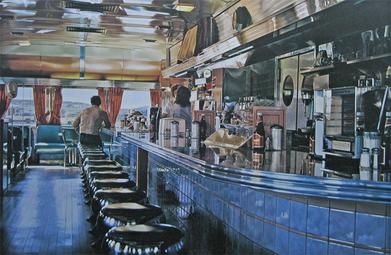
The second half was given to César Franck’s Symphony in d-minor, which made for interesting comparison with the performance of Riccardo Muti. Now conducting with a regular baton, not the thick, piano-lacquered black wand from his collection of historical ‘instruments’, Minkowski got a much more French sound than Muti from this utterly un-French symphony that is organ-like as Bruckner’s symphonies are, chromatically akin to Wagner-Liszt-Reger, and structurally more like Brahms than anything else. Minkowski – throughout the evening – also elicited an excellent, unusually deep and sonorous sound from the orchestra which played with musicality and humanity that it never reaches under Kent Nagano, whose cold musical photorealism is more akin to a Ron Kleeman or Ralph Goings painting rather than organically unfolding, musical joy.